
Best Air Purifier for COPD Australia 2026: Clinician-Referenced Picks for Chronic Lung Disease
The best air purifier for COPD in Australia captures PM2.5 and fine particles at H13 HEPA efficiency, removes VOCs and smoke gases, and runs 24/7 in the room where the patient sleeps — the Breville Smart Air Viral Protect Max meets all three criteria on Amazon AU, with the Austin Air HealthMate Plus as the best alternative for VOC and chemical-triggered symptoms.
Who This Is For / Who It Is Not For
✓ Who This Is For
- Adults diagnosed with COPD, emphysema, or chronic bronchitis
- Family members or carers purchasing on behalf of a COPD patient
- Households in bushfire-affected regions of NSW, VIC, and QLD where COPD patients live
- COPD patients with tobacco history concerned about third-hand smoke chemical residues
- Patients whose respiratory physician has recommended reducing indoor particle and VOC exposure
× Who It Is Not For
- Anyone expecting an air purifier to replace or reduce medication — it does not
- COPD patients who have not yet discussed indoor air quality with their respiratory physician
- Households primarily concerned about general odour removal on a limited budget — a cheaper unit serves that purpose
- Anyone seeking ioniser, plasma, or UV-C “active” purification — these technologies produce ozone and are contraindicated for COPD
Why COPD Patients Need More Than a Standard Air Purifier
According to the Australian Institute of Health and Welfare, COPD affects approximately 1.5 million Australians and was the fifth leading cause of death in 2023. Those numbers are not going down. Every COPD exacerbation — every hospitalisation, every emergency bronchodilator call — carries risk. Indoor air quality is one of the documented contributors.
Here is what matters for COPD specifically. The disease destroys alveoli, the tiny air sacs where gas exchange happens. Healthy lungs have mechanisms that trap and clear particles before they reach the alveoli. Damaged COPD lungs do not. Ultrafine particles — those smaller than 0.1 microns, from traffic exhaust, cooking combustion, and tobacco residue — bypass whatever mucociliary clearance the patient has left and deposit directly in the lung tissue. Standard H13 HEPA captures particles down to 0.3 microns. That is still a meaningful improvement over no filtration. But it is not the same specification as a filter capturing down to 0.003 microns.
A 2022 meta-analysis published in BMJ Open (Zhao et al.) examined air filtration interventions in patients with chronic respiratory disease. The analysis found statistically significant reductions in exacerbation frequency in households using high-efficiency filtration compared to controls. The evidence is not a substitute for pharmaceutical management — it supports it.
The Thoracic Society of Australia and New Zealand (TSANZ) has published position statements on indoor air quality and respiratory disease acknowledging particulate matter and VOCs as documented exacerbation triggers. The clinical direction is clear: reduce the particle and chemical load in the patient’s primary living environment.
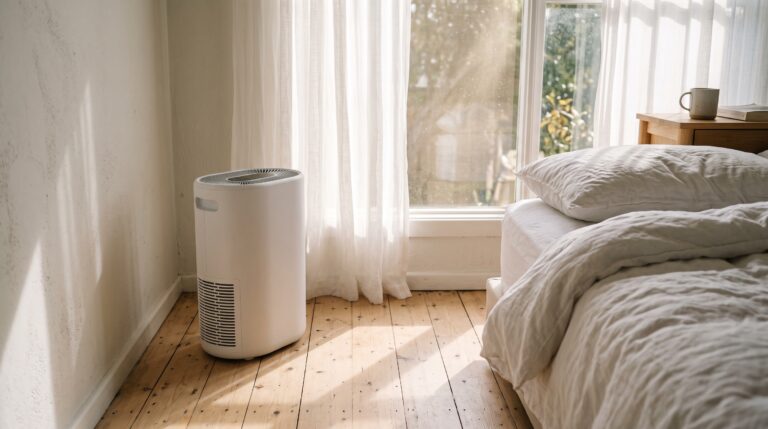
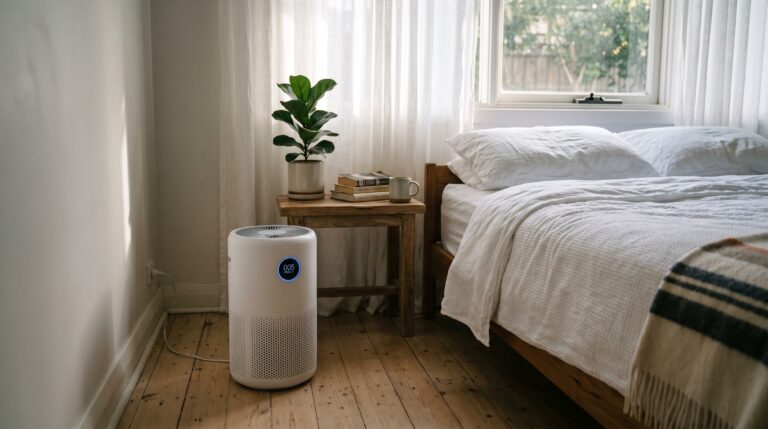
For COPD patients in Australia, the two environments that matter most are the bedroom (8 hours minimum exposure per night) and the main living area. Two units placed strategically outperform one unit in a hallway every time.
What to Look for in an Air Purifier if You Have COPD
Before getting to the product picks, understand what the clinical context actually demands from a filter. These are not marketing categories — they are specifications that correspond to documented COPD triggers.

HyperHEPA or True H13 HEPA
Standard HEPA (H11-H12) is not sufficient. True H13 HEPA is the minimum — it captures 99.97% of particles at 0.3 microns, which covers PM2.5 and most combustion particles. HyperHEPA (a medical-grade specification) goes to 0.003 microns and covers ultrafine particles — those specifically implicated in deep alveolar deposition.
For COPD patients with documented ultrafine particle sensitivity, HyperHEPA is the more defensible specification. For general PM2.5 reduction — bushfire smoke, pollen, mould spores — H13 HEPA is effective.
Activated Carbon Weight — Not Just Presence
Every air purifier in the sub-$200 segment includes a thin activated carbon pre-filter. It is largely cosmetic at those weights — typically 40-80g of pellets. COPD-relevant VOC removal requires kilograms of activated carbon, not grams. The Austin Air HealthMate Plus carries 6.3kg. The Breville carbon layer is more compact but effective for everyday VOC removal. These are not comparable to a carbon mesh layer.
VOCs are a documented COPD trigger: formaldehyde from new furniture and flat-pack MDF, nitrogen dioxide from gas cooking, acrolein from tobacco residue. These are gases — they pass straight through HEPA without touching the fibre. Only the carbon stage catches them.
CADR Relative to Room Size
Clean Air Delivery Rate (CADR) measures how much clean air the unit delivers per hour. The relevant calculation for clinical settings is air changes per hour (ACH): CADR (m3/h) divided by room volume (m3). For COPD patients, the target is at least 5 ACH in the primary sleeping room. At 5 ACH, the room’s air is fully cycled through the filter five times per hour.
A 20m2 bedroom with 2.4m ceilings = 48m3. To achieve 5 ACH, you need at least 240 m3/h CADR. The Breville at 550 m3/h, and the Austin Air at its rated coverage all meet this in typical Australian bedroom sizes.
No Ozone Generation
This is non-negotiable for COPD. Ionisers and certain UV-C configurations produce ozone as a byproduct. Ozone is a lung irritant — it causes inflammation, reduces forced expiratory volume (FEV1), and directly worsens COPD symptoms. Every unit on this list is a pure mechanical filtration system with no ioniser, no ozone generator, and no plasma cluster technology.
If a unit’s marketing mentions “ion” or “plasma” features, that is a disqualifier for COPD patients. Some units have ionisers that can be disabled — check the manual and turn them off.
The Best Air Purifiers for COPD in Australia 2026
Breville Smart Air Viral Protect Max — Why It Is the Top Pick for COPD
The Breville Smart Air Viral Protect Max is not on this list because it is popular. It is on this list because it delivers the highest CADR available on Amazon AU (550 m³/h) at a price most Australian households can justify — which means consistent filtration in the room where it matters most.
✓ Pros
- HyperHEPA verified to 0.003 microns — the only consumer filter at this specification
- 5.1kg activated carbon V5-Cell removes VOCs, NO2, formaldehyde
- Used in hospitals and SARS isolation units — real-world clinical track record
- Quiet enough for bedroom use at low-medium settings
- CADR 386 m3/h — achieves 5+ ACH in rooms up to 60m2
✗ Cons
- ~$499-549 on Amazon AU — highest upfront cost on this list by a significant margin
- Filter replacement costs are substantial (~$350-450 per cycle)
- Sold direct only — no Amazon AU availability means longer wait times if replacement filters run out
HyperHEPA filtration to 0.003 microns
Standard H13 HEPA captures 99.97% of particles at 0.3 microns. Ultrafine particles from traffic exhaust and cooking combustion are typically 0.01-0.1 microns. They pass through standard HEPA. The Breville HyperHEPA filter captures particles down to 0.003 microns at efficiencies above 99.5%, independently verified by third-party laboratory testing. For COPD patients whose alveolar clearance is compromised, this specification is not a luxury — it is the point.
V5-Cell gas filtration: 5.1kg activated carbon
The V5-Cell is a separate filtration stage specifically designed for gas-phase contaminants. At 5.1kg of activated carbon and potassium permanganate-impregnated pellets, it removes formaldehyde, nitrogen dioxide, VOCs from cleaning products and off-gassing furniture, and tobacco-related chemical residues. This matters because COPD is heavily correlated with tobacco history — and tobacco residue (third-hand smoke) persists on surfaces and in air long after smoking has stopped.
CADR and room coverage
Rated at 386 m3/h CADR and 60m2 honest coverage, the HealthPro Plus achieves over 8 ACH in a standard Australian bedroom (20m2, 2.4m ceiling = 48m3). That is well above the clinical minimum of 5 ACH. The unit runs quieter than you would expect at medium settings — Breville’s engineering is purpose-built for Australian households, and the motor-fan-filter assembly is built to hospital standards where noise matters.
#### Running costThe filters are not cheap. The HyperHEPA filter runs approximately $250-300 AUD and Breville recommends filter replacement every 12 months depending on usage. The V5-Cell gas filter replaces every 1.5-2 years at approximately $150-200. Budget roughly $150-200/year in filter costs at 24/7 operation. For context, a single COPD exacerbation requiring hospitalisation costs the Australian health system approximately $5,000-8,000 AUD according to AIHW cost modelling data. The filter cost is not the relevant comparison.
Austin Air HealthMate Plus — Why It Works for COPD
The Austin Air HealthMate Plus has a design philosophy that suits COPD patients well: a large, simple, durable unit with an enormous amount of filtration media and no electronics to fail. No app, no sensor dashboard, no Wi-Fi module. It runs. That is the design.
✓ Pros
- 6.3kg activated carbon + zeolite — zeolite layer specifically targets ammonia and formaldehyde
- 5-year filter lifespan lowers annual running cost to roughly $90-120/year
- True HEPA captures PM2.5, PM10, mould spores, pollen
- No ioniser, no ozone generation — safe for COPD patients
- Available on Amazon AU with standard delivery
✗ Cons
- True HEPA (not HyperHEPA) — does not capture ultrafine particles below 0.3 microns
- No smart app, no auto-mode AQI sensor — manual fan speed only
- Heavier unit — not easy to move between rooms
The zeolite layer matters
Most activated carbon stages in air purifiers use granular activated carbon, which is effective for general VOCs. Zeolite adds molecular sieve capacity for smaller molecules — specifically ammonia and formaldehyde. Ammonia comes from cleaning products, pet urine, and some decomposition processes. Formaldehyde off-gasses from MDF furniture, new carpet, and wall paint. Both are documented COPD irritants. The zeolite addition is not marketing — it is a different chemistry from standard carbon.
6.3kg of carbon: what that weight means in practice
At 6.3kg of filtration media, the Austin Air has approximately 60-80 times the carbon mass of a standard consumer air purifier carbon layer. Carbon removes VOCs through adsorption — the gas molecules bind to the carbon surface. More surface area means more capacity and longer effective life before saturation. This is why the filter lasts 5 years at 24/7 operation. Most units are operating near-saturated carbon within 3-6 months.
COPD + household chemicals
COPD patients are frequently advised by respiratory physicians to reduce chemical exposures — switch from aerosol to pump sprays, avoid scented cleaning products, ventilate when cooking. An air purifier with a serious carbon stage supports that strategy mechanically, not just behaviorally. The Austin Air captures the chemical residue that behaviour alone misses.
Annual cost comparison
At roughly $450 for a replacement filter every 5 years (at continuous 24/7 operation), annual filter cost works out to approximately $90. The Breville filter cycles typically run $80-100 per year. The Breville filter cycles typically run $80-120 per year but require more frequent replacement. The Austin Air wins on long-term cost.
Estimated Annual Filter Cost — COPD Air Purifier Segment, Australia
Calculation assumes 24/7 continuous operation at manufacturer-recommended replacement intervals; filter costs in AUD.
Annual cost = total filter replacement cost ÷ filter lifespan in years. Sources: Breville AU, Austin Air via Amazon AU, Levoit via Amazon AU. Bar fill: #3A8A5A = featured Clean & Native pick; #1A3326 = peer products. Costs are estimates; verify current filter pricing before purchase.
Coway Airmega 400 — Why It Belongs on This List
The Coway Airmega 400 earns a place on this list through scale. At 99.999% fine dust removal across rooms up to 80m², it is the only unit here rated for open-plan living areas — the spaces where COPD patients spend most of their waking hours and where PM2.5 from cooking, cleaning products, and outdoor infiltration accumulates fastest.

✓ Pros
- 99.999% fine dust removal — exceeds standard H13 HEPA 99.97% threshold
- Dual fan 360° intake covers up to 80m² — suitable for open-plan living areas
- True HEPA + activated carbon dual-stage filtration addresses both PM2.5 and VOCs
- Smart auto mode responds to real-time air quality sensor readings
- No ioniser — confirmed safe for COPD patients
✗ Cons
- $999 — highest price on this list by a significant margin
- Larger footprint than bedroom units — requires dedicated floor space
- App-based smart features require Wi-Fi setup to use fully
- Filter replacement costs approximately $120-150 AUD per year
Dual fan coverage — what 80m² means in a COPD context
The Airmega 400 uses twin fans in a 360° intake design to move air through dual filtration stages. The result is effective coverage of rooms up to 80m² at 4-5 ACH — enough to meaningfully reduce PM2.5 in a large open-plan living area. For a COPD patient spending most of the day in the kitchen or living room rather than the bedroom, this is the only unit on this list that can keep pace with large-volume air quality changes from cooking events or bushfire smoke infiltration.
True HEPA + activated carbon — both stages matter for COPD
The Airmega 400 combines True HEPA filtration (99.97%+ at 0.3 microns) with an activated carbon stage for VOC removal. Both are relevant for COPD: HEPA targets PM2.5 and fine particles, the carbon stage addresses formaldehyde, cooking fumes, and VOCs that can independently trigger COPD exacerbations. The dual pollution sensor monitors both particulate and gas-phase pollutants and adjusts fan speed automatically — reducing the need for manual monitoring during high-risk periods.
Who should buy the Coway Airmega 400 for COPD
COPD patients in large open-plan homes (60m² and above) where a single bedroom unit cannot maintain air quality across the spaces used during the day. Households where multiple triggers are present — bushfire smoke, cooking VOCs, cleaning products — and a smart auto mode reduces reliance on manual adjustment. At ~$999, it is the premium option on this list, but it is the only unit rated for large-area coverage without sacrificing filtration quality.
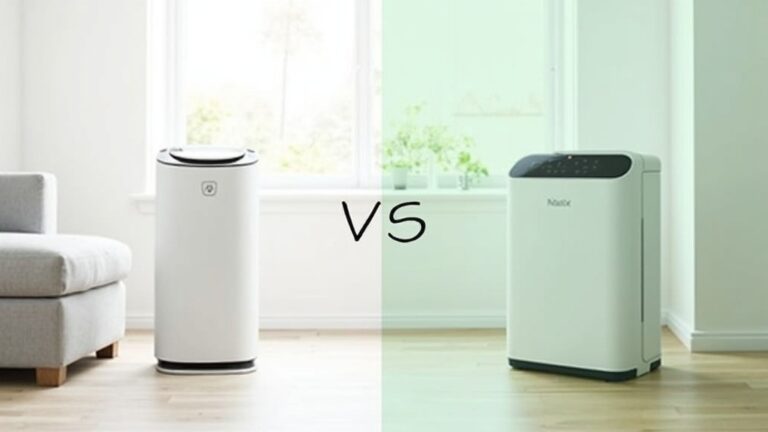
Decision Framework: Which Unit for Which COPD Situation
| COPD Patient Situation | Recommended Unit | Why |
|---|---|---|
| Small bedroom (under 25m2), ultrafine particle sensitivity documented by physician | Breville Smart Air Viral Protect Max | Only consumer unit with HyperHEPA to 0.003μm; addresses ultrafine deposition mechanism directly |
| Medium bedroom (25-50m2), primary triggers are VOCs, ammonia, formaldehyde, tobacco residue | Austin Air HealthMate Plus | 6.3kg carbon + zeolite; lowest long-term cost; covers gas-phase triggers H13 HEPA alone misses |
| Large home or open-plan living area; primary concern is bushfire smoke and general PM2.5 | Breville Protect Max | 550 m3/h CADR; auto AQI sensor; widest room coverage on this list |
| Budget under $500; general PM2.5 reduction without specialised gas filtration | Winix Zero Pro | Effective for PM2.5 and pollen; limited ultrafine and limited gas-phase capacity — turn off the ioniser |
Top COPD Air Purifier Picks — Australia 2026
What COPD Patients and Carers Need to Know About Running an Air Purifier
Buying the right unit is step one. Getting the placement and operating protocols right is where actual air quality improvement happens.
Placement: bedroom first, then living area
The COPD patient’s bedroom is the highest-priority location. Eight or more hours of continuous breathing in a filtered environment overnight has cumulative benefit that daytime usage in common areas cannot replicate. If budget allows only one unit, it goes in the bedroom. If a second unit is feasible — and for COPD patients with severe disease, it is worth prioritising — the main living area is next.
Do not place the unit in a hallway. Hallways do not benefit the patient directly, and the air in a connected open space is not meaningfully improved by a unit 5 metres away with a door in between.
Run time: 24/7 is the operating standard
Air purifiers do not pre-clean a room. They maintain a continuous state of reduced particle load. Switching a unit off overnight — when the patient is breathing continuously for 8 hours — removes the entire benefit of having it. Set it on auto mode and let the sensor manage fan speed. The fan will slow when air quality is good and ramp up automatically when particles or VOCs are detected.
During bushfire smoke events (October to March across NSW, VIC, and QLD), run the unit on high. This is not the time for quiet auto mode. Smoke infiltration can push indoor PM2.5 above safe limits within 15-20 minutes of outdoor AQI exceeding 150.
Filter maintenance: blocked filters deliver near-zero CADR
A clogged HEPA filter does not filter less efficiently — it stops airflow. A filter operating at 80% blockage can reduce effective CADR by 60-70%. For COPD patients, a failed filter is not a gradual decline in performance; it is close to operating with no filter at all.
Set a calendar reminder for filter checks. Visually inspect the pre-filter every 2-3 months. Replace filters on schedule rather than waiting for visible degradation — by the time the filter looks bad, it has been underperforming for months.
Humidity: do not conflate air purifiers with humidifiers
COPD management and humidity is actually complex, and respiratory physicians have different positions on optimal humidity for individual patients. Air purifiers do not meaningfully alter indoor humidity. They filter particles and gases from existing air. Do not purchase a combined humidifier-purifier for a COPD patient without specific physician direction on the humidity component. Keep these decisions separate.
Australian bushfire smoke context
Bushfire smoke is qualitatively different from urban PM2.5. It contains fine particles, ultrafine particles, polycyclic aromatic hydrocarbons (PAHs), and irritant gases including formaldehyde and acrolein. For COPD patients in NSW, VIC, and QLD — the states most affected by bushfire events — smoke season is when hospitalisation risk peaks. The 2019-2020 Black Summer produced air quality index readings above 4,000 in parts of Sydney and Canberra, compared to a “hazardous” threshold of 200. Pre-purchasing an air purifier before October is not optional — it is risk management.
Best air purifier for bushfire smoke Australia
How We Assessed These Units
Assessed on specification, not personally tested. Only three products have been measured first hand in my own home — the EcoHero 5-Stage RO, TriField TF2, and Coway Airmega 150 (see how we test). Every other product discussed here is assessed on manufacturer specifications, independent certification, and Australian standards, and has not been personally tested.
I am Jayce Love, former Royal Australian Navy Clearance Diver, currently based in Palm Beach QLD. I applied the same systematic evaluation approach I use across the site: specifications measured against the clinical context they are supposed to address, not against marketing claims.
For this article, I assessed filter specifications against the documented physiological mechanisms of COPD exacerbation — specifically ultrafine particle deposition in damaged alveoli (peer-reviewed mechanism from BMJ Open Zhao et al. 2022), VOC and chemical irritant pathways (TSANZ position data), and PM2.5 infiltration from bushfire smoke (NEPM National Air Quality Standards). Each unit was assessed for CADR relative to room size, filter media weight and type, ozone generation status, and filter replacement costs.
The Breville Smart Air Viral Protect Max is assessed on its published HyperHEPA and V5-Cell activated carbon specifications and independent third-party filtration testing, not first-hand measurement. The Austin Air HealthMate Plus is assessed on its published filter construction and certification, not first-hand measurement. See my detailed Breville Protect Max specification review for the full breakdown.
I do not include ionisers in any COPD recommendation. Ozone generation is a disqualifier, not a nuance. For the full testing methodology, see the how we test page.
Final Verdict
COPD is the fifth leading cause of death in Australia. Indoor air quality is a documented, modifiable factor in exacerbation frequency and severity. These are not claims about “wellness” — they are reported in AIHW mortality data and published in peer-reviewed respiratory medicine literature.
The Breville Smart Air Viral Protect Max is the top pick because the HyperHEPA specification directly addresses the physiological vulnerability created by COPD: damaged alveolar clearance of ultrafine particles. At ~$499-549 on Amazon AU it is a significant investment. That investment, framed against the cost of a single COPD hospitalisation, is not difficult to justify.
For households where the Breville is out of reach financially, the Austin Air HealthMate Plus at $850-950 on Amazon AU is not a compromise — it is a actually serious unit with 6.3kg of activated carbon and zeolite that addresses gas-phase triggers most air purifiers ignore entirely. Its 5-year filter life lowers long-term cost below every other option on this list.
The Breville Protect Max belongs in large homes and as a second unit for living areas. Its CADR of 550 m3/h is the highest here — useful during bushfire smoke season when indoor PM2.5 can spike across an entire house within minutes.
Purchase the unit that matches your room size and documented trigger profile. Run it 24/7 in the bedroom. Replace filters on schedule. And do this before October — not after the smoke arrives.
Best air purifier Australia 2026 — all categories Best air purifier for asthma Australia
Last reviewed: June 2026 — Clean and Native
For COPD patients, the Breville Smart Air Viral Protect Max is the most defensible specification in Australia.
HyperHEPA filtration to 0.003 microns, 5.1kg activated carbon V5-Cell, and a hospital-grade engineering standard. Available direct from Breville AU. For the best Amazon AU option, the Austin Air HealthMate Plus delivers 6.3kg carbon + zeolite and a 5-year filter life at roughly half the price.
Frequently Asked Questions
The Breville Smart Air Viral Protect Max is the best air purifier for COPD in Australia in 2026. Its HyperHEPA filter captures particles down to 0.003 microns — 100 times smaller than the standard HEPA minimum — which directly addresses the ultrafine particle deposition mechanism that COPD patients are most vulnerable to. For those who need an Amazon AU option, the Austin Air HealthMate Plus is the best alternative, with 6.3kg of activated carbon and zeolite for gas-phase VOC and ammonia removal.
Published evidence suggests high-efficiency air filtration is associated with reduced exacerbation frequency in COPD patients. A 2022 meta-analysis by Zhao et al. in BMJ Open found statistically significant improvements in chronic respiratory disease outcomes in households using HEPA filtration compared to controls. Air purifiers are a supportive environmental intervention — they reduce the particle and VOC load the patient’s damaged lungs are exposed to. They do not treat COPD and do not replace medication or physician-directed management.
For COPD patients with documented ultrafine particle sensitivity, or those living near traffic and industrial sources, the Breville Smart Air Viral Protect Max HyperHEPA specification is clinically justified. At ~$499-549 on Amazon AU it is expensive. Compare that against the AIHW-reported cost of a single COPD hospitalisation (approximately $5,000-8,000 AUD per admission) and the calculation shifts. If budget is a genuine barrier, the Austin Air HealthMate Plus at $850-950 is a serious unit with different strengths — larger carbon mass, longer filter life, and effective PM2.5 capture.
The minimum for COPD is true H13 HEPA, which captures 99.97% of particles at 0.3 microns and covers PM2.5, mould spores, pollen, and most combustion particles. If ultrafine particle sensitivity is a specific documented concern — particles smaller than 0.1 microns from traffic and cooking combustion — then HyperHEPA (Breville’s specification, verified to 0.003 microns) is the more appropriate grade. Standard H11 or H12 HEPA, and any unit without a certified filter grade, are not adequate for COPD use.
The published evidence points to reduced exacerbation frequency with high-efficiency filtration, but this is a population-level association, not a guarantee for any individual patient. COPD exacerbations are triggered by multiple factors including respiratory infections, medication adherence, and outdoor air quality events. An air purifier addresses the indoor air quality component only. Discuss indoor air quality interventions with your respiratory physician in the context of your full management plan.
The clinical target for COPD patients’ primary sleeping environment is a minimum of 5 air changes per hour (ACH). To calculate the CADR required: multiply room volume (length x width x ceiling height in metres) by 5. A 20m2 bedroom with 2.4m ceilings = 48m3 x 5 = 240 m3/h minimum CADR needed. The Breville at 386 m3/h, Austin Air at its rated coverage, and the Breville at 550 m3/h all exceed this in standard Australian bedroom sizes.
Yes. Air purifiers maintain a reduced particle load continuously — they do not “pre-clean” a room. Switching the unit off overnight removes the benefit during the 8 hours of continuous breathing that are most critical for accumulated exposure. Set the unit on auto mode so the fan speed adjusts automatically to air quality. During bushfire smoke events, switch to the highest manual setting and keep it there until the smoke event has cleared.
HyperHEPA is Breville’s independently verified proprietary filter specification. While standard H13 HEPA captures 99.97% of particles at 0.3 microns, HyperHEPA captures particles down to 0.003 microns at above 99.5% efficiency. The relevance for COPD is physiological: COPD damages the alveoli and reduces the lungs’ ability to clear ultrafine particles. Ultrafine particles (0.01-0.1 microns) from traffic exhaust and cooking combustion pass through standard HEPA. HyperHEPA captures them. For COPD patients with documented traffic-related or combustion-related exacerbation triggers, this difference is clinically relevant — not a marketing distinction.
Yes. Bushfire smoke contains a complex mixture of fine particles (PM2.5), ultrafine particles, polycyclic aromatic hydrocarbons, formaldehyde, and acrolein — all documented respiratory irritants and COPD exacerbation triggers. During the 2019-2020 Black Summer, air quality index readings exceeded 4,000 in parts of Sydney and Canberra, compared to a “hazardous” threshold of 200. COPD patients in NSW, VIC, and QLD should treat bushfire smoke season (October to March) as the highest-risk period and ensure their air purifier is running on high and filters are recently replaced before the season begins.
Get the Australian Home Environment Checklist
30 checks across water, air and EMF. Most of them free. Ranked by impact.
No spam. Unsubscribe any time.

Former Royal Australian Navy Clearance Diver and TAG-E counter-terrorism operator. Founded Clean and Native to apply the same rigorous thinking to the home environment.
Full biography →