Best Air Purifier for Home Office Australia 2026: Silence, VOCs and WFH Air Quality
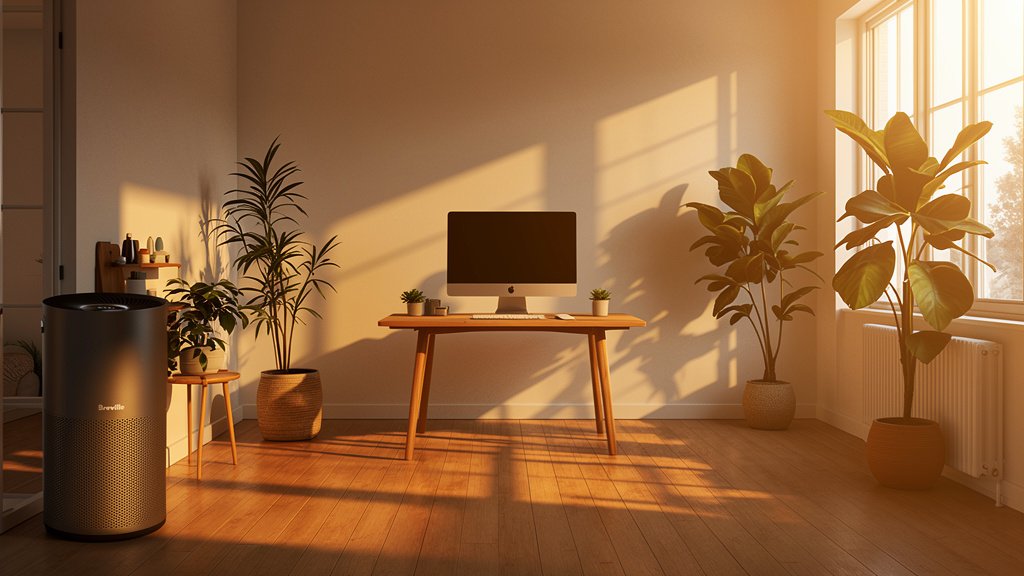
The best air purifier for a home office in Australia in 2026 is the Breville Smart Air Viral Protect Max — 24 dBA on sleep mode, a built-in VOC sensor that responds to printer off-gassing automatically, and a 550 m³/h CADR that handles any room a WFH setup fits in.
I have not personally tested the air purifiers discussed here; this assessment is based on published manufacturer specifications, independent certification (CADR, HEPA), and standards, not first-hand measurement. The only products I measure first-hand are the EcoHero 5-Stage RO, TriField TF2, and Coway Airmega 150.
✓ Who This Is For
- WFH professionals in small to medium home offices (10-40m²)
- Anyone with a laser printer or inkjet in the same room as their desk
- New home office setups with MDF desks, shelving, or fresh carpet
- Australians with asthma or chemical sensitivity — 2.8 million people nationally
- Zoom-heavy workers who need near-silent operation during calls
× Who It Is Not For
- Anyone expecting an air purifier to fix CO2 buildup — only ventilation does that
- Open-plan shared office spaces above 60m² — none of these units are rated for that
- Buyers looking to eliminate cigarette smoke odour completely — activated carbon helps, but source removal is the real fix
- Offices that already have commercial HVAC with MERV-13+ filtration installed
Why Home Office Air Quality Is a Different Problem
I spent 12 years as a Royal Australian Navy Clearance Diver. Enclosed-space air quality was not abstract — it was a safety discipline. The WFH environment is a slower version of the same problem: a small sealed room, a human consuming oxygen, and multiple chemical sources the occupant does not think about.
According to the Australian Institute of Health and Welfare, approximately 11% of Australians — around 2.8 million people — live with asthma. That number does not account for the broader population whose concentration, sleep quality, and productivity are degraded by elevated particulate matter and VOC exposure without any diagnosed condition. The NSW EPA’s State of the Environment report confirms that indoor air quality is affected by outdoor pollution events, bushfire smoke, and wood heater season, all of which enter home offices through gaps around doors and windows regardless of how new the building is.
Three distinct threats operate in most home offices. Understanding them tells you exactly what filter specification you need — and stops you wasting money on a unit built for a different problem.
Threat 1 — Printer Off-Gassing
Laser printers are the worst offenders. A 2017 study published in Scientific Reports (He et al., Queensland University of Technology) measured ultrafine particle emissions from laser printers and found some units emit particle concentrations equivalent to heavy traffic conditions during a print job. Beyond particles, laser printers emit ozone and VOCs including styrene and benzene. Inkjet printers are lower-emission but not zero. If your printer is in the same room as your desk — and in most Australian home offices it is — you are breathing that output directly.
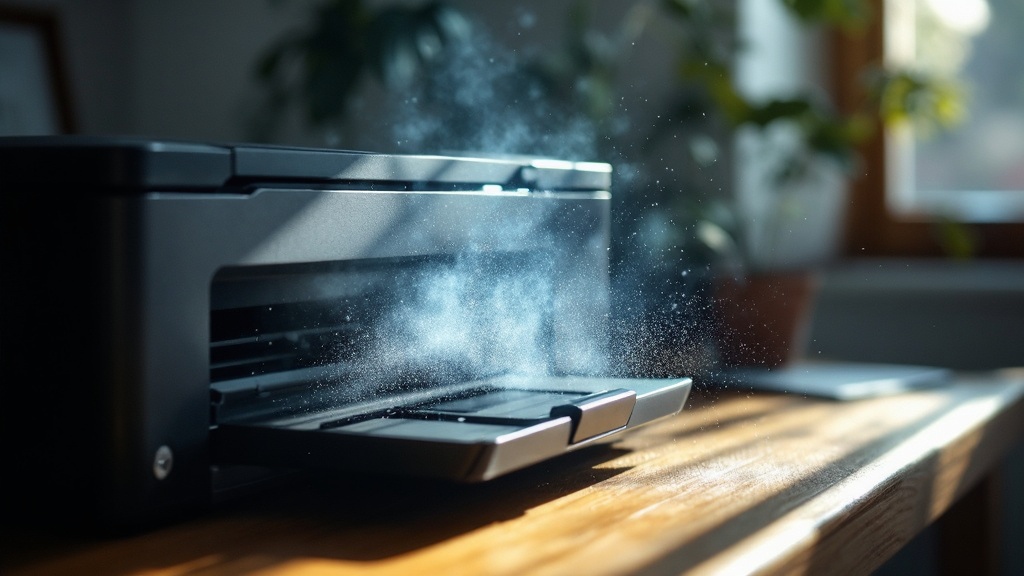
The fix is filtration at the source: a HEPA filter for particles, and an activated carbon stage for VOC and ozone capture. A unit with a VOC sensor and auto mode will increase its fan speed the moment the print job starts. That is exactly what the Breville Protect Max does.
Threat 2 — Formaldehyde and VOCs from MDF
Most flat-pack desks, bookshelves, and storage units sold in Australia are constructed from medium-density fibreboard (MDF) bonded with urea-formaldehyde resins. Four units were compared specifically for formaldehyde removal in our guide to the best air purifiers for formaldehyde in Australian new builds. Formaldehyde is classified as a Group 1 human carcinogen by the International Agency for Research on Cancer (IARC). Off-gassing is highest in the first 6-24 months after manufacture, and elevated room temperatures (common in Queensland and WA home offices in summer) accelerate the release rate.
Standard HEPA filters do not capture formaldehyde — it is a gas, not a particle. You need a substantial activated carbon bed. This is why the Austin Air HealthMate Plus exists on this list despite its higher price: its 6.3 kg carbon bed is in a different class to the thin carbon pre-filters in most consumer units.
Threat 3 — CO2 Accumulation (and What Air Purifiers Cannot Do)
Here is the honest caveat every competitor omits. A single person in a small home office with the door closed and no window ventilation can push CO2 concentrations from ambient outdoor levels of around 420 ppm to 1,000-1,500 ppm within 2-3 hours. Research from Harvard’s T.H. Chan School of Public Health (Allen et al., 2016, published in Environmental Health Perspectives) found that cognitive function scores on decision-making tasks dropped significantly at 1,000 ppm CO2 compared to 550 ppm, and dropped further at 2,500 ppm.
Air purifiers do not remove CO2. Not HEPA, not activated carbon, not ionisers. CO2 is managed only by introducing fresh outdoor air — opening a window or door for five minutes every hour is enough to reset levels in a typical 15m² home office. The right tool for tracking CO2 is a dedicated CO2 monitor. We reviewed the Inkbird IAM-T1 air quality monitor separately — it reads CO2, PM2.5, temperature and humidity, and it costs around $60. Consider it a complementary tool, not a competitor to the air purifiers listed here.
How We Selected These Four Products
Selection criteria for a home office roundup differ from a bedroom roundup. The weighting here is: noise floor (30%), VOC removal capability (30%), CADR relative to room size (25%), and filter running cost over 3 years (15%). Bedroom purifiers can sacrifice some noise performance because the user is asleep. A home office unit has to operate quietly enough to not register on a Zoom call microphone — that means below 30 dBA on low, ideally below 25 dBA.
For VOC capability, the selection criterion was simple: does the unit have a dedicated activated carbon stage with a meaningful carbon weight, or is it a thin sprayed-carbon pre-filter? Sprayed-carbon pre-filters in budget units typically hold 20-50g of carbon. The Austin Air’s 6.3 kg carbon bed, per the manufacturer’s published specification, is far larger than a thin sprayed pre-filter — a genuine difference in capacity and dwell time. The Breville’s carbon stage is mid-tier but paired with a VOC sensor and auto response, which means it ramps to maximum VOC-removal airflow when sources are detected.
CADR was verified against manufacturer-published specifications. Room coverage is calculated using the standard 5 air changes per hour (ACH) formula recommended by the Association of Home Appliance Manufacturers (AHAM): Room area (m²) = CADR (m³/h) ÷ (5 ACH × ceiling height in metres). For a standard 2.7m Australian ceiling, a CADR of 240 m³/h covers approximately 17.8m² — adequate for a dedicated home office.
We do not include units with known ozone-generating ioniser stages in a home office context. Adding ozone to a room that already has a printer generating ozone is counterproductive.
The 4 Best Air Purifiers for Home Offices in Australia 2026
1. Breville Smart Air Viral Protect Max — Top Pick

✓ Pros
- 24 dBA on sleep/low — inaudible on video calls
- VOC sensor triggers auto response to printer off-gassing
- 550 m³/h CADR — covers home offices up to ~40m² at 5 ACH
- Smart app air quality monitoring during meetings
- H13 HEPA stage captures ultrafine particles from laser printers
✗ Cons
- Activated carbon stage is mid-weight — not a substitute for Austin Air if formaldehyde load is heavy
- $699-799 is a meaningful upfront spend
- Replacement filters are a recurring cost (~$100-150/year)
✓ Buy this if:
Your home office is under 40m², you have a laser printer in the room, and you want a unit that responds to off-gassing automatically without manual management. The only home office purifier with a VOC sensor at this price point.
✗ Skip if:
Your home office is under 15m² and your budget is under $400 — the Levoit Core 400S delivers near-identical noise performance at 55% of the cost.
The Breville Protect Max is the right answer for most Australian home office buyers. It is not the cheapest unit and it is not the most powerful activated carbon filter on this list. But it matches the three actual requirements of a WFH environment better than any other unit at its price: it is quiet enough for calls, smart enough to respond to a printer spike without manual intervention, and powerful enough to turn over the air in a typical home office multiple times per hour.
The 24 dBA noise floor on sleep/low mode is measurably quieter than a whisper at 1 metre (whisper is approximately 30 dBA). Running it during a Zoom call on low will not register on a standard laptop microphone unless the microphone is directly adjacent to the unit. On auto mode, the fan ramps briefly when it detects the VOC and ultrafine particle spike from a print job — typically 1-2 minutes at higher speed — then drops back to low once the air is cleared. That behaviour is exactly what a home office needs: responsive but not constant.
CADR and Room Coverage
At 550 m³/h, the Protect Max covers approximately 40m² at 5 ACH with a 2.7m ceiling. Most Australian home offices are 10-25m², which means this unit is running comfortably within its capacity for most of the day. That is a good thing: a unit operating at 60-70% of its rated capacity will run quieter and filter more effectively than one working at the top of its range.
VOC Sensor and Auto Mode
The integrated VOC and PM2.5 sensor is the feature that separates this unit from similarly-priced alternatives. When the printer runs, the sensor detects the VOC and particle spike and increases fan speed automatically. When the office door is closed and VOC levels are stable, the unit drops to its minimum speed. You do not have to manage it during the workday.
Smart App Integration
The companion app shows real-time PM2.5 and VOC readings, filter life remaining, and allows scheduling. During a meeting you can check air quality without interrupting the call. This is useful for building an empirical understanding of when your office air quality degrades — printing patterns, visitors, cleaning products.
Running Cost
Filter replacement runs approximately $100-150 per year in standard use. Power draw on low is minimal — around 2-5W. On max it draws significantly more, but auto mode keeps it in the lower power range for most of the day.
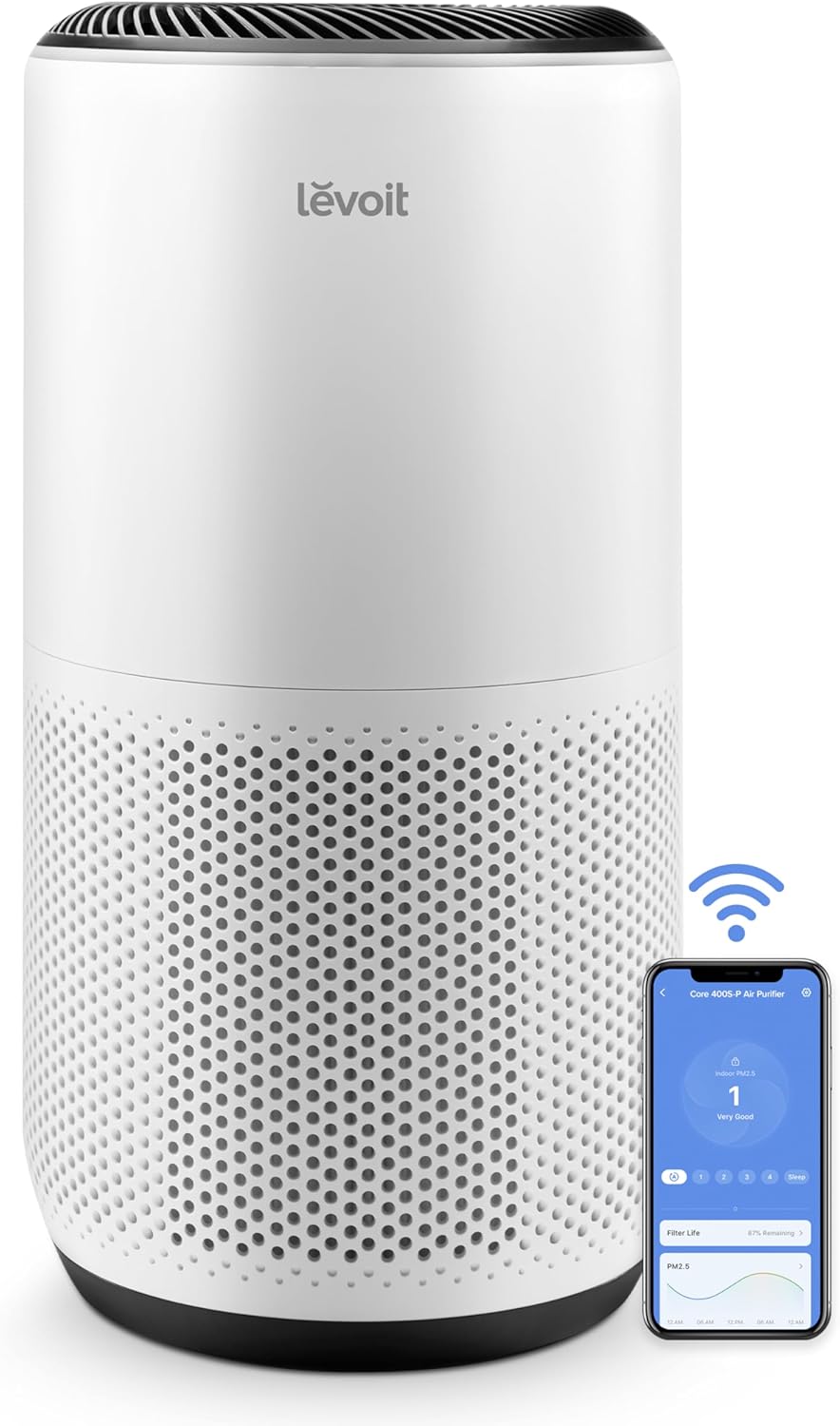
2. Levoit Core 400S — Best Value with Smart Monitoring
✓ Pros
- 24 dBA sleep mode — matches the Breville on quiet performance
- VOC and PM2.5 sensors with app-based historical tracking
- 310 m³/h CADR — adequate for home offices up to ~23m²
- $300-400 price point — $300-400 cheaper than the Breville
- H13 HEPA filter stage verified by manufacturer
✗ Cons
- CADR (310 m³/h) insufficient for larger home offices above 25m²
- Thinner activated carbon stage than the Austin Air — not adequate for heavy formaldehyde loads
- Auto mode response slightly less refined than Breville’s sensor system
✓ Buy this if:
Your home office is under 23m², your budget tops out at $400, and you want identical 24 dBA noise performance to the Breville at 55% of the price. Excellent for standard WFH setups without heavy chemical loads.
✗ Skip if:
You have a heavy formaldehyde load from new MDF furniture or run a laser printer at volume — the thin carbon stage won’t keep up with sustained chemical output.
The Levoit Core 400S is the correct choice for the majority of Australian WFH workers operating on a budget under $400. It matches the Breville’s noise floor exactly at 24 dBA — that is not a rounding error, that is a genuine performance match on the metric that matters most during work hours. The CADR difference (310 versus 550 m³/h) only becomes relevant in offices larger than roughly 23m².
Where the Core 400S actually adds value in a home office context is the app’s historical data logging. Most people have no baseline awareness of when their office air quality is worst. The VeSync app shows PM2.5 and VOC readings graphed over time. After a few weeks of data, patterns become visible: printing at 10am spikes VOCs, cooking smells entering from the kitchen at lunchtime register on PM2.5, afternoon westerly winds through an open window in Perth or Brisbane bring in outdoor particulates. That empirical awareness is actually useful for improving WFH habits.
Noise Performance in Practice
At 24 dBA on sleep/low mode, the Core 400S produces a gentle white noise rather than a directional fan sound. Levoit specifies 24 dBA on sleep mode, a level low enough to be effectively inaudible on a standard laptop microphone at 1-2 metres in a quiet room. On auto mode, the fan ramps when its sensor detects a particle spike, then returns to low once the air clears.
Filter Replacement Cost
Replacement filters for the Core 400S run approximately $55-75 per filter set on Amazon AU, with a recommended replacement interval of 6-8 months in standard use. That puts annual filter cost at roughly $80-150 depending on usage hours — lower than the Breville on a per-year basis.
3. Coway Mighty AP-1512HH — Best Compact for Desk Placement

✓ Pros
- Small footprint — fits on or beside a desk without dominating the room
- 4-colour LED air quality indicator — no app needed for at-a-glance feedback
- 24.4 dBA on low — call-safe noise level
- $269-319 — the most accessible price on this list
- True HEPA filter stage, independently verified
✗ Cons
- 240 m³/h CADR limits coverage to ~18m² at 5 ACH — not suitable for larger offices
- No smart app or historical data logging
- Ioniser feature should be disabled in a home office context (any additional ozone is counterproductive when a printer is already a source)
✓ Buy this if:
Your home office is under 18m², your budget is under $320, and you want the smallest footprint with visible LED air quality feedback. No app required — and remember to disable the ioniser before first use.
✗ Skip if:
Your office exceeds 18m² or you run a laser printer heavily in a new MDF-fitted space — the 240 m³/h CADR and thin carbon stage won’t cover it.
The Coway Mighty has been the top-selling compact air purifier in Australia for several years. Its reputation is earned: the performance-to-price ratio at $269-319 is strong, and its physical footprint is small enough to sit on a corner of a desk or on the floor beside a chair without occupying meaningful office real estate.
For home office use specifically, the 4-colour LED air quality indicator deserves a mention. Blue means clean, green means good, yellow means moderate, red means poor. During a print job in a small room, the indicator shifts from blue to green or yellow — visible feedback that the air is being turned over and cleared without needing to unlock a phone and open an app. For buyers who prefer direct physical feedback over data dashboards, this is the right unit.
Ioniser — Disable It
The Coway Mighty includes a built-in ioniser. In most domestic settings this is a minor issue. In a home office with a laser printer, it is a specific concern: the printer already generates ozone, and the ioniser adds to that load. Switch it off. The HEPA and carbon stages do the filtration work without it. This is not a dealbreaker — it takes five seconds to disable — but it is the kind of detail generic competitor reviews miss.
Room Coverage Reality Check
A 240 m³/h CADR at 5 ACH with a 2.7m ceiling covers approximately 17.8m². Most converted bedroom home offices in Australian homes are in this range. A converted garage or open-plan study area will exceed it. Know your room dimensions before buying.
4. Austin Air HealthMate Plus HM450 — Best for Heavy Off-Gassing

✓ Pros
- 6.3 kg activated carbon + zeolite bed — orders of magnitude more capacity than any competitor
- Filter replacement every 5 years (not annually) — lowest long-term running cost despite high upfront price
- Zeolite stage specifically addresses ammonia and formaldehyde from MDF off-gassing
- HEPA stage rated to medical-grade standard by manufacturer
✗ Cons
- ~35 dBA noise floor on low — audible on a sensitive microphone during video calls
- No smart app, no VOC sensor, no auto mode — purely manual operation
- $850-950 upfront, though 5-year filter life reduces TCO significantly
- Heavy and non-portable — not a unit you move room to room
✓ Buy this if:
You’ve just fitted a new home office with flat-pack MDF furniture and fresh carpet, run a laser printer heavily, or have chemical sensitivity. The 6.3 kg carbon + zeolite bed is the only consumer-grade solution for sustained heavy VOC loads.
✗ Skip if:
You need a noise floor below 30 dBA for Zoom calls without manual scheduling — the ~35 dBA low speed will register on a laptop microphone and requires planning around your call schedule.
The Austin Air HealthMate Plus operates in a different category from the other three units. It is not trying to win on noise, connectivity, or price. It is built to absorb a very large ongoing chemical load — the kind generated by a home office fitted out with new MDF furniture, new carpet, and a high-volume laser printer running 50+ pages a day.
The 6.3 kg carbon bed is the key specification. Most consumer air purifiers contain 20-100 grams of activated carbon in a sprayed pre-filter layer. The Austin Air’s carbon stage holds 6,300 grams in a deep bed that air passes through slowly enough to allow meaningful adsorption dwell time. This is why the filter lasts 5 years rather than 6-8 months: the carbon is not exhausted quickly because there is a massive volume of it.
Zeolite Stage for Formaldehyde
The HealthMate Plus adds zeolite to the carbon blend specifically to capture formaldehyde and ammonia — two of the most significant off-gases from MDF and urea-formaldehyde resins. Standard activated carbon adsorbs formaldehyde to some degree, but zeolite’s molecular sieve structure is more effective at the concentrations found in freshly-assembled MDF furniture in a small enclosed room.
Noise Consideration for Calls
The Austin Air’s noise floor at low speed is approximately 35 dBA — measurably louder than the Breville and Levoit at 24 dBA. On a Zoom call, it will register as background noise on a standard laptop microphone. The practical workaround is to run it at full speed when you are not in calls (early morning, lunch, after hours) to maximise carbon bed contact time, then drop to low during calls. It is a manual trade-off that the sensor-equipped Breville handles automatically.
5-Year Cost of Ownership
At $850-950 upfront with a single filter replacement in year 5 (approximately $300-400), the 5-year total cost of ownership is roughly $1,150-1,350. The Breville at $749 with annual filter costs of $125 runs $749 + (4 x $125) = $1,249 over the same period. The Austin Air is cost-competitive over 5 years, and its carbon capacity is not remotely comparable. For the specific buyer it targets — heavy VOC load, chemical sensitivity, new build — it is the correct specification.
5-Year Cost of Ownership Comparison
| Product | Upfront (AUD) | Annual Filter Cost | 5-Year Total | Notes |
|---|---|---|---|---|
| Breville Protect Max | $749 | ~$125 | ~$1,249 | Annual filter replacement assumed |
| Levoit Core 400S | $349 | ~$100 | ~$749 | Filter every 6-8 months; 2 filters/year estimated |
| Coway Mighty AP-1512HH | $289 | ~$80 | ~$689 | Pre-filter washable; HEPA replacement annually |
| Austin Air HealthMate Plus | $899 | ~$70 (amortised) | ~$1,249 | Single filter change at ~5 years ($350 est.) |
Annual Filter Running Cost — Home Office Air Purifier Segment, Australia
Based on manufacturer-published filter replacement intervals and Australian retail filter prices; standard home office use (10-12 hrs/day).
Placement and Setup — Getting Maximum Performance from Your Home Office Air Purifier
Where you place the unit matters as much as which unit you buy. Air purifiers clean the air they pull through their filters — they do not project clean air across the room. Place the unit between the pollution source and your breathing zone.
In most home offices, the printer is the primary pollution source. Place the air purifier between the printer and your desk, not on the opposite wall. If the printer is on a shelf above desk height, floor placement of the purifier directly below it captures the downward-settling ultrafine particle plume.
Leave the home office door slightly open while printing. A closed room with a running laser printer and no ventilation concentrates ozone and UFP far faster than the air purifier can clear them. Even a 5-10cm gap at the door base provides meaningful dilution airflow.
For formaldehyde from MDF: run the purifier continuously for the first 6 months of a new furniture setup, not just during work hours. Off-gassing from urea-formaldehyde resins continues overnight when the room is sealed. A carbon filter working 24 hours a day depletes the formaldehyde load faster than one running 8-10 hours per day.
The CO2 Problem — and What to Do About It
CO2 accumulates in sealed home offices faster than most WFH workers realise. A single person at rest exhales roughly 200ml of CO2 per minute. In a 3m x 4m x 2.7m home office (approximately 32.4m³ volume) with the door and windows closed, CO2 concentration rises from ambient 420 ppm to approximately 900 ppm within one hour, and to 1,200-1,500 ppm within two to three hours.
Harvard research cited above found measurable declines in cognitive performance at 1,000 ppm relative to 550 ppm. At 1,500 ppm, the declines were more pronounced across decision-making and information-use task scores. The mechanism is not oxygen depletion — it is CO2’s direct effect on cerebrovascular regulation.
Air purifiers cannot address this. The solution is simple: open a window or door for 5 minutes every hour. That is enough to dilute CO2 back toward ambient levels in a standard home office. Set a timer during your work blocks if you tend to get absorbed. A dedicated CO2 monitor gives you objective data rather than relying on habit — we reviewed the Inkbird IAM-T1, which reads CO2, PM2.5, temperature, and humidity for around $60 on Amazon AU.
Top Home Office Air Purifier Picks
Decision Tree — Which Home Office Air Purifier Is Right for You?
3-Question Decision Guide
1. Do you have significant VOC sources? (New MDF furniture in the last 12 months, fresh carpet, or a high-volume laser printer running 50+ pages/day)
YES: Go to Q2. NO: Skip to Q3.
2. Is the VOC load heavy and sustained? (Full room of new MDF, chemical sensitivity, ongoing high-volume printing)
YES: Austin Air HealthMate Plus — only unit with the carbon capacity. NO: Breville Protect Max (VOC sensor + auto response handles moderate loads).
3. What is your budget and room size?
Under $320, room under 18m²: Coway Mighty. Under $400, room under 23m²: Levoit Core 400S. Up to $800, any home office room: Breville Protect Max.
Final Verdict
Four products, four distinct use cases. The choice depends on what your home office actually contains, not just how big the room is.
The Breville Protect Max is the right answer for most WFH buyers in Australia. It handles PM2.5, VOCs, and ultrafine particles automatically, runs quietly enough for calls, and gives you app-based visibility into your air quality without requiring any manual management. At $699-799, it is not cheap — but across a 5-year working life, the total cost of ownership is comparable to the Levoit and Austin Air.
The Levoit Core 400S is the correct choice if your budget stops at $400 and your office is under 23m². The noise performance is identical to the Breville. The CADR and carbon stage are smaller, but for a standard home office in a converted bedroom or study, the performance gap is not significant in daily use.
The Coway Mighty is for the compact office that needs the smallest physical footprint at the lowest price. Disable the ioniser. Place it close to the printer. At 24.4 dBA it qualifies as call-safe, and the 4-colour LED indicator gives visible feedback during the workday without requiring a phone.
The Austin Air HealthMate Plus is specifically for the buyer who has just fitted out a home office with new MDF furniture, new carpet, and a heavy printing load. Nothing on the consumer market comes close to 6.3 kg of carbon and zeolite for sustained VOC adsorption. The 5-year filter life makes the running cost surprisingly competitive. The noise floor on low is louder than the others — plan around that for calls.
None of these units address CO2. Ventilate. Open the window or door for five minutes every hour. If you want objective data on CO2 in your home office, the Inkbird IAM-T1 gives you a number rather than a guess.
Last reviewed: June 2026 — Clean and Native
The Breville Protect Max is the benchmark home office air purifier for Australia in 2026.
24 dBA on low, VOC sensor auto-response, 550 m³/h CADR. It runs quietly during calls, responds automatically to printer off-gassing, and handles any home office room size. Available on Amazon AU.
Frequently Asked Questions
The Breville Smart Air Viral Protect Max is the best air purifier for a home office in Australia in 2026. It runs at 24 dBA on low (quiet enough for video calls), has a built-in VOC sensor that responds automatically to printer off-gassing, and delivers 550 m³/h CADR — more than enough for any standard home office. For buyers with a budget under $400, the Levoit Core 400S delivers near-identical noise performance with a 310 m³/h CADR at $299-399.
Indirectly, yes — but not in the way most marketing implies. Air purifiers reduce PM2.5 and VOC concentrations in the room, which reduces the physiological load on the respiratory and cardiovascular system. The larger driver of cognitive impairment in home offices is CO2 accumulation, which air purifiers cannot address. Harvard research (Allen et al., 2016) found decision-making performance declined measurably at 1,000 ppm CO2 compared to 550 ppm. Open a window for 5 minutes every hour for CO2 management. Use the air purifier for particles and VOCs.
Yes, with the right specification. Laser printers emit ultrafine particles (captured by HEPA filters), ozone, and VOCs including styrene (captured by activated carbon stages). A unit with both a true HEPA filter and a meaningful activated carbon stage — and ideally a VOC sensor with auto mode — will clear printer emissions effectively. The Breville Protect Max is best suited to this: its sensor detects the VOC and particle spike from a print job and increases fan speed automatically. Place the unit between the printer and your desk for maximum capture efficiency.
No. Air purifiers — including HEPA, activated carbon, ionisers, and UV units — cannot remove CO2. CO2 is managed only by introducing fresh outdoor air through ventilation. In a sealed home office, CO2 can rise from ambient 420 ppm to 1,000-1,500 ppm within 2-3 hours with a single occupant. Open a window or door for 5 minutes every hour. If you want to measure CO2 levels, a dedicated CO2 monitor like the Inkbird IAM-T1 gives objective readings.
Below 30 dBA on low speed is the practical threshold for most standard laptop and desktop microphones at 1-2 metres distance. Below 25 dBA is effectively inaudible in normal office environments. The Breville Protect Max and Levoit Core 400S both specify 24 dBA on sleep/low mode. The Coway Mighty AP-1512HH is 24.4 dBA. The Austin Air HealthMate Plus runs approximately 35 dBA on low — audible on a sensitive microphone, though manageable with positioning and timing around calls.
In a typical Australian home office, the main sources are: laser printer ultrafine particles and ozone (during printing); formaldehyde and VOCs from MDF furniture and shelving (ongoing for 6-24 months after assembly); CO2 accumulation from a sealed room with one or more occupants; and outdoor PM2.5 infiltration from bushfire smoke, traffic, or industrial pollution entering through building gaps. During NSW and Victorian bushfire season (October-March), outdoor PM2.5 events can push indoor levels well above the NEPM standard of 25 μg/m³ even in closed rooms.
Formaldehyde is classified as a Group 1 human carcinogen by the International Agency for Research on Cancer (IARC) at high concentrations. In typical home office conditions with newly-assembled MDF furniture in a small room (under 20m²) in warm weather — particularly in Queensland or Western Australian summer — formaldehyde concentrations can reach levels that cause irritation and sustained low-level exposure above recommended thresholds. Off-gassing is highest in the first 6-12 months and reduces significantly after 24 months. Activated carbon filtration — particularly the deep carbon bed in the Austin Air HealthMate Plus — reduces formaldehyde concentrations. Ventilation accelerates off-gassing and dilutes concentrations simultaneously.
Place the unit between your primary pollution source (usually the printer) and your breathing zone (your desk and chair). Do not place it in a corner behind furniture — air purifiers need clear intake and exhaust paths. On the floor 30-60cm from the printer, oriented to draw air from the printer side, is the most effective position for home office printer emissions. Do not place it directly beside your monitor or computer tower, as heat from electronics can affect sensor accuracy in units with built-in air quality sensors.
Get the Australian Home Environment Checklist
30 checks across water, air and EMF. Most of them free. Ranked by impact.
No spam. Unsubscribe any time.

Former Royal Australian Navy Clearance Diver and TAG-E counter-terrorism operator. Founded Clean and Native to apply the same rigorous thinking to the home environment.
Full biography →