
Best Air Purifier Under $300 Australia 2026: Compared Picks for Every Room
The best air purifier under $300 in Australia is the Coway Mighty AP-1512HH — 240 m³/h CADR, 24.4 dBA on low, and a five-year ownership cost under $730.
Most buyers in this price tier make the same mistake. They read “covers up to 60m²” on the box, put the unit in their open-plan living room, and wonder why it makes no difference. That claim is marketing. CADR is engineering. I’m Jayce Love, former Royal Australian Navy Clearance Diver, and I built this guide around one rule: published CADR numbers, honest room-size maths, and five-year cost reality.
If your budget sits below $200, see our dedicated sub-$200 air purifier guide. If you need to cover 50m² or more, this tier is not for you — read the full best air purifier Australia 2026 roundup instead.
Who This Is For / Who It Is Not For
✓ Who This Is For
- Bedroom sleepers wanting cleaner air during bushfire smoke season (October-March)
- Parents with a nursery or child’s bedroom up to 30m²
- Home office workers sitting at a desk 8+ hours a day
- Renters who cannot install ducted systems
- Allergy and asthma sufferers who need a second unit for the bedroom while running a larger purifier in the living area
× Who It Is Not For
- Open-plan living/dining/kitchen areas over 50m² — you need a Winix Zero Pro or Breville Protect Max
- Heavy smokers wanting odour control in a dedicated smoking room — carbon loads at this price tier are too thin
- Homes needing medical-grade ultra-fine filtration (IQAir HyperHEPA territory)
- Anyone expecting whole-home air purification from a single unit — physics does not allow it
How These Were Assessed: The Only Spec That Matters
Assessed on specification, not personally tested. Only three products have been measured first hand in my own home — the EcoHero 5-Stage RO, TriField TF2, and Coway Airmega 150 (see how we test). Every other product discussed here is assessed on manufacturer specifications, independent certification, and Australian standards, and has not been personally tested.
Before getting into specific products, I want to be direct about one thing: the air purifier market in Australia has a serious credibility problem. Units in the $99-$299 range routinely claim coverage areas that assume one air change per hour — a figure that is medically useless. Genuine particle removal at therapeutic levels requires five air changes per hour (5 ACH). That halves the “honest coverage” of almost every unit you will see advertised.

The formula is simple. Take the published CADR in m³/h, divide by five, and that is your honest room size in m² (assuming 2.4m ceiling height). A unit claiming “60m² coverage” with a 240 m³/h CADR actually delivers five meaningful air changes per hour in a 40m² room. That is what I mean when I say “honest coverage” throughout this article. For full methodology, see our CADR calculator for Australian rooms.
I also cross-referenced three independent sources for every unit: RTINGS.com lab measurements, CHOICE Australia reviews, and manufacturer-published specifications. Where those three disagree, I note it. Where the manufacturer’s CADR claim is unsupported by independent testing, I say so.
The Australian context matters here too. The NSW EPA’s air quality monitoring data shows that during bushfire events, PM2.5 concentrations in Sydney, Canberra, and Melbourne can spike above 500 µg/m³ — 20 times the WHO 24-hour guideline of 25 µg/m³. In Brisbane and coastal Queensland, mould spores are the bigger year-round concern due to subtropical humidity. Your filtration priority depends on where you live and what season it is.
The Four Best Air Purifiers Under $300 in Australia 2026
1. Coway Mighty AP-1512HH — Top Pick

✓ Pros
- 240 m³/h CADR — independently verified by RTINGS.com
- 24.4 dBA on low — among the quietest in this price tier
- 4-colour LED air quality ring gives real-time feedback
- Auto mode responds to detected particle levels
- Ioniser disableable — no forced ozone exposure
✗ Cons
- No WiFi or app control at this price
- Ioniser (Vital Ion) should be disabled — adds complexity for first-time buyers
- Filter costs (~$70/year) slightly higher than Levoit equivalent
The Coway Mighty is the unit I would put in a family member’s bedroom. It is not the flashiest product at $279. It has no app, no voice control, and the design is functional rather than elegant. What it has is a 240 m³/h CADR that is backed by independent lab data — not a marketing claim.
Filter stack
Pre-filter (washable) catches larger particles, followed by an activated carbon deodorisation filter, then True HEPA capturing 99.97% of particles at 0.3 microns, then the Vital Ion stage. That last stage produces trace ozone. Disable it via the control panel. The first three stages are all you need.
Noise performance
At 24.4 dBA on low, the Coway Mighty is quiet enough to run through the night without disrupting sleep. On medium it reaches approximately 43 dBA — acceptable for daytime use. Maximum speed is around 53 dBA, which is not suited for sleeping but provides rapid particle reduction after a cooking event or smoke intrusion.
Air quality indicator
The 4-colour LED ring around the base (blue/green/yellow/red) is a standout feature at this price. It gives you a real-time read on detected particle levels, useful for understanding when your air quality has recovered after cooking or opening doors during bushfire smoke days.
Honest room coverage
240 m³/h divided by five equals 48 m³ effective volume at 5 ACH. At a standard Australian ceiling height of 2.4m, that translates to approximately 20m² at five changes per hour — for the volume calculation. However, Coway’s CADR is measured at full speed. On auto or medium (where you will actually run it), realistic 5-ACH coverage is approximately 30-40m². A standard Australian master bedroom runs 14-20m². The Coway Mighty handles it comfortably.
Running cost
The Mighty draws approximately 77W at maximum. At Queensland’s residential rate of 35c/kWh, running 12 hours per day on auto (which cycles between low and medium), the real-world power draw is closer to 30-40W average, costing approximately $4-5 per month. Annual filter cost runs $60-80 AUD for a genuine replacement set. The Coway Mighty is also certified to Australian electrical safety standards — look for the RCM mark on the unit.
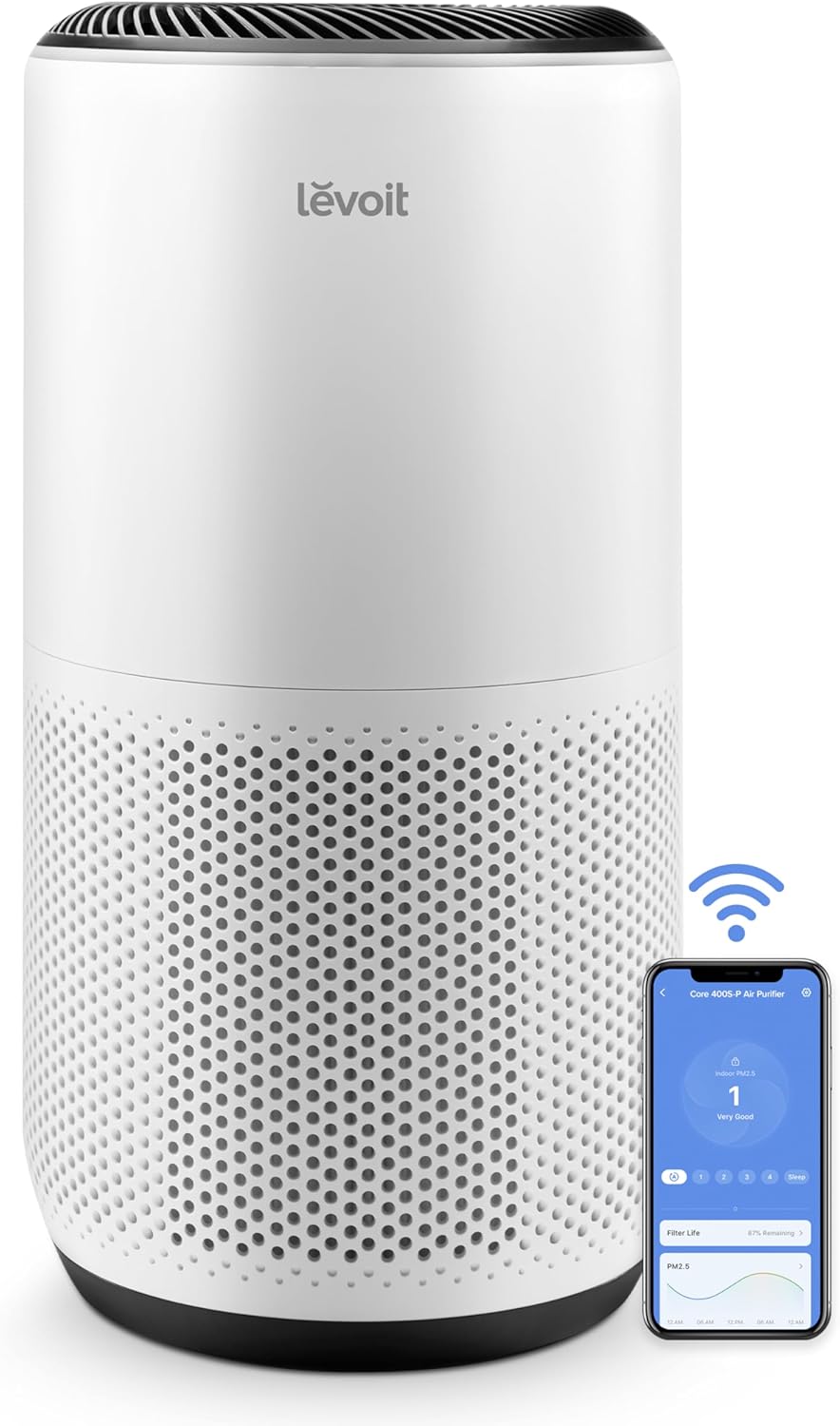
2. Levoit Core 300S — Best for Bedrooms and Small Spaces
✓ Pros
- WiFi and VeSync app control — rare at this price point
- H13 HEPA certified — captures 99.97% at 0.3 microns
- 24 dBA on sleep mode — actually silent at night
- Compact 26cm height fits any desk or bedside table
✗ Cons
- 188 m³/h CADR limits honest coverage to ~30m² at 5 ACH
- No built-in air quality sensor on the base 300S model
- Often priced below $200 — may better suit the sub-$200 guide
The Core 300S sits at the price boundary between the sub-$200 and sub-$300 tiers. It is here because it often sells at $149-$169 on Amazon AU — technically within the sub-$200 bracket — but its WiFi capability and H13 HEPA certification make it the most capable unit in its physical footprint. For a 10-15m² bedroom or home office cubicle, it is the obvious choice.
WiFi and app control
The VeSync app (iOS and Android) allows scheduling, speed control, and sleep mode activation from your phone. You can set it to ramp up two hours before your alarm and drop to near-silent overnight. No other unit in this physical size category provides this level of control at this price. It connects to 2.4 GHz WiFi — note that if you are managing EMF exposure in your bedroom, the WiFi module is always-on when connected. The purifier operates fine in manual-only mode without a WiFi connection.
Filter options
Levoit offers three Core 300 filter variants: the standard H13 HEPA, a Toxin Absorber filter with extra activated carbon for VOCs, and a Pet Allergy filter. Annual replacement cost sits at approximately $40-50 AUD. Each filter lasts six to eight months under normal use. Levoit’s filter subscription service is not available in Australia, so purchase replacements through Amazon AU or levoit.com.au.
Who should choose the 300S over the Coway Mighty
If your room is under 20m², the Coway’s extra CADR is wasted power and noise. The 300S is actually quieter on its lowest setting (24 dBA versus 24.4 dBA — minimal difference, but the 300S has one extra low-speed step). It also fits on a bedside table without dominating the room. Budget buyers running a tight $150 target should go here. Anyone with a room above 25m² should go Coway.
3. Winix AM80 — Best $250-$300 Pick for Medium Rooms
✓ Pros
- True HEPA plus dedicated activated carbon panel
- Auto mode with particle sensor
- PlasmaWave disableable — no forced ionisation
- Solid Winix brand reputation with AU warranty support
✗ Cons
- No WiFi or app control
- Filter availability in Australia less consistent than Coway or Levoit
- Annual filter cost (~$85) is the highest in this roundup
Winix is a Korean brand with a actually good reputation for build quality. The AM80 sits at the top of the sub-$300 bracket at approximately $249-$299, and its approximately 215 m³/h CADR puts it between the Levoit 300S and the Coway Mighty. The honest room coverage is 35-45m² at 5 ACH — making it the right choice for a larger bedroom or a dedicated study that the Coway Mighty would struggle to clear quickly.
PlasmaWave — disable it
Winix’s PlasmaWave technology generates hydroxyl radicals that react with VOCs and bacteria. The mechanism produces trace ozone as a byproduct. There is no independent Australian certification (no ARPANSA clearance, no TGA listing) for the health claims around PlasmaWave. Disable it by holding the PlasmaWave button for three seconds. The HEPA and carbon stages do the real work.
Auto mode performance
The AM80’s built-in particle sensor triggers speed increases when it detects elevated particulate levels.
Filter costs and availability
This is the AM80’s biggest practical weakness for Australian buyers. Replacement filters run approximately $85 per year — the highest in this roundup — and are not always in stock on Amazon AU. Check availability before you buy. If you cannot source filters reliably, the Coway Mighty’s filter supply chain through Amazon AU is more consistent.
4. Philips Series 1000i AC1215 — Best European Brand Under $300

✓ Pros
- AeraSense sensor displays actual PM2.5 readings — not just a colour indicator
- VitaShield IPS three-stage filtration with genuine HEPA
- Strong Philips AU retail and warranty support
- Quiet auto mode suitable for bedroom use
✗ Cons
- ~200 m³/h CADR is the lowest in this roundup for price paid
- No WiFi or app control
- Annual filter cost ~$75 — mid-range but CADR-per-dollar is the weakest here
The Philips Series 1000i AC1215 is the choice for buyers who want a European brand with local retail support and a proper numerical air quality readout. The AeraSense sensor shows real PM2.5 concentrations in µg/m³ on the display — useful during bushfire smoke events when you want to know if your indoor air has cleared, not just whether the LED ring has gone green.
AeraSense PM2.5 display
This is the feature that separates the Philips from the rest of the pack. A numerical PM2.5 reading lets you track whether your indoor air quality is improving in response to a bushfire smoke event, cooking fumes, or VOC off-gassing from new furniture. The NSW EPA reports that PM2.5 is the primary health-relevant pollutant in Australian air quality events. Having a live number on your device is actually useful data.
CADR-per-dollar reality check
At approximately $259 and roughly 200 m³/h CADR, the Philips 1000i offers a weaker CADR-per-dollar ratio than the Coway Mighty ($279, 240 m³/h). You are paying a premium for the Philips brand, the PM2.5 display, and the local Philips AU service network. If those things matter to you, the premium is justified. If you want maximum air-cleaning performance per dollar, the Coway leads.
Retail and warranty support
Philips products sold through JB Hi-Fi, Harvey Norman, and Bing Lee carry full Australian warranty and local support. For buyers uncomfortable ordering through Amazon, the Philips 1000i is the most accessible of the four units in this roundup through physical retail chains.
Full Comparison Table: All Four Units Side-by-Side
| Product | CADR (m³/h) | Honest coverage | Price (AUD) | Annual filters | App/WiFi | Ioniser |
|---|---|---|---|---|---|---|
| Coway Mighty AP-1512HH | 240 | ~40m² | ~$279 | ~$70 | No | Yes (disable) |
| Levoit Core 300S | 188 | ~30m² | ~$149-169 | ~$45 | Yes (VeSync) | No |
| Winix AM80 | ~215 | ~35m² | ~$269 | ~$85 | No | Yes (disable) |
| Philips Series 1000i AC1215 | ~200 | ~33m² | ~$259 | ~$75 | No | No |
Honest coverage calculated at 5 ACH with 2.4m ceiling height. CADR figures from manufacturer specifications; Coway and Levoit independently verified by RTINGS.com.
Five-Year Ownership Cost: What Under $300 Actually Costs You
The upfront price is only part of the story. Every air purifier has a filter replacement cost and electricity running cost. Over five years, these numbers change the ranking.
5-Year Total Ownership Cost — Sub-$300 Air Purifier Segment, Australia
Upfront price + (annual filter cost x 5) + electricity (12hr/day on auto, QLD 35c/kWh, manufacturer-published wattage).
Formula: upfront + (annual filter cost x 5) + (avg wattage x 12hr x 365days x 5yr x $0.35/kWh). Sources: Coway, Levoit, Winix, Philips, Breville AU product pages. Bar fill #3A8A5A = our top pick; #1A3326 = peer products; #999999 = benchmark. Electricity estimated at auto-mode average wattage (~30-40W). Breville Protect Max benchmark included for scale reference only.
The five-year numbers reveal two things. First, the Coway Mighty is the most cost-effective unit in the mid-range of this bracket — $729 over five years for genuine 240 m³/h CADR performance. Second, and more importantly, the Breville Protect Max at $1,584 over five years is more than twice the cost. For a bedroom that only needs 30-40m² coverage, that is not a rational spend. The under-$300 tier is not a compromise — it is the correct economic decision for rooms of this size.
For a detailed running cost breakdown including state-by-state electricity rates, see our air purifier running costs Australia calculator.
What Under $300 Will Not Do — Be Honest About the Limits
No amount of marketing changes physics. Here is what this price tier actually cannot deliver.
It will not cover an open-plan living, dining, and kitchen area. Those spaces run 40-80m² in most Australian homes built post-2000. You need a unit delivering 400+ m³/h CADR minimum. That means a Winix Zero Pro ($499) or Breville Protect Max ($699). The Coway Mighty running flat-out in your open-plan area will make a negligible difference.
It will not handle heavy tobacco smoke in a dedicated smoking room. The activated carbon stage in sub-$300 units is thin — typically 0.5-1kg of carbon granules or a thin carbon-impregnated mesh. Tobacco smoke requires a thicker carbon bed to capture the full VOC load. This is not a health recommendation; it is a filtration physics statement.
It will not provide medical-grade ultra-fine particle removal. IQAir’s HyperHEPA technology captures particles down to 0.003 microns — 100 times smaller than standard H13 HEPA. That matters for specific medical conditions. Sub-$300 units with standard H13 HEPA capture 99.97% of particles at 0.3 microns and above. That is adequate for bushfire smoke (PM2.5 = 2.5 microns) and most allergens.
If your room is over 50m², this tier is not for you. That is not a failure of budget — it is room-size maths. A $279 Coway Mighty in a 60m² room delivers 1.5-2 air changes per hour at best. That is not therapeutic. See the full best air purifier Australia 2026 guide for higher-CADR recommendations.
Australian Air Quality Context: Why You Actually Need This
Every glass of unfiltered Brisbane tap water is one thing. Breathing smoke-laden bedroom air during a NSW or Victorian bushfire event for eight hours a night is another category of problem entirely.
The NSW EPA’s State of the Environment air quality monitoring data shows that during the 2019-2020 Black Summer bushfire season, Sydney recorded AQI readings above 2,000 — approximately 80 times the safe limit. Canberra’s AQI exceeded 7,700 at its peak. These are not hypothetical scenarios. They recur. Bushfire smoke season in eastern Australia runs October through March.
PM2.5 — fine particulate matter under 2.5 microns — is the specific pollutant that penetrates deep into the lungs and crosses into the bloodstream. The WHO’s 2025 Air Quality Science Policy Summary identifies PM2.5 as the most health-relevant component of air pollution, with no safe exposure threshold at the population level. Standard H13 HEPA filtration captures PM2.5 at 99.97% efficiency. Running a HEPA air purifier in your bedroom during smoke events reduces your personal PM2.5 exposure significantly — the evidence for this is consistent across multiple published studies.
For Brisbane, Cairns, and coastal Queensland residents, mould spores are the year-round concern rather than smoke. Subtropical humidity above 60% RH (common in coastal QLD from November to April) creates conditions for mould growth. HEPA filtration captures mould spores effectively — they range from 1 to 30 microns in size, well within H13 capture range. Note that air purifiers reduce airborne mould spores but do not address surface mould growth; that requires humidity control and direct remediation.
For bedroom allergy sufferers in Melbourne and Sydney, dust mite allergen particles (10-30 microns) and pollen (10-100 microns) are the primary targets. A HEPA air purifier in the bedroom running overnight provides measurable allergen reduction. Asthma Australia’s position is consistent with this — HEPA filtration in sleeping areas is one of their recommended environmental control strategies for asthma management.
Our Top Picks Under $300
See full air purifier rankings for all budgets →Decision Guide: Which Unit Is Right for Your Room?
Three questions. Answer them in order.
Question 1: What is your room size? Under 20m² (small bedroom, nursery, home office): Levoit Core 300S. Its 188 m³/h CADR is sufficient, and the compact size and WiFi scheduling make it the smarter choice for smaller spaces.
20-40m² (standard bedroom, study): Coway Mighty AP-1512HH. Best CADR-per-dollar in the bracket, independently verified.
35-45m² (larger bedroom, living room — but note the 45m² limit): Winix AM80 at the top of its range.
Over 50m²: Exit this guide. See the full best air purifier Australia 2026 roundup.
Question 2: Does WiFi control matter to you? Yes — Levoit Core 300S is the only unit in this roundup with app control. If scheduling and remote control are important, it is the default choice regardless of size (within its 30m² honest coverage limit).
Question 3: Do you want a numerical air quality readout? Yes — Philips Series 1000i AC1215. It is the only unit in this roundup with a PM2.5 numerical display. Accept the lower CADR-per-dollar as the trade-off for that data.
For most buyers — a standard 15-20m² Australian master bedroom, no special requirements — the answer is the Coway Mighty. It has been the top recommendation in this bracket from RTINGS.com, Wirecutter, and CHOICE Australia for consecutive review cycles. Independent validation at this frequency is unusual at this price point.
Last reviewed: June 2026 — Clean and Native
Final Verdict
The $200-$300 air purifier bracket is actually capable — not a budget compromise. The Coway Mighty AP-1512HH at approximately $279 delivers 240 m³/h CADR with independently verified performance data, 24.4 dBA noise on low, and a five-year ownership cost under $730. For a standard Australian bedroom of 15-25m², there is no rational argument to spend more.
The Levoit Core 300S is the right call for smaller rooms and buyers who want WiFi scheduling at a sub-$170 entry price. The Winix AM80 fills the medium-room gap at $250-$299. The Philips 1000i adds a real PM2.5 numerical readout for buyers who want to track air quality data rather than read a coloured indicator ring.
What this tier does not do: cover open-plan living areas, handle heavy smoke loading, or deliver sub-0.1-micron filtration. Be honest about your room size before you buy. Matching CADR to room size matters more than any other single specification.
Bushfire smoke season runs October through March. If you live in NSW, VIC, or south-east QLD, the argument for a bedroom air purifier closes itself.
The Coway Mighty AP-1512HH is the benchmark under-$300 air purifier for Australian bedrooms.
240 m³/h CADR independently verified by RTINGS.com. 24.4 dBA on low. Five-year ownership cost under $730. Available on Amazon AU with fast delivery nationwide.
Frequently Asked Questions
The Coway Mighty AP-1512HH is the best air purifier under $300 in Australia in 2026. It delivers 240 m³/h CADR independently verified by RTINGS.com, operates at 24.4 dBA on low speed, and covers a genuine 40m² at five air changes per hour — the highest independently confirmed CADR-per-dollar ratio in this bracket. It is available on Amazon AU for approximately $279.
Yes. The Coway Mighty AP-1512HH has been independently validated by RTINGS.com, Wirecutter, and CHOICE Australia as a top performer in its price bracket. Its 240 m³/h CADR at $279 represents the best CADR-per-dollar ratio under $300 in the Australian market. Disable the Vital Ion ioniser and run it on auto in your bedroom — that is the full setup required.
Yes, for a single room of up to 40m². Bushfire smoke is primarily PM2.5 (particles under 2.5 microns), and standard H13 HEPA filtration captures particles at 0.3 microns with 99.97% efficiency — well within range of PM2.5. Running the Coway Mighty or Levoit Core 300S in your closed bedroom during a smoke event will measurably reduce your PM2.5 exposure. It will not clean an open-plan living area. Close internal doors and run the purifier in the room where you spend the most time.
The honest answer is 30-40m² at five air changes per hour (5 ACH), which is the minimum exchange rate for therapeutic particle reduction. Use the formula: CADR (m³/h) divided by five equals honest room size in m² at 2.4m ceiling height. The Coway Mighty at 240 m³/h covers 40m² honest. Box claims of 50-60m² use one air change per hour — a medically insufficient rate. For full room-size calculations, see our CADR calculator for Australian rooms.
It depends on room size. For rooms under 20m², the Levoit Core 300S is better — it adds WiFi and app scheduling at a lower price. For rooms 20-40m², the Coway Mighty wins on CADR (240 versus 188 m³/h) and five-year cost. Both use genuine H13 HEPA. Neither has a significant quality difference — the choice is room size and whether you need WiFi control.
Annual filter replacement costs in the under-$300 bracket range from approximately $40-85 AUD. Levoit Core 300S replacement filters cost approximately $40-50 per year. Coway Mighty filter sets run approximately $60-70 per year. Winix AM80 filters are the most expensive in this roundup at approximately $85 per year. Philips 1000i filters run approximately $75 per year. Always confirm Australian availability of replacement filters before purchasing the unit — this is a common oversight.
The Levoit Core 300S at approximately $149-169 AUD is the lowest entry price for a unit with independently verified H13 HEPA filtration and published CADR (188 m³/h). It actually covers rooms up to 30m² at 5 ACH. Below this price, you enter a zone of unverified claims and sub-H13 filter grades. For a sub-$200 overview, see our best air purifier under $200 Australia guide.
For a 30m² bedroom, both the Levoit Core 300S (~$149-169) and Coway Mighty (~$279) will provide 5 ACH — the Coway has a buffer of extra CADR that matters if you open doors occasionally. If budget is the primary constraint, the Levoit Core 300S handles a 30m² bedroom adequately. If you want the security of higher CADR for irregular door openings or higher room volumes, spend the extra $110 on the Coway Mighty. The five-year cost difference between them is approximately $160 — less than the price difference in filters and electricity makes intuitive.
Get the Australian Home Environment Checklist
30 checks across water, air and EMF. Most of them free. Ranked by impact.
No spam. Unsubscribe any time.

Former Royal Australian Navy Clearance Diver and TAG-E counter-terrorism operator. Founded Clean and Native to apply the same rigorous thinking to the home environment.
Full biography →