Melbourne Bushfire Smoke Air Quality Purifier 2026
Melbourne’s bushfire smoke events — like the January 2026 Otways fires that blanketed suburbs from Geelong to Dandenong — push PM2.5 levels well above 200 µg/m³, more than eight times the NEPM standard of 25 µg/m³ (24-hour average). A H13 HEPA air purifier rated to your room size is the single most effective intervention for protecting indoor air quality during these events.
Related: best air purifiers for bushfire smoke · best air purifiers Australia 2026
Why Melbourne Bushfire Smoke Is Worse Than You Think
Melbourne’s geography makes it uniquely vulnerable. The Yarra Valley catchment, the Otways, and the Dandenong Ranges form a horseshoe of bushland around one of Australia’s largest urban populations. When fire burns in any of these zones, prevailing winds funnel smoke directly into the metro area. You do not need to be anywhere near the fire front to breathe dangerous air.
During the January 2026 Otways fire event, according to ABC News reporting, smoke blanketed Melbourne for multiple consecutive days with visibility reduced to below 1 km in suburbs from the western corridor through to the eastern ranges. Victoria’s EPA deployed both stationary and mobile monitoring stations across the metro area, according to their bushfire smoke health guidance page, and recorded PM2.5 readings that significantly exceeded the NEPM 24-hour standard of 25 µg/m³.
Here is what those numbers mean for your lungs. PM2.5 — particulate matter 2.5 micrometres or smaller — penetrates deep into the alveoli of your lungs and enters the bloodstream. According to the WHO, there is no safe threshold for PM2.5 exposure. The NEPM ambient air quality standard sets 25 µg/m³ as the 24-hour average limit and 8 µg/m³ as the annual average. During a bushfire smoke event, outdoor readings in Melbourne suburbs commonly sit between 100 and 300+ µg/m³ — four to twelve times the daily limit.
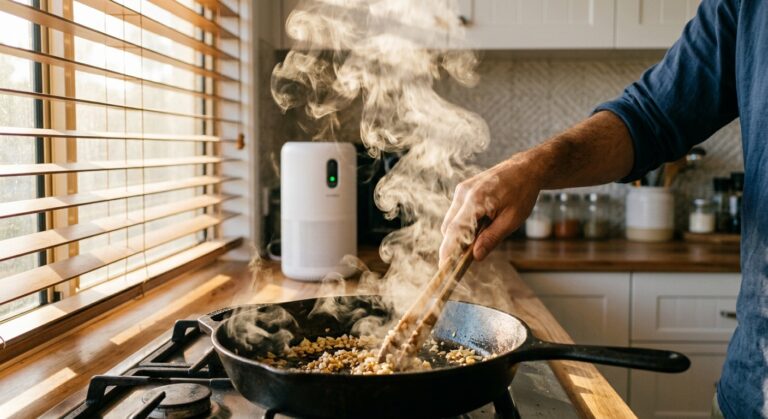
Without active filtration, indoor PM2.5 concentrations in a typical Melbourne home reach 50-80% of outdoor levels within hours. Closing windows helps, but Australian homes are not airtight. Air infiltrates through gaps around doors, exhaust fans, downlights, and the subfloor. Your home is not a sealed environment — it is a leaky box, and smoke finds every gap.
If you have been relying on closing windows and hoping for a wind change, the data says you are breathing hazardous air for hours or days at a time. The next section covers how to use Victoria EPA’s real-time monitoring to know exactly when your suburb is at risk — and when to turn your purifier to maximum.
How to Use Victoria EPA Real-Time AQI for Your Suburb
Most Melbourne residents do not check air quality until they can smell smoke. By then, PM2.5 levels have been elevated for hours and you have already been exposed. Victoria’s EPA operates a network of monitoring stations across the metro area and publishes real-time air quality data at EPA AirWatch (epa.vic.gov.au). This is the first tool you should use — before you even look at purifier settings.
The EPA reports air quality using the AQI (Air Quality Index) framework. Here is what the numbers mean for your response inside your home:
| AQI Range | PM2.5 (µg/m³) | Category | Your Action |
|---|---|---|---|
| 0-33 | 0-8 | Good | Normal ventilation. Open windows fine. |
| 34-66 | 8.1-25 | Fair | Purifier on low. Keep windows closed if smoke visible. |
| 67-99 | 25.1-50 | Poor | Close all windows and doors. Purifier on medium. Seal gaps under doors with wet towels. |
| 100-149 | 50.1-100 | Very Poor | Purifier on high. Tape exhaust fans. Limit door openings. P2/N95 mask if going outdoors. |
| 150-200 | 100.1-250 | Hazardous | Purifier on maximum. Stay indoors. Create a clean air room (smallest room, purifier inside, door closed). |
| 200+ | 250+ | Emergency | Clean air room only. Consider evacuation if purifier cannot maintain safe levels. Monitor hourly. |
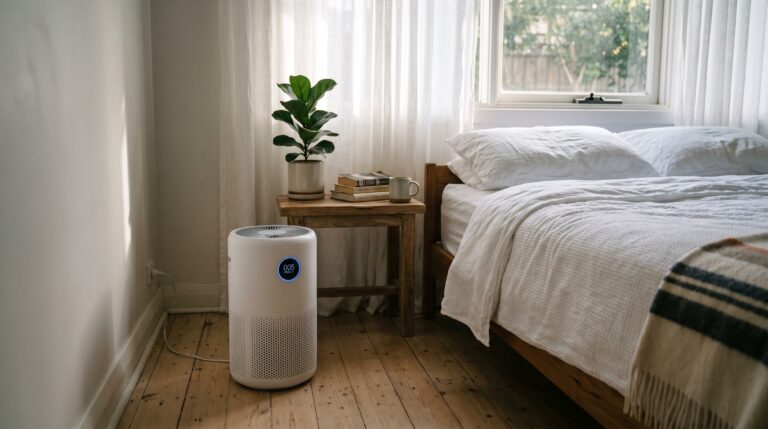
The clean air room strategy is your most important tactic. When PM2.5 exceeds 100 µg/m³ outdoors, even a high-CADR purifier will struggle to keep a 40 m² open-plan living area at safe levels because of continuous infiltration. Instead, close off a single bedroom — roughly 12-16 m² — place the purifier inside, close the door, and seal the gap underneath with a rolled towel. A purifier rated at 400+ CADR can cycle the air in a 15 m² room roughly every 3-4 minutes, keeping PM2.5 well below 25 µg/m³ even during hazardous outdoor conditions.
EPA AirWatch has monitoring stations at Alphington, Footscray, Brighton, Box Hill, Mooroolbark, and the CBD, among others. Check the station nearest your suburb — not the metro average. During the 2026 Otways event, western suburbs like Footscray and Altona recorded readings 30-50% higher than eastern suburbs like Box Hill due to wind direction, according to EPA station data. Your response should be based on your closest station, not a citywide number.
Knowing when to act is half the battle. The other half is having the right purifier for the job. Let’s break down exactly what filtration technology does and does not work against bushfire smoke particulates.
HEPA Filtration vs Bushfire Smoke: What the Specs Mean
Not all air purifiers work against bushfire smoke. Ionisers, ozone generators, and plasma-only units lack the physical barrier to capture PM2.5 at the volumes a smoke event produces. You need mechanical HEPA filtration — specifically H13 grade or higher — combined with activated carbon to address both particulates and volatile organic compounds (VOCs) present in bushfire smoke.
Here is the technical breakdown:
H13 HEPA media captures 99.97% of particles at 0.3 micrometres. This is the MPPS (most penetrating particle size) — the hardest size for the filter to catch. Particles both larger and smaller than 0.3 µm are captured at even higher rates. Bushfire smoke PM2.5 ranges from 0.1 to 2.5 µm, which falls squarely within H13 HEPA’s effective capture range. According to the US EPA’s “Guide to Air Cleaners in the Home” (2nd edition, 2018), true HEPA filters are the most effective portable technology for reducing indoor PM2.5 during wildfire events.
Activated carbon addresses the chemical component. Bushfire smoke is not just particles — it contains carbon monoxide, formaldehyde, benzene, acrolein, and dozens of other VOCs. While carbon monoxide requires ventilation (no consumer filter removes CO effectively), the heavier VOCs that cause eye irritation, headaches, and that persistent smoke smell are adsorbed by activated carbon. A purifier with only HEPA and no carbon stage will reduce particulates but leave you breathing VOCs. For bushfire smoke specifically, you need both stages.
CADR (Clean Air Delivery Rate) is the spec that matters most. CADR tells you how many cubic metres of clean air the unit delivers per hour, tested to ANSI/AHAM AC-1. For bushfire smoke protection, you need a CADR that cycles your room volume at least 4-5 times per hour. Here is the formula:
Required CADR = Room area (m²) × ceiling height (m) × 5 air changes per hour
Example: 20 m² room × 2.7 m ceiling = 54 m³ × 5 = 270 m³/h minimum CADR
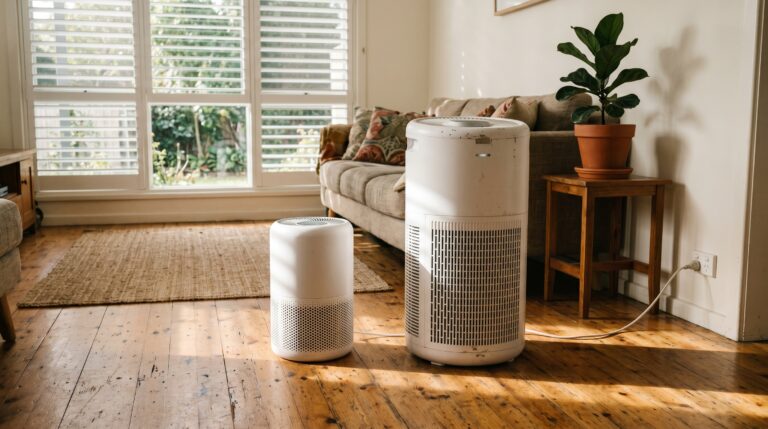
Most Melbourne homes have standard 2.7 m ceilings. For a typical bedroom (15 m²), you need roughly 200 m³/h CADR. For a living area (30-40 m²), you need 400-540 m³/h. Running below these thresholds during a smoke event means the purifier cannot keep up with infiltration — PM2.5 drops, but never reaches safe levels.
What Does NOT Work Against Bushfire Smoke
Ionisers alone charge particles and cause them to stick to surfaces. They do not remove particles from the air — they deposit them on your walls, furniture, and lungs. Some also generate ozone as a byproduct, which is itself a respiratory irritant. The California Air Resources Board (CARB) requires ozone emissions testing for all air purifiers sold in California, and several ioniser-only units have failed. Avoid ioniser-only devices.
“HEPA-style” or “HEPA-type” filters are not true HEPA. They may capture 85-95% of particles at larger sizes but fall off sharply below 1 µm — exactly where the most dangerous bushfire smoke particles sit. Look for “H13 HEPA” or “True HEPA” with a specific efficiency claim (99.97% at 0.3 µm). If the listing does not state the grade, assume it is not H13.
Carbon-only units (like some desktop “air fresheners”) remove odours and some VOCs but do zero for particulates. During a smoke event, PM2.5 is the primary health threat. Carbon without HEPA is the wrong tool.
Now that you know what technology works, let’s compare the three best purifiers for Melbourne homes — with the specs, costs, and room coverage that matter for bushfire season.
Best Air Purifiers for Melbourne Bushfire Smoke: Head-to-Head
I have narrowed this to three units that meet the non-negotiable criteria: H13 HEPA, activated carbon stage, CADR above 250 m³/h, and availability on Amazon AU. Each one suits a different room size and budget. If you are in Footscray, Altona, or the western suburbs that cop smoke first during an Otways event, you need the highest CADR you can afford. If you are in Box Hill, Mooroolbark, or the eastern suburbs where readings are typically lower, the mid-range options serve you well.
| Specification | Breville Protect Max | Levoit Core 400S | Winix Zero Pro |
|---|---|---|---|
| HEPA Grade | H13 (99.97% at 0.3 µm) | H13 (99.97% at 0.3 µm) | H13 (99.97% at 0.3 µm) |
| CADR | 550 m³/h | ~400 m³/h | ~390 m³/h |
| Room Coverage (5 ACH) | ~40 m² | ~30 m² | ~29 m² |
| Activated Carbon | Yes — integrated carbon layer | Yes — activated carbon pre-filter | Yes — carbon + PlasmaWave |
| Noise (lowest setting) | ~24 dB | ~24 dB | ~27 dB |
| Smart Controls | App + auto sensor | VeSync app + Alexa/Google | Auto mode sensor |
| Best For | Open-plan living, worst smoke zones | Bedrooms, value buyers | Mid-size rooms, hands-off operation |
Breville Protect Max — Best Overall for Melbourne Smoke Events
At 550 CADR, this is the highest clean air delivery rate available in a consumer purifier under $700 in Australia. For a 40 m² open-plan Melbourne living area — the kind you find in every post-2000 townhouse and apartment in Southbank, Richmond, or Brunswick — this unit achieves 5 air changes per hour without running at maximum. During the 2026 Otways event, that is the difference between a living room at 120 µg/m³ (dangerous) and one at 15 µg/m³ (safe).
The integrated carbon layer handles the VOC component — formaldehyde, benzene, and the acrid smoke smell that lingers even after particulates drop. At 24 dB on its lowest setting, it is quieter than a whisper, which matters because during a multi-day smoke event like the Otways fire, your purifier runs 24/7. You sleep with it running. It needs to be silent.
The catches: replacement filters are not cheap, and during a heavy smoke season you will burn through them faster than the 12-month rated life. Expect 6-8 months of effective filter life if you run the unit continuously through October-March in a bad season. Factor in one extra replacement filter per smoke season at roughly $80-120. Even so, the total annual cost is a fraction of the health cost of unfiltered PM2.5 exposure.
Levoit Core 400S — Best Value Pick
The Levoit Core 400S delivers roughly 70% of the Breville’s CADR at a significantly lower price. For a dedicated clean air room — a bedroom of 15-20 m² where you seal the door and concentrate filtration — this unit is more than sufficient. It achieves 5+ air changes per hour in a 15 m² room with headroom to spare.
The VeSync app integration lets you monitor air quality remotely and set schedules. During a smoke event, you can turn it to maximum before you get home so the room is already clean when you arrive. Compatible with Alexa and Google Home. The H13 HEPA and carbon pre-filter handle the same particulate and VOC spectrum as the Breville — the difference is room coverage, not filtration quality.
If you are in the eastern suburbs — Box Hill, Ringwood, Mooroolbark — where smoke readings run 30-50% lower than the western corridor during Otways-direction events, this unit in a clean air room gives you safe PM2.5 levels without the higher spend.
Winix Zero Pro — Solid Mid-Range
The Winix Zero Pro sits between the other two on CADR and adds PlasmaWave technology, which Winix claims breaks down VOCs at a molecular level without producing harmful ozone. Independent testing by CARB has confirmed the Winix PlasmaWave units comply with California’s 0.05 ppm ozone emission limit. The auto-mode sensor adjusts fan speed based on detected particulate levels — useful during a smoke event when outdoor readings fluctuate with wind direction.
At ~390 CADR, room coverage is similar to the Levoit but in a larger physical unit with more filter surface area, which may extend filter life during heavy smoke periods. A reasonable choice for medium-sized living rooms (25-30 m²) in suburbs that receive moderate rather than peak smoke loading.
Our Top Picks for Melbourne Bushfire Smoke
Filter Replacement During Smoke Season: The Hidden Cost
Here is the fact that no competitor covers: a HEPA filter rated for 12 months of normal use may last only 6-8 months during a heavy Melbourne bushfire season. When your purifier runs on high for 8-16 hours a day during multi-day smoke events, the filter media loads with particulate at 3-5 times the normal rate. A grey, clogged filter does not just reduce airflow — it reduces the effective CADR, meaning your purifier falls below the air-change threshold needed to keep PM2.5 in safe range.
You can monitor this without guessing. Most H13 HEPA units track cumulative runtime and alert you when the filter approaches end of life. The Breville Protect Max has a filter-life indicator. The Levoit app shows filter percentage remaining. When you see the indicator hit 80% used mid-season, order the replacement immediately. During the Black Summer fires of 2019-2020, replacement HEPA filters sold out across Australia within days of the worst smoke events reaching Sydney and Melbourne. Supply chain delays meant some households ran exhausted filters for weeks.
Order your replacement filter before smoke season starts. October is the beginning of the Victorian bushfire season. By November, demand spikes. Have a spare on the shelf by September.
| Purifier | Filter Cost (Approx.) | Rated Life (Normal) | Expected Life (Heavy Smoke) | Annual Filter Cost (Smoke Season) |
|---|---|---|---|---|
| Breville Protect Max | ~$100-120 | 12 months | 6-8 months | ~$150-200 |
| Levoit Core 400S | ~$60-80 | 6-8 months | 4-6 months | ~$120-160 |
| Winix Zero Pro | ~$80-100 | 12 months | 6-8 months | ~$120-180 |
Even at $200/year for replacement filters on the Breville, you are paying roughly $0.55/day for clean indoor air during the months that matter most. Compare that to the cost of a single asthma-related ED visit or a week of lost productivity from smoke-related headaches and fatigue.
Melbourne Smoke Season Timeline: When to Be Ready
Victoria’s bushfire season officially runs from October to March, but the reality is more nuanced. Melbourne’s worst smoke events in recent years have clustered in two windows:
Late November to mid-January: Hot, dry northerly winds push fire conditions across Gippsland, the Grampians, and the Otways. The January 2026 Otways event fell in this window. The Black Summer fires of December 2019 through January 2020 produced Melbourne’s worst sustained smoke exposure in recorded history, with PM2.5 readings exceeding 500 µg/m³ at some stations according to EPA Victoria data.
Late February to March: Autumn prescribed burns and residual fire activity generate lower-intensity but persistent smoke haze. These events typically produce PM2.5 of 30-80 µg/m³ — not emergency-level, but above NEPM safe thresholds and enough to trigger symptoms in sensitive individuals (asthma, COPD, children, elderly).
Your preparation calendar should look like this:
| Month | Action |
|---|---|
| August-September | Order replacement HEPA filter. Check purifier operation. Identify your clean air room. Download EPA AirWatch app. |
| October | Fire season begins. Set AirWatch alerts for your nearest station. Ensure P2/N95 masks are in stock at home. |
| November-January | Peak risk window. Monitor daily. Run purifier continuously during smoke events. Keep windows and doors sealed. |
| February-March | Prescribed burn haze period. Monitor EPA readings. Run purifier when PM2.5 exceeds 25 µg/m³. |
| April | Season end. Check remaining filter life. Clean pre-filter. Store purifier if desired or run year-round for pollen and mould. |
Bushfire smoke season is the argument that closes this purchase for Melbourne households. You cannot control when the next Otways event happens, but you can control the air inside your bedroom when it does.
Beyond Purifiers: 5 Steps to Seal Your Melbourne Home Against Smoke
A HEPA purifier is your primary defence, but it works harder than it should if your home leaks like a sieve. Every gap that admits outside air forces the purifier to work against continuous infiltration. These five steps reduce that infiltration load and make your purifier dramatically more effective:
1. Seal gaps under external doors. A standard Melbourne front door has a 5-10 mm gap at the bottom. During a smoke event, use a rolled wet towel or a purpose-built door draft stopper. This single step can reduce infiltration by 20-30% in a typical home.
2. Tape bathroom and kitchen exhaust fans. Rangehood and bathroom exhaust ducts are direct channels to outside air. During a smoke event, tape over the interior grille with painter’s tape (easy to remove, no wall damage). Do not use the rangehood — it pulls smoky air inside.
3. Close fireplace dampers. Many older Melbourne homes in suburbs like Hawthorn, Kew, and Northcote have open fireplaces with poorly sealed dampers. A fireplace is an open chimney — a direct conduit for smoky air. Close the damper fully or block the opening with a fireplace blanket or damp sheet.
4. Check evaporative cooling. Evaporative coolers — common in Melbourne homes built before ducted refrigerated air became standard — pull outside air in by design. During a smoke event, running your evaporative cooler is actively pumping PM2.5 into your home. Switch it off. Use fans or split-system air conditioning (which recirculates indoor air) instead. If you have ducted refrigerated air conditioning with a return-air filter, check that the filter is clean — it provides some (limited) particulate reduction.
5. Create positive pressure in your clean air room. If you have a split-system air conditioner in your bedroom, run it on recirculate mode with the purifier inside and the door sealed. The purifier cleans the air; the split system cools it. This combination keeps PM2.5 low and temperature comfortable during a multi-day event when opening windows is impossible.
Final Verdict: What Melbourne Households Should Buy
If you live in Melbourne and you do not own a H13 HEPA air purifier, every bushfire smoke event delivers PM2.5 directly into your lungs for hours or days at a time. The NEPM standard is 25 µg/m³ over 24 hours. Melbourne smoke events routinely hit 100-300+ µg/m³. Your home, unsealed, reaches 50-80% of outdoor levels. That is not speculation — it is measurement.
For most Melbourne homes, the Breville Protect Max is the clear pick. At 550 CADR, it covers 40 m² at 5 air changes per hour — enough for the open-plan living areas that dominate Melbourne housing stock from inner-city apartments to suburban townhouses. It is the most capable consumer HEPA unit available on Amazon AU at its price point. If your budget is tighter or you are building a clean air room in a single bedroom, the Levoit Core 400S delivers H13 HEPA performance at a lower cost and covers 15-20 m² with headroom.
Do not wait for the smoke to arrive. Stock sells out during events. Order before September. Have a replacement filter on the shelf. Know your nearest EPA AirWatch station. Identify your clean air room now, while the sky is blue.
The worst outcome: you buy it, the smoke season is mild, and you have a quiet air purifier that handles pollen and mould spores year-round. The more likely outcome: the next Otways event rolls in, and your family breathes clean air while your neighbours do not.
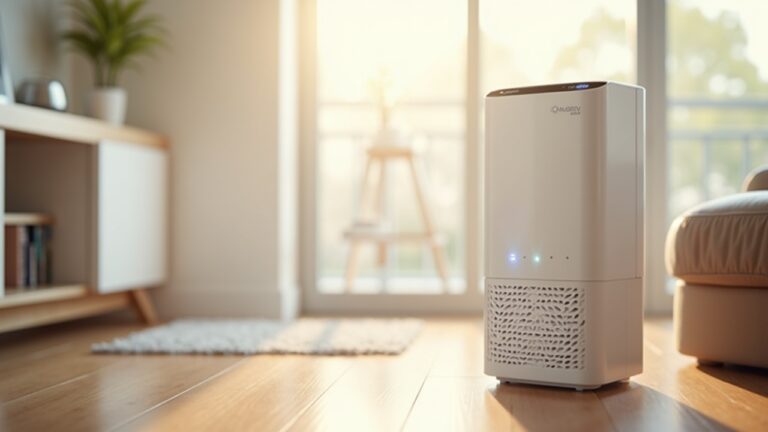
The Breville Protect Max is the benchmark air purifier for Melbourne bushfire smoke.
550 CADR, H13 HEPA, activated carbon stage, and room coverage that handles 40 m² open-plan living. Available on Amazon AU with fast delivery — order before October to beat smoke-season stock shortages.
Last reviewed: July 2026 — Clean and Native
Frequently Asked Questions
Melbourne uses free chlorine for disinfection, managed through Melbourne Water’s Yarra Valley and other catchment systems. Standard carbon filters work effectively for chlorine taste and odour removal in Melbourne. This is separate from air quality, but relevant if you are upgrading household health systems alongside a purifier. See our best water filter for Melbourne guide for details.
Individual smoke events in Melbourne typically last 2-5 days depending on wind direction, fire intensity, and weather patterns. The January 2026 Otways event lasted multiple consecutive days according to ABC News reporting. During the 2019-2020 Black Summer, Melbourne experienced intermittent smoke for several weeks across December and January.
A split-system (refrigerated) air conditioner recirculates indoor air and provides minimal filtration through its return-air filter, but it is not designed to capture PM2.5. It will not reduce particulate levels meaningfully. An evaporative cooler actively pulls outside air in and must be switched off during smoke events. Use a HEPA purifier as the primary defence, and a split-system on recirculate mode for cooling only.
The NEPM 24-hour average standard is 25 µg/m³. The WHO guideline is stricter at 15 µg/m³ (24-hour) and 5 µg/m³ (annual average). According to WHO evidence reviews, there is no known safe threshold for PM2.5 exposure. During Melbourne bushfire events, outdoor PM2.5 commonly reaches 100-300+ µg/m³ — four to twelve times the NEPM daily limit.
A minimum of 5 air changes per hour (ACH) is recommended for effective PM2.5 reduction during bushfire smoke. Calculate required CADR as: room area (m²) × ceiling height (m) × 5. For a 15 m² bedroom with 2.7 m ceilings, that is approximately 200 m³/h CADR. For a 35 m² living room, approximately 470 m³/h.
HEPA media captures particulates only. The smoke smell comes from volatile organic compounds (VOCs) like formaldehyde, benzene, and acrolein. You need an activated carbon stage in addition to HEPA to adsorb these VOCs. All three purifiers recommended in this article — Breville Protect Max, Levoit Core 400S, and Winix Zero Pro — include activated carbon filtration alongside H13 HEPA.
Yes. A P2 mask (equivalent to N95) filters 94%+ of particles at 0.3 µm and protects you when you must go outdoors during a smoke event — collecting mail, brief errands, walking the dog. Your HEPA purifier protects indoor air. A P2 mask protects you during the minutes or hours you cannot avoid outdoor exposure. Stock P2 masks before October — they sell out during smoke events.
Victoria’s EPA AirWatch (epa.vic.gov.au) publishes real-time PM2.5 and AQI data from monitoring stations across metro Melbourne, including Alphington, Footscray, Brighton, Box Hill, and Mooroolbark. Check the station nearest your suburb for the most accurate local reading. During a bushfire event, western suburbs may read 30-50% higher than eastern suburbs depending on wind direction.
Under normal use, most H13 HEPA filters last 6-12 months. During heavy bushfire smoke exposure, filter life drops to 4-8 months because particulate loading runs at 3-5 times the normal rate. Monitor your purifier’s filter life indicator and order a replacement when it reaches 80% used. Order replacement filters before October to avoid smoke-season stock shortages.
Dyson purifier models with H13 HEPA filters (such as the Purifier Big Quiet BP04) can capture PM2.5 effectively. However, Dyson units typically have lower CADR relative to their price compared to dedicated HEPA purifiers like the Breville Protect Max. CADR per dollar spent is the metric that matters during a smoke event. Check the CADR specification, not the brand name — if a Dyson model does not publish CADR to AHAM AC-1, you cannot verify its performance against the room coverage you need.
Get the Australian Home Environment Checklist
30 checks across water, air and EMF. Most of them free. Ranked by impact.
No spam. Unsubscribe any time.

Former Royal Australian Navy Clearance Diver and TAG-E counter-terrorism operator. Founded Clean and Native to apply the same rigorous thinking to the home environment.
Full biography →