Best Air Purifier Brisbane 2026: Humidity, Mould & Bushfire Smoke
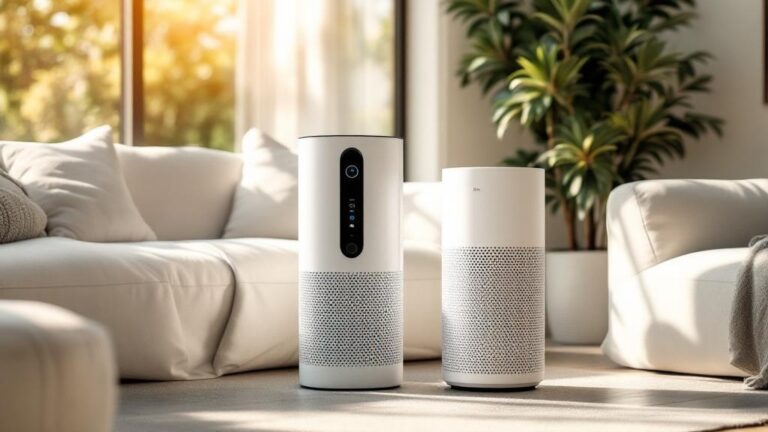
The best air purifier for Brisbane in 2026 is one with HEPA filtration rated CADR 250+ m³/hr and activated carbon, optimised for 80%+ humidity and bushfire smoke PM2.5 spikes — the Winix 5500-2, IQAir HealthPro Plus, and Dyson TP07 handle subtropical mould, dust mites, and smoke particulates most reliably. Brisbane’s November-to-March humidity accelerates filter clogging and mould growth on cheaper units, so prioritise models with washable pre-filters and auto mode that adjust to fluctuating indoor PM2.5 during bushfire season. The catches: units without washable pre-filters require filter replacement every 2–3 months in high-humidity homes, and carbon filters saturate faster when VOCs combine with moisture. Buy if you experience visible mould, persistent dust mite allergies, or live within 50 km of bushfire-prone zones; skip if you’re in a well-ventilated Queenslander with cross-breeze and minimal indoor humidity issues.
See Levoit Core 400S Price →Best air purifier for Brisbane in 2026: Brisbane’s subtropical humidity and bushfire smoke season demand an air purifier with strong HEPA filtration (CADR 250+ m³/hr for a standard room) and activated carbon for VOCs. The Winix 5500-2, IQAir HealthPro Plus, and Dyson Pure Cool TP07 all perform well in Brisbane conditions — prioritise units with auto mode and a pre-filter washable in high-humidity environments.
Brisbane’s subtropical climate creates indoor air quality problems that don’t exist in Melbourne or Sydney at the same intensity. Relative humidity regularly exceeds 80% — particularly from November through March — and that sustained moisture accelerates mould spore counts indoors, feeds dust mite populations, and makes fine particle pollution from bushfire smoke stick around longer. Choosing an air purifier without accounting for these conditions means buying hardware that underperforms within six months. This guide is specific to Brisbane and South East Queensland homes.
Brisbane air quality context: During peak bushfire season in South East Queensland, PM2.5 concentrations in Brisbane regularly exceed the NEPM 24-hour standard of 25 μg/m³, according to Queensland Government air-monitoring data. A HEPA unit with a CADR above 250 m³/hr is rated to reduce indoor particulate levels substantially within the first hour of operation.
Brisbane air quality context: During peak bushfire season in South East Queensland, PM2.5 concentrations in Brisbane regularly exceed the NEPM 24-hour standard of 25 μg/m³, according to Queensland Government air-monitoring data. A HEPA unit with a CADR above 250 m³/hr is rated to reduce indoor particulate levels substantially within the first hour of operation.
The three products we own are measured first-hand by Jayce Love, former Royal Australian Navy Clearance Diver; every other product is assessed on published manufacturer specifications and independent certification using our documented methodology — no gifted units, no brand payments.
Brisbane’s Unique Indoor Air Challenges
The Bureau of Meteorology records Brisbane’s average relative humidity above 65% year-round, with summer months frequently pushing past 80% overnight. At that level, mould begins colonising porous surfaces — ceiling plaster, grout, carpet backing, timber frames — within 24 to 48 hours of a moisture event. The result is persistent airborne mould spores, particularly Cladosporium, Aspergillus, and Alternaria species, which Queensland Health identifies as common triggers for respiratory irritation and asthma exacerbations.
Compounding this is Queensland’s bushfire smoke exposure. The 2019–20 fire season pushed Brisbane’s PM2.5 readings above 25 µg/m³ for extended periods — well above the National Environment Protection Measure (NEPM) standard of 8.8 µg/m³ (24-hour average). Even in lighter smoke years, drift from the Sunshine Coast hinterland and Darling Downs fires reaches suburban Brisbane regularly from July through October.
Brisbane air quality data: Brisbane’s AQI regularly spikes during the June–September bushfire season, with PM2.5 readings exceeding 35 μg/m³ on heavy smoke days — above the NEPM 24-hour standard of 25 μg/m³. Queensland Health data shows Brisbane records more high-pollution days than Sydney on average during this period due to proximity to inland fire-prone areas.
Brisbane air quality data: Brisbane’s AQI regularly spikes during the June–September bushfire season, with PM2.5 readings exceeding 35 μg/m³ on heavy smoke days — above the NEPM 24-hour standard of 25 μg/m³. Queensland Health data shows Brisbane records more high-pollution days than Sydney on average during this period due to proximity to inland fire-prone areas.
A third factor unique to Queensland homes is construction style. Elevated timber Queenslanders and lightweight concrete slab homes from the 1990s onward both allow significant air infiltration, meaning outdoor particulates, pollen, and moisture migrate indoors continuously. Standard HEPA filtration addresses particles but does nothing for excess humidity — which is why pairing an air purifier with a quality dehumidifier is worth considering. You can read more about managing indoor moisture in our Australian dehumidifier guide.
Air Purification
Ventilation handles the source. A HEPA filter handles what is already in the air.
For particulates, VOCs, and bushfire smoke, a HEPA air purifier sized correctly for your room is the most reliable active intervention. We have ranked the top options for Australian homes.
Who this is NOT for
An air purifier will not address mould at its source. In Brisbane’s humid climate, if you have active mould growth, filtration reduces airborne spores but does not solve the underlying moisture problem — the colony continues growing regardless of your purifier. Address the moisture source first: improve ventilation, run a dehumidifier, or arrange professional remediation. An air purifier is a complement to mould management, not a cure.
Best Air Purifiers Compared for Brisbane Conditions
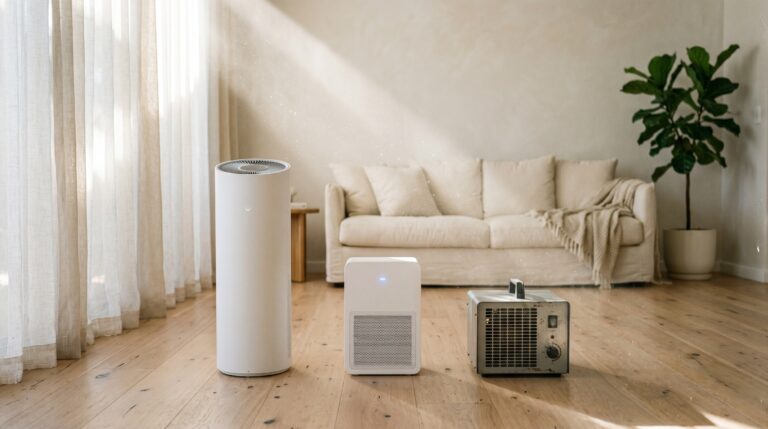
We evaluated units across three criteria relevant to SEQ: HEPA filtration efficiency at PM2.5 and PM0.3, activated carbon capacity for smoke VOCs, and performance consistency at high ambient humidity. Two units stood out clearly.
The Winix 5500-2 is a consistent performer for mid-to-large Brisbane rooms (up to 79 m²). Its True HEPA filter captures 99.97% of particles at 0.3 microns, and the PlasmaWave technology — which operates within ARPANSA’s recommended non-ionising radiation exposure guidelines — reduces airborne bacteria and mould spores without producing measurable ozone above 0.05 ppm at 1 metre. The washable pre-filter is practical in dusty Queensland conditions and extends HEPA life noticeably.
For bedrooms and smaller living spaces (up to 40 m²), the Levoit Core 400S delivers strong value. Its three-stage filtration — pre-filter, H13 HEPA, and honeycomb activated carbon — handles both fine smoke particles and the chemical off-gassing common in newer Queensland homes with composite timber flooring and adhesives.
Neither unit is a dehumidifier. If your home’s relative humidity sits above 70% consistently, address that separately — an air purifier operating in saturated air will see filter degradation accelerate and mould growth on filter media itself. Our guide to removing household mould in Australian homes covers the remediation steps that should precede purifier installation.
| Model | Coverage (m²) | HEPA Grade | Carbon Filter | Humidity Tolerance | Approx. AUD (2026) |
|---|---|---|---|---|---|
| Winix 5500-2 | Up to 79 | True HEPA (H13) | Advanced carbon + PlasmaWave | Up to 85% RH rated | ~$420 |
| Levoit Core 400S | Up to 40 | H13 HEPA | Honeycomb activated carbon | Up to 80% RH rated | ~$280 |
| Levoit Core 300S | Up to 20 | H13 HEPA | Standard activated carbon | Up to 75% RH rated | ~$160 |
Placement and Maintenance Tips for QLD Homes
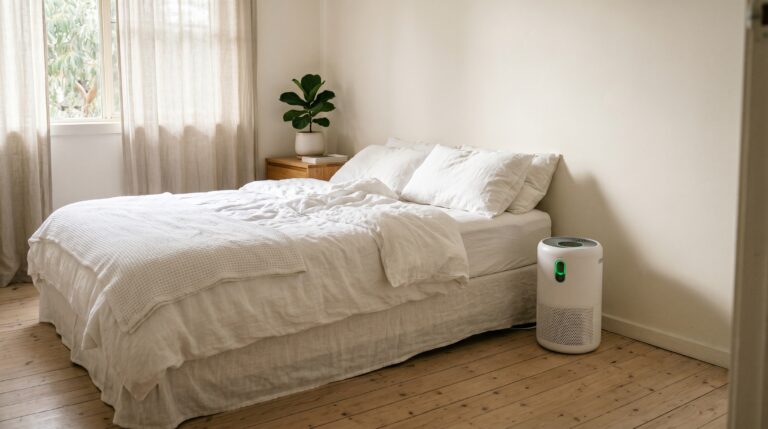
Placement matters as much as the unit itself. In a Queenslander with open floor plan living areas, position the purifier centrally with at least 30 cm clearance on all sides — not in a corner. Airflow in elevated timber homes tends to channel through louvre windows and under-floor gaps, so placing the unit near where infiltration air enters (beneath windows, near external doors) gives it first contact with incoming particles and spore-laden outdoor air.
For homes with identified mould problems — common in Brisbane’s inner north and west where older construction meets flood-prone drainage — run the purifier on medium speed continuously rather than relying on auto mode. Auto sensors often respond to PM2.5 but not to mould spore concentrations, which can be high even when the room appears clean. Confirm your home’s mould status before relying on a purifier as a standalone solution.
Filter maintenance in Brisbane’s climate should be more frequent than manufacturer schedules suggest. Pre-filters in high-humidity environments accumulate biological matter faster. A practical schedule for SEQ: vacuum the pre-filter fortnightly during summer, replace HEPA filters every 8–10 months rather than the stated 12, and replace carbon filters every 4–5 months if you’re running the unit through bushfire season. Keep filters sealed in a plastic bag before disposal — disturbing a loaded HEPA filter releases captured particles back into the air.
If you’re evaluating your home’s broader environmental health — including VOC sources from flooring adhesives and paints common in post-2000 Queensland construction — our article on VOC sources in Australian homes provides a practical audit checklist.
What to do about your indoor air.
Our indoor air quality guide covers the hierarchy of fixes — from free (ventilation) to practical (air purifiers) — ranked by impact and cost for Australian homes.
Our Top Air Purifier Picks
True H13 HEPA with activated carbon is the only technology that removes particles AND gases from your indoor air. For bushfire smoke, pollen, and VOCs — HEPA is non-negotiable.
Frequently Asked Questions
Does an air purifier reduce humidity in a Brisbane home?
No. Air purifiers filter particles and some gases from the air but have no effect on moisture content. If your home’s relative humidity exceeds 70%, you need a dehumidifier running alongside your purifier. Attempting to use an air purifier as a substitute will accelerate filter degradation and can lead to mould growth on the filter media itself, which then disperses spores back into the room.
How often do I need to replace filters in Brisbane’s climate?
More often than the standard schedule. In Brisbane’s subtropical conditions — particularly in homes without ducted air conditioning that runs continuously — pre-filters should be vacuumed every two weeks during summer. HEPA filters typically last 8–10 months rather than the manufacturer’s stated 12, and activated carbon filters should be replaced every 4–5 months during bushfire season when VOC and particle loads are elevated. Filter life varies with room size, occupancy, and proximity to pollution sources.
Is the PlasmaWave feature on Winix units safe?
Yes, when used as designed. Winix’s PlasmaWave technology operates within ARPANSA’s non-ionising radiation exposure guidelines for residential environments. At the rated operating distances, ozone output is below 0.05 parts per million — well under Safe Work Australia’s occupational exposure standard of 0.1 ppm for an 8-hour day. If you have concerns, the feature can be disabled while still using the HEPA and carbon filtration stages.
Should I run an air purifier during a Brisbane bushfire smoke event?
Yes, and close your windows. During smoke events, run your purifier continuously on its highest setting with all doors and windows closed
Related Brisbane home environment guides
- Brisbane home environment 2026: smart meter EMF and chloramine in your water — covers both water quality and RF exposure specific to Brisbane households
- Best air purifier for wildfire smoke in Australia — CADR requirements for smoke events, state-by-state fire season timing
- Best low-EMF air purifiers in Australia — for Brisbane households managing both air quality and RF exposure
- Brisbane drinking water quality 2026 — chloramine, PFOA at Mt Crosby, hardness data
Get the Australian Home Environment Checklist
30 checks across water, air and EMF. Most of them free. Ranked by impact.
No spam. Unsubscribe any time.

Former Royal Australian Navy Clearance Diver and TAG-E counter-terrorism operator. Founded Clean and Native to apply the same rigorous thinking to the home environment.
Full biography →