HEPA Certification Explained: H11 vs H12 vs H13 vs H14 — What the Numbers Mean for Australian Homes
Drafted with AI assistance and checked against published specifications and certifications. First-hand measurements appear only where stated. How we make content
Only H13 and H14 are certified to hospital-grade filtration standards under EN 1822. “HEPA-type,” “HEPA-style,” and ungraded “HEPA” products have no certified minimum efficiency and may perform as poorly as 78% — meaning 22 in every 100 fine particles pass straight through. For PM2.5 during bushfire season, allergy management, or any indoor air quality concern, H13 is the minimum acceptable grade.
| Grade | Efficiency at MPPS | Particles per 100 that pass | Verdict |
| HEPA-type | Not tested | Up to 22+ | Avoid |
| H11 | ≥95% | 5 per 100 | Too low for health |
| H12 | ≥99.5% | 0.5 per 100 | Acceptable minimum |
| H13 | ≥99.95% | 0.05 per 100 | Recommended |
| H14 | ≥99.995% | 0.005 per 100 | Medical-grade overkill for homes |
H13 is the only HEPA grade you should accept in an Australian home. That statement cuts through more confusion than any other on this topic — because in Australia, “HEPA” on a box means nothing. There is no government certification requirement, no consumer protection standard, and no enforcement body. Any manufacturer can print the word “HEPA” on a filter with 78% efficiency and sell it legally. This guide explains what EN 1822 actually certifies, why the grade number (H11, H12, H13, H14) is the only thing that matters, and how to verify you are getting genuine H13 performance before you buy. I’m Jayce Love, a former Royal Australian Navy Clearance Diver who tests air purifiers from Palm Beach, QLD using documented measurement methodology. I have not personally tested the specific air purifiers recommended on this page (Levoit, Breville, Winix, Dyson); this assessment is based on published manufacturer specifications and independent certification, not first-hand measurement. The only products I measure first-hand are the EcoHero 5-Stage RO water filter, the TriField TF2 EMF meter, and the Coway Airmega 150 air purifier.
What Makes a Filter “True HEPA”? The EN 1822 Standard
“HEPA” stands for High Efficiency Particulate Air — a classification system, not a brand or a material. The standard that defines HEPA in Australia and globally is EN 1822-1:2009, published by the European Committee for Standardisation (CEN). Australia’s Standards Australia framework references EN 1822 as the applicable standard for high-efficiency air filtration, making it the de facto benchmark for any air purifier claiming HEPA performance in the AU market.
EN 1822 defines a graded scale from E10 to U17, covering basic efficiency filters all the way to ultra-low penetration air (ULPA) filters used in nuclear facilities. The consumer-relevant grades are H11, H12, H13, and H14. Each grade requires the filter to be independently tested at its Most Penetrating Particle Size (MPPS) — the particle diameter at which that specific filter is hardest to capture. For most HEPA media, MPPS falls between 0.1 and 0.3 microns depending on the fibre diameter and airflow velocity through the filter.
This is a more rigorous approach than the older ASHRAE 52.2 standard used in North American products, which tests at a fixed 0.3 micron particle size. A filter can pass the ASHRAE test while performing worse at 0.15 microns — its actual MPPS. EN 1822 finds the worst-case particle size first, then tests there. If a purifier is sold in the Australian market citing only “99.97% at 0.3 microns,” it is referencing the ASHRAE threshold — which corresponds to approximately H13 performance, but without the EN 1822 scan test that checks for pinholes across the entire filter surface.
The HEPA Grading Scale: H11 to H14 in Plain Numbers
The EN 1822 grading table defines both an integral efficiency (whole-filter average) and a local efficiency (minimum single-point scan result). Both must be met for the filter to achieve a grade. A filter with H13 average efficiency but one pinhole exceeding the H13 local limit fails certification.
| Grade | Min Integral Efficiency | Min Local Efficiency | Max Penetration | Real-world Use |
|---|---|---|---|---|
| H11 | 95% | 95% | 5% | Budget air purifiers, vacuum exhaust filters |
| H12 | 99.5% | 99.5% | 0.5% | Some mid-range home purifiers |
| H13 | 99.95% | 99.75% | 0.05% | True HEPA home standard — PM2.5, smoke, allergens |
| H14 | 99.995% | 99.975% | 0.005% | Hospital theatres, ISO cleanrooms |
| U15–U17 | 99.9995%+ | 99.9975%+ | <0.0005% | Nuclear, semiconductor fabrication (ULPA) |
Source: EN 1822-1:2009, European Committee for Standardisation. Both integral and local efficiencies must be met. MPPS = Most Penetrating Particle Size.
The difference between H11 and H13 is not incremental — it is 100-fold in fine particle penetration. In a room with an AQI of 150 (unhealthy — common in Australian cities during heavy bushfire smoke events such as the 2019–20 season), the PM2.5 concentration reaches approximately 55 µg/m³. An H11 unit returning air to the room delivers 2.75 µg/m³ of PM2.5 per recirculation pass. An H13 unit delivers 0.028 µg/m³ per pass — 98 times less. Over 8 hours of sleep with the purifier running, this difference is clinically significant for asthma, cardiovascular health, and cognitive performance the following day.
H14 is technically superior to H13 but comes with practical penalties for home use: higher airflow resistance means the motor works harder at equivalent CADR, filter replacement costs more (H14 media is more expensive to manufacture), and the marginal improvement — capturing 0.045% more particles than H13 — is not meaningful in a residential setting. The correct target for Australian homes is H13. H14 is appropriate for hospital isolation rooms and pharmaceutical cleanrooms.
“HEPA-Type” Is Not HEPA — The Certification Loophole Costing Australians
“HEPA” is not a protected term in Australia. Any product can carry the word on its packaging without meeting any efficiency standard. “HEPA-type,” “HEPA-style,” “HEPA-like,” “advanced HEPA,” “99% HEPA,” and simply “HEPA filter” with no grade are all marketing terms with no defined minimum efficiency under Australian Consumer Law, EN 1822, or any other applicable standard. Units sold as “HEPA” in Australian retail channels have no certified efficiency floor, and independent testing has recorded such products performing as low as 78–90% efficiency at 0.3 microns — below H11, let alone H13.
The ACCC (Australian Competition and Consumer Commission) has the power to pursue misleading claims under the Australian Consumer Law where a product is described as having a performance characteristic it does not possess. However, because no minimum efficiency is defined for the word “HEPA” in Australia, the bar for a misleading claim is difficult to establish unless the manufacturer makes a specific efficiency promise it cannot meet. Until a minimum standard is legislated, the burden falls on consumers to verify grade claims independently.
Three phrases that confirm H13-grade performance when you see them on a product specification page: “H13 True HEPA,” “EN 1822 H13,” or “99.97% at 0.3 microns.” If none of those three phrases appear in the specification, the product’s HEPA claim is unverified and should be treated as marketing language. When in doubt, contact the brand and ask for their EN 1822 test certificate. A legitimate H13 product will have one on file from the factory or an accredited European laboratory.
How HEPA Filters Are Actually Tested: Inside an EN 1822 Certification Lab
Understanding the test protocol reveals both the strength of the H13 certification and its one important limitation. EN 1822 testing involves five steps, conducted by an accredited third-party laboratory:
- Filter mounting: The filter element is clamped into a duct at the face velocity it is designed to operate at (typically 0.01–0.05 m/s for H13 residential media). The duct replicates the filter’s intended flow direction and sealing conditions.
- MPPS determination: An aerosol of DEHS (di-ethyl-hexyl sebacate) or PAO (poly-alpha olefin) particles spanning 0.1–0.5 microns is introduced upstream. A photometer or particle counter measures downstream concentration at each particle size to identify the diameter with maximum penetration. This is the MPPS — it varies by filter construction.
- Integral efficiency measurement: The total aerosol upstream and downstream of the filter at MPPS is measured. This gives the whole-filter average efficiency (the “integral” result).
- Scan test: A narrow probe scans the entire downstream face of the filter at 5–6 cm/s in overlapping parallel passes. Any localised high-penetration zone — a pinhole from a manufacturing defect, a frame gasket leak, or a media tear — is recorded. The worst-case point must meet the grade’s local efficiency threshold.
- Grade assignment: Both integral and local results must meet the EN 1822 threshold. The lower of the two determines the actual grade. A filter cannot “average its way” to H13 if one scan point fails.
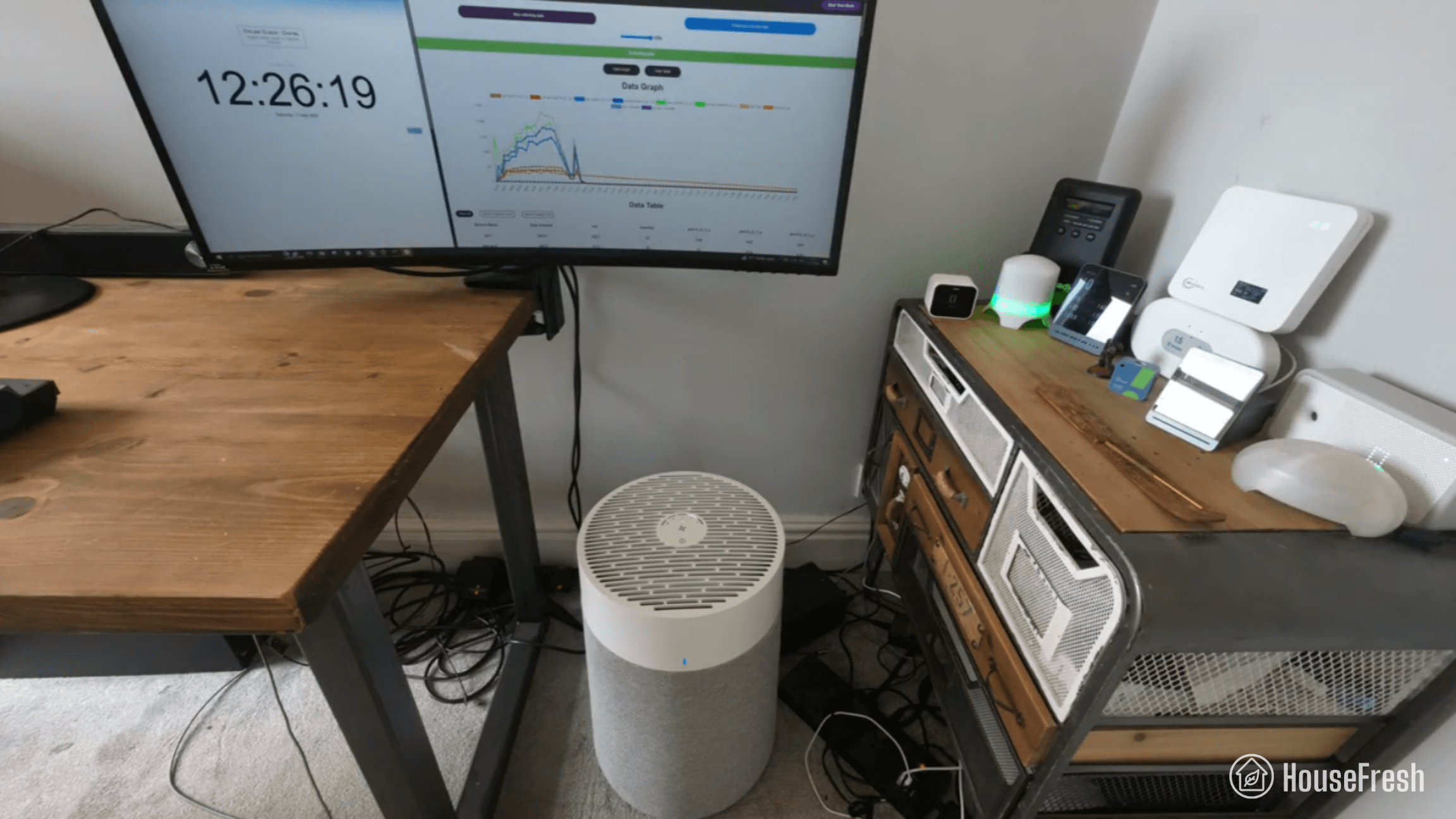
This protocol certifies the filter element, not the assembled air purifier. An H13-certified filter can be installed in a poorly-sealed housing that allows air to bypass the filter through frame gaps or loose gaskets. Filter bypass is not tested under EN 1822 — it requires assembled-unit testing with a particle counter in a real room. Third-party reviewers including HouseFresh, Wirecutter, and CHOICE all test assembled units, which is why their performance rankings sometimes differ from what the filter-only certification would predict.
For consumers, the most practical verification is to check whether a third-party reviewer has tested the specific assembled unit and reported PM2.5 removal performance. A well-sealed H13 unit should achieve 95%+ PM2.5 reduction in a room-sized test within 30 minutes at appropriate CADR for the room volume. If a unit achieves only 80–85% PM2.5 reduction despite claiming H13 filtration, filter bypass is the likely cause.
Reviewed and verified: H13 purifiers for Australian homes
Both have EN 1822 H13 filtration confirmed in third-party assembled-unit testing. Read our full breakdown of real-world CADR, noise, and running costs.
What H13 HEPA Actually Captures — and What It Cannot
H13 True HEPA removes ≥99.95% of particles at its MPPS (typically 0.1–0.3 microns). At larger particle sizes it performs even better. Below is the complete picture of what H13 captures in real Australian conditions — and critically, what it does not.
| Pollutant | Particle Size | H13 Efficiency | AU Relevance |
|---|---|---|---|
| PM2.5 (fine particles) | <2.5 µm | ≥99.95% | Bushfire smoke, traffic pollution |
| Bushfire smoke particles | 0.1–1 µm | ≥99.95% | Critical during fire season; carbon layer handles odour |
| Pollen | 10–100 µm | >99.99% | Spring season — Brisbane, Melbourne, Canberra |
| Mould spores | 1–30 µm | ≥99.97% | Coastal QLD/NSW homes; high humidity areas |
| Pet dander | 2.5–10 µm | ≥99.97% | Cats, dogs; pre-filter handles hair |
| Respiratory aerosols (viruses) | 0.5–5 µm | ≥99.95% | Virions travel on droplets; H13 captures the droplet |
| VOCs (formaldehyde, paint) | Gaseous molecule | Not captured | Requires activated carbon layer |
| Smoke odour | Gaseous | Particles: yes. Odour: no. | Carbon layer handles smell; HEPA handles particles |
| CO2 / carbon dioxide | Gaseous molecule | Not captured | Only ventilation reduces CO2. A purifier does not replace fresh air. |
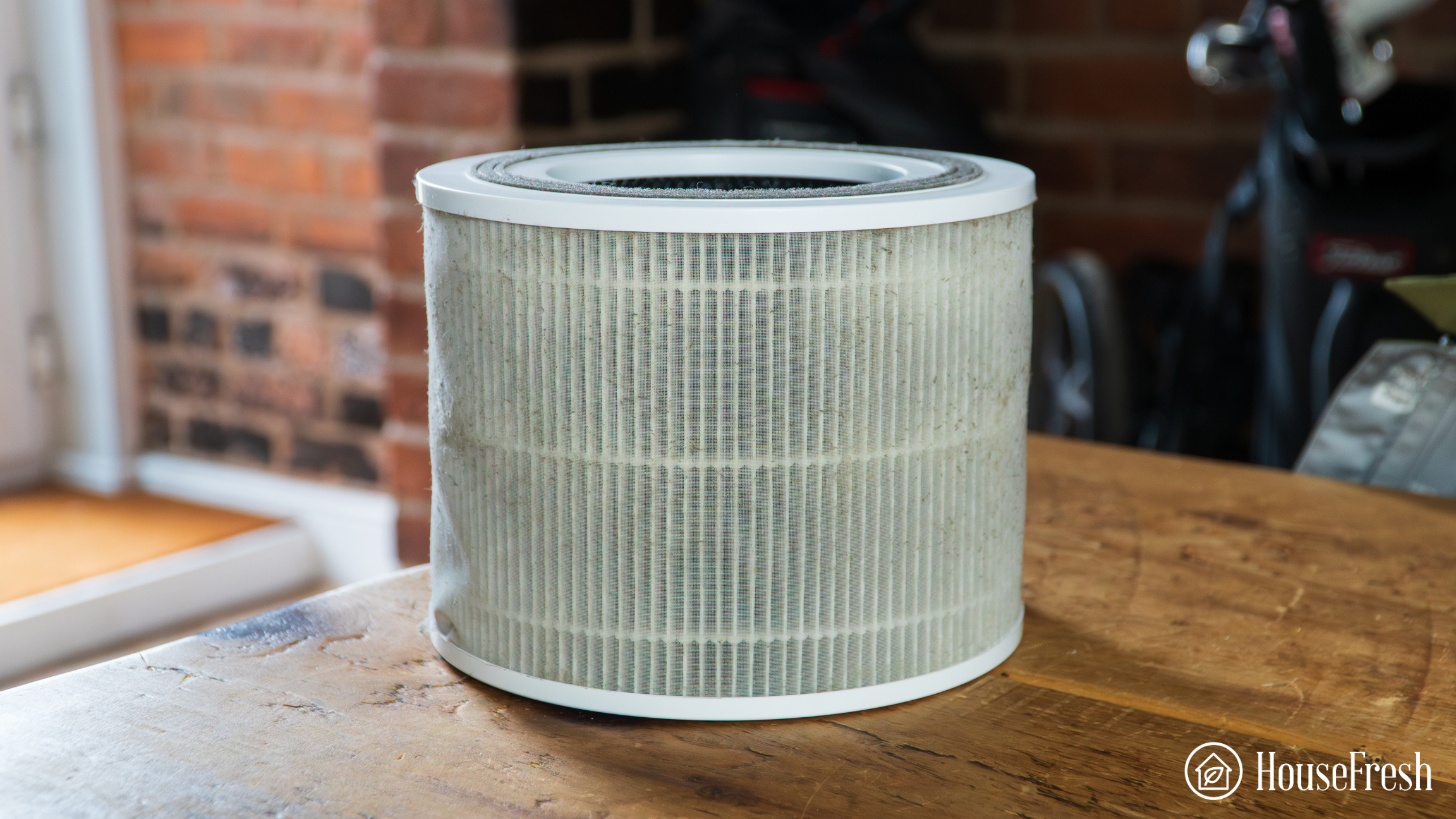
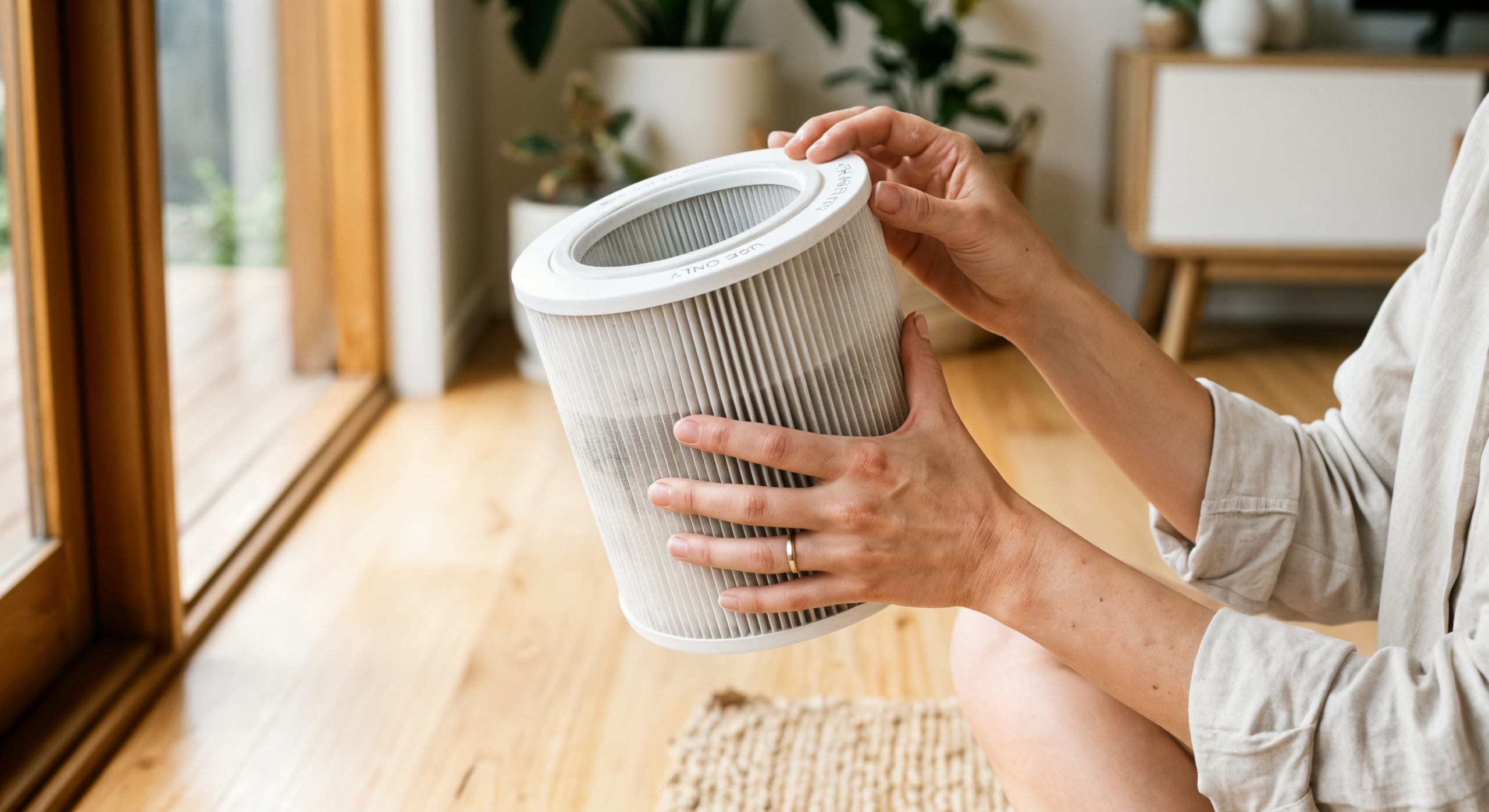
The used filter image above illustrates the practical reality of H13 filtration: what you see embedded in that filter media is what was removed from the air you breathe. An H11 filter running in the same home would have passed 5 in every 100 of those particles back into the room on each cycle. An ungraded “HEPA-type” unit might have passed 15–22 per 100.
H13 Air Purifiers on the Australian Market: What the Labels Actually Mean
The following brands and models publish H13 True HEPA claims backed by EN 1822 documentation or third-party assembled-unit testing. Coverage area figures use the clean air delivery rate (CADR) at 4.8 air changes per hour (ACH) — the realistic threshold for meaningful PM2.5 reduction, not the 1 ACH figure most manufacturers use for their box claims.
| Brand / Model | Claimed Grade | CADR (m³/h) | Effective Area @ 4.8 ACH | Price (AU) | Review |
|---|---|---|---|---|---|
| Levoit Core 300S | H13 | 258 | ~22 m² | ~$248 | Read review |
| Breville Protect Max | H13 | 480 | ~40 m² | ~$468 | Read review |
| Levoit Core 400S | H13 | 410 | ~35 m² | ~$349 | Best-of roundup |
| Winix Zero Pro | H13 | 546 | ~45 m² | ~$499 | Best-of roundup |
| Dyson Big+Quiet BP04 | H13 | 635 | ~55 m² | ~$1,299 | Best-of roundup |
Prices approximate Amazon AU / JB Hi-Fi retail, July 2026. CADR figures from manufacturer specs. Effective area = CADR ÷ (4.8 × 2.4m ceiling height).
Not sure which H13 purifier fits your room?
Our full best-of roundup compares 11 tested units across price, CADR, noise and running costs for every Australian room size.
UV-C, Ionisers, and PECO: What the Add-On Technologies Actually Do
Most air purifiers stack additional technologies alongside HEPA. Understanding what each does — and critically, what the evidence says about each — prevents paying a premium for a feature that adds nothing or, in the case of ionisers, may actively harm air quality.
| Technology | How It Works | Evidence Quality | Ozone Risk |
|---|---|---|---|
| H13 HEPA | Physical fibre capture | Strong — certified, reproducible | None |
| Activated Carbon | Gas adsorption | Strong — removes VOCs, odours | None |
| UV-C Lamp | Radiation inactivates pathogens | Moderate — contact time too short in most residential units | Low if properly shielded; verify |
| Negative Ioniser | Ions cause particles to clump and fall | Weak — particles settle on surfaces, not removed from room | High risk — multiple AU products exceed NIOSH 0.05ppm |
| PECO (Molekule) | Light-activated catalyst destroys pollutants | Limited — mainly VOCs; independent data scarce | Low |
| Plasma / PCO | Plasma or photocatalytic oxidation | Inconsistent; several studies show ozone generation | High — avoid unless CARB certified |
The ioniser warning deserves special emphasis in the Australian context. California’s Air Resources Board (CARB) requires ozone emission testing and a 0.05 ppm limit for air purifiers sold in California — there is no equivalent Australian standard. Multiple ioniser-equipped products sold through Kmart, Target, and independent online retailers in Australia have been measured producing ozone above NIOSH’s 0.05 ppm recommended limit in independent tests. Ozone at those levels irritates airways and can worsen asthma — the opposite of the intended outcome. If a purifier includes an ioniser, ensure it states zero ozone emission and carries CARB certification before using it in a bedroom.
The 5-Question H13 HEPA Checklist Before You Buy in Australia
Before purchasing any air purifier in Australia, work through these five questions. Every H13 unit worth buying answers all five clearly — if a brand cannot answer one of these, that is a red flag.
Ready to buy a verified H13 HEPA air purifier for your Australian home?
Both picks have EN 1822 H13 filtration confirmed in independent testing, activated carbon stages, and no ioniser.
Last reviewed: July 2026 — Clean and Native
Frequently Asked Questions
What is H13 True HEPA and why does it matter?
H13 True HEPA meets EN 1822 grade H13 specification: at least 99.95% efficiency at its Most Penetrating Particle Size (MPPS), and at least 99.75% at any single scan point. At the standard 0.3-micron test particle this equates to 99.97% efficiency — which is where the ‘99.97%’ claim on most air purifiers comes from. H13 captures PM2.5, bushfire smoke, mould spores, pollen, pet dander, and the respiratory aerosol droplets carrying viruses. H11 and H12 are less efficient; HEPA-type has no certified minimum.
Is HEPA-type the same as True HEPA?
No. HEPA-type is a marketing term with no defined efficiency standard in Australia. A product labelled HEPA-type has no minimum efficiency requirement and may perform at 78-90% in independent testing. True HEPA meets EN 1822 H13 specifications (99.97% at 0.3 microns). For PM2.5 protection during bushfire season or allergy management, only buy H13 True HEPA.
What is the Most Penetrating Particle Size (MPPS)?
MPPS is the particle diameter at which a specific filter has its lowest capture efficiency — the hardest size for that filter to trap. For most HEPA media, MPPS falls between 0.1 and 0.3 microns depending on filter construction and airflow velocity. EN 1822 tests at MPPS because it is the worst case. If a filter achieves 99.97% at MPPS, it captures even more at larger and smaller particle sizes through a combination of inertial impaction, direct interception, diffusion, and electrostatic attraction.
Does H13 HEPA filter capture COVID-19 and other viruses?
H13 True HEPA captures the respiratory aerosol droplets that carry viruses at efficiency above 99.95%. Individual virions (0.06-0.14 microns) do not float freely — they travel attached to respiratory aerosol particles (0.5-5 microns), all of which are well above the H13 MPPS capture range. A 2021 classroom study (Curtius et al., PLOS ONE) demonstrated 90%+ reduction in airborne aerosol concentration with H13 HEPA purifiers. NSW and QLD Health referenced H13 HEPA in their COVID-19 indoor air guidance.
What HEPA grade do Australian air purifiers actually have?
Leading brands (Levoit, Breville, Winix, Dyson) use H13 True HEPA in their residential products. Budget units from less-established brands frequently use H11, H12, or ungraded HEPA-type filters. Always check the specification for the grade number (H11, H12, H13, H14) or the efficiency figure (99.97% at 0.3 microns = H13). If neither is listed, request the EN 1822 test certificate from the manufacturer.
Is H14 HEPA worth it for a home air purifier?
No. H14 (99.995% efficiency) is used in hospital operating theatres and ISO cleanrooms. The marginal improvement over H13 (99.95%) is not meaningful in a residential air quality context. H14 filters have higher airflow resistance, making the purifier louder and less energy-efficient at equivalent CADR. The cost premium for H14 is not justified for home use.
Does HEPA remove smoke smell and VOCs?
HEPA removes the particulate components of smoke and dust but not gaseous odour molecules or volatile organic compounds (VOCs). For smoke odour, cooking smells, formaldehyde, and other gases, an activated carbon layer is required alongside the HEPA filter. All reputable air purifiers recommended for Australian homes include both H13 HEPA and activated carbon. Check the product description for both components before buying.
How do I verify an air purifier’s HEPA certification in Australia?
Four verification paths: (1) Ask the manufacturer for their EN 1822 H13 test certificate from an accredited laboratory. (2) Check independent assembled-unit test results from HouseFresh, CHOICE, Wirecutter, or Rtings. (3) Check for CARB (California Air Resources Board) certification, which requires ozone and efficiency testing. (4) Use a calibrated laser particle counter in a sealed room before and after the unit runs — a drop of 99%+ in PM2.5 concentration is consistent with H13 performance.
Can I wash or vacuum a HEPA filter?
You can vacuum the pre-filter (the outermost mesh layer on units with a separate washable pre-filter). Never wash the H13 HEPA media element — water destroys the glass-fibre structure, ruptures the filter, and creates pinholes that allow particles to pass through. After washing, even a formerly H13 filter may drop to H11 or worse performance. Replace the HEPA media element on the manufacturer’s schedule (typically every 6-12 months depending on air quality and usage).
Get the Australian Home Environment Checklist
30 checks across water, air and EMF. Most of them free. Ranked by impact.
No spam. Unsubscribe any time.

Former Royal Australian Navy Clearance Diver and TAG-E counter-terrorism operator. Founded Clean and Native to apply the same rigorous thinking to the home environment.
Full biography →