Aranet4 CO2 Monitor Review Australia 2026
Drafted with AI assistance and checked against published specifications and certifications. First-hand measurements appear only where stated. How we make content
How this assessment was made. I have not personally tested the Aranet4 HOME or the two alternatives in this review. The assessment is based on Aranet’s current datasheet, quick start guide and help centre, the Amazon Australia listings, the peer-reviewed studies cited below, and Australian building and education guidance. Prices were checked on Amazon AU on 19 October 2026. Where a number comes from the manufacturer rather than independent testing, the article says so. Clean and Native may earn a commission on some links. That does not change what the specifications say.
The Aranet4 HOME is the CO2 monitor to buy if you want a portable, battery-powered unit that measures real carbon dioxide rather than estimating it. It uses an NDIR (non-dispersive infrared) sensor rated to ±(30 ppm + 3% of reading), runs for up to four years on two AA batteries at its default 5-minute interval, and costs about $304 on Amazon AU. It does not measure PM2.5, VOCs, carbon monoxide or nitrogen dioxide, so it tells you how well a room is ventilated, not whether the air is safe in every respect.
That limit matters, and most reviews skip it. A CO2 reading is a ventilation gauge. Read it that way and the Aranet4 is one of the most useful $300 you can spend on indoor air.
Buy the Aranet4 HOME if you want a genuine NDIR CO2 reading you can carry from bedroom to office to classroom without a cable. If you want the same sensor class for half the price and can live with a less proven brand, the INKBIRD e-ink Bluetooth monitor publishes the same accuracy figure. If the monitor will live on one desk and you want Wi-Fi logging, the plug-in INKBIRD INK-CO2W is the cheapest NDIR option here.
| Pick | Best for | Price (19 Oct 2026) |
|---|---|---|
| Aranet4 HOME | Portable NDIR monitoring with years of battery life and a proven track record | ~$304 |
| INKBIRD e-ink Bluetooth CO2 | Same published accuracy as the Aranet4, at about half the price | ~$149 |
| INKBIRD INK-CO2W Wi-Fi | A fixed desk or grow-room monitor with app alerts over Wi-Fi | ~$100 |
✓ The Aranet4 is for you if
- You want to know whether a bedroom, office or classroom is adequately ventilated
- You cook on gas and want to see whether your rangehood is actually clearing the kitchen
- You want a monitor you can carry between rooms and buildings with no cable
- You want data you can trust, from a sensor that measures CO2 directly
× Look elsewhere if
- You need PM2.5 readings for bushfire smoke. The Aranet4 has no particle sensor
- You want to detect carbon monoxide from a heater. You need a CO alarm for that
- You want Wi-Fi cloud logging and smart-home triggers out of the box
- You need a backlit screen you can read in a dark room
Why CO2 is worth measuring at home
In the Navy, carbon dioxide was a number we respected. Clearance divers work on rebreathers, where the scrubber canister is the only thing between you and a rising CO2 load you will not notice until your judgement is already going. Your lounge room is not a rebreather, and nobody is going to pass out at 1,500 ppm. But the principle carries over: CO2 builds silently, your senses are a poor gauge of it, and the only way to know is to measure.
Indoors, CO2 comes mostly from people breathing. Outdoor air sits at roughly 420 ppm. In a closed room the level climbs with every occupant and every hour, and how fast it climbs tells you how much fresh air is coming in. That is why CO2 is used as a ventilation indicator in Australian building rules and in school ventilation surveys. The National Construction Code uses an indoor limit of 850 ppm averaged over eight hours as its benchmark for acceptable indoor air, based on body odour rather than toxicity.
The evidence on CO2 and thinking is more mixed than most monitor reviews admit. A widely cited 2012 study by Satish and colleagues in Environmental Health Perspectives exposed 22 adults to 600, 1,000 and 2,500 ppm. At 1,000 ppm, six of nine decision-making scores were 11 to 23% lower than at 600 ppm. At 2,500 ppm, seven scores fell by 44 to 94%. But a 2017 Danish study by Zhang and colleagues in Indoor Air added pure CO2 at 1,000 and 3,000 ppm and found no significant effect on cognitive performance. What did affect people was the build-up of other pollutants from occupants at high CO2 levels. ASHRAE, the US engineering body behind the most-used ventilation standards, says its standards contain no health-based CO2 limit.
Put together, the honest reading is this: moderate CO2 is a marker of stale, under-ventilated air, and stale air carries everything else people and furnishings release. You do not need CO2 to be toxic at 1,500 ppm for a high reading to be worth acting on. It is telling you the room is not being refreshed.
NDIR vs eCO2: most cheap monitors guess
This is the single most important thing to check before buying any CO2 monitor. An NDIR sensor shines infrared light through a small chamber and measures how much is absorbed at the wavelength CO2 absorbs. It is a direct physical measurement of carbon dioxide. The Aranet4 uses one, and the sensor maker Senseair has stated that the Aranet4 uses its Sunrise sensor.
Many cheap “air quality monitors” do not contain a CO2 sensor at all. They use a metal-oxide gas sensor that responds to volatile organic compounds and hydrogen, then calculate an “equivalent CO2” figure, usually labelled eCO2 or CO2eq. Sensirion’s datasheet for its SGP30 sensor states plainly that its CO2-equivalent output is “calculated from Ethanol and H2 measurements”. It is an estimate based on the assumption that people are the main source of both. Spray deodorant or fry onions and an eCO2 reading can jump while real CO2 has not changed. Open a window while a gas burner runs and it can drop while real CO2 stays high.
| Feature | NDIR (Aranet4, INKBIRD) | eCO2 / metal-oxide (many budget units) |
|---|---|---|
| What it measures | CO2, directly, by infrared absorption | VOCs and hydrogen, then estimates CO2 |
| Responds to deodorant or cooking fumes | No | Yes, often strongly |
| Useful for ventilation decisions | Yes | Not reliably |
| How to spot it | Listing says NDIR or photoacoustic CO2 sensor | Listing says eCO2, CO2eq, or gives no sensor type |
Aranet4 HOME specifications
The Aranet4 is made by SAF Tehnika, a Latvian electronics company founded in 1999 and listed on the Nasdaq Riga exchange, which launched the Aranet line in 2017. These figures are from Aranet’s current datasheet and help centre, which correct several numbers that circulate in older reviews.
| Specification | Aranet4 HOME (TDSPC0H3) |
|---|---|
| CO2 sensor | NDIR, 0 to 9,999 ppm, 1 ppm resolution |
| CO2 accuracy | ±(30 ppm + 3% of reading), from 0 to 5,000 ppm |
| Measurement interval | 1, 2, 5 or 10 minutes (5 minutes by default) |
| Temperature | 0 to 50 °C, ±0.3 °C |
| Relative humidity | 0 to 85%, ±3% |
| Atmospheric pressure | 600 to 1,100 hPa, +3/−2 hPa |
| Display | E-ink, not backlit, with green/yellow/red indicator |
| Default colour bands | Green below 1,000 ppm, yellow 1,000 to 1,400, red above 1,400 (adjustable) |
| Alarm | Optional buzzer at the red threshold, off by default |
| Connectivity | Bluetooth (4.1 and up) to the free Aranet Home app |
| History | 15 days on the device at 5-minute logging; up to 90 days in the app |
| Power | 2 × AA batteries, up to 4 years (5-minute interval, Bluetooth off) |
| Size and weight | 71 × 71 × 24 mm, 104 g with batteries |
| Warranty | 2 years, or 3 with registration (Aranet) |
Two corrections are worth calling out because they change how you use it. First, the “four years” battery figure applies at the 5-minute interval with Bluetooth off, not at the 2-minute interval some reviews claim. Second, the Aranet Cloud and base-station features belong to the Aranet4 PRO. The HOME talks to your phone over Bluetooth and nothing else.
How this assessment was made
I have not run an Aranet4 in my own home, and I am not going to pretend otherwise. What I have done is read the primary documents: Aranet’s current datasheet (which revises some figures in its older one), the quick start guide, the default-settings and calibration pages in Aranet’s help centre, and the Amazon Australia listings for all three monitors.
There is also real-world Australian use to point to. A 2022 ventilation survey of Queensland state schools, carried out by engineering firm GHD for the Department of Education and released under Right to Information, records that “commercially available Aranet4 CO2 sensors were used” at one of the schools surveyed, against an 800 ppm limit set with reference to OzSAGE guidance. That is not a laboratory validation, and I have not found a published accuracy test of the Aranet4 against a reference instrument. Several peer-reviewed ventilation studies have used it as their measurement tool, including a 2022 paper on classroom ventilation in Atmospheric Environment: X.
The monitors assessed
1. Aranet4 HOME: best portable CO2 monitor
 NDIR CO2±30 ppm+ 3% of reading
NDIR | CO2, temperature, humidity, pressure | E-ink | Bluetooth | 2 × AA, up to 4 years | 104 g | ~$304 (19 Oct 2026)
Check the Aranet4 Price on Amazon →The Aranet4’s case rests on three things working together. The NDIR sensor gives a CO2 reading you can act on. The e-ink screen draws power only when it changes, which is why two AA cells last years rather than weeks. And the traffic-light indicator means anyone in the house can read it at a glance without understanding parts per million.
It is also genuinely portable. At 104 g with batteries and with no cable, it goes in a bag to the office, the gym, a child’s classroom or a hotel room. That is the use most wired monitors cannot match, and it is the one that tends to change behaviour, because you see the reading where you actually spend your time.
On Amazon AU it is sold and shipped by Amazon US, at $304.10 when checked on 19 October 2026, with more than 1,800 ratings averaging 4.7 out of 5. Australian stockist CO2 Radical listed it at $325.
Limitations: no particle, VOC, CO or NO2 sensing; Bluetooth only, so no remote access unless your phone is in range; the screen is not lit; and auto-calibration is off by default, which matters more than most owners realise (see the calibration section).
✓ Pros
- Genuine NDIR CO2 sensor with a published accuracy of ±(30 ppm + 3%)
- Up to four years on two AA batteries at the default 5-minute interval
- Cable-free and light enough to carry between rooms and buildings
× Cons
- Measures CO2, temperature, humidity and pressure only: no PM2.5, CO or NO2
- Bluetooth only, with no Wi-Fi or cloud logging on the HOME model
- Costs two to three times as much as the INKBIRD alternatives
Buy this if…
you want a proven, portable NDIR monitor you can carry anywhere and leave running for years.
2. INKBIRD e-ink Bluetooth CO2 monitor: the half-price alternative
 NDIR CO2~$149Senseair sensor
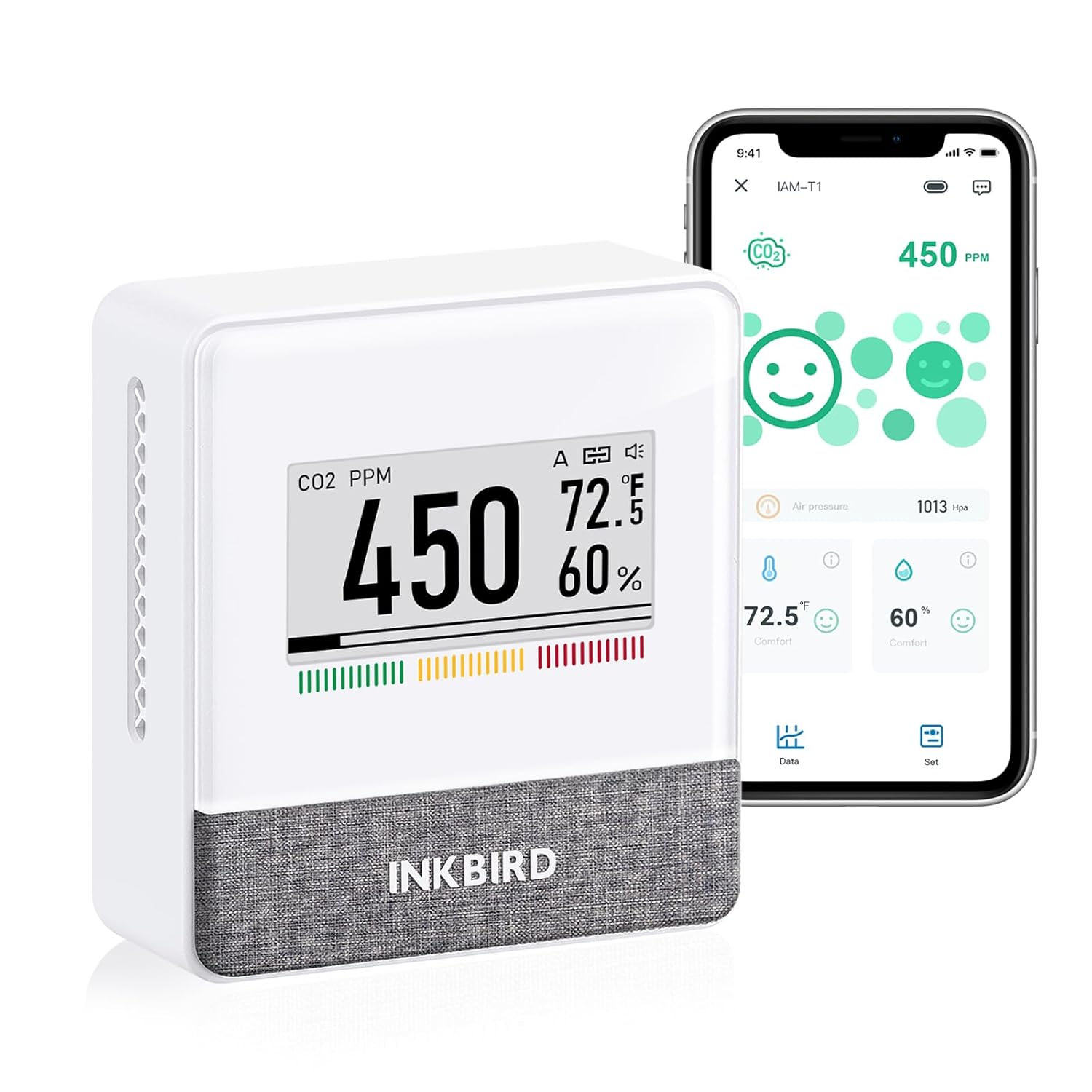
Senseair NDIR | ±(30 ppm + 3%) listed | E-ink | Bluetooth 5.0 | AA batteries, up to 4 years at 10-min interval | ~$149 (19 Oct 2026)
Check the INKBIRD Price on Amazon →This INKBIRD unit follows the Aranet4 formula closely: a Senseair NDIR sensor, an e-ink display, AA batteries and a Bluetooth app that keeps data on your phone rather than in the cloud. Its Amazon listing gives the same accuracy figure as Aranet’s, ±(30 ppm + 3% of reading), and offers the same 1, 2, 5 and 10-minute intervals.
Read the battery claim carefully. INKBIRD’s four-year figure is at the 10-minute interval, and the listing says the unit ships set to a 1-minute interval, which will drain the batteries far faster. Set it to 5 or 10 minutes on day one. It is sold by INKBIRD’s Australian store at $148.98, with 148 ratings averaging 4.3 out of 5.
Limitations: the accuracy figure is the seller’s listing claim, and the brand has a shorter track record in CO2 monitoring than Aranet. There is no particle sensor.
✓ Pros
- Same published NDIR accuracy as the Aranet4 at about half the price
- E-ink and AA batteries, so it is portable and cable-free
- Data stays on your phone rather than a cloud server
× Cons
- Ships on a 1-minute interval that shortens battery life until you change it
- Smaller track record than Aranet, with fewer independent users
- No PM2.5, CO or NO2 sensing
Buy this if…
you want an NDIR, e-ink portable monitor and would rather spend $150 than $300.
3. INKBIRD INK-CO2W Wi-Fi: the plug-in desk monitor
 NDIR CO2Wi-Fiapp alerts
NDIR | CO2, temperature, humidity | 2.4 GHz Wi-Fi app with alerts | Manual fresh-air calibration | ~$100 (19 Oct 2026)
Check the INK-CO2W Price on Amazon →If the monitor is going to live in one place, such as a home office, a nursery or a grow room, a plug-in Wi-Fi unit makes more sense than a portable one. The INK-CO2W uses an NDIR sensor, sends readings to the INKBIRD app over 2.4 GHz Wi-Fi, and can push an alert to your phone when CO2 passes a level you set. Calibration is manual: three buttons held together in fresh outdoor air for 200 seconds.
Its built-in bands are stricter than the Aranet4’s: normal from 400 to 700 ppm, warning from 700 to 1,500 ppm and danger above 1,500. Those are the seller’s labels, not a health standard, so set your own alert points using the thresholds table below. It is sold by INKBIRD’s Australian store at $99.99, with 28 ratings averaging 4.0 out of 5.
Limitations: no published accuracy figure on the listing, it needs power and Wi-Fi, and it is not designed to be carried around.
✓ Pros
- NDIR sensor and Wi-Fi alerts for about $100
- Remote viewing and history without your phone being in Bluetooth range
- Simple manual calibration in fresh air
× Cons
- No accuracy figure published on the Amazon listing
- Needs mains power and 2.4 GHz Wi-Fi, so it is not portable
- Small number of ratings so far
Buy this if…
the monitor will stay in one room and you want phone alerts without paying for an Aranet4.
Specification comparison
| Spec | Aranet4 HOME | INKBIRD e-ink Bluetooth | INKBIRD INK-CO2W |
|---|---|---|---|
| Sensor | NDIR (Senseair Sunrise) | NDIR (Senseair, listed) | NDIR |
| Stated accuracy | ±(30 ppm + 3%) | ±(30 ppm + 3%) (listing) | Not stated |
| Display | E-ink | E-ink | LCD |
| Power | 2 × AA | AA batteries | Mains (USB) |
| Connectivity | Bluetooth | Bluetooth 5.0 | 2.4 GHz Wi-Fi |
| Particle sensor | No | No | No |
| Sold by on Amazon AU | Amazon US | INKBIRD AU | INKBIRD AU |
| Price (19 Oct 2026) | ~$304 | ~$149 | ~$100 |
Where the Aranet4 earns its price in Australia
Gas cooking
A 2018 study in the Medical Journal of Australia by Knibbs and colleagues estimated that 12.3% of the childhood asthma burden in Australia is attributable to gas stoves. That figure is a population attributable fraction, not a 12.3% rise in any one child’s risk, but it is a big number. The same study noted that about 38% of Australian households cooked on piped natural gas in the ABS’s 2011 energy survey.
Be clear about what the Aranet4 can and cannot do here. It does not measure nitrogen dioxide or carbon monoxide, which are the combustion gases of most concern. What it shows you is how well your kitchen is ventilated. If CO2 climbs steadily while the burners run, the rangehood is not clearing the room, and the other combustion products are building up with it. That is the useful signal: it tells you to run the rangehood on high, open a window, or start pricing induction. For more on the pollutants themselves, see gas stove indoor air pollution.
Unflued gas heaters
NSW Health warns that unflued gas heaters release carbon monoxide and nitrogen dioxide and should never be used overnight in a room where people sleep. A CO2 monitor is not a safety device for this. If you have any gas heater, the device you need first is a carbon monoxide alarm; see carbon monoxide detectors compared. The Aranet4 can still show you whether the room is ventilated, but it will not warn you about CO.
Home offices
A closed study with one person working all day is the classic case where CO2 creeps up unnoticed. The value of a monitor here is not a precise number but a prompt: when the screen turns yellow, open the door or a window, and watch how quickly the reading falls. After a week you will know how your room behaves without needing to check.
Schools and childcare
Queensland’s 2022 school ventilation survey is the clearest Australian example of portable NDIR monitors being used to check classrooms, with an 800 ppm limit. NSW’s later Clean Air Schools program used fixed sensors and an 850 ppm threshold in line with the National Construction Code. A battery monitor on a teacher’s desk is a practical way to show whether windows and fans are doing enough, with no installation and no IT sign-off.
Bedrooms
A closed bedroom with two adults can run well above 1,000 ppm by morning. A 2016 study by Strøm-Tejsen and colleagues at the Technical University of Denmark, published in Indoor Air, found that improving bedroom ventilation (lowering CO2 from an average of about 2,400 ppm to about 835 ppm) improved how much of the night subjects spent asleep, and that they felt more rested, with a trend towards better next-day test results. The e-ink screen gives off no light, so it can sit by the bed. Check it in the morning and you will know whether the window or door strategy is working.
What it does well and what could be better
What it does well. It measures the right thing, the right way. The battery life removes the main reason people stop using monitors, which is charging them. And the colour indicator turns a technical number into a simple instruction: green leave it, yellow ventilate, red ventilate now.
What could be better. There is no PM2.5 sensor, so during bushfire smoke it tells you nothing about the particles that matter most; pair it with an air quality monitor with a PM2.5 sensor if smoke is your concern. Bluetooth-only data means no remote alerts. The unlit screen is unreadable in a dark room. And at about $304 it costs twice as much as an INKBIRD with a similar published specification. You are paying for Aranet’s track record and the confidence that comes with it.
What the numbers mean
There is no single Australian health limit for CO2 in homes, and ASHRAE explicitly says its ventilation standards do not set one. These are the reference points that actually exist, and what to do at each level.
| CO2 level | Aranet4 colour (default) | Reference point | What to do |
|---|---|---|---|
| Around 420 ppm | Green | Outdoor air | Nothing |
| Below 800 ppm | Green | Queensland schools survey limit (OzSAGE-based) | Ventilation is good |
| Up to 850 ppm (8-hour average) | Green | National Construction Code benchmark | Acceptable for a building over a day |
| 1,000 to 1,400 ppm | Yellow | Aranet’s caution band | Open a window or door, run a fan |
| Above 1,400 ppm | Red | Aranet’s default alarm level | Ventilate now and work out why it got that high |
A practical target for a lived-in room is to keep it under about 1,000 ppm most of the time and below 800 ppm where you can. If a bedroom routinely hits red by morning, the fix is airflow: a window cracked, the door left open, or a trickle vent. An air purifier does not remove CO2.
Battery life and running cost
Aranet’s current datasheet gives these battery estimates for two alkaline AA cells at 20 °C. They are extrapolations “for descriptive purposes only”, so treat them as a guide.
| Interval | Bluetooth off | Bluetooth on |
|---|---|---|
| 1 minute | about 1.0 year | about 0.9 year |
| 2 minutes | about 2.0 years | about 1.6 years |
| 5 minutes (default) | about 4.0 years | about 2.8 years |
| 10 minutes | about 6.5 years | about 3.8 years |
Lithium AA cells extend all of those figures. Over three years at the default setting with Bluetooth on, the Aranet4 costs about $304 up front plus a set of AA batteries, which works out to roughly 28 cents a day. The real cost is the purchase price; running it is close to free.
Calibration: the setting most owners never change
NDIR sensors drift slowly over time. Aranet factory-calibrates every unit and offers two ways to keep it accurate. Automatic calibration assumes the sensor sees fresh air (about 420 ppm) for around eight hours in every 30-day period and quietly corrects to it. Manual calibration means taking the unit outside into fresh air and triggering a calibration in the app.
The detail that catches people out: Aranet’s own help centre says automatic calibration is disabled by default. If your monitor sits in a bedroom that never drops to outdoor levels, leaving auto-calibration off is the right call, because auto-calibration would wrongly treat the room’s lowest reading as fresh air. Instead, take it outside for a manual calibration once or twice a year. Aranet recommends annual calibration.
Final verdict
The Aranet4 HOME is the best portable CO2 monitor you can buy in Australia for one simple reason: it measures CO2 properly and it keeps doing it, for years, without a cable. If you want to know whether the rooms you live and work in are getting enough fresh air, it answers that question better than anything else at its size.
Choose the Aranet4 if you want the proven option and will carry it around. Choose the INKBIRD e-ink Bluetooth unit if you want the same sensor class and published accuracy for about half the price. Choose the INKBIRD INK-CO2W if the monitor will live in one room and you want Wi-Fi alerts. And whichever you buy, remember what it is: a ventilation gauge, not a smoke or gas detector.
Prices change. Check Amazon AU before buying.
Frequently asked questions
Does the Aranet4 measure real CO2 or estimated CO2?
Real CO2. It uses an NDIR (non-dispersive infrared) sensor that measures how much infrared light carbon dioxide absorbs. Aranet rates it at ±(30 ppm + 3% of reading) between 0 and 5,000 ppm. Many cheaper monitors estimate an “eCO2” figure from VOC and hydrogen readings instead.
How long do the Aranet4 batteries last?
Up to about four years on two alkaline AA batteries at the default 5-minute interval with Bluetooth off, according to Aranet’s datasheet. With Bluetooth on it is about 2.8 years, and at a 1-minute interval about one year.
Where can I buy the Aranet4 in Australia?
It is on Amazon Australia (sold and shipped by Amazon US, about $304 when checked on 19 October 2026) and from Australian stockists such as CO2 Radical (about $325).
What is a good CO2 level for a bedroom?
Aim to keep it under about 1,000 ppm and ideally below 800 ppm. There is no Australian health limit for homes, but the National Construction Code uses 850 ppm averaged over eight hours as its benchmark, and Queensland’s school ventilation survey used 800 ppm.
Does the Aranet4 detect carbon monoxide or gas heater fumes?
No. It measures CO2, temperature, humidity and pressure only. It cannot detect carbon monoxide or nitrogen dioxide. If you use any gas heater, install a carbon monoxide alarm.
Does the Aranet4 measure PM2.5 or bushfire smoke?
No. It has no particle sensor. For bushfire smoke you need a monitor with a PM2.5 sensor or an air purifier with a built-in particle sensor.
Does the Aranet4 need calibrating?
It is factory calibrated, and automatic calibration is off by default. If the room never airs out to outdoor levels, leave it off and do a manual calibration outdoors in fresh air about once a year, as Aranet recommends.
Is the Aranet4 HOME compatible with Aranet Cloud?
No. Aranet Cloud and base stations work with the Aranet4 PRO. The HOME connects by Bluetooth to the free Aranet Home app, which keeps up to 90 days of history.
Is the INKBIRD CO2 monitor as good as the Aranet4?
INKBIRD’s e-ink Bluetooth monitor lists a Senseair NDIR sensor with the same published accuracy, ±(30 ppm + 3%), at about half the price. Aranet has the longer track record. Set the INKBIRD to a 5 or 10-minute interval, because it ships on 1 minute, which shortens battery life.
- Aranet4 HOME datasheet (TDSPC0H3)
- Aranet4 HOME product page
- Aranet help centre: default settings
- Senseair: Aranet4 uses the Senseair Sunrise sensor
- Satish et al. 2012, Environmental Health Perspectives
- Zhang et al. 2017, Indoor Air
- ASHRAE Journal on Strøm-Tejsen et al. 2016 (bedroom ventilation and sleep)
- ASHRAE brief: Indoor carbon dioxide, ventilation and indoor air quality
- Knibbs et al. 2018, Medical Journal of Australia
- National Construction Code 2022, Part F6 (850 ppm benchmark)
- Queensland Department of Education RTI disclosure: GHD school ventilation surveys (2022)
- McNeill et al. 2022, Atmospheric Environment: X (classroom ventilation using Aranet4)
- NSW Health: unflued gas heaters
- Sensirion SGP30 (how eCO2 is calculated)
- Amazon AU: Aranet4 HOME listing
- Amazon AU: INKBIRD e-ink Bluetooth CO2 monitor listing
- Amazon AU: INKBIRD INK-CO2W listing
Get the Australian Home Environment Checklist
30 checks across water, air and EMF. Most of them free. Ranked by impact.
No spam. Unsubscribe any time.

Former Royal Australian Navy Clearance Diver and TAG-E counter-terrorism operator. Founded Clean and Native to apply the same rigorous thinking to the home environment.
Full biography →