Best Carbon Monoxide Detector Australia 2026
The best carbon monoxide detector for most Australian homes in 2026 is a hard-wired, interconnected unit certified to AS 1603.13 or EN 50291 with electrochemical sensing and a sealed lithium battery backup. Carbon monoxide kills without warning — it is colourless, odourless, and tasteless — and according to the WHO Air Quality Guidelines, CO is a major indoor pollutant with direct cardiovascular and respiratory impacts even at sub-lethal concentrations. I have assessed using our documented methodology and researched every detector type available in Australia to build this guide.
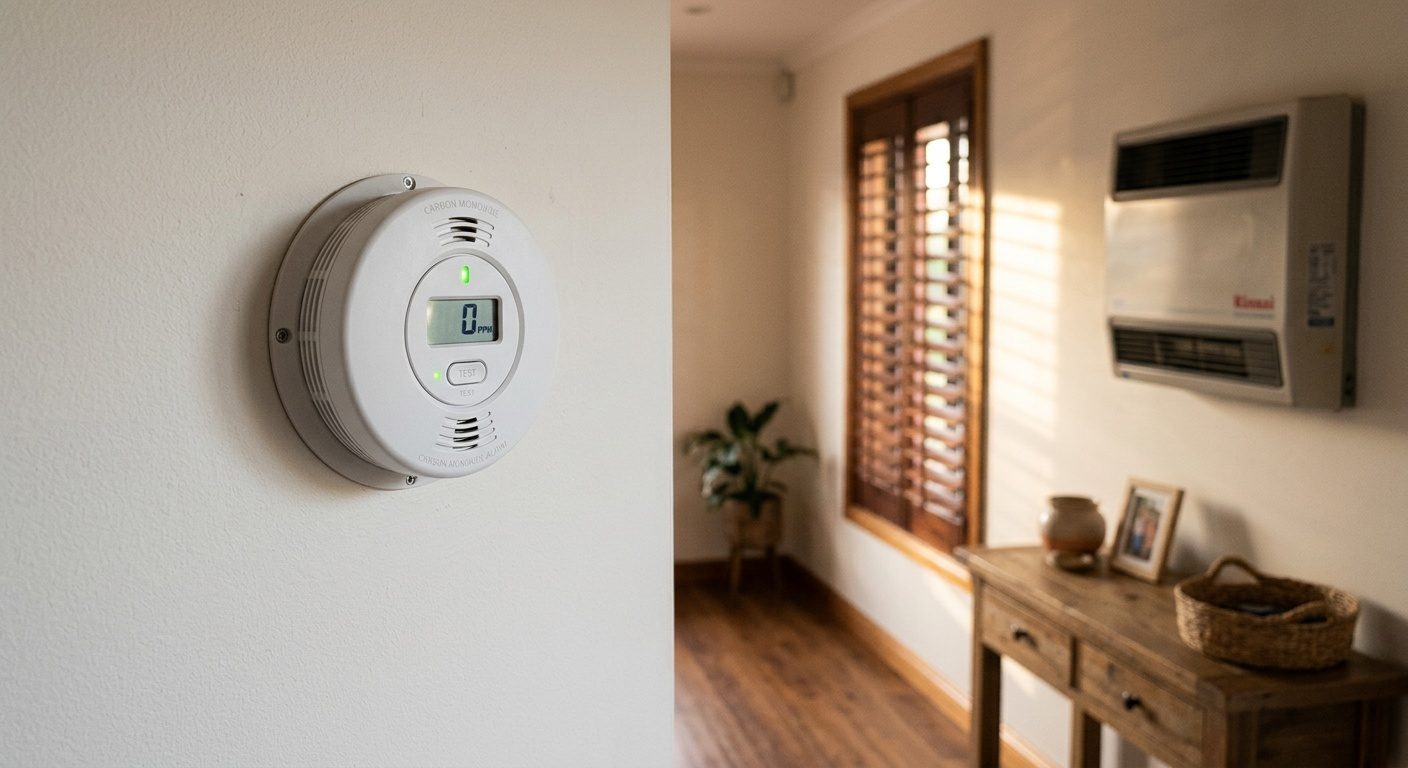
For most Australian households with gas appliances, a hard-wired smoke/CO combo detector (like the First Alert SC5 or equivalent EN 50291-certified unit) is the strongest choice — reliable power, interconnected alerting, and one device covering two lethal threats. Battery-only units suit renters and caravans where hard-wiring is not practical. The critical catch: Australia has no mandatory CO detector requirement in residential buildings as of July 2026, which means you are entirely responsible for your own protection. Every gas heater, gas cooktop, wood fireplace, and enclosed garage is a potential CO source in your home right now.
Key catches
- No Australian Standard mandates CO detectors in homes — AS 1603.13 exists but is voluntary for residential
- Electrochemical sensors degrade — every CO detector must be replaced every 7-10 years regardless of battery life
- CO detectors do NOT detect gas leaks (methane/LPG) — separate combustible gas detector required for that
- Hard-wired installation requires a licensed electrician in all Australian states
| Type | Best For | Verdict |
|---|---|---|
| Hard-wired + battery backup | Owner-occupiers, new builds, renovations | Most reliable — never loses power |
| Battery-only (sealed 10yr lithium) | Renters, caravans, holiday homes | No electrician needed — install in 2 minutes |
| Smoke + CO combo | Most homes wanting one device per room | Best value — covers two threats in one unit |
Why Carbon Monoxide Detection Is Not Optional in Australian Homes
Here is the uncomfortable truth. Australia has no mandatory requirement for residential carbon monoxide detectors. Zero. While smoke alarms are legislated in every state and territory under the Building Code of Australia and various state fire safety regulations, CO detectors remain entirely voluntary. Compare that to the UK, where the Building Regulations 2010 (amended 2022) mandate CO alarms in any room with a fixed combustion appliance. Or the US, where 38 states plus DC require them. Australia is behind.
According to the Australian Government Department of Health, indoor air quality is a priority health factor because Australians spend approximately 90% of their time indoors. The WHO Air Quality Guidelines explicitly identify carbon monoxide as a major indoor pollutant with documented cardiovascular and neurological effects. At concentrations as low as 35 ppm over an 8-hour period, CO begins binding to haemoglobin — forming carboxyhaemoglobin (COHb) — which reduces oxygen delivery to your brain, heart, and every other organ. You will not smell it. You will not taste it. The first symptom is often a headache you attribute to something else.
If your home has any of the following, you need a CO detector: a gas cooktop or oven, a gas ducted heater, a gas wall furnace, a gas hot water system (especially older continuous-flow units), a wood-burning fireplace or combustion heater, an attached or enclosed garage, or a generator used during power outages. That covers the majority of homes in Melbourne (where gas heating is near-universal), Adelaide, Perth, and significant portions of Brisbane, Sydney, and Canberra. Without a detector, you are relying on symptoms to warn you — and by the time symptoms appear, you have already been poisoned.
Hard-Wired vs Battery vs Combo: Which Type Is Right for You?
The three detector types solve different problems, and your living situation determines which one fits. Choose wrong and you either overpay for features you cannot use, or worse, end up with a detector that fails when you need it most. Here is the breakdown.
Hard-Wired CO Detectors (With Battery Backup)
Hard-wired units connect directly to your 240V mains power via the existing smoke alarm circuit. In Australia, this must be installed by a licensed electrician — no exceptions, regardless of state. The unit draws constant power and contains a sealed backup battery (typically lithium, lasting the life of the unit) that activates during power outages. This is the most reliable configuration because the detector is always powered, always monitoring, and never dependent on a battery you forgot to test.
The key advantage is interconnection. Hard-wired detectors can be daisy-chained so that when one unit detects CO in the kitchen, every detector in the house sounds simultaneously. If you are asleep in a rear bedroom three rooms away from a malfunctioning gas heater, interconnection is the difference between waking up and not waking up. Installation cost is typically $80-$150 per unit (electrician labour) plus the detector itself ($60-$120 per unit). For a three-bedroom home, expect $300-$600 total installed.
Best for: Owner-occupiers, new builds, renovations, families with multiple gas appliances, homes where CO source is distant from sleeping areas.
Battery-Only CO Detectors (Sealed Lithium)
Battery-only units mount with two screws or adhesive. No electrician required. Modern sealed-lithium models contain a non-replaceable battery rated for the life of the electrochemical sensor (7-10 years). When the battery dies, the unit chirps and you replace the entire detector. This eliminates the “dead battery” problem that plagued older units with replaceable AA or 9V batteries.
The limitation is that battery-only units typically cannot interconnect with other detectors (unless they use wireless RF or Wi-Fi). A single battery unit protects the room it is in, and maybe the adjacent hallway. If your home has multiple potential CO sources — a gas cooktop in the kitchen and a gas heater in the lounge, for example — you need multiple battery units, each operating independently. That said, for a renter who cannot modify the property, a battery unit installed in 90 seconds is infinitely better than no detector at all.
Best for: Renters, caravans, holiday homes, Airbnbs, travel, and anyone who needs immediate protection without an electrician appointment.
Smoke + CO Combination Detectors
Combo units contain both a photoelectric smoke sensor and an electrochemical CO sensor in a single housing. Available in both hard-wired and battery-only configurations. The advantage is obvious: one device, one mounting point, dual protection. Since smoke alarms are already mandatory in every Australian home, upgrading to a combo unit at replacement time gives you CO protection at marginal extra cost.
First Alert’s SC5 (hard-wired smoke/CO combo) and the SMCO100V-AC are two of the most commonly referenced models in the Australian market. Both use photoelectric smoke sensing (which detects smouldering fires faster than ionisation sensors) combined with an electrochemical CO cell. The combo approach is endorsed by fire services in several states as the simplest path to dual protection. The catch: combo units are physically larger than standalone CO detectors, and if one sensor fails (CO sensor degradation after 7 years, for example), the entire unit must be replaced even though the smoke sensor may still be functional.
Best for: Most homeowners — especially those due to replace existing smoke alarms, which is mandatory every 10 years under state legislation. One device, two protections, one installation visit.
✓ Who This Guide Is For
- Homeowners with gas cooktops, heaters, or fireplaces
- Renters in older homes with unflued gas appliances
- Parents wanting CO protection in children’s bedrooms
- Caravan and RV owners using gas for cooking or heating
- Anyone replacing smoke alarms and wanting dual protection
× Who Should Look Elsewhere
- All-electric homes with no combustion appliances (CO risk is minimal)
- Homes needing a natural gas leak detector — CO detectors do NOT detect methane or LPG
- People wanting air quality monitoring for particulates/VOCs — see our air purifier guide instead
- Commercial/industrial sites requiring BMS-integrated gas detection systems
Australian Standards and Certifications: What to Look For
CO detector certification in Australia is fragmented, and understanding which standard applies prevents you from buying a unit that looks legitimate but has never been independently tested to a recognised safety standard. Here is what matters.
AS 1603.13 — The Australian Standard for CO Alarms
AS 1603.13:2007 (Automatic fire detection and alarm systems — Point-type CO fire detectors) is the Australian Standard that covers CO detection. However, it was primarily developed for commercial fire detection systems, not residential CO poisoning prevention. Very few residential CO detectors sold in Australia are certified specifically to AS 1603.13. This is not because they are unsafe — it is because the standard was not designed for the residential market, and most manufacturers certify to the more widely recognised EN 50291 or UL 2034 instead.
EN 50291 — European Standard (Most Common in AU)
The majority of residential CO detectors available in Australia are certified to EN 50291-1:2018 (Electrical apparatus for the detection of carbon monoxide in domestic premises). This European standard specifies alarm thresholds at three CO concentration levels: 50 ppm within 60-90 minutes, 100 ppm within 10-40 minutes, and 300 ppm within 3 minutes. These thresholds align with WHO exposure limits and are considered appropriate for residential protection by Australian fire services that recommend CO detectors.
UL 2034 — US/Canadian Standard
UL 2034 is the North American standard for residential CO alarms. Some US-manufactured detectors sold in Australia carry UL 2034 certification. The alarm thresholds differ slightly from EN 50291: 70 ppm within 60-240 minutes, 150 ppm within 10-50 minutes, and 400 ppm within 4-15 minutes. Note the higher thresholds — UL 2034 units trigger later at lower concentrations than EN 50291 units. For maximum sensitivity, EN 50291-certified detectors provide earlier warning at lower CO levels.
What to Demand on the Box
At minimum, any CO detector you purchase for an Australian home should carry EN 50291-1 or UL 2034 certification. Do not accept “CE marked” alone — CE marking on its own is a self-declaration by the manufacturer and does not guarantee independent laboratory testing. Look for the specific standard number printed on the unit or its packaging. If the listing does not state a standard, do not buy it. Your life is not the right place to save $20.
| Standard | Origin | 50 ppm Alarm | 100 ppm Alarm | 300+ ppm Alarm | AU Relevance |
|---|---|---|---|---|---|
| EN 50291-1 | Europe | 60-90 min | 10-40 min | ≤3 min | Most common in AU retail |
| UL 2034 | US / Canada | N/A (starts at 70 ppm) | N/A (starts at 150 ppm) | 4-15 min (at 400 ppm) | Less sensitive at low levels |
| AS 1603.13 | Australia | Varies | Varies | Varies | Commercial focus, rarely residential |
Sensor Technology: Why Electrochemical Is the Only Serious Option
CO detectors use one of three sensor technologies: electrochemical, metal oxide semiconductor (MOS), or biomimetic. For residential use in Australia, electrochemical is the only technology worth considering. Here is why.
Electrochemical Sensors
An electrochemical CO sensor contains electrodes immersed in an electrolyte solution. When CO molecules diffuse through a permeable membrane into the sensor, they undergo a chemical reaction at the sensing electrode that generates a tiny electrical current proportional to the CO concentration. This current is measured, and when it exceeds the alarm threshold, the detector sounds. The technology is the same used in professional-grade gas detection instruments carried by firefighters and confined-space entry teams.
Electrochemical sensors are accurate to within ±5% of the reading at concentrations above 50 ppm. They are highly selective for CO — meaning they rarely produce false alarms from cooking fumes, steam, or other household gases. Response time is typically 15-30 seconds for high concentrations. The limitation is lifespan: the electrolyte degrades over time regardless of use. Even in clean air, an electrochemical CO sensor has a finite service life of 7-10 years. This is not a defect — it is chemistry. Replace the detector at end-of-life. No exceptions.
Metal Oxide Semiconductor (MOS) Sensors
MOS sensors use a heated tin dioxide element whose electrical resistance changes in the presence of CO. They are inexpensive to manufacture but significantly less selective than electrochemical sensors. They false-alarm more frequently from cooking vapours, cleaning products, and high humidity. Some cheap imported detectors on Amazon and eBay use MOS technology and sell for under $25. These are not appropriate for life-safety applications. If a CO detector costs $15 and does not name its certification standard, it almost certainly uses a MOS sensor and should not be trusted to protect your family.
Biomimetic Sensors
Biomimetic sensors use a gel disc that changes colour in the presence of CO, triggering an optical sensor. They were common in early residential CO detectors but have been largely replaced by electrochemical technology. Biomimetic sensors are slower to respond and slower to reset after an event. They are rarely found in current-production detectors and are not recommended.
Where to Install CO Detectors in Australian Homes
Placement determines whether your detector alerts you in time or triggers after you have already inhaled dangerous concentrations. CO is slightly lighter than air (molecular weight 28 vs air at 29), so it disperses relatively evenly in a room rather than sinking to the floor or rising to the ceiling. This means placement height is less critical than proximity to both CO sources and sleeping areas.
Mandatory Placement Priorities
Install a CO detector in every room containing a fuel-burning appliance: the kitchen (gas cooktop/oven), any room with a gas heater (ducted outlet counts), the laundry if a gas dryer is installed, and any room with a wood-burning fireplace or combustion heater. For Melbourne homes — where gas ducted heating is near-universal and winter temperatures regularly drop below 5°C — a detector near each ducted outlet is sensible. In Perth and Adelaide, where gas hot water systems are common, a detector near the indoor HWS relief valve location is appropriate.
Install a CO detector outside every sleeping area. This is non-negotiable. If your bedrooms are clustered in a hallway, one detector in the hallway serves multiple rooms. If bedrooms are on different levels, one detector per level, positioned near the bedroom doors. CO poisoning deaths overwhelmingly occur during sleep because occupants never wake to the symptoms.
Placement Rules
Mount detectors at head height (1.5m above floor) on a wall, or on the ceiling. Do not place within 150mm of a corner or within 300mm of a cooking appliance (to minimise false alarms from transient cooking fumes). Do not place in bathrooms, garages, or any space where temperatures regularly exceed 40°C or drop below 0°C — electrochemical sensors have specified operating ranges and extreme temperatures degrade accuracy. For caravans and RVs, mount the detector near the gas cooktop but away from the cooking steam path, ideally between the cooktop and the sleeping area.
Australian Climate Considerations
North Queensland homes (Cairns, Townsville) using all-electric cooling and no gas appliances have minimal CO risk and may not require a detector. However, if you use a portable gas camping stove indoors during cyclone season power outages — which happens more often than people admit — a battery CO detector stored with your emergency kit is a actually life-saving item. Darwin homes face similar considerations: minimal gas heating use but potential generator and portable stove exposure during wet season outages.
Conversely, south-eastern Australian homes — Melbourne, Canberra, Hobart, and the NSW tablelands — face the highest risk during winter months (June-August) when gas heaters run for 8-12 hours daily and windows stay sealed against cold. This is when CO concentrations build insidiously. Your winter heating bill is a direct proxy for your CO exposure risk.
CO Detection as Part of Your Indoor Air Quality System
A CO detector protects you from one specific threat — carbon monoxide poisoning. But indoor air quality is a broader problem, and thinking systemically means addressing CO alongside particulate matter, volatile organic compounds, humidity, and other combustion byproducts.
What CO Detectors Do Not Measure
A CO detector does not measure PM2.5 (fine particulate matter from bushfire smoke, cooking, or combustion heaters). It does not measure NO₂ (nitrogen dioxide — a byproduct of gas cooking that the WHO identifies as a respiratory irritant at concentrations commonly found in kitchens with gas stoves). It does not measure formaldehyde, benzene, or other VOCs off-gassing from furniture, paint, and building materials. And it does not detect methane or LPG gas leaks — a common and dangerous misconception. If you smell gas, your CO detector is irrelevant. You need a combustible gas detector, which is an entirely separate device.
Building a Complete Indoor Air Quality Stack
For an Australian home serious about indoor air quality, the system looks like this:
1. CO detector — electrochemical, EN 50291-certified, one per gas appliance room plus one per sleeping area. Approximately $50-$120 per unit. This article covers this layer.
2. HEPA air purifier — for PM2.5 from bushfire smoke (October-March in NSW, Victoria, and Queensland), cooking aerosols, and general particulate matter. A Breville Protect Max or Levoit Core 400S handles this. See our best air purifier guide for full recommendations.
3. Kitchen ventilation — a rangehood vented externally (not recirculating) is the single most effective intervention for gas cooking byproducts including CO, NO₂, and PM2.5. This is not a product you buy online — it is a renovation decision, but its impact on indoor air quality dwarfs any detector or purifier.
4. Water filtration — separate from air quality but part of the same clean-home approach. Brisbane, Sydney, Adelaide, Gold Coast, and Darwin homes face chloramine in their tap water, which standard carbon filters (including Brita) cannot adequately remove. See our water filter guide for the full breakdown.
CO detection is one layer in a multi-layer system. It is the cheapest layer (as low as $50 for a quality battery unit) and arguably the most immediately life-saving. Start here, then build outward.
Hard-Wired vs Battery vs Combo: Decision Tree
Do not overthink this. Three questions determine the right detector type for your home. Answer them honestly.
No (renter, body corporate restrictions) → Battery-only sealed lithium CO detector. Install today.
Yes (owner-occupier, renovating) → Hard-wired with battery backup. Book an electrician.
Yes (existing alarms approaching 10-year replacement date) → Smoke + CO combo detector. One device, dual protection, one installation cost.
No (smoke alarms recently replaced) → Standalone CO detector. Do not rip out working smoke alarms.
One (single gas cooktop) → One CO detector in the kitchen, one outside the nearest bedroom.
Multiple (gas cooktop + gas heater + gas HWS + attached garage) → Hard-wired interconnected system so all detectors trigger simultaneously. This is the scenario where hard-wiring pays for itself in seconds.
Smart CO Detectors and Home Integration
Smart CO detectors connect to your home Wi-Fi network and send push notifications to your phone when CO is detected. Some integrate with smart home ecosystems (Google Home, Apple HomeKit, Amazon Alexa). The practical benefit is notification when you are away from home — if a gas appliance malfunctions while you are at work, a smart detector alerts you immediately instead of alarming in an empty house.
The risk with smart-only detectors is Wi-Fi dependency. If your internet goes down, the smart features stop working. A well-designed smart CO detector maintains local alarm functionality (the unit itself still sounds a 85 dB+ horn) regardless of network connectivity, and uses smart features as an additional notification layer, not the primary one. Verify this before purchasing any “smart” CO detector — some budget models rely entirely on app notification with an inadequate local sounder.
For homes already using smart smoke detection systems (like Google Nest Protect), adding CO capability through the same ecosystem provides a unified alerting experience. Nest Protect, for example, is a smoke/CO combo that voices the specific threat (“Warning — carbon monoxide detected in the kitchen”) rather than just sounding a generic alarm. It interconnects wirelessly with other Nest Protect units, sends phone notifications, and uses a low-concentration “Heads Up” warning before reaching full alarm thresholds. The downside: it is significantly more expensive than a basic hard-wired combo, at approximately $180-$200 per unit.
Maintenance, Testing, and Replacement Schedule
A CO detector is not install-and-forget. Electrochemical sensors degrade. Without regular testing and timely replacement, your detector becomes a piece of plastic on the wall that provides nothing but false confidence.
Monthly Testing
Press the test button on your CO detector every month. This tests the alarm circuit — the horn, the electronics, the battery connection. It does not test the actual CO sensor (no test button can generate CO). But a failed test confirms a dead battery, failed horn, or damaged circuit board. Monthly testing takes 10 seconds per detector. Set a phone reminder for the first of every month.
Annual Inspection
Visually inspect the detector once a year. Look for dust accumulation on the sensor opening (vacuum gently with a brush attachment), physical damage, discolouration, or moisture intrusion. Check the manufacture date printed on the back of the unit. If the detector is approaching its end-of-life date, order a replacement before it expires.
Mandatory Replacement
Every CO detector has a stated service life — typically 7 years for standalone CO units and 10 years for combo smoke/CO units. This is printed on the unit. When the service life expires, the electrochemical sensor can no longer be trusted to alarm at the correct thresholds. Replace the entire unit. Do not attempt to extend service life. Do not assume it is “probably still fine.” Replace it.
| Task | Frequency | Time Required | Notes |
|---|---|---|---|
| Press test button | Monthly | 10 seconds | Tests circuit and horn only, not CO sensor |
| Visual inspection and dust removal | Annually | 2 minutes | Vacuum sensor openings gently |
| Replace batteries (if replaceable) | Annually or when chirping | 1 minute | Sealed lithium units: N/A |
| Replace entire detector | Every 7-10 years | 5-15 minutes | Non-negotiable. Sensor degrades regardless of use. |
What to Do When Your CO Detector Alarms
This is the section you need to read before you need it. When that 85 dB horn goes off at 2am, your ability to think clearly drops to near zero. Have a plan. Print this section and stick it on the fridge.
Step 1: Do not ignore it. CO detector false alarms are far less common than smoke alarm false alarms (no cooking fumes, no shower steam). If your EN 50291-certified electrochemical detector alarms, treat it as a real CO event until proven otherwise.
Step 2: Open all doors and windows. Ventilate immediately. Every open window reduces CO concentration. Cross-ventilation is ideal — open on opposite sides of the house.
Step 3: Turn off all gas appliances. Gas cooktop, gas heater, gas hot water system — turn them all off at the appliance and ideally at the gas meter if you can access it safely.
Step 4: Account for everyone. Get every person and pet out of the house. Do a headcount outside.
Step 5: Call 000. Request Fire and Rescue. Tell the operator your CO detector has alarmed. They will attend with calibrated gas detection equipment and identify the source. Do not re-enter the house until fire services clear it.
Step 6: Seek medical attention if symptomatic. Headache, nausea, dizziness, confusion, chest pain — any of these in the context of a CO alarm require medical evaluation. Tell the emergency department you have been exposed to carbon monoxide. A blood test for carboxyhaemoglobin (COHb) levels is the definitive diagnostic tool.
Do not reset the detector and go back to bed. Do not assume “it was probably nothing.” A malfunctioning gas appliance that produced enough CO to trigger an alarm will produce more CO when it runs again. Have a licensed gas fitter inspect and certify every gas appliance before resuming use.
CO Detectors for Caravans, RVs, and Boats
Enclosed mobile spaces present the highest CO risk per cubic metre in Australia. A caravan using a two-burner gas cooktop in a 15 m³ interior space with windows closed can reach dangerous CO concentrations within minutes if the burner is not combusting cleanly. Every year, Australian caravan parks see CO poisoning incidents — most unreported because occupants attribute headaches and nausea to “a bad night’s sleep” or food poisoning.
For caravans and RVs, battery-only CO detectors are the practical choice. Ensure the unit is rated for 12V environments (some detectors are sensitive to the electrical noise in caravan 12V systems). Mount the detector between the gas appliance and the sleeping area, at head height when lying in bed. The detector should be within 3 metres of the gas appliance but not directly above it. For boats, marine-rated CO detectors certified to ABYC A-24 or equivalent are preferred, as they are designed for high-humidity, salt-air environments that would degrade a standard residential unit’s sensor faster.
Buying Guide: What to Check Before You Purchase
Use this checklist before adding any CO detector to your cart. Every “no” answer is a reason to keep looking.
☐ Certification: EN 50291-1 or UL 2034 stated on the product listing or packaging. Not just “CE marked.”
☐ Sensor type: Electrochemical explicitly stated. If the listing does not mention sensor type, assume MOS and move on.
☐ End-of-life date or sensor lifespan: Minimum 7 years. Some units state a specific date (e.g., “Replace by 2033”). If not stated, the product does not meet basic transparency requirements.
☐ Alarm volume: Minimum 85 dB at 3 metres. This is the UL and EN standard requirement. If the listing does not state alarm volume, it may not meet the standard.
☐ Digital display (optional but recommended): A real-time CO concentration display (in ppm) lets you see low-level CO presence before the alarm threshold is reached. This is the difference between knowing your gas heater is producing 20 ppm CO (sub-alarm but worth investigating) and having no information until the detector alarms at 50 ppm.
☐ Battery type (for battery-only units): Sealed lithium (non-replaceable, 10-year life) is preferred over replaceable AA/9V. Replaceable batteries get forgotten, die silently, and leave you unprotected.
☐ Australian plug/voltage compatibility (for hard-wired units): Some US-imported hard-wired units are 120V. Australia uses 240V. Verify the unit is rated for 240V or comes with an appropriate transformer. Hard-wired installation must comply with AS/NZS 3000 (Wiring Rules) and be performed by a licensed electrician.
| Feature | Non-Negotiable? | Why It Matters |
|---|---|---|
| EN 50291 or UL 2034 certification | Yes | Guarantees tested alarm thresholds |
| Electrochemical sensor | Yes | Only reliable residential CO sensor technology |
| 85 dB+ alarm volume | Yes | Must wake sleeping occupants |
| 7+ year sensor lifespan stated | Yes | Confirms genuine electrochemical cell |
| Digital ppm display | Recommended | Shows sub-alarm CO presence |
| Smart notifications | Nice to have | Alerts when away from home |
| Interconnection (wired or wireless) | Recommended for 3+ bedroom homes | All detectors alarm simultaneously |
Final Verdict
For owner-occupiers with gas appliances: Install hard-wired smoke/CO combo detectors on every level, with at least one in each room containing a gas appliance and one outside every sleeping area. Have them interconnected by a licensed electrician. Budget approximately $300-$600 for a three-bedroom home (units plus installation). This is a one-time investment that lasts 10 years and could save your family’s lives during a single winter night when a gas heater malfunctions.
For renters: Buy two battery-only sealed lithium CO detectors (approximately $50-$80 each). Mount one near the gas cooktop, one outside your bedroom. Total cost under $160, installed in five minutes, zero landlord permission required. This is the easiest life-safety decision you will ever make.
For caravan and RV owners: A single battery CO detector mounted between the gas cooktop and the sleeping area is mandatory equipment. Non-negotiable. The enclosed volume of a caravan means CO concentrations build dangerously fast.
For all-electric homes: If you actually have zero combustion appliances — no gas cooktop, no gas heater, no gas HWS, no wood fireplace, no attached garage, no generator — your CO risk is minimal. A single battery CO detector near the kitchen is a belt-and-suspenders measure that costs $50 and provides peace of mind.
Last reviewed: August 2026 – Clean and Native
Protect your home from CO and particulates
A CO detector handles the invisible poison. A HEPA air purifier handles bushfire smoke, cooking aerosols, and PM2.5 the rest of the year. Together, they cover the two deadliest indoor air threats in Australian homes.
Frequently Asked Questions
Are carbon monoxide detectors required by law in Australian homes?
Unlike smoke alarms, CO detectors are not currently mandated in Australian residential building codes (as of 2026). However, any home with gas appliances (heaters, cooktops, hot-water units), a wood fireplace, or an attached garage should have one. They are strongly recommended, not legally required.
Which Australian Standard should a CO detector meet?
Look for compliance with AS 3786 or an equivalent international standard such as UL 2034 or EN 50291. Certification means the sensor sensitivity and alarm thresholds have been independently tested to trigger at the correct CO concentrations over time.
Where should I install a carbon monoxide detector?
Fit one on every level of the home and near sleeping areas so the alarm can wake you. CO mixes evenly with air, so wall or ceiling mounting both work. Keep detectors roughly 1.5–3 m away from gas appliances to avoid nuisance alarms, and add one near any attached garage.
How long do carbon monoxide detectors last?
The electrochemical sensor degrades with age, so most units have a 7–10 year service life and must then be replaced entirely — you cannot simply swap the battery. Check the manufacture or expiry date printed on the back and diarise the replacement.
Hard-wired, battery, or combo — which should I choose?
Hard-wired units with battery backup suit new builds and renovations, especially interconnected setups. Sealed 10-year battery units are ideal for renters and retrofits (no wiring, no battery changes). Combo smoke-and-CO alarms save ceiling space but tie both sensors to a single replacement date.
Do I still need a CO detector if my kitchen is all-electric?
The risk is lower but not zero. An attached garage, a wood or gas fireplace, a portable gas heater, or a shared wall with a gas-using neighbour can all introduce carbon monoxide. If your home has any combustion source, fit a detector.
Get the Australian Home Environment Checklist
30 checks across water, air and EMF. Most of them free. Ranked by impact.
No spam. Unsubscribe any time.

Former Royal Australian Navy Clearance Diver and TAG-E counter-terrorism operator. Founded Clean and Native to apply the same rigorous thinking to the home environment.
Full biography →