Wood Heater Smoke and Indoor Air Quality 2026
Wood heater smoke is the single largest source of fine particulate pollution in Australian cities during winter — responsible for 52% of annual PM2.5 in Melbourne and an estimated 700 premature deaths nationally each year according to NESP and NSW EPA data. Even a well-maintained, AS/NZS 4013-compliant heater releases measurable PM2.5 indoors during door-open reload events, startup, and smouldering burn phases, making indoor air quality management essential for any household running a wood fire between May and September.
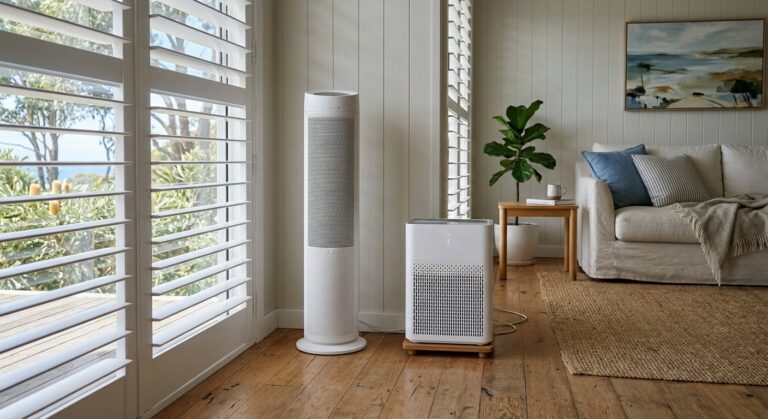
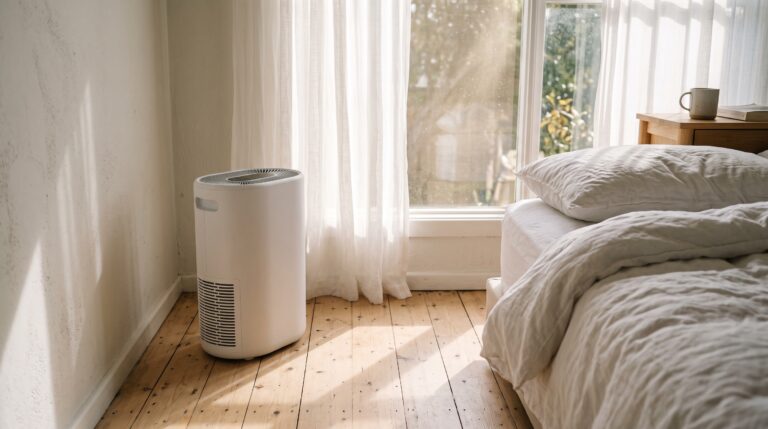
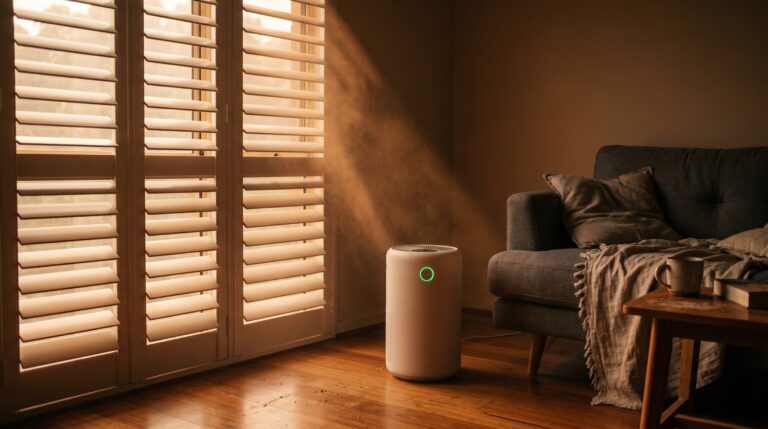
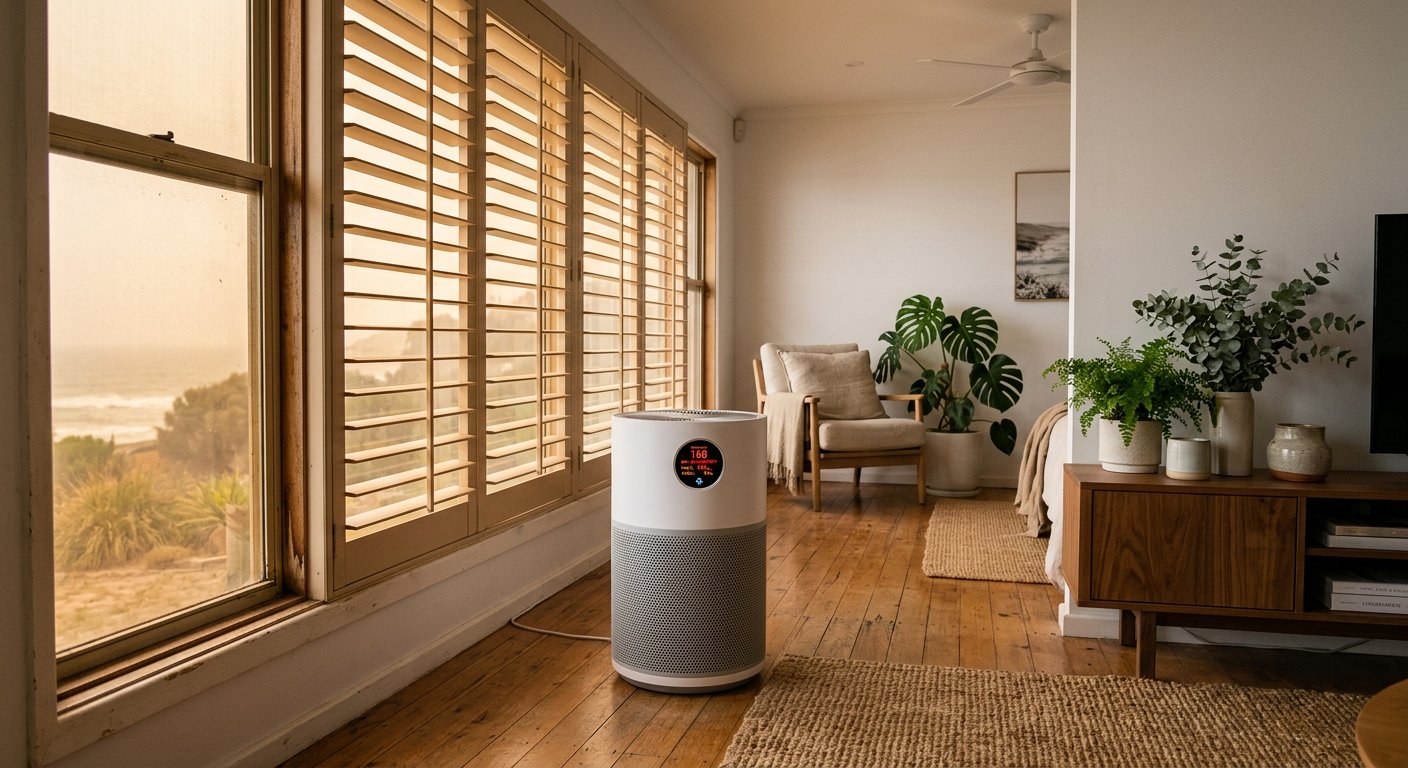
A wood heater operating in your living room exposes you to PM2.5 spikes of 200–500+ µg/m³ every time you open the door to reload — far above the WHO 24-hour guideline of 15 µg/m³. Flue maintenance, dry seasoned hardwood, and correct airflow management reduce emissions at the source. But they do not eliminate indoor particulate spikes. An H13 HEPA air purifier sized to the room is the most effective indoor mitigation. The Breville Protect Max (550 CADR, H13 HEPA, activated carbon) handles rooms up to 40 m² and strips PM2.5 during reload events within minutes. The Levoit Core 400S is the best value alternative for rooms under 30 m².
| Technology / Product | What It Does | Verdict |
|---|---|---|
| Breville Protect Max | H13 HEPA + activated carbon, 550 CADR, covers 40 m² | Recommended — best overall |
| Levoit Core 400S | H13 HEPA + carbon, 350 CADR, smart app, covers 30 m² | Recommended — best value |
| Source control alone | Flue service, seasoned hardwood, correct airflow | Essential but insufficient — does not eliminate indoor PM2.5 spikes during reload |
Key catches
- No wood heater produces zero indoor PM2.5 — even a perfectly operated unit releases particles during door-open events
- HEPA purifiers remove particulate but not carbon monoxide — always maintain a working CO alarm
- Running the purifier on maximum during and for 20 minutes after each reload gives the fastest particle clearance
- Ioniser-only or ozone-generating “purifiers” do not capture particles and may worsen indoor air — avoid them
How Much PM2.5 Does a Wood Heater Actually Put Into Your Room?
This is the question most Australians skip — and the reason indoor air quality in wood-heated homes is so much worse than people assume. The flue is supposed to carry combustion gases outside. In a perfectly sealed, correctly drafted system, it does. But you do not live inside a perfectly sealed system. You live in a house where the heater door opens every 45 to 90 minutes for reloading, where startup involves 10–20 minutes of open-door kindling, and where overnight smouldering burns with dampers closed produce incomplete combustion that leaks from every gasket and joint.
According to research published in the Medical Journal of Australia (2024), wood heater emissions contribute 17–25% of annual mean PM2.5 in the ACT during colder years. That is an outdoor ambient figure. Indoors, the numbers are worse. Real-time PM2.5 monitors placed in wood-heated living rooms consistently record spikes of 200–500 µg/m³ during reload events — and occasionally above 1,000 µg/m³ during cold-start ignitions. The WHO 24-hour PM2.5 guideline is 15 µg/m³. The NEPM (National Environment Protection Measure) advisory reporting standard for Australia is 25 µg/m³ over 24 hours.
Every single reload event exceeds those thresholds by a factor of 10 to 40. The spike typically lasts 5–15 minutes with the door open, then tapers over 20–30 minutes as draft re-establishes. But if the room is sealed — which it often is during a Tasmanian or Victorian winter night — those particles have nowhere to go. They settle on surfaces, re-suspend when disturbed, and remain in the breathing zone for hours.
Even between reloads, a wood heater operating within its design parameters produces a baseline indoor PM2.5 of 20–60 µg/m³ in a typical living room, according to monitoring data from NSW EPA residential studies. That is 1.5 to 4 times the NEPM standard — sustained for every hour the fire is lit.
Where Wood Heaters Are Most Common — and Most Harmful
If you live in metropolitan Sydney or Brisbane, wood heater smoke is a neighbour’s chimney drifting through your window. If you live in regional Tasmania, the Latrobe Valley in Victoria, or the NSW Southern Tablelands, it is your primary heat source — and you breathe it from May through September. The health burden is not evenly distributed. It concentrates in cold-climate regions where wood is cheap, gas is expensive or unavailable, and houses are older with less insulation.
Tasmania — the National Hotspot
Tasmania has the highest per-capita wood heater density in Australia. According to the Tasmanian EPA, approximately 40% of Tasmanian households use wood as their primary heating fuel. Launceston was once labelled the “most polluted city in Australia” during winter inversions — a combination of valley geography, cold still air, and thousands of wood heaters producing a visible brown haze that traps PM2.5 at ground level. The Launceston wood heater replacement program (begun in the early 2000s) reduced ambient wintertime PM10 by approximately 40% over a decade, but residential burning remains the dominant source of winter particulate pollution across the state.
If you heat with wood in Hobart, Launceston, Devonport, or any town in the Huon Valley, Derwent Valley, or Tamar Valley, your indoor and neighbourhood PM2.5 exposure during winter is substantially higher than the national average. Valley inversion conditions — cold dense air trapped under warmer air — mean that even outdoor ventilation strategies can bring contaminated air back inside.
Regional Victoria — Latrobe Valley, Gippsland, and Alpine Towns
Wood heaters are the primary heating source in much of rural and regional Victoria. NESP (National Environmental Science Programme) research found that wood heaters account for 52% of annual PM2.5 in the Melbourne airshed — despite only 5–7% of metropolitan households using them. The concentration effect in regional towns is more extreme. Bright, Mansfield, Beechworth, and towns across the Latrobe Valley rely heavily on wood heating. EPA Victoria ambient monitoring in the Latrobe Valley has recorded wintertime 24-hour PM2.5 averages above 25 µg/m³ on multiple occasions.
For households in these areas, the problem is compounded: your neighbours’ wood smoke enters your home through gaps, windows, and passive ventilation, layering on top of your own heater’s emissions. Sealing your house against your own smoke also seals it against fresh air, creating a CO2 and particulate accumulation problem that demands active air cleaning.
NSW — Blue Mountains, Southern Highlands, Central Tablelands
NESP data attributes 42% of population-weighted particulate pollution in the Greater Sydney airshed to wood heaters. In the Blue Mountains (Katoomba, Leura, Springwood), Southern Highlands (Bowral, Mittagong, Moss Vale), and Central Tablelands (Orange, Bathurst, Oberon), wood heating is standard through winter. NSW EPA estimates that residential wood heater emissions cost the Greater Metropolitan Area $2 billion annually in health impacts, according to their 2024 Local Government Air Quality Toolkit. These are not hypothetical numbers. They translate to emergency department presentations, chronic respiratory disease exacerbation, and cardiovascular events concentrated in winter months.
ACT — Canberra’s Cold Nights
The MJA (2024) rapid health impact assessment for Canberra found wood heater smoke contributed 17–25% of annual mean PM2.5 in colder years. Canberra’s geography — a basin surrounded by hills — creates inversion conditions similar to Launceston. The ACT Government has offered buyback and replacement incentives for older non-compliant heaters, but penetration of wood heating in older suburbs like Tuggeranong, Weston Creek, and Belconnen remains significant.
Ventilation, Flue Maintenance, and Source Control
Before you spend a dollar on an air purifier, get the source right. Every air quality professional will tell you the same thing: source control first, filtration second. A HEPA purifier running next to a heater with a cracked flue liner or wet wood is fighting a losing battle. It will help. But it will work 10 times harder than it needs to, burn through filters faster, and still not bring your PM2.5 down to safe levels.
Annual Flue Service — Non-Negotiable
A professional flue sweep and inspection should happen every year before winter. Creosote buildup narrows the flue diameter, reduces draft, and pushes more combustion products into the room instead of up the chimney. A cracked flue liner or failed gasket around the door or glass panel is invisible to you but creates a continuous particulate leak. The sweep itself costs $150–300 depending on your location and chimney access. Compared to the health cost of breathing 6 months of elevated PM2.5, this is the cheapest intervention available.
Between professional services, check the door rope seal by hand. Close the door on a piece of paper. If you can pull the paper out easily, the seal has compressed and needs replacement. This is a $30–60 part and a 30-minute job for most heater models. A leaking door seal is one of the most common causes of sustained indoor smoke in an otherwise well-maintained system.
Fuel Quality — Dry, Seasoned Hardwood Only
The single biggest controllable factor in wood heater emissions is fuel moisture. Wet or green wood produces dramatically more smoke — PM2.5 emissions from high-moisture fuel can be 2–5 times higher than from properly seasoned timber, according to AS/NZS 4013 test data. “Seasoned” means cut, split, and air-dried for a minimum of 12 months, stored under cover with sides open for airflow. Moisture content should be below 20% — a $25 pin-type moisture meter from Amazon AU confirms this in seconds.
Never burn treated timber (CCA-treated pine, painted wood, particleboard, MDF). These release arsenic, chromium, and formaldehyde compounds that no residential air purifier is designed to handle. Stick to hardwood: ironbark, red gum, yellow box, sugar gum, or their local equivalents. Softwood (pine, cypress) burns faster, hotter, and dirtier — acceptable for kindling only.
Startup and Reload Technique
The top-down lighting method produces less smoke during startup than the traditional bottom-up approach. Stack your largest splits on the bottom, medium pieces on top, then kindling and firelighters at the very top. The fire burns downward, pre-heating fuel below and establishing draft before the main fuel load ignites. This reduces the initial smoke burst by up to 50% compared to bottom-lighting, based on emissions testing conducted for the NSW EPA wood heater guidance.
During reload, open the air control fully 2–3 minutes before opening the door. This increases draft velocity and pulls combustion gases up the flue rather than into the room. Open the door slowly — a quick swing creates a pressure differential that pushes smoke outward. Add fuel, close the door, and leave the air control open for 5–10 minutes until the new fuel is burning cleanly with visible flame. Only then reduce the air supply for a longer burn.
Never fully close the air control for overnight burns. Oxygen-starved smouldering produces the highest PM2.5 emissions of any burn phase. A moderately damped fire with visible flame produces dramatically less smoke than a fully choked, smouldering fire — even though the smouldering fire lasts longer.
When to Run an Air Purifier Alongside a Wood Heater
You have serviced the flue, you are burning seasoned ironbark, you are using top-down lighting. Your indoor PM2.5 is still going to spike every time that door opens. The question is not whether a HEPA air purifier helps — the physics is settled. H13 HEPA media captures 99.97% of particles at 0.3 micrometres, which includes the PM2.5 fraction that constitutes wood smoke. The question is when to run it and how to size it for the room.
The Practical Protocol
Before reload: Switch the purifier to its highest CADR setting 2–3 minutes before you open the heater door. This establishes maximum air turnover in the room before the particulate spike arrives.
During reload: Keep the purifier on maximum. The burst of PM2.5 from a door-open event in a 30 m² room can hit 300–500 µg/m³ within 60 seconds. A 550 CADR purifier like the Breville Protect Max can clear this to below 50 µg/m³ within 10–15 minutes, based on its rated CADR and standard room-volume air change calculations.
Post-reload: Leave the purifier on maximum for 15–20 minutes after closing the heater door. Then drop to medium speed for continuous operation. The continuous setting maintains 2–3 air changes per hour, keeping baseline PM2.5 below 25 µg/m³ between reloads.
Overnight: If the fire is burning overnight (dampered down but not extinguished), run the purifier on medium continuously. The activated carbon stage handles the volatile organic compounds (VOCs) and acrolein that give wood smoke its characteristic smell — compounds that pass through HEPA media as gases.
Monitoring — Know Your Actual Exposure
Without a PM2.5 monitor, you are guessing. A real-time particulate monitor placed in the breathing zone (1–1.5m height, not on the floor, not directly above the heater) gives you the feedback loop you need to adjust your burn technique and purifier speed. Devices based on the Plantower PMS5003 or Sensirion SPS30 laser-scatter sensor are available for $80–150 on Amazon AU and provide real-time PM2.5, PM10, and AQI readings at 1-second intervals. They are not lab-grade instruments, but they are accurate enough to show you the difference between a clean burn and a smoky one, and to confirm your purifier is doing its job.
Place the monitor at seated head height on the opposite side of the room from the heater. This gives you the most representative reading of what you are actually breathing. If the monitor consistently reads above 35 µg/m³ between reloads, your source control needs work — check the door seal, fuel moisture, and flue draft before assuming the purifier is undersized.
HEPA + Carbon Recommendation — Sizing for the Room
Wood smoke is not just particles. It is a mixture of PM2.5 particulate, carbon monoxide, formaldehyde, acrolein, benzene, polycyclic aromatic hydrocarbons (PAHs), and dozens of other VOCs. A HEPA-only purifier captures the particulate. The activated carbon stage adsorbs the gas-phase VOCs that cause the smell, eye irritation, and long-term chemical exposure. You need both stages. Any purifier you run alongside a wood heater must have H13 HEPA media and a meaningful activated carbon bed — not a token carbon sheet, but a pellet or granular carbon bed of at least 500 grams.
Sizing — CADR Per Square Metre
The standard sizing calculation for smoke-producing environments is 8–10 CADR per square metre of floor area. This delivers approximately 5 air changes per hour — enough to clear a reload spike within 15 minutes. For a typical wood-heated living room of 25–35 m², that means you need a purifier delivering 200–350 CADR at minimum.
| Room Size | Min. CADR Needed | Recommended Purifier | Price (approx.) |
|---|---|---|---|
| 15–25 m² | 150–250 CADR | Levoit Core 400S (350 CADR) | ~$349 |
| 25–40 m² | 250–400 CADR | Breville Protect Max (550 CADR) | ~$468 |
| 40–55 m² | 400–550 CADR | Breville Protect Max (550 CADR) | ~$468 |
| 55+ m² / open plan | 550+ CADR | Two units (Breville + Levoit) at opposite ends | ~$817 |
Placement
Position the purifier 2–3 metres from the heater, not directly beside it and not behind furniture. The unit needs unobstructed airflow to its intake. Most HEPA purifiers draw air from the sides or bottom and exhaust upward. Placing it against a wall is fine — placing it in a corner behind a couch is not. The goal is to create a circulation loop: the heater produces a thermal updraft, the purifier draws room air through its filters, and the cleaned air displaces the particulate-laden air near the ceiling.
In open-plan living/kitchen/dining spaces above 40 m², a single unit — even a 550 CADR unit — will not adequately cover the far end of the room. Use two units: one near the heater (the primary clearing unit) and one at the far end of the space (the clean-air anchor). This is more effective than one oversized unit because it creates two distinct air-cleaning zones rather than relying on one unit to pull contaminated air across the entire floor plate.
Why These Two Units
Breville Protect Max (B0CV5PKL3V): 550 CADR is the highest in this price range available on Amazon AU. H13 HEPA captures 99.97% of particles at 0.3 µm. The activated carbon stage handles wood smoke VOCs — formaldehyde, acrolein, benzene. Breville rates it for rooms up to 40 m² at 5 air changes per hour. At ~$468, it costs less than half the price of a Dyson Big Quiet and delivers a higher CADR. For a wood-heated living room in Launceston, Bright, or Bowral, this is the unit that does the heavy lifting.
Levoit Core 400S (B08R794ZMX): 350 CADR, H13 HEPA, activated carbon, smart app with real-time AQI display. Levoit rates it for rooms up to 30 m². The smart app is actually useful here — it shows you the unit’s particle sensor reading in real time, giving you a rough proxy for room air quality without a separate monitor. At ~$349, it is the best value HEPA purifier with meaningful carbon filtration for wood smoke applications. For bedrooms or smaller living rooms, this is the right pick.
Neither unit produces ozone. Both are California Air Resources Board (CARB) listed. Both use genuine H13 HEPA — not “HEPA-type” or “HEPA-style” filters that do not meet the EN 1822 standard.
What a HEPA Purifier Does Not Fix
HEPA filtration is not a complete solution. It is one component of indoor air quality management in a wood-heated home. There are three things it cannot address, and ignoring any of them undermines the entire strategy.
Carbon Monoxide
No HEPA or carbon filter removes carbon monoxide (CO). CO is a colourless, odourless gas produced by incomplete combustion. A poorly drafted or smouldering wood heater can produce dangerous CO concentrations — especially overnight with dampers closed and the room sealed. A CO alarm is mandatory in any room with a combustion appliance. Australian Standard AS 1668.2 covers ventilation requirements for rooms with combustion appliances, but compliance is inconsistent in older installations. A battery-operated CO alarm costs $30–50 and could save your life. This is not an optional accessory.
Structural Smoke Infiltration
If your neighbour runs a wood heater and their smoke enters your home through gaps around windows, doors, and passive vents, your purifier is working against a continuous external source. Sealing gaps with weatherstrip tape and closing passive vents during peak neighbourhood smoke hours (6–10 pm) reduces infiltration. But in densely settled areas like Launceston’s inner suburbs or Blue Mountains townships, neighbourhood smoke is a community problem that no individual purifier fully solves. Running the purifier on medium-high continuously during peak smoke hours is the best individual response.
Heat Distribution
A HEPA purifier does not distribute heat. If you are running the heater with the living room door closed to retain warmth, you are also trapping particulate in that room. A ceiling fan on low speed (pushing air downward from the ceiling) improves heat distribution and helps the purifier by mixing stratified air layers — bringing particle-laden air near the ceiling down to the purifier’s intake level. This is a free improvement if you already have a ceiling fan.
The Decision Sequence for Wood-Heated Homes
If you are reading this from a cold-climate Australian town and you heat with wood, here is the sequence that produces the best result for the least money. Follow it in order. Each step makes the next one more effective.
Step 1 — Service the flue and check door seals. $150–300. Do this before winter every year. A clean flue with intact seals is the foundation. Without it, every other step is compromised.
Step 2 — Switch to seasoned hardwood below 20% moisture. $0–100 (cost difference between green and seasoned wood varies). A $25 moisture meter confirms fuel quality. This step alone can halve your indoor PM2.5 emissions.
Step 3 — Install a CO alarm in the same room as the heater. $30–50. Non-negotiable for any room with a combustion appliance.
Step 4 — Practice top-down lighting and correct air control. $0. Technique change only. Reduces startup smoke by up to 50% and eliminates the worst smouldering-phase emissions.
Step 5 — Add an H13 HEPA + carbon air purifier sized to the room. $349–468 for the Levoit Core 400S or Breville Protect Max. This is the step that catches the PM2.5 that source control cannot eliminate — the reload spikes, the residual baseline, the overnight accumulation.
Step 6 (optional) — Add a real-time PM2.5 monitor. $80–150. Gives you feedback on burn technique, purifier performance, and neighbourhood smoke infiltration. Turns subjective “it seems smoky” into objective data.
Total cost of steps 1–5: approximately $530–820. That is less than 12 months of electricity for a reverse-cycle air conditioner in most of these regions. And it protects you from an exposure that, according to NESP research, contributes to an estimated 700 premature deaths nationally every year.
The Breville Protect Max is the benchmark air purifier for Australian wood-heated homes.
550 CADR, H13 HEPA, activated carbon stage, and the CADR-per-dollar ratio that outperforms every comparable unit on Amazon AU. If your living room is 25–40 m² and you heat with wood in Tasmania, regional Victoria, or the NSW tablelands, this is the unit that clears reload spikes in under 15 minutes.
Last reviewed: August 2026 – Clean and Native
Frequently Asked Questions
Does a well-maintained wood heater still produce indoor PM2.5?
Yes. Even a fully compliant AS/NZS 4013 heater with a clean flue and seasoned hardwood releases measurable PM2.5 into the room during door-open reload events, startup, and low-oxygen burn phases. Real-time monitoring consistently shows spikes of 200–500 µg/m³ during reloads — far above the WHO 24-hour guideline of 15 µg/m³.
How much of Australia’s PM2.5 pollution comes from wood heaters?
According to NESP research, wood heaters account for 42% of population-weighted PM2.5 in the Sydney airshed and 52% of annual PM2.5 in Melbourne. The MJA (2024) found wood smoke contributes 17–25% of annual mean PM2.5 in the ACT during colder years.
Can opening a window reduce wood heater smoke indoors?
Opening a window provides makeup air for combustion and improves flue draft, which can reduce smoke spillage during reloads. However, in valley locations like Launceston or Bright during temperature inversions, outdoor air may be equally contaminated by neighbourhood wood smoke. A HEPA air purifier provides cleaner air without introducing outdoor particulate.
Will a HEPA air purifier remove wood smoke smell?
Partially. The HEPA stage captures particulate (the visible haze). The activated carbon stage adsorbs gas-phase VOCs responsible for the smell — formaldehyde, acrolein, and benzene compounds. A purifier with a substantial carbon bed (500+ grams) like the Breville Protect Max or Levoit Core 400S significantly reduces wood smoke odour but may not eliminate it entirely during heavy burning periods.
What size air purifier do I need for a room with a wood heater?
Size at 8–10 CADR per square metre for wood smoke environments. A 30 m² room needs 240–300 CADR minimum (Levoit Core 400S at 350 CADR covers this). A 40 m² room needs 320–400 CADR (Breville Protect Max at 550 CADR covers this with margin). For open-plan spaces above 40 m², use two units at opposite ends.
Does a HEPA purifier remove carbon monoxide from wood smoke?
No. Neither HEPA filtration nor activated carbon removes carbon monoxide (CO). CO is a gas that requires catalytic conversion or ventilation to address. A battery-operated CO alarm ($30–50) is mandatory in any room with a combustion appliance. Australian Standard AS 1668.2 covers ventilation requirements for rooms with combustion appliances.
How often should a wood heater flue be cleaned?
At least once per year, before winter starts. A professional flue sweep and inspection costs $150–300 and removes creosote buildup that restricts draft and pushes combustion products into the room. Between professional services, check the door rope seal — if a piece of paper slides out easily when the door is closed on it, the seal needs replacement ($30–60 part).
Is an ioniser effective against wood heater smoke?
No. Ioniser-only devices charge particles and cause them to stick to surfaces (walls, furniture, lungs) but do not remove them from the air. Some ionisers produce ozone as a byproduct, which is itself a respiratory irritant. Only true HEPA filtration (H13 grade, EN 1822 standard) physically captures and removes PM2.5 particles from the airstream. Avoid any product labelled “ionic purifier” or “plasma purifier” for wood smoke applications.
Where in Australia are wood heater smoke levels worst?
Tasmania (especially Launceston and the Huon, Derwent, and Tamar valleys) has the highest per-capita wood heater density. Regional Victoria (Latrobe Valley, Gippsland, alpine towns like Bright and Mansfield) and the NSW tablelands (Blue Mountains, Southern Highlands, Bathurst-Orange) are also high-exposure zones. Valley geography and cold-air inversions trap wood smoke at ground level, creating sustained elevated PM2.5 throughout winter.
How much moisture should firewood have before burning?
Below 20% moisture content. Properly seasoned hardwood has been cut, split, and air-dried under cover with sides open for a minimum of 12 months. A pin-type moisture meter ($25 on Amazon AU) confirms this in seconds. Burning wood above 20% moisture produces 2–5 times more PM2.5 than dry seasoned timber, according to AS/NZS 4013 emissions testing data.
Get the Australian Home Environment Checklist
30 checks across water, air and EMF. Most of them free. Ranked by impact.
No spam. Unsubscribe any time.

Former Royal Australian Navy Clearance Diver and TAG-E counter-terrorism operator. Founded Clean and Native to apply the same rigorous thinking to the home environment.
Full biography →