Sharp Plasmacluster Air Purifier Review Australia 2026: Does It Really Work?
Drafted with AI assistance and checked against published specifications and certifications. First-hand measurements appear only where stated. How we make content
How this assessment was made. I have not tested a Sharp Plasmacluster air purifier. This review is built from Sharp’s own operation manual for the FX-J80J (the 220 to 240 V model sold in Australia), Sharp USA’s published AHAM and CARB results for the US version, Sharp’s own Plasmacluster press releases, US EPA guidance on ion and ozone-producing air cleaners, independent research on ion-based air cleaning, and Australian retailer listings checked on 10 Nov 2026. The one purifier I have run at home is a Coway Airmega 150 in a 12.5 m² bedroom (32.1 dBA on Silent at 1 m, Decibel X app), which appears below as an alternative. The ion diagram is a schematic drawn by Clean and Native.
The Sharp Plasmacluster air purifier is a HEPA purifier with a quiet low speed (15 dBA in Sharp’s manual) and an ion generator added. Its HEPA and carbon filters do the measurable cleaning; the Plasmacluster ions rest mainly on Sharp’s own tests. In Australia the FX-J80 is no longer available from Appliances Online, though its replacement filters still are, so most buyers are better served by a HEPA purifier sold here today.
That is the short answer to “is the Sharp air purifier worth it in Australia?”. Below: what Plasmacluster actually does, the FX-J80J’s real specifications from Sharp’s manual, what you can and cannot buy here, what happens with ozone, a room sizer that compares the Sharp with three purifiers you can buy today, and what to do if you already own one.
Good hardware, unproven extra. If you own a Sharp, keep it running and buy genuine filters. If you are shopping now, buy a HEPA purifier with a published CADR and a local filter supply.
| Question | Answer | Detail |
|---|---|---|
| Does it clean the air? | Yes, through its filters | HEPA plus deodorising filter (Sharp manual) |
| Do the ions add much? | Not shown independently in real rooms | Sharp’s evidence is mostly its own tests |
| Can I buy one in Australia? | Not easily (10 Nov 2026) | FX-J80 and FP-J50 listed as not available at Appliances Online |
| Filters for owners | Still sold locally | HEPA FZ-J80HFE $167, deodorising FZ-J80DFE $141 |
| Buy instead | Philips 2200 or Coway Airmega 150 | $366 and $299 online (10 Nov 2026) |
What Plasmacluster is
Plasmacluster is Sharp’s name for an ion generator built into its purifiers (and into some of its air conditioners and fridges). It releases positive and negative ions into the room. Sharp’s claim is that these ions act on airborne particles, microbes and odours outside the machine, in the room itself.
The important detail is that a Sharp Plasmacluster purifier is two systems in one box. The first is a conventional fan-and-filter purifier: a pre-filter, a deodorising (carbon) filter and a HEPA filter. Sharp’s FX-J80J manual says its HEPA filter removes more than 99.97% of particles of 0.3 microns and larger, measured to the Japan Electrical Manufacturers’ Association standard JEM1467. The second is the ion generator. They work very differently, and only one of them has strong independent evidence behind it.
Does Sharp Plasmacluster really work?
The filters work: that is ordinary HEPA physics, and it is the same reason any good HEPA purifier works (the mechanism is explained in what HEPA filtration is). How fast a purifier cleans a room depends on its clean air delivery rate (CADR), which comes from the fan and the filter together.
The ion part is where the evidence thins out. Sharp’s published evidence for Plasmacluster is largely a series of Sharp press releases describing verification tests run jointly with partner institutes, such as its 2004 test with the Kitasato Institute Medical Center Hospital on feline coronavirus sprayed into a 1 m³ test box. Those are not the same as independent, peer-reviewed tests in ordinary furnished homes, and I could not find that kind of evidence for Plasmacluster specifically.
Independent research on ion-based air cleaning in general is not encouraging. A 2021 study from Illinois Institute of Technology and Portland State University (Zeng and colleagues, Building and Environment) tested a commercial in-duct bipolar ionisation device in a large chamber and found it did little to particle levels, with some evidence of unwanted chemical by-products. That was a different device from Sharp’s, so it does not prove anything about Plasmacluster, but it is the reason the honest default is to treat any ion feature as unproven and judge a purifier on its filters and CADR.
Sharp FX-J80J specifications
The FX-J80J is the 220 to 240 V Sharp model sold in Australia. These figures are from Sharp’s own operation manual.
| Specification | Max | Med | Low |
|---|---|---|---|
| Airflow (m³/h) | 480 | 288 | 60 |
| Noise (dBA, JEM1467) | 47 | 45 | 15 |
| Power (W) | 48 | 28 | 4.0 |
- Recommended room size: up to about 62 m², defined by Sharp as the area in which a set amount of dust is removed in 30 minutes on the maximum fan speed (JEM1467).
- High-density Plasmacluster room size: about 35 m², the area in which about 25,000 ions per cubic centimetre can be measured in the centre of the room on the medium setting.
- Filters: HEPA plus deodorising, with a pre-filter. Standby power 1.3 W. Size 416 x 291 x 728 mm, weight 10.6 kg.
Two cautions. First, 480 m³/h is fan airflow, not CADR, and Sharp’s 62 m² uses a Japanese 30-minute test, so neither number lines up with the AHAM figures most Australian buyers compare. Second, the US version of the same J80 family (FX-J80UW) is tested by AHAM: Sharp USA lists smoke, dust and pollen CADRs of 324, 334 and 361 cfm and an AHAM suggested room size of 502 sq ft (about 47 m²). That is a different, US-market model, so treat it as a guide to the platform, not a spec for the Australian unit.
Ozone and safety
The US Environmental Protection Agency advises avoiding air cleaners that intentionally produce ozone, a lung irritant, and notes that ionisers and plasma air cleaners “may have the potential to emit ozone”. It points buyers to the California Air Resources Board (CARB) and AHAM lists of cleaners tested and shown to emit little or no ozone.
Sharp USA lists the FX-J80UW as CARB certified, which means it met CARB’s ozone emission limit of 0.050 ppm in testing. That is a pass on a safety limit, not proof that the ions improve the air. There is no Australian certification scheme for ozone from air purifiers, so CARB is the most useful check available. If you want zero doubt, run the purifier with the ion function off and let the HEPA filter do the work.
Can you buy a Sharp air purifier in Australia?
Not easily, as of 10 Nov 2026. Appliances Online, which listed Sharp’s FX-J80 and FP-J50 Plasmacluster purifiers, shows both as “not available”, and CHOICE lists the FX-J80J-W as discontinued. Amazon AU search results for Sharp Plasmacluster mostly show Japanese import ion generators (such as the IG-MX15 cup-holder type) from third-party sellers. Those are ion generators without a HEPA filter, so they are not substitutes for a purifier, and Japanese domestic models may not be built for Australian power. Check voltage and plug type with the seller before buying any import.
The useful exception is filters. Appliances Online still sells the FX-J80J’s HEPA filter (FZ-J80HFE, $167) and deodorising filter (FZ-J80DFE, $141), checked 10 Nov 2026. That matters if you already own one.
Check all seven rooms, not just this one
38 checks, 29 free, ranked by impact. Sent as a 32-page PDF.
We'll email you the audit and a short series of practical guides. Unsubscribe in one click, any time. Privacy.
Sent. Taking you to your download...
Room sizer: the Sharp vs purifiers you can buy today
Enter your room. The sizer works out air changes per hour (ACH) for each unit: clean air delivered per hour divided by the room’s volume. AHAM’s room-size rule works out to about 4.8 air changes an hour, which is the figure Sharp USA itself uses for its AHAM room size, so the sizer marks 4.8 ACH as the target.
| Purifier | Clean air (m³/h) | ACH | 4.8 ACH? |
|---|
Enter your room size to compare.
Sharp FX-J80J: 480 m³/h is maximum fan airflow from Sharp’s manual, so its real CADR will be lower. Philips 2200 (420 m³/h) and Levoit Core 402S (433 m³/h) are manufacturer CADR figures. Coway Airmega 150: 153 cfm AHAM smoke CADR (about 260 m³/h). Makers use different test methods, so treat close results as a tie.
For a typical 16 m² bedroom with a 2.4 m ceiling, every unit here clears the target on its top speed, including my Airmega 150. The difference shows up in living areas over about 30 m², where the larger units pull ahead. For more room sizes and other purifiers, use the full CADR calculator for Australian rooms.
What to buy instead
If you came here wanting a Sharp, you probably want what it does well: quiet running and a real HEPA filter. These three do the same job, are sold in Australia today, and have a local filter supply. For the full ranked list by room, see the best air purifiers in Australia.
Closest match to the Sharp: Philips 2200 Series (AC2220)
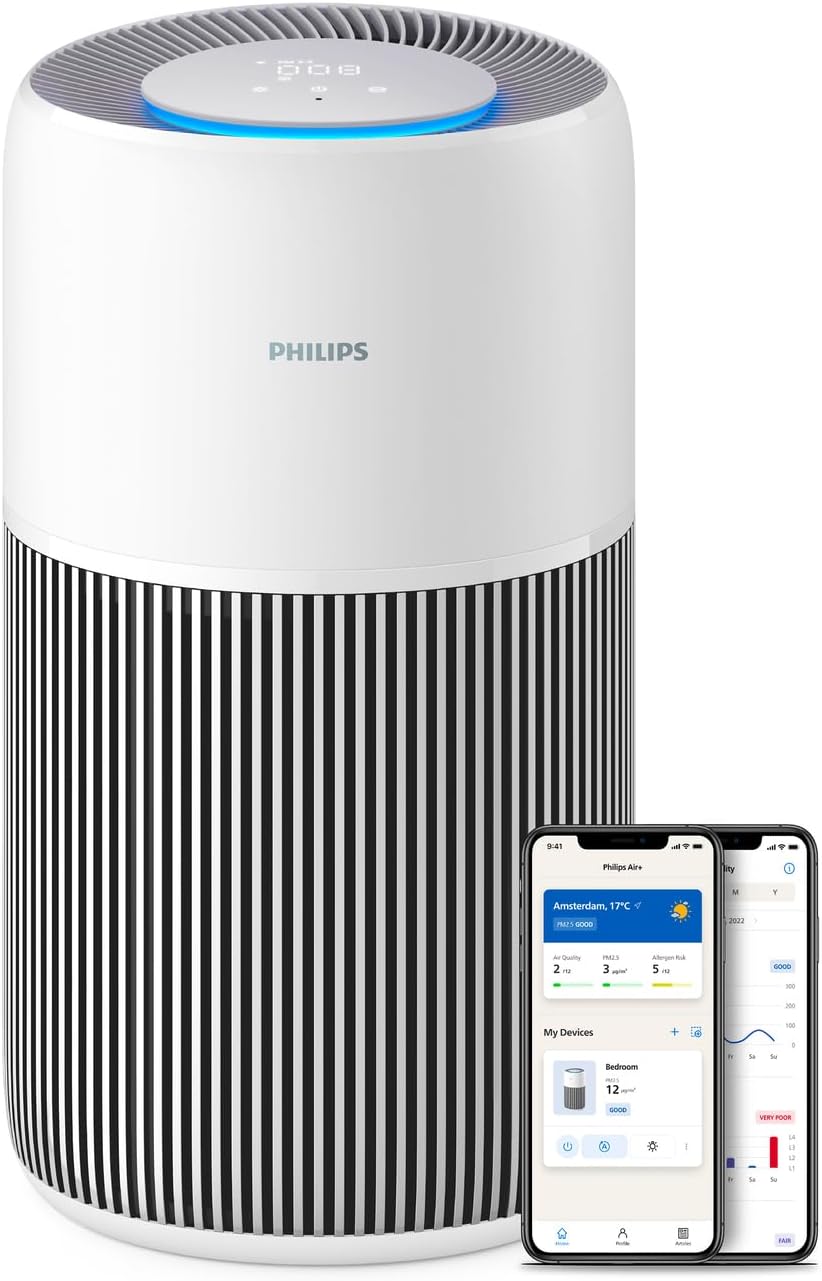
HEPA NanoProtect + active carbon | CADR 420 m³/h (Philips) | As quiet as 13 dB(A) (Philips) | Filter life alert | Sold by Amazon AU
Check the Philips 2200 Price on Amazon →Amazon AU price: $258.40 · as of 21 Nov 2026, 11:29 pm AEST DetailsOn paper this is the nearest match to the FX-J80J: a similar airflow class, a very quiet lowest speed and HEPA plus carbon, without depending on an ion feature. Philips’s 420 m³/h CADR and its 109 m² coverage claim come from the maker, and Philips does not use the AHAM test, so compare it on the sizer rather than on the box. Not for you if you want an AHAM-verified number to compare like for like.
Bedrooms, and the one I own: Coway Airmega 150
 Noise measured at home32.1 dBASilent mode at 1 m (my reading)
Pre-filter + carbon + HEPA | Smoke CADR 153 cfm (Coway) | No ioniser listed | Sold by Coway Australia
Check the Airmega 150 Price on Amazon →Amazon AU price: $199.00 · as of 22 Nov 2026, 5:43 am AEST DetailsThis is the purifier in my own 12.5 m² bedroom in Palm Beach. On Silent it read 32.1 dBA at one metre on the Decibel X app, and the pre-filter was visibly loaded with dust and dog hair after a month. It has no ion feature to worry about. Not for you if the room is over about 20 m²; the full write-up is in my Coway Airmega 150 review.
Value pick for bigger rooms: Levoit Core 402S

HEPA | CADR 433 m³/h (Levoit) | 38 W listed | App control | Sold by VeSync
Check the Core 402S Price on Amazon →Amazon AU price: $299.00 · as of 22 Nov 2026, 2:29 am AEST DetailsThe most clean air per dollar of the three, and sold by VeSync, the company behind Levoit. One flag: the Amazon AU listing title says “with Plasma”. If avoiding any ion or plasma feature is the reason you are reading this page, confirm with the seller what that feature is and whether it can be switched off before you buy.
- Owners of an FX-J80J who can buy genuine filters locally
- Buyers who find one new, from an Australian retailer, at a fair price
- You are buying the ion feature for health claims
- You would have to import one: power, warranty and filters all get harder
If you already own a Sharp
- Keep using it. Its HEPA filter is doing real work. Run it on a speed you can sleep with, and size by the sizer above rather than the 62 m² on the box.
- Buy genuine filters. For the FX-J80J, the HEPA filter is FZ-J80HFE and the deodorising filter is FZ-J80DFE. Appliances Online listed them at $167 and $141 on 10 Nov 2026.
- Vacuum the pre-filter. A clogged pre-filter cuts airflow, which cuts cleaning, whatever the ion count.
- Turn the ions off if they worry you. The filters work without them. Check your manual for the ion control on your model.
As a former Navy Clearance Diver I was trained to trust equipment that has been tested in conditions like the ones you will use it in. That is the whole case against paying extra for ions: the filters have that kind of evidence, and the ions, so far, do not.
Final verdict
The Sharp Plasmacluster is a good HEPA purifier wearing an unproven extra. Its HEPA filter and quiet low speed, on Sharp’s published figures, are real strengths. Its ion technology rests mostly on Sharp’s own tests, and in Australia you can no longer easily buy the FX-J80 new. If you own one, keep it and buy genuine filters. If you are shopping, the Philips 2200 is the nearest equivalent sold here, the Coway Airmega 150 is the quiet bedroom pick I use myself, and the Levoit Core 402S gives the most airflow for the money. For more HEPA picks and how to check a HEPA claim, see the best HEPA air purifiers in Australia and True HEPA vs H13 explained.
Prices change. Check Amazon AU before buying.
Frequently asked questions
Does Sharp Plasmacluster really work?
The purifier’s HEPA and carbon filters do work, as in any HEPA purifier. The Plasmacluster ion feature rests mainly on tests Sharp ran with partner institutes, and there is little independent evidence that it adds much in ordinary homes. Judge a Sharp on its filters and airflow.
Can you buy a Sharp air purifier in Australia?
Not easily as of 10 Nov 2026. Appliances Online lists the FX-J80 and FP-J50 as not available, and Amazon AU mainly shows Japanese import ion generators from third-party sellers. Replacement filters for the FX-J80J are still sold locally.
Does Sharp Plasmacluster produce ozone?
The US EPA says ionisers and plasma air cleaners may have the potential to emit ozone. Sharp USA lists the FX-J80UW as CARB certified, which means it met CARB’s 0.050 ppm ozone emission limit. If you are concerned, run it with the ion function off.
What are the limitations of Sharp Plasmacluster technology?
The ions act in the room rather than through a filter, their benefit in real homes is not well established independently, and ion technology in general can create unwanted by-products. In Australia, the bigger practical limits are availability and warranty support.
How big a room does the Sharp FX-J80J suit?
Sharp says up to about 62 m² on a Japanese 30-minute dust test, with 480 m³/h of maximum airflow. On the 4.8 air changes an hour rule, that airflow covers about 41 m² with a 2.4 m ceiling at most, and less in practice because CADR is lower than airflow.
Where can I buy Sharp FX-J80J filters in Australia?
Appliances Online listed the HEPA filter (FZ-J80HFE) at $167 and the deodorising filter (FZ-J80DFE) at $141 on 10 Nov 2026. Check the part number against your manual before ordering.
What is the best alternative to a Sharp air purifier in Australia?
The Philips 2200 (AC2220) is the closest match: HEPA plus carbon, 420 m³/h CADR by Philips’s figure and a very quiet low speed. For a bedroom, the Coway Airmega 150 is cheaper and sized for smaller rooms; it is the unit I run at home.
Are Sharp air purifiers good?
As HEPA purifiers, yes: the US FX-J80UW is AHAM tested with a 324 cfm smoke CADR. The question for Australians is not quality but supply: buy one only if you can get it, and its filters, from a local retailer.
- Sharp FX-J80J operation manual, specifications (page 15)
- Sharp USA, FX-J80UW product page (AHAM CADR, CARB certification)
- Sharp press release 04-026 (2004), Plasmacluster verification with the Kitasato Institute
- US EPA, Guide to Air Cleaners in the Home
- US EPA, Ozone Generators that are Sold as Air Cleaners
- Zeng et al. (2021), Evaluation of an in-duct bipolar ionization device on particulate matter and gas-phase constituents in a large test chamber, Building and Environment
- California Air Resources Board, list of CARB-certified air cleaning devices
- CHOICE, Sharp FX-J80J-W product listing (discontinued)
- Appliances Online, Sharp FX-J80-W listing and filters
- Philips 2200 Series (AC2220/10) listing, Amazon AU
- Levoit Core 402S listing, Amazon AU

Former Royal Australian Navy Clearance Diver and TAG-E counter-terrorism operator. Founded Clean and Native to apply the same rigorous thinking to the home environment.
Full biography →The 7-Room Home Audit
Air is where most homes have their biggest free fix. The audit walks every room: 38 checks across air, water and EMF, ranked by impact against Australian guidelines.
- The rangehood habit that cuts gas cooking fumes
- Two-minute tests for exhaust fans, mould and stale bedrooms
- When a purifier helps, and the bedroom one I own
We'll email you the audit and a short series of practical guides. Unsubscribe in one click, any time. Privacy.
Sent. Taking you to your download...