Air Purifier vs Air Conditioner: Do You Need Both? (Australia 2026)
An air conditioner cools your home — it does not clean your air. The filter inside your split system is a coarse G1 or G2 mesh rated to catch hair and lint, protecting the evaporator coil from damage. It captures almost nothing smaller than 10 microns, which means PM2.5 particles, smoke, pollen, mould spores, VOCs, and bacteria pass straight through. An air purifier with a true HEPA H13 filter removes 99.97% of particles at 0.3 microns — the size of wildfire smoke, fine pollen, and most airborne pathogens. For Australian households exposed to bushfire smoke season, high humidity, or urban air pollution, the honest answer is: yes, you need both.
Split systems and air purifiers do completely different jobs. Your AC controls temperature; an air purifier controls what you breathe. During bushfire smoke season, high-pollen months, or if you have allergies or children, running both is not optional — it is the minimum. The Levoit Core 400S covers bedrooms and smaller living spaces; the Breville Protect Max handles larger open-plan areas.
What Your Split System’s Filter Actually Does
Open the front panel of any Daikin, Mitsubishi Electric, or Fujitsu split system and pull out the filter. What you have in your hand is a coarse plastic mesh — usually rated G1 or G2 under Australian Standard AS 1324. That rating means it captures particles larger than 10 microns with moderate efficiency. Human hair averages 70 microns. A dust mite is around 200 microns. The filter catches these, protecting the evaporator coil from fouling and maintaining airflow efficiency. That is its entire purpose.
PM2.5 — fine particles smaller than 2.5 microns — passes through a G1/G2 filter with almost zero resistance. Wildfire smoke particles average 0.4–0.7 microns. Pollen ranges from 10–100 microns (some pollen passes through; ultrafine pollen fragments do not). VOCs — volatile organic compounds off-gassing from paint, flooring adhesives, and cleaning products — are gases with molecular sizes measured in nanometres. No mesh filter, regardless of grade, removes gases. The distinction matters enormously during bushfire events, renovation off-gassing periods, and high-allergy months across NSW, Victoria, and Queensland.
Some premium units — certain Daikin Ururu Sarara models and Panasonic Nanoe-X systems — do include supplementary PM2.5-capable filters or ionisation stages. These improve on a standard mesh significantly, but they still do not reach HEPA H13 efficiency (99.97% at 0.3 microns), and they do not include the activated carbon stage required to adsorb VOCs and odour compounds. They are better than nothing; they are not a substitute for a dedicated air purifier.
How an Air Purifier Works — and Why HEPA and CADR Are the Only Numbers That Matter
A true HEPA H13 filter is a dense mat of randomly arranged glass fibres. It removes 99.97% of airborne particles at 0.3 microns — the most penetrating particle size (MPPS), the point at which particles are hardest to capture. Particles both smaller and larger than 0.3 microns are captured more efficiently. This means a HEPA H13 filter removes PM2.5 smoke particles, mould spores (2–10 microns), pollen, dust mite allergen fragments, bacteria (0.3–10 microns), and most viruses when combined with other stages. This is a fundamentally different mechanism to an AC filter — it works by interception, impaction, and diffusion at the fibre level, not coarse mesh screening.
The second critical component is activated carbon. A quality air purifier includes several hundred grams of activated carbon granules or a carbon-impregnated filter layer. Activated carbon adsorbs VOCs through chemical bonding at the molecular level — the same VOCs your split system cannot touch. Formaldehyde from MDF furniture, benzene from cleaning products, toluene from paints, cooking fumes — activated carbon addresses all of these. If you have recently renovated, moved into a new build, or regularly use aerosol cleaning products indoors, activated carbon is not optional. Learn more about what VOCs are and why they matter in Australian homes.
CADR (Clean Air Delivery Rate) is the only metric that tells you how much clean air the unit actually delivers, measured in cubic metres per hour (m³/h). A unit with a CADR of 250 m³/h delivers 250 m³ of air free of smoke, pollen, and dust per hour. Divide the room volume by CADR and multiply by 60 to get the minutes per air change. For allergy sufferers or smoke events, target five or more complete air changes per hour. For a 30m² bedroom with 2.7m ceilings (81m³), a CADR of at least 405 m³/h is required for five ACH. The Levoit Core 400S delivers 260 m³/h — appropriate for that room at 3–4 ACH, which is adequate for everyday use. For smoke events, run it on high and close doors. For a detailed sizing guide, see our HEPA filtration guide.
The Australian Context: Bushfire Smoke, High Humidity, and Urban PM2.5
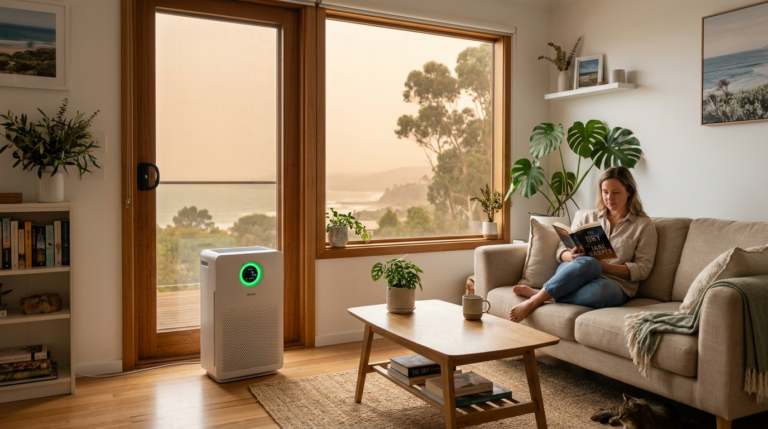
About 78% of Australian homes have air conditioning, according to ABS Household Energy Consumption data — one of the highest rates in the world. This creates a complacency risk: many households assume their AC is managing their air quality because it moves air and has a filter. It is not. During the Black Summer bushfires of 2019–20, the AQI in Sydney peaked at 2,467 — more than twelve times the hazardous threshold of 200. PM2.5 concentrations reached 748 µg/m³, compared to the NEPM daily standard of 25 µg/m³ and the WHO guideline of 15 µg/m³. Running a split system during these events recirculates smoke-contaminated indoor air through a coarse mesh filter and returns it to the room at slightly reduced temperature. A HEPA air purifier captures PM2.5 on each pass through the filter; your AC does not.
Humidity adds a separate layer of complexity in Brisbane, coastal Queensland, and northern New South Wales. High relative humidity — consistently above 60% — accelerates mould growth on surfaces and elevates airborne mould spore concentrations. Dust mite populations also peak in humid conditions, producing allergen particles concentrated in bedding, carpets, and upholstery. A split system in cooling mode dehumidifies moderately, which helps suppress mould and dust mite conditions. But it does not capture mould spores or dust mite allergen fragments already suspended in the air. A HEPA air purifier in the bedroom captures both. For households with a history of mould, see our guide to the best air purifiers for smoke events.
Urban households in Sydney, Melbourne, and Brisbane face elevated baseline PM2.5 from road traffic, construction dust, and industrial activity year-round. Homes within 500 metres of a major arterial road experience indoor PM2.5 concentrations measurably above background. In apartments without mechanical ventilation — very common in Brisbane and Sydney high-rises — opening windows during peak traffic hours imports polluted outdoor air. A HEPA air purifier running continuously keeps indoor concentrations below the NEPM standard regardless of what is happening outside. Your split system does not.
When You Need Both — and When You Might Not
You need both an air conditioner and an air purifier if any of the following apply: you live in NSW, VIC, or QLD within the bushfire smoke corridor; you or a family member has asthma, hay fever, or a respiratory condition; you have indoor pets; you have children under five or adults over 65 in the household; you live in a city apartment near a main road; or your home was recently renovated or built within the past five years. This is not a theoretical recommendation — it reflects the reality that your AC is controlling temperature while nothing in your home is controlling what you breathe.
The scenarios where an air conditioner alone may be adequate are narrow: a rural property with consistently clean outdoor air and no occupant health vulnerabilities, outside bushfire smoke season. Even then, indoor VOC sources — cooking, cleaning products, off-gassing furnishings — mean indoor air is rarely as clean as the outdoor baseline. The ABS reports that Australians spend approximately 90% of their time indoors. Indoor air quality is not a secondary concern.
An air purifier alone — without an air conditioner — is a valid setup for renters who cannot install split systems, or households in temperate climates where mechanical cooling is unnecessary. A good benchtop or floor-standing air purifier improves air quality independently of any HVAC system. The two appliances operate in parallel and do not interfere with each other. The air purifier filters the air; the AC conditions its temperature and humidity. Running both simultaneously is the standard approach in modern homes that take indoor air quality seriously.
The Best Air Purifiers to Run Alongside Your Split System
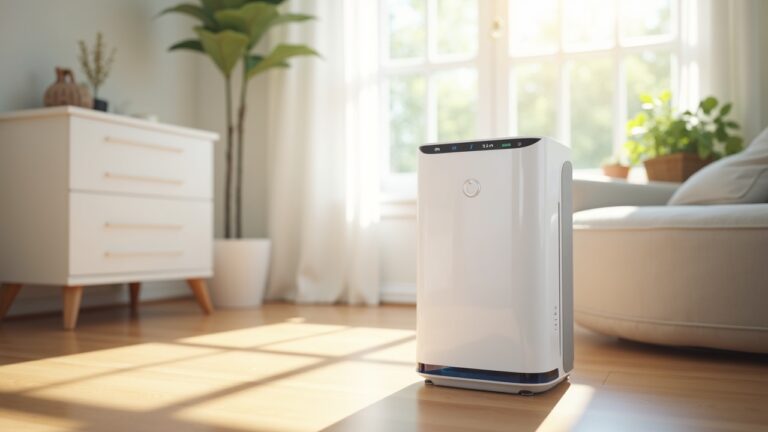
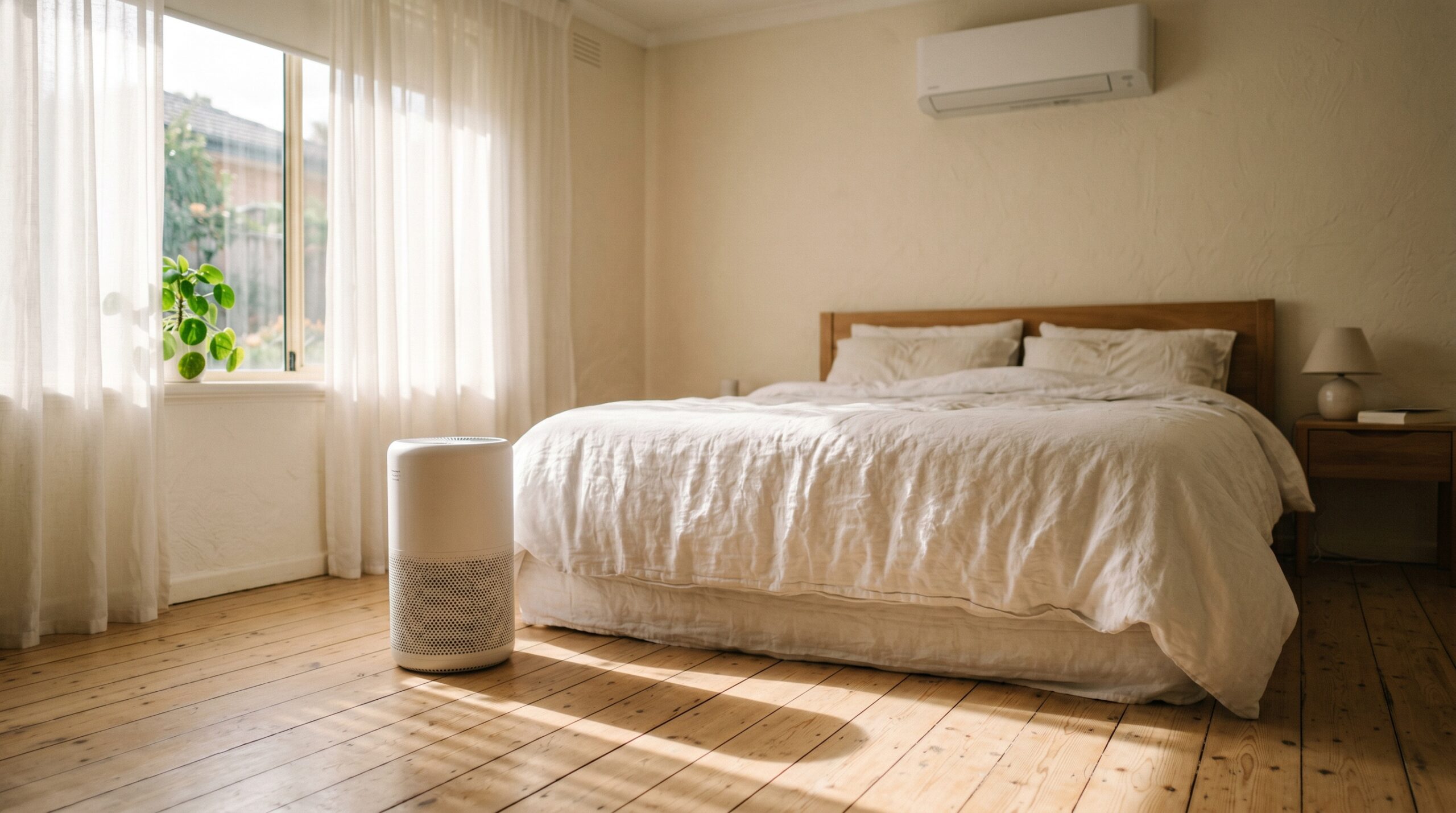
Position your air purifier to complement your split system, not compete with it. The AC distributes conditioned air across the room; the purifier draws room air through its filter on repeat passes. Place the purifier away from the AC outlet to avoid recirculating air before it has time to mix — ideally in the part of the room where you spend most time (beside a desk or bed), on the floor or a low surface where PM2.5 settles and concentrates.
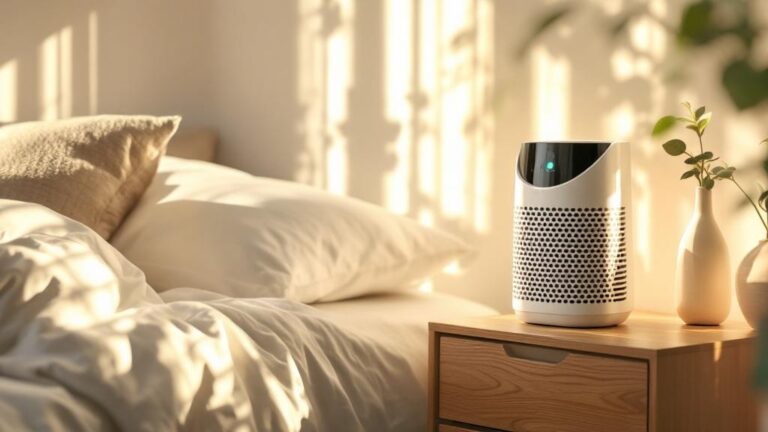
Levoit Core 400S (recommended for bedrooms and rooms up to 42m²) — CADR of 260 m³/h for smoke, 200 m³/h for pollen, 230 m³/h for dust. True HEPA H13 filter plus activated carbon. Built-in AQI sensor with auto mode adjusts fan speed to real-time air quality. Quiet at low settings — audible but not disruptive on auto. Connects to the VeSync app for scheduling and historical AQI tracking. For a full bedroom setup guide, see best air purifiers for Australian bedrooms.
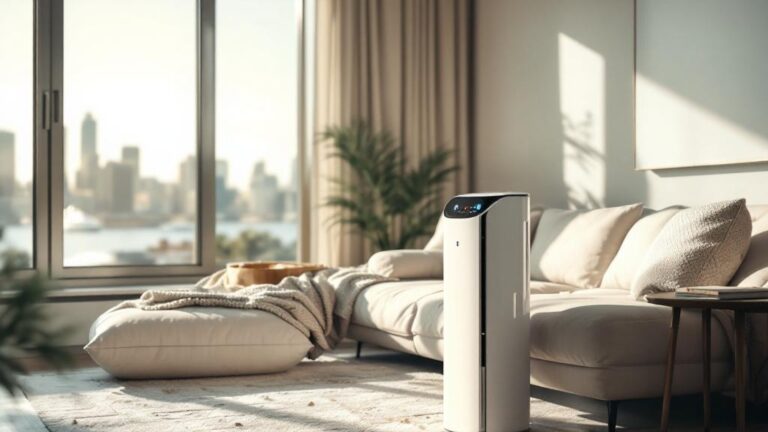
Breville Protect Max (recommended for open-plan living areas 50–70m²) — higher CADR suited to the larger volumes typical of open-plan kitchen-dining-living layouts, which are common in Australian homes built after 2000. Five-stage filtration including HEPA and activated carbon. Auto mode. Breville’s after-sales support is Australia-based, which matters for warranty claims and filter replacement availability. Replacement filters are stocked at major Australian retailers, avoiding the shipping delays common with imported-only brands.
Winix Zero Pro (recommended for households with pets or persistent odours) — HEPA H13 plus 2.2kg activated carbon stage, the largest carbon load in this price bracket. PlasmaWave ionisation neutralises odours at the molecular level without producing meaningful ozone when used as directed. Well-suited to households where pet dander and cooking odours compound fine particle contamination. Australian warranty coverage available.
Compare all three options
Decision Guide: What You Actually Need
Answer 3 questions to find your setup:
1. Do you live in NSW, VIC, or QLD within the bushfire smoke corridor?
→ Yes: an air purifier is not optional. Run it year-round on auto; high during smoke events.
→ No: proceed to question 2.
2. Does anyone in your household have asthma, hay fever, allergies, or respiratory issues?
→ Yes: HEPA air purifier in the bedroom as a minimum. See bedroom air purifier guide.
→ No: proceed to question 3.
3. Do you live in a coastal QLD/NSW location with high humidity, or an urban apartment near a main road?
→ Yes: air purifier addresses mould spores, dust mites, and urban PM2.5 that your AC cannot.
→ No: you are in the narrow category where AC alone may be adequate — but monitor indoor air quality and reassess during smoke season.
Final Verdict
The comparison between an air purifier and an air conditioner is not a competition — they are two separate tools solving two separate problems. Your split system controls temperature and reduces humidity; it does not filter PM2.5, remove smoke, capture pollen or mould spores, or adsorb VOCs. For the vast majority of Australian households — particularly those in bushfire-corridor states, coastal humidity zones, and urban apartments — running both is the only way to control both temperature and air quality simultaneously.
If you are starting from scratch, put the air purifier in your bedroom first. You spend eight hours there unconscious with no control over what you breathe. The Levoit Core 400S is the most cost-effective HEPA H13 unit for that purpose in Australia at this price point. For living areas, the Breville Protect Max is the better call. Neither requires any modification to your split system — they simply run alongside it.
Start with the bedroom.
8 hours unconscious. No control over what you breathe. Fix that first.
Last reviewed: May 2026 — Clean and Native
Frequently Asked Questions
Does an air conditioner filter the air?
In a limited sense, yes — but not in any way that improves air quality for health purposes. The filter in a standard split system is a G1 or G2 coarse mesh rated to catch large particles like hair and lint. It is designed to protect the evaporator coil, not to remove PM2.5, smoke, pollen, mould spores, or VOCs. It will not capture any particle smaller than approximately 10 microns with reliability.
Can I run an air purifier and air conditioner at the same time?
Yes. They operate completely independently. The AC moves and conditions air (temperature and humidity); the air purifier draws air through a HEPA filter on continuous passes. Running both simultaneously is the standard approach in households that want both temperature control and clean air. Place the purifier away from the AC outlet so it processes room air rather than immediately recirculating air from the AC.
Does an air conditioner help with smoke from bushfires?
No. Running your split system during a smoke event does not filter PM2.5 from wildfire smoke. The coarse mesh filter in a split system allows smoke particles (averaging 0.4–0.7 microns) to pass through freely. If outdoor air quality is poor, close all windows and doors and run a HEPA air purifier on its highest setting. Only a HEPA H13 or H14 filter removes PM2.5 from smoke at meaningful efficiency.
How many air purifiers do I need for a whole house?
One per occupied room is the most effective approach, but prioritise the bedroom first. You spend more time in your bedroom than any other single room, and you have no conscious control over your breathing during sleep. A unit sized for the bedroom is the highest-return-per-dollar installation. Add a second unit for the main living area. Open-plan areas require a higher CADR unit; closed bedrooms can be served by medium-CADR models like the Levoit Core 400S.
Does an air purifier help with dust?
Yes, significantly. Settled dust is disturbed by foot traffic, vacuuming, and air movement and becomes briefly airborne — at which point a HEPA filter captures it on pass-through. Running an air purifier continuously reduces the total dust load in the room over time. A unit with a pre-filter stage (most quality purifiers include one) captures larger dust particles before they reach and clog the HEPA layer, extending HEPA filter life.
What does CADR mean and why does it matter?
CADR stands for Clean Air Delivery Rate — the volume of clean air an air purifier delivers per hour, measured in cubic metres (m³/h). A higher CADR means the unit processes more air per hour. To size correctly, divide your room volume (length × width × ceiling height) by the CADR and multiply by 60 to get the minutes per full air change. Target at least 4 air changes per hour for everyday use; 5+ for smoke events or allergy sufferers.
Can an air purifier replace an air conditioner?
No. An air purifier does not heat, cool, or dehumidify the air. It only filters airborne particles and, if it includes an activated carbon stage, adsorbs gases and VOCs. For temperature control in Australian summers, a split system or other cooling system is still required. The two appliances address different problems and are not interchangeable.
Is it worth buying an air purifier if I already have a ducted air conditioning system?
Yes. Ducted systems typically use higher-grade filters than split systems — some are fitted with MERV-8 to MERV-11 filters — but these still do not match HEPA H13 efficiency. More importantly, ducted systems condition air throughout the house on a fixed cycle; a dedicated air purifier in the bedroom or living room provides continuous filtration at much higher air change rates in the specific spaces where you spend the most time. Many households with ducted AC still add bedroom air purifiers for this reason.
Get the Australian Home Environment Checklist
30 checks across water, air and EMF. Most of them free. Ranked by impact.
No spam. Unsubscribe any time.

Former Royal Australian Navy Clearance Diver and TAG-E counter-terrorism operator. Founded Clean and Native to apply the same rigorous thinking to the home environment.
Full biography →