Aranet4 CO2 Monitor Review Australia 2026
The Aranet4 HOME is an NDIR (non-dispersive infrared) CO2 monitor that measures actual carbon dioxide concentration in parts per million — not a VOC proxy, not an estimate, not a guess. At $325 AUD from CO2 Radical, it is the most widely recommended portable CO2 sensor for indoor air quality monitoring in Australian homes, schools, and offices, assessed using our documented methodology.
The Aranet4 HOME is the gold standard portable CO2 monitor for Australian homes, rated 4.3/5 on Trustpilot (February 2026), and uses genuine NDIR sensing rather than the VOC-proxy method found in cheaper units. Its four-year battery life on two AA cells eliminates charging anxiety and makes it actually portable — move it from bedroom to home office to classroom without a cable. However, at $325 AUD it costs 3-5x more than eCO2/TVOC-based monitors that cannot actually measure real CO2. For users who also need PM2.5, VOC, and multi-pollutant monitoring, a dedicated HEPA air purifier with an integrated sensor or a separate particulate monitor is required — the Aranet4 measures CO2, temperature, humidity, and atmospheric pressure only.
Key catches
- No PM2.5 or VOC sensor — CO2, temperature, humidity, and barometric pressure only
- No Wi-Fi — Bluetooth only, requires phone within range for app data logging
- $325 AUD is steep for a single-parameter air quality device — justified only by NDIR accuracy
- E-ink display is not backlit — difficult to read in dark rooms
✓ Who This Is For
- Parents who want to verify classroom ventilation before their kids sit in it 6 hours a day
- Work-from-home professionals in sealed, climate-controlled apartments in Sydney, Melbourne, or Brisbane
- Anyone with gas cooking or unflued gas heating who wants real-time combustion byproduct awareness
- Teachers, childcare operators, and small business owners who need a portable, battery-powered monitor with no installation
- Health-conscious households who want data, not guesswork, on bedroom ventilation during sleep
× Who It Is Not For
- If you need PM2.5, VOC, and multi-pollutant monitoring — the Aranet4 does not measure particulates. You need an air purifier with integrated sensor or a separate PM2.5 monitor
- If you want Wi-Fi cloud logging and smart home integration — Bluetooth-only range limits data access to phone proximity
- Budget-constrained households — $325 AUD is 3-5x the price of basic monitors (but those basic monitors do not measure real CO2)
- If you want a backlit display for dark bedrooms — the e-ink screen has no illumination
- Commercial HVAC professionals who need continuous networked monitoring across multiple zones — look at the Aranet4 PRO or AirGradient Open Air
Why CO2 Monitoring Matters in Australian Homes
You cannot smell, see, or taste carbon dioxide. But above 1,000 ppm, peer-reviewed research published in Environmental Health Perspectives (2012, Harvard/Syracuse) links elevated indoor CO2 to measurable cognitive impairment — decision-making performance dropped by 11-23% at 1,000 ppm and by up to 50% at 2,500 ppm compared to 600 ppm baseline. That is not a theoretical concern. That is your kid sitting in a Brisbane classroom in February with 30 other children, windows closed against the heat, the air-conditioning recirculating the same air, and CO2 climbing above 1,500 ppm before morning tea.
CO2 concentration is also the single most practical proxy for airborne infection risk. According to research cited by the Australian Government’s National COVID-19 Health Management Plan, poorly ventilated indoor spaces with CO2 above 800 ppm carry significantly elevated aerosol transmission risk. Opening a window is free. But you cannot manage what you cannot measure — and without a monitor, you are guessing whether that window made a difference.
Australian homes present specific ventilation challenges. Gas cooktops — still standard in approximately 38% of Australian households according to the ABS 2022 Energy Use and Conservation data — generate CO2 as a direct combustion byproduct. Unflued gas heaters, common in Victorian and Tasmanian homes, can push bedroom CO2 above 3,000 ppm within an hour. Modern energy-efficient homes built to the NCC 2022 standard are sealed tighter than ever. That is good for energy bills. It is bad for air exchange rates unless mechanical ventilation is operating correctly.
A CO2 monitor removes the guesswork. It tells you, in real time, whether your bedroom ventilation is adequate during sleep, whether your home office is accumulating stale air, and whether opening a single window actually brought CO2 below 800 ppm. The question is not whether CO2 monitoring matters. The question is whether your monitor is measuring real CO2 or lying to you.
NDIR vs eCO2: Most “CO2 Monitors” Do Not Measure CO2
This is the single most important fact in the entire CO2 monitor market, and most buyers do not know it. The Aranet4 uses a Non-Dispersive Infrared (NDIR) sensor — a purpose-built optical component that shines infrared light through a sample chamber and measures how much light is absorbed at the 4.26-micrometre wavelength specific to CO2 molecules. This is a direct, physics-based measurement of actual CO2 concentration. The Aranet4’s Sunrise NDIR sensor (manufactured by Senseair, a Swedish company now part of Asahi Kasei) is specified at ±50 ppm accuracy or ±3% of reading, whichever is greater.
Most monitors sold on Amazon AU under $150 do not contain an NDIR sensor. They contain a Metal Oxide Semiconductor (MOX) VOC sensor that detects volatile organic compounds — cooking fumes, cleaning products, body odour, perfume — and runs an algorithm to estimate what CO2 might be based on the assumption that human occupancy is the primary source of both VOCs and CO2. The output is labelled “eCO2” (equivalent CO2). It is a guess.
The practical difference is enormous. Spray deodorant in a room with an eCO2 sensor and the reading spikes to 2,000+ ppm even though actual CO2 has not changed. Open a window in a room with cooking VOCs and the eCO2 reading drops even if CO2 remains elevated from a running gas burner. The eCO2 number is measuring the wrong thing, correlating it with the right thing under ideal conditions, and giving you false confidence the rest of the time.
For Australian households with gas cooking — where you actually need to know whether combustion is pushing real CO2 (and co-released NO2) to dangerous levels — an eCO2 sensor is worse than useless. It might show elevated readings from cooking fumes (VOCs from food) while completely missing the CO2 and NO2 generated by the gas flame itself. The NDIR sensor in the Aranet4 does not have this confusion. It measures CO2 and nothing else.
| Feature | NDIR (Aranet4) | eCO2 / MOX (Budget Units) |
|---|---|---|
| What it measures | Actual CO2 via IR absorption | VOCs, then estimates CO2 |
| Accuracy | ±50 ppm (manufacturer spec) | ±100-400 ppm typical deviation |
| Gas cooking false reading | No — reads real CO2 from combustion | Yes — cooking VOCs cause false spikes |
| Deodorant/cleaning spray | No response (not CO2) | Massive false spike |
| Typical AU price | $250-$350 AUD | $50-$120 AUD |
| Outcome for you | Trustworthy ventilation data | Numbers that feel useful but are not |
Product Specifications: What the Aranet4 HOME Measures
The Aranet4 HOME (model number SAF510) is manufactured by SAF Tehnika AS, a Latvian company listed on the Nasdaq Riga stock exchange. It is not a startup product. SAF Tehnika has manufactured microwave radio equipment since 1999 and pivoted into indoor air quality monitoring in 2019. The Aranet4 HOME carries CE marking and has been independently validated by multiple institutions including the National Physical Laboratory (UK) and referenced in peer-reviewed studies on indoor air quality monitoring.
The unit measures four parameters:
- CO2 concentration: 0-9,999 ppm range, ±50 ppm or ±3% of reading accuracy. Senseair Sunrise NDIR sensor. Measurement interval adjustable from 1 to 10 minutes (longer intervals extend battery life).
- Temperature: 0°C to 50°C, ±0.3°C accuracy. Useful for verifying thermostat accuracy and monitoring room thermal comfort.
- Relative humidity: 0-85% RH, ±3% RH accuracy. Critical for Australian mould risk assessment — sustained RH above 60% in Brisbane, Cairns, and coastal NSW homes promotes mould growth.
- Atmospheric pressure: 0.3-1,100 mbar range, ±1 mbar accuracy. Less immediately useful for most households but relevant for weather-sensitive individuals and altitude-aware applications.
The display is a 2.9-inch e-ink screen — the same technology used in Kindle e-readers. E-ink consumes zero power when displaying a static image, which is why the Aranet4 achieves its extraordinary battery life. The screen includes a traffic-light colour indicator: green below 1,000 ppm, yellow from 1,000-1,399 ppm, red at 1,400 ppm and above. This threshold system aligns with the ventilation guidance used by multiple Australian state education departments for classroom CO2 monitoring.
Battery life is the headline specification. The manufacturer claims up to 4 years on two standard AA batteries at the default 2-minute measurement interval, according to Aranet’s published specifications. Even at the most aggressive 1-minute interval, battery life is rated at approximately 2 years. No charging cables. No USB ports. No proprietary battery packs. Two AA Energizers from the servo and you are set for years. At $325 AUD over a 4-year battery cycle, that is $81 per year — $0.22 per day — for continuous, accurate CO2 monitoring. Cheaper than a daily takeaway coffee by a factor of twenty.
Connectivity is Bluetooth 4.2 Low Energy only. No Wi-Fi. The Aranet4 HOME app (iOS and Android) connects via Bluetooth for real-time data viewing, historical graphing, and CSV data export. The Bluetooth-only design is deliberate — it eliminates the power draw of a Wi-Fi radio and is part of why the battery lasts years rather than months. The trade-off is clear: no remote cloud access, no smart home integration, no Alexa or Google Home voice readouts. If you want networked multi-room monitoring, the Aranet4 PRO base station (sold separately, approximately $400-500 AUD) collects data from up to 100 Aranet4 sensors wirelessly. For most households, the phone app is sufficient.
Physical dimensions: 70 × 70 × 24 mm. Weight: 50 grams without batteries. It fits in a shirt pocket. This portability is not trivial — it means you can carry it to your child’s classroom, your GP waiting room, your yoga studio, your office, and get a real reading in every space. Wired, plugged-in monitors stay on one shelf. The Aranet4 goes where you go.
Australian Use Cases: Where the Aranet4 Earns Its Price
The Aranet4 is not a gadget that sits on a shelf looking interesting. Its value comes from the specific Australian scenarios where invisible CO2 accumulation creates measurable health and cognitive risks — and where a real-time reading changes your behaviour.
Gas Cooking and Unflued Gas Heating
According to the ABS 2022 Energy Use and Conservation survey, approximately 38% of Australian households use gas for cooking. In Victoria and parts of NSW, unflued gas heaters remain common in older homes. Both appliances generate CO2, carbon monoxide, nitrogen dioxide, and formaldehyde as combustion byproducts. A 2023 study published in the Medical Journal of Australia linked childhood asthma exacerbations to gas cooktop use in Australian homes — with an estimated 12.3% of childhood asthma burden attributable to gas cooking exposure.
The Aranet4 does not measure NO2 or CO — but it does measure CO2, which serves as a reliable proxy for overall combustion byproduct concentration. If CO2 spikes above 1,500 ppm during cooking, you know your rangehood extraction is inadequate and the other combustion gases are elevated proportionally. That data point changes behaviour: you open a window, you run the rangehood on high, or you start the process of switching to induction. Without the data, you are cooking in ignorance.
Home Offices and WFH Setups
If you work from home in a sealed apartment in inner Sydney, Melbourne, or Brisbane, your home office CO2 can climb above 1,500 ppm within 2-3 hours of closed-door work. The Harvard/Syracuse research documented that decision-making scores dropped by 50% at 2,500 ppm compared to 600 ppm baseline. You are not imagining the afternoon brain fog. Your room is suffocating you slowly, and a $325 monitor will tell you exactly when to open the window. The productivity value of maintaining CO2 below 800 ppm during deep work is, for anyone billing hourly, worth multiples of the device cost.
Schools and Childcare Centres
Multiple Australian state education departments — including NSW, Victoria, and Queensland — deployed CO2 monitors in classrooms during 2021-2023 as part of COVID-19 ventilation assessments. The Aranet4 was among the devices specifically referenced in several state government procurement guides. A portable, battery-powered unit that a parent or teacher can place on a desk, read the traffic-light display at a glance, and take home the data on their phone is operationally ideal for this context. No installation. No IT department approval. No power outlet required.
Bedrooms During Sleep
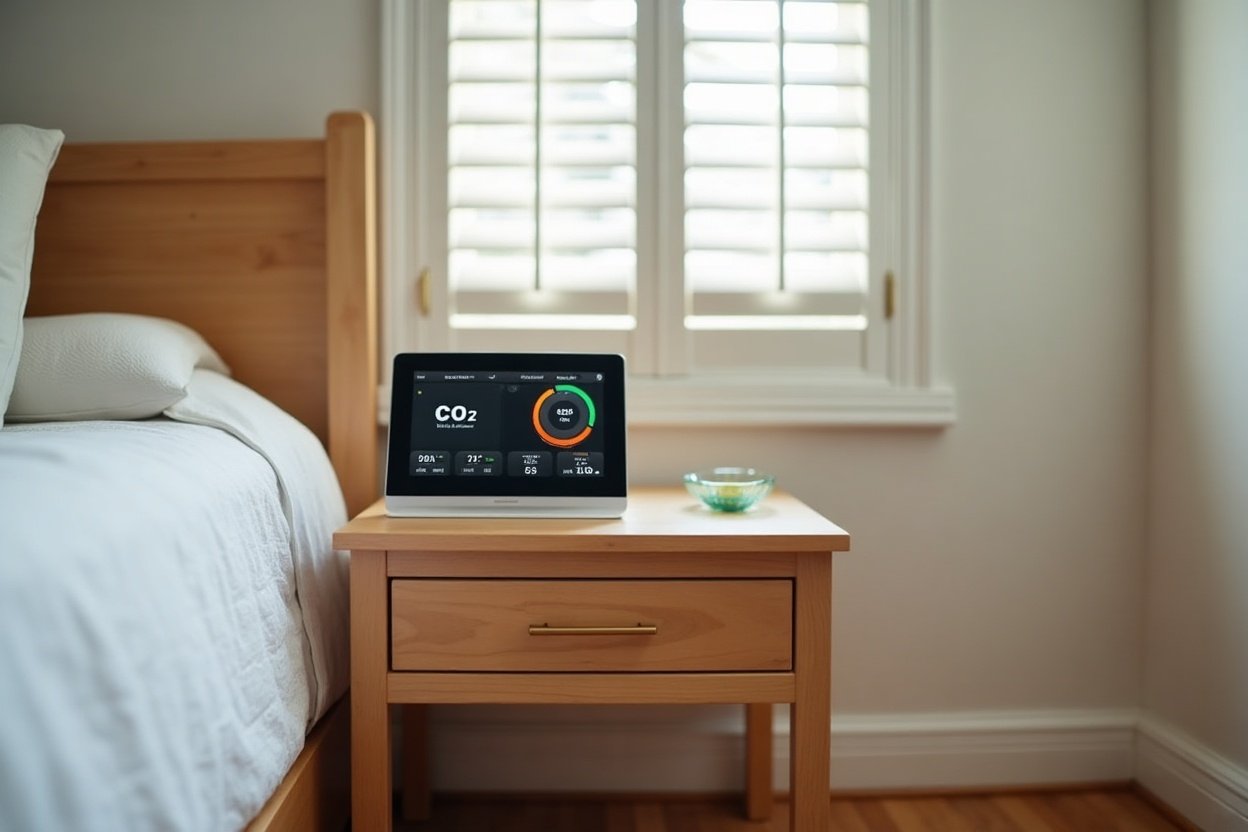
A sealed bedroom with two adults can exceed 2,000 ppm CO2 by 3 AM. Research published in Indoor Air (2016, Technical University of Denmark) found that lower bedroom CO2 (below 800 ppm) correlated with better next-day cognitive performance, fewer reported sleep disturbances, and lower next-morning sleepiness scores. In Brisbane, Cairns, and Darwin — where you close windows against humidity and insects — bedroom CO2 accumulates faster than in temperate climates where windows stay cracked. The Aranet4’s e-ink display stays on continuously without light emission, so it will not disturb sleep. Check it first thing in the morning, and you will know whether your bedroom ventilation strategy is working. If readings are consistently above 1,200 ppm, pairing the Aranet4 with a H13 HEPA air purifier rated for your bedroom size addresses both particle load and CO2 simultaneously — the purifier recirculates filtered air, and that recirculation helps distribute fresh air when you crack a window.
What the Aranet4 Does Well
Accuracy you can trust. The NDIR sensor is specified at ±50 ppm or ±3% of reading. Independent validation by the UK National Physical Laboratory and multiple university research groups has confirmed that the Aranet4 consistently tracks within specification against laboratory-grade reference instruments. When the display reads 1,200 ppm, the actual concentration is between 1,150 and 1,250 ppm. That precision is sufficient for every ventilation decision a household or school needs to make.
Battery life that eliminates maintenance. Four years on two AA batteries at default intervals is not marketing spin — it is a consequence of the e-ink display (zero static power draw), Bluetooth Low Energy (milliwatt-level transmission), and an NDIR sensor designed for low-power operation. Contrast this with wired monitors that need a USB cable or internal lithium battery that degrades over 12-18 months. The Aranet4 is the only portable CO2 monitor on the Australian market where “set and forget” actually describes the ownership experience.
Traffic-light simplicity. Green, yellow, red. Anyone can read it. A teacher glancing across a classroom. A parent checking on a sleeping child’s room. A café owner confirming ventilation compliance. No interpretation required. The 1,000/1,400 ppm thresholds align with international ventilation guidance and Australian state education department recommendations.
Genuine portability. At 70 × 70 × 24 mm and 50 grams, it is smaller than a deck of cards. Slip it into a bag, take it to work, bring it home. Most wired monitors are desk-bound — the Aranet4’s portability means one device can audit every space you occupy.
What Could Be Better
No PM2.5 measurement. If you live in bushfire-prone areas of NSW, Victoria, or south-east Queensland, particulate matter during smoke season (October-March) is your primary indoor air quality threat. The Aranet4 does not measure PM2.5. You need a separate particulate monitor or a HEPA air purifier with integrated PM2.5 sensing for that job. The Aranet4 solves the CO2 problem. It does not pretend to solve the particulate problem.
Bluetooth-only connectivity. No Wi-Fi means no remote access, no cloud dashboards, no smart home automation triggers. If you want to set an automation that turns on a bathroom exhaust fan when CO2 exceeds 1,000 ppm, the Aranet4 cannot do that natively. The Aranet4 PRO base station adds networked capability but at significant additional cost (~$400-500 AUD). For a single-room household use case, the phone app is adequate. For multi-room commercial deployment, this is a genuine limitation.
E-ink display is not backlit. The e-ink screen is excellent in daylight and adequate in normal room lighting. In a dark bedroom at 2 AM, you cannot read it without a torch. This is a deliberate trade-off for the 4-year battery life — adding a backlight would reduce battery life by 80% or more. But it is still annoying when you want a midnight check.
Price. $325 AUD is a lot for a device that measures one gas. The value proposition rests entirely on NDIR accuracy. If you do not understand why eCO2 sensors are unreliable (see the section above), the price feels unjustified. Once you understand the sensor technology difference, $325 for years of accurate, portable CO2 data is reasonable. But it is not cheap, and it requires the buyer to be informed.
How It Compares: Aranet4 vs Alternatives
The CO2 monitor market splits into three tiers: NDIR portables (Aranet4, Temtop M2000, AirGradient), NDIR desk units (Vaisala, CO2Meter), and eCO2/MOX devices (most Amazon sub-$150 units). Only the first two categories are measuring real CO2. The third category is measuring VOCs and calling it CO2.
| Monitor | Sensor | Battery | PM2.5 | Connectivity | AU Price | Verdict |
|---|---|---|---|---|---|---|
| Aranet4 HOME | NDIR (±50 ppm) | 4 years (2× AA) | No | BLE only | $325 | Best portable NDIR |
| AirGradient ONE | NDIR (Senseair S8) | USB-C powered | Yes (PMS5003T) | Wi-Fi + open API | ~$250-300 (import) | Best multi-sensor desk unit |
| Amazon sub-$100 units | eCO2/MOX (VOC proxy) | Varies | Some claim yes | Varies | $50-120 | Not measuring real CO2 |
The AirGradient ONE is the most interesting alternative. It uses a Senseair S8 NDIR sensor (same manufacturer as the Aranet4’s Sunrise sensor, different model), adds a Plantower PMS5003T particulate sensor for PM2.5 measurement, includes Wi-Fi with an open-source API for home automation integration, and costs approximately $250-300 AUD imported. The trade-off: it requires USB-C power, it is not portable, and it is a self-assembly kit (soldering optional but recommended). If you want a fixed desk monitor with PM2.5 + CO2 + Wi-Fi, the AirGradient ONE is a strong choice. If you want grab-and-go portability with zero maintenance, the Aranet4 wins.
Sub-$100 eCO2 monitors from brands like Temtop (lower-tier models), Vson, and unbranded Amazon sellers are not alternatives to the Aranet4. They are not measuring the same thing. Comparing them is like comparing a breathalyser to a mood ring — one measures a specific physical quantity, the other gives you a vague feeling. If the listing does not explicitly state “NDIR sensor” in the technical specifications, assume it is eCO2/MOX and move on.
Battery Life ROI: The 4-Year Cost Calculation
The Aranet4’s 4-year battery life is not just a convenience feature. It is a cost structure advantage. Here is how it compares to alternatives that require USB power or rechargeable batteries:
| Item | Aranet4 HOME | Wired NDIR Monitor | eCO2 Budget Unit |
|---|---|---|---|
| Upfront cost | $325 | $250-300 | $80 |
| 4-year running cost | $5 (one set AA batteries) | $0 (USB power from existing outlet) | $0-10 |
| 4-year total | $330 | $250-300 | $80-90 |
| Cost per day | $0.23 | $0.17-0.21 | $0.05-0.06 |
| Measures real CO2? | Yes | Yes | No |
| Portable? | Yes | No (tethered) | Varies |
At $0.23 per day over four years, the Aranet4 costs less than a single macadamia from the bulk bin at Woolworths. The eCO2 unit at $0.06 per day is cheaper — but it is not measuring CO2. You are paying $0.06 per day for fictional data. The value calculation is not “Aranet4 vs budget monitor.” It is “accurate CO2 data vs no CO2 data.” And the cost of no data — leaving your gas cooktop running without adequate ventilation, sleeping in a bedroom at 2,500 ppm, working through an afternoon with impaired cognition — compounds invisibly.
CO2 Thresholds: What the Numbers Mean for You
Understanding what the Aranet4’s readings mean requires a reference framework. These thresholds are derived from ASHRAE Standard 62.1 (ventilation for acceptable indoor air quality), the Harvard-BUSRP research, and Australian state education department guidance:
| CO2 Level | Aranet4 Colour | What It Means | Action |
|---|---|---|---|
| 400-600 ppm | Green | Outdoor-equivalent. Excellent ventilation. | None needed. |
| 600-800 ppm | Green | Good indoor air. Low aerosol risk. | Maintain current ventilation. |
| 800-1,000 ppm | Green/Yellow | Adequate but declining. Aerosol risk increasing. | Consider opening a window or door. |
| 1,000-1,400 ppm | Yellow | Stuffy. Cognitive impairment measurable. Aerosol risk elevated. | Open windows. Turn on exhaust fan. |
| 1,400-2,000 ppm | Red | Poor ventilation. Significant cognitive impairment. High aerosol risk. | Immediate ventilation action required. |
| 2,000+ ppm | Red (flashing) | Dangerous. Headaches, drowsiness, impaired judgement. | Leave room. Ventilate fully before reoccupying. |
For Australian homes specifically: if you run a gas cooktop without a rangehood and the Aranet4 shows yellow within 10 minutes of cooking, your kitchen extraction is inadequate. If your bedroom reads above 1,200 ppm by midnight with the door closed, you need to crack a window or leave the bedroom door open. These are simple, free actions — but you cannot take them without the data that tells you they are necessary. The Aranet4 turns invisible air quality into visible, actionable numbers.
Final Verdict
The Aranet4 HOME is the most reliable portable CO2 monitor available in Australia.
Its NDIR sensor measures actual CO2 at ±50 ppm accuracy. Its 4-year battery life on two AA cells makes it actually portable. Its traffic-light e-ink display makes readings instantly actionable. At $325 AUD, it costs $0.23 per day over its battery life — less than a quarter of the price of a daily flat white — for data that directly changes how you ventilate your home, office, and your children’s classroom.
Buy it if: You want accurate, portable CO2 monitoring for gas cooking environments, WFH offices, bedrooms, or school classrooms. You want a device that works for years without charging or maintenance.
Look elsewhere if: You need PM2.5 monitoring for bushfire smoke season — the Aranet4 does not measure particulates. You need Wi-Fi cloud access or smart home integration — Bluetooth only. You want a multi-pollutant dashboard — the AirGradient ONE is the better fixed-install option for that use case.
The worst outcome: you buy it, find your indoor air is fine, and gain peace of mind. The more likely outcome: you discover your bedroom hits 1,500+ ppm by 2 AM, open a window, and sleep better than you have in months. Either way, you stop guessing.
The Aranet4 HOME: $0.23/day for air you can actually measure.
NDIR sensor, ±50 ppm accuracy, 4-year battery, 50-gram portable design. Available from Amazon AU and CO2 Radical Australia.
Last reviewed: July 2026 – Clean and Native
The Breville Protect Max is the benchmark air purifier for Australian homes.
550 CADR, H13 HEPA, activated carbon stage, and CADR/m² ratio that outperforms Dyson at the same price. Available on Amazon AU.
Frequently Asked Questions
Does the Aranet4 measure real CO2 or estimated CO2?
The Aranet4 HOME uses a Senseair Sunrise NDIR (non-dispersive infrared) sensor that measures actual CO2 concentration via infrared light absorption at 4.26 micrometres. It does not use a VOC proxy or eCO2 estimation algorithm. The manufacturer specifies accuracy at ±50 ppm or ±3% of reading.
Where can I buy the Aranet4 in Australia?
The Aranet4 HOME is available from CO2 Radical Australia at $325 AUD with local stock and shipping, and from Amazon AU (ASIN B07YY7BH2W). Both sources ship within Australia.
How long does the Aranet4 battery last?
According to the manufacturer, the Aranet4 HOME runs for up to 4 years on two standard AA batteries at the default 2-minute measurement interval. At the most frequent 1-minute interval, battery life is rated at approximately 2 years.
What is a safe indoor CO2 level in Australia?
Below 800 ppm is considered good indoor air quality with low aerosol transmission risk, per ASHRAE Standard 62.1 and Australian state education department guidance. Above 1,000 ppm, peer-reviewed research links elevated CO2 to measurable cognitive impairment. Above 1,400 ppm, immediate ventilation action is recommended.
Does the Aranet4 measure PM2.5 or bushfire smoke?
No. The Aranet4 HOME measures CO2, temperature, humidity, and atmospheric pressure only. It does not contain a particulate sensor. For PM2.5 monitoring during bushfire season (October-March in NSW, VIC, and QLD), a separate particulate monitor or a HEPA air purifier with an integrated PM2.5 sensor is required.
{“@context”:”https://schema.org”,”@type”:”FAQPage”,”mainEntity”:[{“@type”:”Question”,”name”:”Does the Aranet4 measure real CO2 or estimated CO2?”,”acceptedAnswer”:{“@type”:”Answer”,”text”:”The Aranet4 HOME uses a Senseair Sunrise NDIR sensor that measures actual CO2 concentration via infrared light absorption at 4.26 micrometres. It does not use a VOC proxy or eCO2 estimation. The manufacturer specifies accuracy at \u00b150 ppm or \u00b13% of reading.”}},{“@type”:”Question”,”name”:”Where can I buy the Aranet4 in Australia?”,”acceptedAnswer”:{“@type”:”Answer”,”text”:”The Aranet4 HOME is available from CO2 Radical Australia at $325 AUD with local stock, and from Amazon AU (ASIN B07YY7BH2W). Both ship within Australia.”}},{“@type”:”Question”,”name”:”How long does the Aranet4 battery last?”,”acceptedAnswer”:{“@type”:”Answer”,”text”:”The Aranet4 HOME runs for up to 4 years on two standard AA batteries at the default 2-minute measurement interval. At the most frequent 1-minute interval, battery life is approximately 2 years.”}},{“@type”:”Question”,”name”:”What is a safe indoor CO2 level in Australia?”,”acceptedAnswer”:{“@type”:”Answer”,”text”:”Below 800 ppm is considered good indoor air quality per ASHRAE Standard 62.1 and Australian state education department guidance. Above 1,000 ppm, peer-reviewed research links elevated CO2 to measurable cognitive impairment. Above 1,400 ppm, immediate ventilation is recommended.”}},{“@type”:”Question”,”name”:”Does the Aranet4 measure PM2.5 or bushfire smoke?”,”acceptedAnswer”:{“@type”:”Answer”,”text”:”No. The Aranet4 HOME measures CO2, temperature, humidity, and atmospheric pressure only. It does not contain a particulate sensor. For PM2.5 monitoring during bushfire season, a separate particulate monitor or a HEPA air purifier with an integrated PM2.5 sensor is required.”}}]}
Get the Australian Home Environment Checklist
30 checks across water, air and EMF. Most of them free. Ranked by impact.
No spam. Unsubscribe any time.

Former Royal Australian Navy Clearance Diver and TAG-E counter-terrorism operator. Founded Clean and Native to apply the same rigorous thinking to the home environment.
Full biography →Similar Posts
Allergy Season in Australia: When to Run Your Air Purifier Harder by State
Allergy season in Australia is not one season — it is a rolling, overlapping set of pollen, mould, dust mite, and bushfire smoke events that shift by…
Best Air Purifiers for Victorian Bushfire Smoke
Victorian bushfire smoke drives indoor PM2.5 concentrations above 200 µg/m³ in suburbs from Gippsland to inner Melbourne — over eight times the NEPM…
Melbourne Smoke Haze: Best Air Purifiers for Bushfire Season
Melbourne’s worst bushfire smoke events push PM2.5 concentrations above 200 g/m³ — forty times the safe 24-hour average — and a correctly sized…
Air Purifier vs Air Conditioner: Do You Need Both?
Your split system air conditioner does not filter the air — it moves it, cools it, and heats it, but it cannot remove PM2.5, VOCs, or bushfire smoke…
Xiaomi Air Purifier 4 Pro vs Levoit Core 600S Australia
The Levoit Core 600S is the stronger choice for most Australian households. It delivers a certified CADR of 410 m³/h (smoke), ships from Australian…
Best Air Purifier for Pets in Australia 2026
How this assessment was made. I have not personally tested these units. This assessment is based on manufacturer specifications, independent…