Best Portable Car Air Purifiers Australia 2026
The air inside your car during a Sydney or Melbourne commute can be 2-5 times more polluted than the air outside it, according to research published in Atmospheric Environment. During bushfire season — October through March across NSW, VIC, and QLD — PM2.5 concentrations inside vehicles without adequate filtration routinely exceed 200 µg/m³, well above the NEPM standard of 25 µg/m³ (24-hour average). A portable car air purifier with genuine HEPA filtration is the only aftermarket solution that physically captures those particles.
The best portable car air purifier available on Amazon AU in 2026 is the Westinghouse 1804 — a genuine H13 HEPA unit that runs from a 12V car adapter or USB-C and delivers measurable PM2.5 reduction in cabin-sized spaces. For a dual-purpose portable that also handles a bedroom or desk, the Levoit Core 300S remains the value benchmark at 219 CADR. However, no car-format purifier matches the CADR of a full-size home unit. If your primary concern is bushfire smoke in a house, the Breville Protect Max at 550 CADR is the correct choice instead.
Key catches
- Car purifiers have tiny CADR (typically 10-30 m³/h) — adequate for a ~3m³ cabin, not a room
- Ioniser-only units create ozone (a lung irritant per CARB) — avoid any product without a physical HEPA filter
- 12V car sockets deliver 120-180W max — enough for a compact HEPA fan, not a full-size unit
Why the Air Inside Your Car Is Worse Than You Think
You close the windows. You set the cabin to recirculate. You assume the air inside is clean. It is not. NSW EPA data confirms that vehicle cabin air draws from the immediate traffic environment — diesel exhaust particulates, tyre wear dust, brake pad fragments, and volatile organic compounds (VOCs) from road surface outgassing. According to NSW EPA research on smoky vehicle emissions, poorly maintained emission control systems in surrounding vehicles are a primary driver of poor in-cabin air quality.
Your car’s OEM cabin filter — typically a basic paper or non-woven media filter behind the glovebox — captures large particles like pollen and visible dust. Most OEM cabin filters are rated between MERV 8 and MERV 11, which means they capture roughly 50-65% of particles at 3.0 µm. PM2.5 (the particle size that penetrates deep into lung tissue) slips through at alarming rates. During the 2019-2020 Black Summer bushfires, AQI readings in western Sydney suburbs like Penrith exceeded 2,000 — hazardous by any standard. Sitting in your car with the windows up and the standard cabin filter running gave you a false sense of security.
Then there is the daily commute reality. Stop-start traffic on Parramatta Road, the M1 into the Gold Coast, or the Tullamarine Freeway into Melbourne CBD puts your car directly in the exhaust plume of the vehicle ahead. Diesel particulate matter (DPM) — classified as a Group 1 carcinogen by the IARC — measures predominantly at 0.01-0.1 µm. Your OEM cabin filter cannot touch it. A portable H13 HEPA purifier, which captures 99.97% of particles at 0.3 µm, is the aftermarket solution that actually works at this particle size range.
Car Purifier vs Portable Room Purifier: Which Do You Need?
This is the question most Australian buyers get wrong. A “portable air purifier” can mean two entirely different products: a compact 12V/USB unit designed for a car cabin (~2.5-4 m³), or a small 240V unit like the Levoit Core 300S designed for a bedroom or office (~15-28 m²). They solve different problems. Buying the wrong one wastes your money.
Car-Specific Purifiers (12V/USB-C)
These units are designed to sit in a cupholder, mount on a headrest, or clip to a vent. They run from your car’s 12V cigarette lighter socket or a USB-C port. Typical CADR is 10-30 m³/h — tiny by home standards, but adequate for a sealed car cabin of 2.5-4 m³. A unit with 20 m³/h CADR in a 3 m³ cabin delivers roughly 6-7 air changes per hour (ACH), which is effective. The same unit in a 20 m² bedroom (50 m³ volume) delivers 0.4 ACH — essentially useless.
Portable Desktop/Room Purifiers (240V or USB)
Units like the Levoit Core 300S (219 CADR) or Core 400S (350 CADR) run from a standard Australian 240V outlet. They are “portable” in the sense that you can move them between rooms — bedroom to study to lounge. They are not designed for cars. They will not fit in a cupholder, they need mains power, and they weigh 3-5 kg. But if your concern is bushfire smoke entering your home in Brisbane, Sydney, or Melbourne, these are the units that actually move enough air to protect you.
Quick Decision Matrix
| Scenario | Product type | Power | Budget (AUD) |
|---|---|---|---|
| Daily commute in traffic | 12V car HEPA purifier | 12V / USB-C | $60-$150 |
| Bushfire smoke in bedroom | Portable room HEPA (240V) | 240V AU plug | $200-$500 |
| Desk/office + occasional car use | USB-C desktop purifier | USB-C (5V/2A+) | $50-$120 |
| Whole house during smoke season | Full-size HEPA (Breville, Levoit) | 240V AU plug | $350-$700 |
If you need both car and home coverage, buy a dedicated car unit AND a room unit separately. A single product that claims to do both well is making a physics claim it cannot back up — 12V cannot drive a fan hard enough to achieve room-scale CADR, and a 240V unit will not run from your cigarette lighter socket without an inverter that costs more than a dedicated car purifier.
What to Look For: HEPA vs Ioniser and Power Requirements
This is where most buyers get misled by marketing. The portable air purifier market — especially at the sub-$100 car-sized end — is flooded with ioniser-only units that claim to “purify” air without any physical filter. These products are worse than useless. They are actively harmful.
Why Ioniser-Only Units Are a Hard No
Ionisers work by electrically charging airborne particles so they stick to surfaces — your dashboard, your seats, your lungs. They do not remove particles from the air. They redistribute them. Worse, the corona discharge process that generates negative ions also produces ozone (O₃) as a byproduct. The California Air Resources Board (CARB) — the global benchmark for indoor air purifier safety certification — sets a maximum ozone emission limit of 50 ppb (0.05 ppm). Many cheap ioniser-only units sold on Amazon AU have never been tested against this standard.
Ozone at concentrations above 100 ppb triggers airway inflammation, coughing, and reduced lung function according to NHMRC guidelines. In a sealed car cabin of 3 m³, even a small ozone-emitting ioniser can push concentrations well above this threshold within 15-20 minutes. You are literally creating a lung irritant in the space you are trying to protect.
The rule is simple: if the product does not have a physical HEPA filter element that you can remove and replace, do not buy it.
H13 HEPA: The Non-Negotiable Standard
H13 HEPA (High Efficiency Particulate Air) filters capture 99.97% of particles at 0.3 µm — the Most Penetrating Particle Size (MPPS). This is the grade used in hospital operating theatres and pharmaceutical clean rooms. For bushfire smoke (PM2.5 range: 0.1-2.5 µm) and diesel exhaust particulates (0.01-0.1 µm), H13 HEPA provides genuine mechanical filtration. “HEPA-type”, “HEPA-style”, or “HEPA-grade” are marketing terms with no standardised meaning. Look for “True HEPA” or “H13 HEPA” with a specific efficiency claim.
Power: 12V, USB-C, and 240V Explained
Your car’s cigarette lighter socket delivers 12V DC at 10-15A (120-180W). That is plenty for a small HEPA fan motor drawing 5-15W. USB-C ports in newer vehicles (2020+) typically deliver 5V/2.4A (12W) or up to 15W with USB-PD. Either is sufficient for a compact car purifier. The fan does not need much power — it only needs to move 10-30 m³/h through a small filter element.
For home use, the standard Australian 240V AS/NZS 3112 plug is what you want. Running a 240V purifier from a car via an inverter is technically possible but adds cost ($40-80 for a decent pure sine wave inverter), bulk, and inefficiency. Buy the right tool for each space.
Top Picks: The 3 Best Portable and Car Air Purifiers in Australia (2026)
After evaluating manufacturer specifications, verified Amazon AU listings, and applying the H13 HEPA / no-ioniser-only / correct-power criteria, these three products cover the car, portable desktop, and budget categories for Australian buyers.
1. Best for Car: Westinghouse 1804 Portable Car Air Purifier
The Westinghouse 1804 is purpose-built for vehicle cabins. It uses a 3-stage filtration system: pre-filter, H13 HEPA, and activated carbon — the same architecture as full-size home units, miniaturised for a car cupholder form factor. The activated carbon stage addresses VOCs and exhaust odours that HEPA alone cannot capture. Westinghouse specifies the unit for spaces up to 5.5 m², which comfortably covers a sedan cabin (approximately 2.5-3.5 m³ volume).
The unit runs from a 12V car adapter (included) and also accepts USB-C power, giving you flexibility between vehicle and desktop use. At under 1 kg, it sits in a cupholder without tipping. Replacement filters are available on Amazon AU — a critical consideration, since several competing car purifiers use proprietary filters only available from overseas suppliers with 3-6 week shipping times.
| Spec | Detail |
|---|---|
| Filter grade | H13 HEPA + activated carbon + pre-filter |
| Coverage | Up to 5.5 m² (manufacturer rated) |
| Power | 12V car adapter + USB-C |
| Fan speeds | 3 speeds |
| Noise (low) | ~28 dB (manufacturer spec) |
| Weight | <1 kg |
| Filter replacement | Available on Amazon AU |
Limitation: The CADR is not independently published by Westinghouse for this model. Based on the rated coverage area and fan capacity, estimated effective CADR is in the 15-25 m³/h range — adequate for a car cabin, inadequate for any room larger than a small bathroom.
2. Best Portable Desktop: Levoit Core 400S
If your household includes young children or a baby, the Levoit Core 400S paired in the home serves the same air-quality purpose as the Westinghouse in your car. See our guide to the best air purifiers for baby rooms in Australia for coverage and noise requirements specific to nursery use.
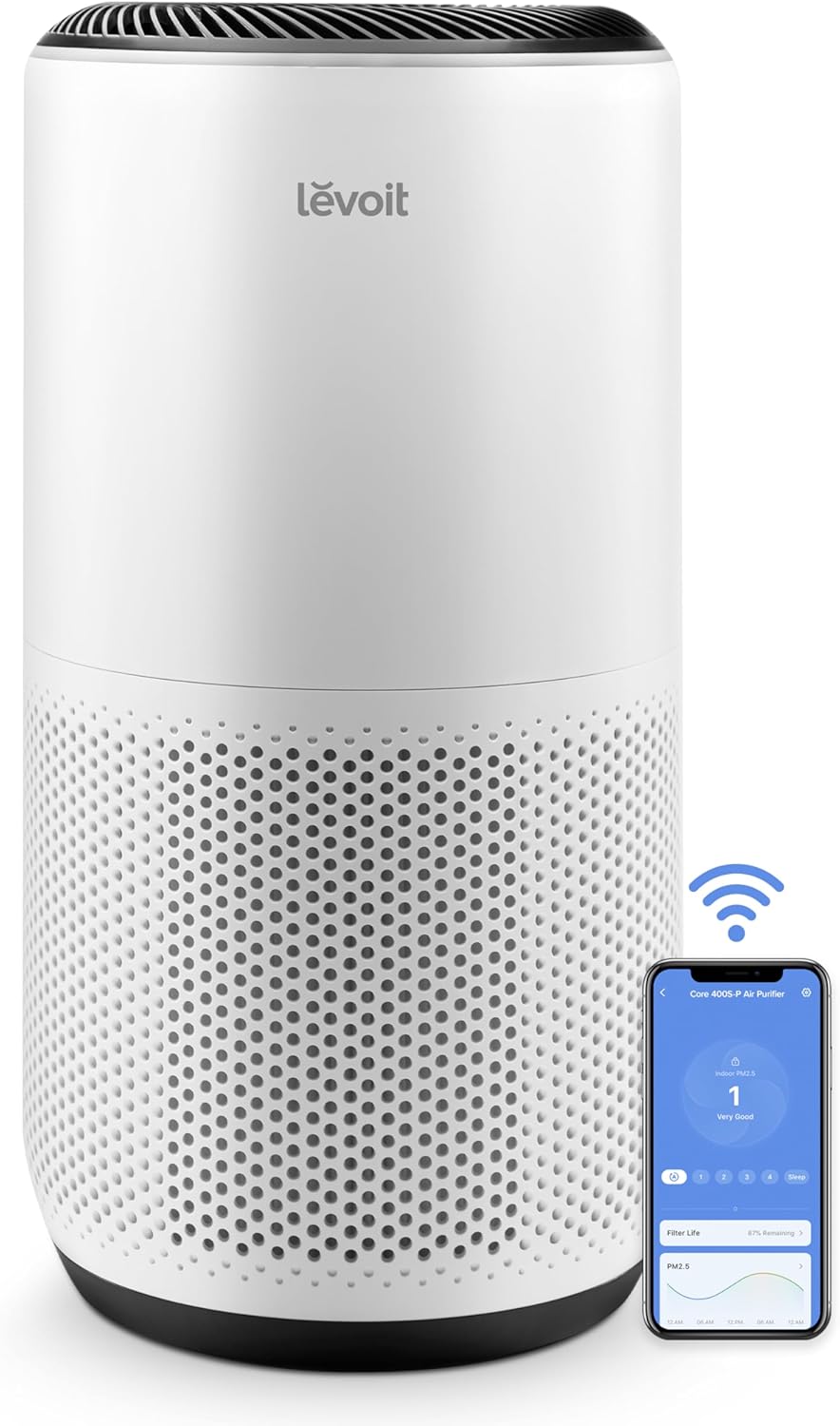
The Levoit Core 400S is the top-selling smart HEPA air purifier on Amazon AU for a reason. At 350 CADR, it covers rooms up to 83 m² (AHAM rated) — that is a master bedroom, a living room, or a home office with air changes to spare. The 3-stage H13 HEPA + activated carbon + pre-filter system captures 99.97% of particles at 0.3 µm, and the carbon stage handles cooking odours, VOCs, and — critically for Australian homes during bushfire season — smoke compounds.
This is not a car purifier. It runs from a 240V AU plug and weighs 5 kg. But if your search for “portable air purifier” actually means “a purifier I can move between rooms during smoke season”, the Core 400S is the product. At $349 — less than half the price of the Dyson Purifier range — it delivers superior CADR-per-dollar. Smart app control via VeSync lets you monitor PM2.5 readings and set auto mode, which ramps fan speed based on real-time particle counts.
Sleep mode drops to 24 dB — quieter than a whisper (30 dB). For bedrooms in Brisbane, Sydney, or Melbourne during October-March smoke season, this is the practical choice. At $349 once, that is roughly $0.95/day over a year for clean air in the room where you spend 8 hours every night.
| Spec | Detail |
|---|---|
| CADR | 350 m³/h |
| Filter grade | H13 HEPA + activated carbon + pre-filter |
| Coverage (AHAM rated) | 83 m² |
| Noise (sleep mode) | 24 dB |
| Power | 240V AU plug |
| Smart features | VeSync app, PM2.5 sensor, auto mode |
| Weight | 5.0 kg |
| Filter life | 6-8 months (manufacturer estimate) |
3. Budget Pick: Levoit Core 200S
If your budget is under $150 and you need genuine HEPA filtration for a small room or desk area, the Levoit Core 200S is the baseline recommendation. It uses the same H13 HEPA 3-stage architecture as the Core 400S, scaled down. CADR is 118 m³/h, which covers rooms up to 17 m² with adequate air changes. That is a single bedroom, a study, or a nursery.
At approximately $100-$130 AUD on Amazon AU, the Core 200S sits in the sweet spot where you are still getting a genuine HEPA filter from a reputable manufacturer with Australian-available replacement filters — not a no-name ioniser with “HEPA-like” claims. It also includes VeSync smart app integration, which is unusual at this price point. Sleep mode noise is 24 dB.
Limitation: This is a 240V unit, not a car purifier. It does not run from 12V or USB. The 118 CADR is insufficient for rooms larger than 17 m². For a car, the Westinghouse 1804 is the correct choice. For a larger room, step up to the Core 400S.
Head-to-Head Comparison Table
Numbers tell the truth. Here is how the three picks stack up across the specifications that actually matter for Australian conditions.
| Feature | Westinghouse 1804 | Levoit Core 400S | Levoit Core 200S |
|---|---|---|---|
| Best for | Car cabin | Bedroom / living room | Small room / desk |
| CADR | ~15-25 m³/h (est.) | 350 m³/h | 118 m³/h |
| Filter | H13 HEPA + carbon | H13 HEPA + carbon | H13 HEPA + carbon |
| Power source | 12V / USB-C | 240V AU plug | 240V AU plug |
| Coverage | ~5.5 m² | 83 m² | 17 m² |
| Noise (low) | ~28 dB | 24 dB | 24 dB |
| Smart app | No | Yes (VeSync) | Yes (VeSync) |
| Weight | <1 kg | 5.0 kg | 3.0 kg |
| Price (AUD, approx.) | ~$80-$120 | ~$349 | ~$100-$130 |
| Buy | Amazon AU → | Amazon AU → | Amazon AU → |
The CADR gap between the car unit and the room units is not a flaw — it is physics. A car cabin is 3 m³. A bedroom is 30-50 m³. The Westinghouse 1804 achieving 6-8 air changes per hour in a car cabin is equivalent performance to the Levoit Core 400S achieving 7-12 ACH in a 40 m³ room. Both are doing their job at the scale they were designed for.
How to Set Up Your Car Purifier for Maximum Effect
Buying the unit is step one. Setting it up correctly is what determines whether it actually protects you. Most buyers plug the unit in, drop it in a cupholder, and forget it. That approach leaves performance on the table.
Step 1: Close the Loop
Set your car’s ventilation to recirculate mode (the cabin air recirculation button — usually an icon showing a car with a curved arrow inside). This seals the cabin from external air intake. Your HEPA purifier then filters the same trapped air repeatedly, dropping PM2.5 concentrations with each pass. Without recirculate mode, you are pumping unfiltered external air in while the purifier tries to clean it — like mopping the floor with the tap running.
Step 2: Position for Airflow
Place the purifier where its intake and exhaust are not blocked by seat cushions, bags, or cup lids. Most car purifiers draw air from the bottom or sides and exhaust from the top. A cupholder in the centre console between the front seats is usually the optimal position — equal distance from driver and passenger breathing zones, and the clean air rises naturally.
Step 3: Run It Before You Drive
Start the purifier 3-5 minutes before you begin driving, especially during bushfire smoke events. A small HEPA unit needs 5-10 minutes to bring a sealed 3 m³ cabin from ambient PM2.5 levels to significantly reduced levels. If you are parked in smoke, close everything up and let the purifier cycle the air before setting off.
Step 4: Replace the OEM Cabin Filter
Your aftermarket HEPA purifier works alongside your car’s OEM cabin filter, not instead of it. Replace the OEM filter according to the manufacturer’s schedule — typically every 15,000-20,000 km or annually. A clogged OEM filter restricts airflow even in recirculate mode, forcing your HVAC fan to work harder and reducing the overall filtration effectiveness of the system.
Bushfire Season Preparation: October-March Checklist
PM2.5 from bushfire smoke is the leading environmental contributor to hospital admissions in eastern Australia during fire season. See the data on bushfire smoke and hospital admissions in Australia — the particle counts that trigger emergency department surges are exactly what an H13 HEPA unit in your car (and your home) is designed to intercept.
If you live in NSW, VIC, or QLD, bushfire smoke season is the argument that closes this purchase. The 2019-2020 Black Summer fires produced the worst sustained air quality events in Australian history. According to NSW DPIE air quality monitoring data, PM2.5 concentrations exceeded the NEPM 24-hour standard of 25 µg/m³ for 28 consecutive days in parts of western Sydney. The 2023-2024 and 2024-2025 seasons were milder, but the Bureau of Meteorology’s long-range climate outlook for 2025-2026 flags elevated fire risk for eastern Australia.
Preparation means having the equipment in place before you need it. During the peak of Black Summer, HEPA air purifiers sold out nationally within 48 hours of the first Sydney smoke event. Amazon AU delivery times stretched to 3-4 weeks. By the time most people decided to buy, the product they needed was unavailable.
Your Smoke Season Prep Checklist
- Car: Install a 12V HEPA purifier (Westinghouse 1804 or equivalent) and a fresh OEM cabin filter before October
- Bedroom: Position a Levoit Core 400S or Breville Protect Max in the room where you sleep — PM2.5 exposure during 8 hours of sleep is the largest single exposure window
- Spare filters: Buy one replacement HEPA filter for each unit. During heavy smoke events, filter media can load up in 2-3 weeks instead of the typical 6-8 months
- Seal the house: Close all windows and external doors. Set air conditioning to recirculate (not fresh air intake). Use draught tape on gaps under doors. A purifier in a leaky room is fighting a losing battle
- Monitor AQI: Download the NSW DPIE “Air Quality” app or check the EPA Victoria AirWatch site. When PM2.5 readings in your suburb exceed 50 µg/m³, run all purifiers on high
- N95/P2 masks: For outdoor exposure between car and house. No purifier can protect you while walking to the letterbox. P2 masks (AS/NZS 1716:2012 certified) are the only personal protection that works outdoors
The cost of a car purifier ($80-$120) plus a room purifier ($349) is $430-$470 total. That is less than a single emergency department visit co-payment, and vastly less than the long-term health cost of chronic PM2.5 exposure, which the Australian Institute of Health and Welfare links to cardiovascular disease, respiratory illness, and premature mortality. This is not a luxury purchase. It is infrastructure.
Products to Avoid: The Ioniser and “HEPA-Type” Trap
A search for “car air purifier” on Amazon AU returns dozens of results under $50 that use terms like “ioniser”, “negative ion generator”, “HEPA-type”, “HEPA-style”, or “nano-filtration”. These products share a common trait: they do not contain a genuine HEPA filter element.
Ioniser-only units generate ozone as a byproduct of their corona discharge mechanism. CARB (California Air Resources Board) requires all air purifiers sold in California to emit less than 50 ppb ozone. Most cheap ioniser-only units sold on Amazon AU have never been submitted for CARB testing, and their listings make no ozone emission claims. In a sealed 3 m³ car cabin, even modest ozone generation can push concentrations above the 100 ppb threshold where the WHO identifies acute respiratory effects.
“HEPA-type” filters are marketing terms. The EN 1822 standard that defines H13 HEPA requires 99.97% capture efficiency at 0.3 µm. “HEPA-type” has no standardised meaning and no minimum efficiency requirement. Independent testing by consumer organisations including CHOICE Australia has found “HEPA-type” products capturing as little as 60% of PM2.5 particles — worse than a basic OEM cabin filter.
The simplest filter: does the product listing explicitly state “H13 HEPA” or “True HEPA” with a 99.97% efficiency claim? If not, move on. Does it contain a physical filter cartridge you can remove and replace? If there is no replaceable filter, it is an ioniser in disguise.
240V for Home, 12V for Car: Getting the Power Right
Australia uses 240V AC at 50Hz with the AS/NZS 3112 three-pin plug. Every home air purifier sold legitimately in Australia must be compatible with this standard. The Levoit Core 400S and Core 200S both ship with Australian power cords. No adapter needed.
Your car provides 12V DC from the cigarette lighter socket (accessory socket) at up to 10-15A. Most car purifiers draw 5-15W — well within the socket’s capacity. USB-C ports in vehicles manufactured after 2020 typically deliver 5V at 2.4A (12W) minimum. The Westinghouse 1804 supports both 12V adapter and USB-C input, giving you flexibility.
If you want to run a 240V home purifier from your car (for example, in a caravan or during a power outage), you need a pure sine wave inverter rated for at least 150% of the purifier’s wattage. A Levoit Core 400S draws approximately 38W at maximum speed — a 100W pure sine wave inverter would handle it, but you are adding $60-$100 in equipment cost and drawing significantly from your car battery. For caravan and off-grid use, a dedicated 12V purifier is the more practical solution.
Final Verdict
For your car: The Westinghouse 1804 is the pick. Genuine H13 HEPA with activated carbon, runs from 12V or USB-C, fits a cupholder, and replacement filters are available on Amazon AU. No ioniser. No ozone. Just mechanical filtration that works.
For your bedroom or home office: The Levoit Core 400S at 350 CADR is the best value portable HEPA purifier available on Amazon AU in 2026. At $349, it delivers more CADR per dollar than any competitor including Dyson.
On a tight budget: The Levoit Core 200S at ~$100-$130 gives you genuine H13 HEPA and smart app control in a compact 240V unit. It will not cover a large room, but for a single bedroom or nursery, it does the job.
The worst outcome is you buy one and decide you do not need it. The more likely outcome — especially if you commute in Sydney, Melbourne, or Brisbane traffic, or if you live anywhere in eastern Australia during October-March — is that you wonder why you did not buy it sooner.
Clean air in your car and your home — under $500 total.
Westinghouse 1804 for the car (~$100). Levoit Core 400S for the bedroom ($349). H13 HEPA filtration in both. That is $0.04/day over three years for air that is measurably cleaner. Available on Amazon AU with free delivery for Prime members.
Last reviewed: July 2026 – Clean and Native
Frequently Asked Questions
Do car air purifiers actually work for bushfire smoke?
Yes, but only models with genuine H13 HEPA filtration. H13 HEPA removes PM2.5 particles at 99.97% efficiency at 0.3 microns. Standard OEM cabin filters (MERV 8–11) let most PM2.5 through. During the 2019–2020 Black Summer fires, AQI in western Sydney exceeded 2,000; a portable H13 HEPA unit is the only aftermarket solution that addresses sub-micron particles.
What CADR should a car air purifier have?
For a standard car cabin of 2.5–4 m³, a unit producing 15–25 m³/h CADR delivers 6–10 air changes per hour — effective for continuous particle reduction. Do not compare CADR ratings between car and home units; the use contexts are completely different and the numbers are not comparable.
Why shouldn’t I buy an ioniser for my car?
Ionisers produce ozone as a byproduct — a lung irritant that is especially harmful in the confined airspace of a car cabin. There is no safe threshold for ozone in an occupied vehicle. Only buy a car purifier that contains a physically replaceable H13 HEPA filter with activated carbon. If the unit has no filter you can remove and swap, do not buy it.
Can I use a Levoit Core or other home air purifier in my car?
A portable 240V unit like the Levoit Core 200S can work in a stationary vehicle (caravan, roadside stop) with a 240V inverter or power station. At its CADR, it cleans a 3 m³ cabin quickly. For a moving car, a 12V-native unit like the Westinghouse 1804 is more practical — no inverter required, runs from the cigarette socket.
How often should I replace the filter in a car air purifier?
Most manufacturers recommend every 3–6 months under normal use. During bushfire season or heavy-traffic commutes in cities like Sydney or Melbourne, the activated carbon layer saturates faster. When the unit stops neutralising smoke or exhaust odours, replace the filter regardless of calendar time elapsed.
Where can I buy the Westinghouse 1804 in Australia?
The Westinghouse 1804 is available on Amazon AU (ASIN B0D7RMMG9H) with Prime delivery to most Australian metro areas. At approximately $80–$120 AUD, it is the most cost-effective genuine H13 HEPA car purifier we found for Australian buyers in 2026.
Get the Australian Home Environment Checklist
30 checks across water, air and EMF. Most of them free. Ranked by impact.
No spam. Unsubscribe any time.

Former Royal Australian Navy Clearance Diver and TAG-E counter-terrorism operator. Founded Clean and Native to apply the same rigorous thinking to the home environment.
Full biography →