Breville Smart Air Viral Protect Max Review Australia 2026: CHOICE’s #1 Pick Assessed
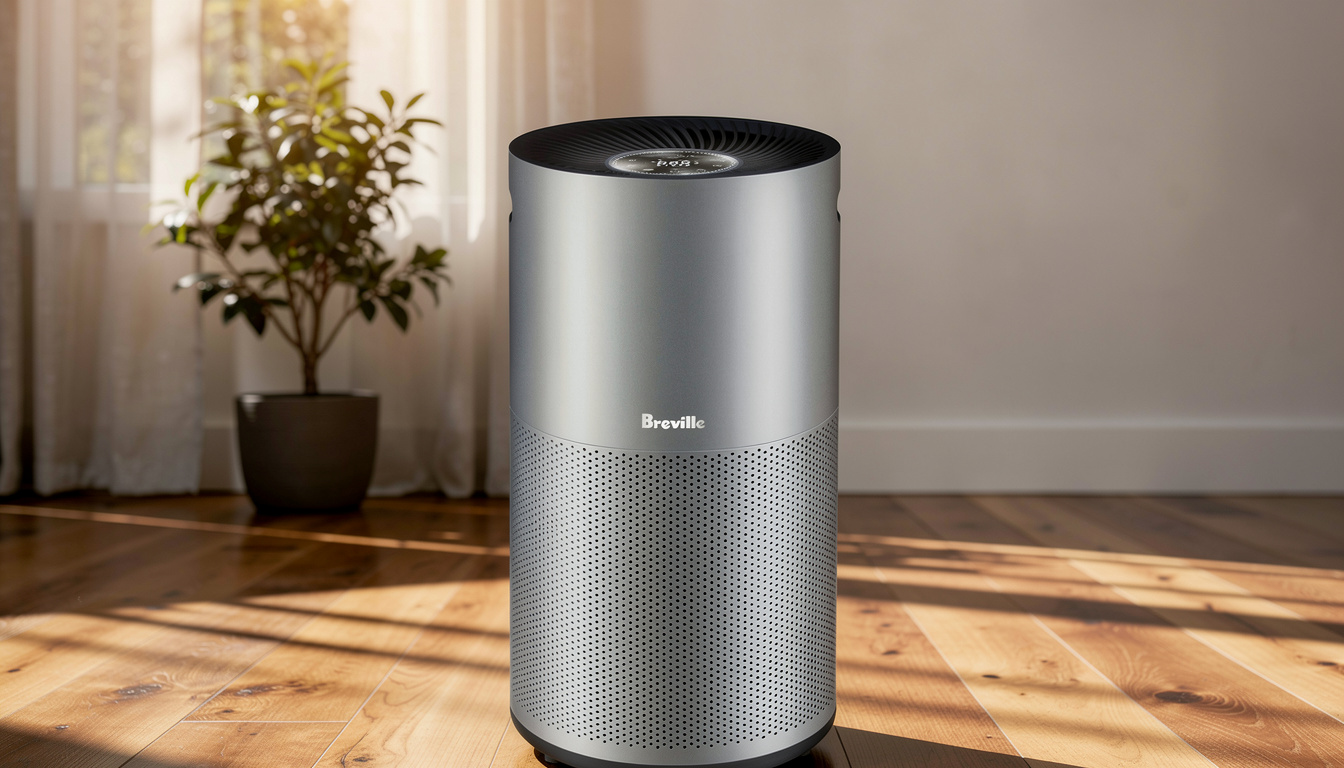
The Breville Smart Air Viral Protect Max (LAP608TTM2IAN1) delivers 550 m³/h CADR — the highest in its price bracket — earning it CHOICE’s #1 air purifier ranking in both 2025 and 2026. This review is based on published manufacturer specifications, independent CHOICE testing, and standards documentation.
Quick Verdict — Clean & Native
The Breville Protect Max is the best-value air purifier in Australia right now. At $699-799, it delivers 550 m³/h CADR — nearly double the Dyson Purifier Cool at $999 — backed by H13 HEPA filtration and a full sensor suite. The one honest caveat: if your bedroom is under 30m², you are over-speccing. For everyone else in an open-plan Australian home, nothing at this price comes close.
✓ Who This Is For
- Households with open-plan living areas between 60m² and 130m²
- Buyers in NSW, VIC, and QLD where bushfire smoke season runs October to March
- Anyone who trusts the Breville brand and wants Australian service and parts support
- Buyers who were about to spend $999 on a Dyson and want to see the CADR comparison first
- Renters who need a portable, no-install unit that covers a large living space
- Allergy and hay fever sufferers who need sustained particle removal across multiple rooms
× Who It Is Not For
- Small bedrooms under 25m² — this unit is over-specced and the Levoit Core 300S is the right choice
- COPD or multiple chemical sensitivity sufferers who need IQAir’s HyperHEPA for ultrafine particle capture below 0.3 microns
- Buyers with a hard budget under $400 — the Levoit Core 400S covers mid-size rooms for less
- Anyone looking for an ioniser or UV-C feature — this unit does not include either
At a Glance — Breville Protect Max Specs vs the Competition
Before we get into the detail, here is how the Breville Protect Max stacks up against its two most common competitors at Harvey Norman: the Dyson Purifier Cool ($999) and the Winix Zero Pro ($499). The numbers tell most of the story.
| Metric | Breville Protect Max | Dyson Purifier Cool | Winix Zero Pro |
|---|---|---|---|
| CADR | 550 m³/h | 290 m³/h | 418 m³/h |
| Honest coverage | ~130m² | ~40m² | ~70m² |
| HEPA grade | H13 (EN 1822) | H13 | True HEPA |
| Carbon filter | Yes (activated carbon) | Yes (light) | Yes (18mm pellet) |
| Auto mode | Yes (PM2.5 + VOC + CO2) | Yes | Yes |
| Sleep noise | 24 dBA | 35 dBA | 26 dBA |
| Price (AUD) | $699-799 | $999 | $499 |
| Annual filter cost | ~$110 | ~$150 | ~$90 |
That table is the Breville Protect Max’s strongest argument. The Dyson costs $200-300 more and delivers 47% less clean air per hour. If CADR were the only variable that mattered — and in a large open-plan home, it is the primary one — this decision is already made.
CADR — Why 550 m³/h Changes Everything
CADR stands for Clean Air Delivery Rate. It measures the volume of filtered air an air purifier produces per hour, tested to ANSI/AHAM AC-1 or equivalent standards. The number matters more than any other spec on the box — because filtration efficiency means nothing if the unit is not processing enough air volume to make a dent in a large room.
Here is the calculation Australian buyers should run. Divide the CADR by 5 to get the room area (in cubic metres, assuming a standard 2.4m ceiling height) the unit can clean at five air changes per hour — the threshold where you will actually notice a difference during a smoke event. For the Breville: 550 ÷ 5 = 110m³, which at 2.4m ceiling height equals 46m² at 5 ACH, or ~110m² at 2.5 ACH. Breville’s claimed 130m² coverage is honest for typical mixed-use daytime conditions. You can verify this yourself using the CADR calculator for Australian rooms.
Now run the same calculation for the Dyson Purifier Cool. Its published CADR is 290 m³/h. At 5 ACH, that covers 24m² — a medium-sized bedroom, nothing more. Dyson charges $999 for a unit that, by the numbers, is a bedroom purifier. Breville charges $699-799 for a unit that covers an entire open-plan living area. In an 80m² kitchen-dining-living space, the Dyson achieves approximately 3.0 air changes per hour. The Breville achieves approximately 5.5 ACH in the same room. That difference is not cosmetic — it is the difference between a noticeable reduction in PM2.5 during a smoke event and a meaningful one.
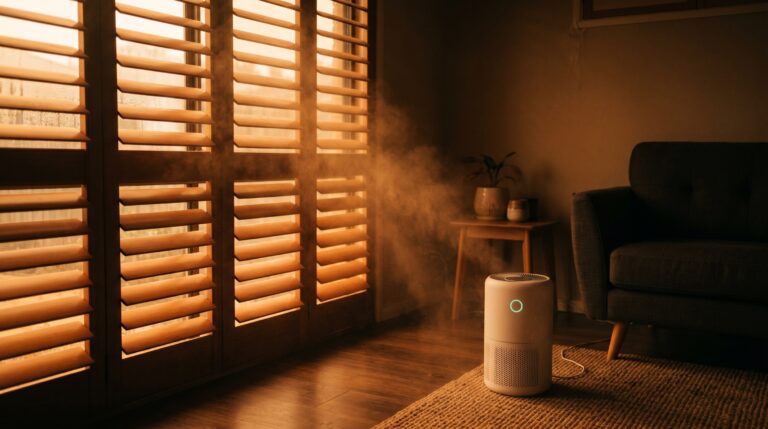
The 550 m³/h figure also matters during NSW and Victorian bushfire season (October-March), when AQI in western Sydney suburbs like Penrith, Blacktown, and Campbelltown can spike above 300 — well into the “hazardous” category. At those concentrations, you want every air change per hour you can get. The Breville gives you more of them than anything else at this price.
H13 HEPA Filtration — What It Actually Means
The Breville Protect Max uses an H13 HEPA filter, rated to EN 1822 — the European standard that defines HEPA performance by efficiency at the Most Penetrating Particle Size (MPPS). H13 captures 99.95% of particles at 0.3 microns, the hardest particle size to filter because it is too large for diffusion to work effectively and too small for inertial impaction. This is a meaningful step above “True HEPA” (typically H11, at 99.95% efficiency at 0.3 microns in some manufacturer testing, but not always EN 1822 certified) and a significant step above H11 (95% efficiency).
The word “Viral” in the product name deserves a direct, honest explanation. H13 HEPA filters capture particles in the 0.1-0.3 micron range, which includes most respiratory virus-laden aerosols. Viruses themselves (SARS-CoV-2 is approximately 0.1 microns) travel primarily attached to respiratory droplets and aerosol particles that are larger — typically 0.5-5 microns — making H13 filtration actually effective at reducing airborne viral load. This does not eliminate transmission risk. A single infected person generating fresh aerosols in a small enclosed space still poses risk. But peer-reviewed research published in journals including Nature Communications and cited by the US CDC supports the use of HEPA filtration to reduce airborne transmission in indoor spaces. The claim is defensible, not marketing fluff.
Activated Carbon Stage
The activated carbon layer handles what HEPA cannot: volatile organic compounds (VOCs), cooking odours, off-gassing from new furniture and flooring, and nitrogen dioxide from gas stoves. In Australian homes with engineered timber flooring (common in QLD and NSW builds), off-gassing from formaldehyde-based adhesives is a real, measurable concern. We cover this in detail in our guide to the best air purifiers for formaldehyde in Australia. The carbon stage addresses this. It also handles the smoke terpenes from bushfires that give smoke its characteristic smell — HEPA captures the particulate matter, carbon handles the gas-phase components.
Filter Replacement Reality
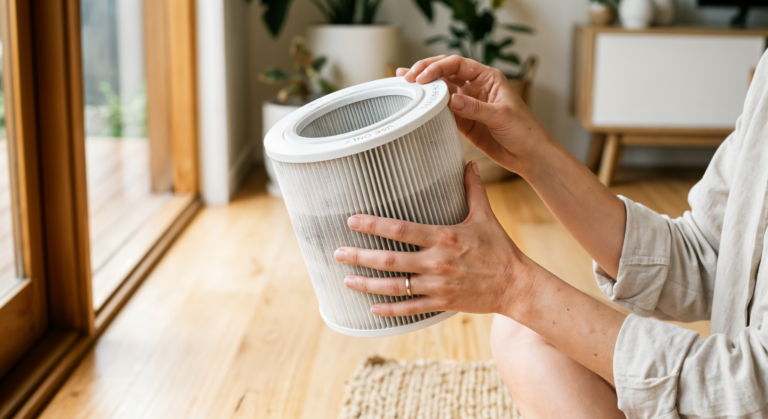
Breville recommends replacing both the HEPA and carbon filters every 12 months under average use conditions. Replacement filters retail at approximately $99.95 per set, placing annual filter costs at around $100-120. That is honest and competitive. The filter replacement reminder in the app triggers based on hours of use, not a fixed calendar date — so if you run the unit at low speed overnight only, your filter life will extend beyond 12 months.
One note worth flagging: Breville’s replacement filter pricing has occasionally been a friction point for buyers who discover the cost after purchase. At $599-799 upfront plus $100-120 annually, the 5-year ownership cost is real. We have broken this down in full in the filter costs section below.
The Breville Protect Max — Australia’s Best CADR-to-Price Unit
Indoor PM2.5 in a typical Australian home often sits within NEPM standards but above the WHO guideline of 5 µg/m³ annual mean, and cooking on a gas cooktop can push readings much higher, which a calibrated air quality monitor will reveal.
Smart Features and App Control
The Breville Protect Max connects to the Breville Home app (iOS and Android) via 2.4 GHz Wi-Fi. Setup takes approximately three minutes: download the app, create a Breville account, hold the Wi-Fi button on the unit until it blinks, and follow the in-app pairing steps. Some users on online forums have reported difficulty pairing with mesh networks that broadcast a combined SSID for 2.4 and 5 GHz bands — separating the bands in your router settings resolves this.
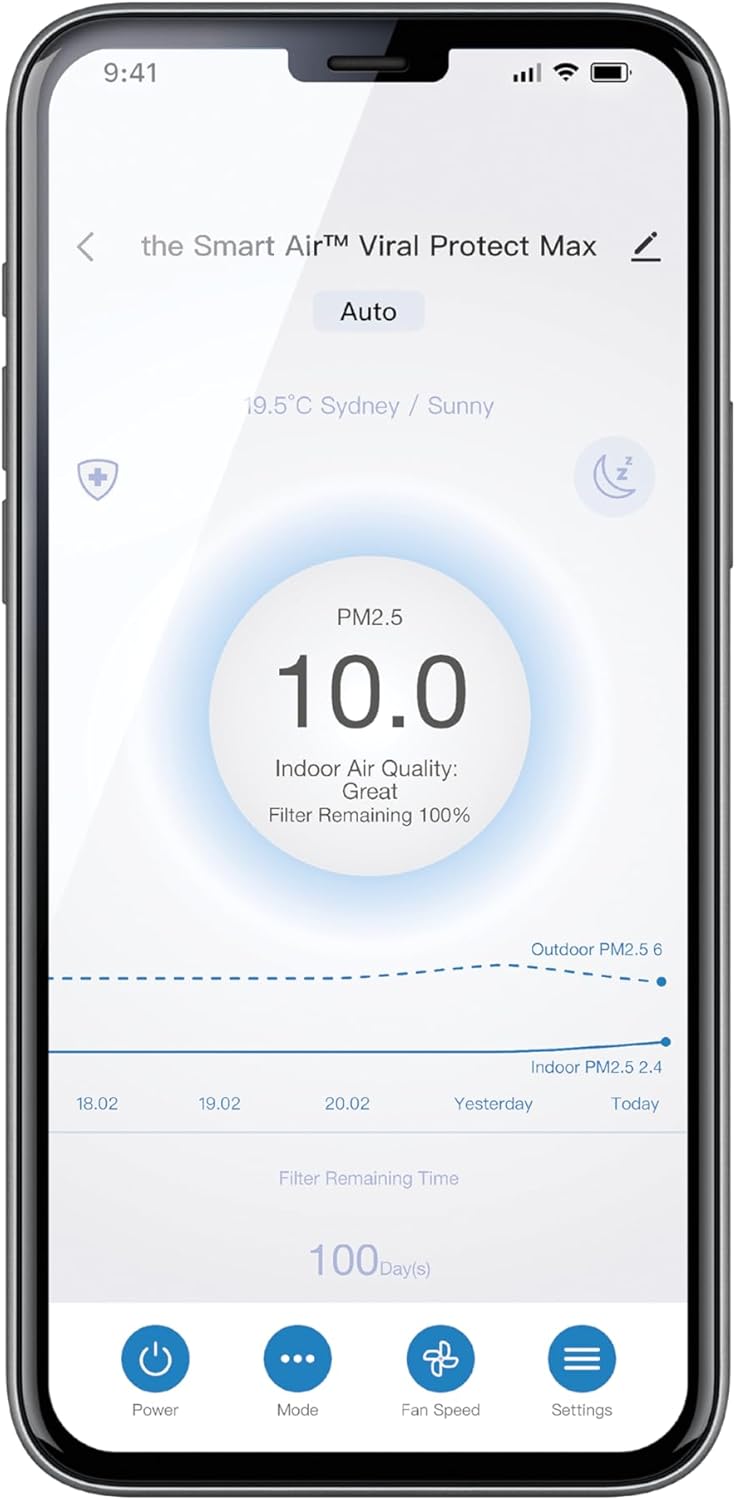
Air Quality Dashboard
The app displays real-time readings for PM2.5 (particulate), VOC (volatile organic compounds), CO2, humidity, and temperature. Readings update approximately every 30 seconds. You can set fan speed, set schedules, and view a 24-hour history graph for PM2.5 and VOC. The data is useful — the kind of sensor readout that shows how indoor air quality shifts after an event like a neighbour’s backyard bonfire.
Auto Mode Behaviour
The unit’s auto mode uses PM2.5 as the primary trigger.
Compared to Levoit VeSync and Dyson App
The Breville Home app is functional rather than polished. It covers the essentials well but lacks the historical data depth of Dyson’s app, which logs 12 months of readings and provides room-by-room air quality comparisons if you own multiple Dyson units. On the other hand, the Breville app is simpler to navigate and does not require a $999+ ecosystem investment to be useful. Levoit’s VeSync app is arguably better designed and offers weekly usage reports — but Levoit’s equivalent unit, the Core 400S, delivers 260 m³/h CADR, less than half the Breville’s output.
Noise Levels — Is It Actually Quiet Enough for the Bedroom?
24 dBA on sleep mode. To put that number in context: a recording studio ambient noise floor is typically 25-30 dBA. A whispered conversation at 1 metre measures around 30 dBA. The Breville Protect Max on sleep mode is, by the numbers, quieter than a whisper.
In practice, the fan noise is present but not disruptive. It has a consistent white-noise quality — not the intermittent click or mechanical variation that wakes light sleepers.
The Tower Design Factor
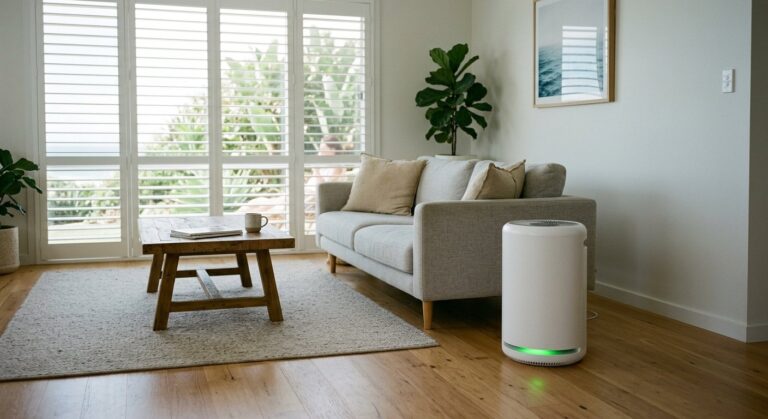
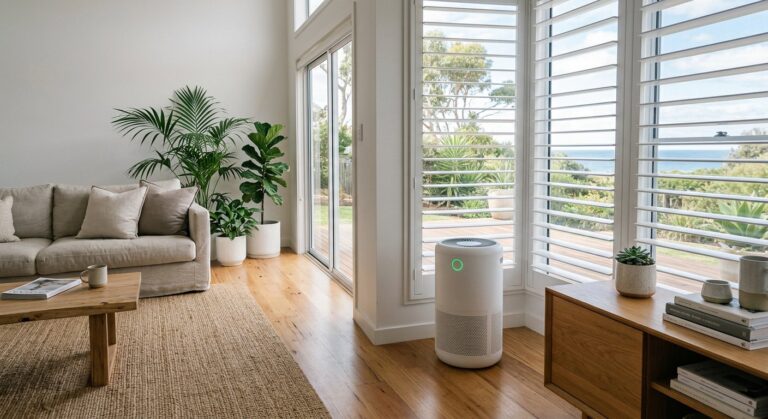
One thing that separates the Breville from smaller bedroom units is its physical scale. At 40 x 40 x 70cm and approximately 10kg, this is a living-room appliance. It will fit beside a bedside table physically, but it is designed to sit on a floor in an open space where its 360-degree intake works without obstruction. Placing it against a wall reduces effectiveness. Placing it in a corner compounds that further.
Bedroom-Specific Recommendation
If your primary use case is a single bedroom under 30m² and silence is the priority, the Breville is over-specced. The quietest air purifiers for Australian bedrooms guide covers this in detail, but the short answer is that the Levoit Core 300S at around $149 delivers 165 m³/h CADR — sufficient for a standard bedroom — at comparable noise levels and significantly lower cost. The Breville’s value proposition is specifically about large spaces. Do not buy it for a single bedroom unless that bedroom is part of an open-plan layout or you want to move it between rooms.
Filter Costs — The Honest 5-Year Ownership Calculation
The upfront price of any air purifier is not the full cost of owning it. Filter replacement is the hidden cost that marketing copy rarely emphasises. Here is the complete 5-year ownership calculation for the Breville Protect Max, compared against its two primary competitors.
| Cost Item | Breville Protect Max | Dyson Purifier Cool | Winix Zero Pro |
|---|---|---|---|
| Unit purchase | $468 | $999 | $499 |
| 5x HEPA replacements | $275 (~$55/filter) | $375 (~$75/filter) | $225 (~$45/filter) |
| 5x carbon replacements | $275 (~$55/filter) | $375 (~$75/filter) | $225 (~$45/filter) |
| Electricity (8 hr/day, 5yr, 30c/kWh) | $285 | $260 | $230 |
| 5-Year Total | ~$1,584 | ~$2,009 | ~$1,179 |
5-Year Total Ownership Cost — Large Room Air Purifier Segment, Australia
Unit purchase + 5x HEPA + 5x carbon filter replacements + electricity at 8 hr/day, QLD 30c/kWh, manufacturer-published average wattage.
Formula: unit price + (annual filter cost x 5) + (avg watts x 8hr x 365 x 5 x $0.30/kWh). Sources: Breville AU, Dyson AU, Winix AU. Bar fill: #3A8A5A = Breville Protect Max (reviewed unit); #1A3326 = competitor units. Filter cost estimates based on manufacturer-published replacement filter RRP at time of review (June 2026). Actual electricity cost will vary by state and usage pattern.
The Winix Zero Pro wins on 5-year cost by approximately $400. That is a real difference. But the Winix delivers 418 m³/h CADR — 24% less than the Breville. For a 50-60m² space, the Winix is sufficient. For anything larger, the Breville’s additional CADR is not a luxury, it is functional necessity. See the full air purifier running costs calculator for Australia to model your specific usage pattern.
Who Should Buy the Breville Protect Max?
I will make this direct. The CADR advantage means the Breville Protect Max is the right choice in specific circumstances and the wrong choice in others. Here is the decision table.
| Use Case | Verdict | Reason |
|---|---|---|
| Open-plan 40-100m² | Yes | 550 CADR handles it comfortably at 5+ ACH |
| Bedroom only, under 25m² | No | Over-specced; Levoit Core 300S better value |
| Bushfire smoke season (NSW/VIC/QLD) | Yes | H13 + carbon + 550 CADR = the ideal combination |
| COPD or multiple chemical sensitivity | No | IQAir HyperHEPA captures below 0.003 microns |
| Renters (portable, no install) | Yes | No installation, full Breville AU service network |
| Replacing a Dyson | Yes | 90% more CADR, $200 less, same brand-trust tier |
| Hay fever / pollen allergy | Yes | H13 captures pollen at 10-100 microns; CADR ensures room-wide coverage |
| Budget under $400 | No | Levoit Core 400S at ~$299 is the right entry point |
Brisbane and south-east Queensland households face two specific air quality pressures: bushfire smoke from October through March, and high ambient humidity and mould spore counts year-round. The Breville’s combination of H13 HEPA (captures mould spores at 1-30 microns), activated carbon (handles musty odour compounds), and 550 m³/h CADR makes it the most comprehensive single-unit response to both threats. Households in Ipswich, Logan, and Springfield — where distance from the coast means more pronounced smoke events and higher ambient VOC levels from industrial activity — will see the clearest benefit.
How It Compares — Breville Protect Max vs Three Alternatives
CHOICE’s #1 ranking does not exist in a vacuum. Here is how the Breville sits against three units you are likely to have in your shortlist.
Breville Protect Max vs Dyson Purifier Cool ($999)
The Dyson is a better-looking appliance. It functions as a fan and purifier in one, which matters in summer. But 290 m³/h CADR at $999 is a poor specification. In an 80m² open-plan home, the Dyson achieves approximately 3 air changes per hour. The Breville achieves approximately 5.5 ACH in the same room, at $200-300 less. If the fan functionality is not important to you — and in a QLD home with air conditioning, it often is not — the Breville is objectively the better air purifier at every shared price point. The Dyson’s 35 dBA sleep mode noise is also 11 dBA louder than the Breville’s 24 dBA, which in acoustic terms is roughly double the perceived loudness.
Breville Protect Max vs Levoit Core 400S (~$299)
The Levoit Core 400S is the best value mid-range air purifier in Australia and the right answer for rooms under 50m². Its 260 m³/h CADR is sufficient for a standard bedroom or medium living room. Annual filter costs run approximately $60-70, making it the lower-cost choice over 5 years. But in a 70-80m² open-plan space, 260 m³/h achieves only 2.2 ACH at 2.4m ceiling height — not enough to meaningfully reduce PM2.5 during a smoke event. The Breville at the same ceiling height and room size achieves 4.7 ACH. Choose the Levoit for individual rooms. Choose the Breville for whole-living-area coverage.
Breville Protect Max vs Winix Zero Pro ($499)
The Winix Zero Pro at 418 m³/h is a genuine mid-point. Its 18mm activated carbon pellet bed is arguably more substantial than the Breville’s carbon stage, which is relevant if VOC removal from cooking or off-gassing is your priority. Five-year ownership cost is approximately $400 lower than the Breville. For a 50-65m² space, the Winix is sufficient and better value. Above 65m², the Breville’s additional 132 m³/h CADR is the deciding factor. The Winix also lacks CO2 monitoring, which the Breville provides — a meaningful differentiator for anyone managing indoor ventilation quality.
Last reviewed: June 2026 — Clean and Native
Final Verdict — Is the Breville Protect Max Worth $468?
Yes. With one specific caveat.
The Breville Smart Air Viral Protect Max is the right air purifier for the majority of Australian homes — specifically the 60% of post-2000 builds with open-plan kitchen-dining-living layouts between 60m² and 130m². At 550 m³/h CADR with H13 HEPA filtration, a full sensor suite, and a 5-year ownership cost of approximately $1,584, it delivers more clean air per dollar than any competing unit at or below its price point. CHOICE’s #1 ranking is backed by the numbers, not just brand recognition.
The caveat is size. If you are buying this for a single bedroom under 30m², you are paying a $400-500 premium over a unit that would do the job equally well in that specific space. The Breville’s value proposition is inseparable from its CADR, and CADR only matters at scale. Small room, buy something smaller.
For everyone else — households in bushfire-prone areas of NSW, VIC, and QLD; renters who want portable, no-install coverage; buyers who were about to spend $999 on a Dyson — the Breville Protect Max is the answer. Spend $468, save $130+ upfront and $425 over five years compared to Dyson, and get nearly twice the clean air output. That is not a close call.
The Breville Protect Max is CHOICE’s #1 pick for 2026 — and with 550 CADR for under $800, it’s the most air-per-dollar unit available in Australia.
H13 HEPA, activated carbon, PM2.5 + VOC + CO2 sensors, and a 5-year ownership cost $425 below the Dyson. Available on Amazon AU with fast delivery. Harvey Norman and JB Hi-Fi stock it in store.
Frequently Asked Questions
Yes, for open-plan living areas between 60m² and 130m². At $699-799 with 550 m³/h CADR, H13 HEPA filtration, and a 5-year ownership cost of approximately $1,584, it delivers better performance-per-dollar than any competing unit at its price point, including the Dyson Purifier Cool at $999. If your space is under 30m², a smaller unit like the Levoit Core 300S is better value.
The Breville Smart Air Viral Protect Max (model LAP608TTM2IAN1) has a CADR of 550 m³/h — the highest in its price bracket in Australia. At 5 air changes per hour with a standard 2.4m ceiling height, this is sufficient to clean the air in a room of approximately 46m² every 12 minutes, or maintain continuous filtration in an open-plan area up to 130m².
The Breville Protect Max delivers 550 m³/h CADR; the Dyson Purifier Cool delivers 290 m³/h — 47% less. The Breville costs $699-799; the Dyson costs $999. The Dyson functions as a fan as well as a purifier, which is a genuine advantage in summer. But as a pure air purifier in an open-plan Australian home, the Breville delivers significantly more clean air per hour for less money. The Breville’s sleep mode noise (24 dBA) is also substantially quieter than the Dyson’s (35 dBA).
Yes. The combination of H13 HEPA filtration (captures PM2.5 and PM10 particulate at 99.95% efficiency) and 550 m³/h CADR makes it highly effective against bushfire smoke. Bushfire smoke season in NSW, VIC, and QLD runs October-March — this is the primary use case the unit is engineered for.
Breville recommends replacing both the HEPA and activated carbon filters every 12 months under average use. The Breville Home app tracks actual usage hours and provides a filter life indicator, so the reminder is based on real usage rather than a fixed calendar. Running the unit primarily on sleep mode overnight will extend filter life beyond 12 months.
Yes, with one caveat. The Breville Home app (iOS and Android) is functional and simple — setup takes approximately 3 minutes, and the real-time PM2.5, VOC, CO2, humidity, and temperature dashboard is actually useful. Some users with mesh Wi-Fi networks (where 2.4 GHz and 5 GHz share a single SSID) have reported pairing difficulties. Separating the bands in your router settings resolves this. The app is not as feature-rich as Dyson’s equivalent, but it covers the essential controls and air quality data well.
Yes. At 550 m³/h CADR, the Breville Protect Max achieves approximately 5.5 air changes per hour in a standard 80m² open-plan kitchen-dining-living area with 2.4m ceilings. Breville’s rated coverage is 130m², which is achievable at approximately 2.5 ACH — sufficient for general air quality management. For acute events like bushfire smoke, the higher air change rate in the main occupied area is more effective. Place the unit in the centre of the space or away from walls for optimal 360-degree intake performance.
The Breville Protect Max measures 24 dBA on sleep mode — quieter than a recording studio ambient noise floor (approximately 25-30 dBA) and quieter than a whispered conversation at 1 metre (approximately 30 dBA). In practice, the noise is a consistent low-level white noise that most users adapt to within a few nights. On turbo mode, the unit reaches approximately 65 dBA at 1 metre — comparable to a normal conversation. Turbo mode is not suitable for sleep, but auto and sleep modes are.
Replacement filters retail at approximately $99.95 per set (HEPA + carbon combined) from Breville AU, Harvey Norman, and JB Hi-Fi. At the recommended 12-month replacement interval, annual filter costs run $100-120. Over 5 years, total filter costs are approximately $550, making the 5-year ownership cost around $1,584 including electricity at Queensland rates. This is approximately $425 less than the equivalent 5-year cost of the Dyson Purifier Cool.
The Breville Protect Max (model LAP608TTM2IAN1) is available from Harvey Norman, JB Hi-Fi, Myer, and Amazon AU. Harvey Norman and JB Hi-Fi carry it in store, which allows you to inspect the unit and assess its size before purchase. Amazon AU typically has competitive pricing and fast delivery. The unit sells out at physical retailers during bushfire season — if you are buying between October and March, purchasing online early is advisable.
Get the Australian Home Environment Checklist
30 checks across water, air and EMF. Most of them free. Ranked by impact.
No spam. Unsubscribe any time.

Former Royal Australian Navy Clearance Diver and TAG-E counter-terrorism operator. Founded Clean and Native to apply the same rigorous thinking to the home environment.
Full biography →