
How Grounding Sheets Work: The Science Behind Earthing (Australian Guide)
Drafted with AI assistance and checked against published specifications and certifications. First-hand measurements appear only where stated. How we make content
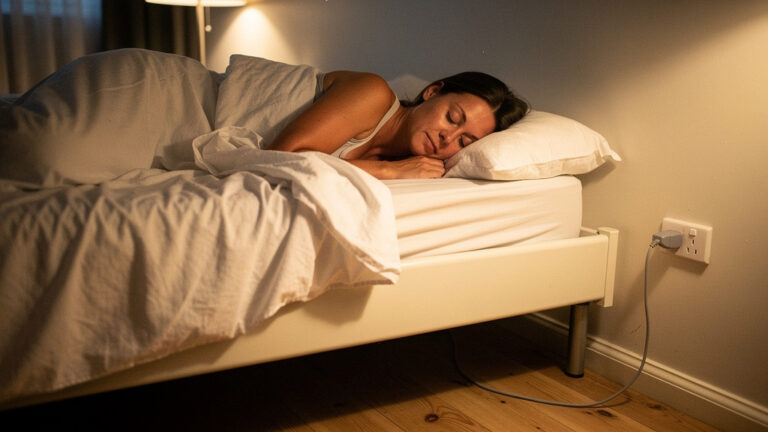
A grounding sheet works by connecting conductive fibres woven into your bedsheet to the earth pin of an Australian 3-pin wall socket, allowing free electrons from the Earth’s surface to transfer to your body during sleep. The science rests on three verified physical facts: the Earth carries a sustained negative charge, the earth pin of an AS/NZS 3112-compliant outlet connects directly to ground, and conductive materials including stainless steel and silver thread allow electron flow at body contact.
Quick Verdict — How Grounding Sheets Work
Grounding sheets transfer free electrons from the Earth to your body via conductive fibres and the earth pin of your wall socket. In Australian homes wired to AS/NZS 3000, the round top pin on a 3-pin outlet is the dedicated earth connection — the same pathway used by every grounding sheet on the market. The mechanism is physically real. The biological outcomes remain under active research.
| Concept | What it means | Verdict |
|---|---|---|
| Electron transfer pathway | Earth pin → grounding cord → conductive sheet → skin | Physically verified |
| Australian socket compatibility | AS/NZS 3112 type I — top round pin is earth in post-1966 homes | Check your wiring first |
| Biological outcomes | Free electrons proposed to neutralise reactive oxygen species | Under active research |
What Is Earthing and Why Does the Earth Have Electrons to Give?
The Earth’s surface is not electrically neutral. It carries a sustained negative charge maintained by continuous lightning strikes — approximately 40 to 50 per second globally — along with solar radiation and geomagnetic activity. This negative charge concentrates in the upper layer of the Earth’s crust and in any conductive material in direct contact with it. Standing barefoot on grass, sand, or soil connects your body to that charge. A grounding sheet replicates that pathway indoors, through a wire, while you sleep.
This is not fringe theory. The global atmospheric electrical circuit has been documented in peer-reviewed geophysics since the early twentieth century. What remains under active scientific investigation is the secondary question: what does electron transfer to the human body actually do, and can it be reliably measured? The Earth-as-electron-reservoir is a fact. The biological dose-response to electrons gained via skin contact is a live research question, with a growing body of controlled studies examining outcomes including sleep quality, inflammation markers, and heart rate variability.
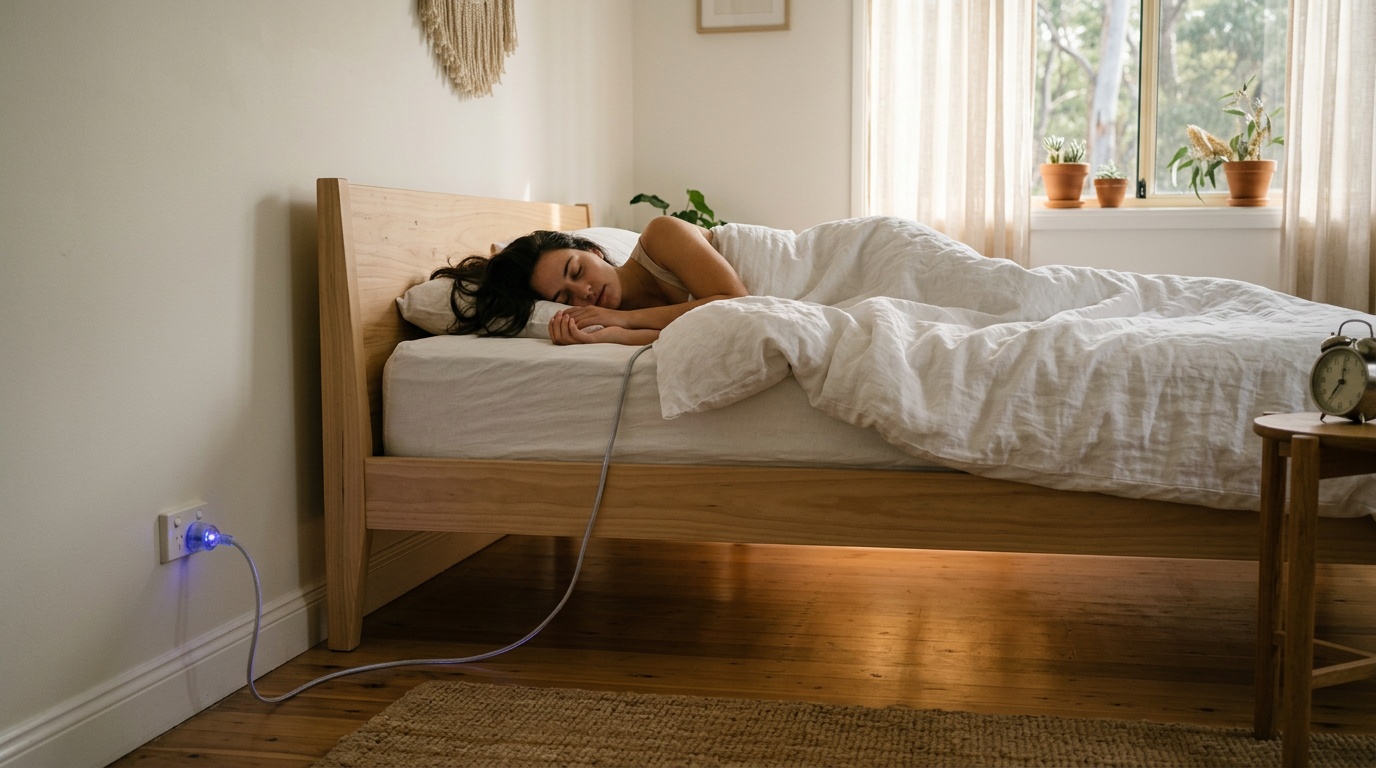
The most commonly cited biological mechanism proposes that free electrons from the Earth neutralise reactive oxygen species (ROS) — the unstable molecules generated by normal metabolism and by external stressors including UV radiation, pollution, and processed foods. ROS carry an unpaired electron and are highly reactive. An electron donor, which is exactly what the Earth represents, can stabilise them. The body already uses endogenous antioxidants including vitamins C and E for this function. The earthing hypothesis suggests that direct electron contact with the Earth provides a supplementary, low-cost antioxidant input that modern indoor living has removed.
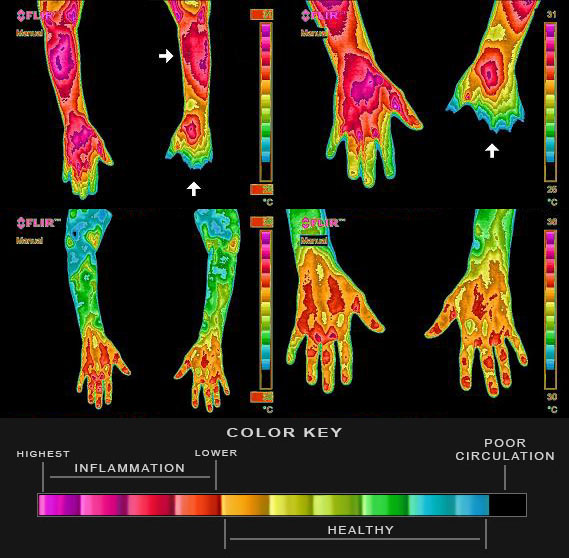
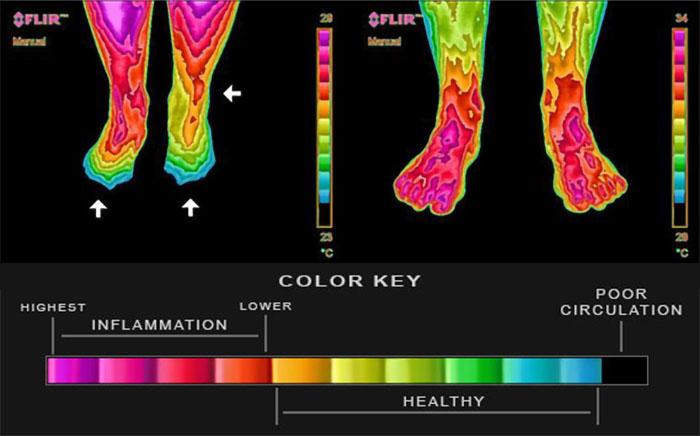
A 2015 review by Chevalier et al. published in the Journal of Inflammation Research compiled controlled studies on grounding and found measurable reductions in markers of inflammation and improvements in sleep latency in grounded subjects versus controls. That is not proof of mechanism — it is evidence of effect. The mechanism (electron transfer → ROS neutralisation) remains a hypothesis with supporting evidence, not a confirmed causal chain. Understand that distinction before you buy. What you are purchasing is a device that measurably connects you to the Earth’s electrical potential. What that does to your body over time is an open scientific question with early promising data.
The Physical Pathway: How a Grounding Sheet Connects You to the Earth
A grounding sheet is a standard fitted or flat sheet woven with conductive threads — most commonly stainless steel (316L grade is standard in quality products) or silver. These threads run through the fabric in a grid or parallel-line pattern at spacings typically between 1 and 5 mm. One corner of the sheet includes a snap connector or integrated wire port. A grounding cord attaches here and runs to the wall socket.
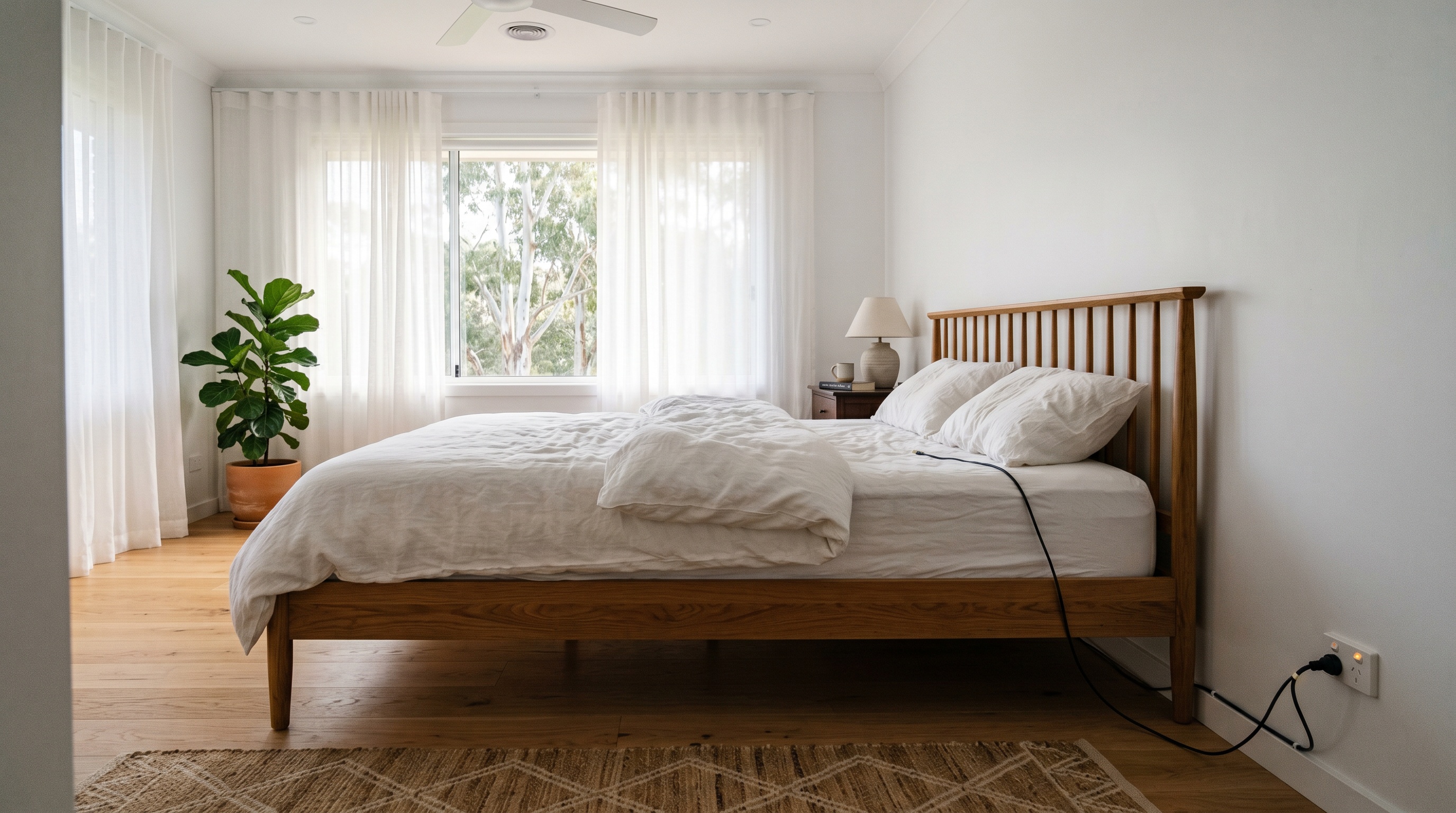
The cord itself is not a standard electrical cable. It contains a 100 kΩ (100,000 ohm) current-limiting resistor in series. This resistor is a deliberate safety feature. It allows the very small electron flow associated with earthing — measured in microamperes — while blocking any meaningful current in the event of a fault. You cannot receive a shock through a properly constructed grounding cord because the resistor limits current to levels far below the threshold of human perception (approximately 1 milliampere). This is the same principle used in ESD (electrostatic discharge) wrist straps in electronics manufacturing.
The plug on the cord is a single-pin adapter designed to connect only to the earth pin of the socket — the round top pin in the Australian AS/NZS 3112 configuration. It does not contact the active or neutral pins. When inserted correctly, the circuit is: Earth crust → building earth stake → earth wiring → socket earth pin → grounding cord (via resistor) → snap connector → conductive sheet fibres → your skin. The voltage differential drives electron migration from higher-electron-density ground to the lower-electron-density body, equalising potential at skin contact. Once equalised, net electron flow stops. You are not drawing continuous current — you are reaching equilibrium with the Earth’s electrical potential.
Australian Electrical Context: AS/NZS 3112, Wiring Standards, and Grounding Sheet Compatibility
This is where the Australian context matters and where every overseas article you will find falls short. Grounding sheets from the US plug into a 3-prong NEMA socket. UK versions use a BS 1363 plug. Australian homes use the AS/NZS 3112 Type I configuration — a flat two-pin socket for active and neutral, with an additional round pin above them for earth. The round pin is the earth, wired under Australian Standard AS/NZS 3000 (the Wiring Rules) to a grounding electrode — typically a copper rod driven into the soil at the meter box or main switchboard.
In homes built or rewired after the 1966 adoption of the standard three-pin socket in Australia, the earth pin is present and connected. In homes built before the 1950s — including much of inner-city Sydney, Melbourne, Brisbane, and Adelaide — two-pin or ungrounded sockets may still be present, particularly in older rooms not yet rewired. A grounding sheet plugged into an ungrounded socket does nothing. The cord finds no earth path and the electron transfer mechanism is broken entirely.
How to Test Whether Your Australian Outlets Are Grounded
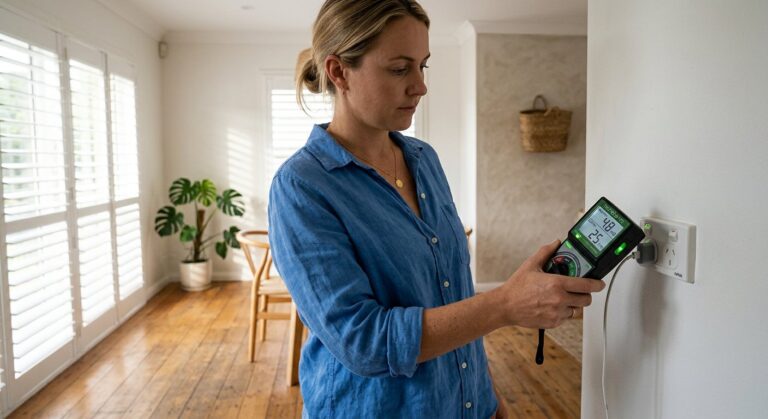
Before spending money on a grounding sheet, confirm your sockets are earthed. The tool for this is a socket outlet tester, available on Amazon AU for approximately $20. These testers have three indicator lights that show active, neutral, and earth presence, along with common fault patterns including open earth, reversed polarity, and open neutral.
Cabac Power Point Tester
Australian brand • Tests earth, polarity and RCD • Designed for AU power points
Plug the tester into the socket you plan to use for your grounding sheet. A correct wiring result shows two lit indicator lights in the standard pattern for your brand of tester — refer to the legend on the unit. An “open earth” reading means the earth pin is present in the socket but not connected to ground. A “correct” reading confirms you have a live earth path and a grounding sheet will function as intended.
If your bedroom socket fails the test, your options are: (1) use a socket in a different room that passes — many homes have a mix of grounded and ungrounded outlets; (2) have a licensed electrician retrofit a grounded circuit to your bedroom under AS/NZS 3000 compliance, which is simple in homes with modern switchboards; (3) use outdoor earthing instead — bare feet on soil, grass, or concrete over soil achieves the same electrical connection and requires no socket at all.
Grounding Sheets and AS/NZS 3000 Compliance
No grounding sheet product carries explicit AS/NZS 3000 compliance certification because they are not classified as electrical appliances under Australian electrical equipment safety law. The grounding cord draws no meaningful current. It is treated similarly to a static earthing device — not a power consumer. The 100 kΩ resistor in the cord is the engineering solution that keeps grounding products outside the regulated appliance category while maintaining safe operation.
What this means practically: you do not need an electrician to install a grounding sheet. You plug a single-pin adapter into the earth pin of your existing socket. No modifications to wiring, no new circuits, no permits. The responsibility on you is to confirm the socket is actually earthed using a tester before use.
Conductivity, Dry Climate, and What Australian Conditions Mean for Grounding Performance
One factor that no overseas competitor article discusses — because it does not affect the UK or Pacific Northwest USA the way it affects inland Australia — is the effect of dry climate on the earth ground itself.
The Earth’s electrical conductivity at the grounding electrode (the rod buried at your meter box) is highest in moist soil and lowest in dry, sandy, or rocky ground. In areas including coastal Perth, outback Queensland, the Red Centre, and parts of the ACT during dry seasons, soil resistivity can be significantly higher than in consistently wet climates. AS/NZS 3000 requires a maximum earth loop impedance of 1 Ω at the main earthing point for residential installations — your electrical system is designed to meet this specification regardless of soil conditions, and electricians use earth rod depth, multiple rods, or chemical earth enhancement compounds to achieve it.
For a grounding sheet, the practical implication is this: the building’s earth system is engineered to maintain compliant impedance, so your grounding sheet inherits a reliable earth path regardless of whether you are in humid Brisbane or dry Kalgoorlie. The sheet’s conductivity itself is also unaffected by climate — stainless steel and silver threads do not absorb or lose moisture in the way that bare soil does. The grounding cord’s 100 kΩ resistor dominates the circuit resistance anyway, dwarfing any variation in earth electrode resistance.
Where Australian dry conditions do matter is in direct outdoor earthing. Walking barefoot on dry, compacted, sandy soil is less electrically effective than walking on moist grass or wet beach sand. If you are supplementing sheet grounding with outdoor sessions — which adds to total earthing time — prioritise damp surfaces or shallow water contact (wet sand at the beach, dewy morning grass) over dry inland soil.
Recommended for Australian Homes
What the Research Actually Shows (And Where It Stops)
The earthing research base is real, peer-reviewed, and growing — but it is not conclusive, and you should know exactly what the studies show before drawing conclusions about your own situation.
A 2004 study by Ghaly and Teplitz published in the Journal of Alternative and Complementary Medicine measured cortisol levels in 12 subjects sleeping on grounded versus ungrounded sheets over 8 weeks. Grounded subjects showed improved synchronisation of cortisol secretion with the natural diurnal rhythm — specifically, cortisol peaked closer to the natural 6-8am morning window. All subjects reported improved sleep quality. Sample size is a limitation. No blinding was employed for the subjective sleep measures.
A 2010 pilot study by Oschman et al. measured the effect of grounding on blood viscosity in 10 subjects, finding a significant reduction in red blood cell zeta potential — a measure of cell surface charge that affects clumping. Higher zeta potential (more negative, achieved post-grounding) corresponds to better cell separation and reduced viscosity. This is one of the more mechanistically credible results because it directly measures an electrical property of blood cells, which would respond to whole-body voltage changes.
A 2019 controlled trial by Sokal et al. published in Biomedical Research International examined thyroid function in 84 patients with autoimmune thyroiditis, randomised to grounded versus ungrounded sleep. The grounded group showed statistically significant reductions in TSH and autoimmune antibody levels after 90 days. This is the largest and most methodologically rigorous grounding trial to date — and it found a measurable biological effect.
What the research does not include: large randomised controlled trials with hundreds of subjects, double-blinded protocols where neither participant nor researcher knows grounding status, long-term follow-up beyond 12 weeks, or replication across multiple independent research groups for any single finding. The field needs this work. Until it exists, the position of “promising early evidence, not conclusive proof” is the honest one.
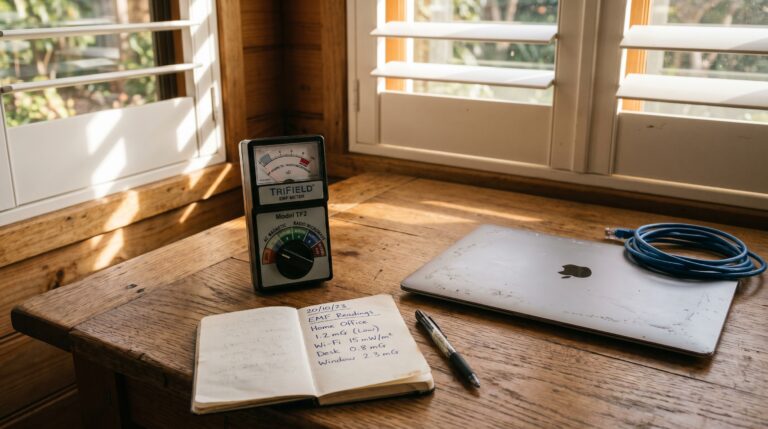
The building biology community, including the Institut für Baubiologie + Nachhaltigkeit (IBN) whose SBM-2015 standard is used by practitioners in Australia, treats body voltage reduction during sleep as a measurable parameter. Their sleeping area recommendation is AC electric field below 5 V/m. A grounding sheet directly reduces body voltage by connecting the body to a reference potential — this is a measurable, instrumentable fact that sits independently of the biological-effect debate.
How to Use a Grounding Sheet Correctly in an Australian Home
Getting this right is simple. The common failure modes are worth knowing before you start.
Step 1 — Test Your Socket
Buy a socket outlet tester (Jaycar CAT.No. QP2279, ~$15, or equivalent) and test the bedroom socket you plan to use. Confirm a correct earth reading. If you get an open earth, test other sockets in the room and adjacent rooms. Mark the passing socket with tape and use that one exclusively.
Step 2 — Connect the Cord Correctly
The single-pin plug on the grounding cord goes into the round top pin of the Australian socket only. It will only physically enter that one hole in the socket face — the flat active and neutral pins are a different shape and the cord plug cannot accidentally insert into them. Push it in firmly until it sits flush.
Step 3 — Attach the Sheet and Confirm Contact
The snap connector on the cord attaches to the corresponding snap point on the sheet. Most quality grounding sheets place this at one corner. Make sure the sheet is positioned so that the conductive area contacts bare skin — typically the calf, foot, or lower back area depending on your sleeping position. Sleeping through a thick doona with no bare skin contact breaks the circuit. Direct skin-to-sheet contact is required for electron transfer.
Step 4 — Wash and Maintain Conductivity
Conductive sheets lose conductivity over time if washed with fabric softener (which coats fibres and insulates them) or bleach (which degrades stainless steel thread). Use plain mild detergent, cold water, no fabric softener, and air dry. Most quality sheets maintain conductivity for 100-200 washes under correct care conditions. To verify ongoing conductivity, a multimeter set to resistance (Ω) mode, placed between the snap connector and a point on the sheet fabric, should read below 1,000 Ω. A reading of OL (open loop / infinite resistance) means conductivity has been lost and the sheet needs replacing.
Grounding Sheets vs Outdoor Earthing: Does It Matter Which You Use?
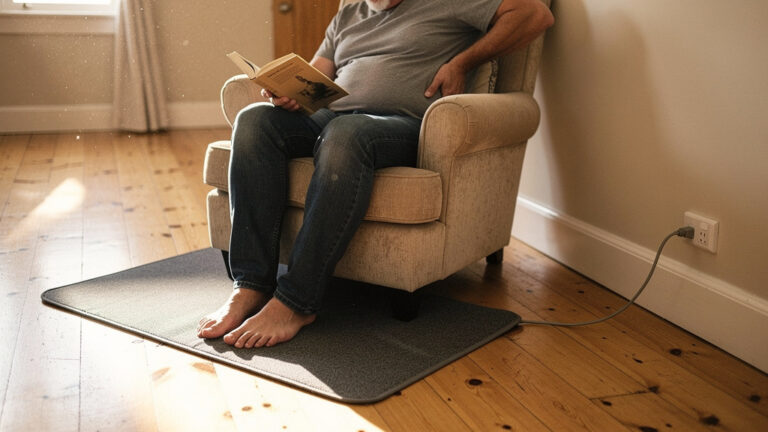
Direct outdoor earthing — bare feet on moist soil, grass, or sand — is the original mechanism. It predates every commercial product by the entire span of human evolution. A grounding sheet is an engineering solution to the problem that modern humans spend most of their time on insulating surfaces: carpet, timber floors, rubber-soled shoes, concrete slabs with vapour barriers.
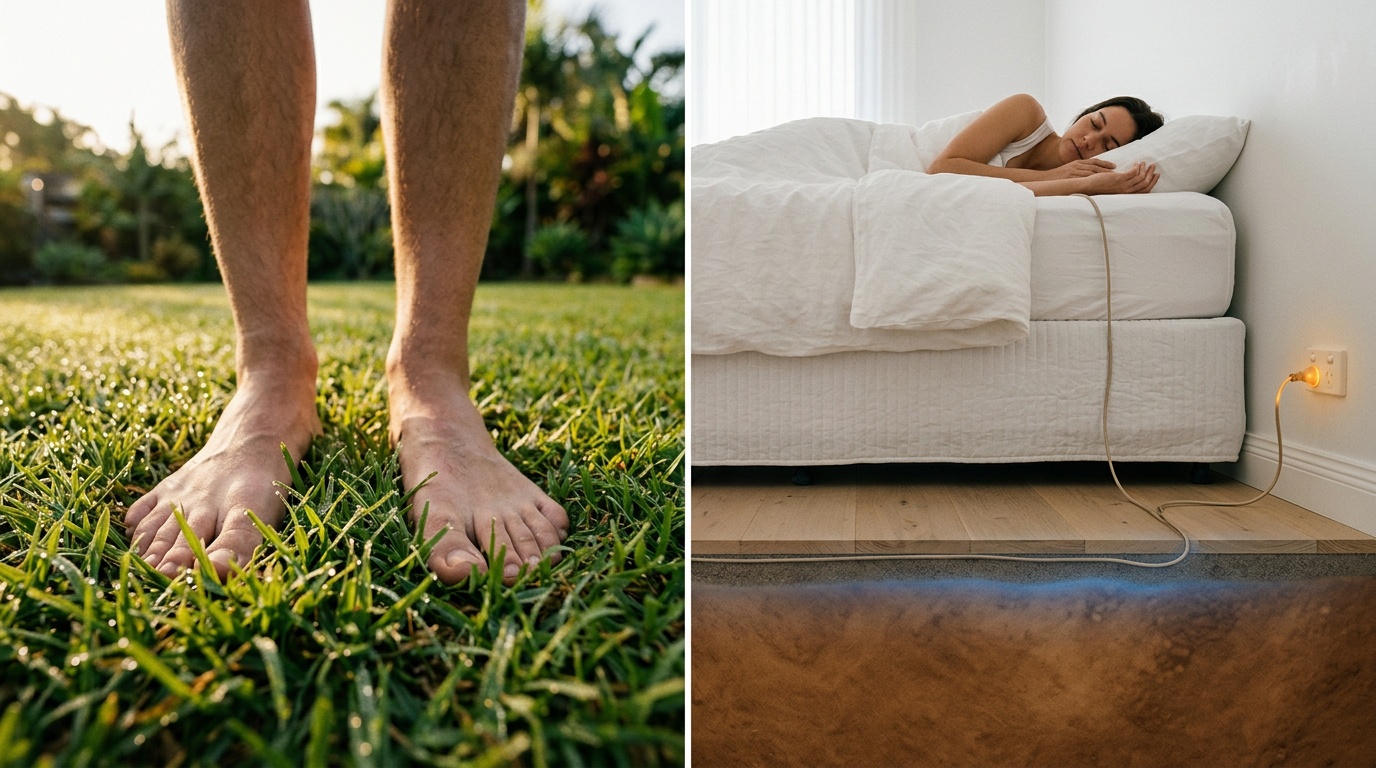
Electrically, the two pathways are equivalent in principle. Both connect your body to the Earth’s electrical reference potential. The sheet does it through a resistor-limited wire to a building earth electrode. Outdoor contact does it through the soles of your feet directly. The body voltage measured in both cases converges toward the same ground reference.
The practical difference is duration. Most Australians who add deliberate outdoor grounding to their routine manage 20 to 30 minutes per day. A grounding sheet provides 6 to 8 hours of contact during sleep. If the biological effects are real and dose-dependent — which the cortisol and blood viscosity studies suggest — then nightly sheet grounding delivers a substantially larger total exposure than intermittent outdoor sessions.
The two are not competing choices. If you can walk barefoot on grass in the morning and sleep on a grounding sheet, you are maximising your daily earthing exposure. If you can only do one, the sheet wins on duration.
Last reviewed: June 2026 — Clean and Native
Ready to try grounding? Start with a sheet that ships to Australia.
Premium Grounding includes the correct single-pin earth adapter for Australian sockets. Confirm your outlet passes the socket tester first — then this is a 10-minute setup.
Frequently Asked Questions
Grounding sheets work in Australia provided your home has grounded sockets (AS/NZS 3112 Type I). Quality products include a single-pin adapter that inserts into the round earth pin of an Australian 3-pin socket. The earth pin in Australian wiring connects to ground under AS/NZS 3000 — the same earth path used in the US and UK. Test your socket with a $15 outlet tester before use to confirm the earth connection is present.
Use a socket outlet tester — available from Bunnings or Jaycar for approximately $15. Plug it into the socket you plan to use. A correct wiring result confirms an active earth. An “open earth” result means the earth pin is present but not wired to ground, and a grounding sheet will not function in that socket. Older Australian homes built before the 1950s are most likely to have ungrounded outlets in unrenovated rooms.
Yes, in a correctly wired socket. All grounding sheet cords contain a 100 kΩ current-limiting resistor that restricts any possible current to microamperes — far below the 1 mA threshold of human perception and orders of magnitude below any harmful level. The single-pin adapter physically cannot contact the active or neutral pins of an Australian socket. The safety design is the same used in industrial ESD wrist straps.
Most quality grounding sheets use stainless steel thread (316L grade) or silver thread woven into a cotton or cotton-blend fabric. Stainless steel is more affordable and durable across repeated washing. Silver thread has higher inherent conductivity and antimicrobial properties but is more expensive and requires careful washing to avoid degradation. Both materials provide sufficient conductivity for earthing purposes.
The grounding sheet’s connection to earth is through the wall socket cord, not through the floor. The floor material under your bed is irrelevant. What matters is skin contact with the sheet and a live earth connection at the socket. You can be on the tenth floor of an apartment building and still earth effectively, provided your building’s electrical system has a functional earth connection to ground — which all AS/NZS 3000-compliant buildings do.
Test the socket first with an outlet tester. If the socket passes the earth test, use the sheet as normal — no landlord permission is needed because you are not modifying any wiring. If the socket fails the earth test, you cannot earth through the wall socket in that rental. Outdoor grounding (barefoot contact with soil or grass) is a free alternative that requires no socket and achieves the same electrical connection.
A grounding sheet reduces AC electric field body voltage — it brings your body to earth potential, which reduces the induced voltage from mains wiring in your bedroom walls. Building Biology standard SBM-2015 recommends sleeping-area AC electric fields below 5 V/m. A grounding sheet helps achieve this for the body specifically. It does not reduce ambient RF (radiofrequency) fields from Wi-Fi or mobile signals. For RF reduction, a demand switch on the bedroom circuit plus turning devices to aeroplane mode overnight is more effective.
The controlled studies on grounding show measurable changes in cortisol rhythm over 6-8 weeks of nightly use. Some users report improved sleep in the first week. Body voltage reduction is immediate and measurable with a multimeter on the first night. The honest answer is that individual response varies, the research shows effects over weeks not hours, and any subjective change in the first few nights may include placebo component. Use it consistently for at least 4 weeks before judging effectiveness.
Not for the sheet itself. The sheet’s conductive fibres are stainless steel or silver — both unaffected by ambient humidity. The building’s earth electrode is engineered under AS/NZS 3000 to maintain compliant impedance regardless of soil conditions, including dry inland soils. Where dry conditions matter is in direct outdoor earthing: dry, sandy soil has higher electrical resistance than moist grass or wet sand, making beach or dewy-grass contact more effective for outdoor sessions.
Best Earthing Products Australia 2026: Mats, Sheets, Pillowcases & Bands
Compare every earthing product category tested in Australia →Get the Australian Home Environment Checklist
30 checks across water, air and EMF. Most of them free. Ranked by impact.
No spam. Unsubscribe any time.

Former Royal Australian Navy Clearance Diver and TAG-E counter-terrorism operator. Founded Clean and Native to apply the same rigorous thinking to the home environment.
Full biography →