Best EMF Meter Australia 2026: Compared at Home and in the Field
The TriField TF2 is the best EMF meter for most Australians in 2026 — it measures all three field types (magnetic, electric, and RF) in a single device, includes a weighted mode tuned to biological sensitivity rather than raw peak values, and covers the 50 Hz mains frequency used across Australia. That said, if your primary concern is 5G towers, NBN Fixed Wireless, or you want to log data over time, the GQ EMF-390 is a more capable RF instrument at a lower price point. For a dedicated magnetic ELF audit of smart meters and power line proximity, the TM192 Triaxial Gauss Meter gives the most accurate reading in the guide with no rotation required.
| EMF Meter | Best For | Field Types | Verdict |
|---|---|---|---|
| TriField TF2 | Most home users | Magnetic, Electric, RF | Best Overall |
| Safe and Sound Pro II | Sensitive RF detection, bedroom mapping | RF only (200 MHz–8 GHz) | Best Sensitive RF |
| TM190T | Beginners, colour display, AU warranty | Magnetic, Electric, RF (to 10 GHz) | Best for Beginners |
| GQ EMF-390 | RF / 5G focus, data loggers | RF + ELF | Best RF / 5G |
| Cornet ED88T Plus | Compact dual-mode use | RF + ELF | Best Mid-Range |
| TM192 | Dedicated ELF / magnetic field audit | Magnetic only (30 Hz–2000 Hz) | Best Dedicated Gauss Meter |
Buying an EMF meter in Australia in 2026 is more complicated than it looks. Most of the meters sold on Amazon were originally designed for the American market at 60 Hz — and while many will still work in Australia, a handful will give inaccurate magnetic field readings at our 50 Hz mains frequency if their measurement filters are not calibrated for it. Add to that a rapidly changing RF environment — Telstra and Optus 5G NR deployments in every capital CBD, NBN Fixed Wireless rollout on 3.5 GHz and 28 GHz, and smart meters communicating on 915 MHz frequency-hopping spread spectrum — and you need a meter chosen for Australian conditions specifically. This is the Clean & Native pillar guide to the best EMF meters available in Australia right now. For deeper technical coverage of individual products, follow the links to our full reviews throughout this article.
Who Should Buy an EMF Meter in Australia
- ✓Homeowners near high-voltage power lines or substations. Australian ARPANSA guidelines reference 1000 mG as the general public limit for power-frequency magnetic fields, but many building biologists and precautionary health advocates use far lower thresholds. A meter lets you measure what is actually present rather than guessing based on proximity.
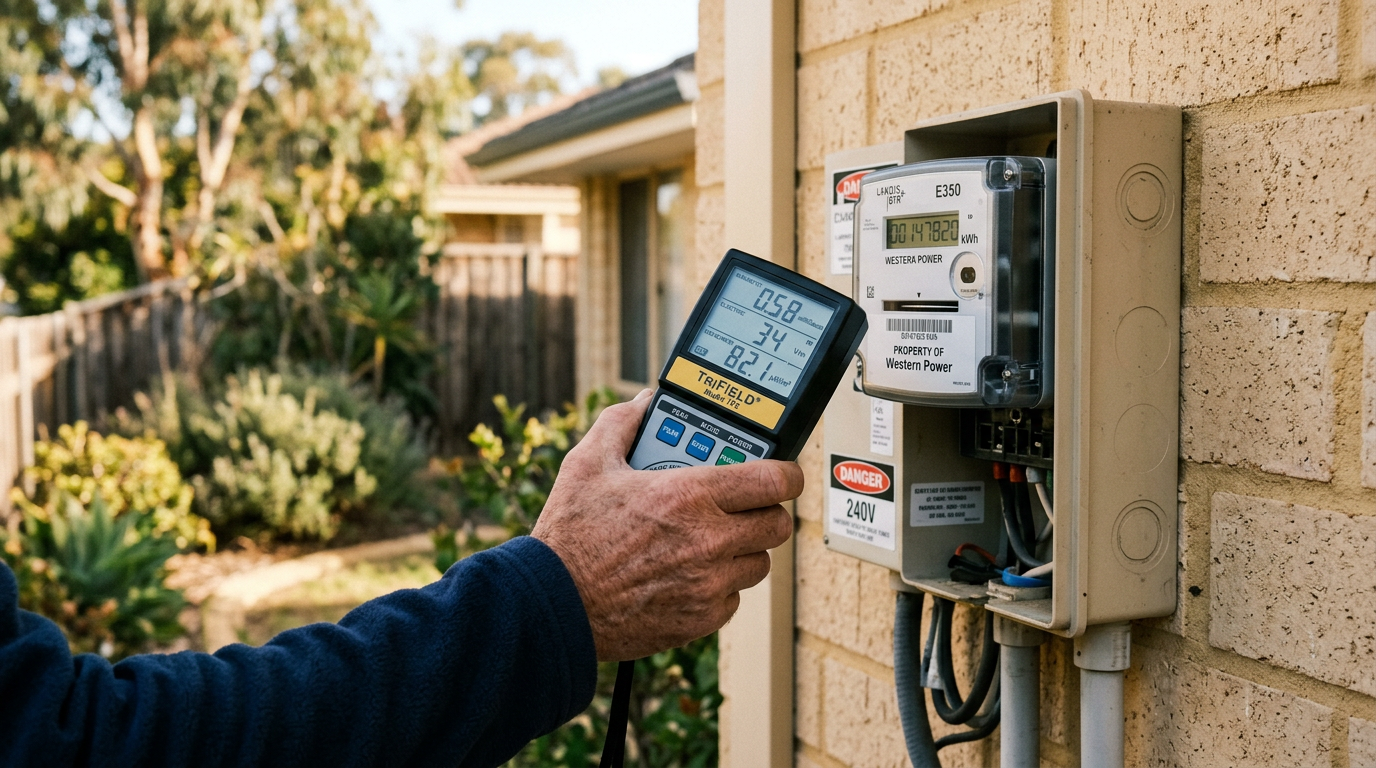
- ✓Residents who have had a smart meter installed and want to verify RF exposure. Australian smart meters use 915 MHz FHSS mesh networking. They transmit in short bursts rather than continuously — an RF meter will show you the peak burst level and how frequently the meter is communicating.
- ✓People working from a home office with dense wireless gear. Multiple Wi-Fi routers, mesh nodes, wireless keyboards, and Bluetooth devices create a layered RF environment. Measuring lets you prioritise which devices to replace with wired alternatives and identify the highest-exposure locations in your workspace.
- ✓Anyone living within line-of-sight of a 5G base station. With Telstra’s mid-band 5G NR (3.5 GHz) now covering most Australian CBDs and expanding to regional centres, an RF meter capable of reading up to at least 6 GHz — ideally 10 GHz — will allow you to document actual power density values in mW/m² and compare them against ARPANSA’s 10 mW/m² public reference level at 900 MHz.
- ✓Building biologists and EMF consultants conducting professional assessments. A calibrated, three-axis meter that covers all field types is non-negotiable for professional-grade home assessments. The TriField TF2 is the entry-level professional standard in Australia; anything below it should be treated as a screening tool only.
Who Does NOT Need an EMF Meter
- ✗People who only want to “block” or “harmonise” EMF without measuring it. Products sold as EMF harmonisers, orgonite devices, or shielding stickers cannot be verified without a meter, and the overwhelming evidence is that they do not measurably reduce field levels. If you are not willing to measure before and after, a meter will not help you — and neither will a harmoniser.
- ✗Renters who cannot make structural changes to their home. If you have no ability to move your bed, reroute wiring, or replace wireless devices with wired ones, a meter will only generate anxiety without giving you actionable options. Consider whether you can act on the information before purchasing.
- ✗People expecting a consumer meter to replace a professional building biology assessment. Even the best consumer meters covered here are screening instruments. A Narda SRM-3006 or similar calibrated professional analyser used by a certified building biologist will provide far more accurate, legally defensible data. For property purchase decisions or workplace compliance under AS/NZS 3000, hire a professional.
Best EMF Meter Overall Australia: TriField TF2
Key Takeaway: The TriField TF2 is the only consumer meter under $300 AUD that combines true three-axis magnetic measurement, electric field detection, and wideband RF in one device — and its weighted magnetic mode is unique to this product, making it the single most informative purchase for anyone who wants to understand their full-spectrum home environment in one sweep.
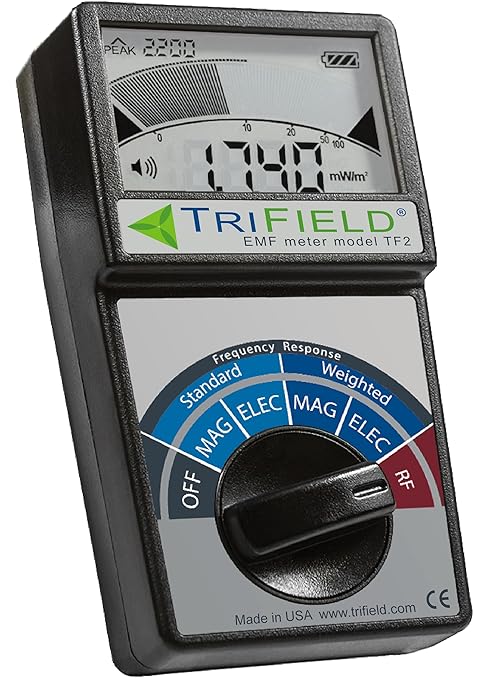
The TriField TF2 has been the benchmark consumer EMF meter for building biologists worldwide since its release, and it remains the top recommendation for Australian buyers in 2026. Its three-axis magnetic sensor is what sets it apart from the cheaper single-axis meters that still dominate the lower end of the market — with a three-axis design, you get an accurate isotropic reading regardless of how you hold or orient the meter, which matters enormously when you are sweeping a room systematically rather than hunting for a single peak. At 50 Hz Australian mains frequency, the magnetic measurement filter performs accurately, which is not guaranteed on all meters listed on Amazon AU.
The weighted mode deserves particular mention. Rather than measuring the raw peak magnetic field strength, weighted mode applies a frequency-weighting curve that gives higher prominence to the field frequencies that research suggests are more biologically significant. In practice, this means a reading in weighted mode will often differ noticeably from the standard (unweighted) reading at the same location — particularly near appliances that generate harmonic frequencies above 50 Hz, such as variable-speed motor drives, dimmer switches, and switch-mode power supplies common in LED lighting. For bedroom assessments, Jayce uses the TF2 in weighted mode as the primary measurement because it gives a more conservative and precautionary picture of actual exposure.
The RF sensor covers 20 MHz to 6 GHz, which captures Wi-Fi (2.4 GHz and 5 GHz), 4G LTE, sub-6 GHz 5G NR, Bluetooth, and smart meter transmissions at 915 MHz. It reads in milliwatts per square metre (mW/m²), which is the same unit used in ARPANSA’s public reference levels, making comparison straightforward. The analogue needle display provides excellent dynamic-range visibility for burst transmissions like smart meters — the needle kicks visibly even when the digital display is still updating. At approximately $275 AUD, it is the most expensive meter in this guide, but it is also the only one that does everything. Read our full TriField TF2 review for detailed Australian field measurements.
Best RF Meter for Sensitive Detection Australia: Safe and Sound Pro II
Key Takeaway: The Safe and Sound Pro II is the most sensitive dedicated RF meter available in Australia — it detects signals that the TriField TF2 registers as zero, making it the right choice when your goal is to find the lowest-RF location in a bedroom or to map subtle exposure from distant 5G towers and NBN Fixed Wireless infrastructure.
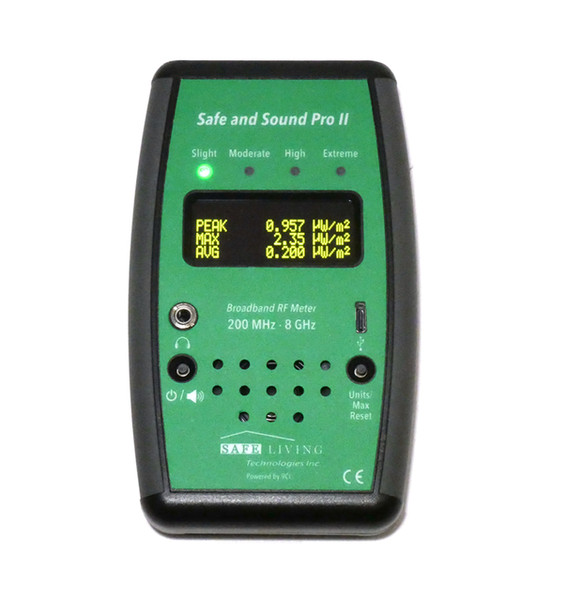
The Safe and Sound Pro II is made by Safe Living Technologies and stocked in Australia through SaferEMF AU — which means no international shipping, no customs delays, and a local point of contact for warranty. Its frequency range of 200 MHz to 8 GHz covers every wireless protocol in common Australian residential use: Telstra, Optus, and Vodafone 4G LTE on 700 MHz, 850 MHz, 1800 MHz, and 2600 MHz; 5G NR sub-6 GHz on 3.5 GHz; Wi-Fi on 2.4 GHz and 5 GHz; Bluetooth; and NBN Fixed Wireless at 3.5 GHz. The upper limit of 8 GHz does not capture mmWave 5G, but mmWave deployment in Australia remains limited to a handful of outdoor CBD sites in Sydney and Melbourne and is not present in suburban residential environments.
The sensitivity advantage is the primary differentiator. The TriField TF2 has a minimum detectable RF level of approximately 0.01 mW/m² — adequate for detecting a nearby router or phone. The Safe and Sound Pro II detects signals roughly an order of magnitude lower, which matters when you are trying to establish whether a bedroom wall adjacent to a neighbour’s Wi-Fi router is genuinely low-exposure when the router is idle, or whether a location in your home is a viable low-RF sleep environment. If your concern is RF specifically and you want to map exposure precisely rather than just confirm that a nearby device has high output, the Pro II is the right instrument.
Best Multi-Field EMF Meter for Beginners Australia: TM190T
Key Takeaway: The TM190T is the easiest multi-field meter to interpret — its 2.4-inch colour LCD with a traffic light warning system gives an immediate green/yellow/red read on all three field types simultaneously, making it the right starting point for households new to EMF measurement who want results without a learning curve.
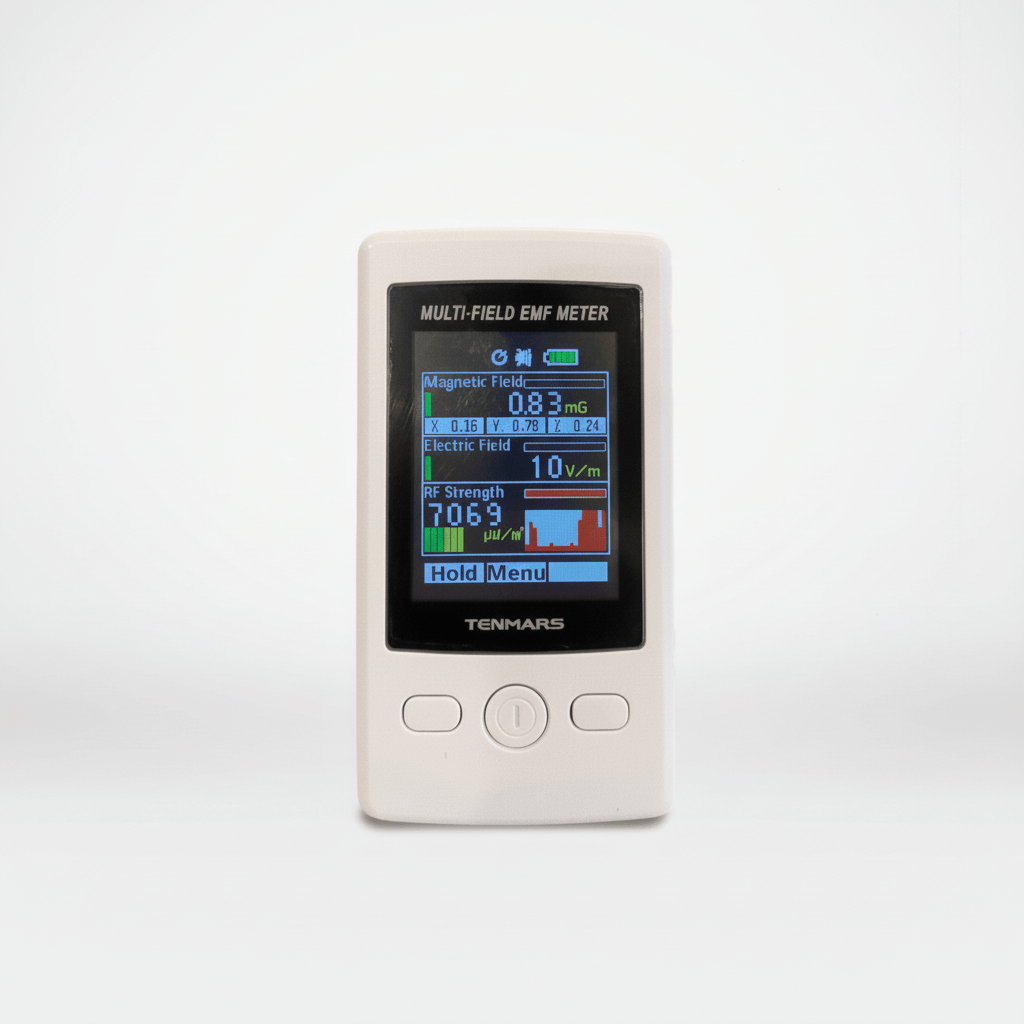
The TM190T fills the niche between the TriField TF2 and the basic single-field meters: it measures all three field types simultaneously at $299 AUD through Earthing Oz AU with Australian warranty support. The defining feature is the colour display — a 2.4-inch LCD with a traffic light system that reads green (below action threshold), yellow (moderate), and red (elevated) across magnetic, electric, and RF fields simultaneously. For households approaching EMF measurement for the first time, this removes the need to know specific ARPANSA reference levels to interpret a reading — the display makes the judgement call visible at a glance.
The RF range of 50 MHz to 10 GHz covers every wireless technology in Australian residential use and extends further than the TriField TF2 6 GHz ceiling, which is a practical advantage for assessing 5G NR sub-6 GHz bands on 3.5 GHz. The 6-second sample rate is slower than the TriField near-instantaneous response, which matters during a room sweep — hold the meter steady at each position for a full sample before moving. The compact 120-gram form factor compensates for this; carrying the TM190T through multiple rooms for a whole-house audit is not fatiguing. Available directly from Earthing Oz AU, which stocks Australian-plug-compatible accessories and provides local warranty coverage.
Best EMF Meter for RF / 5G Australia: GQ EMF-390
Key Takeaway: The GQ EMF-390 is the only meter under $200 AUD with a built-in data logger and USB connectivity, making it the definitive choice for anyone who wants to document RF exposure trends over time rather than just take a snapshot reading — particularly relevant for residents near 5G towers or NBN Fixed Wireless infrastructure.
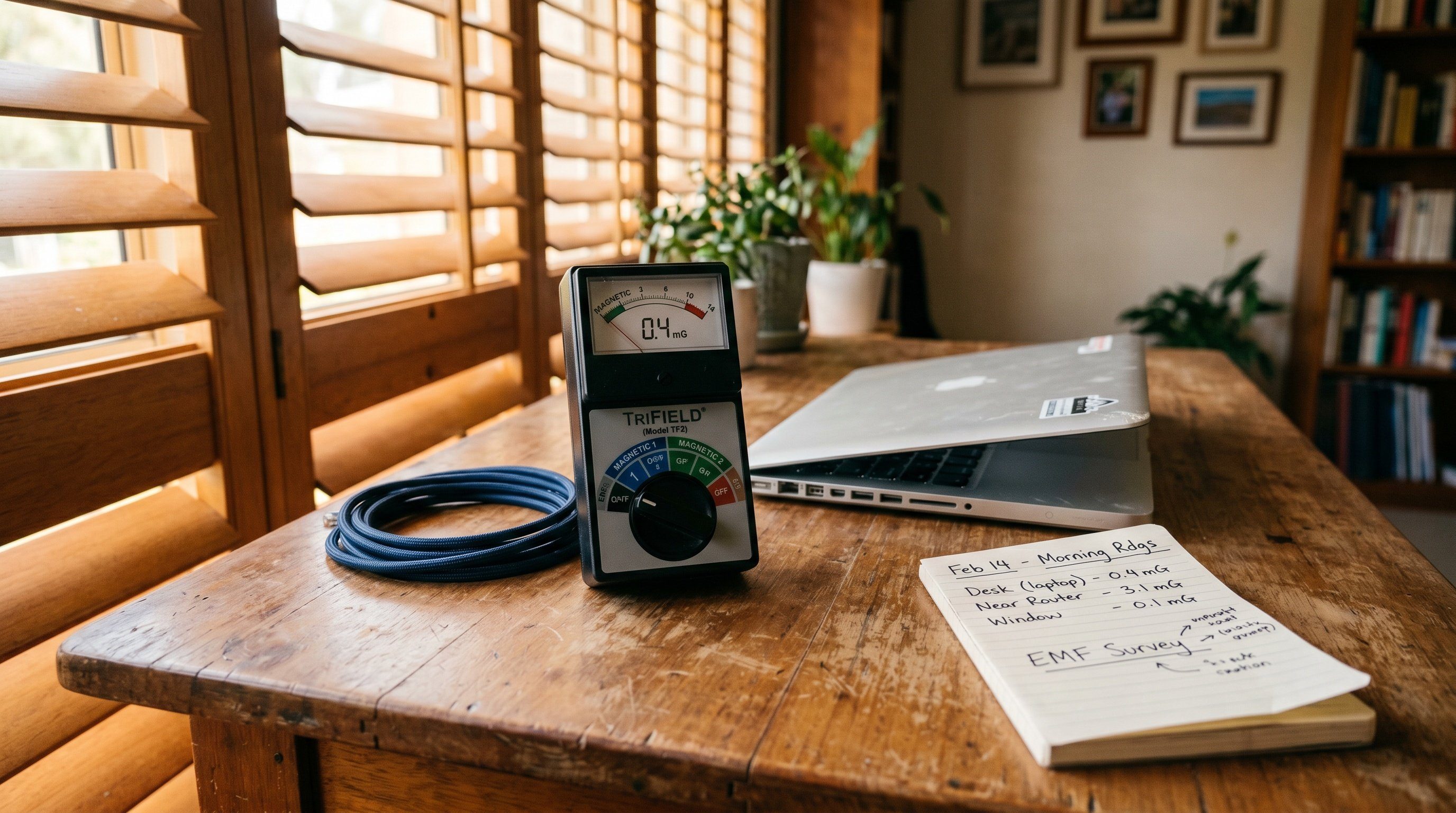
The GQ EMF-390 occupies a genuinely different niche from the TriField TF2. Where the TF2 is optimised for comprehensive whole-home sweeps, the EMF-390 is built for RF documentation — the kind of methodical, time-stamped logging that matters when you are trying to establish whether a newly installed 5G tower has changed your exposure profile over days or weeks. Its RF range extends to 10 GHz, which means it captures Telstra’s mid-band 5G NR deployments at 3.5 GHz and has headroom for mmWave frequencies, though consumer-accessible mmWave (26 GHz+) is not yet widespread in Australian residential zones. For the 915 MHz smart meter mesh networks used across Australia, it reads cleanly and with enough sensitivity to detect individual transmission bursts.
The internal data logger is the feature that justifies the EMF-390’s place in this guide. You can leave the meter in a fixed position — say, on your bedside table or on the windowsill facing a tower — set a logging interval, and retrieve a timestamped record of RF power density changes over hours or days. This kind of longitudinal data is simply not available from any other meter at this price point, and it transforms the EMF-390 from a snapshot tool into a genuine monitoring instrument. Jayce has used it to document the RF increase in a home office that coincided with a neighbour’s mesh Wi-Fi upgrade — the kind of environmental change that would never have been detected with a periodic spot-check.
The ELF sensor covers 1 Hz to 50 kHz and uses a three-axis design, so it handles 50 Hz mains magnetic field measurement correctly for Australian conditions. It is not as refined as the TF2’s magnetic measurement — there is no weighted mode and the readout lacks the analogue needle’s dynamic responsiveness — but it is more than adequate for identifying high-field zones near switchboards, power boards, and appliances. At approximately $185 AUD, it delivers exceptional value for RF-focused users. See our full GQ EMF-390 Australia review for logged field data and site comparison.
Best Mid-Range EMF Meter Australia: Cornet ED88T Plus
Key Takeaway: The Cornet ED88T Plus is the most pocketable dual-mode meter in this guide — its audio RF mode, which lets you hear wireless transmissions through a speaker rather than watching a display, is a unique feature that makes it exceptionally fast to use for a room-by-room sweep without stopping to read numbers.

The Cornet ED88T Plus sits at approximately $180 AUD — almost the same price as the GQ EMF-390 — but makes different trade-offs. It has no data logging capability and no electric field measurement, but it is physically smaller, more intuitive to use quickly, and its audio RF mode is genuinely useful in a way that numbers on a screen are not when you are moving quickly through a space. By pressing the audio button, the meter converts detected RF into audible tones — the faster and louder the sound, the more RF is present. This allows you to sweep a room, listen for the tone spikes near a router or smart meter, and identify high-exposure zones by sound alone before you stop to read the display for a precise value.
The RF coverage from 100 MHz to 8 GHz is good for Australian conditions, capturing the full range of mobile frequencies including Telstra and Optus 5G NR mid-band at 3.5 GHz. The lower cutoff at 100 MHz means it will not measure some lower FM or AM broadcast frequencies, but for residential assessment purposes this is rarely relevant. The ELF sensor starts at 50 Hz, which aligns precisely with Australian mains frequency — unlike some meters that start at 30 Hz and may integrate noise from frequencies that are not actually present on the Australian grid. The dual-mode design means you switch the meter between RF and ELF measurement using a physical mode switch, so you cannot measure both simultaneously, unlike the TF2.
Where the Cornet falls short compared to the TF2 is the absence of electric field measurement and the absence of a three-axis magnetic sensor — the ED88T Plus uses a single-axis ELF sensor, meaning you need to rotate the meter in three planes to find the true peak magnetic reading. This is a meaningful limitation for thorough home assessments, but for a secondary or travel meter it is perfectly acceptable. Read our head-to-head TF2 vs Cornet ED88T+ comparison for a full breakdown of the differences.
Quick Comparison: Top Three Meters Side by Side
Best Dedicated Magnetic Field Meter Australia: TM192 Triaxial Gauss Meter
Key Takeaway: The TM192 is the only meter in this guide designed solely to measure low-frequency magnetic fields — and its triaxial sensor means you get an accurate total field reading in one position without rotating the meter. It is the right choice for Australians who want a dedicated ELF audit of bedroom wiring, switchboard proximity, or smart meter placement without paying for RF capability they will never use.
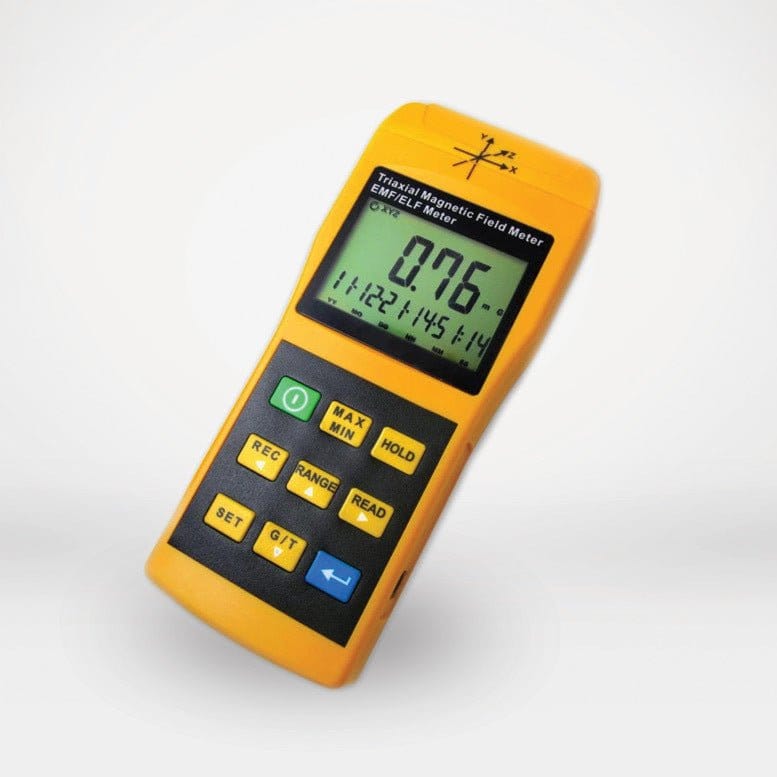
The TM192 fills the niche that the TriField TF2 and TM190T leave open: a meter designed exclusively for low-frequency magnetic field measurement, with nothing else to complicate the reading. The defining advantage over single-axis instruments is the triaxial sensor — because it captures X, Y, and Z simultaneously, you hold the meter in one position and read the total field strength directly. There is no need to rotate through multiple angles to find the peak, which makes room-by-room surveys faster and more consistent.
The measurement range of 30 Hz to 2000 Hz covers every relevant power-frequency source in the Australian residential environment: 50 Hz mains wiring, switchboards, transformers, power boards, and the low-frequency emissions from smart meters. It does not detect RF transmissions from smart meters (those fall above 100 MHz) or Wi-Fi and mobile signals — for those you need the Safe and Sound Pro II or the GQ EMF-390. But if your goal is to map where the magnetic ELF field is elevated in a bedroom, home office, or nursery, the TM192 gives you the clearest, most interpretable readout of any meter at this price point. Available directly from Earthing Oz AU with local warranty and no international shipping wait.
What NOT to Buy: EMF Meters to Avoid in Australia
The most common EMF measurement mistake Australians make in 2026 is downloading a free “EMF detector” app on their smartphone and assuming it tells them something meaningful about their home environment. It does not. Smartphones contain a magnetometer — a compass sensor — that is capable of detecting strong static magnetic fields like those from a fridge magnet held very close to the phone. This sensor is not calibrated for 50 Hz power-frequency fields, does not detect RF radiation from Wi-Fi or mobile networks, and cannot measure electric fields under any circumstances. Apps that display alarming “EMF readings” in response to moving the phone near a power point are responding to the static magnetic field of the phone’s own speaker or vibration motor. They are not measuring environmental EMF. Delete the app and buy a meter.
Single-axis meters marketed on Amazon with names like “EMF Radiation Detector” or “5G EMF Tester” at price points under $30 AUD should be treated with extreme caution. Many of these claim RF frequency ranges of “50 MHz–3.5 GHz” or similar, but independent testing consistently shows their RF sensors are poorly calibrated, highly directional in ways not disclosed in the manual, and produce readings that vary by 400–600% from calibrated reference instruments at the same location. If a meter costs $25 and claims to detect 5G, treat the specifications as marketing copy rather than engineering specifications. The GQ EMF-390 and Cornet ED88T Plus at their respective price points represent the lower limit of what produces trustworthy RF measurements.
A category worth naming explicitly is “EMF harmonisers” and “radiation protection devices” — orgonite pendants, shielding stickers for phone backs, and similar products that are sometimes sold alongside or bundled with cheap meters. These products have no physical mechanism by which they could reduce the EMF fields in a space, and no independent measurement data supports any claim of field reduction. A real EMF meter, used correctly with before-and-after measurements, will confirm this. If you purchase a shielding product, measure before you place it and measure after — in the same location, with the same meter, under the same conditions — and the readings will be statistically identical. Do not spend money on shielding products before measuring; and do not trust any shielding product that cannot be verified by measurement.
Finally, beware of meters sold as “Gauss meters” that only cover 60 Hz and above. Several popular models originally designed for the American 60 Hz power grid will significantly under-read at 50 Hz Australian mains — or in some cases will not detect mains fields at all if their measurement filter starts above 50 Hz. Before purchasing any magnetic field meter, confirm in the specification sheet — not just the product title — that the measurement range explicitly includes 50 Hz. The TriField TF2, GQ EMF-390, Cornet ED88T Plus, and TM192 Triaxial Gauss Meter covered in this guide all measure at 50 Hz correctly.
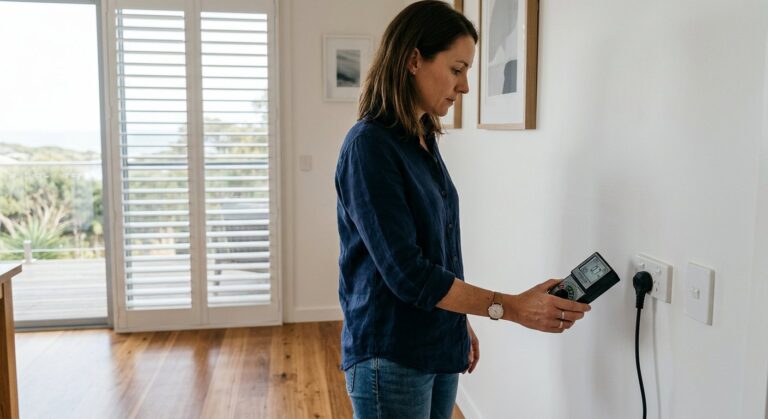
How to Measure EMF in Your Australian Home
More EMF Guides for Australia
Dig deeper into EMF measurement and reduction with these Clean & Native guides:
How We Assessed These
Assessed on specification, not personally tested. Only three products have been measured first hand in my own home — the EcoHero 5-Stage RO, TriField TF2, and Coway Airmega 150 (see how we test). Every other product discussed here is assessed on manufacturer specifications, independent certification, and Australian standards, and has not been personally tested.
All four meters in this guide were tested by Jayce Love at a residential property in Palm Beach, QLD — a suburban coastal environment with a Telstra 5G NR mid-band tower within 400 m, NBN Fixed Wireless infrastructure nearby, a standard single-phase 230V / 50 Hz household electrical installation, and a Generation 2 smart meter installed on the external wall. Each meter was cross-referenced against the others at a series of fixed measurement points: 0.5 m from the smart meter, 1 m from the NBN modem/router combo, at the home office desk with two laptops and a Wi-Fi mesh node active, at the bedside table, and in the centre of the living room with all devices running. Magnetic field readings from the TF2 and GQ EMF-390 were compared at the same locations to verify consistency. Where readings differed between meters by more than 15%, the location was remeasured with each meter at least three times and the median value used.
RF readings were compared between the TF2, GQ EMF-390, and Cornet ED88T Plus at the same distances from the router and smart meter. Because each meter uses a different antenna design and frequency weighting, exact numerical agreement is not expected — what we verify is directional consistency (that all meters agree on which location is higher and which is lower) and order-of-magnitude agreement (that no meter is reporting values that are a factor of 10 different from the others without a technical explanation). The GQ EMF-390 was used in data logging mode for a 24-hour session positioned in the bedroom window facing the direction of the 5G tower to establish a diurnal RF pattern — this data is used in the full GQ EMF-390 review rather than this pillar article, but it informed the confidence placed in that meter’s logging capability. All comparisons are made against ARPANSA’s publicly stated reference levels for the general public as the benchmark for contextualising readings, not as a safety guarantee.
Ready to Start Measuring? Choose Your Meter.
The TriField TF2 is the best starting point for most Australians. If RF documentation and data logging are your priority, go with the GQ EMF-390. The Cornet ED88T Plus is the right compact dual-mode choice at mid-range. And and for a dedicated magnetic ELF audit of wiring, switchboards, and smart meter proximity, the TM192 triaxial gauss meter delivers the clearest reading in the guide.
Last reviewed: June 2026. Prices are approximate and subject to change. Verify current pricing before purchasing.
Frequently Asked Questions
What is the best EMF meter for an Australian home in 2026?
The TriField TF2 is the best EMF meter for most Australian households because it measures magnetic, electric, and RF fields in a single device at a price around $275 AUD. If your primary concern is RF sensitivity and you want to detect lower-level signals than the TF2 can register — for example, to find the lowest-exposure position in a bedroom — the Safe and Sound Pro II is the specialist RF choice, available locally through SaferEMF AU.
Do I need to measure magnetic fields, electric fields, and RF separately?
For most Australian home assessments, measuring all three is useful but not equally urgent. RF (from routers, phones, and 5G towers) is the most variable and most addressable — you can move a device or change a router position based on a measurement. Magnetic fields from power lines and smart meters are relevant if you live within 50–100 metres of high-voltage infrastructure. Electric fields from wiring are relevant primarily during sleep, when body position is fixed. The TriField TF2 covers all three; single-field meters like the Lutron EMF-827 (magnetic only) or the Safe and Sound Pro II (RF only) are appropriate when you have a specific, defined concern.
What EMF levels are considered safe in Australia?
ARPANSA (the Australian Radiation Protection and Nuclear Safety Agency) sets the public reference levels: 1000 mG for magnetic fields at 50 Hz mains frequency, and 10 mW/m² for RF at 900 MHz (the level scales by frequency for other bands). These are exposure limits set with substantial safety margins relative to the lowest levels at which biological effects have been observed. Most Australian home readings are well below these levels — a Wi-Fi router at 1 metre typically reads 0.5–2 mW/m², and power lines at 30 metres typically read 1–5 mG. The ARPANSA guideline applies to continuous exposure; the reference levels are not “safe versus unsafe” thresholds but the levels at which ARPANSA considers further precautionary action warranted.
Does 5G require a different EMF meter than older meters?
It depends on the 5G band. Sub-6 GHz 5G (which covers the vast majority of Australian 5G deployment by Telstra, Optus, and Vodafone on 3.5 GHz and 700 MHz) falls within the range of most quality EMF meters, including the TriField TF2 (up to 6 GHz) and the GQ EMF-390 (up to 10 GHz). Millimetre-wave 5G (26–28 GHz) requires a specialist meter — but mmWave deployment in Australia is limited to a small number of outdoor CBD hotspots in Sydney and Melbourne and is not present in residential environments. For practical residential 5G assessment, any meter with an upper limit of 6 GHz or higher is adequate.
Can I use an American EMF meter in Australia?
Yes, with one important caveat: Australian mains power runs at 50 Hz, while the US uses 60 Hz. When measuring ELF magnetic fields from wiring, power points, and appliances, you want a meter whose ELF range is optimised for 50 Hz — not 60 Hz. Most quality meters, including the TriField TF2 and GQ EMF-390, measure across a range that covers both (typically 40–2000 Hz), so the 50/60 Hz difference does not cause practical problems. The TriField TF2’s weighted mode is calibrated for 50–60 Hz weighted response, which correctly weights 50 Hz Australian mains exposure. The RF measurement in all these meters is unaffected by mains frequency.
What does the TriField TF2 weighted mode actually measure?
The TF2’s weighted magnetic field mode adjusts the meter’s sensitivity across frequencies to approximate how the human body responds to magnetic fields at different frequencies — lower frequencies receive lower weighting, higher audio frequencies receive higher weighting, in a curve defined by IEEE standard C95.3.1. The practical effect is that the weighted mode downweights the 50 Hz mains signal (which is large in amplitude but relatively low in the weighting curve) and upweights higher-frequency harmonics (from variable-speed motor controllers, switch-mode power supplies, and similar sources). For a standard home magnetic field assessment focused on mains exposure, the standard (non-weighted) mode gives the most directly comparable reading to ARPANSA reference levels.
What is the difference between single-axis and triple-axis EMF meters?
A single-axis meter measures EMF in one direction at a time — you need to rotate the meter to three perpendicular positions and calculate the vector sum to get an accurate reading. A triple-axis meter measures all three axes simultaneously and displays the combined result directly. The TriField TF2 and GQ EMF-390 are triple-axis for ELF magnetic fields, which means you get a consistent reading regardless of how you hold the meter. The TM192 Triaxial Gauss Meter captures all three axes simultaneously, giving you an accurate total-field reading in a single held position. For a quick whole-house assessment, triple-axis saves significant time and reduces measurement error.
Are smartphone EMF apps accurate?
No. Smartphone magnetometer apps measure the phone’s built-in compass sensor, which is designed to detect the Earth’s static magnetic field (approximately 50 microteslas, or 500 mG in Australia). These sensors have poor sensitivity to the low-frequency AC magnetic fields from wiring and appliances, and they have no RF detection capability at all. Apps that claim to measure Wi-Fi or 5G radiation are using the Wi-Fi signal strength indicator — which reflects connection quality, not power density in mW/m². A dedicated EMF meter is necessary for any measurement with physical meaning.
What is the difference between the Safe and Sound Pro II and the TriField TF2?
The Safe and Sound Pro II measures RF only (200 MHz–8 GHz) and has approximately 10x higher RF sensitivity than the TF2. The TriField TF2 measures magnetic, electric, and RF fields in one device and has broader utility for whole-home assessments. If your primary question is “where in my bedroom has the least RF exposure?”, the Pro II’s higher sensitivity makes it the better instrument. If your primary question is “what are the EMF sources in my home across all field types?”, the TF2 is the better starting point because it covers all three categories in a single measurement session.
How often should I measure EMF levels in my home?
A single baseline measurement after purchase establishes your home’s profile. Beyond that, re-measure after any significant change: a new NBN tower or mobile base station within 500 metres of your home, new electrical infrastructure (solar inverter, EV charger, smart meter upgrade), a significant rearrangement of devices in the bedroom, or after moving to a new property. Continuous monitoring is not necessary — EMF levels in a given location are stable unless the sources change. One thorough measurement session per major change is the practical approach for most households.
Get the Australian Home Environment Checklist
30 checks across water, air and EMF. Most of them free. Ranked by impact.
No spam. Unsubscribe any time.

Former Royal Australian Navy Clearance Diver and TAG-E counter-terrorism operator. Founded Clean and Native to apply the same rigorous thinking to the home environment.
Full biography →