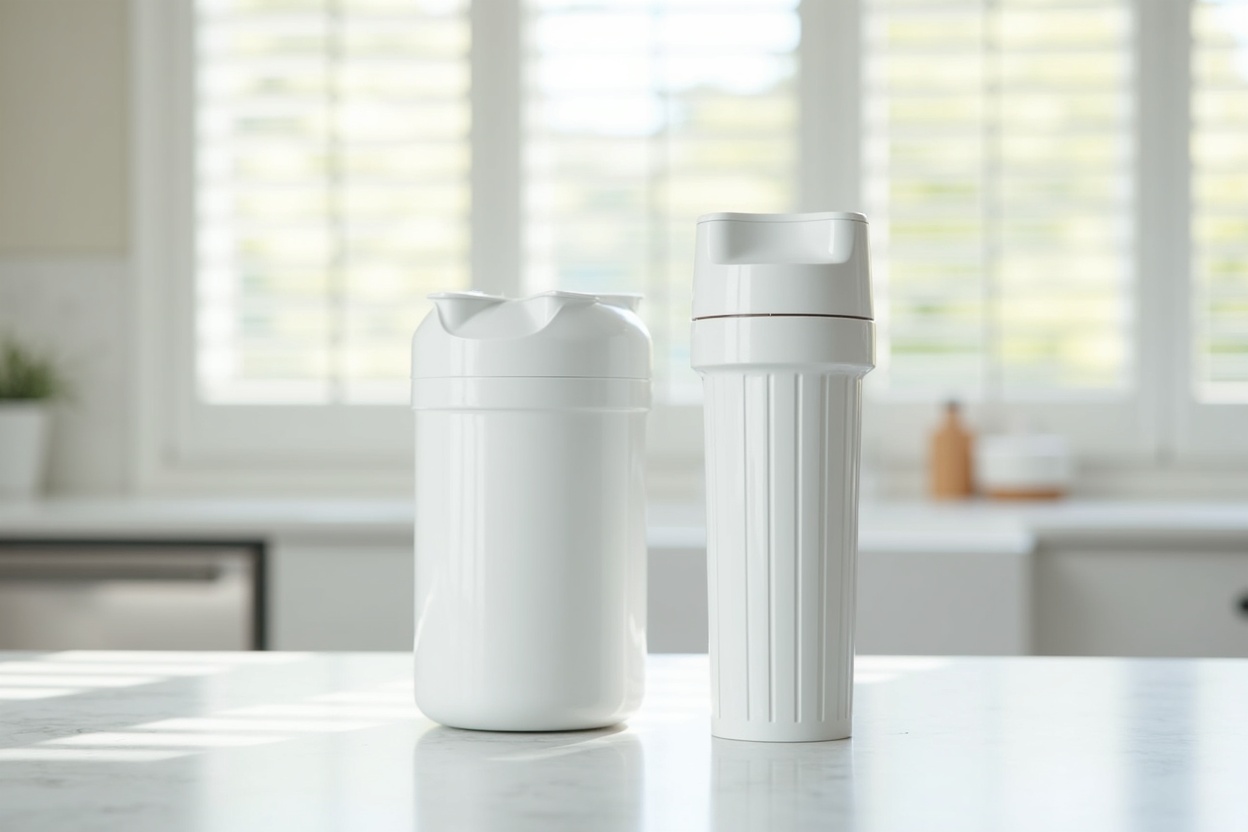
AquaTru Countertop RO vs Clearly Filtered Pitcher Australia 2026: Which Is Worth Your Money?
9 min read
This article contains affiliate links. We may earn a commission at no extra cost to you. Full disclosure.
You’re comparing AquaTru vs Clearly Filtered Australia, and every review you’ve read gives you a different answer. One claims both remove everything. Another says neither handles fluoride properly. The marketing copy promises pure water, but you need to know which actually delivers in Australian conditions. You live with Brisbane’s chloramine-heavy water, or Perth’s high TDS levels, or Melbourne’s taste issues. The wrong choice means months of regret and a kitchen bench occupied by something that doesn’t work. This breakdown cuts through the confusion with actual performance data, Australian pricing, and the deciding factors that matter for our water conditions.
The Short Answer
AquaTru removes more contaminants (99%+ for 83 substances) but costs $649+ upfront and needs bench space and power. Clearly Filtered removes 365+ contaminants at 99.9% efficiency for under $200 but requires manual refilling and slower filtration. Choose AquaTru if you want maximum removal and don’t mind the investment; choose Clearly Filtered if budget and simplicity matter more than absolute filtration performance.
| Specification | AquaTru Countertop RO | Clearly Filtered Pitcher |
|---|---|---|
| Price (AUD) | $649-799 | $169-199 |
| Filtration Technology | 4-stage reverse osmosis | Affinity filtration media |
| Fluoride Removal | 99.9% (NSF/ANSI 58) | 97.0% (NSF/ANSI 53) |
| Chlorine/Chloramine | 99.9% | 99.8% |
| Lead Removal | 99.9% | 99.9% |
| TDS Reduction | 95-99% | Limited (selective) |
| Daily Capacity | 60-75 litres | 19 litres (pitcher size) |
| Annual Filter Cost (AUD) | $240-280 | $150-180 |
| Power Required | Yes (24W) | No |
| Installation | Plug-in, no plumbing | Ready to use |
| Warranty | 2 years | 1 year |
| NSF Certifications | 58, 372 | 42, 53, 401 |
## AquaTru Countertop RO: Maximum Removal Performance
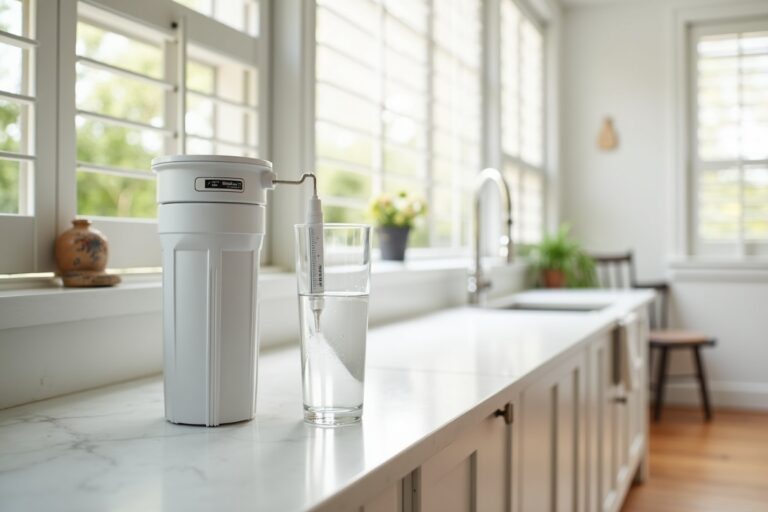
The AquaTru represents reverse osmosis technology adapted for Australian kitchens without permanent plumbing modifications. The system useses a four-stage process: sediment pre-filter, activated carbon pre-filter, reverse osmosis membrane, and activated carbon post-filter. This configuration achieves 99%+ removal rates for 83 documented contaminants, including the fluoride compounds added to most Australian municipal water supplies under NHMRC guidelines.
For Australian water conditions, the RO membrane handles the high Total Dissolved Solids (TDS) levels common in Adelaide (300-400 ppm) and Perth (150-200 ppm). The system reduces TDS by 95-99%, essentially creating laboratory-grade water regardless of input quality. This matters significantly if you’re dealing with bore water, rural supplies, or areas with known contamination issues. The NSF/ANSI 58 certification covers fluoride removal at 99.9% efficiency, addressing concerns about the 0.6-1.0 mg/L fluoride levels maintained in Australian drinking water.
The unit processes water on demand, storing 12 litres in an internal tank and producing additional water at approximately 2 litres per hour. This capacity suits families consuming 8-15 litres daily for drinking and cooking. The system’s computer-controlled operation includes automatic flushing cycles that maintain membrane performance and prevent bacterial growth — critical in Australia’s varying climate conditions where stored water can become problematic.
Installation requires only a power connection and access to fill the input tank. The system fits most kitchen benches at 36cm wide by 38cm deep, though the height (43cm) may conflict with overhead cabinets. Filter replacement occurs every 6-12 months depending on input water quality, with annual costs ranging $240-280 AUD based on current Australian pricing.
Affiliate link — we may earn a commission at no extra cost to you.
## Clearly Filtered Pitcher: Targeted Filtration Efficiency
The Clearly Filtered pitcher uses proprietary Affinity filtration media designed to selectively remove specific contaminants while preserving beneficial minerals. The technology targets 365+ substances including heavy metals, pharmaceuticals, pesticides, and disinfection byproducts. Unlike reverse osmosis, this approach maintains water’s natural mineral content, preserving taste and avoiding the flat characteristic of RO water.
For Australian conditions, the system excels at removing chlorine and chloramine — the disinfectants used by water authorities in Brisbane, Adelaide, and Perth. The 99.8% removal rate for these compounds eliminates the taste and odour issues affecting many Australian tap water supplies. Lead removal reaches 99.9% efficiency, addressing concerns about older plumbing in established suburbs across Australian cities.
Fluoride removal achieves 97.0% efficiency under NSF/ANSI 53 testing protocols. While this doesn’t match RO performance, it reduces typical Australian fluoride levels from 0.8 mg/L to approximately 0.02 mg/L — below naturally occurring levels in most groundwater. The filtration process maintains beneficial minerals including calcium and magnesium, which RO systems remove entirely.
The pitcher holds 19 litres total with 10 litres of filtered water storage. Filtration occurs by gravity, taking 10-15 minutes to process a full reservoir. This passive system requires no power, installation, or plumbing modifications. The compact design stores easily in refrigerators or sits permanently on benchtops without dominating kitchen space.
Filter replacement occurs every 400 litres or approximately 3-4 months for typical household use. Annual filter costs range $150-180 AUD, making this the more economical long-term option despite similar upfront cost per litre filtered.
Affiliate link — we may earn a commission at no extra cost to you.
## Where Each Falls Short
The AquaTru’s reverse osmosis process removes beneficial minerals alongside contaminants, producing water with extremely low TDS that some users find tasteless. The system requires regular maintenance including tank sanitisation and membrane replacement. Power consumption adds to operating costs, and the unit’s size may not suit smaller kitchens. Most significantly, the waste water ratio runs approximately 3:1 — producing 3 litres of waste for every litre of filtered water. In drought-conscious Australia, this inefficiency creates environmental and cost concerns, particularly in areas with water restrictions.
The Clearly Filtered pitcher cannot match RO performance for dissolved solids or certain contaminants. TDS reduction is minimal, meaning the system won’t address high mineral content that affects taste in some Australian regions. The 97% fluoride removal, while substantial, leaves measurable amounts that some users specifically seek to eliminate completely. Filtration speed becomes problematic for high-consumption households — the 10-15 minute processing time creates bottlenecks when multiple family members need water simultaneously. The gravity-fed system also cannot remove certain dissolved gases or achieve the sub-micron filtration of pressurised systems.
## Which Should You Buy?
**If you rent or cannot modify your kitchen**: Choose the Clearly Filtered pitcher. No installation, no permanent changes, and easy transport if you move. The passive system works in any location with access to tap water.
**If you have a large family consuming 15+ litres daily**: Choose AquaTru. The continuous production capacity and 12-litre storage tank better support high-consumption households, despite higher operating costs.
**If fluoride removal is your primary concern**: Choose AquaTru. The 99.9% removal rate reduces fluoride to essentially undetectable levels, while Clearly Filtered’s 97% reduction leaves measurable amounts.
**If your budget is under $300 total first-year cost**: Choose Clearly Filtered. At $169-199 initial cost plus $40-50 for first filter replacement, total first-year investment stays under $250. AquaTru requires $649+ initial plus $60-80 for first filter replacement.
**If water restrictions or environmental impact matter**: Choose Clearly Filtered. Zero waste water production versus AquaTru’s 3:1 waste ratio makes this the environmentally responsible choice during drought conditions.
**If you want the lowest ongoing costs**: Choose Clearly Filtered. Annual filter costs of $150-180 versus AquaTru’s $240-280, plus no electricity consumption, makes this significantly cheaper long-term.
## Frequently Asked Questions
### Can I use the AquaTru in a rental property in Australia?
Yes, the AquaTru requires no permanent installation or plumbing modifications. It plugs into standard Australian power outlets and connects to tap water through a removable hose. This makes it rental-friendly across all states, though check your lease agreement regarding benchtop appliances.
### Does the Clearly Filtered remove fluoride from Queensland tap water effectively?
The Clearly Filtered removes 97% of fluoride, reducing Queensland’s typical 0.8 mg/L levels to approximately 0.02 mg/L. While not as thorough as reverse osmosis, this reduction brings fluoride below naturally occurring levels in most groundwater sources.
### Which system is cheaper to run per year in Australia?
Clearly Filtered costs $150-180 annually for filter replacements. AquaTru costs $240-280 for filters plus approximately $25-35 in electricity (based on 24W continuous operation at average Australian power rates). Total annual operating cost: Clearly Filtered $150-180, AquaTru $265-315.
### Will either system work during Australian water restrictions?
Both systems work during water restrictions since they filter existing tap water rather than increasing consumption. However, AquaTru produces 3 litres of waste water for every litre filtered, which may conflict with severe restriction guidelines. Clearly Filtered produces no waste water.
### Do these systems need special maintenance in Australia’s climate?
Both systems benefit from regular cleaning in humid Australian conditions. Store Clearly Filtered pitchers in refrigerators to prevent bacterial growth. AquaTru includes automatic sanitisation cycles, but manually sanitise the storage tank monthly in tropical areas like Darwin or Cairns where ambient temperatures exceed 30°C regularly.
The decision between these systems ultimately comes down to your specific water quality concerns, household consumption patterns, and budget constraints. Both represent quality filtration options adapted to Australian water conditions and regulations. For more comprehensive water filtration guidance, see our complete review of the [best water filters available in Australia](/water-filters/best-water-filter-australia-2026/). You might also want to understand [what’s actually in Australian tap water by state](/water/whats-in-australian-tap-water-by-state-2026/) to better assess which contaminants your local supply contains.
Written by Jayce Love — Former Royal Australian Navy Clearance Diver & Founder, Clean and Native
Get the Australian Home Environment Checklist
30 checks across water, air and EMF. Most of them free. Ranked by impact.
No spam. Unsubscribe any time.

Former Royal Australian Navy Clearance Diver and TAG-E counter-terrorism operator. Founded Clean and Native to apply the same rigorous thinking to the home environment.
Full biography →