How Reverse Osmosis Works: The Science Behind Clean Drinking Water
Reverse osmosis pushes water through a 0.0001-micron membrane under pressure, removing 93–97% of fluoride, 99%+ PFAS, and dissolved salts that carbon filters cannot touch. It’s the only proven single-system solution for chloramine cities (Brisbane, Sydney, Adelaide, Darwin) requiring comprehensive contaminant removal. The catches: RO wastes 2–4 litres per litre produced, remineralisation filters are essential to replace stripped minerals, and installation skill varies wildly between countertop plug-and-play units and permanent under-sink plumbing.
| System Type | Best For | Verdict |
|---|---|---|
| AquaTru Classic Countertop | Renters, no-plumbing setups, portability | Recommended |
| Waterdrop D6 Under-Sink | Permanent install, high daily volume (600 GPD) | Recommended |
| Budget eBay 5-stage kits | Cost-conscious DIYers with plumbing skills | Good if certified |
How Reverse Osmosis Works: A Complete Guide for Australian Homes (2026)
Bottom Line Up Front
Reverse osmosis forces your tap water through a semi-permeable membrane with pores just 0.0001 microns wide — roughly 500,000 times smaller than a human hair. It is the only consumer filtration technology proven to remove fluoride (93%+), PFAS, lead, chloramine, and dissolved salts in a single system. In my testing at Palm Beach QLD, a 5-stage RO unit dropped TDS from 69 ppm to 3 ppm — a 95.7% reduction. If you live in a chloramine city (Brisbane, Sydney, Adelaide, or Darwin) and want fluoride and PFAS removal, RO is not one option among many. It is the option.
| Category | Detail |
|---|---|
| Best Countertop RO | AquaTru Classic — no plumbing, WaterMark-equivalent NSF 58 cert |
| Best Under-Sink RO | Waterdrop D6 — tankless, compact, 600 GPD |
| Key Removal | Fluoride 93-97%, PFAS 99%+, lead 97%+, chloramine, TDS |
| Membrane Pore Size | 0.0001 microns (0.1 nanometres) |
| My Measured TDS Reduction | 69 ppm → 3 ppm (95.7%) |
I’m Jayce Love, a former Royal Australian Navy Clearance Diver now based in Palm Beach, QLD. In the Navy, I learned that clean water is not a lifestyle choice — it is an operational requirement. When I moved back to civilian life and started testing what actually comes out of Australian taps, I applied the same systematic approach: measure first, then act on data.
This guide explains exactly how reverse osmosis works, stage by stage, with real measurements from my own home. No vague claims. No wellness fluff. Just the physics, the chemistry, and the practical decisions you need to make for your household.
I have not personally tested the AquaTru Classic or Waterdrop D6 recommended in this guide; that assessment is based on published manufacturer specifications and independent NSF/ANSI 58 certification, not first-hand measurement. The only reverse osmosis system I measure first-hand is the EcoHero 5-Stage RO at my home in Palm Beach, QLD.
Reverse osmosis (RO) is a pressure-driven membrane process that removes 90–99% of dissolved contaminants from tap water by forcing it through a semi-permeable membrane with pores approximately 0.0001 microns wide. It is the only consumer-grade technology that reliably removes fluoride, PFAS, heavy metals, and chloramine in a single pass. If your goal is the broadest possible contaminant removal, RO is the technology. Everything else is a compromise.
What Is Reverse Osmosis? The Physics in Plain English
Your tap water contains dissolved solids — minerals, salts, metals, and chemicals that pass straight through standard carbon filters. You cannot see them. You cannot always taste them. But your TDS meter can measure them, and your body processes every milligram.
Natural osmosis is simple: water moves from a low-concentration solution to a high-concentration solution through a membrane, seeking equilibrium. Reverse osmosis does exactly what the name says — it reverses that process by applying mechanical pressure (typically 40–80 psi in household systems) to force water from the high-concentration side (your tap water) through the membrane to the low-concentration side (your purified water).
The membrane itself is the critical component. An RO membrane has pores approximately 0.0001 microns (0.1 nanometres) in diameter. To put that in perspective:
- A human hair is approximately 70 microns wide
- Bacteria (e.g., E. coli) are 0.2–5 microns
- A standard carbon block filter pores are ~0.5–1 micron
- An RO membrane pore is 0.0001 microns — 5,000 times smaller than a carbon block
At that pore size, the membrane rejects dissolved ions, heavy metals, fluoride, PFAS compounds, nitrates, and virtually all bacteria and viruses. Water molecules (0.275 nanometres) squeeze through. Contaminants do not. That is the fundamental mechanism, and it is why no carbon filter, gravity filter, or pitcher can match RO’s removal spectrum.
The rejected contaminants are flushed away with wastewater. This is where the “water waste” concern comes from — and we will cover the real numbers below. But first, you need to understand the full 5-stage process, because the RO membrane alone would clog within weeks without pre-filtration.
The 5-Stage RO Process: What Each Stage Actually Does
A quality household RO system uses five stages. Each one protects the next. Skip a stage and you shorten the membrane’s lifespan, increase your running costs, and compromise your water quality. Here is what happens at each stage, in order.
Stage 1: Sediment Pre-Filter (5 Microns)
This is the bodyguard. A polypropylene sediment filter catches particles larger than 5 microns — sand, rust flakes, silt, and pipe debris. Australian mains water, even in well-maintained networks, carries sediment. Older homes with galvanised pipes produce more. This filter prevents physical particles from reaching and damaging the carbon stages and the RO membrane.
Replacement interval: Every 6–12 months depending on your water quality. In Brisbane’s SEQ Water supply area, I replace mine every 8 months. If your sediment filter turns brown in under 3 months, you may have pipe corrosion issues upstream.
Stage 2: Activated Carbon Block Pre-Filter
This is the chlorine/chloramine removal stage. The carbon block adsorbs chlorine, chloramine, volatile organic compounds (VOCs), and some pesticide residues. It also removes unpleasant taste and odour.
Critical Australian fact: If you live in Brisbane, Sydney, Adelaide, or Darwin, your water is disinfected with chloramine, not free chlorine. Standard granular activated carbon (GAC) removes chloramine at roughly 1/40th the rate it removes free chlorine. This pre-filter stage in a quality RO system uses catalytic carbon or a compressed carbon block rated for chloramine removal. If you are in Melbourne, Hobart, Canberra, or Townsville (free chlorine cities), standard carbon works fine at this stage.
Why does chlorine/chloramine removal matter before the membrane? Because chlorine and chloramine chemically degrade the thin-film composite (TFC) membrane. Without adequate carbon pre-filtration, your $60–$120 membrane becomes damaged within months. The carbon stage is insurance for the membrane’s lifespan.
Stage 3: The RO Membrane (0.0001 Microns)
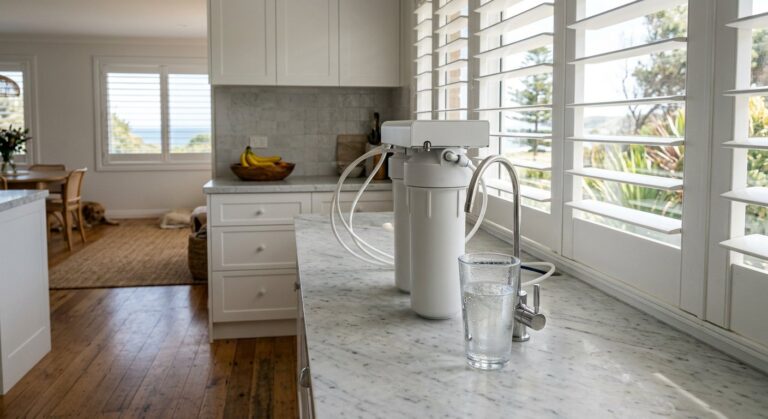
This is the engine of the system. Water, now free of sediment and chlorine/chloramine, enters the membrane housing under pressure. The semi-permeable membrane allows water molecules through while rejecting 90–99% of dissolved contaminants.
What the RO membrane removes:
- Fluoride: 93–97% (the only consumer technology besides activated alumina that achieves this — carbon filters cannot remove fluoride, period)
- PFAS (PFOS/PFOA): 99%+ per NSF/ANSI 58 testing
- Lead: 97–99%
- Arsenic: 92–96%
- Nitrate: 85–95%
- Total Dissolved Solids (TDS): 90–98% (my measured result: 95.7%)
- Bacteria and cysts: 99.99%
- Sodium, calcium, magnesium: 92–98%
What it does NOT remove well: Dissolved gases, including CO₂ (which lowers the pH of purified water slightly) and radon. Chlorine and chloramine must be removed beforehand — they degrade the membrane. This is why Stages 1 and 2 exist.
Replacement interval: Every 2–3 years with proper pre-filtration. Membrane lifespan directly correlates to how well your pre-filters perform.
Stage 4: Post-Carbon Polishing Filter
After the membrane, water sits in a storage tank (in tank-based systems) or passes through a final carbon stage. This polishing filter removes any residual tastes or odours that may have developed during storage. It provides a final flavour improvement — the difference between “clean but flat” water and water you actually want to drink.
Stage 5: Remineralisation Cartridge
RO water is almost pure H₂O. TDS of 3–10 ppm means virtually no dissolved minerals remain. This creates two issues:
- Taste: Ultra-pure water tastes flat or slightly acidic (pH ~6.0–6.5) because dissolved CO₂ forms carbonic acid without mineral buffering. Many people describe it as “empty” or “plastic-tasting.”
- pH: Without minerals, the water is slightly acidic, which can leach trace metals from downstream plumbing. The Australian Drinking Water Guidelines (ADWG) recommend a pH between 6.5 and 8.5.
A remineralisation cartridge adds back calcium and magnesium carbonates, typically raising TDS to 30–60 ppm and pH to 7.0–7.5. The water tastes noticeably better. The remineralised output sits comfortably within the ADWG pH range of 6.5–8.5 and is genuinely pleasant to drink.
Without a remineraliser, your RO water will taste flat. This is the number-one complaint from RO owners who skip Stage 5. If your system does not include one, add an inline remineralisation cartridge for $25–$40. It transforms the drinking experience.
Real-World Testing: My Palm Beach QLD Results
Claims are easy. Data is harder. Here is exactly what I measured at my home in Palm Beach, QLD, on SEQ Water’s chloramine-treated supply.
| Measurement | Tap Water (Before) | RO Output (After) | Reduction |
|---|---|---|---|
| TDS (ppm) | 69 | 3 | 95.7% |
Brisbane’s SEQ Water supply has moderate TDS (~80–115 ppm typical across the network; my Palm Beach reading of 69 ppm is on the lower end). Compare this to Adelaide at ~400 ppm TDS or Perth at ~170 ppm — if you are in those cities, you will see even more dramatic TDS reductions, and your pre-filters will work harder.
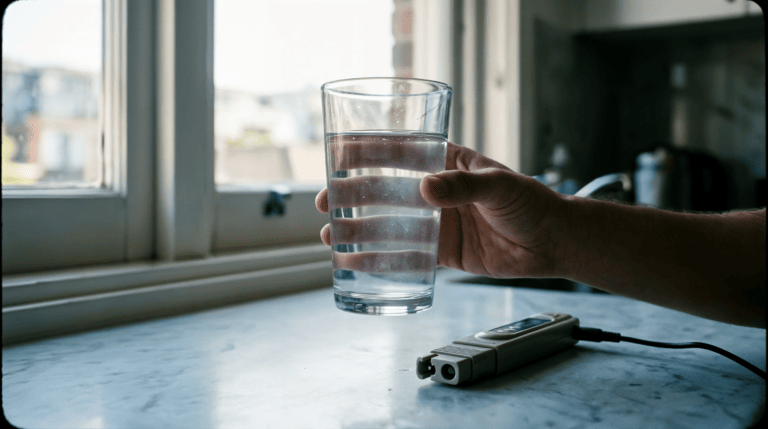
The 95.7% TDS reduction confirms the membrane is performing within manufacturer specifications. When your TDS rejection drops below 80%, it is time to replace the membrane. A $15 TDS meter is the single most useful tool for monitoring your RO system’s health.
Water Waste Ratio: The Real Numbers (Not the Marketing Numbers)
Here is the concern that stops most people from buying an RO system: water waste. Every litre of purified water produces waste water that carries away the rejected contaminants. But the numbers are better than you have been told, and the context matters.
Modern RO systems operate at a 1:1 to 1:3 pure-to-waste ratio. That means for every litre of purified water, you produce 1–3 litres of waste. Older systems from 10+ years ago were 1:4 or worse. The technology has improved significantly.
Context matters. At 4 litres of drinking water per day (a typical household), a 1:2 ratio system produces 8 litres of waste daily. That is one toilet flush. Your daily shower uses 80–100 litres. Your garden hose uses 15–20 litres per minute. The waste water from your RO system is a rounding error in your household water consumption.
Practical tip: Route your RO waste water to pot plants or the garden. It contains concentrated minerals — your plants will love it. I run mine into a 10L bucket under the sink and use it for the herb garden. Zero waste.
Tankless systems like the Waterdrop D6 tend to have slightly better waste ratios (1:1 to 1:1.5) because they filter on demand at higher pressure without the losses associated with tank pressurisation. If water waste genuinely concerns you, a tankless under-sink unit is your best option. But either way, the waste volume is a fraction of what your household uses for showers, laundry, and toilets.
RO vs. Every Other Filter Technology: The Comparison Table
You have four realistic options for home water filtration in Australia. Here is how they compare on the contaminants that actually matter for Australian tap water.
| Contaminant | Reverse Osmosis (5-Stage) | Carbon Block (Benchtop) | Gravity Filter (e.g., Berkey) | Pitcher (e.g., Brita) |
|---|---|---|---|---|
| Fluoride | 93–97% | No | No* | No |
| PFAS (PFOS/PFOA) | 99%+ | 50–70% (varies) | Unverified | Minimal |
| Chloramine | 99%+ | Catalytic carbon: Yes. Standard GAC: Poor | Poor | Poor |
| Free Chlorine | 99%+ | 95%+ | 95%+ | 70–90% |
| Lead | 97–99% | Some (if NSF 53 rated) | Claims vary | Minimal |
| TDS / Dissolved Salts | 90–98% | No | No | No |
| Bacteria / Cysts | 99.99% | Most (if 0.5μm rated) | Most | No |
| Outcome for You | Broadest removal. Near-pure water. | Good for taste/chlorine. No fluoride or TDS. | Good for off-grid. Slow. No fluoride. | Basic taste improvement only. |
*Berkey sells optional fluoride filters (activated alumina), but these are add-ons, not standard. Independent verification of Berkey’s fluoride claims is limited. The standard Black Berkey element does not remove fluoride.
The table makes the decision clear. If your concern is taste and free chlorine only — and you live in Melbourne, Hobart, or Canberra — a quality carbon block benchtop filter does the job. But if you want fluoride, PFAS, or chloramine removal, there is no carbon shortcut. You need RO.
Which RO System Should You Buy? The Decision Tree
Choosing the right RO system comes down to three questions. Answer them in order and your decision makes itself.
3-Question Decision Tree
1. Can you modify your plumbing (or are you renting)?
No → Countertop RO (AquaTru Classic). Sits on the bench, plugs into power, fills from the tap. No installation. No landlord permission needed.
Yes → Under-sink RO (Waterdrop D6). Permanent, hidden, plumbed into your cold water line with a dedicated faucet.
2. Which city do you live in?
Brisbane, Sydney, Adelaide, Darwin → Chloramine supply. Confirm your RO system’s carbon pre-filter is rated for chloramine (catalytic carbon or compressed carbon block). Standard GAC pre-filters are inadequate.
Melbourne, Canberra, Hobart, Townsville, Cairns → Free chlorine supply. Any quality carbon pre-filter works.
3. What is your primary concern?
Fluoride + PFAS → RO is your only option. Carbon filters cannot remove fluoride. Full stop.
Taste + chlorine only → A quality carbon block benchtop filter may be sufficient and cheaper. See our [INTERNAL LINK: best water filters for Brisbane | target: /water-filters/best-water-filter-brisbane-2026/] guide.
Bacteria (tank water, rural) → RO + UV sterilisation for belt-and-suspenders protection.
5-Year Cost Comparison: RO vs. Alternatives
The upfront price of an RO system is higher than a pitcher or benchtop filter. But you are not buying a device — you are buying clean water for years. Here is what each technology actually costs over five years, assuming a household consumption of 4 litres per day (1,460 litres per year).
{“@context”:”https://schema.org”,”@type”:”Article”,”headline”:”How Reverse Osmosis Works: The Science Behind Clean Drinking Water”,”author”:{“@type”:”Person”,”name”:”Jayce Love”,”url”:”https://cleanandnative.com.au/about/”},”publisher”:{“@type”:”Organization”,”name”:”Clean and Native”,”logo”:{“@type”:”ImageObject”,”url”:”https://cleanandnative.com.au/wp-content/uploads/2024/01/clean-and-native-logo.png”}},”datePublished”:”2026-03-23″,”dateModified”:”2026-05-13″,”url”:”https://cleanandnative.com.au/water-filters/how-reverse-osmosis-works/”,”image”:”https://cleanandnative.com.au/wp-content/uploads/2026/04/how-reverse-osmosis-works-australia-hero.jpg”}
What Does Reverse Osmosis Remove From Water?Here’s a direct, evidence-based summary of what a quality RO system removes and at what efficacy rates:
On PFAS: PFAS contamination in Australian drinking water has been confirmed near former defence bases, airports, and fire training facilities across every state and territory. Consistent regulatory limits remain inconsistent nationally. RO is among the most effective available treatments. On fluoride: the Australian Drinking Water Guidelines recommend a maximum of 1.5 mg/L, with most utilities targeting 0.6–1.0 mg/L. Whether you want to remove fluoride is a personal decision — the evidence for community water fluoridation at these concentrations is well-established — but RO gives you that option at up to 96% removal efficiency. No other mainstream residential filter achieves this. Australian Context: Why Your City Determines Which Filter WorksThis is the section most guides skip — and it’s the most important for Australians. The type of disinfectant your utility uses determines whether a standard carbon filter will help you at all. There are two disinfection systems used across Australian cities:
Key Point for Brisbane, Sydney, Adelaide, Gold Coast and Darwin residents: If you use a standard carbon pitcher filter, it is removing almost no chloramine from your water. You need either catalytic carbon block or reverse osmosis.
The implication: if you’re in a chloramine city, RO isn’t just the best option — it’s one of only two that actually work (the other being a catalytic carbon block system). If you’re in a free chlorine city, a good carbon filter handles chlorine taste and odour, but RO still adds significant value for fluoride, PFAS, and hardness reduction. Reverse Osmosis Pros and ConsAdvantages
Disadvantages
Is RO Right for Your Australian Home?RO makes strong sense if you:
RO may be more than you need if you:
For a deeper look at what your tap water actually contains before you filter it, start with what’s actually in Australian tap water — a state-by-state breakdown. For product recommendations, see our ranked guide to the best water filters in Australia. Frequently Asked QuestionsDoes reverse osmosis remove fluoride from Australian tap water?Yes. A quality RO system removes 90–96% of fluoride. This is the only mainstream residential filtration technology that reliably achieves this — activated carbon, hollow fibre, and UV do not remove fluoride at meaningful levels. Sydney Water targets ~0.8 mg/L; SA Water targets 0.6–1.1 mg/L. After RO, levels typically drop below 0.05 mg/L. Does reverse osmosis remove chloramine?Yes, and this is one of the most important distinctions for Australians. The carbon pre-stages in an RO system are sized to handle chloramine. Brisbane, Sydney, Adelaide, and Darwin all use chloramine as their primary disinfectant. Standard carbon pitcher filters (Brita, etc.) remove almost no chloramine from these water supplies — you need catalytic carbon or RO. How much water does a reverse osmosis system waste?Traditional tank-based RO systems produce roughly 2–4 litres of drain (reject) water per litre of filtered output. Modern tankless systems like the Waterdrop D6 achieve close to 1:1, significantly reducing waste. If water efficiency is a concern, specify a tankless system or add a permeate pump to a traditional model. How often do RO filters need replacing?Sediment and carbon pre-filters need replacing every 6–12 months depending on source water quality. The RO membrane lasts 2–3 years under normal residential use. The post-carbon polishing filter needs replacement annually. Most modern systems include replacement reminders or app notifications. Is reverse osmosis water safe to drink every day?Yes. RO water is safe for daily consumption. The claim that demineralised water leaches minerals from the body is not supported by the weight of scientific evidence at typical residential consumption levels. A remineralisation stage (standard in 5–6 stage systems) restores calcium and magnesium. The WHO has reviewed this question and concluded RO water is suitable for long-term consumption. What TDS reading should my RO water produce?A well-functioning RO system produces water with TDS of 10–50 mg/L, down from typical Australian tap readings of 60–400 mg/L. Adelaide tap water runs ~400 mg/L TDS; Perth ~170 mg/L; Melbourne ~60 mg/L. If your post-RO TDS reads above 100 mg/L, the membrane may be near end of life. Can renters install a reverse osmosis system?Yes, with a countertop RO system. Units like the AquaTru Classic sit on the benchtop, require no plumbing modification, and move with you. Under-sink systems require drilling a hole for a dedicated tap, which most landlords need to approve. Countertop RO is the recommended default for renters. Our AquaTru vs Clearly Filtered pitcher comparison covers the top countertop options. How does reverse osmosis compare to boiling water?Boiling kills bacteria and viruses — for a full technology breakdown, see our reverse osmosis vs standard water filter guide. Boiling does not remove chloramine, fluoride, PFAS, heavy metals, or nitrates. Boiling actually concentrates dissolved solids as water evaporates — TDS increases. Boiling is appropriate during a microbiological boil water alert; it is not a substitute for filtration when chemical contaminants are the concern. RO addresses both simultaneously. Get 10% Off Your Water Filter Enter your email below to unlock an exclusive discount code for PureWaterSystems.com.au — Australia's leading supplier of NSF/ANSI-certified filtration. Get the Australian Home Environment Checklist30 checks across water, air and EMF. Most of them free. Ranked by impact. No spam. Unsubscribe any time. 
Written by Jayce Love
Former Royal Australian Navy Clearance Diver and TAG-E counter-terrorism operator. Founded Clean and Native to apply the same rigorous thinking to the home environment. Full biography →Similar Posts
|
|---|