Big Berkey vs Doulton Gravity Filter: Which Should You Choose? (Australia 2026)
Drafted with AI assistance and checked against published specifications and certifications. First-hand measurements appear only where stated. How we make content
Disclosure: Clean and Native earns a commission if you purchase through links on this page. This does not affect our recommendations.
Choose the Doulton if you’re filtering municipal town water in a flat or small home; choose the Big Berkey if you’re on bore, tank, rural water, or need fluoride removal. Both produce excellent-quality filtered water, but the Big Berkey’s 23L capacity, longer element lifespan (~22,700L vs ~2,250L), and lower 5-year running cost (~$620 vs ~$760) make it the smarter long-term choice for larger households or contaminated sources. The Doulton wins on bench footprint and upfront price. The catches: the Big Berkey takes up significant bench space (55cm tall), and the Doulton requires filter changes roughly 10 times more often, which adds labour and cartridge waste.
| Scenario | Best Choice | Verdict |
|---|---|---|
| City flat / small home / town water | Doulton Gravity (compact, simple) | Recommended |
| Rural property / bore / tank / fluoride removal | Big Berkey (23L capacity, PF-2 add-on) | Recommended |
| Budget-first / short-term use | Doulton (lower upfront cost ~$200–280) | Acceptable short-term |
Bottom Line Up Front
Both filters produce excellent water. The Big Berkey wins on throughput (23L capacity), long-term running cost, and versatility with contaminated sources. The Doulton wins on size, simplicity, and bench space — it’s the better choice if you’re filtering municipal town water in a flat or small home. If you’re on bore, tank, or rural water, choose the Big Berkey.
Verdict: Doulton for city renters and small homes. Big Berkey for rural properties, large households, and high-contamination sources.
Head-to-Head Comparison
| Criteria | Big Berkey | Doulton Gravity | Winner |
|---|---|---|---|
| Capacity | 22.7 L | 8.5–11 L | Big Berkey |
| Filter element lifespan | ~22,700 L per element | ~2,250 L per element | Big Berkey |
| Flow rate (2 elements) | ~11 L/hr | ~4–8 L/hr | Big Berkey |
| Chloramine removal | Yes (BB9 elements) | Partial (depends on model) | Big Berkey |
| Fluoride removal | Yes (PF-2 add-on) | No (standard) | Big Berkey |
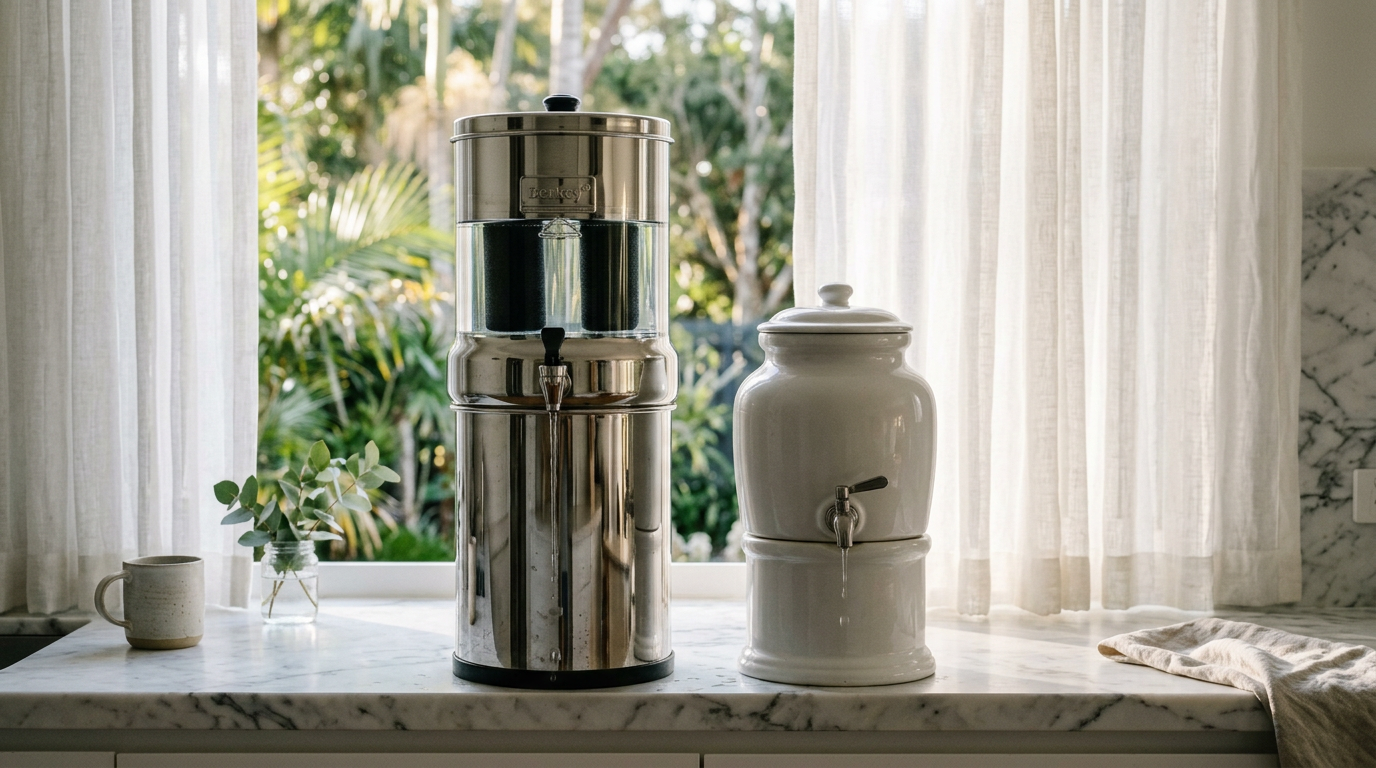
| Bench footprint | Large (23cm diameter, 55cm tall) | Compact (20cm diameter) | Doulton |
| Price (AU) | ~$380–450 | ~$200–280 | Doulton |
| 5-year running cost | ~$620 total | ~$760 total | Big Berkey |
| Rural / bore water suitable | Yes | Limited | Big Berkey |
| Reputable AU supplier | Berkey Australia | Doulton AU / Amazon AU | Both available |
Why Gravity Filters Still Make Sense in Australia in 2026
Gravity filters are the oldest water filtration technology still in active use — and they remain competitive for specific use cases where under-sink systems fail. They require no plumbing, no electricity, no installation, and they travel with you. In Australian homes, they’re particularly relevant for:
- Renters who can’t modify plumbing and need an effective solution they can take when they move
- Rural and regional households on bore or tank water where mains pressure may be unavailable or unreliable
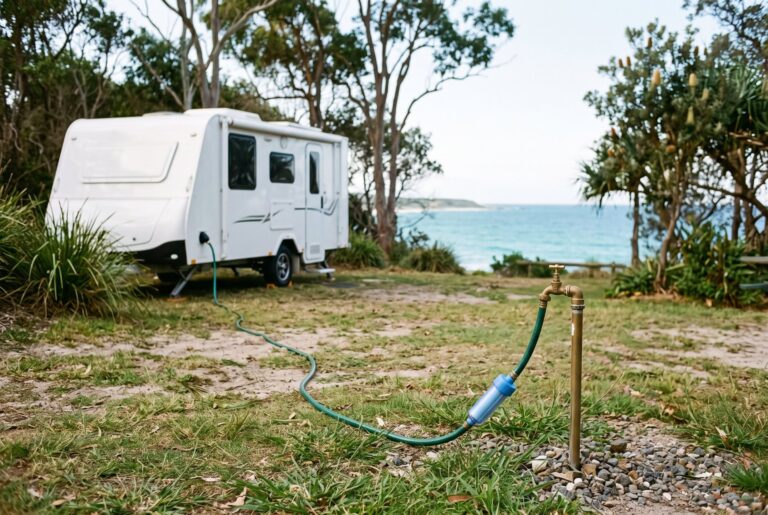
- Off-grid properties, caravans, and boats where electricity is a constraint
- Disaster and emergency preparedness — gravity filters work with lake, river, or rain water if necessary
The trade-off: flow rate. A gravity filter produces water at 4–11 L/hr depending on the model and number of elements. For a family of four using 12–16L of drinking water per day, you need to refill consistently. For a single person or couple, it’s low-effort. For a household of five who wants filtered water for cooking as well, you’ll be refilling twice daily — manageable but worth understanding before you buy.
Big Berkey: What You’re Actually Getting
The Big Berkey is the most popular gravity filter sold in Australia, and it’s earned that reputation with legitimate performance data. The key element is the Black Berkey purification element — a proprietary blend of six different media including ion exchange resin, activated carbon, and sub-micron pores. Each element is rated to 22,700 L (roughly 6,200 gallons in Berkey’s US labelling).
Big Berkey — What the Specs Actually Mean
- 22.7L capacity — enough to filter a day’s supply for a family of 5–6 in one batch
- 2 Black Berkey elements standard — expandable to 4 for higher flow (4 elements = ~22 L/hr)
- Chlorine >99.9%, chloramine >99.9% (BB9 elements), VOCs >99.9%, heavy metals >99%
- E. coli, pathogenic bacteria: >99.9999% (6-log removal) — relevant for bore/tank/river water
- Giardia and Cryptosporidium: >99.999% — critical for rural properties near livestock
- PF-2 fluoride reduction filters available as an optional add-on (~$70 AU per pair, fits under the base elements)
- Stainless steel 304 food-grade body — no BPA, no plastic contact with filtered water
Chloramine note for Australian cities
Sydney, Brisbane, Adelaide, and Canberra water supplies use chloramine, not free chlorine. The standard Black Berkey elements remove chloramine >99.9%. If you’re buying used or older stock, confirm you have BB9 generation elements — older Black Berkey elements were not tested specifically for chloramine. Check the date code on your elements if buying second-hand.
Where to buy in Australia: Berkey filters are not available on Amazon AU. Buy from Berkey Australia (berkeyfilters.com.au) — the authorised Australian distributor. Avoid grey market imports as warranty and element authenticity can’t be verified.
Doulton Gravity Filter: What You’re Actually Getting
Doulton is the oldest water filter company in the world — founded in 1826, originally producing ceramic filters for Victorian England’s cholera epidemics. The Australian market carries several Doulton gravity configurations, most commonly the Doulton HCP (Highly Compacted Porous) ceramic combined with a carbon core.
Doulton Gravity — What the Specs Actually Mean
- Ceramic shell pore size: 0.9 µm — removes bacteria, cysts, turbidity, sediment
- Carbon core (W9123 models) — reduces chlorine, taste, odour, some VOCs
- E. coli, Cryptosporidium, Giardia: >99.99% (4-log removal)
- Chlorine: >90% reduction (carbon core models)
- Chloramine: limited removal — standard Doulton elements are not rated for chloramine. The ceramic shell does not adsorb chloramine, and the carbon core uses standard activated carbon, not catalytic.
- Fluoride: not removed by standard Doulton elements
- ~2,250 L element lifespan (vs Big Berkey’s 22,700 L) — requires more frequent replacement
- Compact form factor — fits in small apartments and on narrow benches
Chloramine cities (Sydney, Brisbane, Adelaide, Canberra): The standard Doulton gravity filter provides meaningful chlorine and bacteria removal, but is NOT rated for chloramine. If you’re on a chloramine supply and buying Doulton specifically for disinfectant removal, you need to either add an external catalytic carbon stage or choose the Big Berkey instead. For rural bore/tank water where the primary concern is bacteria and sediment (not disinfectants), the Doulton performs well.
5-Year Total Cost of Ownership: The Real Numbers
| Cost Item | Big Berkey | Doulton |
|---|---|---|
| Purchase price (AU) | ~$420 | ~$240 |
| Annual filter cost (3L/day household) | ~$8/yr (1 pair lasts ~17 yrs) | ~$65/yr (replace ~2 per year) |
| PF-2 fluoride filters (optional) | ~$70/yr if used | — |
| Electricity | $0 | $0 |
| 5-Year Total (without PF-2) | ~$460 | ~$565 |
The Big Berkey is cheaper to run long-term because Black Berkey elements last ~22,700L each — a pair has a combined lifespan of ~45,000L. At 3L/day household consumption, that’s over 40 years of filter life. You’ll almost certainly replace the stainless steel body before you replace the elements. Doulton ceramic elements have a ~2,250L lifespan (per element, per candle). At 3L/day, you’re replacing one element roughly every 2 years.
Compare both to bottled water at 3L/day: $10,950 over 5 years. Either gravity filter is vastly more economical.
Who Should Buy Each Filter
Choose the Big Berkey if:
- You’re on bore, tank, river, or rainwater — the Big Berkey’s pathogen removal is rated for contaminated sources where Doulton’s is not
- You want fluoride removal (PF-2 add-on)
- Your city uses chloramine (Sydney, Brisbane, Adelaide, Canberra, Newcastle)
- You’re feeding a household of 3+ people and want high throughput
- You want the lowest 10-year running cost
- You’re building a disaster preparedness kit
Choose the Doulton if:
- You’re in a city apartment with limited bench space (Melbourne, Darwin, Hobart — lower chloramine risk)
- Your primary concern is bacteria, sediment, and chlorine from mains water (not chloramine)
- You prefer a lower upfront cost and a more compact, lower-profile unit
- You’re on a Darwin or Hobart supply (primarily chlorine, not chloramine) where standard carbon removes the disinfectant residual
- You want a simple, low-maintenance system with no accessories to manage
What the Big Berkey Does NOT Remove
No filter is a complete solution, and Berkey’s marketing can overstate capability. Independent third-party testing has raised questions about some Berkey claims. Being specific:
- PFAS: Black Berkey elements provide partial PFAS removal through activated carbon adsorption, but are not NSF 58 certified for PFAS and should not be relied on as the primary PFAS mitigation strategy in contaminated areas. For PFAS removal, NSF 58 reverse osmosis is the reliable standard.
- Total dissolved solids (TDS): Gravity carbon filters do not reduce TDS. If your water has high TDS (bore water, hard water), a gravity filter won’t address mineral load. Check TDS with a calibrated meter — at Palm Beach, NSW, mains TDS reads 69ppm (low) but many bore water sources in WA and QLD exceed 400ppm.
- Nitrates: Standard Black Berkey elements do not effectively remove nitrates. Relevant for rural properties near agricultural land where nitrate runoff into bores is a documented issue.
The Independent Testing Question
Berkey has faced scrutiny over its testing claims. In 2020, the State of California listed Berkey as a point-of-use device subject to certification requirements that Berkey did not hold. Berkey disputed this and has since published independent laboratory test data on its website. The core filter performance claims (bacteria, viruses, heavy metals) are backed by legitimate third-party test reports, not just manufacturer assertions. Review the test certificates if this matters to your decision.
Doulton has been third-party certified for over a century, with NSF and British Standards certifications for its core ceramic filtration claims. For the specific certifications that matter in Australia — bacteria, turbidity, Giardia/Cryptosporidium — Doulton’s documentation is more straightforward and independently verified.
The practical conclusion: both filters will meaningfully improve water quality for their respective use cases. For high-stakes rural or bore water situations where pathogen removal is critical, the Doulton’s simpler certification history may be reassuring. For city mains water with disinfectant removal as the primary goal, the Big Berkey’s broader contaminant scope is the better fit.
The Gravity Filter vs Under-Sink RO Question
If you’re comparing gravity filters to under-sink options, the decision tree is clear:
- Own your home and want the most thorough filtration? Under-sink RO removes everything — PFAS, fluoride, chloramine, TDS, nitrates. Gravity filters don’t.
- Renting, can’t modify plumbing, or want portability? Gravity filter is the best available option.
- On bore or tank water in rural Australia? Big Berkey for pathogen removal first. RO if TDS or nitrates are also an issue.
- Not sure what’s in your water? Use our Water Filter Finder tool — it maps your postcode to water quality data and recommends a filter type based on your actual contaminant profile.
Frequently Asked Questions
Is the Big Berkey better than Doulton?
For most Australian households, yes — the Big Berkey is the more capable filter. It holds 22.7L (vs 8.5–11L for Doulton), removes chloramine (used in Sydney, Brisbane, Adelaide, Canberra and Newcastle water supplies), and offers optional fluoride removal via PF-2 add-on elements. The Doulton wins on compactness, lower upfront cost (~$240 vs ~$420), and simplicity. Choose Doulton for a small apartment on low-chloramine mains water. Choose Big Berkey for rural bore/tank water, chloramine cities, or larger households.
Does the Big Berkey remove chloramine?
Yes. Black Berkey BB9 elements are rated for chloramine removal at greater than 99.9%. This matters for Sydney, Brisbane, Adelaide, Canberra, and Newcastle, which all use chloramine rather than free chlorine as the residual disinfectant. Standard Doulton ceramic filters are not rated for chloramine removal — a critical distinction for SEQ residents.
Does the Big Berkey remove fluoride?
Standard Black Berkey elements do not remove fluoride. You need to add the PF-2 Fluoride Reduction Elements (~$70–80 AU per pair), which attach below the main elements. With PF-2 installed, Berkey claims more than 95% fluoride reduction. The PF-2 elements have a shorter lifespan (~2,270L per pair) and require separate replacement tracking. Standard Doulton gravity filters also do not remove fluoride.
Can I use a Big Berkey or Doulton on bore water or tank water in Australia?
The Big Berkey is rated for untreated surface and bore water — it achieves 6-log (99.9999%) removal of E. coli. The Doulton achieves 4-log bacterial removal, adequate for pre-treated municipal water but less robust for high-load bore supplies. Critical caveat: neither filter removes nitrates or TDS. If your bore water reads above 400 ppm TDS or has nitrate concerns, reverse osmosis is needed alongside or instead of a gravity filter.
How long do Big Berkey and Doulton filter elements last?
Black Berkey elements are rated to 22,700 litres each. A standard 2-element Big Berkey has 45,400L combined capacity — at 3L/day household use, that exceeds 40 years. Doulton ceramic elements are rated to approximately 2,250L each, or roughly 2 years at 3L/day. Amortised replacement cost: Big Berkey ~$8–10/year, Doulton ~$60–70/year.
Where can I buy the Big Berkey in Australia?
Big Berkey is available through authorised Australian distributors and on Amazon AU. The Doulton is widely available via Australian water filter retailers. Always buy from authorised sources — counterfeit Berkey elements have been documented, and without certification numbers the filter performance cannot be verified.
Will a gravity filter remove PFAS from Australian tap water?
Neither the Big Berkey nor standard Doulton ceramic elements are certified for PFAS removal. If PFAS is a concern — particularly relevant in affected catchments — reverse osmosis is the only residential technology that reliably removes per- and polyfluoroalkyl substances at greater than 99%. A gravity filter is not sufficient for PFAS reduction.
What’s the real cost difference between Big Berkey and Doulton over 5 years?
Big Berkey: ~$420 upfront plus ~$40 in replacement elements over 5 years (elements rarely need replacing in that window) = ~$460 total. Doulton: ~$240 upfront plus ~$325 in replacement ceramic candles over 5 years = ~$565 total. The Big Berkey costs more initially but is cheaper long-term at equivalent water volumes.
Get the Australian Home Environment Checklist
30 checks across water, air and EMF. Most of them free. Ranked by impact.
No spam. Unsubscribe any time.

Former Royal Australian Navy Clearance Diver and TAG-E counter-terrorism operator. Founded Clean and Native to apply the same rigorous thinking to the home environment.
Full biography →