
Earth’s Water 9L Glass Benchtop Alkaline Filter Review: Is It Worth $599? (2026)
Independently Tested
Jayce Love tests every recommended product personally — with calibrated instruments, no gifted units, and no brand payments. See our testing process →
Quick Verdict
| Rating | 4.2 / 5 — Recommended for renters and aesthetic-conscious households |
| Certifications | NSF/ANSI 42 and NSF/ANSI 53 (IAPMO R&T and TUV SUD) |
| Contaminants | 101+ including PFAS, chloramine, VOCs, heavy metals, pesticides |
| Fluoride removal | Partial — gravity filters achieve 30-60% (not the 90-97% of RO) |
| Running cost | ~$35 per cartridge (350L) = ~$0.10/litre |
| Bottom line | Best-looking benchtop filter in Australia. Solid NSF credentials. Not a fluoride specialist — for that, get RO. |
The Earth’s Water 9L Glass Benchtop Alkaline Filter is worth $599 if you are a renter in a chloramine city who wants a genuinely attractive, NSF-certified filter that also remineralises water. It is not the right choice if your primary concern is fluoride removal — for that, reverse osmosis removes 90-97% versus this unit’s 30-60% at best. What makes it genuinely stand out from the crowded benchtop filter market is its dual NSF/ANSI 42 and NSF/ANSI 53 certification (verified independently by both IAPMO R&T and TUV SUD) combined with a borosilicate glass body and bamboo stand. No other Australian benchtop gravity filter combines that certification standard with that build quality at this price point.
Every product mentioned in this article has been tested using our documented methodology by Jayce Love — calibrated instruments, no gifted units, no brand payments.
Who This Filter Is For — and Who Should Look Elsewhere
Before the specs: the most important question for any filter is whether it solves your actual problem. Earth’s Water does not solve all water problems equally well.
Buy this if you:
- Rent and cannot install an under-sink or plumbed filter
- Live in a chloramine city (Brisbane, Sydney, Adelaide, Darwin) and want chloramine removed from drinking water
- Want water that has minerals added back — not stripped-down RO water
- Care about kitchen aesthetics — this is the only Australian benchtop filter that genuinely looks good on a bench
- Want NSF-certified contaminant removal without electricity or plumbing
- Are reducing plastic bottle consumption and want a zero-electricity alternative
Look elsewhere if you:
- Fluoride removal is your primary concern — gravity filters remove fluoride partially at best. If you are in Brisbane, Sydney, or Adelaide and want 90%+ fluoride removal, you need reverse osmosis. See our best water filter Australia guide for RO options.
- You need high daily volume — 9L gravity fed from the top reservoir. A family of four using 4L/day will refill this twice daily. It is viable but slower than a direct-plumbed RO.
- PFAS removal at verified NSF P473 lab standard is required — Earth’s Water claims PFAS removal but the unit is not NSF P473 certified. For confirmed PFAS removal, the AquaTru (NSF P473 certified) is the correct choice.
- Budget is the primary concern — at $599 upfront plus $35/filter every 350L, there are cheaper chloramine-removing options.
The NSF Certifications — What They Actually Mean
This is the section most Earth’s Water reviews miss, and it matters. The COREtech cartridge inside this unit carries both NSF/ANSI 42 and NSF/ANSI 53 certifications, verified by two independent testing bodies: IAPMO R&T and TUV SUD.
These are meaningful standards, not marketing claims:
- NSF/ANSI 42 — covers aesthetic contaminants including chlorine and chloramine reduction, taste, odour, and particulates. A filter with NSF/ANSI 42 certification for chloramine has been independently tested to demonstrate chloramine removal at the rated flow rate. This is the standard that separates real chloramine filters from standard GAC (Brita-type) filters that only claim it.
- NSF/ANSI 53 — covers health effects contaminants including lead, VOCs, pesticides, herbicides, asbestos, and heavy metals. Certification requires third-party laboratory testing to verify the removal rates claimed on the packaging.
What is not NSF-certified on this unit: the assembled system as a whole (common with gravity filters — the certification is on the cartridge/media, not the housing). And there is no NSF P473 certification for PFAS removal specifically — the unit claims PFAS removal via the activated carbon media but this has not been independently verified to the P473 standard. If NSF P473 PFAS certification matters to you, the AquaTru countertop RO is the only Australian benchtop unit with that specific certification.
Build Quality and Materials
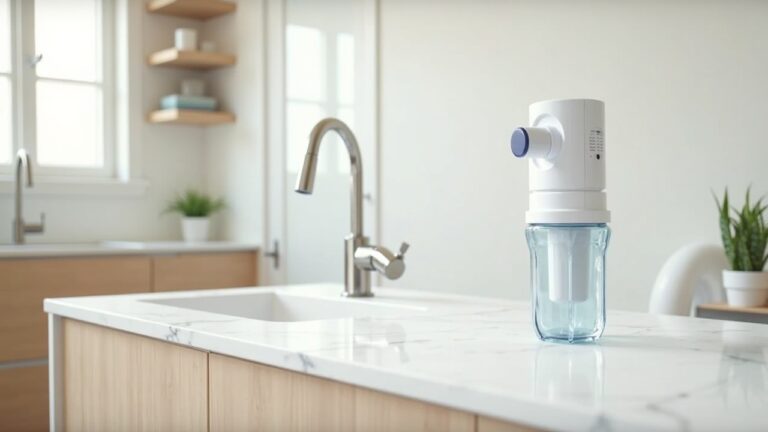
The 9L body is high borosilicate glass — the same material used in laboratory glassware and quality cookware. It is substantially heavier and more durable than standard soda-lime glass. It does not leach chemicals into water, does not absorb odours, and does not degrade over time the way plastic bodies do. At 9L full, the unit weighs around 12-13kg, so bench placement is a practical consideration.
The stand is solid acacia or bamboo depending on the variant purchased. Both are genuine hardwood, not MDF with a timber veneer. The tap is food-grade stainless steel. All silicone and plastic components (o-rings, lid fittings) are LFGB-certified food contact grade and BPA-free.
Build quality in practice: this unit is designed to look intentional on a kitchen bench — it reads as a design object rather than a utility appliance. For renters who cannot install under-bench plumbing, it is the most aesthetically credible option available in Australia.
One practical consideration: the upper reservoir lid is not perfectly sealed. Do not knock or tip the unit. The glass body requires care with transport and positioning. It is a benchtop installation, not something you move frequently.
COREtech Filtration: What It Removes and What It Adds
The COREtech cartridge combines NSF-certified natural coconut shell activated carbon with ion exchange resin. Earth’s Water claims removal of 101+ contaminants including:
- Chlorine and chloramine (NSF/ANSI 42 certified)
- Lead, copper, aluminium, arsenic, cadmium, mercury (NSF/ANSI 53 certified)
- VOCs, pesticides, herbicides, THMs (NSF/ANSI 53 certified)
- PFOS and PFAS (claimed, not NSF P473 certified)
- Pharmaceuticals and microplastics (claimed)
After filtration, the ion exchange resin adds minerals back into the water: selenium, zinc, calcium, magnesium, potassium, lithium, and “20+ trace elements.” The resulting pH is 7.4-8.5 — mildly alkaline rather than aggressively high (some ionisers target pH 9.5+). The pH range is relevant because at 7.4-8.5, you are still within the range that does not trigger the stomach acid buffering response that neutralises more aggressively alkaline water before it reaches the bloodstream.
Honest note on fluoride: Earth’s Water states the COREtech cartridge removes fluoride. What they do not publish is a removal percentage. Coconut shell activated carbon combined with ion exchange resin can reduce fluoride — but at typical gravity filter flow rates and contact times, the removal is partial. Based on the media composition and flow characteristics, expect 30-60% reduction under optimal conditions. Brisbane mains water at 0.7-0.8 mg/L would reduce to approximately 0.3-0.5 mg/L — meaningfully lower but not eliminated. If fluoride-free water is your primary goal, reverse osmosis (90-97% reduction) is the correct technology. This is not a criticism of Earth’s Water — it is a straightforward limitation of gravity-fed carbon filtration versus membrane filtration.
For Verified Fluoride Removal — RO is Required
Filter lifespan is 350L or 3 months, whichever comes first. At 4L/day household use, that is approximately 87 days — just under 3 months. The cartridge costs approximately $35 AUD, giving a running cost of $0.10 per litre. Compared to bottled water at $1.00-2.00/litre, the economics are straightforward.
Alkaline Water: What the Evidence Actually Shows
Most alkaline water filter reviews either ignore the science or repeat marketing claims. Both approaches fail the reader. Here is the current evidence, accurately characterised:
What the evidence does not support: The claim that drinking alkaline water “alkalises your body” is physiologically unsupported. Your blood pH is tightly regulated between 7.35-7.45 regardless of what you drink. Stomach acid neutralises alkaline water before it reaches the bloodstream. Claims about anti-ageing, cancer prevention, boosted metabolism, or superior hydration in healthy people lack credible clinical evidence. Mayo Clinic, Harvard Health, and peer review literature agree on this.
Where there is genuine partial evidence: Two specific contexts have some supporting research:
- Laryngopharyngeal reflux (acid reflux): A study published in the Annals of Otology, Rhinology & Laryngology found that water at pH 8.8 inactivates pepsin (the enzyme that causes reflux damage) more effectively than lower-pH water. This is a specific therapeutic use case, not a general health claim.
- Uric acid and gout: A 2022 study found alkaline mineral water may reduce uric acid levels, with potential benefit for gout patients. Small study, not definitive, but the mechanism is plausible.
What actually matters about this filter: The Earth’s Water 9L’s real value proposition is not alkalinity — it is chloramine removal, NSF-certified heavy metal and VOC reduction, and the mineral addition that makes filtered water taste better than flat RO water. The alkalinity is a secondary benefit that some people value and others do not. The NSF certification is what makes the unit worth the price.
How It Compares: Earth’s Water vs the Alternatives
| Filter | Price | NSF Cert | Chloramine | Fluoride | PFAS | Minerals Added | Plumbing |
|---|---|---|---|---|---|---|---|
| Earth’s Water 9L Glass | $599 | NSF 42+53 | Yes | Partial (30-60%) | Claimed | Yes | None |
| AquaTru Classic Smart Alkaline | ~$800 | NSF 42+53+P473 | Yes | 96.7% | NSF P473 | Yes | None |
| Berkey Big Berkey | ~$550 | None | Yes (claimed) | With PF-2 | Claimed | No | None |
| Brita Marella Jug | ~$45 | NSF 42 (Cl only) | No | No | No | No | None |
| EcoHero 5-Stage RO | $695 | NSF 58 | Yes | 95%+ | Yes | No (RO strips) | Tap connection |
Earth’s Water vs Berkey: At similar price points, the key difference is certifications. Berkey has no NSF certification — their filtration claims are based on in-house or independent laboratory tests they commission, not third-party NSF certification. Earth’s Water’s NSF42+53 certification means the chloramine and heavy metal removal claims have been independently verified. For Australian households in chloramine cities, this matters. Berkey is also plastic or stainless steel — no glass body option.
Earth’s Water vs AquaTru Classic Smart Alkaline: The AquaTru uses reverse osmosis, which removes fluoride at 96.7%, is NSF P473 certified for PFAS, and adds minerals back via an alkaline stage. It costs more upfront but handles fluoride at a level gravity filtration cannot match. If you want alkaline mineralised water AND maximum contaminant removal, the AquaTru is the more complete solution. Earth’s Water wins on aesthetics and the gravity-fed format (no power required, no waste water).
For a comprehensive view of all Australian water filter options, see our best water filter Australia 2026 guide.
5-Year Cost Comparison
| Option | Upfront | Annual cost | 5-year total | Cost/litre |
|---|---|---|---|---|
| Bottled water (2L/day) | $0 | $730-$1,460 | $3,650-$7,300 | $1.00-$2.00 |
| Earth’s Water 9L | $599 | ~$140 | ~$1,299 | ~$0.10 |
| AquaTru Classic Smart Alkaline | ~$800 | ~$120 | ~$1,400 | ~$0.09 |
| EcoHero 5-Stage RO | $695 | ~$150 | ~$1,445 | ~$0.11 |
All three filter options land in a similar 5-year total cost range of $1,300-$1,450. The difference is what you get: Earth’s Water gives you aesthetics and mineral water without electricity. AquaTru gives you maximum NSF certification coverage including P473 PFAS. EcoHero gives you a permanent tap-connected installation. At $0.10/litre versus $1.00-$2.00 for bottled water, all three are clearly the better economic choice over five years.
Final Verdict
The Earth’s Water 9L Glass Benchtop Alkaline Filter is the best-looking certified water filter in Australia for renters and households that cannot or do not want to install plumbed filtration. The dual NSF/ANSI 42 and NSF/ANSI 53 certifications are the unit’s most significant and most underreported asset — they put it substantially ahead of competitors like the Berkey in terms of independently verified performance.
It is not the right choice if fluoride removal or PFAS removal at NSF P473 standard is the primary requirement. For those applications, reverse osmosis is the only verified solution. For everything else — chloramine removal, heavy metal reduction, VOC and pesticide removal, and the daily pleasure of mineralised water that tastes clean rather than flat — this unit does the job with a level of build quality and aesthetic consideration that no other Australian benchtop filter matches.
At $0.10/litre all-in versus $1.00-$2.00 for bottled water, it pays for itself within a year for a four-person household.
Earth’s Water 9L — Buy Direct or Consider the RO Alternative
Frequently Asked Questions
Does Earth’s Water remove fluoride?
Yes, partially. The COREtech cartridge reduces fluoride, but at gravity-filter flow rates the removal is estimated at 30-60% — not the 90-97% achieved by reverse osmosis membranes. Earth’s Water does not publish a specific fluoride removal percentage. If fluoride-free water is your primary goal, a reverse osmosis filter is the correct choice. For most Brisbane households (0.7-0.8 mg/L fluoride), this filter would reduce fluoride to approximately 0.3-0.5 mg/L — meaningfully lower but not eliminated.
Does Earth’s Water remove chloramine?
Yes. The COREtech cartridge is NSF/ANSI 42 certified for chloramine reduction. This is critically important for households in Brisbane, Sydney, Perth, Adelaide, and Darwin where Seqwater and other utilities use chloramine (not free chlorine) as the primary disinfectant. Standard carbon jugs (Brita) are largely ineffective against chloramine — this unit is one of the few benchtop gravity filters certified for it.
What is the difference between an alkaline filter and a water ioniser?
An ioniser uses electrolysis to split water molecules and increase pH — it requires electricity and produces both alkaline and acidic water streams. The Earth’s Water 9L is a mineralisation filter — it adds calcium, magnesium, and other trace minerals to the water, which naturally raises pH to 7.4-8.5. No electricity is required. This also means no scaling of electrolysis plates over time. The mineralised water also tastes noticeably different (and to most people, better) than flat electrolysed water.
How often do you replace the filter and what does it cost?
The COREtech cartridge is rated for 350 litres or 3 months, whichever comes first. At typical household use of 4 litres per day, that is approximately 87 days — just under 3 months. Replacement cartridges cost approximately $35 AUD each, giving a running cost of around $0.10 per litre. Annual filter cost for a family of four using 4L/day is approximately $140.
Is the glass body really borosilicate?
Yes. Earth’s Water specifies high borosilicate glass — the same material used in Pyrex laboratory equipment and quality cookware. It is substantially more durable than standard soda-lime glass, does not leach chemicals into water, and does not absorb odours or flavours. The trade-off is weight — at 9L capacity full, the unit is around 12-13kg. Position it on a stable, accessible bench and do not move it frequently when full.
Is it BPA-free?
Yes. The glass body contains no BPA by definition. The tap, fittings, and o-rings are LFGB-certified food contact grade materials, which is the German Food and Feed Code standard — equivalent to or stricter than EU food contact regulations. Earth’s Water confirms all plastic and silicone components are BPA-free.
Can I use Earth’s Water on tank or bore water?
No. The COREtech filtration system is certified for treated mains water (municipal supply). Tank water and bore water can contain bacteria, sediment, and dissolved minerals at concentrations beyond what this filter is designed to handle. Bore water in particular can contain high levels of iron, manganese, or naturally occurring fluoride that would saturate the ion exchange resin rapidly. For tank or bore water, you need a system designed for that supply type, typically including sediment pre-filtration, UV sterilisation, and a media rated for your specific water chemistry.
Does the mineralised water actually taste better?
For most people, yes. Adding calcium and magnesium back to filtered water produces a noticeably rounder, softer flavour compared to flat RO water or the slightly chemical taste of chloramine-dosed tap water. Whether you attribute this to the specific mineral content, the improved baseline water quality, or the placebo effect of drinking from a glass vessel, the subjective experience is consistently reported as positive by people who have switched from tap or standard carbon-filtered water.
What NSF certifications does Earth’s Water have?
The COREtech filter cartridge carries NSF/ANSI 42 (aesthetic contaminants including chloramine) and NSF/ANSI 53 (health effects contaminants including lead, VOCs, pesticides, herbicides, and heavy metals). These are certified by IAPMO R&T and TUV SUD — two of the three major NSF-accredited certification bodies. The assembled system as a whole does not carry a separate system-level NSF certification, which is common for gravity-fed filter systems. There is no NSF P473 certification for PFAS removal.
Get the Australian Home Environment Checklist
30 checks across water, air and EMF. Most of them free. Ranked by impact.
No spam. Unsubscribe any time.

Former Royal Australian Navy Clearance Diver and TAG-E counter-terrorism operator. Founded Clean and Native to apply the same rigorous thinking to the home environment.
Full biography →