Mount Gambier Tap Water Quality 2026: What’s In It and Whether You Should Filter It
Drafted with AI assistance and checked against published specifications and certifications. First-hand measurements appear only where stated. How we make content
The three products we own are measured first-hand by Jayce Love, former Royal Australian Navy Clearance Diver; every other product is assessed on published manufacturer specifications and independent certification using our documented methodology — no gifted units, no brand payments.
Quick Verdict — Best Filters for Mount Gambier Water
Mount Gambier’s water is hard (220 mg/L as CaCO3), moderately mineralised (TDS 320 mg/L), fluoridated (1.0 mg/L), and disinfected with free chlorine drawn from the Gambier Limestone aquifer. Because SA Water uses free chlorine here — not chloramine like Adelaide — a standard carbon block removes the taste issue. But only reverse osmosis addresses fluoride, hardness, and any PFAS concern simultaneously.
| Filter | Type | Removes Fluoride | Best For |
|---|---|---|---|
| AquaTru Classic Smart RO | Countertop RO | Yes (95-97%) | Renters, no plumbing |
| EcoHero 5-Stage RO | Under-sink RO | Yes (95-97%) | Homeowners, best value |
| Waterdrop D6 | Under-sink RO | Yes (95-97%) | Compact kitchens |
Mount Gambier tap water supplied by SA Water is safe to drink and meets all Australian Drinking Water Guidelines. SA Water reports TDS of 320 mg/L, hardness 220 mg/L as CaCO3, fluoride 1.0 mg/L, pH 7.9, and free chlorine disinfection sourced from the Gambier Limestone aquifer.
As a former Royal Australian Navy Clearance Diver, I approach water quality the same way I approached equipment selection in the field: with data, not guesswork. Mount Gambier’s water profile is specific — and it’s meaningfully different from Adelaide’s supply in ways that change which filter you should buy. This guide covers the chemistry, what it means for your health and appliances, and three filter options matched to the actual contaminant profile of this supply.
Where Does Mount Gambier’s Water Come From?
Mount Gambier’s drinking water is drawn from the Gambier Limestone aquifer — a deep, confined groundwater system underlying the south-east of South Australia. This is a fundamentally different source type to the surface water catchments that supply Adelaide, Melbourne, or Brisbane. Groundwater filtered through kilometres of porous limestone typically arrives at the treatment plant with low microbial load, high mineral content, and a characteristic hardness profile.
SA Water’s treatment for Mount Gambier involves disinfection with free chlorine — not chloramines, which Adelaide uses across its metropolitan network. This distinction is critical when selecting a water filter, as explored in detail below. Blue Lake, the famous volcanic crater lake and a visible feature of the region’s groundwater system, contributes to aquifer recharge — though it is not a direct drinking water source.
According to SA Water’s Annual Drinking Water Quality Report, the Gambier Limestone system is one of SA’s most consistently performing water supplies. Low turbidity, stable chemistry year-round, and consistent ADWG compliance. The trade-off for that geological stability is hardness: limestone dissolution naturally loads the water with calcium and magnesium, producing very hard water at the tap.
Mount Gambier Water Quality Data 2026: The Full Profile
Here is the complete water quality profile for Mount Gambier as reported by SA Water, compared against the Australian Drinking Water Guidelines 2022 (ADWG 2022):
| Parameter | Mount Gambier Level | ADWG Guideline | Assessment |
|---|---|---|---|
| TDS | 320 mg/L | 500 mg/L max | Within guidelines — noticeably mineralised |
| Hardness | 220 mg/L as CaCO3 | 200 mg/L preferred | Very hard — causes appliance scale |
| Fluoride | 1.0 mg/L | 1.5 mg/L max | Within guidelines — upper end of target range |
| pH | 7.9 | 6.5 — 9.2 | Normal — slightly alkaline |
| Disinfection | Free chlorine | — | Standard carbon removes taste effectively |
| Turbidity | <1 NTU (typical) | 5 NTU max | Excellent — low for groundwater source |
TDS at 320 mg/L sits in the moderate-high range on the Australian scale. Melbourne’s mountain catchment water runs around TDS 60 mg/L (very soft), Brisbane’s SEQ grid at 80-115 mg/L (moderate), and Adelaide often exceeds 400 mg/L in summer. Mount Gambier’s 320 mg/L produces water with a distinct mineral flavour. Some people prefer it; many don’t — and it’s the reason bottled water consumption is higher in hard-water regions.
Hardness at 220 mg/L as CaCO3 places this supply firmly in the “very hard” category. The World Health Organisation notes water above 180 mg/L causes significant scale deposits in heating applications. At 220 mg/L, scale in your kettle and hot water system is not a hypothetical — it is a certainty without treatment. This is Mount Gambier’s most practically significant water quality characteristic, and it’s one that filters rarely marketed correctly for it.
Fluoride at 1.0 mg/L sits at the upper boundary of SA Health’s target supplementation range for dental health. The ADWG maximum is 1.5 mg/L — so this supply is compliant. Whether to filter fluoride is a personal decision. If you want to reduce it, the only residential technologies that work are reverse osmosis (90-97% reduction) and activated alumina (80-95%). Standard carbon filters, including high-quality catalytic carbon, cannot remove fluoride. This is a frequent and costly misconception in online filter guides.
Free Chlorine vs Chloramine — Why This Changes Your Filter Choice
This is the most practically important piece of information in this article, and it’s one most Mount Gambier residents don’t know. SA Water uses free chlorine to disinfect Mount Gambier’s water — not chloramines. Adelaide, by contrast, uses chloramines (a blend of chlorine and ammonia) across most of its metropolitan supply. Brisbane, Sydney, and Darwin also use chloramines.
Why does this matter? Standard activated carbon (GAC) filters — the type found in Brita jugs, benchtop carbon blocks, and most fridge filters — remove free chlorine very effectively. They remove chloramine at approximately 1/40th the rate. In a chloramine city like Adelaide or Brisbane, a standard carbon filter is almost useless for removing the disinfectant taste. In Mount Gambier, the same filter works exactly as advertised.
What this means practically:
- If your only concern is the chlorine taste or odour in Mount Gambier tap water, a $35-75 benchtop carbon block filter handles it. You do not need an RO filter for this purpose.
- If you want to remove fluoride, reduce TDS, address hardness, or ensure PFAS removal, you need reverse osmosis. Carbon filtration cannot achieve any of these.
- Filter guides written generically for “SA water” may be based on Adelaide’s chloramine profile — the recommendation for Mount Gambier is different, and following Adelaide advice here would lead you to overpay or underprepare.
This distinction is why the best water filters for fluoride removal in Australia need to specify what else they remove — a carbon block that works perfectly in Hobart (free chlorine, like Mount Gambier) does nothing for fluoride in either city.
The Hard Water Problem — What 220 mg/L as CaCO3 Costs You
Mount Gambier’s most practically significant water quality issue is not fluoride, not chlorine, and not TDS. It is hardness. At 220 mg/L as CaCO3, you are dealing with very hard water — and that number carries direct financial consequences for every heating appliance in your home.
In your kettle and coffee machine: Calcium carbonate scale deposits on heating elements when hard water is heated. At 220 mg/L, a kettle used twice daily requires descaling every 2-4 weeks if you’re using unfiltered tap water. A quality espresso machine drawing on unfiltered water will develop scale on its boiler, group head, and steam wand within months. Professional baristas in hard water regions use RO water specifically to prevent this — scale on the boiler reduces heat efficiency and shortens machine life substantially. A machine worth $800-1,500 deserves filtered water.
In your hot water system: Scale on an electric hot water tank’s element reduces heating efficiency by creating an insulating layer between the element and the water. SA Water’s own guidance recommends regular maintenance in hard water areas. Systems running on continuous heating cycles lose efficiency progressively as scale builds. The element replacement cost and reduced system life represent real money compared to the cost of a point-of-use filter.
On your skin and hair: Hard water reacts with soap and shampoo, forming insoluble calcium soap compounds that reduce lathering. Many people in hard water areas use 20-30% more soap than necessary without realising it. The “dry skin” or “filmy” feeling after showering in hard water is documented — not a perception issue. It does not cause medical harm but it is unpleasant, and it drives up product consumption.
What actually removes hardness: Two residential technologies reduce water hardness at the drinking point. Reverse osmosis reduces hardness 95%+ by rejecting calcium and magnesium at the membrane (along with other dissolved solids). Ion-exchange water softeners replace calcium and magnesium with sodium, which is effective but adds sodium to your water — a consideration for people on low-sodium diets. For drinking water, RO is the standard choice. An RO unit filtering Mount Gambier’s supply would produce output TDS in the 10-20 mg/L range — the same kind of reduction I measured running Palm Beach mains water (69 ppm) through an EcoHero 5-Stage RO to get 3 ppm output. For a detailed breakdown of how RO works against Australian water chemistry, see our EcoHero 5-Stage RO review.
Does Mount Gambier Tap Water Contain PFAS?
PFAS (per- and polyfluoroalkyl substances) are industrial chemicals that persist in the environment and have been linked to health effects at elevated exposure levels. The national PFAS contamination situation in Australia has centred primarily on Defence sites, fire training facilities, and industrial processing areas. The key question for Mount Gambier: how close is the supply source to known contamination?
The situation for Mount Gambier is reassuring. The Gambier Limestone aquifer is a confined, deep groundwater source in a predominantly agricultural and residential region. SA Water’s monitoring of this supply has not identified PFAS exceedances against the Australian Drinking Water Guidelines 2022 values — PFOS at 0.07 micrograms per litre and PFOA at 0.56 micrograms per litre. The Department of Climate Change, Energy, the Environment and Water (DCCEEW) national PFAS investigation register does not list Mount Gambier as a site of current concern for drinking water.
The important caveat: PFAS testing at the tap is not mandated under current Australian regulations. SA Water conducts monitoring and reports results, but there is no regulatory requirement for PFAS to be tested at every connection point with publicly reported results. The absence of a documented PFAS problem in Mount Gambier is meaningful — it is not the same as a blanket guarantee of zero PFAS at every tap.
If you want complete PFAS removal certainty, an NSF/ANSI P473-certified reverse osmosis filter removes PFAS compounds at greater than 99% under certified test conditions. P473 certification specifically tests for PFOS and PFOA. No carbon filter — including block carbon or catalytic carbon — carries this certification, because carbon does not remove PFAS effectively. For a detailed breakdown of the national PFAS situation in Australian drinking water, see our guide to PFAS in Australian water supplies.
Best Water Filters for Mount Gambier Homes in 2026
With TDS 320 mg/L, hardness 220 mg/L, fluoride 1.0 mg/L, and free chlorine disinfection, Mount Gambier’s water profile has a specific filter answer. Here are the three options, matched to the supply characteristics and different household situations.
1. AquaTru Classic Smart RO — Best for Renters
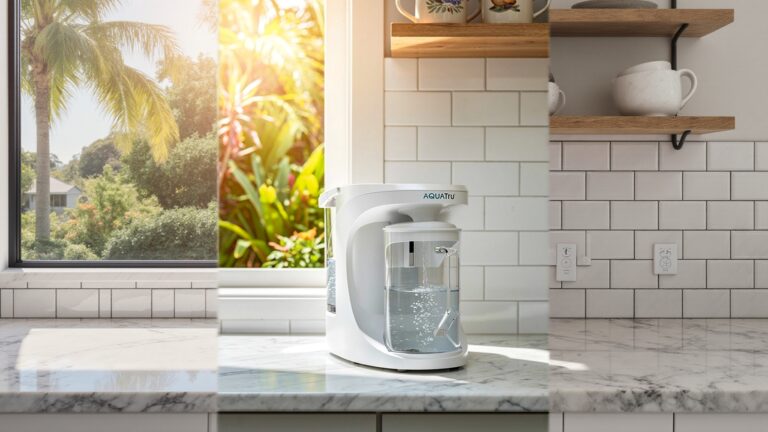
The AquaTru Classic Smart is a countertop reverse osmosis unit that requires zero plumbing. You fill the input tank from the tap; the 4-stage system (sediment pre-filter, RO membrane, post-carbon, alkaline remineralisation) processes it into a separate filtered reservoir. NSF/ANSI 58 certified. For Mount Gambier renters who cannot make permanent plumbing changes, this is the practical RO solution.
Against Mount Gambier’s 320 mg/L supply, expect filtered output TDS in the 10-20 mg/L range — a 94-97% reduction. That eliminates the mineral taste, removes the hardness that causes scale, and reduces fluoride by 90-97%. The alkaline stage in the Smart version adds back a small amount of beneficial minerals and adjusts pH upward, which many people prefer for drinking. The catches: it occupies bench space, produces water in batches (not instant-on), and filter replacement runs approximately AUD $120 per year.
AquaTru Classic Smart RO
NSF/ANSI 58 certified countertop RO. No plumbing. Reduces Mount Gambier’s TDS from 320 mg/L to approximately 10-20 mg/L, fluoride by 90-97%, and removes hardness minerals entirely.
2. EcoHero 5-Stage RO — Best Value for Homeowners
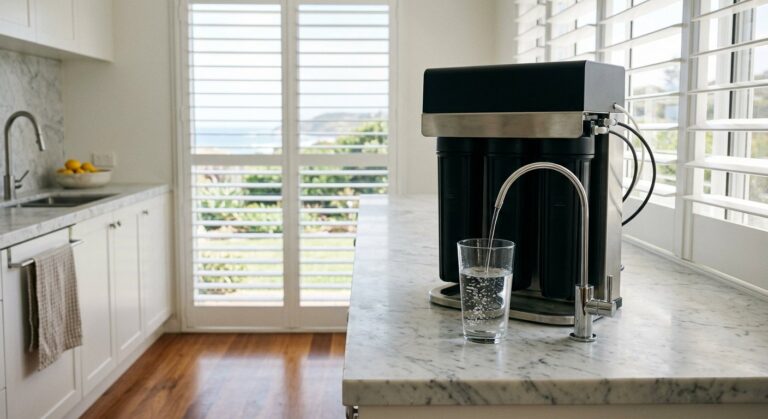
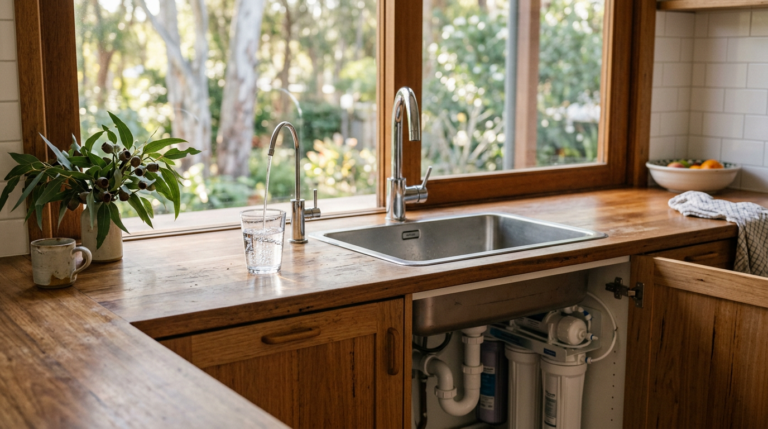
The EcoHero 5-Stage Reverse Osmosis System from Pure Water Systems is an under-sink unit that installs permanently beneath your kitchen bench and connects to a dedicated filtered-water tap. Five filtration stages: sediment, two carbon blocks, RO membrane, and alkaline remineralisation post-filter. For Mount Gambier homeowners willing to install under-sink plumbing (a 2-3 hour job for a competent DIYer or a plumber), this is the best value option.
This article contains affiliate links. We may earn a commission at no extra cost to you.
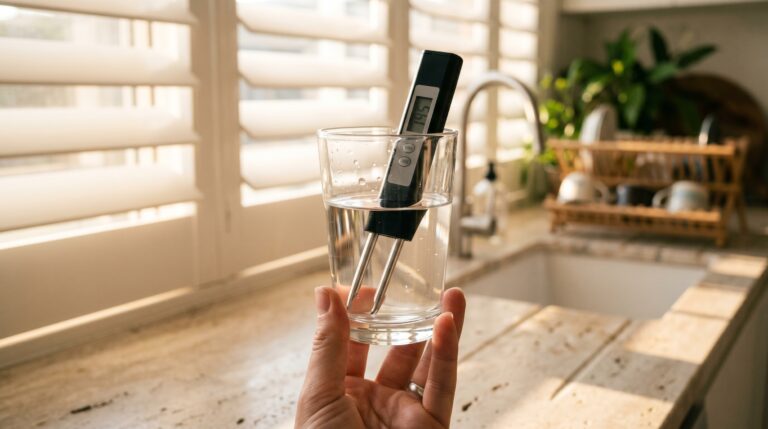
This is the unit we use for our own testing baseline. Filtering Palm Beach mains water at 69 ppm TDS with a calibrated TDS-3 meter, the EcoHero 5-Stage produced 3 ppm filtered output — a 95.7% reduction. On Mount Gambier’s 320 mg/L, expect similar percentage performance: filtered output in the 12-20 mg/L range. Fluoride reduction at 90-95%. Available through Pure Water Systems — an Australian-based retailer, which means local support and Australian filter replacement shipping without the delays and costs of importing.
The catches: requires under-sink installation and a plumbing connection (homeowners only in most cases). Filter replacement runs approximately AUD $80-100 per year. The storage tank takes up cabinet space.
3. Waterdrop D6 — Best for Compact Kitchens
The Waterdrop D6 is a tankless under-sink RO filter. Where traditional RO systems store filtered water in a pressurised tank (adding cabinet bulk), the D6 produces filtered water on demand without storage. NSF/ANSI 58 certified. It is significantly more compact than the EcoHero or most comparable units — if your under-sink cabinet is limited, this is the filter that fits.
The D6’s RO membrane handles Mount Gambier’s hard water profile as effectively as any other RO system. Hardness does not damage or impede RO membranes (though it may reduce membrane longevity marginally in very hard water — a minor consideration). Filter life is rated at six months or approximately 1,500 litres for the RO membrane. The main consideration with tankless RO is flow rate — the D6 produces approximately 0.3L per minute, fine for filling a glass or jug but not for high-volume applications. Annual filter cost approximately AUD $100.
5-Year Cost Comparison: Filter vs Bottled Water in Mount Gambier
Mount Gambier residents unhappy with their tap water commonly buy bottled water as the path of least resistance. Here is what that choice costs over five years, compared to filtering:
| Option | Upfront | Annual cost | 5-year total | Cost per litre |
|---|---|---|---|---|
| Bottled water (2L/day household) | $0 | ~$700-1,400 | $3,500-7,000 | $0.96-1.92 |
| AquaTru Classic Smart RO | ~$649 | ~$120 | ~$1,249 | ~$0.09 |
| EcoHero 5-Stage RO | ~$399 | ~$90 | ~$849 | ~$0.06 |
| Waterdrop D6 | ~$499 | ~$100 | ~$999 | ~$0.07 |
At $0.06-0.09 per litre for RO-filtered water versus $0.96-1.92 per litre for bottled water, the EcoHero pays for itself in under 10 months for a two-person household. That calculation doesn’t include the avoided scale damage to appliances — extending a $1,200 espresso machine’s life by two years, or preventing an early hot water element replacement, adds to the case. The financial argument for filtering is not marginal in Mount Gambier. It is clear.
Which Filter Do You Actually Need? Three Questions
Not every household has the same concern about Mount Gambier’s water. Three questions determine the right solution:
Question 1: What is your primary concern?
- Chlorine taste/odour only — a standard carbon block ($35-75) is sufficient. Free chlorine is easily removed with activated carbon. This is not Adelaide — you don’t need catalytic carbon or RO for this.
- Mineral taste, hardness scale, TDS reduction, or fluoride removal — reverse osmosis required. Continue to Question 2.
- PFAS certainty — NSF/ANSI P473-certified reverse osmosis required. Continue to Question 2.
Question 2: Renter or homeowner?
- Renter (no permanent plumbing changes permitted) — AquaTru Classic Smart RO. Countertop, no installation required, no permission needed from your landlord.
- Homeowner (can install under-sink) — Continue to Question 3.
Question 3: How much under-sink cabinet space do you have?
- Standard kitchen cabinet space — EcoHero 5-Stage RO. Best value, Australian retailer, full five-stage system.
- Limited cabinet space — Waterdrop D6. Tankless, most compact, same RO performance.
Final Verdict: Is Mount Gambier Water Worth Filtering?
Mount Gambier’s tap water is safe. That statement matters and belongs at the top of the answer. SA Water’s supply meets all ADWG parameters. No documented contamination events. No PFAS exceedances. No bacterial issues. You are not drinking unsafe water by using the tap unfiltered.
Whether filtering is worth it depends on what you’re trying to achieve. If the mineral taste bothers you and you’ve been spending $700-1,400 per year on bottled water, an RO system pays for itself quickly and produces water that outperforms most bottled brands (which are often drawn from municipal sources with minimal additional treatment). If you have an espresso machine that’s accumulating scale, filtered water extends its life measurably. If you want fluoride intake below 1.0 mg/L, only RO achieves that reliably. None of these are emergencies — they’re quality-of-life decisions with direct, well-understood solutions.
The clearest recommendation for Mount Gambier homeowners is the EcoHero 5-Stage RO at Pure Water Systems — Australian supply, under-sink installation, approximately $849 over five years for unlimited filtered water. For renters, the AquaTru Classic Smart delivers the same RO technology in a countertop format without requiring a plumber or landlord permission. Both produce water that costs less per litre than Melbourne’s cheapest bottled brand and outperforms it on every measurable parameter.
Filter Recommendations for Mount Gambier
Homeowners: EcoHero 5-Stage RO at Pure Water Systems. Renters: AquaTru Classic Smart on Amazon AU. Both address TDS 320 mg/L, hardness 220 mg/L, fluoride 1.0 mg/L, and any PFAS concern in a single unit.
Last reviewed: April 2026 — Clean and Native
Frequently Asked Questions
Is Mount Gambier tap water safe to drink?
Yes. Mount Gambier tap water supplied by SA Water meets all Australian Drinking Water Guidelines. TDS 320 mg/L, fluoride 1.0 mg/L, pH 7.9, and free chlorine disinfection are all within ADWG parameters. There are no documented contamination events or PFAS exceedances in this supply as of the most recent SA Water Annual Drinking Water Quality Report.
Does Mount Gambier water have fluoride?
Yes. Mount Gambier’s water contains fluoride at approximately 1.0 mg/L, within SA Health’s target supplementation range. The ADWG maximum is 1.5 mg/L. If you want to reduce fluoride below this level, reverse osmosis is the only residential technology that achieves it — carbon filters, including catalytic carbon, cannot remove fluoride.
Is Mount Gambier water hard?
Yes, very hard. At 220 mg/L as CaCO3, Mount Gambier’s water is in the very hard category. This is a direct result of drawing from the Gambier Limestone aquifer. You will see scale in kettles, coffee machines, and showerheads. Only reverse osmosis or a whole-house ion-exchange softener reduces hardness at the point of use.
Does SA Water use chloramine in Mount Gambier?
No. Mount Gambier’s water is disinfected with free chlorine, not chloramines. This is different from Adelaide’s metropolitan supply, which uses chloramines. It means standard activated carbon filters effectively remove the chlorine taste from Mount Gambier water. You do not need catalytic carbon or RO just to address the disinfection taste.
Does Mount Gambier water contain PFAS?
No PFAS exceedances have been documented in Mount Gambier’s water supply. The Gambier Limestone aquifer is not near known industrial PFAS contamination sites. For absolute certainty, an NSF/ANSI P473-certified reverse osmosis filter removes PFAS at greater than 99%. Carbon filters do not remove PFAS.
What is the TDS of Mount Gambier tap water?
Mount Gambier tap water has a TDS of approximately 320 mg/L — moderate-high on the Australian scale. This is noticeably mineralised compared to Melbourne (~60 mg/L) or Brisbane (~80-115 mg/L). Reverse osmosis reduces this to approximately 10-20 mg/L in the filtered output.
Which water filter is best for Mount Gambier?
For homeowners: the EcoHero 5-Stage RO from Pure Water Systems (under-sink, approximately $849 over 5 years, Australian retailer). For renters: the AquaTru Classic Smart RO on Amazon AU (countertop, no plumbing). Both are reverse osmosis systems that address TDS, hardness, fluoride, and PFAS in one unit.
Can I use a Brita filter or standard carbon block for Mount Gambier water?
A Brita or standard activated carbon block removes the free chlorine taste from Mount Gambier water effectively — unlike in Adelaide or Brisbane, where carbon fails on chloramine. But carbon filters do not remove fluoride, do not significantly reduce TDS, do not address hardness, and do not remove PFAS. For those goals, reverse osmosis is required.
How does Mount Gambier water compare to Adelaide water?
The two SA Water supplies differ significantly. Adelaide uses chloramines (standard carbon fails for disinfection taste removal), has variable TDS that can exceed 400 mg/L in summer, and has had PFAS monitoring due to proximity to Defence sites. Mount Gambier uses free chlorine, has stable TDS around 320 mg/L year-round due to its groundwater source, and has no documented PFAS issues. Filter selection differs between the two cities.
Is Mount Gambier water safe for babies?
SA Water states Mount Gambier water meets all ADWG parameters, including those relevant to infant health. NHMRC infant formula guidance recommends cooled boiled water for reconstituting formula — this applies to all Australian tap water and addresses bacterial safety, not a specific concern about Mount Gambier. If you want to reduce fluoride intake for infants, use RO-filtered water for formula preparation.
Get the Australian Home Environment Checklist
30 checks across water, air and EMF. Most of them free. Ranked by impact.
No spam. Unsubscribe any time.

Former Royal Australian Navy Clearance Diver and TAG-E counter-terrorism operator. Founded Clean and Native to apply the same rigorous thinking to the home environment.
Full biography →