Adelaide Tap Water Quality 2026: What’s Actually in SA Water (and Which Filters Work)
Water quality data in this article is sourced from SA Water annual quality reports, the DCCEEW PFAS investigation registers, the EPA SA Edinburgh Groundwater Prohibition Area orders, and the Australian Drinking Water Guidelines (ADWG 2024). Filter recommendations reflect Adelaide’s chloramine treatment system, Murray River seasonal TDS variation, and documented PFAS zones. See our full testing methodology →
Adelaide tap water (SA Water) meets Australian Drinking Water Guidelines but has three features that make filtration more important here than in most Australian cities: TDS that swings from 200 mg/L to 400+ mg/L depending on Murray River reliance, chloramine disinfection that renders standard Brita-style filters useless, and documented PFAS contamination from RAAF Edinburgh affecting northern Adelaide suburbs. The result: Adelaide residents in the Edinburgh, Salisbury, and Parafield zones need reverse osmosis, and residents everywhere else still need catalytic carbon or RO to address chloramine — the standard jug filter sold at every Woolworths and Coles does not work on chloramine.
| Concern | Risk Level | Solution |
|---|---|---|
| Chloramine (city-wide) | Present in most zones | RO or catalytic carbon block only |
| High seasonal TDS (200-400+ mg/L) | Varies — worst in summer | RO reduces by 90-97% |
| PFAS (northern suburbs) | Documented — Edinburgh zone | RO only (90-95% removal) |
| Fluoride (0.6 mg/L) | Within ADWG range | Optional — RO removes 90-97% |
✓ Who This Is For
- Adelaide homeowners who want long-term protection against chloramine, high TDS, and seasonal water quality swings
- Residents in Edinburgh, Salisbury North, Penfield, Paralowie, or Waterloo Corner — the documented RAAF Edinburgh PFAS zone
- Renters across Greater Adelaide who need a no-plumbing countertop RO solution
- Anyone currently using a Brita or ZeroWater jug in Adelaide who wants to understand why it is not working
- Households noticing scale buildup in kettles and appliances due to Adelaide’s variable hardness
✗ Who It Is Not For
- Anyone expecting a standard carbon jug filter to remove Adelaide’s chloramine — it will not
- Residents outside the Edinburgh PFAS zone who only want taste improvement — a catalytic carbon block is adequate and cheaper
- Households wanting water softening for scale prevention — water softeners do not remove chloramine or PFAS
Adelaide’s Water Comes from Three Sources — and That’s Why the Quality Varies
Adelaide is the only Australian capital city that relies substantially on a large external river system for its drinking water supply. SA Water blends water from three primary sources: the Mount Lofty Ranges reservoirs (Happy Valley, Myponga, Warren, Mount Bold), the River Murray (via the Murray Bridge and Mannum-Adelaide pipelines), and the Adelaide Desalination Plant at Port Stanvac. The proportions of this blend shift substantially by season and rainfall, and that shift is the primary reason Adelaide’s water quality is more variable than other Australian capitals.
In good rainfall years, Adelaide’s reservoirs carry most of the supply load. Reservoir water from the Mount Lofty Ranges is softer, lower in TDS, and has fewer agricultural contaminants than Murray River water. In dry years — and South Australia experiences extended dry periods — SA Water increases its reliance on the Murray River. Murray River water arrives in Adelaide with higher TDS (driven by salinity from upstream agricultural irrigation and natural mineral weathering across the Murray-Darling Basin), more dissolved organics, and seasonally higher turbidity. In dry summer conditions, TDS at the Adelaide tap can approach 400 mg/L, compared to as low as 180-200 mg/L in good rainfall seasons when reservoir supply dominates.
The Adelaide Desalination Plant at Port Stanvac produces water with near-zero mineral content through a seawater reverse osmosis process — TDS of approximately 30 mg/L before blending. This plant provides approximately 100 GL per year of supply capacity and acts as a drought buffer. However, its output is blended with Murray River and reservoir water at the treatment plants, meaning it reduces the overall TDS only proportionally. At 100% desalination capacity, the blend is still 30-50% reservoir and Murray water. The desalination plant is not a magic fix for Adelaide’s water quality variability.
As a former Navy Clearance Diver who now tests water quality with calibrated instruments at my Palm Beach home, I apply the same principle to all Australian city water guides: understand the source, understand the treatment, then match the filter to the actual chemistry — not to generic recommendations written without reference to the specific city’s water profile. Adelaide’s three-source blend, chloramine treatment, and PFAS contamination zone make it one of the most filter-relevant cities in Australia.
Adelaide Water Quality Data 2026
The following metrics are drawn from SA Water’s published annual quality reports and drinking water profiles, cross-referenced with the ADWG 2024 health and aesthetic guidelines. Adelaide’s metropolitan supply metrics vary by zone and season; the figures below represent typical metropolitan values.
| Metric | Adelaide Level | ADWG Limit | Status | Filter needed? |
|---|---|---|---|---|
| TDS | ~200-400 mg/L (seasonal) | 500 mg/L | Variable — worst in summer | RO reduces 90-97% |
| Hardness (as CaCO3) | 47-133 mg/L (variable by zone) | 200 mg/L (aesthetic) | Moderate | No critical issue |
| pH | 7.2-7.8 | 6.5-8.5 | Within range | No |
| Fluoride | ~0.6 mg/L | 1.5 mg/L | Within range | Optional — RO only |
| Disinfection | Chloramine (most zones) | ADWG accepted method | Standard carbon filters fail | Yes — catalytic carbon or RO |
| PFAS (Edinburgh zone) | Documented in groundwater | No safe threshold exists | Elevated risk (northern suburbs) | Yes — RO required |
Adelaide’s compliance record for regulated health parameters is strong — SA Water reports 100% compliance with ADWG health limits for the metropolitan system annually. The issue is not that Adelaide tap water is unsafe — it meets all mandatory standards. The issue is that Adelaide’s water chemistry makes it one of the worst-tasting and highest-dissolved-solids supplies of any major Australian city, particularly in summer. And because most filter advice written for Australian consumers uses Melbourne or Brisbane as the baseline, Adelaide residents frequently buy the wrong products.
The hardness range of 47-133 mg/L reflects genuine zone variation. Inner Adelaide suburbs (particularly those on predominantly reservoir supply) can sit at the lower end; outer northern and western suburbs with higher Murray River blend typically sit higher. Checking your specific suburb’s current drinking water profile via the SA Water postcode lookup tool will give you the most accurate current figures for your tap.
Adelaide Is a Chloramine City — the Most Important Filter-Selection Fact
SA Water uses chloramine as the primary disinfectant across most of the Adelaide metropolitan supply. Chloramine — a compound formed by combining chlorine with ammonia — is preferred over free chlorine for large distribution networks because it is more stable, persisting further through the pipe network without breaking down. For a metropolitan area with Adelaide’s pipe length and warm climate, this makes chloramine the practical disinfection choice.
The problem: standard activated carbon (GAC), the filter media inside Brita jugs, ZeroWater pitchers, and most inline jug filters sold at supermarkets, removes free chlorine at a rate that matters practically. For chloramine, the same media removes it at approximately 1/40th the efficiency. This is not a minor performance gap — it means a standard Brita cartridge operating in Adelaide is doing almost nothing for the primary disinfection chemical in the water. You could run every millilitre of Adelaide’s tap water through a full Brita cartridge and emerge with water that contains nearly the same chloramine concentration it started with.
This matters because several major Australian filter review sites — including WaterScore — recommend Brita-style filters for Adelaide. That recommendation is factually incorrect for a chloramine city. The correct filter technologies for chloramine removal are: reverse osmosis membranes (which remove chloramine as a byproduct of the membrane’s molecular rejection mechanism) and catalytic carbon block filters (a modified form of activated carbon with a surface chemistry that decompose chloramine rather than merely adsorbing it). Standard GAC, ceramic, KDF-55, and ion exchange filters do not adequately address chloramine and should not be the primary recommendation for any Adelaide household seeking water quality improvement.
For the wider picture on how Adelaide’s chloramine disinfection compares to other Australian capitals and what filter technologies apply, see our guide to the best water filters for Australian tap water, which maps disinfection type by city and ranks filters accordingly.
PFAS Contamination Around RAAF Edinburgh
Adelaide’s most significant water quality risk — beyond the chemistry of the supply itself — is PFAS contamination associated with RAAF Base Edinburgh in the city’s northern suburbs. RAAF Edinburgh is a documented PFAS contamination source, with detailed Defence investigations beginning in November 2016 following the nationwide review of firefighting foam (AFFF) use at Defence sites.
The contamination is in groundwater, not in SA Water’s treated town supply. SA Water draws from surface reservoirs and the Murray River, not from groundwater aquifers beneath or around Edinburgh. For Adelaide residents on town water, the PFAS from Edinburgh does not enter your tap through SA Water’s supply chain. However, PFAS groundwater contamination is a serious concern for any resident in the affected zone who draws from a private bore or tank, and it is a factor in the long-term environmental quality of the affected suburbs.
The Groundwater Prohibition Area: The EPA South Australia established a formal Groundwater Prohibition Area in two stages. Stage 1 (February 2022) covers the area from the Edinburgh RAAF Defence Precinct to Port Wakefield Road. Stage 2 (February 2023) extends this from the Precinct area to the Barker Inlet. The specific Adelaide suburbs within or adjacent to the mapped contamination zone include: Edinburgh, Direk, Burton, Salisbury North, Penfield, Paralowie, and Waterloo Corner.
Defence completed remediation works removing approximately 34,000 tonnes of PFAS-contaminated soil from six source areas at the base. However, PFAS that has already migrated into groundwater aquifers cannot be easily recovered. Groundwater monitoring continues, and bore water in the mapped zone should be treated as contaminated unless independently tested by an accredited NATA laboratory.
For town water residents in these northern suburbs: your SA Water supply does not draw from the affected groundwater. But if you have a private bore on your property or use rainwater tanks for drinking water in these suburbs, PFAS testing and RO filtration is strongly recommended. And given PFAS’s bioaccumulative nature — these compounds build up in the body over decades — many residents in the Edinburgh zone choose RO filtration for their town water supply as an additional precautionary layer even though the regulatory risk to town water is low.
Filter Technology vs Adelaide’s Specific Contaminants
The table below maps each filter technology against Adelaide’s specific water quality priorities. Most online filter guides fail Adelaide residents because they use generic national recommendations rather than Adelaide-specific chemistry. The disinfection column is the critical differentiator.
| Filter Type | Chloramine | High TDS | PFAS (bores) | Fluoride | Adelaide Verdict |
|---|---|---|---|---|---|
| Standard GAC (Brita, jug filters) | <5% | None | Negligible | None | Inadequate |
| Catalytic carbon block | 60-80% | Partial | Partial | None | Taste only |
| Reverse osmosis (RO) | Excellent (95%+) | 90-97% reduction | 90-95% | 90-97% | Best choice |
| Ion exchange / water softener | None | Reduces hardness only | None | None | Addresses hardness only |
| ZeroWater (ion exchange for TDS) | None | Reduces TDS | None | None | Misses chloramine entirely |
Adelaide is one of the strongest arguments in Australia for reverse osmosis over any other filtration technology. The combination of three contaminant priorities (chloramine, high TDS, and PFAS risk in northern suburbs) that all require different technologies means a single-purpose filter cannot address all three. RO addresses all three simultaneously. For Adelaide residents wanting a comprehensive solution, the decision tree is shorter than in most cities: does it use an RO membrane? Yes or no. If no, it does not fully address Adelaide’s water.
Best Water Filters for Adelaide Residents 2026
The three filters below are selected specifically for Adelaide’s water chemistry: chloramine disinfection, seasonal TDS variation driven by Murray River reliance, and documented PFAS groundwater contamination in northern suburbs. All three use RO membranes — the only technology that addresses all three of Adelaide’s priorities simultaneously.
1. EcoHero 5-Stage Reverse Osmosis — Best Under-Sink for Adelaide
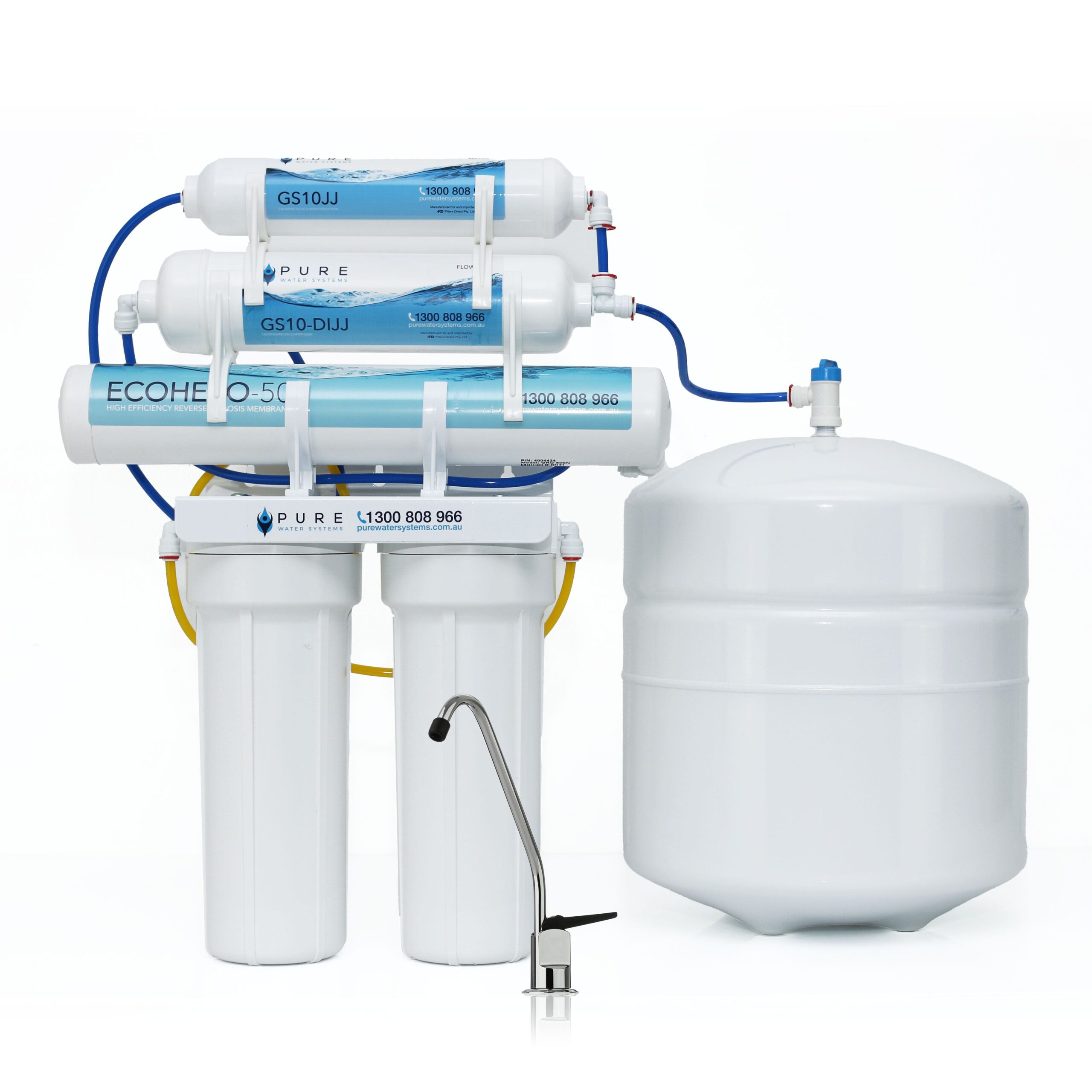
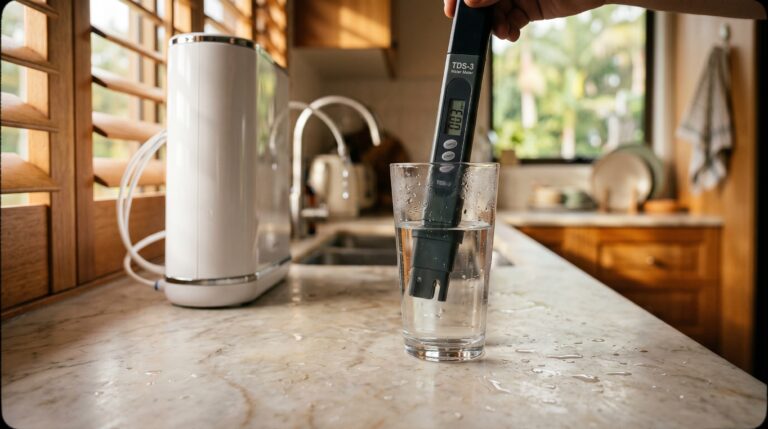
The EcoHero 5-Stage RO is the unit I run at my Palm Beach home, where mains water starts at 69 ppm TDS (SEQ Grid, also a chloramine city) and exits the membrane at 3 ppm — a 95.7% TDS reduction confirmed with a calibrated TDS-3 meter. For Adelaide, where summer TDS can approach 400 mg/L from Murray River water, the same 95.7% rejection rate produces output in the 15-20 ppm range regardless of the seasonal source blend. You are drinking the same quality water in February as you are in June, irrespective of how much Murray River water SA Water is currently drawing.
The key design feature for Adelaide specifically: stage 2 of the 5-stage system uses a catalytic carbon block (not standard GAC). Catalytic carbon decomposes chloramine rather than attempting to adsorb it. This means Adelaide’s primary disinfection challenge is handled before the water even reaches the RO membrane at stage 4. The membrane then removes the residual dissolved solids, PFAS class compounds, fluoride, and any agricultural contaminants from the Murray River that made it through pre-treatment. It is a comprehensive system for a complex water supply.
Pure Water Systems provides Australian-based support, and full filter replacement kits are available domestically. Professional installation is recommended for under-sink connection (budget approximately $150-200 for an Adelaide plumber) but filter cartridge replacement is DIY, with annual replacement cost around $120-150. The system includes a dedicated RO tap so full mains flow remains available at the main kitchen tap. Use the discount code at checkout for 10% off.
2. AquaTru Classic Smart Alkaline — Best Countertop / Renters
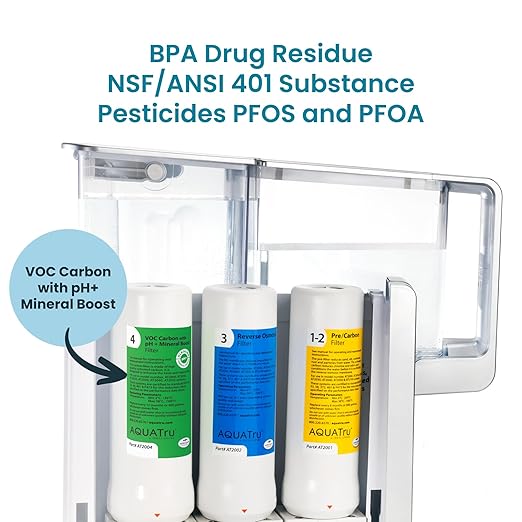
The AquaTru Classic Smart carries four NSF/ANSI certifications — 42 (aesthetic), 53 (health effects), 58 (RO membranes), and 401 (emerging contaminants). That is the strongest independent certification stack available on a countertop RO unit in Australia. The NSF/ANSI 58 certification specifically validates the membrane’s performance against controlled test parameters, including rejection rates for PFAS-class compounds. For Adelaide renters who cannot modify plumbing, this is the only viable path to certified RO-grade filtration without landlord involvement.
The internal pump is a particular advantage for Adelaide. Mains pressure in some Adelaide suburbs, particularly older inner-city and character-home precincts, can vary more than in newer developments. Under-sink RO systems relying entirely on mains pressure may produce slower filtration at low-pressure times. The AquaTru’s pump delivers consistent membrane contact regardless of mains variation — which matters in a city where the water quality itself is variable.
The alkaline remineralisation stage adds calcium and magnesium back after RO filtration, which is relevant for Adelaide given the high TDS of the input water. Post-RO, Adelaide water at near-zero TDS can taste flat to some palates. Remineralisation addresses this while leaving all the chloramine, PFAS, and dissolved solids rejected. Note: remineralisation does not affect contaminant removal — filtration occurs before remineralisation in the system architecture.
3. Waterdrop D6 — Best Tankless Under-Sink
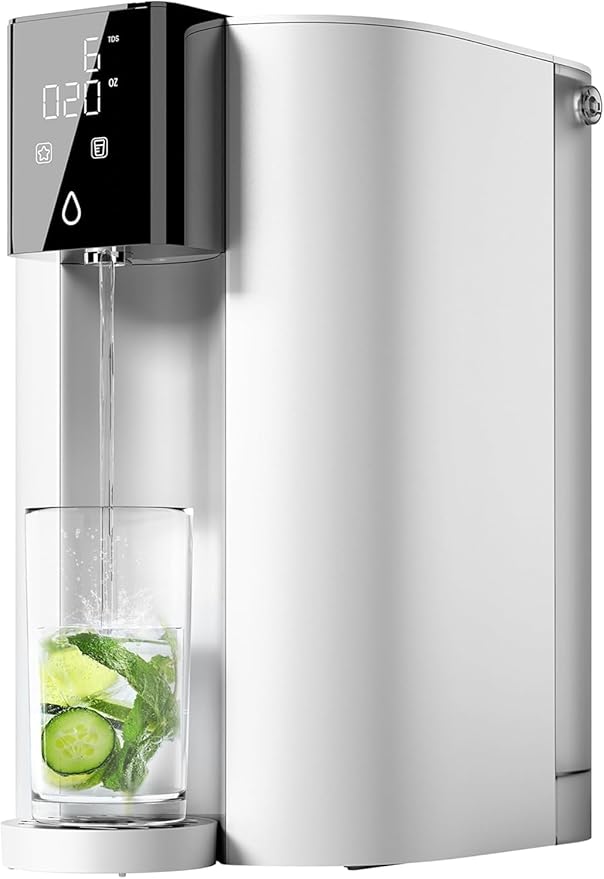
The tankless design is a meaningful advantage for Adelaide’s warmer climate. Traditional under-sink RO systems store filtered water in a pressurised vessel — typically 4-8 litres. In Adelaide’s summer temperatures, water sitting in a warm under-sink cabinet for 48-72 hours between uses can develop taste changes that a fresh-fill tankless system avoids. The D6’s on-demand production at 600 GPD means filtered water is freshly produced each time the tap is opened, rather than drawn from a tank that may have been sitting warm.
For Adelaide’s character homes and older inner-city housing stock, the compact tankless design also solves a practical problem: under-sink cabinets in renovated terraces and 1960s housing often have limited space that does not comfortably accommodate a large pressure tank alongside existing plumbing. The D6’s compact footprint fits where many tank-based systems do not. Tool-free cartridge replacement means filter changes require no plumber, no tools, and no water shutoff.
Filters That Do Not Work in Adelaide
⚠ These Filters Are Widely Recommended for Adelaide — and All Fail
- Brita and standard carbon jug filters: Multiple Australian filter sites recommend Brita for Adelaide. This is wrong. Standard GAC removes chloramine at less than 5% efficiency. Adelaide uses chloramine. A Brita jug in Adelaide is achieving almost nothing for the primary disinfection chemical in the water. The filter is not faulty — it is designed for free chlorine cities and is the wrong product for Adelaide.
- ZeroWater pitcher: Ion exchange technology reduces TDS, but Adelaide’s TDS issue is seasonal and primarily a taste/mineral concern, not a health risk. ZeroWater does nothing for chloramine or PFAS. The ion exchange resin also saturates much faster when input TDS is high (300-400 mg/L), requiring frequent expensive cartridge replacements.
- Water softeners (for drinking water): Water softeners address hardness only, exchanging calcium and magnesium for sodium. They do not remove chloramine, TDS, PFAS, or fluoride. Adelaide’s hardness is moderate (47-133 mg/L) and does not cause severe scale problems — a water softener is overshooting the problem while missing the primary concerns.
- Alkaline ionisers: Electrolytic ionisers adjust pH only. They have no mechanism for removing chloramine, reducing TDS, or filtering PFAS. Adelaide’s pH of 7.2-7.8 is already within the ideal range. Alkaline ionisers are not a filtration technology.
5-Year Cost Comparison — Adelaide Households
Adelaide’s seasonal water quality variation means the effective value of filtration is higher here than in cities with stable water quality. When your unfiltered tap water swings between tasting acceptable in June and tasting noticeably mineral-heavy in January, the argument for consistent filtered output is stronger. The table below uses AUD pricing with 4L/day filtered consumption.
| Product | Upfront | Annual Filter Cost | 5-Year Total | Cost/Litre |
|---|---|---|---|---|
| Bottled water (2L/day) | $0 | ~$730-$1,095 | $3,650-$5,475 | $1.00-$1.50 |
| Brita jug (chloramine city — largely ineffective) | ~$60 | ~$120 | ~$660 | $0.09 (fails chloramine) |
| EcoHero 5-Stage RO (homeowners) | ~$750 + install | ~$130 | ~$1,600 | $0.11 |
| AquaTru Classic Smart (renters) | ~$699 | ~$150 | ~$1,449 | $0.10 |
| Waterdrop D6 (tankless) | ~$699 + install | ~$140 | ~$1,499 | $0.10 |
ZeroWater is excluded from this table because its cartridge replacement cost is particularly punishing with Adelaide’s high-TDS input water. At 300-400 mg/L input TDS, ZeroWater cartridges saturate significantly faster than at lower-TDS inputs, making it one of the most expensive jug filter options in Adelaide specifically — while providing no chloramine removal. The Brita row is included to illustrate that $660 over 5 years buys a product that does not address Adelaide’s primary water concern.
Which Filter Is Right for You — Adelaide Decision Guide
3 Questions to Find Your Adelaide Filter
- Can you modify your plumbing?
YES: EcoHero 5-Stage RO (under-sink, best long-term value for Adelaide homeowners) or Waterdrop D6 (tankless, ideal for compact kitchens and character homes)
NO: AquaTru Classic Smart (countertop, zero plumbing, NSF certified) - Which Adelaide suburb are you in?
Salisbury North / Penfield / Paralowie / Edinburgh / Direk / Burton / Waterloo Corner — within or near the RAAF Edinburgh groundwater prohibition area. If on a private bore: PFAS testing + RO essential. If on town water: RO strongly recommended as precautionary.
Inner Adelaide / southern suburbs / coastal suburbs — outside PFAS zone. Chloramine is the primary concern city-wide. RO recommended, catalytic carbon block as budget alternative for taste-only improvement. - What is your primary concern?
Chloramine taste + comprehensive protection: RO (EcoHero or AquaTru)
Chloramine taste only, budget-conscious: Catalytic carbon block benchtop (NOT a standard GAC jug — requires catalytic, not standard, carbon)
High summer TDS / seasonal variation: RO (the only technology that removes dissolved solids)
PFAS (bore water): RO only — catalytic carbon is insufficient
Adelaide is one of the cleaner decisions in the Australian filter market, once you understand the chemistry. The high seasonal TDS, chloramine disinfection, and PFAS zone in the north all point to the same technology: reverse osmosis. Residents wanting a more affordable option for taste improvement only can use a catalytic carbon block benchtop filter — but they should understand it does not reduce TDS or PFAS, and they need to specifically seek out catalytic carbon rather than standard GAC. For comprehensive protection, RO is the answer. For a detailed look at how Adelaide compares to other Australian cities across all three filter priorities, see our guide to reverse osmosis water filters in Australia.
Testing Methodology
My direct filter performance testing uses a calibrated TDS-3 meter at my Palm Beach QLD home. The SEQ Grid (Palm Beach supply) is also a chloramine city with TDS of approximately 69 ppm — a different mineral profile from Adelaide but the same disinfection chemistry. Filter performance data on chloramine and TDS removal referenced in this article reflects this testing plus manufacturer NSF/ANSI certification data, which is third-party verified.
Adelaide-specific water quality data is drawn from SA Water’s published annual quality reports and drinking water profiles, the EPA SA Groundwater Prohibition Area orders for Edinburgh, and DCCEEW PFAS investigation registers. I have not independently tested Adelaide tap water at source — the metrics in this article reflect SA Water’s published monitoring results. For current suburb-specific data, SA Water’s online drinking water profile tool (postcode lookup) is the most accurate current source.
Last reviewed: May 2026 — Clean and Native
Frequently Asked Questions
Is Adelaide tap water safe to drink?
Yes, Adelaide tap water meets all Australian Drinking Water Guidelines and is safe to drink. SA Water reports 100% compliance with ADWG health parameters for the metropolitan system annually. The concern is not safety but water quality variability: Adelaide’s TDS swings significantly by season and source blend, and chloramine disinfection means most standard filters are ineffective. PFAS contamination from RAAF Edinburgh is in the groundwater, not in SA Water’s treated town supply.
Does Adelaide water have chlorine or chloramine?
Adelaide uses chloramine disinfection across most of the metropolitan supply zone. Chloramine (chlorine combined with ammonia) is more stable than free chlorine in Adelaide’s long pipe network. This is the most important filter-selection fact for Adelaide: standard carbon filters including Brita, ZeroWater, and most jug filters are designed for free chlorine and remove chloramine at less than 5% efficiency. Only catalytic carbon block or reverse osmosis adequately addresses chloramine.
Why does Adelaide water taste bad in summer?
In dry summer months, SA Water increases its reliance on the Murray River. Murray River water arrives with higher TDS — driven by upstream agricultural irrigation salinity and natural mineral weathering across the Murray-Darling Basin — and can push Adelaide tap water TDS above 300-400 mg/L at the tap. This higher mineral load creates a heavier, sometimes slightly saline taste that is notably different from the winter supply when reservoir water dominates the blend. A reverse osmosis filter eliminates this seasonal variation by removing 90-97% of dissolved solids regardless of source.
Does Adelaide water have PFAS?
PFAS contamination from RAAF Base Edinburgh is documented in groundwater beneath northern Adelaide suburbs including Edinburgh, Direk, Burton, Salisbury North, Penfield, Paralowie, and Waterloo Corner. This contamination is in the groundwater, not in SA Water’s treated town water supply, which draws from surface reservoirs and the Murray River. Residents in these suburbs on SA Water mains are not drinking PFAS-contaminated town water. However, residents with private bores in the Groundwater Prohibition Area should treat bore water as potentially contaminated and use RO filtration.
Does Adelaide water have fluoride?
Yes, SA Water fluoridates the Adelaide supply to approximately 0.6 mg/L, within the Australian recommended range of 0.6-1.0 mg/L. Standard carbon filters cannot remove fluoride. Only reverse osmosis (90-97% removal) or activated alumina (80-95%) does. If fluoride removal is a priority, reverse osmosis addresses this simultaneously with Adelaide’s chloramine and TDS issues.
Is Adelaide water hard or soft?
Adelaide water hardness varies by suburb and season, ranging from approximately 47 mg/L to 133 mg/L as calcium carbonate. This moderate range does not typically cause severe appliance scaling or skin issues. Minor limescale in kettles is manageable with routine descaling. Adelaide’s hardness level does not require a water softener for most households, and softening would not address chloramine or TDS — the more pressing concerns for Adelaide’s water chemistry.
What is the TDS of Adelaide tap water?
Adelaide’s tap water TDS varies seasonally between approximately 200 mg/L (in good rainfall seasons dominated by reservoir supply) and 400+ mg/L (in dry summers with higher Murray River reliance). This is significantly higher than Brisbane (~80-115 mg/L), Melbourne (~60 mg/L), or Darwin (~140 mg/L), and the variability itself is a quality concern independent of the absolute value. After RO filtration, Adelaide water TDS typically drops to 10-20 mg/L regardless of season.
Will a ZeroWater filter work in Adelaide?
ZeroWater uses ion exchange to reduce TDS but does not remove chloramine or PFAS. For Adelaide, ZeroWater’s TDS reduction is also particularly expensive: at 300-400 mg/L input TDS, the ion exchange resin saturates much faster than at lower-TDS inputs, requiring cartridge replacement every 4-6 weeks rather than the 3-5 months typical in softer water cities. ZeroWater addresses one aspect of Adelaide’s water (high TDS) while completely missing chloramine — Adelaide’s primary disinfection chemistry concern.
Get the Australian Home Environment Checklist
30 checks across water, air and EMF. Most of them free. Ranked by impact.
No spam. Unsubscribe any time.

Former Royal Australian Navy Clearance Diver and TAG-E counter-terrorism operator. Founded Clean and Native to apply the same rigorous thinking to the home environment.
Full biography →