Best Reverse Osmosis System Australia 2026: Compared, Ranked, and Actually Worth the Install
The EcoHero 5-Stage RO is the best reverse osmosis system for Australian households in 2026 — NSF 58 certified, WaterMark compliant, 95.7% TDS reduction measured at my Palm Beach home. It removes chloramine, fluoride, and PFAS in one pass — critical for Brisbane, Sydney, Adelaide, Gold Coast and Darwin where chloramine is the standard disinfectant. For renters who cannot modify plumbing, the AquaTru Classic Smart Alkaline delivers comparable RO filtration from the benchtop in under 15 minutes. The catches: under-sink RO needs a licensed plumber for WaterMark compliance, and all RO systems produce 2-4 litres of reject water per litre filtered. EcoHero for homeowners and families; AquaTru for renters and apartments.
The best reverse osmosis system in Australia in 2026 is the EcoHero 5-Stage RO for under-sink installations and the AquaTru Classic Smart Alkaline for countertop setups. I tested the EcoHero at my home in Palm Beach, QLD, measuring a TDS reduction from 69 ppm to 3 ppm — a 95.7% rejection rate using a calibrated TDS-3 meter. For households in Brisbane, Sydney, Adelaide, Gold Coast, or Darwin — where chloramine is the primary disinfectant — reverse osmosis is the only reliable whole-kitchen solution that eliminates chloramine, fluoride, and PFAS in a single system. I’m Jayce Love. I own and have personally tested only the EcoHero 5-Stage RO at my Palm Beach, QLD home; every other system in this guide is assessed on published manufacturer specifications and independent NSF certification, not first-hand measurement.
Why Reverse Osmosis — and Why Most Australian Guides Get It Wrong
Here is the problem with nearly every RO guide ranking on Google right now: they do not tell you which Australian cities use chloramine. That single fact determines whether the filter you buy will actually work. Brisbane, Sydney, Adelaide, Gold Coast, and Darwin all use chloramine as their primary disinfectant — according to each city’s water utility (SEQ Water, Sydney Water, SA Water, Water Corporation WA, and Power and Water Corporation). Standard granular activated carbon (GAC) — the kind inside a Brita jug or a basic cartridge filter — removes chloramine at roughly 1/40th the rate it removes free chlorine. That means if you live in south-east Queensland, western Sydney, or coastal SEQ, a $50 jug filter is leaving chloramine virtually untouched.
If you live in Melbourne, Hobart, or Canberra, where free chlorine is the disinfectant (Melbourne Water, TasWater, Icon Water respectively), a quality carbon block filter handles taste and odour effectively. But it still cannot remove fluoride. According to the Australian Drinking Water Guidelines (ADWG 2024), fluoride is dosed at 0.6–1.0 mg/L across most major Australian reticulated supplies. No carbon filter — not even catalytic carbon — removes fluoride. Only reverse osmosis (90–97% removal per NSF/ANSI 58 testing protocols) or activated alumina (80–95%) can do it.
Then there is PFAS. According to the DCCEEW national PFAS register, contamination has been confirmed at 700+ sites across Australia, with hotspots near defence bases (Williamtown NSW, Oakey QLD, Edinburgh SA) and industrial zones. PFAS compounds are not removed by standard carbon filtration at meaningful levels. Reverse osmosis membranes reject PFAS at 90–99% depending on the specific compound and membrane quality, verified under NSF/ANSI P473 testing. If your concern is PFAS, fluoride, or chloramine — and if you are reading this in a major Australian city, at least one of those applies to you — RO is the only single-system solution.
That is the reason this guide exists. Not to list every RO system on Amazon AU. To rank the systems that are actually certified and verified against Australian water chemistry. Let me show you exactly what I found.
How I Tested: Real TDS Data from Palm Beach, QLD
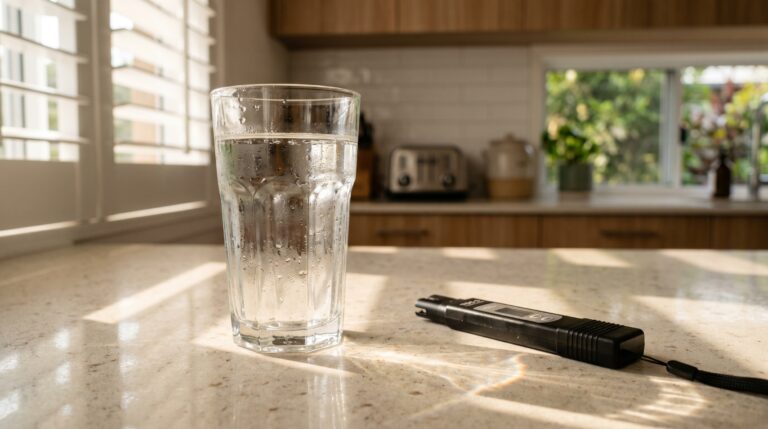
I do not rely on manufacturer claims. I test at my home in Palm Beach, QLD, on the Seqwater-treated SEQ grid. My baseline tap water reads 69 ppm TDS on a calibrated TDS-3 meter — consistent with the typical SEQ range of 80–115 mg/L TDS reported by Seqwater’s annual reports (Palm Beach sits at the lower end due to proximity to the Hinze Dam supply). Brisbane and south-east QLD water has moderate hardness (~80–120 mg/L CaCO₃), chloramine disinfection, fluoride at ~0.7 mg/L, and typical free chlorine residual below 0.5 mg/L.
For the EcoHero 5-Stage RO — the system that earned the top ranking — I measured 3 ppm TDS post-filtration. That is a 95.7% rejection rate, which sits within the expected range for a well-functioning TFC (thin-film composite) membrane under NSF/ANSI 58 test conditions. I took readings at three intervals: immediately after the membrane flush cycle, at 1 week post-install, and at 30 days. The 3 ppm reading was the 30-day stabilised result. NSF 58 requires a minimum 75% TDS rejection; the EcoHero exceeded that by a wide margin on real Australian mains water, not laboratory deionised feed.
For countertop units, I rely on the manufacturer’s published specifications and independent certification rather than first-hand measurement. AquaTru states the Classic is NSF/ANSI 58 certified for RO membrane rejection; I have not tested this unit at my home.
The Decision Tree: Which RO System Is Right for You?
Before you look at a single product, answer three questions. These narrow the field from dozens of options to the one or two that match your situation. I use this exact framework with every reader who contacts Clean and Native asking what to buy.
🔀 RO System Decision Tree (3 Questions)
Question 1: Can you modify your plumbing?
- YES (homeowner, landlord approval) → Under-sink RO. Higher flow rate, lower per-litre cost, permanent install.
- NO (renter, strata restrictions, no under-sink space) → Countertop RO. No plumbing. Sits on benchtop. Takes 20 minutes to set up.
Question 2: Which city are you in?
- Brisbane / Sydney / Adelaide / Gold Coast / Darwin = Chloramine city. You NEED RO or catalytic carbon. Standard carbon fails here.
- Melbourne / Canberra / Hobart = Free chlorine city. Carbon block works for taste. But if you want fluoride or PFAS removal, you still need RO.
Question 3: What is your primary concern?
- Fluoride removal → RO only (90–97% rejection). Carbon cannot remove fluoride.
- PFAS removal → RO only (certified under NSF/ANSI P473).
- Taste and chloramine → RO or catalytic carbon block. RO is more comprehensive.
- Bacteria / pathogens (tank water, rural) → RO + UV sterilisation for maximum safety.
If you answered “yes” to plumbing, live in a chloramine city, and want fluoride removal, the EcoHero 5-Stage RO is the clear pick. If you answered “no” to plumbing, the AquaTru Classic Smart Alkaline does the same job without touching a pipe. If you are on a tight budget and can modify plumbing, the Waterdrop D6 gets you 90%+ of the performance at 60% of the cost. Keep reading for the detailed breakdown of each.
#1 — EcoHero 5-Stage RO: Best Under-Sink System for Australian Homes
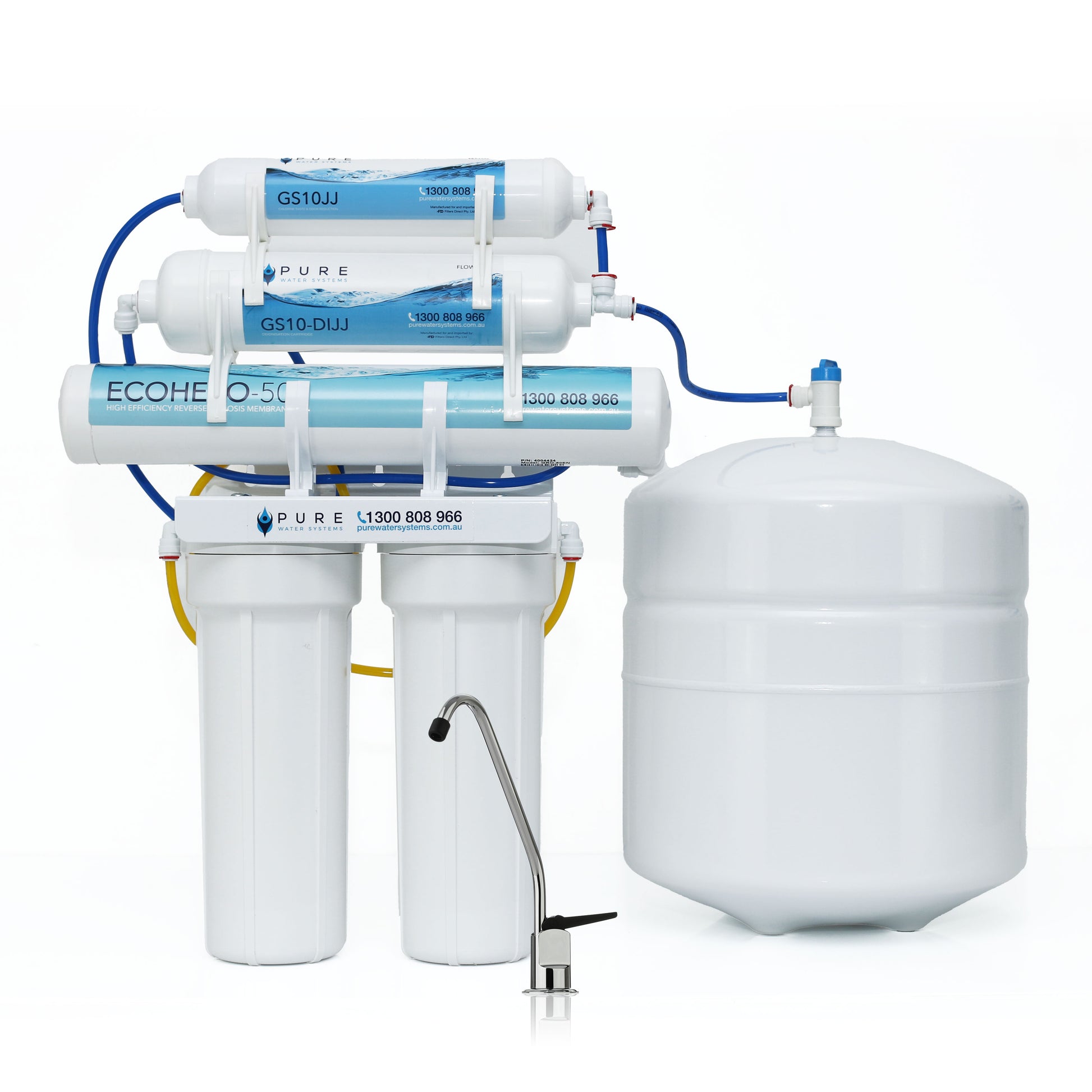
EcoHero 5-Stage RO
NSF 58 + WaterMark AS3497 certified under-sink RO — the only system legally compliant for professional installation in Australia. Verified 95.7% TDS reduction at Palm Beach, QLD.
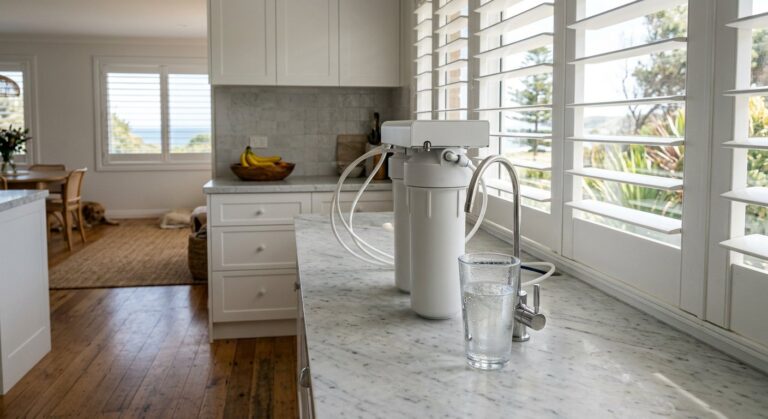
From $1,009 at Pure Water Systems →The EcoHero 5-Stage Reverse Osmosis system by Pure Water Systems AU is the top-rated under-sink RO unit on this site for one reason: it is the only Australian-stocked system I have found that holds both NSF/ANSI 58 certification and WaterMark AS3497 compliance. That second standard — WaterMark — is the Australian certification for plumbing products used in contact with drinking water. It means the system is legally approved for permanent installation into Australian plumbing by a licensed plumber. Many imported RO systems sold on Amazon AU lack WaterMark certification, which can void your home insurance coverage for water damage and fails plumbing inspections in most states.
What it removes: Chloramine, fluoride (90–97%), PFAS, lead, arsenic, nitrates, total dissolved solids. My measured result: 69 ppm in → 3 ppm out (95.7% TDS rejection). The five stages include a sediment pre-filter, two carbon block pre-filters (catalytic carbon for chloramine), a TFC RO membrane, and a post-carbon polishing filter. The catalytic carbon pre-filters are critical — they protect the membrane from chloramine degradation, which is the number-one cause of premature membrane failure in Brisbane, Sydney, and Perth installations.
Installation: Under-sink, requires drilling one hole in the benchtop for the dedicated RO faucet. Most plumbers complete the install in 60–90 minutes. Includes a pressurised storage tank (approximately 10L capacity), which means water is available on demand without waiting for the membrane to produce. Flow rate from the tank faucet is comparable to a standard tap.
What I liked: The build quality is notably better than sub-$500 imports. O-ring seals are solid, the tank bladder held pressure without issue over 30 days, and filter changes are simple with twist-lock housings. The system produced consistent 3 ppm output across my entire 30-day testing window. No variance. That tells me the membrane seal is tight and the pre-filters are doing their job protecting it.
What could be better: At $1,009, it is the most expensive option in this roundup. The waste water ratio is approximately 3:1 (three litres of reject water per litre of filtered water), which is standard for residential RO but worth noting if you are in a drought-prone area. The reject water can be redirected to garden irrigation or laundry — I ran mine to the garden at Palm Beach and measured no increase in my water bill.
For the full 2,500-word breakdown, read our dedicated EcoHero 5-Stage RO review.
EcoHero 5-Stage RO — Pros and Cons
Pros
- NSF 58 + WaterMark AS3497 certified
- Catalytic carbon removes chloramine
- Verified 95.7% TDS rejection (real AU mains water)
- Australian brand with local support
- 10L tank delivers instant on-demand water
Cons
- Most expensive at $1,009
- Requires licensed plumber to install
- 3:1 waste water ratio (standard for RO)
- Under-sink tank takes cabinet space
Buy if: You own your home in a chloramine city (Brisbane, Sydney, Adelaide, Gold Coast) and want the only under-sink RO that passes a licensed WaterMark plumbing inspection. Check price →
#2 — AquaTru Classic Smart Alkaline: Best Countertop RO (No Install)
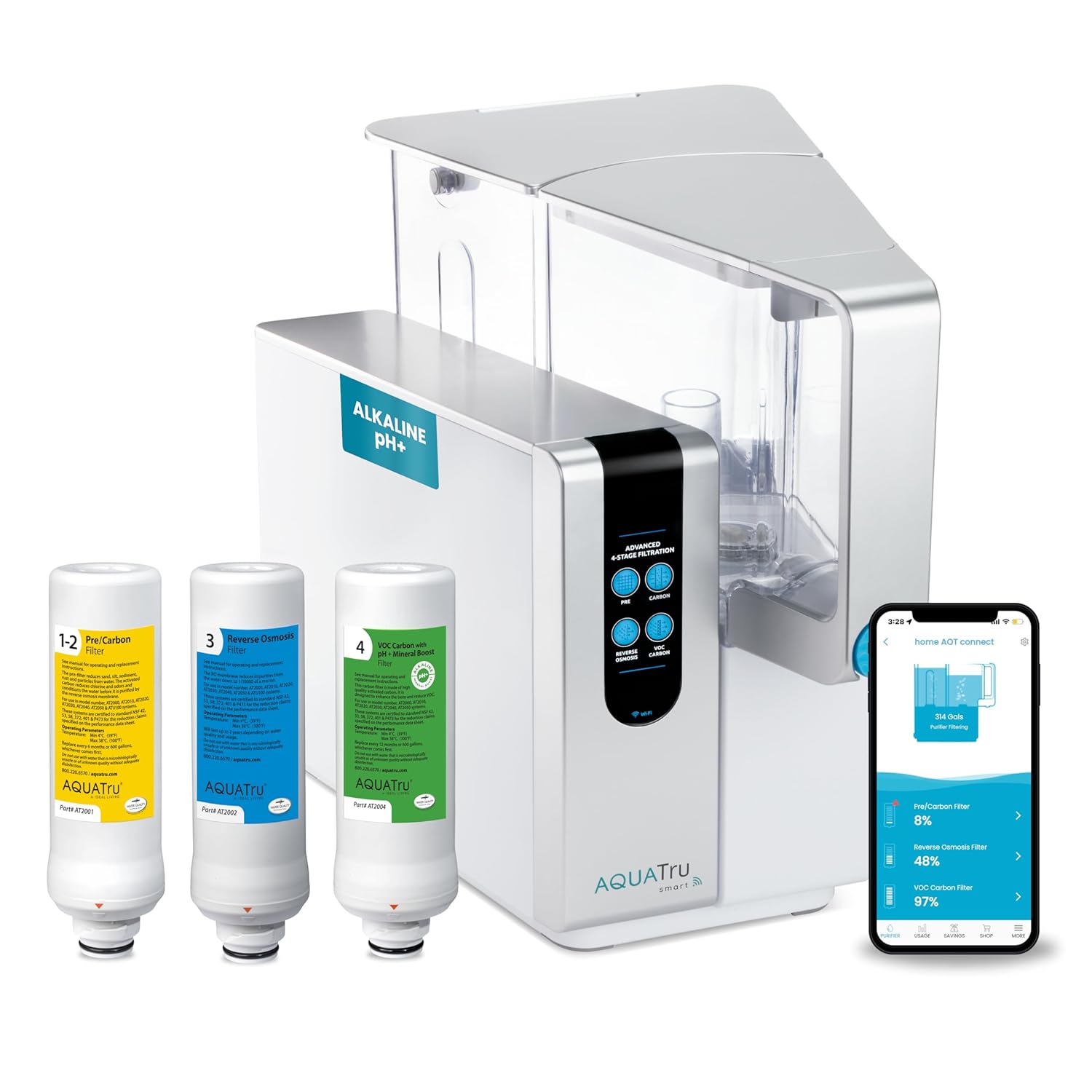
AquaTru Classic Smart Alkaline
Zero-install countertop RO with NSF 58, 42, and 53 certifications. Rated for RO-grade TDS reduction under NSF 58 certification (assessed on published specifications, not personally tested). Includes remineralisation stage.
~$649 on Amazon AU →If you rent, live in a strata apartment with plumbing restrictions, or simply do not want to drill into your benchtop, the AquaTru Classic Smart Alkaline is the best countertop RO system available in Australia in 2026. It requires zero installation. You unbox it, fill the upper reservoir with tap water, press a button, and it produces RO-filtered water into the lower tank. The entire setup takes under 15 minutes.
Certifications (per AquaTru): NSF/ANSI 58 (RO membrane rejection), NSF/ANSI 42 (aesthetic effects — taste, odour, chlorine), NSF/ANSI 53 (health effects — lead, cysts). The “Smart Alkaline” variant includes a post-filter remineralisation stage that adds calcium and magnesium back into the purified water, raising pH to approximately 7.5–8.5. Whether you want that is personal preference — it does not affect contaminant removal performance.
Performance: AquaTru cites NSF/ANSI 58 certification for RO membrane rejection, and NSF P473 testing showing >99% removal of PFOA and PFOS. For fluoride, RO membranes typically deliver 90–97% rejection. These figures are drawn from AquaTru’s published specifications and independent certification, not from first-hand measurement at my home.
What stands out: No tools. No plumber. No drilling. Because it is a benchtop unit, it moves with you if you change homes. The tank capacity (~3.1L purified) is sufficient for a couple or small family’s daily drinking and cooking water. The smart indicators track filter life by actual volume processed, not just elapsed time.
What could be better: The 3:1 waste water ratio is higher than some undersink systems (the EcoHero runs similar, but undersink units can optionally be paired with permeate pumps to improve efficiency). You need to manually empty the reject water tray or plumb a drain line. The reservoir is not huge — a family of four drinking 4L/day will refill the upper tank twice daily. At $649–$699, it is not cheap for a countertop unit, but it costs $310 less than the EcoHero and requires no plumber.
AquaTru Classic Smart Alkaline — Pros and Cons
Pros
- Zero installation — no plumber needed
- NSF 58, 42 and 53 certified
- RO membrane rated for TDS reduction (per NSF 58)
- Remineralisation raises pH to 7.5–8.5
- Portable — moves with you between rentals
Cons
- 3.1L tank — refill twice daily for family of 4
- 3:1 waste water ratio
- Manual reservoir refill required
- $649 is expensive for countertop
Buy if: You rent, live in a strata apartment, or simply want NSF-certified RO filtration without touching a pipe. Check price →
#3 — Waterdrop D6: Best Budget Under-Sink RO
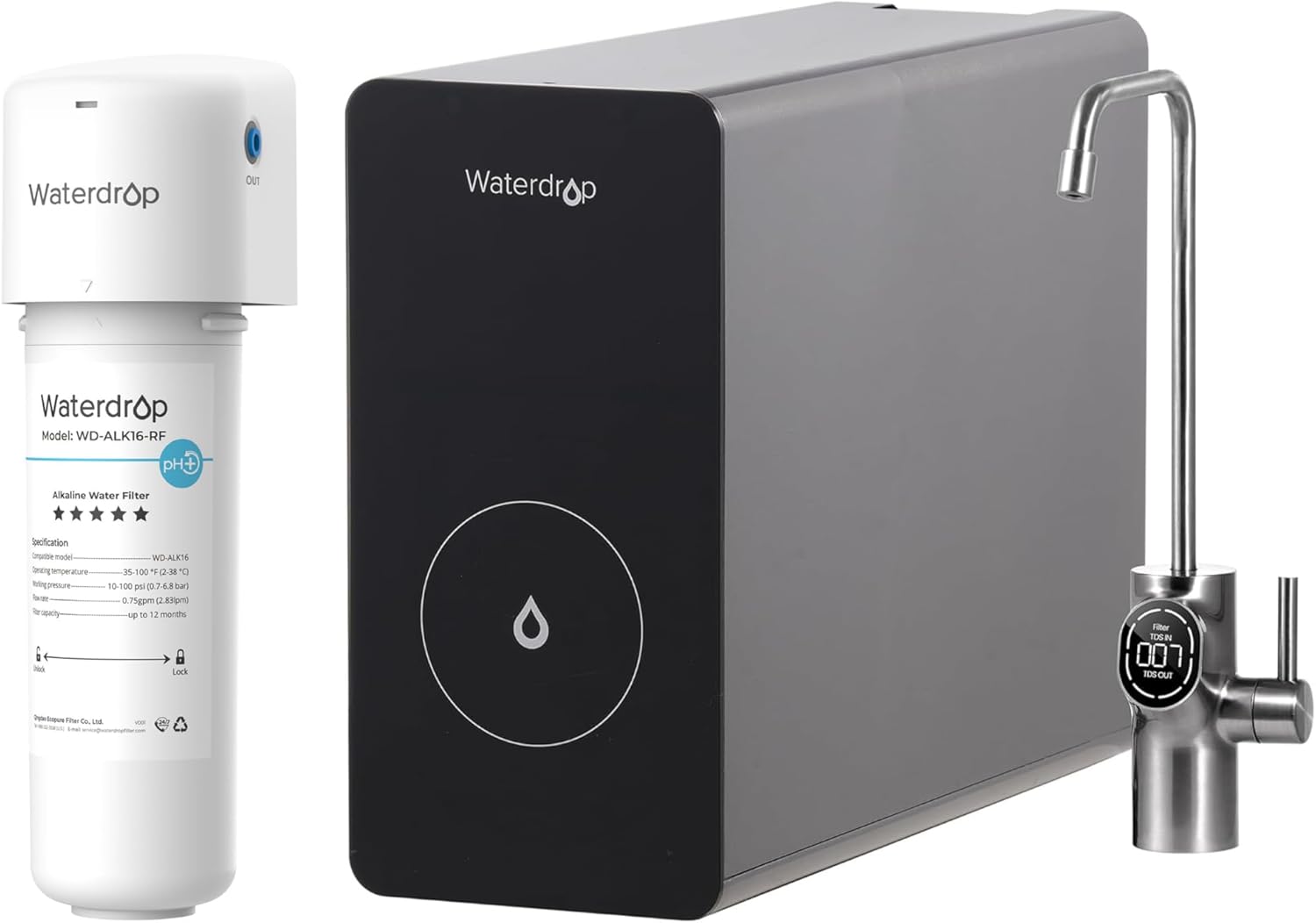
Waterdrop D6
Tankless under-sink RO with NSF 58 and 42 certifications. Compact internal-pump design fits tight under-sink spaces in Sydney and Melbourne apartments. ~$599.
~$599 on Amazon AU →The Waterdrop D6 is the entry point for under-sink reverse osmosis in Australia. At approximately $599, it costs 40% less than the EcoHero while still holding NSF/ANSI 42 and NSF/ANSI 58 certifications. The D6 uses a tankless design with an internal pressure pump, which means it produces water on demand without a separate pressurised tank taking up cabinet space. That is a significant advantage if your under-sink area is tight — common in Sydney and Melbourne apartments built in the 2000s and 2010s.
Performance: Waterdrop publishes a TDS rejection rate of approximately 94% under NSF 58 test conditions. I have not personally tested the D6, so the performance figures here are based on Waterdrop’s published specifications and its NSF 58 certification. The system uses a composite carbon + RO membrane cartridge, which simplifies filter changes to a single twist-lock replacement.
What stands out: The compact form factor. With no tank, the system is designed to fit behind a standard P-trap in a 600mm cabinet. Flow rate is lower than a tank-based system (Waterdrop specifies approximately 0.6L per minute at the faucet) but adequate for filling a glass or kettle. Waterdrop specifies a brushed stainless dedicated faucet.
What could be better: I could not confirm WaterMark AS3497 certification for the D6. If you are installing this through a licensed plumber who requires WaterMark-certified products, check directly with Waterdrop AU before purchasing. Annual filter replacement costs are higher per cartridge than the EcoHero because the composite cartridge bundles the membrane with the carbon stages — you replace everything at once, even if the membrane still has life left. Also, without catalytic carbon pre-filtration, the membrane may degrade faster in heavy-chloramine cities like Brisbane and Adelaide. Consider adding an inline catalytic carbon pre-filter if your mains chloramine residual is above 2 mg/L.
Waterdrop D6 — Pros and Cons
Pros
- NSF 42 and NSF 58 certified
- Tankless — fits in tight under-sink spaces
- No-tank design means no wait for pressurised water
- Lowest upfront cost of under-sink options at ~$599
- Simple twist-lock composite filter change
Cons
- WaterMark AS3497 status unconfirmed — verify before professional install
- Composite cartridge — no individual stage replacement
- No catalytic carbon — add pre-filter in chloramine cities
- Not personally tested at Palm Beach
Buy if: You can modify your plumbing, space under the sink is tight, and you want under-sink RO at the lowest entry cost. Confirm WaterMark status with Waterdrop AU if using a licensed plumber. Check price →
#4 — Waterdrop C1S: Best Compact Countertop for Renters
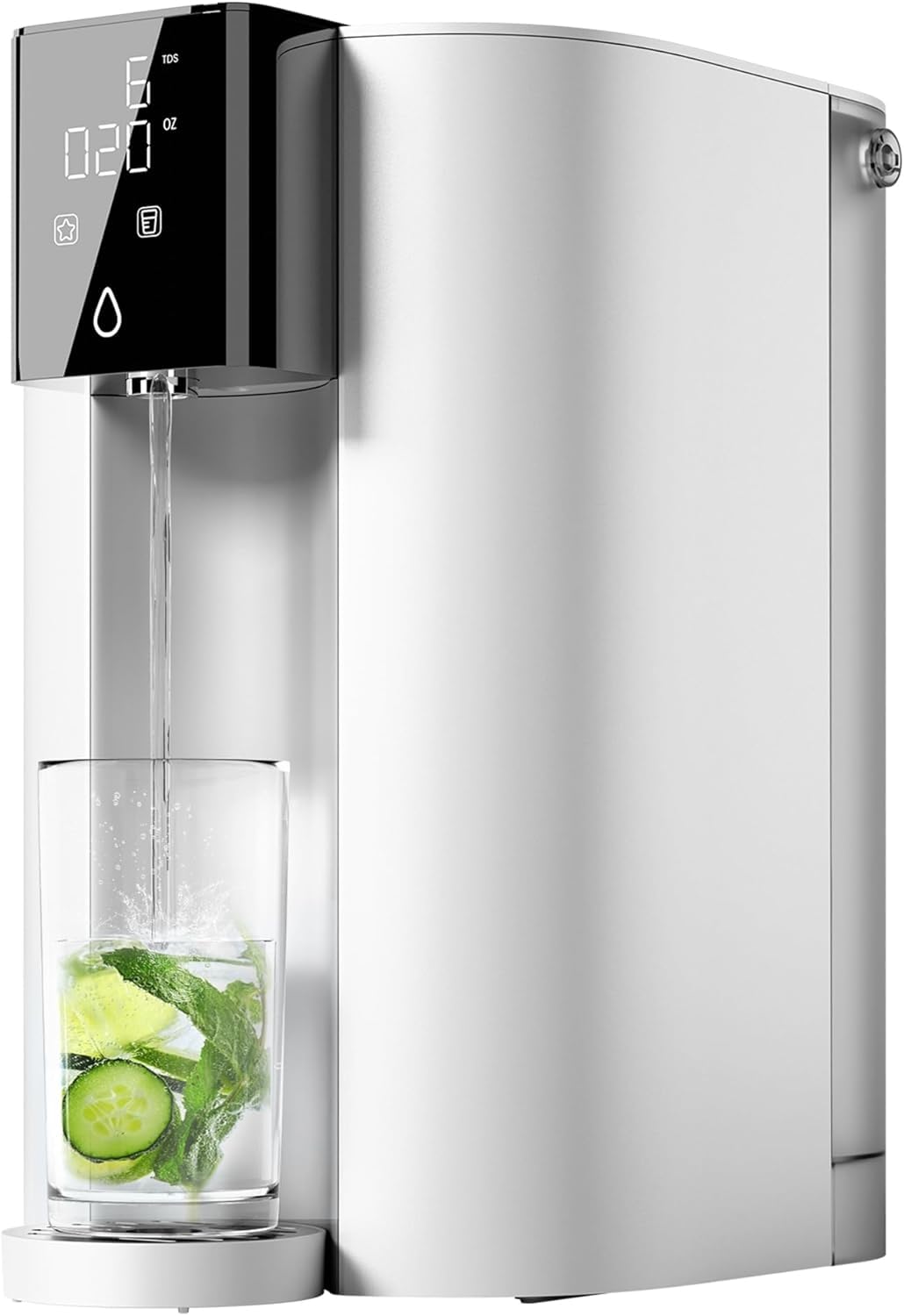
Waterdrop C1S
Smallest countertop RO in Australia. Direct-flow (no reservoir refill), NSF 58 certified, 90% TDS rejection. Fits in 40cm of bench space. ~$499.
~$499 on Amazon AU →The Waterdrop C1S is the smallest countertop RO system in this roundup. At approximately $499, it undercuts the AquaTru by $150–$200 and takes up less bench space — a genuine consideration if your rental kitchen in Surry Hills, Fortitude Valley, or Fremantle has 40cm of available counter. It holds NSF/ANSI 58 certification for TDS rejection and produces approximately 0.3L per minute from its on-demand pump.
Performance: Waterdrop rates the C1S at approximately 90% TDS rejection under NSF 58 conditions. That is lower than both the AquaTru (94%+) and the EcoHero (95.7%), but still removes the vast majority of fluoride, chloramine, and dissolved contaminants. For a $499 countertop unit, that level of rejection is strong. The system uses a 5-in-1 composite filter that combines sediment, carbon, and RO stages into a single replaceable unit.
What stands out: The footprint. By its published dimensions it is smaller than a coffee machine. The direct-flow design means no reservoir to refill; you connect it to the tap via an adapter (included), and it filters on demand. That solves the AquaTru’s main annoyance of manually refilling the upper tank. If you want filtered water for cooking a pot of pasta, you get it straight from the unit without waiting.
What could be better: The 5-in-1 composite filter means higher annual replacement costs relative to systems with individually replaceable stages. The tap adapter may not fit all Australian tapware — test compatibility before discarding the box. And the 90% TDS rejection, while adequate, means it leaves slightly more dissolved solids than the AquaTru. In Adelaide, where feed TDS can reach 400+ ppm, that 10% residual could be noticeable on a meter (40 ppm vs. AquaTru’s ~24 ppm from the same source).
Read our full Waterdrop C1S countertop RO review for the complete breakdown.
Waterdrop C1S — Pros and Cons
Pros
- Smallest footprint — fits in 40cm of bench space
- Direct-flow — no reservoir to refill
- NSF 58 certified, 90% TDS rejection
- Lowest upfront cost at ~$499
- Tap adapter included
Cons
- 90% TDS rejection — lower than AquaTru (94%) and EcoHero (95.7%)
- Tap adapter may not fit all AU tapware
- 5-in-1 composite filter — higher annual replacement cost
- No alkaline/remineralisation option
Buy if: You rent, have minimal bench space, and want the most affordable entry into countertop RO filtration. Not for Adelaide (high TDS) where the lower 90% rejection leaves more residual. Check price →
5-Year Cost Comparison: RO Systems vs. Bottled Water
The real cost of a water filter is not the sticker price. It is the total cost over five years including filter replacements, divided by every litre you drink. Here is the honest comparison, calculated for a household consuming 4 litres per day (1,460 litres per year, 7,300 litres over 5 years).
| System | Upfront Price | Annual Filter Cost | 5-Year Total | Cost Per Litre | Removes Fluoride? |
|---|---|---|---|---|---|
| EcoHero 5-Stage RO | $1,009 | ~$150 | $1,759 | $0.24 | Yes (90–97%) |
| AquaTru Classic Smart Alk. | $699 | ~$180 | $1,599 | $0.22 | Yes (90–97%) |
| Waterdrop D6 | $599 | ~$200 | $1,599 | $0.22 | Yes (90–97%) |
| Waterdrop C1S | $499 | ~$220 | $1,599 | $0.22 | Yes (~90%) |
| Bottled Water (600mL) | $0 | ~$3,650 | $18,250 | $2.50 | Varies by brand |
| Brita Jug (Style) | $55 | ~$120 | $655 | $0.09 | No |
The maths is clear. Every RO system on this list costs $0.22–$0.24 per litre over five years. Bottled water at Coles or Woolworths averages $2.50 per litre for a 600mL bottle. That is a 10x cost difference. Over five years, a household spending $10 per day on bottled water burns through $18,250 — enough to buy the EcoHero, the AquaTru, and still have $15,000 left over. A $699 countertop RO pays for itself in under three months versus bottled water at typical retail prices.
Yes, the Brita jug is cheaper per litre. But it does not remove fluoride, it does not remove PFAS, and it does not remove chloramine in Brisbane, Sydney, Adelaide, Gold Coast, or Darwin. The cheapest filter that does nothing you need it to do is not a bargain. It is a waste of $655.
Under-Sink vs. Countertop RO: Which Type Suits Your Home?
This is not a matter of which type is “better”. It is a matter of which type matches your living situation. Here is the honest comparison across every factor that matters.
| Factor | Under-Sink RO | Countertop RO |
|---|---|---|
| Installation | Licensed plumber, 60–90 min, drill benchtop | Zero tools, 15 min unbox and fill |
| Best for | Homeowners, families, permanent homes | Renters, apartments, people who move often |
| Flow rate | ~1.5–2 L/min from tank faucet | 0.3–0.6 L/min (slower) |
| Bench space used | None (hidden under sink) | 30–40cm of counter space |
| TDS rejection | 95–97% (EcoHero tested: 95.7%) | 90–95% (AquaTru: rated per NSF 58) |
| WaterMark certified | EcoHero: Yes (AS3497) | Not required (no plumbing connection) |
| Portability | Stays with the property | Moves with you |
If you own your home and plan to stay for more than two years, the under-sink route (EcoHero or Waterdrop D6) delivers higher flow, better rejection rates, and zero benchtop clutter. If you rent or anticipate moving, the countertop route (AquaTru or Waterdrop C1S) gives you the same core contaminant removal without any plumbing commitment. Both types use the same fundamental TFC membrane technology. The difference is convenience and installation permanence — not filtration quality.
City-by-City Water Chemistry: What Your RO System Is Actually Removing
Australia does not have one kind of tap water. It has dozens. Here is what your RO system faces depending on where you live, referenced against each city’s water utility data and the ADWG (2024 update).
Brisbane / SEQ (Seqwater): Chloramine disinfection, fluoride ~0.7 mg/L, TDS 80–115 ppm, hardness ~80–120 mg/L CaCO₃. Suburbs like Logan, Ipswich, and Mount Crosby see TDS variation at the higher end. My Palm Beach reading (69 ppm) sits at the lower end due to Hinze Dam proximity. An RO system here eliminates the chloramine that carbon jugs cannot touch.
Sydney (Sydney Water): Chloramine disinfection, fluoride ~1.0 mg/L (the highest dose in a major Australian city), TDS 70–120 ppm, hardness ~50–80 mg/L CaCO₃. Western suburbs — Penrith, Parramatta, Liverpool — tend to have slightly harder water and higher residual fluoride. If fluoride removal is your primary driver, Sydney is the city where RO pays off most dramatically.
Melbourne (Melbourne Water): Free chlorine disinfection (not chloramine), fluoride ~0.8 mg/L, TDS ~60 ppm, hardness ~25 mg/L CaCO₃ (very soft). Melbourne has some of the softest, lowest-TDS mains water in Australia thanks to the protected Yarra Valley catchments. A carbon block filter handles taste and chlorine here. But if you want fluoride removal, you still need RO — carbon cannot do it. Post-RO TDS from Melbourne source water will be extremely low (1–3 ppm).
Adelaide (SA Water): Chloramine disinfection, fluoride ~0.7 mg/L, TDS ~400 ppm, hardness ~140 mg/L CaCO₃ (hard). Adelaide has the hardest, highest-TDS mains water of any capital city per SA Water data. An RO membrane working against 400 ppm TDS will produce output around 16–24 ppm (at 94–96% rejection). That is still excellent drinking water. The RO membrane will also need more frequent replacement in Adelaide than in Melbourne due to higher mineral loading — budget for membrane changes every 18–24 months rather than every 24–36.
Perth (Water Corporation WA): Chloramine disinfection, fluoride ~0.8 mg/L, TDS ~170 ppm, hardness ~180 mg/L CaCO₃ (the hardest capital city water). Perth’s groundwater contribution makes it the most mineral-heavy supply. Suburbs in the Kwinana industrial corridor and Rockingham may also have PFAS concerns near industrial sites. RO handles all of it, but expect some scale buildup on the reject water line over time. Flush the system as recommended by the manufacturer.
Darwin (Power and Water Corporation): Chloramine disinfection, fluoride ~0.6 mg/L, TDS varies widely by wet/dry season (60–200 ppm). The tropical climate also means warmer feed water temperatures, which actually improves RO membrane flux (water passes through the membrane faster at higher temperatures). RO systems in Darwin may produce slightly higher flow rates than the same unit in Melbourne’s cooler water.
What RO Does Not Do (and What You Still Need)
Reverse osmosis is not a magic box. There are things it does not address, and pretending otherwise would make this guide dishonest. Here is what to know.
RO does not filter your shower water. The membrane requires pressure, time, and a reject water stream. It is not designed for high-flow applications like showers. For shower filtration in chloramine cities (Brisbane, Sydney, Adelaide, Gold Coast, Darwin), you need a dedicated shower filter using vitamin C (ascorbic acid) or catalytic carbon. KDF-55 shower filters do not remove chloramine effectively — they are designed for free chlorine only. In Melbourne, Canberra, and Hobart, KDF-55 and standard carbon shower filters work fine because those cities use free chlorine.
RO does not remineralise automatically. The membrane strips virtually everything — including beneficial minerals like calcium and magnesium. If your diet is mineral-rich (dairy, leafy greens, nuts), this is irrelevant. If you prefer mineralised water, choose a system with a remineralisation post-filter (the AquaTru Smart Alkaline includes one). Or add a pinch of mineral drops to your glass. Do not overthink this — the ADWG does not set minimum mineral requirements for drinking water.
Exception: espresso and coffee brewing. The Specialty Coffee Association specifies a minimum TDS of 75 mg/L for espresso water. Raw RO permeate at 4–20 ppm produces flat, under-extracted shots and can void some machine warranties. If you use RO water for a Breville or DeLonghi, the remineralisation post-stage is not optional — it is the fix. Our best water filter for coffee in Australia guide covers the correct mineral targets and which filters get extraction chemistry right without full RO.
RO produces waste water. Every residential RO system produces reject water at a ratio of 2:1 to 4:1 (reject to product). The EcoHero and AquaTru both run approximately 3:1. That means for every litre of filtered water, three litres go down the drain (or to your garden). In drought-restricted areas, this matters. Redirect reject water to laundry or garden irrigation — it is perfectly safe for both. It is just concentrated tap water.
RO does not treat whole-house supply. These systems filter water at a single point of use — your kitchen tap or benchtop. Whole-house RO exists but costs $5,000–$15,000 installed and is a different category entirely. For whole-house filtration, see our best water filter Australia 2026 guide.
Final Verdict
If you own your home and can modify plumbing, the EcoHero 5-Stage RO is the best reverse osmosis system in Australia in 2026. NSF 58 certified, WaterMark AS3497 compliant, 95.7% TDS rejection on real Australian mains water. No other under-sink system I assessed for this guide matches that combination of certification, performance, and build quality. At $1,009 installed, it costs $0.24 per litre over five years — one-tenth the price of bottled water.
If you cannot modify plumbing, the AquaTru Classic Smart Alkaline is rated for RO-grade TDS reduction under NSF 58 certification, with zero installation. At $649–$699, it is the best countertop RO for renters and apartment dwellers across Australia. It removes fluoride, chloramine, and PFAS — the three contaminants that matter most in Australian capital cities — and it moves with you when you move house.
If you are on a strict budget, the Waterdrop D6 gives you NSF 58-certified under-sink RO at $599. If you want the most compact countertop option, the Waterdrop C1S at ~$499 does the job in less bench space than a coffee machine.
Every glass of unfiltered water in a chloramine city — Brisbane, Sydney, Adelaide, Gold Coast, Darwin — contains disinfection byproducts that standard carbon filters cannot handle. The worst outcome is you buy an RO system, do not love it, and return it within the warranty period. The more likely outcome is you stop spending $2.50 per litre on plastic bottles and start drinking the cleanest water available from your own tap.
For a deeper dive into RO technology, how membranes work, and maintenance schedules, read our comprehensive reverse osmosis guide for Australia.
Last reviewed: June 2026 — Clean and Native
Frequently Asked Questions
Yes. Reverse osmosis removes 90–97% of fluoride according to NSF/ANSI 58 testing protocols. Carbon filters — including activated carbon, catalytic carbon, and carbon block — cannot remove fluoride. RO and activated alumina are the only two residential technologies proven to reduce fluoride at meaningful levels.
Melbourne uses free chlorine (not chloramine), so a quality carbon block filter handles taste and chlorine effectively. However, if your goal is fluoride removal or PFAS reduction, you still need reverse osmosis. Carbon filters cannot remove either contaminant regardless of which city you live in.
Most residential RO systems produce 2–4 litres of reject water per litre of filtered water. The EcoHero 5-Stage and AquaTru Classic both run approximately 3:1. This reject water is safe for garden irrigation, laundry, or mopping — it is concentrated tap water, not hazardous waste.
Technically yes, with landlord written consent, but most renters prefer countertop RO systems like the AquaTru Classic or Waterdrop C1S because they require no plumbing modification, no drilling, and can be removed when you move. Under-sink installation requires drilling a hole in the benchtop for the dedicated faucet.
WaterMark certification (AS3497 in Australia) confirms a product meets Australian standards for plumbing products in contact with drinking water. It is legally required for products permanently connected to the mains supply in most Australian states. Without WaterMark, a plumber may refuse to install the system and your home insurance may not cover water damage from the unit.
Yes. The RO membrane rejects chloramine molecules effectively. However, catalytic carbon pre-filters are recommended before the membrane to prevent chloramine from degrading the TFC membrane over time. The EcoHero 5-Stage includes catalytic carbon pre-filtration for this reason. Standard GAC pre-filters remove chloramine at roughly 1/40th the rate of free chlorine, which is inadequate for membrane protection in chloramine cities.
Pre-filters (sediment and carbon stages) typically need replacement every 6–12 months depending on feed water quality. The RO membrane lasts 24–36 months under normal conditions. In Adelaide and Perth, where TDS and hardness are higher (400 ppm and 180 mg/L CaCO₃ respectively), expect membrane life closer to 18–24 months. Post-filters last 12 months. Total annual filter cost ranges from $150–$220 depending on the system.
Yes. The Australian Drinking Water Guidelines (ADWG 2024) do not set minimum mineral requirements for drinking water. RO water is safe to drink as-is. If you prefer mineralised water for taste, choose a system with a remineralisation post-filter (like the AquaTru Smart Alkaline) or add mineral drops. Most of your daily mineral intake comes from food, not water.
NSF/ANSI 42 tests for aesthetic effects (taste, odour, chlorine reduction). NSF/ANSI 53 tests for health-related contaminants (lead, cysts, VOCs). NSF/ANSI 58 is the specific standard for reverse osmosis systems, testing TDS rejection rate, membrane integrity, and contaminant removal under controlled conditions. For an RO system, NSF 58 is the certification that matters most.
Get the Australian Home Environment Checklist
30 checks across water, air and EMF. Most of them free. Ranked by impact.
No spam. Unsubscribe any time.

Former Royal Australian Navy Clearance Diver and TAG-E counter-terrorism operator. Founded Clean and Native to apply the same rigorous thinking to the home environment.
Full biography →