Reverse Osmosis Systems vs Gravity Filters Australia 2026: Which Is Worth Your Money?
If your Australian tap water contains fluoride, PFAS, lead, nitrates, or bacteria, only reverse osmosis systems remove all five; gravity carbon filters handle chlorine, sediment, and some bacteria but cannot remove fluoride, dissolved salts, or PFAS. Five of eight capital cities use chloramine disinfection (Brisbane, Sydney, Adelaide, Darwin), which standard gravity carbon also struggles with. RO costs 2–3× more over five years but delivers NSF/ANSI 58 certified broad-spectrum removal. The catches: RO wastes 2–4 litres per litre produced and requires mains pressure or countertop setup, while gravity filters need manual refilling and won’t protect against dissolved contaminants.
| Technology | Best for | Verdict |
|---|---|---|
| Reverse Osmosis | Fluoride, PFAS, chloramine, nitrates, dissolved salts | Recommended for broad-spectrum removal |
| Gravity Carbon | Chlorine, sediment, taste/odour, bacteria only | Good budget option if no dissolved contaminants |
| Hybrid approach | RO for drinking, gravity for cooking/coffee | Overkill for most households |
Reverse Osmosis vs Gravity Filters Australia 2026: Which Actually Removes What?
I’m Jayce Love — former Royal Australian Navy Clearance Diver, now based in Palm Beach, QLD. In the Navy, the difference between clean water and contaminated water was not a preference. It was a survival requirement. I bring that same standard to this site.
This article exists because I keep seeing the same question in Australian water-filter forums: “Is a gravity filter good enough, or do I actually need reverse osmosis?” The answer depends entirely on what you need to remove — and what your local water utility puts into (and fails to fully remove from) your supply. Most content on this topic is vague. This one is not. I have mapped 15+ contaminants against both technologies, with certifications, removal percentages, and Australian-specific chemistry so you can make a decision based on evidence, not marketing copy.
Let’s start with the single most important factor most Australians overlook.
The Chloramine Problem: Why Your City Matters More Than Your Filter Brand
Before you compare filter types, you need to know what disinfectant your city uses. This one fact eliminates half the products on the market for most Australians — and almost no filter-comparison article mentions it.
Chloramine cities (monochloramine disinfection): Brisbane/SEQ, Sydney, Adelaide, Darwin.
Free chlorine cities: Melbourne, Hobart, Canberra, Townsville, Cairns, Toowoomba.
Why does this matter? Standard granular activated carbon (GAC) — the type used in almost every gravity filter, benchtop jug, and Brita-style cartridge — removes free chlorine effectively. But it removes chloramine at roughly 1/40th the rate. That is not a typo. Chloramine is a far more stable molecule (NH₂Cl vs Cl₂), and it passes through standard carbon with minimal reduction.
If you live in Brisbane, Sydney, Adelaide, or Darwin, a standard gravity carbon filter will not reliably strip the disinfectant from your water. You need either catalytic carbon, a compressed carbon block rated for chloramine, or reverse osmosis — which handles chloramine through its pre-filter stage (catalytic carbon) combined with the semi-permeable membrane.
This alone is a decisive advantage for RO systems in the five chloramine capitals. If you are in Melbourne, Hobart, or Canberra, a quality gravity carbon filter handles free chlorine just fine. Keep reading to see where gravity carbon still falls short even in those cities.
How Reverse Osmosis Actually Works (And What It Removes)
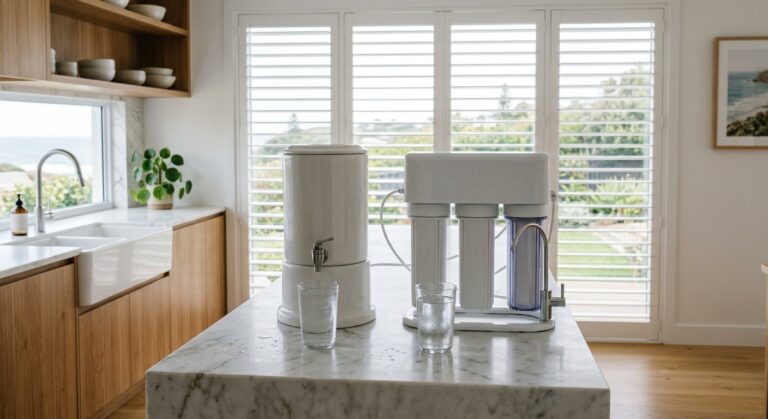
Reverse osmosis is not one filter. It is a multi-stage system. A typical countertop unit like the AquaTru Classic or an under-sink system like the Waterdrop D6 includes three to four stages:
- Sediment pre-filter — catches rust, sand, and particles down to ~5 microns.
- Activated carbon / catalytic carbon block — removes chlorine, chloramine, VOCs, and improves taste before water reaches the membrane.
- RO membrane — a semi-permeable membrane with pore size around 0.0001 microns (0.1 nanometres). This is the core stage. It physically blocks dissolved solids, heavy metals, fluoride, PFAS, nitrates, arsenic, lead, and bacteria.
- Post-carbon polishing filter — final taste improvement before the water reaches your glass.
The RO membrane’s pore size is the key. At 0.0001 microns, it rejects molecules based on size and charge. The Australian Drinking Water Guidelines (ADWG 2024) set aesthetic and health guideline values for dozens of contaminants — RO systems certified to NSF/ANSI 58 are independently tested against a standardised list of those contaminants, including lead (>97% rejection), arsenic (>95%), fluoride (90–97%), and total dissolved solids (85–95%).
What RO removes that matters for Australians:
- Fluoride — added at 0.6–1.0 mg/L in most Australian reticulated supplies. Carbon filters cannot remove fluoride. Only RO (90–97%) or activated alumina (80–95%) can.
- PFAS — per- and polyfluoroalkyl substances, detected in groundwater near RAAF bases (Williamtown NSW, Oakey QLD, Edinburgh SA) and some municipal supplies. RO membranes reject PFAS at >95%.
- Lead — from pre-1980s copper pipes with lead solder, common in older Sydney, Melbourne, and Adelaide homes.
- Nitrates — relevant for bore-water users in agricultural regions of QLD, NSW, and WA.
- Chloramine — handled by the pre-filter carbon stage plus membrane rejection.
- TDS — Adelaide tap water averages ~400 mg/L TDS, Perth ~170 mg/L. RO drops these to 10–30 mg/L.
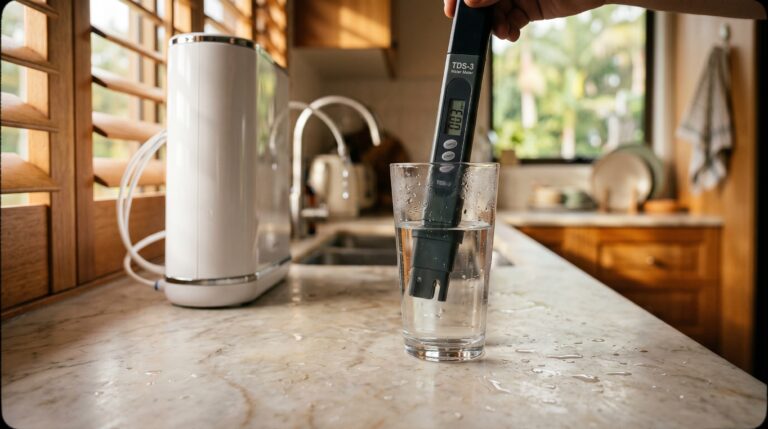
The tradeoffs: RO wastes some water (modern systems like the Waterdrop D6 achieve a 3:1 pure-to-drain ratio, older systems can be 1:3). RO also strips beneficial minerals — calcium and magnesium. This is solvable with a remineralisation stage or simply eating food. Your mineral intake from water is a fraction of your dietary intake.
If your concern is fluoride, PFAS, or heavy metals, no gravity carbon filter on the market can match these numbers. Let’s look at what gravity carbon actually does.
How Gravity Carbon Filters Work (And Where They Stop)
Gravity filters use — as the name suggests — gravity to push water through one or more carbon-based filter elements. There is no electricity, no pump, no water line connection. You pour water into the top chamber, it drips through the filter element(s), and you draw filtered water from the bottom chamber via a spigot.
The most common filter elements in Australian gravity systems are:
- Ceramic + carbon core (e.g., Doulton Ultracarb) — the ceramic shell filters particles and bacteria at ~0.5–0.9 microns, while the internal activated carbon core adsorbs chlorine, some VOCs, and improves taste.
- Compressed carbon block — denser than GAC, with smaller pore channels that improve contact time. Some blocks are rated to NSF/ANSI 53 for lead and cyst reduction.
- GAC (granular activated carbon) — loose carbon granules. Effective for free chlorine and taste/odour. Poor for chloramine. No fluoride or PFAS capability.
The Doulton Ultracarb is one of the better gravity elements available in Australia. It is NSF 42 (aesthetic — chlorine, taste, odour) and NSF 53 (health — lead, cysts) certified. The ceramic outer shell provides genuine bacteria reduction (>99.99% for E. coli and cholera per Doulton’s test data). This makes it useful for tank/rainwater users concerned about microbial contamination.
What gravity carbon does well:
- Free chlorine — 95–99% removal (in free chlorine cities only).
- Sediment and turbidity — ceramic shell to 0.5 microns.
- Bacteria — ceramic models achieve >99.99% for pathogenic bacteria.
- Lead — some models (NSF 53 certified) reduce lead by >93%.
- Taste and odour — excellent.
What gravity carbon cannot do:
- Fluoride — 0% removal. Carbon does not adsorb fluoride ions. Not standard carbon. Not catalytic carbon. Not any carbon. Only RO or activated alumina removes fluoride.
- PFAS — not certified, not reliably tested. Some carbon block filters show partial PFAS reduction in lab settings, but no major gravity filter system holds NSF/ANSI P473 (PFAS) certification.
- Chloramine — extremely poor with standard GAC. If you are in Brisbane, Sydney, Adelaide, or Darwin, your gravity filter is passing chloramine through largely untouched.
- Nitrates — 0% removal. Carbon does not adsorb nitrate ions.
- TDS reduction — 0%. Dissolved salts pass through carbon unaffected.
- Dissolved heavy metals (arsenic, chromium-6, mercury) — limited to no reduction unless specifically certified.
This is the core distinction. A gravity carbon filter is a taste-and-sediment device with some bacterial capability. An RO system is a broad-spectrum contamination-removal device. They are not the same category of product, even though they both sit on your kitchen bench.
Full Contaminant Comparison: 17 Parameters, Side by Side
This is the table you came here for. Every claim is based on NSF/ANSI certification standards, manufacturer test data, or published ADWG guideline values. Where a technology is “not certified,” it means no accredited third-party testing supports the claim for that contaminant class.
| Contaminant | ADWG Guideline | RO (NSF 58) | Gravity Carbon (NSF 42/53) | What This Means for You |
|---|---|---|---|---|
| Fluoride | 1.5 mg/L | 90–97% | 0% | RO only. Carbon cannot remove fluoride ions. |
| Chloramine | 3 mg/L (aesthetic) | >95% | ~5% (GAC) | Critical for Brisbane, Sydney, Adelaide, Darwin. |
| Free chlorine | 5 mg/L (health) | >99% | 95–99% | Both effective. Gravity carbon fine in free-chlorine cities. |
| PFAS (PFOA/PFOS) | 0.07 µg/L (PFOS+PFHxS) | >95% | Not certified | RO only for verified PFAS reduction. |
| Lead | 0.01 mg/L | >97% | 93%+ (NSF 53 models only) | Gravity carbon OK if NSF 53 certified. RO more complete. |
| Arsenic | 0.01 mg/L | >95% | Not certified | Relevant for bore water in rural QLD, WA, NT. |
| Mercury | 0.001 mg/L | >95% | Limited | RO removes dissolved inorganic mercury. |
| Nitrate | 50 mg/L | 85–95% | 0% | RO only. Carbon has zero nitrate capability. |
| TDS | 600 mg/L (aesthetic) | 85–95% | 0% | Adelaide (TDS ~400) and Perth (TDS ~170) benefit most. |
| Bacteria (E. coli) | 0 CFU/100mL | >99.99% | >99.99% (ceramic models) | Both effective. Ceramic gravity filters strong here. |
| Cysts (Giardia/Crypto) | 0 organisms | >99.95% | >99.9% (ceramic) | Both effective. Ceramic shell at 0.5 µm blocks cysts. |
| Sediment | Aesthetic | 5 µm pre-filter | 0.5 µm (ceramic) | Gravity ceramic is actually finer filtration for particles. |
| VOCs (pesticides, herbicides) | Varies | Carbon stage + membrane | Good (carbon adsorption) | Both effective via carbon adsorption pathway. |
| Chromium-6 | 0.05 mg/L (total Cr) | >90% | Not certified | RO membrane rejects dissolved chromium. |
| Copper | 2 mg/L (health) | >95% | Partial (some NSF 53) | RO is more reliable. Carbon variable. |
| Sodium | 180 mg/L (aesthetic) | 85–95% | 0% | Relevant for Adelaide and bore-water users. |
| Hardness (CaCO₃) | 200 mg/L (aesthetic) | 85–95% | 0% | Perth (~180 mg/L) and Adelaide (~140 mg/L) hardness reduced by RO only. |
5-Year Cost Comparison: RO vs Gravity Carbon vs Benchtop Carbon
The most common objection to RO is cost. But when you calculate over five years — the realistic ownership period — the gap narrows dramatically. Here is the full breakdown based on a 4-person household using approximately 4 litres of filtered drinking water per day (1,460L per year).
| Product | Upfront Price | Annual Filter Cost | 5-Year Total | Cost per Litre |
|---|---|---|---|---|
| AquaTru Classic RO | $549 | $120–$150 | $1,149–$1,299 | $0.16–$0.18 |
| Waterdrop D6 Under-Sink RO | $599
Get the Australian Home Environment Checklist30 checks across water, air and EMF. Most of them free. Ranked by impact. No spam. Unsubscribe any time. 
Written by Jayce Love
Former Royal Australian Navy Clearance Diver and TAG-E counter-terrorism operator. Founded Clean and Native to apply the same rigorous thinking to the home environment. Full biography →Similar Posts
|