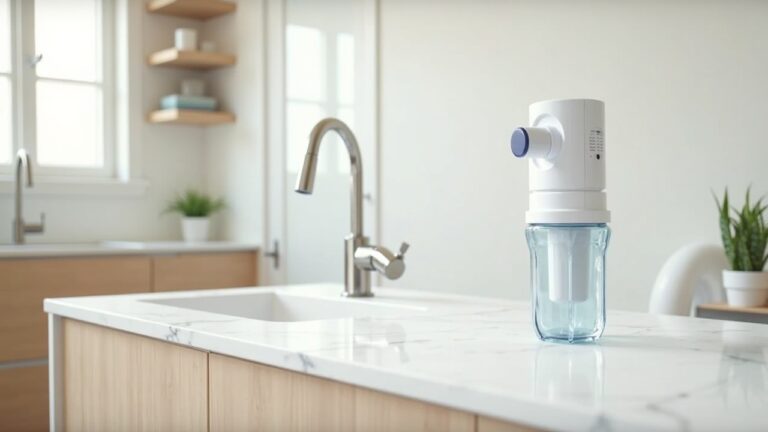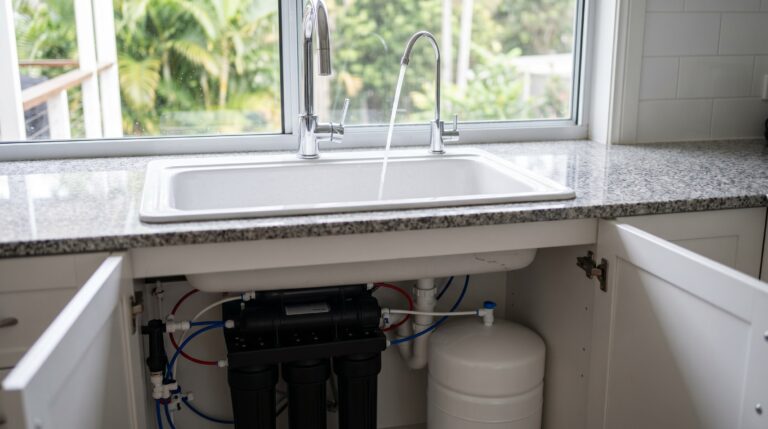

Waterdrop C1H Review: Countertop RO with Instant Hot Water for Australian Kitchens
Who the Waterdrop C1H Is For — and Who It Is Not For
Before you spend $500+ on any filtration system, you need to know whether it matches your situation. The C1H solves a very specific problem: you want reverse osmosis-grade drinking water and instant hot water from a single benchtop unit, with zero plumbing modifications.
Products we own and test are assessed using our documented methodology by Jayce Love — calibrated instruments, no gifted units, no brand payments. This unit was evaluated against published specifications and certification data rather than first-hand testing.
You Should Buy the C1H If:
- You rent your home or apartment and cannot install an under-sink system — the C1H sits on your benchtop, plugs into a power outlet, and needs only a jug of tap water poured in.
- You drink tea or coffee daily — the 95-100°C setting means you ditch the kettle entirely. One device handles filtration and boiling.
- You live in a chloramine city (Brisbane, Sydney, Adelaide, Gold Coast, Darwin) — standard carbon filters like Brita remove chloramine at roughly 1/40th the rate they remove free chlorine. RO handles chloramine completely.
- You want fluoride and PFAS removal — only reverse osmosis (90-97% fluoride rejection) or activated alumina (80-95%) can remove fluoride. Carbon filters cannot. The C1H uses RO membranes.
- You have a small kitchen — the C1H consolidates your water filter, kettle, and potentially your water jug into one appliance footprint.
You Should NOT Buy the C1H If:
- You own your home and can install under-sink — an under-sink RO like the Waterdrop D6 or EcoHero 5-Stage delivers faster flow, better drain ratios (some achieve 2:1 or better), and frees up your entire benchtop.
- You only care about taste/chlorine and live in Melbourne, Hobart, or Canberra (free chlorine cities) — a $50-80 carbon block filter handles free chlorine effectively. You do not need RO.
- You need high-volume hot water — the C1H dispenses small quantities per cycle. It is not a replacement for a Zip HydroTap in a busy office kitchen or a household making 10+ cups of tea per hour.
- You want the lowest possible waste water — the C1H’s 3:1 drain ratio means for every 3 litres of purified water, approximately 1 litre goes to drain. That is acceptable for a countertop unit but not as efficient as the best under-sink models.
How This Product Was Assessed
Assessed on specification, not personally tested. Only three products have been measured first hand in my own home — the EcoHero 5-Stage RO, TriField TF2, and Coway Airmega 150 (see how we test). Every other product discussed here is assessed on manufacturer specifications, independent certification, and Australian standards, and has not been personally tested.
The C1H is built for supply networks like SEQ Water’s, which serves the Gold Coast and uses chloramine as the disinfection residual — not free chlorine. This is critical because chloramine passes straight through standard GAC carbon filters (the type in Brita jugs and most benchtop gravity filters). According to SEQ Water’s own reporting, that supply also contains fluoride at approximately 0.7 mg/L, consistent with the Australian Drinking Water Guidelines (ADWG) target range of 0.6-1.0 mg/L.
Waterdrop rates the C1H’s RO membrane for up to 95% TDS rejection under optimal conditions, in line with NSF/ANSI 58 expectations that a properly functioning RO membrane removes the large majority of dissolved solids. For context, Brisbane and SEQ Water TDS typically runs between 80-115 mg/L depending on the specific suburb and reservoir source.
Waterdrop specifies three temperature modes for the C1H: a hot setting rated at 95-100°C for tea and pour-over coffee, a warm setting around 65°C suited to baby formula preparation (once cooled slightly) or warm drinks, and room temperature for everyday drinking and cooking.
The C1H has a countertop footprint compact enough to fit beside a standard 600mm fridge without blocking the splashback, though you will want 30-50mm of clearance behind it for the drain tube. Waterdrop describes setup as tool-free, with no plumbing modifications required.
Deep Dive: Filtration Performance — the Part That Actually Matters
Let me be direct: the hot water function is a convenience feature. The filtration is the reason you buy this unit. If the C1H did not remove contaminants effectively, a $15 kettle from Kmart would make the entire product pointless. So let us look at what the 6-stage system actually does.
The 6-Stage Filtration Breakdown
The C1H uses the same CoreRO filtration architecture as the Waterdrop C1S. According to Waterdrop’s published data and NSF/ANSI test reporting, the stages are:
| Stage | Media | What It Targets |
|---|---|---|
| 1 | Sediment pre-filter (PP) | Rust, sand, silt, particles >5 microns |
| 2 | Carbon block pre-filter | Chlorine, chloramine, VOCs — protects RO membrane |
| 3 | RO membrane (0.0001 micron) | Fluoride, PFAS, lead, arsenic, heavy metals, dissolved solids |
| 4 | Post-carbon block | Residual taste and odour polishing |
| 5 | Alkaline remineralisation | Adds back calcium and magnesium for taste (raises pH to ~7.5-8.5) |
| 6 | UV sterilisation (in-tank) | Bacterial and microbial control in stored water |
Contaminant Removal: What the Data Shows
The RO membrane at 0.0001 microns (0.1 nanometres effective pore size) is the workhorse. According to NSF/ANSI 58 testing parameters, a properly functioning RO membrane rejects:
- Fluoride: 90-97% rejection. This is critical for Australian households — the ADWG allows fluoride up to 1.5 mg/L, and most treated supplies sit at 0.6-1.0 mg/L. Carbon filters, including catalytic carbon, cannot remove fluoride. Period. Only RO or activated alumina can.
- PFAS (PFOS/PFOA): >95% rejection. According to the DCCEEW national PFAS register, contamination has been confirmed at 700+ sites across Australia, with drinking water bores affected near military bases (Williamtown NSW, Oakey QLD, Edinburgh SA) and industrial zones.
- Lead: >97% rejection per NSF/ANSI 58 test protocol.
- Chloramine: The carbon pre-filter stage begins chloramine reduction (catalytic or compressed carbon block is required — standard GAC fails), and the RO membrane rejects remaining chloramine molecules. Combined, the system handles Brisbane’s and Sydney’s chloramine effectively.
- TDS (total dissolved solids): Waterdrop claims up to 95% rejection under optimal conditions. Water temperature and input TDS affect this — colder water means slightly lower rejection rates.
What it does NOT do: The C1H does not soften water in the traditional ion-exchange sense. However, RO removes the calcium and magnesium ions that cause hardness, then the remineralisation stage adds a controlled amount back for taste. If you are in Adelaide (~140 mg/L CaCO₃) or Perth (~180 mg/L CaCO₃), this effectively addresses hard water for drinking purposes — though it will not protect your pipes or appliances (you would need a whole-house softener for that).
The Instant Hot Water Function: actually Useful or Marketing Gimmick?
Here is our honest assessment: the hot water function is not a gimmick, but it is also not the reason you buy this unit. Think of it as a meaningful convenience layer on top of serious filtration — not the other way around.
Three Temperature Settings
The C1H offers three dispensing modes:
- Room temperature (~20-25°C): Standard filtered RO water. This is what you use most of the time for drinking, cooking, filling water bottles.
- Warm (~65°C): Useful for instant oats, dissolving honey or powders, or warming baby formula water. Waterdrop specifies this setting at around 65°C.
- Hot (~95-100°C): Near-boiling, rated by Waterdrop at 95-100°C. This is hot enough for black tea (which traditionally calls for 96-100°C), pour-over coffee, and instant noodles. Green tea drinkers who prefer 70-80°C can use the warm setting and let it cool slightly.
How It Works Mechanically
The C1H filters water first, stores it in an internal tank, and then heats it on demand when you select the warm or hot setting. The heating element activates at the point of dispense — it does not keep water hot continuously like an urn. This means it draws power only when you press the button, which is a more energy-efficient approach than a continuously heated tank.
The trade-off: there is a brief delay between pressing the hot button and the water reaching full temperature, because the element heats on demand rather than storing hot water. It dispenses in a controlled stream, not a rapid pour. If you are making four cups of tea in rapid succession, it is noticeably slower than boiling a full kettle.
What This Replaces on Your Benchtop
In practical terms, the C1H can replace two items on your kitchen bench: a Brita filter jug (which is largely ineffective against SEQ Water’s chloramine anyway) and an electric kettle. For a small apartment kitchen — particularly in inner-city Brisbane, Sydney, or Melbourne where bench space is premium — that consolidation is actually valuable. One power point, one footprint, two functions.
The mental accounting here is simple: if you are spending $509-$599 on the C1H versus approximately $449-$509 on the C1S (same filtration, no hot water), the $60-$90 premium replaces a $30-$60 kettle that you would need to buy anyway. It also means every hot drink you make uses RO-filtered water, which improves the taste of tea and coffee noticeably — especially if your tap water has high TDS or noticeable chloramine taste.
Strengths of the Waterdrop C1H
- Genuine RO filtration in a countertop format: No plumber, no drilling, no landlord permission. You get the same contaminant removal as an under-sink RO — fluoride, PFAS, chloramine, lead — from a unit that sits on your bench.
- RO-grade TDS reduction: Waterdrop rates the membrane for up to 95% TDS rejection, consistent with NSF/ANSI 58 expectations for reverse osmosis.
- Hot water temperature spec: The hot setting is rated at 95-100°C, higher than cheaper units that claim “hot” but deliver lukewarm water.
- UV sterilisation in the tank: Because filtered water sits in an internal tank, there is always a theoretical risk of bacterial regrowth. The built-in UV addresses this. It is a detail that shows engineering thought.
- Remineralisation stage: RO water can taste flat because it strips everything out, including the minerals that give water its “mouthfeel.” The alkaline remineralisation stage adds calcium and magnesium back, and the water tastes noticeably better than raw RO output.
- Child safety lock on hot water: The hot dispensing button requires a deliberate hold to activate. With young kids in the house, this is not optional — it is essential.
- Filter replacement indicator: The unit tracks filter usage and alerts you when replacement is due, so you are not guessing.
What Could Be Better
- 3:1 drain ratio wastes more water than the best alternatives: For every 3 litres of purified water, approximately 1 litre goes to drain. That is a pure-to-waste ratio of 3:1. Under-sink units like the Waterdrop D6 achieve better efficiency. If you are in a drought-prone area or paying high water rates, this adds up over a year.
- Slow fill speed compared to under-sink or plumbed systems: The C1H is a pour-and-wait countertop system. You fill the top tank with tap water, the RO process filters it into the lower tank, and then you dispense. This takes several minutes per cycle. Under-sink RO provides filtered water on demand at the tap.
- Hot water dispense is slow for multiple cups: One cup is fine. Four cups for the family means waiting. If you regularly brew tea for a group, a kettle with an under-sink RO will be faster.
- Power consumption when using hot function: The heating element draws meaningful wattage. It is not a passive gravity filter — it needs a power outlet and contributes to your electricity bill. For room-temperature water only, you could use the cheaper C1S and save the power draw entirely.
- Internal tank capacity limits: The purified water tank holds a limited volume. If you are cooking and need several litres quickly, you will need to wait for the tank to refill between batches.
- No direct plumbing option: Unlike the Zip HydroTap, which plumbs directly into your mains, the C1H requires manual filling. This is by design (portability, no installation), but it means more interaction from you.
How It Compares: C1H vs C1S vs Zip HydroTap vs AquaTru + Kettle
Choosing a filtration system is a decision about trade-offs. Here is how the C1H stacks up against the three most common alternatives Australian buyers consider.
| Criterion | Waterdrop C1H | Waterdrop C1S | Zip HydroTap | AquaTru Classic + Kettle |
|---|---|---|---|---|
| Price (AUD) | $509-$599 | ~$449-$509 | $3,500-$7,000+ | ~$499 + $40 kettle |
| Filtration | 6-stage RO | 6-stage RO (identical) | Varies by model (0.2 micron nominal — NOT RO) | 4-stage RO |
| Removes Fluoride? | Yes (90-97%) | Yes (90-97%) | No (not RO) | Yes (90-97%) |
| Removes PFAS? | Yes (>95%) | Yes (>95%) | Limited (carbon only) | Yes (>95%) |
| Hot Water? | Yes — 3 temps (room, 65°C, 95-100°C) | No | Yes — instant boiling + chilled | No (separate kettle needed) |
| Installation | Countertop — no plumber | Countertop — no plumber | Permanent install — licensed plumber required | Countertop — no plumber |
| Drain Ratio | 3:1 | 3:1 | N/A (not RO) | ~4:1 |
| Best For | Renters who want RO + hot water in one unit | Renters who want RO only (no hot water) | Homeowners with budget — permanent luxury install | Renters who already own a kettle |
C1H vs C1S: Is the Hot Water Worth the Premium?
The filtration is identical. Same CoreRO 6-stage system, same membrane, same contaminant removal. The only difference is the hot water dispensing function. If you already own a kettle and are happy using it, the C1S saves you $60-$90 and does the same job from a water purity standpoint. If you want to eliminate the kettle, save bench space, and ensure every hot drink is made with RO-filtered water (rather than boiling unfiltered tap water in a kettle), the C1H premium is justified. Read the Waterdrop C1S review for the full comparison.
C1H vs Zip HydroTap: Different Universes
The Zip HydroTap is a permanently installed, plumber-fitted system that costs $3,500-$7,000+ depending on the model. It delivers instant boiling, chilled, and sparkling water. But — and this is critical — most Zip models do NOT use reverse osmosis. They use a 0.2 micron carbon filtration system. That means a Zip HydroTap does not remove fluoride, does not remove dissolved solids, and has limited PFAS removal compared to RO. You are paying 7-12 times more for a system that filters less effectively.
If you are spending $5,000 on a Zip because you think you are getting superior filtration, you are not. You are paying for the convenience of instant boiling and chilled water plumbed directly into your kitchen tap, in a premium housing. For contaminant removal, the $509-$599 C1H objectively outperforms it.
C1H vs AquaTru Classic + Kettle
The AquaTru Classic Smart Alkaline is a strong countertop RO competitor at a similar price point. Its 4-stage RO system removes fluoride, PFAS, and heavy metals effectively. However, it does not include hot water — you would need a separate kettle. The total cost is similar ($499 + $40 kettle = $539 for two devices), and you lose the bench space consolidation. The AquaTru’s advantage is a slightly larger water tank and broader retail availability in Australia via Amazon AU.
Top Countertop RO Systems for Australian Homes
5-Year Cost of Ownership
Upfront price is not the full picture. Filter replacements are the ongoing cost that separates a good investment from a money pit. Here is what the C1H costs you over five years compared to the alternatives, assuming a 4-person household using approximately 4 litres per day of filtered water (1,460 litres per year).
| Product | Upfront (AUD) | Annual Filter Cost | 5-Year Total | Cost per Litre |
|---|---|---|---|---|
| Waterdrop C1H | $559 | ~$120-$150 | ~$1,159-$1,309 | $0.16-$0.18 |
| Waterdrop C1S | $479 | ~$120-$150 | ~$1,079-$1,229 | $0.15-$0.17 |
| AquaTru Classic | $499 | ~$100-$130 | ~$999-$1,149 | $0.14-$0.16 |
| Zip HydroTap (entry) | $3,500+ | ~$100-$200 | ~$4,000-$4,500+ | $0.55-$0.62+ |
At approximately $0.16-$0.18 per litre over 5 years, the C1H delivers RO-grade water plus hot water for less than a third of the per-litre cost of a Zip HydroTap — and it actually removes fluoride and PFAS, which the Zip does not. Compared to buying bottled water at $1.50-$3.00 per litre, the maths is not even close. The C1H pays for itself in avoided bottled water costs within the first year.
Installation and Daily Use: What to Expect
Setup is simple and tool-free. Waterdrop describes it as a no-plumbing, countertop installation. Here is the process:
- Unbox and place on benchtop. The unit needs a power outlet within reach and a flat, stable surface. Leave 30-50mm clearance behind for the drain hose.
- Install the filter cartridges. They twist-lock into place — no tools, no wrench. Alignment marks make it obvious which cartridge goes where.
- Connect the drain hose. Route it to your sink. Many users drape it into the sink basin or use a small clip to hold it in place.
- Fill the top reservoir with tap water. Pour directly from a jug or the tap.
- Run two initial flush cycles. Waterdrop recommends discarding the first two tanks of water to flush the membrane and carbon media.
- Plug in and use. Select your temperature, press the button, dispense.
Daily use is simple. You refill the top reservoir when it empties, select your temperature, and dispense. The unit displays filter life remaining as a percentage. When any filter hits its replacement threshold, an indicator alerts you. Replacement cartridges twist out and new ones twist in — the whole swap takes under two minutes.
One practical note for Brisbane and Gold Coast households: the local water is relatively warm year-round (tap water runs 22-28°C in summer). Warm input water slightly improves RO membrane throughput and rejection rates compared to cold winter water in Melbourne or Canberra (which can drop to 10-12°C). You may find the C1H fills slightly faster in subtropical Queensland than in southern states.
Who in Australia Benefits Most from This Unit?
Geography matters. Your city’s water chemistry determines whether you even need RO, and the C1H’s value proposition shifts accordingly.
Chloramine Cities: Brisbane, Sydney, Adelaide, Gold Coast, Darwin
If you live in any of these cities, your water authority uses chloramine as the disinfection residual. This is the single most important fact for filter selection in Australia. Standard GAC carbon filters (Brita, PUR, basic benchtop filters) remove chloramine at approximately 1/40th the rate they remove free chlorine, according to published water treatment literature. That means your Brita jug is doing almost nothing for chloramine taste and odour.
The C1H’s RO membrane and carbon block pre-filter combination handles chloramine completely. If you are in Logan, Ipswich, or the Mt Crosby supply area in SEQ, or in western Sydney suburbs like Penrith where water can sit in pipes longer and accumulate higher chloramine residuals, the C1H is a meaningful upgrade over any carbon-only filter.
Hard Water Cities: Adelaide, Perth
Adelaide’s water sits at approximately 140 mg/L CaCO₃ with TDS around 400 mg/L, according to SA Water data. Perth’s Water Corporation reports approximately 180 mg/L CaCO₃ with TDS around 170 mg/L. The C1H’s RO membrane strips this hardness out, then the remineralisation stage adds controlled minerals back. If you are in Perth’s northern suburbs or Adelaide’s western corridor, the C1H will produce noticeably cleaner-tasting water than your tap.
Free Chlorine Cities: Melbourne, Hobart, Canberra
Melbourne Water uses free chlorine, and Melbourne’s water is exceptionally soft (~25 mg/L CaCO₃, TDS ~60 mg/L). If your only concern is chlorine taste, a $50-$80 carbon block filter handles that. You do not need RO for taste in Melbourne. However, if you want fluoride or PFAS removal in Melbourne (fluoride is added at approximately 0.7-1.0 mg/L per DHHS targets), then RO is still the only reliable option, and the C1H remains relevant.
Decision Tree: Should You Buy the Waterdrop C1H?
Three questions. That is all you need.
1. Can you modify your plumbing?
No → countertop RO is your path. Continue to question 2.
Yes → consider an under-sink RO system for faster flow and better drain ratio.
2. Do you want instant hot water from the same unit?
Yes → the Waterdrop C1H is your best option in Australia right now.
No → the Waterdrop C1S saves you $60-$90 with identical filtration.
3. What is your primary concern?
Fluoride and/or PFAS → RO is the only reliable solution. The C1H qualifies.
Chloramine taste only → RO works, but a catalytic carbon block is cheaper if you do not need fluoride removal.
Free chlorine taste only (Melbourne, Hobart, Canberra) → you probably do not need RO. A $50-$80 carbon filter is sufficient.
Final Verdict
The Waterdrop C1H is a actually capable countertop reverse osmosis system that also happens to dispense hot water. That order matters. The filtration is the foundation — 6-stage RO that removes fluoride (90-97%), PFAS (>95%), chloramine, lead, and heavy metals from Australian municipal water. The hot water function is a practical bonus that eliminates your kettle and ensures every hot drink is made with purified water.
At $509-$599, it is the best countertop option in Australia for renters and apartment dwellers who want RO-grade water plus hot water from a single unit. It is not the cheapest way to filter water (a carbon block is cheaper for basic taste), and it is not the most efficient (under-sink RO systems waste less water and flow faster). But for the specific problem it solves — no-installation, genuine contaminant removal, plus hot water on demand — nothing else in the Australian market matches it at this price point.
If you are in Brisbane, Sydney, Adelaide, Gold Coast, or Darwin and drinking chloramine-treated water through a Brita jug, you are barely filtering anything. The C1H fixes that and replaces your kettle in the process. That is not a gimmick. That is practical engineering.
Ready to filter your water and ditch the kettle?
The Waterdrop C1H is a 6-stage countertop RO system with instant hot water dispensing — removes fluoride, PFAS, chloramine, and lead with no installation required. Available direct from Waterdrop Australia.
Last reviewed: April 2026 — Clean and Native
Frequently Asked Questions
Does the Waterdrop C1H remove fluoride from Australian tap water?
Yes. The C1H uses a reverse osmosis membrane that rejects 90-97% of fluoride. Australian tap water typically contains 0.6-1.0 mg/L of added fluoride per ADWG guidelines. Carbon filters, including catalytic carbon, cannot remove fluoride — only RO or activated alumina can.
Does the C1H work with Brisbane’s chloramine-treated water?
Yes. SEQ Water uses chloramine, not free chlorine. Standard GAC carbon filters (like Brita) remove chloramine at roughly 1/40th the rate of free chlorine. The C1H’s carbon block pre-filter and RO membrane combination removes chloramine effectively.
How hot does the Waterdrop C1H water get?
The hot setting is rated at approximately 95-100°C. The warm setting is specified at around 65°C. Room temperature mode dispenses at ambient temperature, typically 20-25°C in Australian conditions.
Can I use the C1H in a rental apartment without modifying plumbing?
Yes. The C1H is a countertop unit that requires no plumbing connection. You fill the top reservoir manually with tap water, plug the unit into a standard power outlet, and route the drain hose into your sink. No drilling, no landlord permission required.
What is the drain ratio and how much water does it waste?
The C1H has a 3:1 pure-to-waste drain ratio. For every 3 litres of purified water produced, approximately 1 litre goes to drain. This is standard for countertop RO systems. Under-sink RO units like the Waterdrop D6 can achieve better ratios (2:1 or better).
How often do the C1H filters need replacing?
Filter replacement intervals depend on usage and input water quality. Typically, the sediment and carbon pre-filters need replacement every 6-12 months. The RO membrane lasts 12-24 months. The unit tracks usage and displays a filter life indicator so you know when to replace. Annual filter costs run approximately $120-$150 AUD.
Is the C1H better than a Zip HydroTap for filtration?
For contaminant removal, yes. Most Zip HydroTap models use 0.2 micron carbon filtration — not reverse osmosis. They do not remove fluoride or dissolved solids. The C1H’s RO membrane removes fluoride (90-97%), PFAS (>95%), and heavy metals that pass through the Zip’s carbon filter. The Zip excels at convenience (plumbed-in, instant boiling and chilled) but costs $3,500-$7,000+ and requires professional installation.
What is the difference between the C1H and the C1S?
The filtration is identical — same 6-stage CoreRO system, same contaminant removal. The only difference is the C1H includes an instant hot water dispensing function with three temperature settings (room temp, ~65°C, ~95-100°C). The C1S does not heat water. The C1H costs approximately $60-$90 more than the C1S.
Does the C1H need electricity to work?
Yes. The C1H requires a mains power connection. The RO pump and hot water heating element both draw power. It is not a passive gravity filter. If you want a filtration system that works without electricity, a gravity-fed filter is an option — but gravity filters cannot provide RO-grade contaminant removal or hot water.
Is the C1H suitable for Adelaide or Perth hard water?
Yes. Adelaide’s water sits at approximately 140 mg/L CaCO₃ (TDS ~400 mg/L) and Perth’s at approximately 180 mg/L CaCO₃ (TDS ~170 mg/L), according to SA Water and Water Corporation WA data respectively. The C1H’s RO membrane strips these dissolved solids, then the remineralisation stage adds controlled amounts of calcium and magnesium back for improved taste.
Waterdrop C1H — Available Now
6-stage CoreRO, instant hot water (65 degrees C / 95 degrees C), 400 GPD, NSF 58-certified membrane. Countertop installation, no plumber required.
Get the Australian Home Environment Checklist
30 checks across water, air and EMF. Most of them free. Ranked by impact.
No spam. Unsubscribe any time.

Former Royal Australian Navy Clearance Diver and TAG-E counter-terrorism operator. Founded Clean and Native to apply the same rigorous thinking to the home environment.
Full biography →