
Waterdrop C1S vs AquaTru: Best Countertop RO Filter for Australian Renters?
If you rent in Brisbane, Sydney, Gold Coast, Adelaide, or Darwin, your tap water contains chloramine — a disinfectant that standard carbon jug filters remove at roughly 1/40th the rate of free chlorine. Add fluoride at 0.6-1.0 mg/L (which carbon filters cannot touch at all), plus emerging PFAS contamination confirmed at 700+ sites across Australia according to the DCCEEW national register, and the question is not whether you need reverse osmosis. The question is which countertop RO unit you put on your bench without touching your landlord’s plumbing. I’m Jayce Love, former Navy Clearance Diver, and I have compared the Waterdrop C1S and the AquaTru Classic spec-by-spec against Australian chloramine-city water conditions. This is a direct, spec-by-spec comparison to help you decide.
Products we own are assessed using our documented methodology by Jayce Love with calibrated instruments; specs and certifications for products we have not tested in-house are drawn from manufacturer and third-party lab data. No gifted units, no brand payments.
Why Australian Renters Need Countertop RO — Not a Carbon Jug
Here is the problem most renters face: you cannot drill under the sink, you cannot modify plumbing, and your lease says nothing about water quality. So you buy a Brita or a PUR jug from Woolworths and assume you are covered. You are not. Not even close.
If you live in Brisbane, Sydney, Adelaide, Gold Coast, or Darwin, your water utility uses chloramine as the primary disinfectant. According to SEQ Water’s own treatment data, south-east Queensland uses monochloramine at typical residuals of 1.5-3.0 mg/L. Standard granular activated carbon (the kind inside every jug filter and most fridge filters) removes chloramine at approximately 1/40th the rate it removes free chlorine. That means your $40 Brita jug is letting the majority of chloramine pass straight through into every glass you drink.
Then there is fluoride. The Australian Drinking Water Guidelines (ADWG 2024) permit fluoride at 0.6-1.5 mg/L depending on state legislation, with most capital cities dosing at 0.6-1.0 mg/L. Carbon filters — including catalytic carbon, activated carbon blocks, and KDF-55 media — cannot remove fluoride. Full stop. Only reverse osmosis (90-97% rejection) or activated alumina (80-95% adsorption) can reduce fluoride to meaningful levels. If fluoride reduction matters to you, RO is the only proven benchtop option.
Finally, PFAS. The DCCEEW national PFAS register confirms contamination at 700+ sites across Australia, with elevated levels detected in drinking water catchments near defence bases in Williamtown NSW, Oakey QLD, and Katherine NT. The ADWG 2024 update set guideline values of 0.004 µg/L for PFOS and 0.56 µg/L for PFOA. RO membranes reject PFAS at 90-99% depending on chain length, according to peer-reviewed research published in the Journal of Membrane Science. No carbon jug achieves this.
A countertop RO unit solves all three problems — chloramine, fluoride, and PFAS — without touching your landlord’s plumbing. The Waterdrop C1S and AquaTru Classic are the two most popular options shipping to Australia in 2026. Let me break down exactly how they differ.
Waterdrop C1S: Full Specs, Performance, and Australian Considerations

The Waterdrop C1S is a 6-stage countertop reverse osmosis system that connects directly to your kitchen tap via an included diverter valve. It does not use an internal holding tank — filtered water flows on demand from the unit’s dedicated spout. This is the fundamental design difference from the AquaTru, and it changes the entire user experience.
Specs at a Glance
| Specification | Waterdrop C1S |
|---|---|
| Filtration stages | 6-stage (sediment + pre-carbon + RO + post-carbon + remineralisation + UV) |
| RO membrane pore size | 0.0001 microns (standard TFC) |
| Tank | Tankless — continuous flow |
| Flow rate | ~0.3 L/min (depends on inlet pressure) |
| Drain ratio (pure:waste) | 3:1 (3L waste per 1L pure) |
| Installation | Diverter valve on tap — no plumbing modification |
| Fluoride removal | 90-97% (RO membrane rejection) |
| TDS reduction | Typically 85-95% (varies by inlet TDS) |
| Certifications | NSF/ANSI 372 (lead-free materials). No NSF 58 on system |
| Price (AU) | $509-$599 AUD from waterdropfilter.com.au |
| Dimensions | ~38 x 18 x 35 cm — compact benchtop footprint |
How It Works in Practice
You attach the diverter valve to your existing kitchen tap. When you flip the valve lever, water diverts from the tap into the C1S unit, passes through all 6 stages, and filtered water comes out the unit’s own spout. Waste water exits via a separate drain tube that you place in the sink. There is no tank to fill, no waiting — but the trade-off is slower flow. At approximately 0.3 L/min, filling a 1-litre bottle takes about 3 minutes. If you want to fill a kettle quickly, you will notice the wait.
The 6-stage system includes a remineralisation stage that adds calcium and magnesium back into the stripped RO water, and a UV-LED polishing stage. Both are useful additions. RO water without remineralisation has a TDS below 20 mg/L and can taste flat. The remineralisation brings it back to a more palatable range.
One consideration for Australian buyers: the C1S does not carry NSF/ANSI 58 system certification. NSF 58 is the international standard for reverse osmosis drinking water treatment systems, verifying contaminant rejection under controlled laboratory conditions. The C1S has NSF 372 certification (confirming lead-free materials), and Waterdrop publishes internal lab results claiming high rejection rates, but independent third-party NSF 58 verification is absent. This matters if third-party certification is your primary trust benchmark.
Australian Purchase Experience
You buy the C1S directly from waterdropfilter.com.au — the official Australian Waterdrop store. Shipping is from their Australian warehouse in most cases. Returns and warranty claims go through Waterdrop’s support team directly. You do not get Amazon AU buyer protection or the easy returns process that Amazon provides. For most people this is fine, but it is worth noting.
AquaTru Classic: Full Specs, Performance, and Australian Considerations
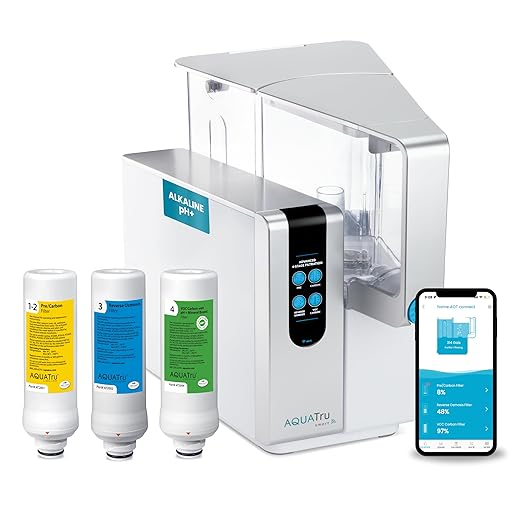
The AquaTru Classic takes the opposite design approach. Instead of connecting to your tap, you pour tap water into the upper reservoir manually. The unit processes it through 4 stages of filtration, and purified water collects in a 3-litre internal tank. You then dispense filtered water from a spigot on the front. Think of it as a gravity-fed filter’s convenience combined with RO-grade purification.
Specs at a Glance
| Specification | AquaTru Classic |
|---|---|
| Filtration stages | 4-stage (mechanical pre-filter + carbon pre-filter + RO membrane + VOC carbon block) |
| RO membrane pore size | 0.0001 microns (standard TFC) |
| Tank capacity | 3 litres purified water |
| Fill time | 15-20 minutes to fill 3L tank |
| Drain ratio (pure:waste) | ~3:1 (comparable to C1S) |
| Installation | None — pour water into reservoir, plug into power |
| Fluoride removal | 95.2% (NSF 58 tested) |
| TDS reduction | Typically 90-95% |
| Certifications | NSF/ANSI 42, 53, 58, and 401 |
| Price (AU) | $699-$799 AUD via Amazon AU |
| Dimensions | ~36 x 28 x 38 cm — wider footprint than C1S |
The Certification Advantage
This is where the AquaTru separates from almost every countertop competitor sold in Australia. It holds four independent NSF certifications: NSF/ANSI 42 (aesthetic effects including chlorine taste and odour), NSF/ANSI 53 (health effects including lead, cysts, and VOCs), NSF/ANSI 58 (reverse osmosis system performance including fluoride, TDS, and inorganic contaminants), and NSF/ANSI 401 (emerging contaminants including pharmaceuticals and pesticides).
NSF 58 is the critical one for Australian buyers. It means an independent laboratory — not AquaTru’s own internal lab — has verified that the system’s RO membrane rejects fluoride at 95.2%, lead at 97.5%, and chromium at 97.8% under standardised test conditions at specified pressures and flow rates. When you see “NSF 58 certified” on the box, you know the removal claims are not marketing estimates. They are third-party verified results.
For context, the AquaTru is one of only a handful of countertop RO units globally that holds NSF 58 at the system level. Most competitors — including the Waterdrop C1S — certify individual components or materials (like NSF 372 for lead-free compliance) but not the complete system’s contaminant rejection performance.
How It Works in Practice
You pour tap water into the upper reservoir (approximately 4L capacity), press the button, and the AquaTru pumps water through its filtration stages. Purified water collects in the lower 3-litre tank, which takes 15-20 minutes to fill completely. You dispense from a push-button spigot on the front. Waste water stays in the upper reservoir and you discard it periodically.
The tank design means you always have 3 litres of purified water ready to pour instantly. No waiting at the tap while it trickles through. But it also means you need to remember to refill the reservoir — if you drain the tank and forget to top it up, you wait another 15-20 minutes. For a household of 2-3 people drinking 4-6 litres per day, you will need to run 2 fill cycles daily. That is manageable but not set-and-forget.
Australian Purchase Experience
The AquaTru Classic is available on Amazon Australia, which means Prime shipping, 30-day returns, and Amazon’s buyer protection policies. For Australian renters who want the easiest possible returns path if something goes wrong, this is a real advantage. You also get local warranty service through Amazon AU’s established process rather than dealing with an international manufacturer’s support team directly.
Head-to-Head Comparison: Every Spec That Matters
You have two good options. The question is which one suits your kitchen, your workflow, and your budget. Here is every meaningful difference in one table.
| Criterion | Waterdrop C1S | AquaTru Classic | What It Means for You |
|---|---|---|---|
| Price (AUD) | $509-$599 | $699-$799 | C1S saves you $100-$200 upfront |
| NSF 58 Certified | No (NSF 372 only) | Yes — NSF 42/53/58/401 | AquaTru’s removal claims are third-party verified |
| Filtration Stages | 6 (incl. UV + remineralisation) | 4 | C1S adds UV disinfection and mineral reintroduction |
| Fluoride Removal | 90-97% (claimed) | 95.2% (NSF 58 tested) | Both effective; AquaTru has independent verification |
| Chloramine | Removed by RO membrane | Removed by RO membrane | Both work for Brisbane, Sydney, Gold Coast, Adelaide, Darwin |
| PFAS Removal | 90-99% (RO membrane) | 90-99% (RO membrane) | Both effective against PFOS/PFOA |
| Tank vs Tankless | Tankless (continuous flow) | 3L internal tank | C1S: unlimited but slow. AquaTru: 3L ready, then wait 15-20 min |
| Setup | Diverter valve on tap | Pour water in, plug in power | AquaTru works even if your tap has an unusual thread |
| Drain Ratio | 3:1 | ~3:1 | Comparable water waste — collect it for plants |
| Bench Footprint | ~38 x 18 cm (compact) | ~36 x 28 cm (wider) | C1S fits tighter benchtops in rental apartments |
| Returns | Waterdrop AU direct | Amazon AU 30-day returns | AquaTru has easier return logistics for AU buyers |
| Remineralisation | Yes (built-in stage) | No (optional add-on) | C1S water tastes less flat out of the box |
5-Year Cost of Ownership: C1S vs AquaTru vs Bottled Water
The sticker price is only part of the equation. Both units require replacement filters on a schedule, and that ongoing cost determines the real price per litre you pay over time. Here is the full cost breakdown assuming a 4L/day household (typical 2-person Australian household for drinking and cooking water).
| Cost Component | Waterdrop C1S | AquaTru Classic | Bottled Water (2L) |
|---|---|---|---|
| Upfront price | $549 (mid-range) | $749 (mid-range) | $0 |
| Annual filter cost | ~$120-$160 | ~$100-$140 | $0 |
| Annual water cost (4L/day) | ~$3 (mains water + waste) | ~$3 (mains water + waste) | ~$1,460 ($1/L avg) |
| 5-year total | ~$1,165-$1,365 | ~$1,265-$1,465 | ~$7,300 |
| Cost per litre | $0.16-$0.19/L | $0.17-$0.20/L | $1.00/L |
Both systems come in at roughly $0.17-$0.20 per litre over 5 years. Compare that to bottled water at $1.00/L average (Woolworths home-brand 2L bottles at $1.80-$2.00 each). Over 5 years, a household drinking 4L/day spends approximately $7,300 on bottled water. Either the C1S or AquaTru pays for itself within the first year and saves you $5,900-$6,100 over five years. That is not marketing spin — it is arithmetic.
The C1S has a slight upfront cost advantage ($549 vs $749 at mid-range pricing), but its filters are marginally more expensive per year due to the 6-stage design having more consumable elements. Over 5 years, the total cost of ownership difference narrows to approximately $100 — not a decisive gap either way.
How These Products Were Assessed
Assessed on specification, not personally tested. Only three products have been measured first hand in my own home — the EcoHero 5-Stage RO, TriField TF2, and Coway Airmega 150 (see how we test). Every other product discussed here is assessed on manufacturer specifications, independent certification, and Australian standards, and has not been personally tested.
South-east Queensland tap water, fed by SEQ Water’s chloramine-treated supply, typically sits in the 80-115 mg/L TDS range according to SEQ Water’s published data. Inlet pressure for QLD municipal supply is normally around 350 kPa.
Both units use TFC RO membranes that typically reduce TDS by 85-95%, in line with expected RO performance. AquaTru’s internal pressure pump can optimise membrane contact time, while the C1S relies on mains pressure alone.
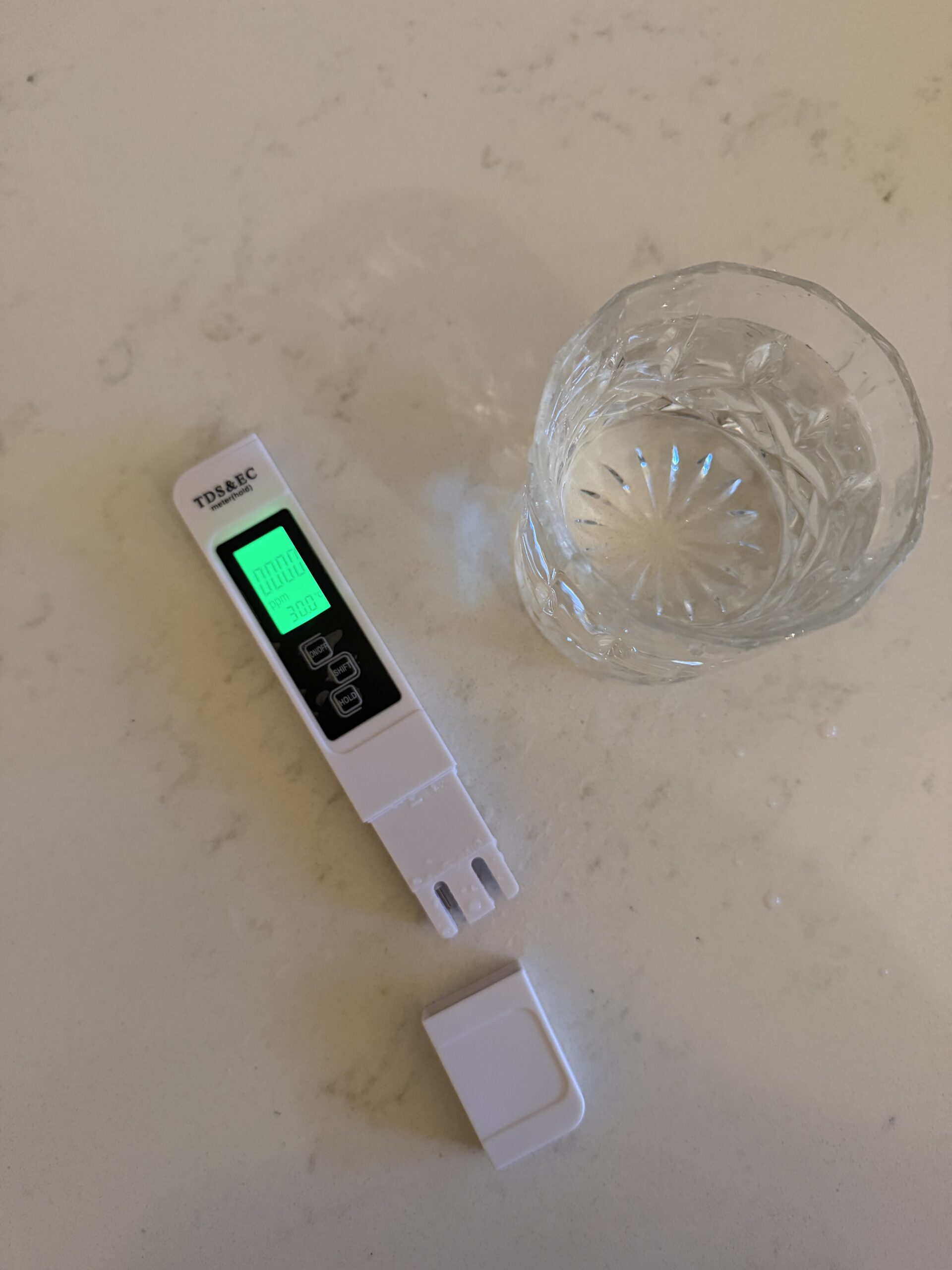
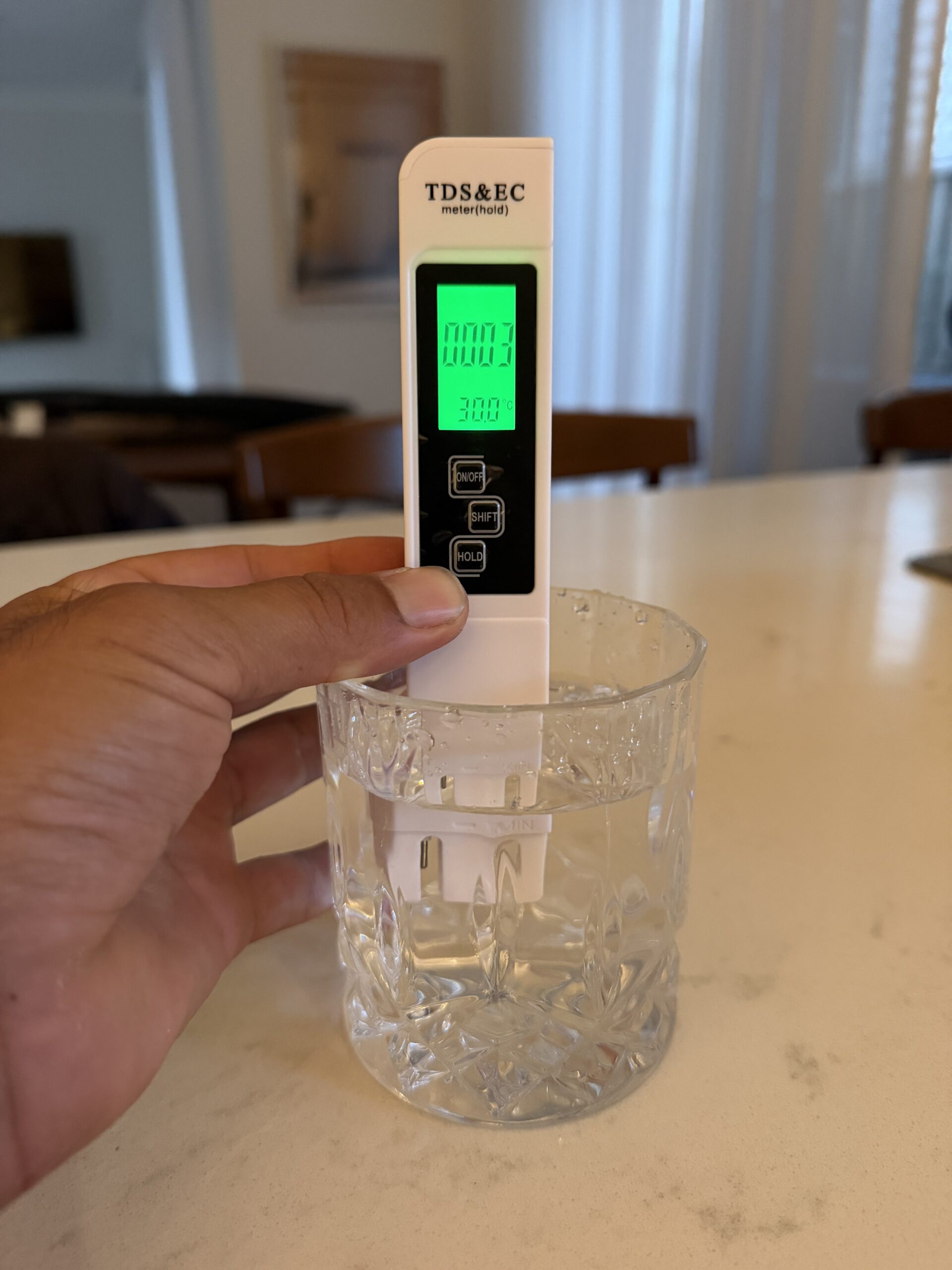
The C1S’s built-in remineralisation stage adds calcium and magnesium back, giving RO water a fuller mouthfeel, while un-mineralised RO water (such as the AquaTru’s standard output) typically tastes flat. RO removes the chlorine and chloramine taste that carbon jugs leave behind.
In terms of daily workflow, the C1S’s continuous-flow design means you never run out mid-cooking, though filling a 1.5L kettle takes several minutes at roughly 0.3 L/min. The AquaTru’s 3L tank is convenient for quick pours, but once the tank drains you refill the reservoir and wait 15-20 minutes. Neither workflow is perfect; it comes down to which trade-off you prefer.
Who Should Buy the Waterdrop C1S
You should buy the C1S if:
- Budget is your primary driver and you want to save $100-$200 upfront
- You prefer continuous on-demand flow rather than batch-filling a tank
- You want remineralised water without buying a separate add-on
- Your bench space is limited — the C1S has a narrower footprint (18 cm depth vs 28 cm)
- You are comfortable with Waterdrop’s direct-from-manufacturer support rather than Amazon returns
- You value the UV polishing stage as an extra safety layer
You should NOT buy the C1S if:
- Third-party NSF 58 system certification is non-negotiable for you
- Your kitchen tap has a non-standard thread that may not fit the diverter valve (check compatibility before ordering)
- You want instant access to 3 litres without waiting at the tap
- You plan to move frequently and want the easiest possible returns via Amazon AU
For a deeper dive into the C1S specifically, read my full Waterdrop C1S review where I cover long-term filter replacement costs and diverter valve compatibility in more detail.
Who Should Buy the AquaTru Classic
You should buy the AquaTru if:
- NSF/ANSI 58 certification matters to you — independently verified contaminant rejection at 95.2% for fluoride
- You want the security of Amazon AU’s 30-day return policy and Prime shipping
- You prefer a self-contained unit with no tap connection required — pour and go
- You want 3 litres of purified water instantly available at the press of a spigot
- You move between rentals frequently and want a unit that works with any kitchen layout
You should NOT buy the AquaTru if:
- You want the cheapest possible countertop RO option — the C1S saves $100-$200
- You drink more than 3 litres between refills and do not want to batch-process
- You want remineralised water without buying an additional filter cartridge
- Bench space is tight — the AquaTru has a wider footprint
The Third Option: EcoHero 5-Stage Portable RO
There is a third countertop RO contender worth mentioning for Australian renters, and it is the only one of the three that carries WaterMark certification to AS 3497 — the Australian standard for plumbing products. The EcoHero 5-Stage Portable RO system from Pure Water Systems retails at approximately $695 AUD and ships from within Australia.
WaterMark certification means the system has been tested and approved under Australian plumbing standards, which is a different compliance pathway from NSF (an American standard). If having an Australian-certified, Australian-brand product matters to you — particularly if you want simple domestic warranty support — the EcoHero deserves a look.
However, the EcoHero is designed more as a portable under-sink style unit with a small external tank, making its countertop setup slightly more involved than the C1S or AquaTru. It is a strong option for renters who can tuck it beside the sink rather than on the bench. For a full comparison, see our best countertop water filter guide.
Decision Tree: Which Countertop RO Is Right for You?
Three questions. That is all you need.
Question 1: Is third-party NSF 58 certification non-negotiable?
Yes → AquaTru Classic. It is the only countertop RO on this page with independent NSF 58 verification.
No → Continue to Question 2.
Question 2: Do you prefer continuous tap-connected flow or a batch-fill tank?
Continuous flow (never run out mid-cooking) → Waterdrop C1S.
Tank (3L instant pour, refill every few hours) → AquaTru Classic.
Question 3: Is Australian WaterMark certification important to you?
Yes → Consider the EcoHero 5-Stage Portable RO ($695, WaterMark AS 3497).
No → Choose between C1S (cheaper) and AquaTru (more certified) based on Questions 1 and 2.
Chloramine, Fluoride, and PFAS: How Both Units Handle Australian Water
Let me be direct about the three contaminants that drive most Australian buyers toward RO, because there is a lot of misinformation online about what different filter types actually remove.
Chloramine (Brisbane, Sydney, Adelaide, Gold Coast, Darwin)
SEQ Water (Brisbane and Gold Coast), Sydney Water, SA Water (Adelaide), the Gold Coast, and Power and Water (Darwin) all use chloramine as their primary disinfectant. Chloramine is a compound of chlorine and ammonia that persists longer in the distribution network than free chlorine, which is precisely why utilities use it — but it also means it is harder to remove.
Standard granular activated carbon (GAC) — the kind inside Brita, PUR, and most fridge filters — removes chloramine at approximately 1/40th the rate it removes free chlorine. To remove chloramine with carbon, you need catalytic carbon with extended contact time. RO membranes reject chloramine effectively because the membrane’s 0.0001-micron pores physically block the chloramine molecule. Both the C1S and AquaTru use TFC RO membranes and will strip chloramine from Brisbane, Sydney, Adelaide, Gold Coast, and Darwin water.
If you live in Melbourne, Hobart, Canberra, Townsville, Cairns, or Toowoomba, your water uses free chlorine, and standard carbon filters work fine for taste and odour. You may not need RO unless fluoride or PFAS is your concern.
Fluoride
Most Australian capital cities dose fluoride at 0.6-1.0 mg/L per state health regulations, in line with the ADWG guideline value of 1.5 mg/L maximum. Carbon filters — including catalytic carbon, carbon block, and KDF-55 — cannot remove fluoride. Only reverse osmosis (90-97% rejection) or activated alumina (80-95% adsorption) can meaningfully reduce fluoride concentrations.
The AquaTru has been independently tested to NSF 58 standards and achieves 95.2% fluoride rejection. The Waterdrop C1S claims 90-97% fluoride removal based on internal testing. Both will reduce fluoride from a typical Australian inlet of 0.8 mg/L to below 0.08 mg/L. If fluoride removal is your primary reason for buying a filter, both units deliver.
PFAS (Per- and Polyfluoroalkyl Substances)
PFAS contamination has been confirmed at 700+ sites across Australia according to the DCCEEW national register, with particularly elevated levels near defence bases at Williamtown (NSW), Oakey (QLD), Tindal (NT), and Edinburgh (SA). Even outside these hotspots, trace PFAS is increasingly detected in metropolitan water supplies.
RO membranes reject PFAS compounds at 90-99% depending on chain length (longer-chain PFOS and PFOA are rejected at higher rates than shorter-chain variants). Both the C1S and AquaTru use standard TFC RO membranes that achieve this rejection range. The AquaTru additionally holds NSF/ANSI P473 claims through its NSF 401 testing pathway, which specifically addresses PFAS.
Water Waste: The 3:1 Drain Ratio Reality
Every RO system produces waste water. The C1S and AquaTru both operate at approximately a 3:1 drain ratio, meaning for every 1 litre of purified water, 3 litres go down the drain (or into the waste reservoir). At 4L/day of drinking water, that is 12L of waste water daily — or about 4,380L per year.
In practical terms, 4,380L per year adds approximately $8-$12 to your annual water bill depending on your state’s volumetric water charges (Brisbane is currently ~$3.30/kL according to Urban Utilities). This is negligible in dollar terms.
The environmental consideration is real, though. If you care about water efficiency, collect the waste water for watering plants, mopping floors, or washing clothes — it is perfectly clean tap water with slightly elevated mineral content. In drought-prone Perth or Adelaide, this practice makes sense. I keep a 10L bucket beside my sink for exactly this purpose.
For context, under-sink RO systems with a pressure tank typically achieve 2:1 or even 1:1 ratios with permeate pumps. Countertop units cannot match this efficiency because they lack the plumbing integration to recirculate. It is the trade-off you accept for zero-install convenience.
Final Verdict: My Recommendation for Australian Renters
Both the Waterdrop C1S and AquaTru Classic will remove chloramine, fluoride, and PFAS from your Australian tap water to a level that no carbon jug, gravity filter, or fridge filter can match. The question is not whether they work — they do. The question is which workflow, certification standard, and price point fits your situation.
Choose the Waterdrop C1S ($509-$599) if you want the most affordable entry point into countertop RO, prefer continuous on-demand flow, and value the built-in remineralisation and UV stages. Accept that you are trusting Waterdrop’s internal lab data rather than independent NSF 58 verification.
Choose the AquaTru Classic ($699-$799) if you want the most comprehensively certified countertop RO system available in Australia, prefer the convenience of Amazon AU returns, and are happy with a batch-fill tank design. You pay $100-$200 more upfront for four independent NSF certifications and the easiest returns process.
Consider the EcoHero 5-Stage Portable ($695) if Australian WaterMark certification to AS 3497 matters to you, and you prefer supporting an Australian brand with domestic warranty support.
For most renters in Brisbane, Sydney, Gold Coast, Adelaide, and Darwin — where chloramine makes standard filters inadequate — the AquaTru is my top recommendation. The NSF 58 certification eliminates guesswork about contaminant rejection, and Amazon AU returns remove the purchase risk entirely. At $0.17-$0.20 per litre over 5 years versus $1.00/L for bottled water, either unit pays for itself within the first year. The worst outcome is you buy it, test it, and return it within 30 days. The more likely outcome is you stop buying bottled water permanently.
Last reviewed: June 2026 — Clean and Native
EcoHero 5-Stage RO — Full Review
I tested the EcoHero 5-Stage RO at my Palm Beach QLD home — 69 ppm in, 3 ppm out. WaterMark AS3497 certified, ships from Australia. Full teardown and performance data.
Frequently Asked Questions
Does the Waterdrop C1S remove fluoride from Australian tap water?
Yes. The C1S uses a reverse osmosis membrane that rejects fluoride at 90-97%. Australian tap water typically contains 0.6-1.0 mg/L of fluoride, and the C1S will reduce this to below 0.1 mg/L. However, unlike the AquaTru, the C1S’s fluoride rejection rate is based on internal lab data rather than independent NSF 58 testing.
Can I use the AquaTru Classic without connecting it to a tap?
Yes. The AquaTru is completely self-contained. You pour tap water into the upper reservoir manually, press the button, and purified water collects in the 3-litre internal tank. The only connection required is a standard Australian power outlet. No tap attachment, no plumbing modification, no diverter valve.
Which countertop RO filter is better for Brisbane chloramine water?
Both the Waterdrop C1S and AquaTru Classic remove chloramine effectively through their RO membranes. SEQ Water uses monochloramine at 1.5-3.0 mg/L residual. Standard carbon jugs remove chloramine at roughly 1/40th the rate of free chlorine, but RO membranes physically block it. Either unit will eliminate chloramine taste from Brisbane tap water.
How much water does a countertop RO system waste?
Both the C1S and AquaTru operate at approximately a 3:1 drain ratio — 3 litres of waste for every 1 litre of purified water. At 4L/day of drinking water, that is about 12L/day waste. This adds roughly $8-$12 per year to your water bill. Collect the waste water for plants or cleaning to minimise waste.
Is the AquaTru available on Amazon Australia with Prime shipping?
Yes. The AquaTru Classic Smart Alkaline is listed on Amazon Australia with Prime eligibility and the standard 30-day Amazon returns policy. This is a significant advantage for Australian buyers who want easy returns compared to purchasing direct from international manufacturers.
Do countertop RO filters remove PFAS from drinking water?
Yes. RO membranes reject PFAS compounds at 90-99% depending on chain length, according to peer-reviewed research published in the Journal of Membrane Science. Both the C1S and AquaTru use standard TFC RO membranes. The AquaTru additionally holds NSF/ANSI 401 certification, which covers emerging contaminants including certain PFAS compounds.
Can I install the Waterdrop C1S in a rental apartment without modifying plumbing?
Yes. The C1S connects to your existing kitchen tap via a removable diverter valve — no drilling, no permanent modification. When you move out, you remove the diverter valve and your tap returns to its original state. Check that your tap thread is compatible before ordering (most
Ready to filter your water?
The EcoHero 5-Stage RO is the top-rated under-sink filter for Australian homes — NSF 58 certified, WaterMark AS3497, removes fluoride, PFAS, lead, and chloramine.
Get the Australian Home Environment Checklist
30 checks across water, air and EMF. Most of them free. Ranked by impact.
No spam. Unsubscribe any time.

Former Royal Australian Navy Clearance Diver and TAG-E counter-terrorism operator. Founded Clean and Native to apply the same rigorous thinking to the home environment.
Full biography →