What Is TDS in Water? A Plain-English Guide for Australian Homes
5 min read
What Is TDS in Water? A Plain-English Guide for Australian Homes
TDS (Total Dissolved Solids) in water refers to the total concentration of dissolved minerals, salts, and organic compounds measured in parts per million (ppm) or milligrams per litre (mg/L). In Australian drinking water, TDS includes calcium, magnesium, sodium, chloride, sulfates, and other dissolved substances that pass through a 2-micrometer filter. The Australian Drinking Water Guidelines recommend TDS levels below 600 mg/L for good taste, though levels up to 1,200 mg/L remain safe for consumption. Higher TDS doesn’t necessarily mean unsafe water, but it can affect taste, smell, and appliance performance. Understanding your water’s TDS helps determine if filtration systems like reverse osmosis are necessary for your Australian home.
Understanding TDS: The Scientific Definition
Total Dissolved Solids represents the combined content of all inorganic and organic substances dissolved in water. These substances pass through a filter with pores of 2 micrometers or smaller. TDS includes minerals like calcium, magnesium, potassium, and sodium, as well as salts, metals, cations, and anions.
The measurement process involves evaporating a water sample at 103-105°C and weighing the remaining residue. This standardised method, outlined in AS/NZS 3550.2.4:2011, ensures consistent results across Australian laboratories.
Common dissolved solids in Australian water supplies include:
- Calcium carbonate from limestone geology
- Sodium chloride from coastal aquifers
- Magnesium sulfate from mineral deposits
- Fluoride compounds (added for dental health)
- Chloramine residuals from treatment processes
TDS Measurement Methods and Accuracy
Two primary methods measure TDS in water: gravimetric analysis and electrical conductivity (EC) measurement. Gravimetric analysis provides the most accurate results by physically measuring dried residue weight. This laboratory method follows AS/NZS 3550.2.4 standards and delivers precision within ±2 mg/L.
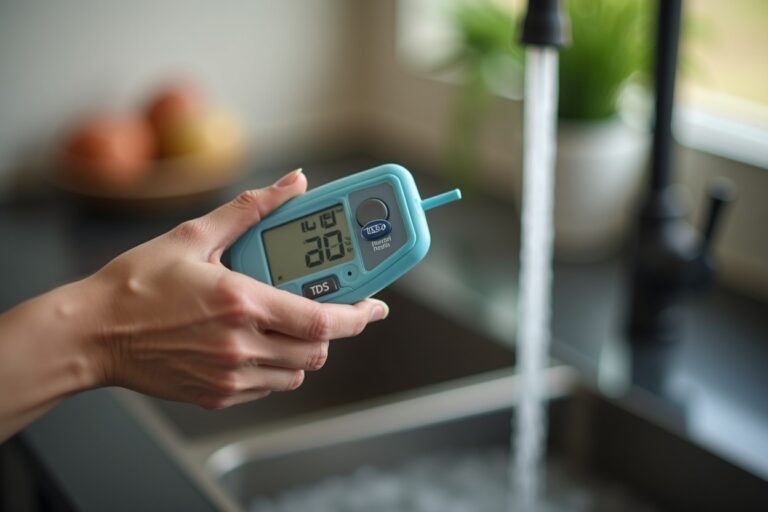
Electrical conductivity meters estimate TDS by measuring water’s ability to conduct electricity. These portable devices multiply EC readings by a conversion factor (typically 0.5-0.7) to estimate TDS. While convenient for field testing, EC meters can vary by ±10-15% compared to laboratory analysis.
Professional TDS meters used by Australian water utilities include:
- Hanna Instruments HI-9813-6 (±2% accuracy)
- Hach HQd Portable Meter (±1% of reading)
- WTW Multi 3630 IDS (±0.5% of reading)
For home testing, digital TDS pens provide reasonable accuracy for monitoring purposes, though results should be verified through accredited laboratory testing for precise measurements.
Australian Water Quality Standards for TDS
The Australian Drinking Water Guidelines establish TDS standards based on both health and aesthetic considerations. The NHMRC sets the aesthetic guideline at 600 mg/L, where taste becomes increasingly noticeable to most consumers.
Australian TDS classification system:
| TDS Range (mg/L) | Classification | Taste Characteristics |
|---|---|---|
| 0-150 | Excellent | No taste, may seem flat |
| 150-300 | Good | Slight mineral taste |
| 300-600 | Fair | Noticeable taste |
| 600-900 | Poor | Unpleasant taste |
| >900 | Unacceptable | Strong mineral/salty taste |
Regional variations across Australia reflect geological differences. Perth’s groundwater typically ranges 200-400 mg/L, while Adelaide’s Murray River supply averages 350-450 mg/L. Brisbane and Sydney maintain lower TDS levels (150-300 mg/L) through dam-sourced supplies.
Common Sources of High TDS in Australian Water
Natural geological processes contribute most dissolved solids in Australian water supplies. Coastal aquifers experience saltwater intrusion, particularly in Perth and Adelaide regions. The Murray-Darling Basin shows elevated TDS from agricultural runoff and natural salt deposits.
Primary TDS contributors include:
Geological Sources:
- Limestone dissolution adding calcium and bicarbonate
- Salt lakes and evaporite deposits
- Weathered granite releasing silica and feldspars
- Sandstone aquifers with mineral leaching
Anthropogenic Sources:
- Agricultural fertilizers (nitrates, phosphates)
- Industrial discharge (regulated under ADWG)
- Urban stormwater runoff
- Wastewater treatment plant discharges
Water treatment facilities add controlled TDS through fluoridation (0.6-1.1 mg/L) and chloramination processes. These additions comply with TGA therapeutic goods regulations and contribute minimally to overall TDS levels.
Clean Water
The right filter removes what this article describes.
Reverse osmosis is the only residential technology that reliably removes PFAS, fluoride, chloramine, and heavy metals. Our guide covers the top-rated options for Australian homes — tested, certified, and ranked.
Health Implications of TDS Levels
The relationship between TDS and health remains complex, with research showing both benefits and concerns at different concentration levels. The World Health Organization notes that very low TDS water (below 100 mg/L) may lack essential minerals and potentially increase cardiovascular disease risk.
Clinical studies demonstrate specific health correlations:
Low TDS (0-150 mg/L) Health Considerations:
- Potential electrolyte imbalance from mineral deficiency
- Increased risk of mineral leaching from body tissues
- Possible cardiovascular effects (Hungarian studies, 1980-2020)
- Reduced taste acceptability leading to lower water consumption
Moderate TDS (150-600 mg/L) Health Benefits:
- Essential mineral intake (calcium, magnesium)
- Optimal taste encouraging adequate hydration
- Cardiovascular protection from mineral content
- Bone health support through calcium availability
High TDS (>600 mg/L) Health Concerns:
- Gastrointestinal irritation from excess minerals
- Kidney stress from processing high mineral loads
- Hypertension risk from elevated sodium levels
- Dehydration from poor taste acceptance
Australian research from Griffith University (2019) found optimal health outcomes at TDS levels between 200-400 mg/L, balancing mineral intake with taste acceptability.
TDS vs Other Water Quality Indicators
TDS provides one dimension of water quality assessment but requires context from other parameters. The ADWG emphasises that TDS alone cannot determine water safety or suitability for consumption.
Comparative water quality indicators:
Electrical Conductivity (EC):
- Measures ionic activity rather than total dissolved content
- Expressed in microsiemens per centimetre (μS/cm)
- Conversion factor: TDS ≈ EC × 0.64 for most Australian waters
- More responsive to temperature variations than TDS
Turbidity:
- Measures suspended particles, not dissolved solids
- Expressed in Nephelometric Turbidity Units (NTU)
- ADWG guideline: <1 NTU for treated supplies
- High turbidity can mask TDS measurements
pH Levels:
- Measures hydrogen ion concentration
- ADWG range: 6.5-8.5 for distribution systems
- Affects mineral dissolution and TDS levels over time
- Low pH increases metal leaching from pipes
Hardness:
- Specific measure of calcium and magnesium content
- Expressed as mg/L CaCO₃ equivalent
- Contributes to TDS but represents only portion of dissolved solids
- ADWG aesthetic guideline: 200 mg/L CaCO₃
Regional TDS Variations Across Australia
Australian water supplies show significant TDS variation reflecting geological diversity and treatment approaches. Bureau of Meteorology data (2020-2023) reveals distinct regional patterns influenced by source water characteristics and treatment methods.
Major City TDS Profiles:
Sydney Water (Multiple Sources):
- Warragamba Dam: 150-220 mg/L (soft sandstone catchment)
- Prospect WTP output: 180-250 mg/L
- Distribution system: 160-280 mg/L (seasonal variation)
Melbourne Water (Protected Catchments):
- Thomson Dam: 45-85 mg/L (pristine mountain sources)
- Cardinia WTP: 90-140 mg/L
- Distribution average: 120-180 mg/L
Water Corporation WA (Groundwater Blend):
- Gnangara Mound: 200-350 mg/L
- Wanneroo WTP: 280-420 mg/L
- Perth distribution: 320-450 mg/L
SA Water (Murray River):
- Murray Bridge intake: 300-500 mg/L (seasonal)
- Happy Valley WTP: 350-480 mg/L
- Adelaide Hills: 280-380 mg/L (local groundwater blend)
Urban Utilities QLD (Dam Sources):
- Wivenhoe Dam: 120-180 mg/L
- Mt Crosby WTP: 160-220 mg/L
- Brisbane distribution: 140-260 mg/L
Rural and remote communities often experience higher TDS levels from bore water sources. The Northern Territory reports TDS ranges from 400-1,200 mg/L in groundwater supplies, requiring specific treatment approaches or alternative sources.
Testing TDS in Your Home Water Supply
Accurate TDS measurement requires proper sampling techniques and appropriate testing methods. The Australian Laboratory Services National Association (NATA) accredits laboratories following AS/NZS ISO/IEC 17025 standards for water analysis.
Professional Laboratory Testing:
- Sample collection in sterile containers (provided by lab)
- Chain of custody documentation required
- Turnaround time: 3-5 business days
- Cost range: $45-85 for basic TDS analysis
- Includes gravimetric method confirmation
Home Testing Options:
- Digital TDS pens: $15-45 (±2% accuracy when calibrated)
- Benchtop meters: $80-200 (±1% accuracy, temperature compensation)
- Test strips: $20-35 (rough indication only, ±20% variation)
Proper Sampling Procedure:
- Run cold tap for 2-3 minutes to flush system
- Fill clean container to eliminate air bubbles
- Test immediately or refrigerate below 4°C
- Calibrate meters using standard solutions (342 ppm, 1413 ppm)
- Record water temperature during measurement
Professional
Get the Australian Home Environment Checklist
30 checks across water, air and EMF. Most of them free. Ranked by impact.
No spam. Unsubscribe any time.

Former Royal Australian Navy Clearance Diver and TAG-E counter-terrorism operator. Founded Clean and Native to apply the same rigorous thinking to the home environment.
Full biography →