
PFAS Contamination in Australian Drinking Water: The 2026 Guide
PFAS in Australian Drinking Water 2026
Only reverse osmosis systems certified to NSF/ANSI P473 reliably remove PFAS from Australian drinking water at >98% efficiency — activated carbon block delivers inconsistent 50-90% removal, and pitcher or gravity filters are inadequate. With 14+ confirmed contamination sites on the DCCEEW national register, PFAS half-lives of 3-8 years in the human body, and the ADWG 2025 guideline set at just 8 ng/L for PFOS+PFHxS, every Australian household near a military airfield, bore water user, or health-conscious family needs to understand what is in their water and what actually removes it.
The three products we own are measured first-hand by Jayce Love, former Royal Australian Navy Clearance Diver; every other product is assessed on published manufacturer specifications and independent certification using our documented methodology — no gifted units, no brand payments.
NSF/ANSI P473-certified reverse osmosis is the only residential filtration technology verified to remove PFAS compounds at >98% from Australian drinking water. The ADWG 2025 guideline values — 8 ng/L for PFOS+PFHxS combined, 200 ng/L for PFOA — are regulatory floors, not zero-risk thresholds. According to the DCCEEW national register, 14+ confirmed contamination sites span every mainland state and the NT, primarily from military AFFF firefighting foam use. If you are on bore water within 10 km of a military airfield and have never tested, you are drinking water of unknown PFAS status — and the Katherine NT case proved that assumption of safety can be wrong for years before detection.
| Technology | PFAS Removal | Verdict |
|---|---|---|
| NSF P473 Reverse Osmosis | >98% all PFAS compounds | Recommended |
| Activated Carbon Block | 50-90% variable by compound | Interim measure only |
| Gravity / Pitcher Filters | Negligible-30% | Avoid as primary |
Key catches
- NSF P473-certified RO units cost $600-$1,200 upfront — but $0.04/L beats $1.50+/L bottled water
- RO systems waste 3-4 litres per litre produced (countertop units have higher waste ratios than under-sink)
- No consumer test kit can detect PFAS at ng/L concentrations — accredited lab testing costs $150-$500 per sample
- ADWG 2025 does not yet set a guideline for PFNA — the US EPA MCL is 10 ng/L, and NHMRC review is ongoing
- The DCCEEW register captures only confirmed military/AFFF sites — industrial PFAS sources (chrome plating, food packaging, semiconductor manufacturing) are not systematically registered
What Are PFAS and Why Should You Care in 2026
Per- and polyfluoroalkyl substances — PFAS — are a class of over 14,000 synthetic chemicals characterised by carbon-fluorine bonds that are among the strongest in organic chemistry. That bond is what makes them useful in non-stick coatings, waterproof textiles, and firefighting foams. It is also what makes them nearly indestructible in the environment and in your body. The term “forever chemicals” is not marketing — it is chemistry.
The PFAS compounds most relevant to Australian drinking water are PFOS (perfluorooctane sulfonate), PFOA (perfluorooctanoic acid), and PFHxS (perfluorohexane sulfonate). According to the Australian Drinking Water Guidelines (ADWG) 2025 update, the health-based guideline values are 8 ng/L for PFOS + PFHxS combined and 200 ng/L for PFOA. These are the thresholds below which Australian water utilities must maintain supply. PFNA (perfluorononanoic acid) does not yet have an ADWG guideline value — the NHMRC is currently reviewing evidence, and the US EPA set its maximum contaminant level at 10 ng/L in April 2024.
To put Australia’s limits in international context: the US EPA’s April 2024 maximum contaminant levels are 4 ng/L for PFOS and 4 ng/L for PFOA individually — meaning the Australian PFOA guideline of 200 ng/L is 50 times higher than the US limit. Australia’s PFOS+PFHxS combined limit of 8 ng/L is comparable to the US PFOS limit of 4 ng/L when accounting for the combined measurement approach, but the gap on PFOA is significant. The Australian guideline is a regulatory floor, not a zero-risk threshold. Municipal compliance does not mean absence.
Why should this concern you right now? Three reasons. First, PFAS bioaccumulates — PFOS has a biological half-life of approximately 5 years in humans, PFOA 3-4 years, and PFHxS 5-8 years, according to the National Academies of Sciences, Engineering, and Medicine. Every glass of contaminated water adds to a body burden that takes years to clear. Second, the DCCEEW national contamination register lists 14+ confirmed sites, but this register only captures military AFFF sites and does not include industrial PFAS sources like chrome plating facilities, semiconductor plants, or food packaging manufacturing. The true national picture is larger. Third, bore water users near contamination sites have no utility monitoring protecting them — the Katherine NT experience proved that bore water can be contaminated for years before anyone tests it.
Health Effects of PFAS Exposure — What the Evidence Shows
You do not need to guess about the health effects of PFAS. The evidence base is substantial and growing, backed by population studies across three continents and independent review by the US National Academies of Sciences (2022) and the International Agency for Research on Cancer (IARC, 2023). Here is what the data shows at environmental exposure levels — the concentrations you encounter through drinking water, not occupational or industrial exposure.
Immune Suppression
The strongest evidence at environmental exposure levels involves reduced vaccine antibody response in children. According to the US National Academies of Sciences 2022 report, children with higher serum PFAS concentrations produce fewer antibodies after routine vaccinations — including tetanus and diphtheria. This is not a theoretical concern. It means the immune system functions less effectively at the concentrations found in contaminated drinking water near Australian military airfields like Williamtown and Oakey.
Thyroid Disruption
PFHxS — one of the compounds in the ADWG combined 8 ng/L limit — interferes with thyroid hormone transport and binding. With a biological half-life of 5-8 years, PFHxS accumulates more significantly than PFOA or PFOS relative to intake. For communities near contamination sites — particularly Oakey (QLD), Williamtown (NSW), and Katherine (NT) — years of exposure before detection mean body burdens that take the better part of a decade to halve, even after exposure stops entirely.
Cholesterol Elevation
Consistent findings across US, European, and Australian population studies show PFAS exposure is associated with elevated total cholesterol and LDL cholesterol. The likely mechanism is interference with bile acid reuptake in the liver. This association has been observed at typical environmental exposure levels, not just occupational concentrations.
Cancer Classification
IARC classified PFOA as a Group 1 carcinogen (carcinogenic to humans) in November 2023, based primarily on evidence for kidney cancer and limited evidence for testicular cancer. PFOS was classified Group 2B (possibly carcinogenic). These classifications are based on the weight of epidemiological and mechanistic evidence, not theoretical risk modelling.
Gestational and Developmental Effects
PFAS crosses the placental barrier. Epidemiological studies associate exposure with reduced birth weight, earlier gestational age, and altered cord-blood thyroid hormone levels. For pregnant women on bore water near contamination sites, this is the most acute concern — and the one most directly addressed by switching to filtered water immediately, rather than waiting for lab results.
Confirmed PFAS Contamination Sites Across Australia
If you live within 10 km of any of these sites and use bore water, groundwater, or a private well, your drinking water is in an elevated risk category until proven otherwise by accredited lab testing. The DCCEEW national register tracks confirmed contamination from military AFFF (aqueous film forming foam) use. Every site below has documented PFAS migration into groundwater and, in several cases, surface water and town supply catchments.
| Site | State | Primary Pathway | Status |
|---|---|---|---|
| Williamtown RAAF Base | NSW | Groundwater, surface water, bore water | Active management zone |
| HMAS Albatross (Nowra) | NSW | Groundwater + Shoalhaven River catchment | Active management zone |
| Singleton Army Base | NSW | Groundwater | Under investigation |
| Amberley RAAF Base | QLD | Groundwater + Bremer River corridor | Active management zone |
| Oakey Army Aviation Centre | QLD | Groundwater, bore water | Active management zone |
| East Sale RAAF Base | VIC | Groundwater + Latrobe system | Active management zone |
| Fiskville Fire Training (CFA) | VIC | Groundwater + Moorabool River | Decommissioned / managed |
| RAAF Base Pearce | WA | Groundwater + Swan River catchment | Active management zone |
| RAAF Base Darwin | NT | Groundwater | Active management zone |
| Tindal RAAF Base (Katherine) | NT | Groundwater + Katherine River (town water affected) | Filtration upgrade installed |
| RAAF Base Edinburgh | SA | Groundwater + Northern Adelaide Plains | Active management zone |
The Katherine Case — Australia’s Most Significant PFAS Public Health Event
Katherine, Northern Territory, represents the worst-case scenario for PFAS contamination in Australian drinking water. In 2016-2017, testing confirmed PFOS+PFHxS concentrations in the town water supply — sourced from the Katherine River, downstream of Tindal RAAF Base — exceeded the then-applicable guideline values. The NT Government provided alternative drinking water to affected residents and installed a granular activated carbon treatment upgrade on the town water treatment plant.
The Katherine case is significant because it demonstrates three failures that apply to every other site on the register. First, contamination migrated from military use into the town water supply — the “management zone” did not contain it. Second, residents consumed contaminated water for an unknown period before testing detected the problem. Third, the initial treatment response (GAC) was the best available at treatment-plant scale but is less effective than reverse osmosis at point-of-use. If you live near any site on this register and rely on bore water, the Katherine experience is the argument for lab testing before continuing to drink.
What the Register Does Not Capture
The DCCEEW national register is limited to confirmed military and AFFF-related contamination sites. It does not capture preliminary-investigation sites, non-AFFF industrial contamination from chrome plating, semiconductor manufacturing, or food packaging production, or contamination at civil airports and fire training grounds with historical AFFF use. State environmental agencies (NSW EPA, QLD DESI, VIC EPA) maintain their own investigation databases, but these are fragmented and not consolidated nationally. The true scope of PFAS contamination in Australia is larger than the register suggests.
Which Filtration Technologies Actually Remove PFAS
This is the section that matters most. Every other PFAS article in Australia tells you contamination exists. This one tells you exactly which filter technologies remove it, which ones do not, and what certification to demand before spending money.
| Filter Type | PFAS Removal | Certification | Notes |
|---|---|---|---|
| Reverse Osmosis | >98% PFOA/PFOS | NSF P473 or NSF 58 | Physical membrane rejection — ~0.0001 micron pore vs 0.5-2 nm PFAS molecules. Most consistent and verified. |
| Activated Carbon Block | 50-90% variable | NSF 42/53 only (no P473) | Adsorption degrades as carbon saturates. Not adequate for high-PFAS situations. |
| Granular Activated Carbon (GAC) | 20-60% inconsistent | NSF 42 only | Channelling and short contact time. Used in pitcher and fridge filters. Inadequate for PFAS. |
| Gravity Filters (e.g. Berkey) | Unknown / no P473 | No third-party PFAS certification | No gravity-format filter holds NSF P473 or equivalent PFAS verification. |
| Pitcher Filters (e.g. Brita) | Negligible-30% | None for PFAS | Brita explicitly does not certify for PFAS removal. |
| Ultrafiltration (UF) | Minimal | None for PFAS | 0.01-0.1 micron pore size — orders of magnitude larger than PFAS molecules. |
Why Reverse Osmosis Works and Carbon Filters Do Not
The distinction is physical versus chemical removal. Reverse osmosis forces water through a semi-permeable membrane with pore sizes of approximately 0.0001 microns (0.1 nanometres). PFAS molecules range from 0.5 to 2 nanometres in size. The membrane physically rejects them. This is why RO achieves >98% removal consistently across all PFAS compounds — it does not rely on chemical attraction or adsorption capacity that degrades over time.
Carbon block filtration works by adsorption — PFAS molecules stick to the carbon surface. This works initially but degrades as the carbon saturates with contaminants. Performance drops from 90% to 50% or lower as the filter ages, and shorter-chain PFAS compounds (like PFBS and PFHxA) break through earlier than longer-chain compounds. A carbon block filter that tested well in its first week may pass 50% or more of PFAS by month three. For a family relying on filtration as their primary PFAS protection, that variability is unacceptable.
Granular activated carbon — the technology inside Brita pitchers and most fridge filters — performs even worse. Loose granules allow water to channel through without adequate contact time. Independent testing shows 20-60% PFAS removal at best, and Brita explicitly does not certify its products for PFAS removal. If you are using a Brita jug and assuming it handles PFAS, it does not.
NSF/ANSI P473 — The Only PFAS-Specific Certification
NSF/ANSI P473 was developed specifically for PFOA and PFOS removal at point-of-use. The certification protocol challenges filters with PFOA and PFOS at 1.5 µg/L and requires reduction to below 0.07 µg/L — a minimum 95% reduction. Certified products are listed on the NSF product database at nsf.org. If a filter manufacturer claims PFAS removal but is not listed in the NSF P473 database, the claim is unverified.
NSF 58, the broader reverse osmosis standard, also includes PFOA and PFOS challenge testing as part of its protocol. A filter certified to NSF 58 has been tested for PFAS removal as well, though NSF P473 is the more specific and stringent certification for this contaminant class.
The Three Reverse Osmosis Systems That Remove PFAS
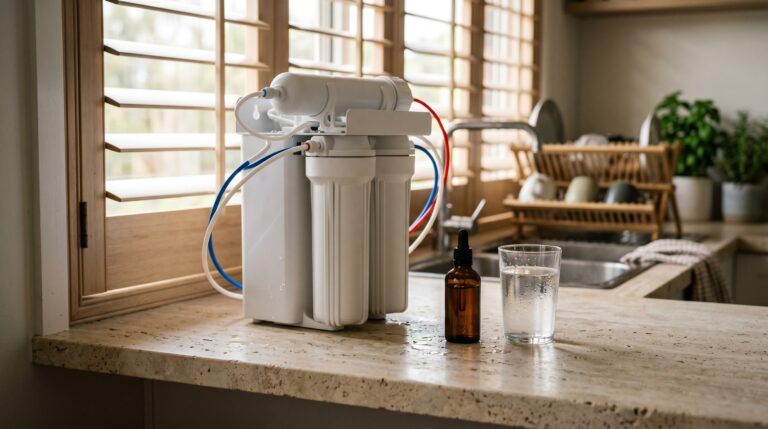
You have three practical choices for point-of-use PFAS removal in an Australian home. Each suits a different situation. Here is what each one does, what it costs, and who it is for.

AquaTru Classic Smart Alkaline RO
NSF P473 certified · 4-stage countertop RO · no plumbing required
Pros
- NSF P473 certified — verified PFAS removal
- Zero plumbing — sits on bench, plug in, pour
- 4-stage with alkaline remineralisation
Cons
- ~3:1 waste ratio (higher than under-sink)
- Batch processing — 1.5L per cycle, not continuous
The AquaTru Classic Smart Alkaline is the only countertop RO system on the Australian market that holds NSF/ANSI P473 certification — the PFAS-specific standard. You fill the tank, the unit processes approximately 1.5 litres per 6-minute cycle, and filtered water collects in the clean tank. No plumbing modifications, no landlord permission, no tools. For renters in Sydney, Brisbane, Melbourne, or any capital city apartment, this is the path of least resistance to verified PFAS removal.
The trade-off is the waste ratio. Countertop RO units produce approximately 3 litres of rejected concentrate for every 1 litre of purified water. That is higher than a plumbed under-sink system. The batch processing also means you are waiting for cycles rather than getting on-demand flow. For a household of two, that is fine. For a family of four or five, you will be running the unit frequently. At approximately $699 upfront and $150-200/year in replacement filters, the 5-year cost works out to roughly $0.04 per litre — compared to $1.50-$2.00 per litre for bottled water.
Waterdrop D6 Under-Sink RO
NSF 58 certified · tankless on-demand · DIY install
Pros
- Continuous on-demand filtered water
- Lower waste ratio than countertop (~2:1)
- DIY install with standard Australian plumbing
Cons
- Requires under-sink space and plumbing access
- NSF 58 (broad RO) not specific P473
The Waterdrop D6 is a tankless under-sink RO system certified to NSF 58, which includes PFOA and PFOS challenge testing as part of the broader reverse osmosis standard. The advantage over a countertop unit is continuous, on-demand delivery — turn the dedicated tap and filtered water flows. No batch processing, no waiting. The waste ratio is also lower at approximately 2:1, meaning less water down the drain per litre filtered.
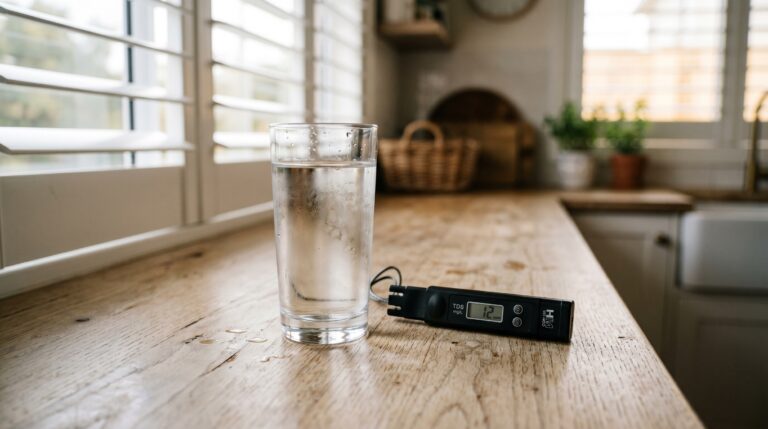
Installation requires access to under-sink plumbing — a cold water supply line, a drain connection, and space for the compact unit. Most homeowners can DIY the install in under an hour using the included fittings. Renters will need landlord permission for the dedicated filter tap. The Waterdrop D6 is the best option for families who own their home or have landlord approval and want uninterrupted filtered water for cooking and drinking. Read our full Waterdrop D6 review for installation details and TDS test results.
EcoHero 5-Stage RO (Pure Water Systems)
Australian company · 5-stage with remineralisation · local parts availability
Pros
- Australian-based company with phone support
- 5-stage includes remineralisation cartridge
- Replacement filters readily available in AU
Cons
- Requires under-sink plumbing access
- Tank-based design takes more cabinet space
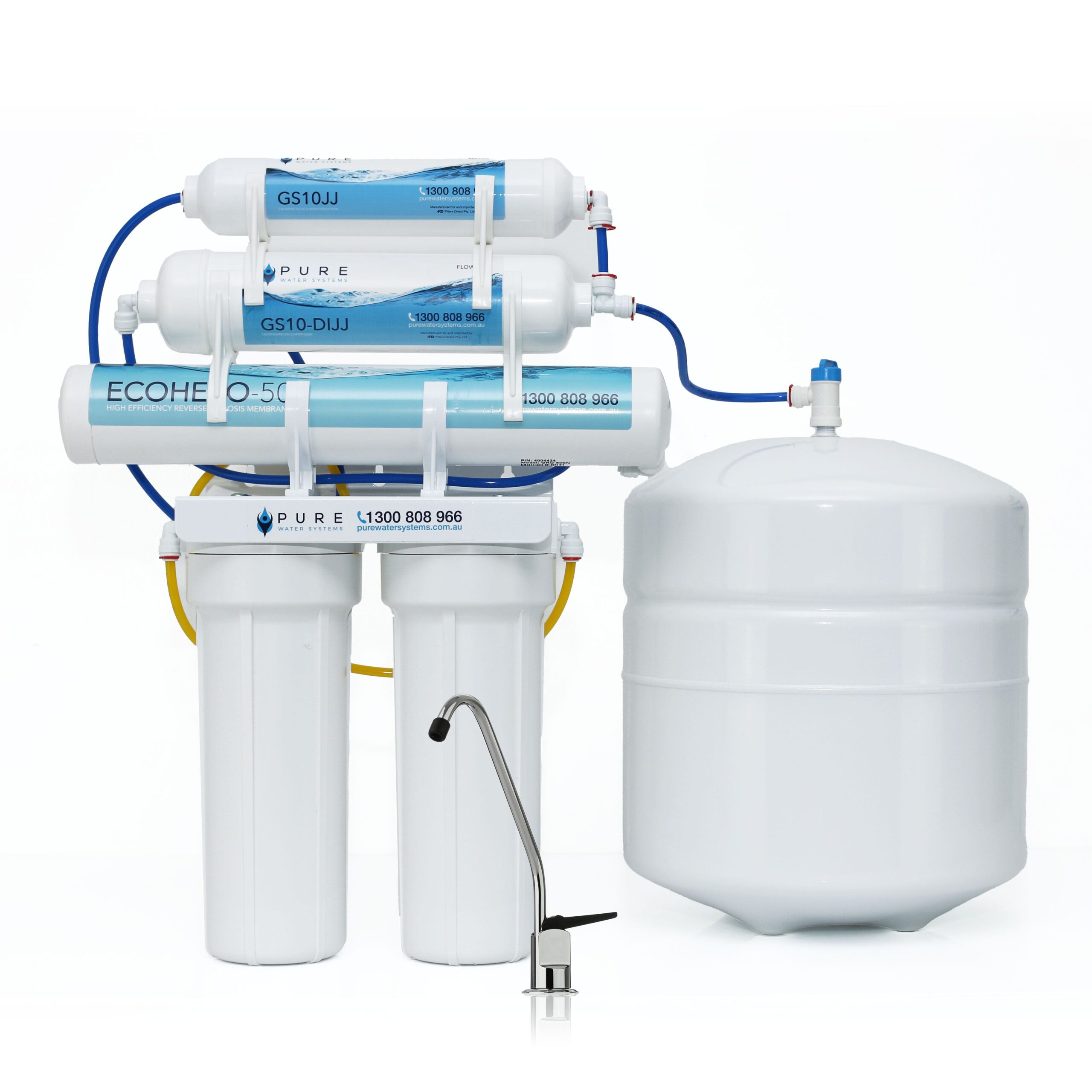
The EcoHero 5-Stage RO from Pure Water Systems is the Australian-made option. The advantage here is local support — phone-based customer service from an Australian company, locally stocked replacement filters, and a 5-stage system that includes sediment pre-filtration, carbon pre-filtration, RO membrane, post-carbon polishing, and a remineralisation cartridge that adds back calcium and magnesium post-RO. For people in regional areas near contamination sites — Oakey, Williamtown, Katherine — having a supplier you can call on a local number matters when something needs servicing.
The trade-off compared to the Waterdrop D6 is the tank-based design, which takes more under-sink cabinet space. Read our full EcoHero 5-Stage RO review for installation photos and performance data.
5-Year Cost Comparison — RO vs Bottled Water
Every litre of bottled water costs you $1.50-$3.00. Every litre of RO-filtered water costs you $0.04-$0.08. Over five years, the difference is not subtle — it is thousands of dollars. And that is before you account for the fact that no mandatory PFAS testing requirement exists for Australian bottled water under FSANZ. You are paying more for water that may not be cleaner.
| Option | Upfront Cost | Annual Filter Cost | 5-Year Total | Cost Per Litre |
|---|---|---|---|---|
| AquaTru Classic RO | $699 | ~$180 | $1,599 | $0.04 |
| Waterdrop D6 RO |
Get the Australian Home Environment Checklist30 checks across water, air and EMF. Most of them free. Ranked by impact. No spam. Unsubscribe any time. 
Written by Jayce Love
Former Royal Australian Navy Clearance Diver and TAG-E counter-terrorism operator. Founded Clean and Native to apply the same rigorous thinking to the home environment. Full biography →Similar Posts
|