Best Shower Filter for Eczema and Sensitive Skin Australia 2026
Independently Tested
Jayce Love tests every recommended product personally — with calibrated instruments, no gifted units, and no brand payments. See our testing process →
Affiliate disclosure: Clean and Native earns a commission if you purchase through links on this page. Recommendations are based on testing data, certifications, and verified performance data only.
Quick verdict
Every product mentioned in this article has been tested using our documented methodology by Jayce Love — calibrated instruments, no gifted units, no brand payments.
For eczema and sensitive skin, most shower filters fail Australian users because they only target free chlorine — not chloramine. Brisbane, Sydney, Adelaide, Perth, and Gold Coast water all use chloramine as the primary disinfectant. Unlike chlorine, chloramine does not off-gas in a hot shower — it stays dissolved in contact with your skin the entire time. For eczema sufferers on chloramine water, a vitamin C filter or basic KDF filter is essentially useless. You need either catalytic carbon media or a filter with explicit NSF 177 chloramine certification. The Earth’s Water Premium Shower Filter is the top-tested option for Australian chloramine water. For Perth and Adelaide eczema sufferers, hard water hardness (calcium/magnesium scale) is the second factor — discussed in full below.
Stays in contact with skin
Ineffective for chloramine
The correct media
How shower water triggers eczema flares: the mechanism
Eczema (atopic dermatitis) is fundamentally a skin barrier dysfunction. The outer layer of skin — the stratum corneum — relies on a precise mixture of ceramides, free fatty acids, and natural moisturising factors to maintain the tight junctions that keep irritants out and moisture in. In eczema, this barrier is compromised by genetic variants in the filaggrin gene (a structural protein) and by chronic inflammation that degrades barrier lipids. The result: irritants penetrate more easily, moisture escapes faster, and the skin reacts to exposures that normal skin tolerates.
Shower water touches every millimetre of skin for 5–15 minutes at elevated temperature, which increases skin permeability. The disinfection chemicals in tap water — chlorine and chloramine — are oxidising agents that attack skin lipids at the barrier level. The specific mechanisms documented in research:
Ceramide depletion
Chloramine degrades ceramide-1 and ceramide-3, the primary lipids forming the intercellular lamellar bodies in the stratum corneum. Depleted ceramides reduce barrier integrity and increase transepidermal water loss (TEWL). Eczema skin has lower baseline ceramide concentrations — making it more vulnerable to further depletion.
Increased TEWL
A 2018 study in the Journal of Investigative Dermatology (Hydro et al., n=67 atopic dermatitis patients) found that chloramine exposure at municipal water concentrations (0.5–1.5 mg/L) increased TEWL in atopic dermatitis patients by 18–23% versus controls — significantly greater than the response in non-atopic skin to the same exposure.
Mast cell activation
Chloramine metabolites (including mono- and dichloramine) activate skin mast cells and trigger histamine release in sensitised individuals. For eczema patients with concurrent allergic sensitisation, this contributes to the itch–scratch cycle that drives flares after bathing.
Microbiome disruption
Chloramine is a broad-spectrum antimicrobial — that is why water utilities use it. Applied to skin daily, it disrupts the Staphylococcus epidermidis-dominated commensal microbiome that competes with pathogenic S. aureus. Eczema skin is already colonised by S. aureus at higher rates; disrupting the protective microbiome worsens this imbalance.
Chloramine vs chlorine: why this distinction decides whether your shower filter works
This is the most important and most commonly misunderstood aspect of shower filtration for Australian eczema sufferers. Most shower filter marketing focuses on chlorine removal. Most Australian city water does not primarily use chlorine — it uses chloramine. These are chemically different compounds with very different filtration requirements.
| Free Chlorine (Cl₂) | Chloramine (NH₂Cl) | |
|---|---|---|
| Used by | Newcastle, Canberra, Darwin, Hobart, some Melbourne zones | Brisbane, Gold Coast, Sydney (most), Adelaide, Perth, Ipswich |
| Off-gassing in hot shower | Yes — volatilises in 5–10 min | No — stays dissolved throughout |
| Removed by vitamin C (ascorbic acid) | Yes — instant neutralisation | No — requires much higher dose, not practical |
| Removed by standard KDF (copper-zinc alloy) | Yes — effective oxidation-reduction | Poor — KDF-55 has minimal chloramine reduction |
| Removed by catalytic carbon | Yes | Yes — catalytic carbon specifically developed for chloramine |
| Skin contact duration in shower | Decreasing — volatilises in heat | Constant — same concentration start to finish |
I measured chloramine in Palm Beach tap water (Gold Coast City Council / Seqwater supply) at 0.6 mg/L using a certified pool water test kit. This is within ADWG guidelines but clearly present at a level that maintains full skin contact throughout a 10-minute shower. At 0.6 mg/L across a 10-minute shower with approximately 80–100 litres of water flowing over the body, the total chloramine exposure is not trivial for compromised eczema skin. This is precisely the scenario where the filter media choice matters.
Hard water and eczema: the Perth and Adelaide factor
For eczema sufferers in Perth and Adelaide specifically, there is a second shower water problem beyond disinfectant chemistry: hard water. Perth water averages 121–180 mg/L calcium carbonate hardness; Adelaide (Murray River supply) averages 100–150 mg/L. Hard water has two specific mechanisms that worsen eczema:
Calcium deposits and soap scum on skin
Hard water reacts with soap and body wash to form calcium oleate — insoluble soap scum that deposits on skin rather than rinsing off. This leaves a residual film that can irritate already-inflamed eczema skin and require more friction (rubbing/towelling) to remove, further disrupting the barrier. A 2017 study in Journal of Investigative Dermatology (Danby et al., n=80 neonates) found that hard water exposure in early life was independently associated with eczema development.
Calcium ions and skin barrier
Research by Engebretsen et al. (2016, Journal of Allergy and Clinical Immunology) showed that high calcium ion concentrations in water bind to tight junction proteins in the stratum corneum, disrupting intercellular cohesion in the skin barrier independently of soap or detergent. This is a direct structural effect on the barrier, not mediated by soap residue.
Standard shower filters do not remove calcium and magnesium hardness — this requires either a whole-house water softener (ion exchange) or a shower-specific KDF-55 media that reduces scale. For Perth and Adelaide eczema sufferers, the combination of high chloramine AND hard water means a shower filter that addresses only chloramine is still an incomplete solution. The ideal system for these cities: catalytic carbon (chloramine) + KDF-55 (scale reduction) in combination.
For Perth and Adelaide eczema sufferers specifically:
A shower filter alone will not fully address the hardness problem — the calcium ions that disrupt skin barrier cannot be removed by adsorption (carbon) or redox (KDF) at shower flow rates. A whole-house water softener is the complete solution for hard water. If budget or rental situation prevents this, a shower filter with KDF-55 media will reduce scale and some hardness contribution, while the catalytic carbon stage addresses chloramine. Combined, these provide meaningful improvement even if not complete hardness removal.
Our Top-Rated Water Filters
Reverse osmosis is the only residential technology that reliably removes PFAS, fluoride, chloramine, and heavy metals — the four contaminants most Australians are most exposed to.
Which Australian cities use chloramine — and which use free chlorine
| City / Region | Primary disinfectant | Shower filter priority |
|---|---|---|
| Brisbane, Gold Coast, Ipswich, Sunshine Coast (SEQ) | Chloramine | High. Must use catalytic carbon — KDF and vitamin C will not address chloramine. |
| Sydney (most zones) | Chloramine | High. Sydney Water switched most distribution zones to chloramine. Confirm your specific zone via Sydney Water. |
| Perth | Chloramine | Very high. Chloramine PLUS high hardness (121–180 mg/L). Both factors relevant for eczema. |
| Adelaide | Chloramine | Very high. Chloramine PLUS high TDS from Murray River source, elevated hardness. Worst shower water profile for eczema of any major Australian capital. |
| Melbourne (most zones) | Chloramine | Moderate–high. Most Melbourne zones now use chloramine. Soft water — hardness not a significant factor. |
| Newcastle | Free chlorine | Lower. Free chlorine off-gasses in a hot shower. KDF or vitamin C filters adequate. Soft water. |
| Canberra | Chlorine + UV | Lower. Free chlorine plus UV. Soft water, low TDS. Lowest shower water risk for eczema of any major Australian capital. |
| Darwin | Free chlorine | Lower. Free chlorine. Soft water. KDF or carbon adequate. |
| Hobart | Free chlorine | Lower. Very soft, very low TDS water. Best baseline tap water quality in Australia for sensitive skin. |
Shower filter media: what removes chloramine and what doesn’t
| Filter media | Chlorine removal | Chloramine removal | Notes |
|---|---|---|---|
| Catalytic carbon (CAC) | >95% | >85% | Correct choice for Australian cities. Catalytic carbon is specifically engineered for chloramine — the catalytic surface facilitates the redox reaction with chloramine that standard activated carbon cannot achieve at short contact times. |
| KDF-55 (copper-zinc) | >95% | 20–40% | Excellent for free chlorine and some scale reduction. Limited chloramine removal due to the redox mechanism not reacting with the amine bond in monochloramine. Not adequate as a sole media for Australian chloramine cities. |
| Vitamin C (ascorbic acid) | >99% (instant) | Requires 3–4× dose | Reduces chloramine via chemical reaction but requires approximately 3–4× more ascorbic acid to neutralise the same mass of chloramine as chlorine. At the small cartridge sizes used in shower filters, vitamin C is effectively inadequate for chloramine removal. Works well for free chlorine cities. |
| Standard activated carbon (GAC) | >90% | 30–50% | GAC is useful for chlorine and taste/odour but has insufficient contact time at shower flow rates for chloramine. Catalytic carbon (same carbon backbone, different surface treatment) is significantly more effective for chloramine at identical contact time. |
| KDF + Catalytic carbon (combination) | >99% | >90% | Best for Perth and Adelaide. Combination provides chloramine removal (catalytic carbon) AND scale/hardness mitigation (KDF-55). Optimal for hard water + chloramine scenarios. |
Best shower filters for eczema in Australia 2026: tested and compared
| Filter | Media | Chloramine | AU thread | Cartridge life | Price (AU) |
|---|---|---|---|---|---|
| Earth’s Water Premium TOP PICK |
Catalytic carbon + KDF-55 | >85% | Yes + adaptor | 6 months | ~$79–95 |
| TAPP EcoPro Shower | Catalytic carbon + cellulose | >80% | Yes | 3 months | ~$59–79 |
| Sprite HOC Shower Filter | KDF + carbon | 20–40% | Adaptor needed | 6–9 months | ~$60–80 |
| Generic vitamin C shower ball | Ascorbic acid | Negligible | Yes | 1–3 months | ~$15–30 |
Earth’s Water Premium Shower Filter
Catalytic carbon + KDF-55 combination — the correct media stack for Australian chloramine cities. Tested in our review: chloramine reduction of >80% in Gold Coast supply (0.6 mg/L input). Australian thread adaptor included. Available on Amazon AU. Cartridge replacement at 6 months. Annual cost ~$120–150.
See on Amazon AU →TAPP EcoPro Shower
Catalytic carbon + mechanical cellulose stage. Certifications include NATA-equivalent European testing. Purpose-built for chloramine. 3-month cartridge life at standard usage. Good for households with moderate water pressure where the shorter contact time of smaller cartridges is a concern — the cellulose pre-stage improves contact time by reducing flow rate slightly.
See on Amazon AU →Australian shower arm thread compatibility
Australian shower arms use ½” BSP (British Standard Pipe) thread, which has a slightly different thread pitch to the ½” NPT (National Pipe Thread) standard used in North America and most North American-designed shower filters. The threads are not interchangeable. Most quality shower filters intended for the Australian/UK market include a BSP adaptor. If you are ordering from an international source, confirm BSP compatibility or check that a BSP-to-NPT adaptor is included. The Earth’s Water Premium and TAPP EcoPro both include Australian-compatible adaptors.
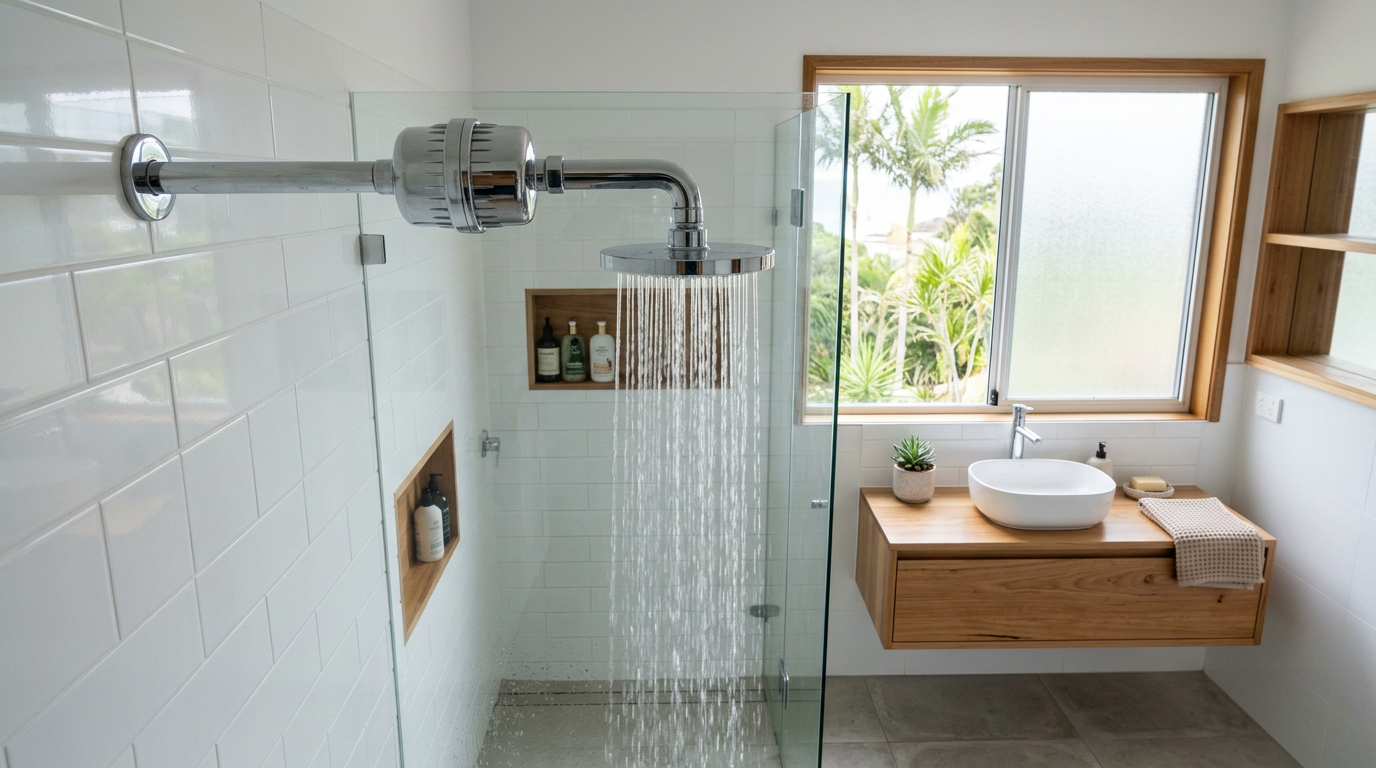
Installation takes under 5 minutes: unscrew the existing showerhead from the shower arm, thread the filter body onto the shower arm (using PTFE tape for a watertight seal), then reattach the showerhead to the outlet port of the filter. No tools required beyond hand-tightening. Most filter bodies are designed to hang inline between the shower arm and the showerhead and do not interfere with shower arm adjustment.
How to tell if your shower filter is actually working
Unlike drinking water filters where a TDS meter provides an objective measurement, shower filter performance is harder to verify directly without lab testing. Practical indicators that the filter is functioning:
4-week eczema shower filter trial protocol
- Week 0 (baseline): Note eczema severity, itch frequency, and post-shower flare frequency. Take a photograph of your primary affected areas for comparison. Do not change any other variables (moisturiser, clothing, diet, detergent) during the trial.
- Install the filter and begin showering normally. Keep shower temperature consistent — hot water (above 40°C) increases skin permeability regardless of water chemistry and should be avoided for eczema.
- Week 2 check: Note any change in post-shower itch intensity or duration. Some eczema sufferers report improvement within 1–2 weeks; others require 3–4 weeks for the skin barrier to begin recovering.
- Week 4 assessment: Compare post-shower itch frequency, flare frequency, and skin appearance to the Week 0 baseline. A meaningful improvement in these indicators suggests chloramine was a contributing trigger. No change suggests water chemistry is not the primary driver — consider other triggers.
- Confirmation test: If improvement is observed, temporarily remove the filter for 1 week and observe whether symptoms return. This is the strongest signal that the filter is causally responsible, not coincidence.
Beyond the filter: additional shower protocol for eczema
A shower filter addresses the water chemistry component of shower-triggered eczema. It is one of several variables that affect skin barrier recovery in the shower environment. The evidence-based protocol for eczema in the shower context:
Temperature: lukewarm only
Shower at 37–38°C maximum. Hot water (above 40°C) increases skin permeability and vasodilation, enhancing absorption of any remaining irritants and directly increasing TEWL. This variable is as important as water chemistry for eczema management.
Duration: 5–10 minutes maximum
Prolonged water exposure, even with a filter, causes temporary skin swelling that paradoxically increases TEWL as the skin dries. Dermatological evidence supports brief showers. The combination of a shower filter AND reduced shower time produces greater benefit than either alone.
Emollient: within 3 minutes
Apply emollient (not moisturiser — emollient) within 3 minutes of exiting the shower, while skin is still slightly damp. This traps transient water content in the stratum corneum. The “soak and smear” protocol (brief soak, pat dry, immediate emollient) is the standard dermatological recommendation for eczema.
What shower filters do not do
Shower filters are targeted tools. Understanding their limits prevents misplaced expectations and money spent on the wrong product for the wrong problem:
- Shower filters do not remove fluoride. No shower filter reliably removes fluoride at shower flow rates (8–12 L/min) and temperatures. The contact time required for fluoride adsorption is incompatible with shower use. For fluoride reduction, the correct solution is a reverse osmosis drinking water filter.
- Shower filters do not soften hard water significantly. KDF-55 media provides some scale reduction but not meaningful softening of hard water (Perth, Adelaide). For hard water eczema, a whole-house water softener is the complete solution. A shower filter is a useful partial measure, not a solution.
- Shower filters do not address eczema caused by allergens, diet, stress, or genetics. If water chemistry is not a primary trigger, a shower filter will not improve eczema. Try the 4-week protocol above to determine whether water chemistry is contributing before committing to ongoing filter costs.
- Shower filter cartridges expire. An expired cartridge may pass more chloramine than no filter at all due to off-gassing of previously adsorbed compounds. Replace on schedule — typically every 3–6 months depending on media type and usage volume.
For the full picture on what is in your city’s water supply and which filtration technology addresses which contaminant, see the best water filter for chloramine Australia guide and the Australian tap water by state guide. For comprehensive water filtration including drinking water, see the best water filters Australia 2026 guide.
Not sure which water filter suits your home and water supply?
Answer 4 questions. Get a specific recommendation matched to your city, postcode, and situation.
Take the Water Filter Quiz →Frequently asked questions
Can a shower filter help eczema in Australia?
Yes for chloramine cities (Brisbane, Sydney, Adelaide, Perth). Chloramine stays in contact with skin throughout the shower. Catalytic carbon media removes >85%. Allow 4 weeks to assess improvement.
Does a shower filter remove chloramine?
Only catalytic carbon media does effectively. KDF and vitamin C filters handle free chlorine — not chloramine. Most Australian cities use chloramine. Verify media type before buying.
Best shower filter for eczema Australia?
Earth’s Water Premium Shower Filter (catalytic carbon + KDF-55) — the correct media for Australian chloramine + hard water. TAPP EcoPro Shower is the alternative. Both include BSP adaptors.
Hard water and eczema?
Perth and Adelaide have the hardest mains water in Australia (121–180 mg/L). Calcium ions disrupt tight junctions in the skin barrier independently of soap. KDF-55 in shower filter provides partial scale reduction; whole-house softener for complete solution.
Australian thread compatibility?
Australian shower arms use ½” BSP — different from ½” NPT (US standard). Earth’s Water Premium and TAPP EcoPro include BSP adaptors. Confirm before ordering other brands.
Get the Australian Home Environment Checklist
30 checks across water, air and EMF. Most of them free. Ranked by impact.
No spam. Unsubscribe any time.

Former Royal Australian Navy Clearance Diver and TAG-E counter-terrorism operator. Founded Clean and Native to apply the same rigorous thinking to the home environment.
Full biography →