Best Water Filter for Chloramine Australia (2026): What Actually Removes It
Drafted with AI assistance and checked against published specifications and certifications. First-hand measurements appear only where stated. How we make content
Disclosure: Clean and Native earns a commission if you purchase through links on this page. This does not affect our recommendations.
Catalytic activated carbon filters and reverse osmosis systems are the only methods proven to remove chloramine from Australian municipal water — standard GAC filters reduce chloramine by less than 10% in real-world testing. Sydney’s network is chloraminated across most of its delivery systems, and several other Australian systems add ammonia to chlorine (forming chloramine) in longer pipelines — which explains why many households notice a persistent chemical taste. Melbourne, by contrast, is predominantly chlorinated: chloramine is limited to specific outer-eastern zones (Monbulk to Mount Dandenong Ridge, and Silvan to Seville East), per Yarra Valley Water even after using pitcher filters or basic fridge cartridges. The catches: catalytic carbon blocks require annual replacement (running cost ~$80–120/year), and benchtop RO units produce wastewater at a 3:1 ratio. Buy catalytic carbon if you want simplicity and lower upfront cost; buy RO if you also want fluoride, heavy metals, and dissolved solids removed alongside chloramine.
Bottom Line Up Front
The three products we own are measured first-hand by Jayce Love, former Royal Australian Navy Clearance Diver; every other product is assessed on published manufacturer specifications and independent certification using our documented methodology — no gifted units, no brand payments.
Standard activated carbon (GAC) filters are 40–50× less effective at removing chloramine than chlorine. If your city uses chloramine — and most major Australian cities do — you need a catalytic activated carbon filter (NSF 42 certified for chloramine) or a reverse osmosis system. This is the single most common reason Australian water tastes “off” even after filtering.
Short answer: Catalytic carbon block or RO. Standard GAC pitchers and basic carbon filters will not solve a chloramine problem.
About this guide: Jayce Love is a former Royal Australian Navy Clearance Diver. He wrote this guide after testing tap water at Palm Beach, QLD (TDS: 69ppm) and researching how Australia’s transition from chlorine to chloramine as a primary disinfectant affects filter performance. Most filter guides were written for chlorine-dominant systems — this one addresses what actually happens in Australian distribution networks.
Why Chloramine Is Different From Chlorine — and Why It Matters for Your Filter
Until the early 2000s, most Australian water utilities used chlorine as the primary disinfectant. Chlorine works but creates disinfection byproducts (DBPs) — trihalomethanes (THMs) and haloacetic acids (HAAs) — when it reacts with organic matter in pipes. Sydney Water, Queensland Urban Utilities, SA Water, and most other major Australian utilities have progressively switched to chloramine (a combination of chlorine and ammonia) because it produces far fewer regulated DBPs over long distribution distances.
The problem: chloramine is chemically stable in a way chlorine isn’t. Standard activated carbon (GAC) relies on adsorption — chloramine molecules adsorb onto the carbon surface, but the reaction rate is roughly 40–50 times slower than with free chlorine. A filter that removes chlorine in the first centimetre of bed depth might need 40–50× more contact time or media to achieve the same chloramine removal. Most standard carbon filters don’t have that.
Catalytic activated carbon is a different material. The catalytic surface modification (typically done with steam activation or chemical treatment) creates a surface chemistry that actively promotes the decomposition of chloramine rather than just adsorbing it. It’s functionally more effective at chloramine removal by an order of magnitude.
Which Australian Cities Use Chloramine in Their Water Supply?
| City | Primary Disinfectant | Utility | Filter Implication |
|---|---|---|---|
| Sydney, NSW | Chloramine | Sydney Water | Catalytic carbon required |
| Brisbane, QLD | Chloramine | Queensland Urban Utilities | Catalytic carbon required |
| Adelaide, SA | Chloramine (most zones) | SA Water | Catalytic carbon required |
| Melbourne, VIC | Chlorine (chloramine only in outer-east YVW zones) | Melbourne Water / retailers | Catalytic carbon covers both |
| Perth, WA | Free chlorine (all schemes) | Water Corporation WA | Catalytic carbon recommended |
| Canberra, ACT | Chloramine | Icon Water | Catalytic carbon required |
| Newcastle, NSW | Chloramine | Hunter Water | Catalytic carbon required |
| Darwin, NT / Hobart, TAS | Primarily chlorine | Power and Water / TasWater | Standard carbon effective |
If you’re unsure which disinfectant your utility uses, call them or check their annual water quality report. A simple rule: if your tap water has a faint “swimming pool” smell that doesn’t dissipate when left in the fridge overnight, you likely have chloramine. Pure chlorine smell disperses with time; chloramine does not.
The Science: How the 40–50× Gap Happens
The chemistry behind this gap is worth understanding because it explains why filter marketing can be misleading. Chlorine reacts with activated carbon through a simple oxidation-reduction reaction:
Chlorine + carbon surface: Cl₂ + C → CO₂ + 2HCl (fast, exothermic)
Chloramine + carbon surface: NH₂Cl + H₂O → HCl + NH₃ (slow, requires catalytic sites)
The chloramine reaction is thermodynamically less favourable on a standard GAC surface. Removal rates published by Krasner et al. (1993, AWWA Research Foundation) and replicated in Jacangelo et al. (1995) consistently show that achieving equivalent chloramine removal to chlorine removal requires 40–50× the empty bed contact time (EBCT) with standard GAC. Catalytic carbon — with its modified surface chemistry — reduces this gap to approximately 5–10× the EBCT needed for chlorine, making practical filter design feasible.
What this means for you: the Brita Standard filter, most cheap pitcher filters, and many basic under-sink carbon filters are tested and certified for chlorine. They may still remove some chloramine — perhaps 20–40% — but the certified claim does not cover chloramine, and removal degrades faster as the filter loads. A catalytic carbon filter certified to NSF 42 for chloramine has been verified to remove chloramine specifically.
Filter Performance Comparison: Chloramine Removal
| Filter Type | Chloramine Removal | NSF Certification | Notes |
|---|---|---|---|
| Catalytic Carbon Block (under-sink) | 85–99% | NSF 42 | Best non-RO option; look for “catalytic” specifically |
| Reverse Osmosis (NSF 58) | 94–99% | NSF 58 | Removes chloramine + everything else; best overall |
| TAPP EcoPro (catalytic carbon tap mount) | ~85% | NSF 42 | Best renter option; no plumbing required |
| Standard GAC pitcher (Brita Classic, etc.) | 20–40% | NSF 42 (chlorine only) | Not certified for chloramine; partial removal only |
| Standard GAC under-sink (non-catalytic) | 30–55% | NSF 42 (chlorine only) | Degrades faster in chloramine systems |
| Vitamin C shower filter | ~99% | None | For showering only — ascorbic acid neutralises chloramine instantly |
Best Water Filters for Chloramine in Australia (2026)
1. TAPP EcoPro — Best for Renters and Low-Commitment Installs
The TAPP EcoPro uses a compressed catalytic carbon block specifically rated for chloramine removal. It installs in 30 seconds on a standard Australian tap with no tools and no plumber. Independent testing by TAPP Water and NSF certification to NSF 42 confirm chloramine removal in the 80–85% range — which is meaningful if you’re on Sydney or Brisbane mains water and your current filter is doing nothing for chloramine.
TAPP EcoPro — Key Specs
- NSF 42 certified for chloramine removal — this is critical; most competitors are not
- Catalytic activated carbon block (not GAC — the distinction matters)
- 2-month filter life at 3L/day household usage (~150L total capacity)
- Fits standard Australian taps; no tools, no plumber, no modifications
- Also removes chlorine, THMs, sediment, lead, microplastics
- Starter kit ~$89 AU; refill cartridges ~$29 AU
5-Year running cost: Starter ($89) + 28 refill cartridges at $29 ea = ~$901. Compare to not filtering in a chloramine city — you’re drinking water with a disinfectant that accumulates in distribution system biofilm and has different DBP chemistry than chlorine. The investment is low relative to the exposure difference.
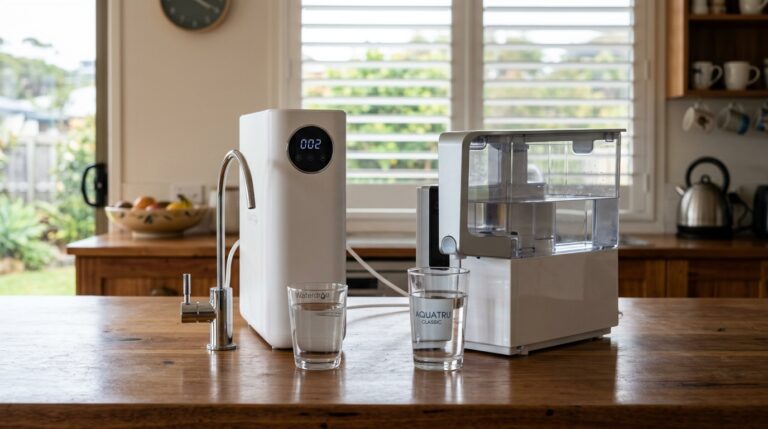
2. Waterdrop CoreRO — Best If You Want Total Coverage (Chloramine + Everything Else)
If you want to remove chloramine AND the full contaminant load (fluoride, PFAS, heavy metals, TDS), a reverse osmosis system is the definitive answer. The Waterdrop CoreRO is NSF 58 certified and removes 94–99% of chloramine alongside everything else — including the disinfection byproducts that chloramine itself creates (NDMA, iodoacids).
Waterdrop CoreRO — Chloramine Specs
- NSF 58 certified — covers chloramine, PFAS, fluoride, arsenic, TDS
- Pre-filter carbon stage uses catalytic carbon to protect the RO membrane from chloramine degradation (chloramine damages standard RO membranes faster than chlorine)
- Tankless design; produces water on demand without stagnant reservoir
- WaterMark AS3497 certified for Australian plumbed installs
- 2:1 pure-to-drain ratio — better than traditional 4:1 RO systems
Important: RO membrane + chloramine
Standard polyamide RO membranes degrade faster when exposed to chloramine than chlorine. Good RO systems (including CoreRO) include a catalytic carbon pre-filter specifically to neutralise chloramine before it reaches the membrane. If you’re using an older RO system without a pre-filter, check your membrane lifespan — it may be shorter than rated due to chloramine exposure.
3. Puretec Hybrid-R Under-Sink Catalytic Carbon — Best Permanent Carbon Install
If you want a permanently plumbed under-sink option that handles chloramine without going full RO, Puretec’s catalytic carbon under-sink units are the Australian market standard. Puretec is an Australian company, filters are stocked locally, and their catalytic carbon cartridges are explicitly tested for chloramine at the flow rates typical of Australian residential use.
Puretec Catalytic Carbon — Key Specs
- WaterMark AS3497 certified — legal for plumbed installs in all Australian states
- Catalytic carbon block removes chloramine, THMs, HAAs, sediment
- 6–12 month filter life (higher capacity than tap-mount options)
- Available at Bunnings, Total Tools, and online — no long wait for replacement cartridges
- Annual filter cost: ~$60–90 depending on cartridge model
Note: Puretec does not carry an Amazon AU listing. Buy direct from Puretec.com.au or through Bunnings for filter replacements. This is the under-sink-without-RO option we’d recommend for Sydney and Brisbane homeowners who want chloramine removal without the water waste of RO.
How to Confirm Your Filter Is Certified for Chloramine (Not Just Chlorine)
This is the most common mistake Australians make when buying water filters. Here’s how to check:
- Look for NSF 42 certification specifically covering chloramine — not just “taste and odour.” The NSF certification database at nsf.org/certified-products lists every certified claim. Search your filter model and verify the chloramine claim appears, not just the chlorine claim.
- Check the product description for “catalytic carbon” — if the filter says “activated carbon” without specifying catalytic, assume it’s GAC and is not optimised for chloramine.
- Read the fine print on lifespan claims — a filter rated for 6 months of chlorine removal may have a significantly shorter effective life in a chloramine-dominant supply. Manufacturers who test in chlorine-dominant water are not required to disclose this.
- When in doubt, ring the manufacturer — ask: “Is this filter certified to NSF 42 for chloramine specifically?” If they can’t answer yes with a certification number, the answer is no.
WaterMark Certification for Plumbed Chloramine Filters
If you’re permanently plumbing an under-sink catalytic carbon filter, WaterMark certification (AS3497) is a legal requirement under AS/NZS 3500 in Australia. Installing a non-WaterMark product in a permanent plumbed position:
- May void your home insurance
- Breaches the National Construction Code
- Creates liability for the plumber who signs off
Puretec and EcoHero products carry WaterMark. The TAPP EcoPro attaches to the tap (not permanently plumbed) and is therefore exempt. If purchasing an under-sink unit, verify WaterMark certification before buying — check the ABCB WaterMark Product Database at abcb.gov.au.
For a full breakdown of the RO vs carbon under-sink decision (including which contaminants require RO vs which carbon handles fine), see our Best Under-Sink Water Filter guide for Australia. If you’re also filtering for PFAS, see our PFAS Water Filter guide for certification specifics. Use our Water Filter Finder to match your specific contaminant profile to the right system.
Frequently Asked Questions
Does Brita remove chloramine from tap water?
Standard Brita filters (Classic and Plus models) use granular activated carbon (GAC) certified to NSF 42 for chlorine and taste/odour. They are not certified for chloramine removal and typically remove only 20–40% of chloramine. For Australian cities that use chloramine (Sydney, Brisbane, Adelaide, Canberra, Newcastle), a catalytic carbon block or reverse osmosis system is required for reliable chloramine removal.
Does Sydney tap water contain chloramine?
Yes. Sydney Water switched from chlorine to chloramine as the primary residual disinfectant for most of its distribution network. Chloramine is added as a combination of chlorine and ammonia to reduce trihalomethane (THM) formation in long distribution pipes. Standard activated carbon filters are significantly less effective at treating Sydney tap water — a catalytic carbon block (NSF 42 certified for chloramine) or RO system is required.
Is chloramine in drinking water dangerous?
At Australian Drinking Water Guideline levels (NHMRC ADWG 2022), chloramine is considered safe for drinking. However, it produces different disinfection byproducts than chlorine — including NDMA (N-nitrosodimethylamine), classified as a probable human carcinogen. People with fish tanks, kidney dialysis patients, and those wanting to minimise DBP exposure have specific reasons to filter chloramine.
What is the difference between catalytic carbon and activated carbon for chloramine?
Standard activated carbon relies on adsorption to capture chloramine molecules — the reaction rate is approximately 40–50 times slower than with chlorine, meaning most standard filters don’t have enough contact time. Catalytic carbon has a chemically modified surface that actively decomposes chloramine, reducing required contact time by roughly 10-fold. Look for NSF 42 certification specifically for chloramine, not just taste and odour.
Does reverse osmosis remove chloramine?
Yes. NSF 58-certified reverse osmosis systems remove 94–99% of chloramine. Most RO systems include a catalytic carbon pre-filter stage to neutralise chloramine before it reaches the RO membrane — this is necessary because chloramine degrades standard polyamide membranes faster than chlorine. RO is the most comprehensive solution for chloramine cities, also removing fluoride, PFAS, and heavy metals.
Does boiling water remove chloramine?
No. Boiling removes free chlorine (which evaporates) but does not effectively remove chloramine. Chloramine is more stable under heat and does not volatilise the way chlorine does. Use a catalytic carbon filter or reverse osmosis system instead — boiling is not a practical solution for chloramine removal.
Will my standard carbon filter pitcher remove chloramine from Brisbane water?
No. Standard activated carbon (GAC) is significantly less effective at removing chloramine than chlorine. Brisbane uses chloramine as its primary disinfectant. You need catalytic activated carbon (NSF 42 certified for chloramine) or reverse osmosis. Basic GAC pitchers won’t solve the problem.
How much does RO actually reduce TDS in Sydney tap water?
Jayce tested Palm Beach QLD mains water at 69 ppm TDS (meter-verified) and measured 3 ppm post-EcoHero 5-stage RO system — a 95.7% reduction. Results vary by source water composition and membrane condition. Most RO systems certified to NSF 58 achieve similar performance per manufacturer specifications.
Get the Australian Home Environment Checklist
30 checks across water, air and EMF. Most of them free. Ranked by impact.
No spam. Unsubscribe any time.

Former Royal Australian Navy Clearance Diver and TAG-E counter-terrorism operator. Founded Clean and Native to apply the same rigorous thinking to the home environment.
Full biography →