Best Water Filter for Arsenic Australia 2026: Bore Water and High-Risk Zones
Drafted with AI assistance and checked against published specifications and certifications. First-hand measurements appear only where stated. How we make content
Affiliate disclosure: Clean and Native earns a commission if you purchase through links on this page. Recommendations are based on testing data, certifications, and verified performance data only.
Quick verdict
The three products we own are measured first-hand by Jayce Love, former Royal Australian Navy Clearance Diver; every other product is assessed on published manufacturer specifications and independent certification using our documented methodology — no gifted units, no brand payments.
Arsenic in Australian water is not a metropolitan tap water concern — all major city utilities consistently test below the ADWG limit of 0.01 mg/L. It is a specific, serious concern for bore water users in the Yilgarn Craton (WA), Northern Territory, Eyre Peninsula (SA), and parts of western Queensland, where geological arsenic leaches into aquifers at concentrations that can exceed safe limits by 2–10 times. If you are on bore water in these regions: test first with a NATA-accredited lab, then filter. Reverse osmosis is the correct technology — achieving >95% arsenic removal and simultaneously handling fluoride, PFAS, lead, nitrates, and hardness in a single system. Standard carbon block filters do not remove arsenic.
Australian guideline
NSF 58 certified
Does not work
Before you filter
Is arsenic in your tap water? The Australian context
The short answer for metropolitan Australians: no. All major city water utilities — Sydney Water, Melbourne Water, Seqwater (Brisbane/SEQ), Water Corporation (Perth), SA Water (Adelaide), ActewAGL (Canberra) — are required under the Australian Drinking Water Guidelines (ADWG) to monitor and maintain arsenic below 0.01 mg/L (10 µg/L). Annual water quality reports from every metropolitan utility consistently show arsenic well below this threshold, typically at or near the detection limit of 0.001 mg/L. For capital city households, arsenic in tap water is not a meaningful filtration concern.
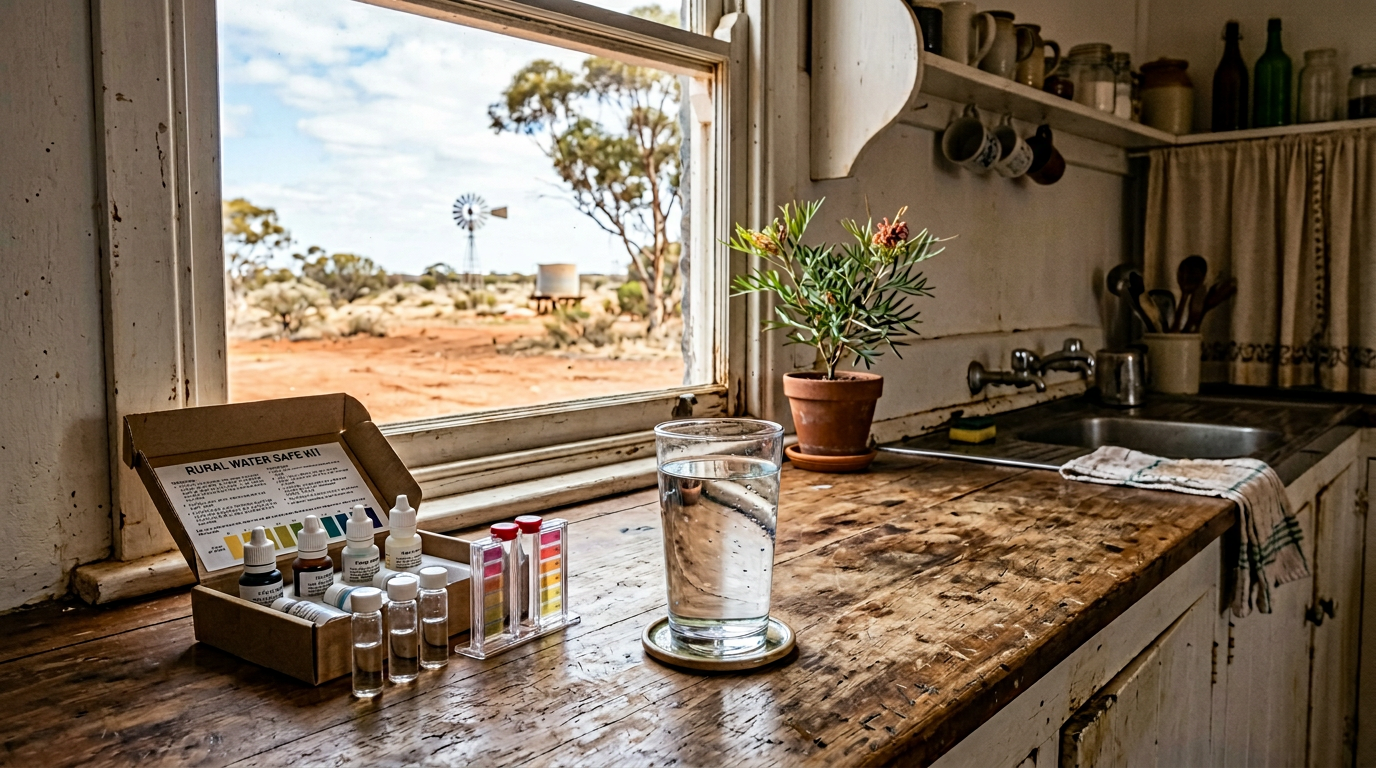
The answer is different for bore water and groundwater users. Approximately 1.5–2 million Australians rely on bore water as their primary drinking supply, primarily in rural and remote Western Australia, the Northern Territory, South Australia, and Queensland. In these areas, arsenic is a genuine water quality risk — not because of industrial pollution, but because of geology. Australia’s ancient Precambrian rock formations contain arsenic-bearing sulphide minerals (arsenopyrite, realgar, orpiment) that oxidise and dissolve into groundwater as the water table fluctuates. The Yilgarn Craton in WA is one of the world’s most extensive arsenic-bearing geological formations. Mine-affected regions present an additional risk layer from tailings and acid rock drainage.
Arsenic hot spots in Australia: where the risk is real
| Region | Risk source | Typical arsenic range | Who is affected |
|---|---|---|---|
| Yilgarn Craton, WA | Geological (arsenic-bearing Precambrian rock) | 0.01–0.5 mg/L | Pastoral station operators, farming properties, remote communities relying on bore water in the Goldfields and Wheatbelt regions. |
| Katherine region, NT | Geological + historical mining | Elevated in bore water | Properties relying on the Tindall Limestone Aquifer. Note: Katherine’s reticulated town supply is treated and monitored; bore water users are the risk population. |
| Eyre Peninsula, SA | Geological groundwater | 0.005–0.05 mg/L | Properties using local bore water rather than SA Water reticulated supply. Particularly relevant for properties outside the Port Lincoln scheme. |
| Western Queensland | Great Artesian Basin geology | Variable, spot detections above guideline | Pastoral properties on Great Artesian Basin bore water in western QLD, particularly older bores with untreated water. Channel Country and outback regions. |
| Mining-adjacent WA/QLD/NSW | Mine tailings, acid rock drainage | Highly variable, can be very high | Properties within 5–10km of historic gold, copper, or base metal mines — particularly operations pre-1990 where tailings containment was minimal. |
| Metropolitan / Capital Cities | N/A — treated reticulated supply | <0.001 mg/L (monitored) | Not a concern. All metropolitan utilities consistently test below detection limit. Filtration for arsenic is unnecessary for mains-connected households. |
Understanding arsenic chemistry: why speciation matters for filtration
Not all arsenic filters are equal — and the reason is chemistry. Arsenic exists in water in two primary oxidation states, and they behave differently across filtration technologies:
Arsenic V (Arsenate — As(V))
The oxidised form. Predominates in oxygenated surface water and shallow bores. Negatively charged — adheres effectively to RO membranes, activated alumina, and ion exchange media. All certified RO systems and activated alumina filters are rated against As(V).
Easier to remove with standard certified filters.
Arsenic III (Arsenite — As(III))
The reduced form. Predominates in deep anaerobic bore water, old aquifers, and reducing groundwater environments. Uncharged — passes through some filter media more readily than As(V). Requires pre-oxidation (chlorination or aeration) to convert to As(V) before filtration, OR a system specifically rated for both species.
Requires testing and may need pre-treatment before filtration.
If your bore water has elevated arsenic, a NATA-accredited lab report will specify total arsenic and ideally arsenic speciation (As(III) vs As(V)). This matters when selecting a filter system. Reverse osmosis membranes address both species effectively at >95% — making RO the safest choice where speciation is unknown. Activated alumina and most ion exchange resins are optimised for As(V); properties with anaerobic deep bores should either pre-oxidise or use RO.
How to test your water for arsenic in Australia
Before investing in filtration, confirm whether arsenic is actually present and at what level. The ADWG guideline of 0.01 mg/L (10 µg/L) is the threshold that triggers action. Here is how to test:
Testing protocol for bore water arsenic
- Use a NATA-accredited laboratory. NATA (National Association of Testing Authorities) accreditation ensures the lab meets ISO 17025 testing standards. Find a NATA-accredited lab at nata.com.au. Cost: AU$50–120 for a basic arsenic test. For a full heavy metals panel (arsenic, lead, mercury, cadmium, chromium): AU$150–250.
- Collect a first-flush sample. Run the tap for 2 minutes to clear standing water from the pipes before collecting. Use the lab’s supplied sample bottle (acid-washed polyethylene). Do not use a glass jar.
- Request arsenic speciation if your bore is deep (>50m) or old. Speciation (As(III) vs As(V)) costs an additional AU$30–50 but is critical for filter selection in anaerobic bore environments.
- Test annually if levels were previously detected near the guideline. Arsenic concentrations in bore water can fluctuate seasonally and with water table changes.
- Mine-adjacent properties: request a full EPA metals panel. Historic mining operations may have contributed arsenic, lead, cadmium, zinc, and other heavy metals to local groundwater. A basic arsenic test alone is insufficient.
Filter technologies: what removes arsenic and what doesn’t
| Technology | As(V) removal | As(III) removal | Australian availability & notes |
|---|---|---|---|
| Reverse osmosis (NSF 58) | >95% | >90% | Recommended. Best overall — addresses both As(III) and As(V) and simultaneously removes fluoride, PFAS, lead, nitrates, heavy metals, and hardness. EcoHero (WaterMark certified), AquaTru (NSF P473), Waterdrop CoreRO all suitable. |
| Activated alumina (AA) | >90% | 40–60% | Effective for As(V) and fluoride. Poor against As(III) without pre-oxidation. Available as standalone point-of-entry systems for whole-house bore water treatment. pH-sensitive — perform best at pH 5.5–6.0; less effective above pH 7. |
| Iron-based media (e.g. KDF) | 70–90% | Variable | GFH (granular ferric hydroxide) and iron oxide media effectively adsorb As(V). Performance varies significantly by water matrix (iron, phosphate, silica compete). Used in whole-house pre-treatment systems for high-arsenic bore water. |
| Ion exchange (IX) | >90% | <20% | Strong anion exchange resins are effective for As(V). Highly selective for As(III). Most practical for treated water with known As(V) speciation. |
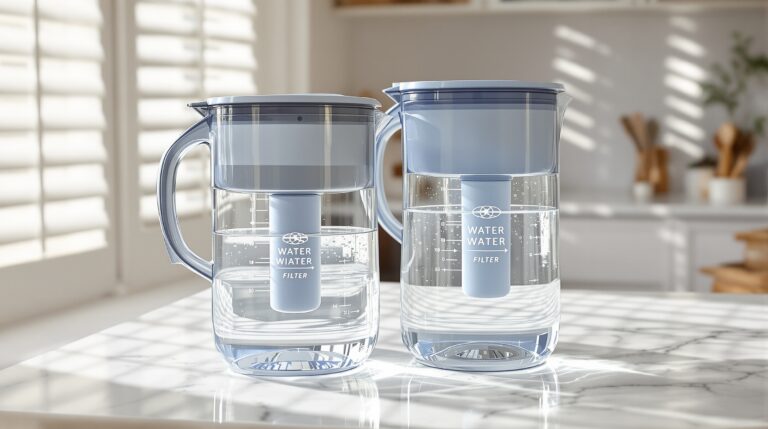
| Standard carbon (GAC or block) | <5% | <5% | Does not remove arsenic. Carbon adsorption is ineffective for dissolved ionic arsenic regardless of contact time or carbon type. Do not rely on a carbon-only system (Brita, pitcher filters, basic tap-mount filters) for arsenic. |
| Ceramic / gravity filters | None | None | Ceramic removes bacteria and sediment by physical exclusion. It does not remove dissolved ionic arsenic — including Berkey and Doulton ceramic-element gravity filters unless they contain a specific ion exchange stage. |
| Distillation | >99% | >99% | Highly effective but slow (typically 4L/hour), energy-intensive (~700W), and expensive to run. Not practical for most households. RO is the preferred alternative — faster, less energy, and nearly as effective. |
Recommended systems for arsenic removal in Australia
The correct system depends on whether you are dealing with mains water (precautionary only), bore water with moderate arsenic, or high-arsenic bore water requiring whole-house treatment. Here are the specific recommendations for each scenario.
EcoHero 5-Stage RO
Best for: permanent under-sink installation
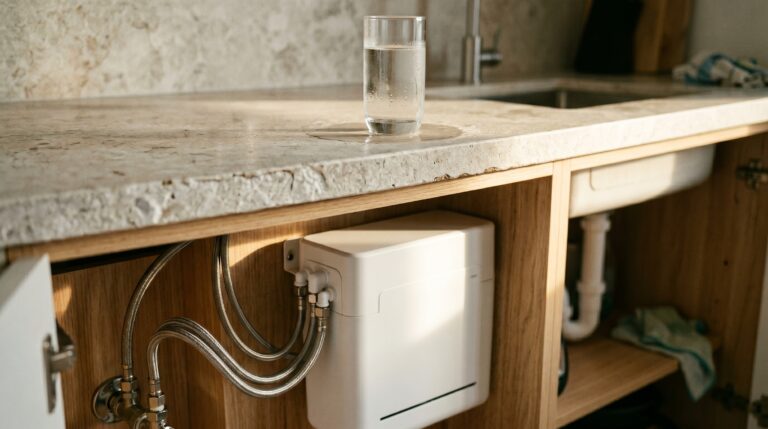
WaterMark AS3497 + NSF 58 certified. Arsenic >95% removal as part of full dissolved contaminant reduction: fluoride 93–96%, PFAS >98%, lead >99%, nitrates >85%. 50% water recovery membrane. Licensed plumber installation arranged by Pure Water Systems. Palm Beach QLD tested: 69 ppm tap TDS → 3 ppm post-RO.
See EcoHero 5-Stage RO → EcoHero 5-Stage ROAquaTru Countertop RO
Best for: renters, no-drill, rural properties
NSF 42, 53, 58, 401, and P473 certified — 5 standards, the highest NSF certification breadth of any countertop system. Arsenic removal at NSF 53 levels. No plumbing or bench drilling. Benchtop reservoir system: pour water in, filter on-demand. Ideal for remote properties, renters, or as a point-of-use solution while a whole-house system is installed. Requires 110V step-down converter for AU power (~AU$30).
Full AquaTru Review →High-arsenic bore water: whole-house treatment considerations
For properties where bore water arsenic exceeds the ADWG guideline and the bore is the primary water source for the entire household — including cooking, bathing, stock watering — a point-of-use RO filter at the kitchen tap is insufficient. Arsenic is absorbed through skin during bathing in prolonged exposure (particularly As(III)), and cooking and washing vegetables in high-arsenic water contributes to total body burden. High-arsenic bore water warrants a point-of-entry (whole-house) treatment approach:
Bore water arsenic decision framework
| Arsenic level | Recommended action |
|---|---|
| <0.005 mg/L (<50% of guideline) | Below half the guideline. Precautionary point-of-use RO at the drinking tap is reasonable but not urgent. Re-test annually. |
| 0.005–0.01 mg/L (50–100% of guideline) | At or approaching guideline. Install point-of-use RO at the drinking/cooking tap immediately. Avoid using untreated bore water for infant formula or concentrated cooking. Test every 6 months. |
| 0.01–0.05 mg/L (1–5× guideline) | Above guideline. Point-of-use RO at minimum. Consider whole-house treatment if bathing and cooking exposure is a concern. Consult a NATA-accredited water treatment specialist. |
| >0.05 mg/L (>5× guideline) | Significantly above guideline. Do not use untreated bore water for drinking, cooking, or frequent bathing. Install whole-house treatment (granular ferric hydroxide + RO) or engage a commercial water treatment provider. Consider an alternative supply for immediate use. |
For properties where whole-house bore water treatment is required, consult a specialist water treatment company with NATA laboratory analysis of your full water chemistry — arsenic removal efficiency depends on pH, competing ions (phosphate, silica, iron), and water temperature. A solution that works at pH 6.5 may not work at pH 8.0. This is not a scenario for a generic consumer product recommendation — it requires site-specific engineering.
Health effects of arsenic in drinking water
Arsenic is classified as a Group 1 carcinogen (IARC) — the highest certainty classification, meaning the evidence for human cancer causation is definitive. Long-term consumption of arsenic above safe levels is associated with bladder, lung, kidney, and skin cancers. The mechanism is both genotoxic (DNA damage) and epigenetic. The dose-response relationship is non-linear — there is no established safe threshold below which arsenic has zero risk, which is why the ADWG guideline of 0.01 mg/L represents a risk management target rather than a safe dose.
Australia’s ADWG limit of 0.01 mg/L is consistent with WHO guidelines. The US EPA has set the same limit; the EU is progressively tightening its standard toward 0.005 mg/L. For reference, the ADWG arsenic guideline of 0.01 mg/L represents a theoretical excess cancer risk of approximately 6 in 10,000 for 70 years of consumption — considered an acceptable risk level for drinking water guidelines. At 0.05 mg/L (5× guideline), the theoretical risk increases to approximately 1 in 200. These figures are why high-arsenic bore water warrants serious action rather than a precautionary approach.
Arsenic vs other bore water contaminants
Bore water users who test for arsenic should also test for nitrates (common in agricultural areas, serious risk for infants), fluoride (naturally occurring in some Australian groundwater at levels above the ADWG), total dissolved solids, hardness, and microbial indicators (coliforms). Arsenic is rarely the only elevated parameter in bore water that also shows arsenic — the geological and agricultural factors that create arsenic risk often co-occur with other contaminants. A full water quality test is more useful than a single-parameter arsenic test.
Reverse osmosis addresses all of these simultaneously: arsenic >95%, nitrates >85%, fluoride 93–96%, TDS >95%, and hardness >95%. For bore water users, RO is not just the best arsenic solution — it is the correct broad-spectrum treatment technology for the range of elevated parameters typically found in Australian bore water. See the full reverse osmosis filter Australia guide for system selection, WaterMark certification requirements, and cost comparisons.
Not sure which filter is right for your water supply?
Answer 4 questions. Get a specific recommendation matched to your postcode, water source, and home situation. Takes under 60 seconds.
Take the Water Filter Quiz →Frequently asked questions
Is arsenic in Australian tap water?
Not in capital cities — all major utilities test below the ADWG guideline of 0.01 mg/L. Bore water users in WA (Yilgarn Craton), NT, SA Eyre Peninsula, and parts of QLD should test before assuming safety.
Best filter for arsenic in Australia?
Reverse osmosis — >95% removal (both As(III) and As(V)). EcoHero 5-Stage RO (WaterMark, NSF 58) for permanent install. AquaTru countertop (NSF P473) for no-drill situations.
Does carbon filter remove arsenic?
No. Standard carbon block, GAC, pitcher filters, and gravity ceramic filters do not remove dissolved ionic arsenic. Only RO, activated alumina, or specific ion exchange media do.
Does Berkey remove arsenic?
Not reliably. Standard Black Berkey elements are not NSF 58 certified for arsenic. Results are inconsistent. Use a certified RO system for verified arsenic removal.
How to test for arsenic?
NATA-accredited lab, AU$50–120 for basic arsenic test. First-flush sample after 2 minutes running. Request speciation (As(III)/As(V)) for deep anaerobic bores.
Recommended RO systems for arsenic removal in Australia
Both options below use RO membranes independently tested for arsenic removal at greater than 95% efficiency. The AquaTru Classic requires no plumbing. The EcoHero 5-Stage is WaterMark certified for permanent installation.
Get the Australian Home Environment Checklist
30 checks across water, air and EMF. Most of them free. Ranked by impact.
No spam. Unsubscribe any time.

Former Royal Australian Navy Clearance Diver and TAG-E counter-terrorism operator. Founded Clean and Native to apply the same rigorous thinking to the home environment.
Full biography →