
Perth Drinking Water at Risk: What You Need to Know
Perth’s drinking water supply is under documented regulatory scrutiny, with Water Corporation confirming it has “significantly diminished” ability to monitor quality across 12 public drinking water catchments where Alcoa operates bauxite mining. A 2025 GHD engineering study commissioned for regulatory review identified mining expansion in these catchments as “high risk” to the water supply serving 2.3 million Perth residents.
I have not personally tested the VARIFY test kit or the water filters discussed here other than the EcoHero 5-Stage RO; this assessment is based on published manufacturer specifications and independent certification, not first-hand measurement. The only products I measure first-hand are the EcoHero 5-Stage RO, TriField TF2, and Coway Airmega 150.
The 12 Catchment Problem: What Water Corporation Actually Said
Perth’s drinking water catchments are not abstract geography. They are the source of supply for one of the driest capital cities on earth, and they sit directly beneath Alcoa’s Darling Range bauxite mining leases.
In March 2026, ABC News reported that Water Corporation had confirmed its ability to monitor drinking water quality in these catchments was “significantly diminished.” That is a regulatory agency — the body responsible for the safety of metropolitan scheme water — telling the public it cannot adequately do its job. Twelve public drinking water catchments are covered by Alcoa’s operational leases. Access restrictions tied to those leases prevent the routine sampling and monitoring that the Water Corporation would normally conduct.
To be clear about what “monitoring” means here: it is not just turbidity or colour. It covers sediment load, nutrient levels, pathogen indicators, and chemical contamination from operational runoff. When catchment managers cannot get to their own monitoring points, they are flying partially blind on supply quality for 2.3 million people.
Perth already has a compromised supply position. Climate-driven rainfall reductions across the Darling Range mean dams now contribute only around 10-20% of Perth’s total supply in most years, with desalination and groundwater making up the rest. But the catchment contribution still matters enormously for system resilience, and the integrity of that source water is not something you can manage from behind a locked gate.
The GHD Study: What “High Risk” Actually Means for Perth
The phrase “high risk” gets used loosely in environmental reporting. In engineering risk assessment, it has a specific meaning: the combination of probability of failure and consequence of failure places the scenario in the top tier of the risk matrix. For a study commissioned as part of the regulatory process for Alcoa’s mining expansion, that rating carries weight.

The GHD engineering study, reported by the Guardian in August 2025 and corroborated by WA Forest Alliance FOI documents, assessed the expansion of Alcoa’s bauxite mining into additional Darling Range catchment areas. The study found the expansion posed “high risk” to Perth’s drinking water supply.
What does that translate to in practice? Bauxite mining in forested catchments changes three things simultaneously. First, vegetation clearing reduces interception and evapo-transpiration, which alters runoff volumes and sediment transport. Second, earthworks and haul road construction create surface disturbance pathways for sediment and nutrients to reach waterways during rainfall events. Third, operational chemicals — lubricants, fuel, dust suppressants — introduce contamination risks that require active monitoring to detect and manage. When the body responsible for monitoring those risks cannot get consistent access to its own monitoring points, none of those pathways are being adequately tracked.
Perth’s TDS from the Water Corporation scheme averages approximately 170 mg/L, which already reflects the blend of Gnangara groundwater, desalinated seawater, and surface water sources. That figure does not tell you anything about turbidity spikes or sediment events at the catchment level — those require in-situ monitoring, which is exactly what is restricted.
The GHD study findings were not released publicly by the regulator. They emerged via FOI request. That in itself is a data point about transparency.
The $100M Guarantee: What It Does and Does Not Do
Alcoa has cited its $100 million environmental bond as evidence of accountability. That figure sounds substantial. The question worth asking is: what triggers it, who administers it, and has it ever been tested?
Environmental bonds under Western Australian mining and environmental law are typically held by the Department of Energy, Mines, Industry Regulation and Safety (DEMIRS). They are designed to cover rehabilitation costs if an operator abandons a site or fails to meet remediation obligations. They are not designed as compensation mechanisms for water supply contamination events. They do not automatically trigger on a contamination detection. They do not create a rapid-response fund for Water Corporation to deploy during an emergency.
More practically: the bond exists in a legal framework where enforcement requires the regulator to first establish a breach, then issue a direction, then pursue recovery if the direction is not complied with. In the context of a drinking water contamination event affecting a city of 2.3 million people, that timeline is measured in months or years — not hours. The Water Corporation would be managing a supply crisis while the legal machinery caught up.
None of this means Alcoa is operating unlawfully. What it means is that a financial instrument held by one government agency does not substitute for real-time monitoring access by the agency responsible for drinking water safety. The $100M bond and the monitoring access restriction are two separate issues. Resolving the first does nothing about the second.
Western Australia’s drinking water standards are aligned with the Australian Drinking Water Guidelines (ADWG), administered federally by the NHMRC. The ADWG framework relies on a preventive risk management approach — the Drinking Water Safety Plans model — which explicitly requires source water protection monitoring as the first control layer. If that first layer cannot be consistently operated due to access restrictions, the framework’s assumption of layered protection no longer holds.
What Perth Residents Can Actually Do: Independent Monitoring and Filtration
You cannot fix a regulatory access gap from your kitchen. But you can stop gambling on the assumption that what comes out of your tap is fully characterised by the monitoring that is actually occurring.
Perth metro’s scheme water uses free chlorine as its primary disinfectant, not chloramine. This is the critical chemistry fact for any Perth household choosing a water filter. Standard activated carbon filters — including Brita jugs, GAC countertop filters, and most refrigerator filters — remove free chlorine effectively, so a basic carbon filter will noticeably improve the taste and odour of Perth tap water. What a standard carbon filter does not remove is fluoride, PFAS, heavy metals, or dissolved solids — and that is where filter choice actually matters in Perth.
Removing fluoride, PFAS, and heavy metals requires reverse osmosis. Reverse osmosis is the only common technology that addresses fluoride (Perth adds fluoride at approximately 0.6-0.7 mg/L, within the ADWG guideline of 1.5 mg/L), heavy metals including lead from older plumbing, and any sediment or chemical contamination that might reach distribution from a catchment event. A 5-stage RO system with a 0.0001 micron rejection membrane will remove 90-97% of dissolved solids including PFAS compounds, which have been confirmed at multiple sites across the Kwinana industrial corridor and Rockingham areas south of Perth.
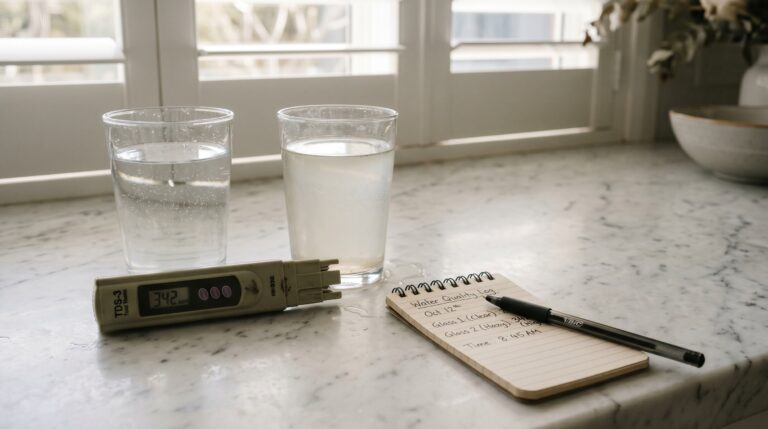
The first step is to know what is actually in your water. A 17-parameter test kit gives you a baseline for TDS, pH, chlorine, hardness, nitrates, and heavy metals at your tap. Perth tap water runs approximately 170 mg/L TDS and moderate hardness at around 180 mg/L calcium carbonate. After a catchment event or during periods of heavy rainfall and runoff, those numbers can shift. You will not know unless you test.
Independent Monitoring & Filtration for Perth Households
Choosing the Right Filter for Perth Water: The Technology Decision
Perth water is free-chlorine-treated and moderately hard at approximately 180 mg/L calcium carbonate — the hardest scheme water of any Australian capital city. That combination defines what works and what does not.
Standard GAC and Jug Filters: Fine for Taste, Limited Beyond That
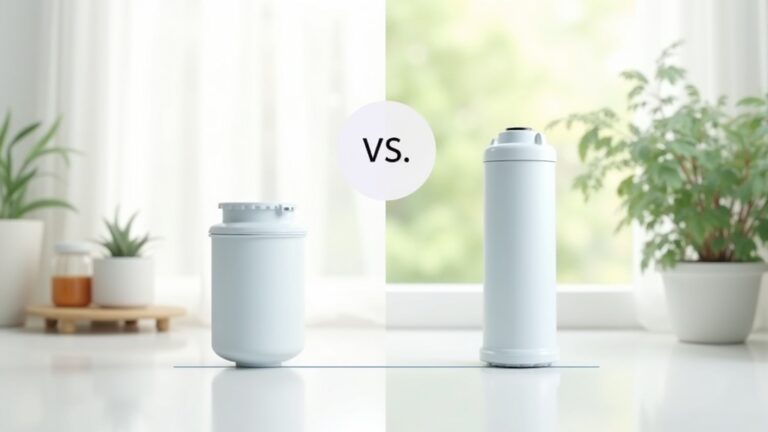
Granular activated carbon removes free chlorine through adsorption, and because Perth uses free chlorine rather than chloramine, a standard GAC or Brita-style jug filter will meaningfully improve taste and odour. What it will not do is remove fluoride, PFAS, heavy metals, or dissolved solids. In Perth, a Brita jug is a taste-and-chlorine device and little else — adequate if taste is your only concern, inadequate for the wider chemistry.
Catalytic Carbon Block: Good for Taste, Still No Fluoride or PFAS
A catalytic carbon block filter will reduce chlorine effectively and improve taste substantially. It will not remove fluoride. It will not remove PFAS. If your primary concern is chlorine taste and odour, a compressed carbon system under the sink is a reasonable solution at a lower cost than full RO. The limitation is that it addresses disinfectant chemistry and taste only — it does not provide protection against fluoride, heavy metals, or the class of dissolved organic contamination that might result from a catchment disturbance event.
Reverse Osmosis: The Complete Solution for Perth Conditions
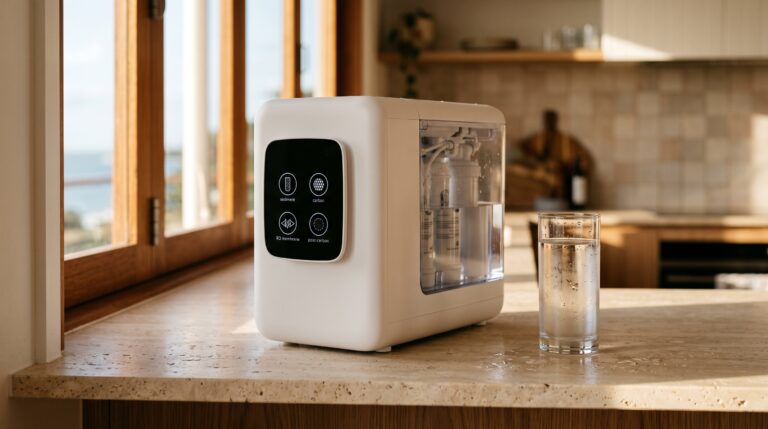
A 5-stage RO system addresses the full Perth water chemistry picture. Membrane rejection at 0.0001 microns removes: chlorine and disinfection by-products, fluoride (90-97%), PFAS compounds including PFOA and PFOS (95-99%), lead and other heavy metals, nitrates, sediment, and the vast majority of dissolved solids that drive Perth’s 170 mg/L TDS. Perth’s disinfectant is free chlorine, which is easily reduced by carbon — but a 5-stage RO with a sediment pre-filter, carbon block, and RO membrane goes well beyond taste to handle fluoride, PFAS, and heavy metals as well.
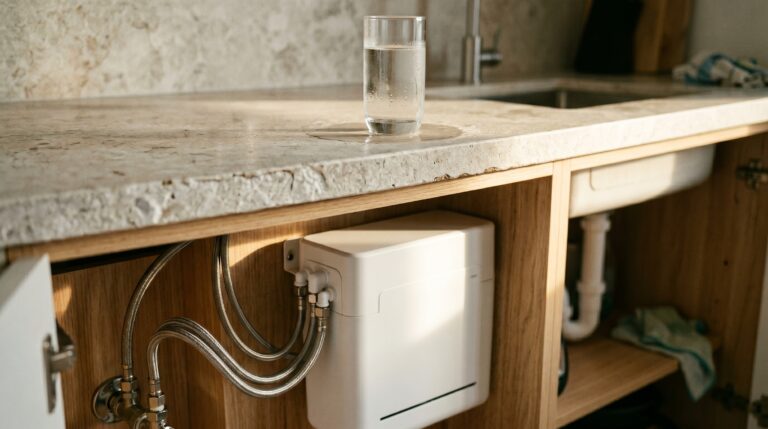
Perth’s water hardness at 180 mg/L also means scale buildup will affect membrane life. A well-designed under-sink RO system with a sediment pre-filter extends membrane service intervals significantly. The PWS EcoHero 5-Stage is WaterMark-certified to AS3497, which is the mandatory Australian standard for plumbing products — non-WaterMark systems cannot legally be connected to Perth plumbing under WA plumbing regulations.
Testing: What to Measure and When
A VARIFY 17-in-1 test kit covers TDS, pH, total chlorine, free chlorine, nitrate, nitrite, lead, iron, copper, hardness, and several other parameters — and since Perth’s supply is disinfected with free chlorine, the free and total chlorine readings are the relevant ones. It will not detect PFAS — PFAS analysis requires laboratory gas chromatography and costs approximately $150-250 per sample from certified Australian labs. For a Perth household near Kwinana, Rockingham, or Mandurah where PFAS groundwater contamination has been documented by the WA DCCEEW, a one-time laboratory PFAS test is worth the cost.
The ADWG 2022 guideline values for PFAS in drinking water are: PFOS + PFHxS combined ≤ 0.07 µg/L, PFOA ≤ 0.56 µg/L. Perth Water Corporation conducts its own PFAS monitoring at treatment plants, but that monitoring occurs upstream of household plumbing. Lead, for instance, is a post-treatment concern in homes with pre-1989 plumbing and copper pipes with lead-soldered joints.
The Regulatory Framework and Its Gaps
Australia’s drinking water safety system is built on the ADWG preventive risk management model. Under this model, Water Corporations develop Drinking Water Safety Plans (DWSPs) that identify hazards at every step from catchment to consumer, then establish control measures and monitoring to manage those hazards.
The first and most critical control tier in every DWSP is source water protection — maintaining the quality of water before it enters treatment. This is not an optional layer. It is the foundation the entire downstream treatment chain assumes is functioning. When the source water quality is well-characterised and protected, treatment plants can be sized and operated appropriately. When catchment monitoring is restricted, the treatment plant is operating without full information about what is coming through the pipe.
The WA Department of Water and Environmental Regulation (DWER) is the state body responsible for water resource management and environmental licensing. The Water Corporation sits under DWER’s framework for source water protection. Alcoa’s operations are licensed by DWER under the Environmental Protection Act 1986. When those two regulatory frameworks interact at the same piece of land — a public drinking water catchment on a mining lease — the question of which takes precedence is not always resolved cleanly.
FOI documents obtained by the WA Forest Alliance and reported by the Guardian show that the monitoring access issue is not a recent development. It reflects a long-running tension between Alcoa’s operational lease conditions and Water Corporation’s monitoring obligations under its DWSP. That tension has not been publicly resolved as of mid-2026.
For context: the ADWG framework is a guideline, not legislation. It is not directly enforceable. Individual states implement it through their own public health and water acts, which vary in how prescriptively they require DWSP compliance and catchment monitoring access. In Western Australia, the Public Health Act 2016 and the Water Services Act 2012 establish the framework, but the practical question of access to monitoring points on private mining leases has no neat resolution in either statute.
Our Verdict
There is a simple principle from high-consequence safety work: when a system tells you it cannot fully inspect something critical, you do not assume everything is fine — you apply the most conservative available measure and build independent verification into the protocol.
That is the appropriate response to Perth’s current situation. Water Corporation has said it cannot adequately monitor 12 drinking water catchments. GHD rated the risk as high. The $100M bond does not fix either of those facts. The Water Corporation still treats scheme water, and Perth’s treated water consistently meets ADWG guideline values at the treatment plant. The gaps are upstream, in the source water monitoring that should precede treatment.
For Perth households in Fremantle, Subiaco, Cottesloe, and the wider metropolitan area: your scheme water meets treatment plant discharge standards. But the monitoring gap is real, and while Perth’s free-chlorine treatment means a basic carbon filter will handle taste, cheaper filters do nothing for the fluoride, PFAS, and heavy metals that RO addresses. A VARIFY test kit costs under $30 and gives you a tap-level baseline. A WaterMark-certified 5-stage RO under the sink removes the chemistry that catalytic carbon alone cannot touch. For households in Kwinana, Rockingham, or Mandurah — areas with confirmed PFAS groundwater contamination in the industrial corridor — a laboratory PFAS test is the additional step worth taking.
The system should be providing complete oversight. It is not. Work around it.
Last reviewed: June 2026 — Clean and Native
Frequently Asked Questions
Yes. Water Corporation’s treated water meets ADWG guideline values at the point of discharge from treatment plants. The monitoring gap identified by Water Corporation is upstream — in source water catchment access — not in the treated water quality itself. The concern is what happens to oversight and risk management if a catchment contamination event occurs and monitoring access is restricted.
Perth metro uses free chlorine as its primary disinfectant, not chloramine. Standard activated carbon and GAC jug filters remove free chlorine effectively, so a basic carbon filter will improve the taste of Perth tap water. The critical point for filter selection is that carbon filters do not remove fluoride, PFAS, or heavy metals — for those you need reverse osmosis.
For taste alone, a standard carbon filter handles Perth’s free chlorine. For complete coverage, reverse osmosis is the only option that simultaneously removes fluoride, PFAS, heavy metals, and dissolved solids. For Perth households wanting that coverage, a 5-stage RO system with WaterMark AS3497 certification is the recommended choice.
A GHD engineering study, reported by the Guardian in August 2025, rated the expansion of Alcoa’s bauxite mining in the Darling Range as “high risk” to Perth’s drinking water supply. The study was not proactively released by regulators — it became public through a Freedom of Information request by the WA Forest Alliance. The study assessed impacts on 12 public drinking water catchments where Alcoa holds operational mining leases.
Water Corporation confirmed in March 2026 that its monitoring capacity across 12 drinking water catchments is “significantly diminished.” The restriction arises from Alcoa’s mining lease conditions, which limit third-party access to operational lease areas. The practical result is that Water Corporation — the body responsible for drinking water safety — cannot conduct routine catchment water quality sampling at its own monitoring points within those lease boundaries.
Water Corporation conducts PFAS testing at treatment plants and publicly reports that treated scheme water meets ADWG health guideline values for PFAS. However, residents in the Kwinana, Rockingham, and Mandurah areas face separate documented PFAS groundwater contamination from the industrial corridor, which affects those on private bore water rather than scheme supply. If you are on scheme water, Water Corporation’s treatment plant data applies. If you have a bore, independent PFAS laboratory testing (approximately $150-250 per sample from an accredited Australian lab) is recommended.
The bond is a rehabilitation instrument held by DEMIRS, designed to cover site remediation costs if Alcoa fails to meet its post-mining rehabilitation obligations. It does not function as a rapid-response fund for drinking water contamination events, does not automatically trigger on water quality detection, and does not address the monitoring access gap. A financial instrument held by one agency does not substitute for real-time monitoring access by the agency responsible for drinking water safety.
Perth scheme water averages approximately 180 mg/L calcium carbonate hardness — the hardest of any Australian capital city’s scheme supply. This affects RO membrane service life. A sediment pre-filter ahead of the RO membrane extends membrane intervals significantly. For Perth households, a 5-stage RO system with a dedicated sediment stage is preferable to a 3-stage system. High hardness also means scale buildup will shorten membrane life compared to softer-water cities like Melbourne (25 mg/L) or Sydney (60-70 mg/L).
Perth scheme water TDS averages approximately 170 mg/L, reflecting the blend of Gnangara groundwater, desalinated seawater from the Kwinana and Southern Seawater desalination plants, and surface water from Darling Range catchments. This is moderate by Australian standards — higher than Melbourne (~60 mg/L) but lower than Adelaide (~400 mg/L). A TDS meter gives you the real-time reading at your specific tap. A VARIFY 17-in-1 kit covers TDS alongside 16 other parameters for a full baseline picture.
Get the Australian Home Environment Checklist
30 checks across water, air and EMF. Most of them free. Ranked by impact.
No spam. Unsubscribe any time.

Former Royal Australian Navy Clearance Diver and TAG-E counter-terrorism operator. Founded Clean and Native to apply the same rigorous thinking to the home environment.
Full biography →