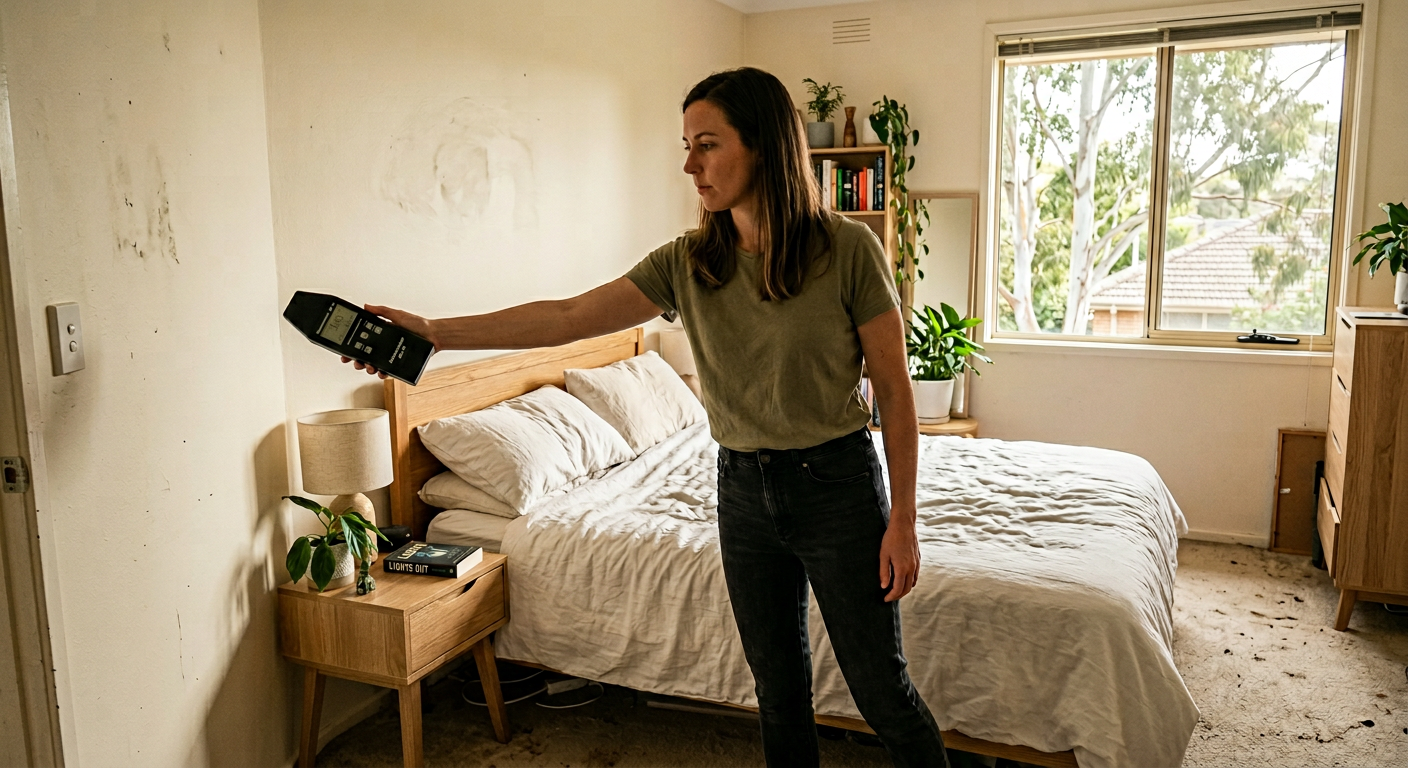
How to Measure EMF in Your Home – Australia Guide
QUICK VERDICT
The TriField TF2 is the best EMF meter for most Australian homes — it measures RF, ELF magnetic, and ELF electric fields in one device for around $250 AUD and requires no technical background to operate.
| Which EMF meter is best for Australian homes? | TriField TF2 (~$250 AUD) — measures RF, ELF magnetic, and ELF electric in one device; the only all-in-one under $300 with peak-hold mode. |
| Which meter detects 5G and 5 GHz Wi-Fi? | Safe and Sound Pro II (~$380 AUD) — covers 200 MHz to 8 GHz, reliably detects 5G (sub-6 GHz) and 5 GHz Wi-Fi; the most accurate RF-only meter under $500. |
| What is the quickest action to reduce home EMF? | Set your phone to aeroplane mode or charge it outside the bedroom — free, takes 30 seconds, and eliminates the highest-proximity RF source during sleep. |
| Which room should I measure for EMF first? | The bedroom — you spend 7–9 hours there each night, so small reductions compound into significant drops in cumulative overnight exposure. |
| What is a safe RF EMF level for a sleeping area? | Below 10 µW/m² is the Building Biology SBM-2015 “no concern” target for sleeping areas. Above 1,000 µW/m² is rated extreme concern. |
| What is a safe ELF EMF level for a sleeping area? | Below 0.2 mG for ELF magnetic fields and below 1 V/m for ELF electric fields — the SBM-2015 sleeping area no-concern thresholds. |
Once you understand what EMF is and have decided to assess your home environment, the practical question is: how do you actually do it? This guide covers which meters to use in Australia, what the readings mean against reference values, and a room-by-room protocol for a systematic home assessment.
The three products we own are measured first-hand by Jayce Love, former Royal Australian Navy Clearance Diver; every other product is assessed on published manufacturer specifications and independent certification using our documented methodology — no gifted units, no brand payments.
The critical point upfront: EMF is not a single thing, and a single meter won’t measure all of it. There are three distinct field types you need to understand, each requiring different measurement approaches and each responding to different mitigation strategies.
The Three Types of EMF — and What Measures Them
1. RF (Radiofrequency) — 100 MHz to 6 GHz
Emitted by Wi-Fi routers, mobile phones, smart meters, Bluetooth devices, baby monitors, and 5G small cells. Measured in microwatts per square metre (µW/m²) or milliwatts per square metre (mW/m²). This is the field type most commonly elevated in modern Australian homes, and the one that has increased most significantly with smart meter rollouts and 5G deployments since 2020.
Key Australian context: Brisbane, Sydney, Adelaide, and Darwin water authorities use chloramine for disinfection — but more relevant here, Australia’s smart meter rollouts (mandatory in Victoria, voluntary in NSW and QLD) mean most metropolitan homes have a pulsed RF transmitter within 5–10 metres of a living area.
2. ELF Magnetic Fields — 50 Hz
Generated by anything carrying alternating current — power lines, household wiring, electrical appliances, transformers. In Australia, mains frequency is 50 Hz. Measured in milligauss (mG) or microtesla (µT — 1 µT = 10 mG). This is the field type associated with the childhood leukaemia research (Draper et al., 2005; Ahlbom meta-analysis) that underpins building biology precautionary standards. Inverse square law governs decay — doubling your distance from a source reduces exposure by 75%.
3. ELF Electric Fields — 50 Hz
Radiates from any wire carrying voltage, even when no current is flowing. Measured in volts per metre (V/m). Often overlooked in home assessments, but can be significant near wiring in walls behind beds, particularly in homes built before modern earthing standards. Electric fields are easily shielded by earthed materials — grounding the bed frame or ensuring metallic conduit is earthed resolves many elevated readings.
Which EMF Meter to Buy in Australia
| Meter | Measures | RF Frequency Range | Price AUD | Best For |
|---|---|---|---|---|
| TriField TF2 | RF + ELF magnetic + ELF electric | ~50 MHz – 1 GHz | ~$230–280 | First home audit; 2.4 GHz Wi-Fi; mobile phone handsets; ELF sources |
| Safe and Sound Pro II | RF only | 200 MHz – 8 GHz | ~$350–420 | 5 GHz Wi-Fi; 5G small cells; comprehensive RF survey; audio mode for pulse identification |
| Acoustimeter AM-11 | RF only | 200 MHz – 8 GHz | ~$400–500 | Both numeric and audio readout; excellent for identifying pulsed vs continuous sources |
| Gigahertz Solutions HF38B + NFA1000 | RF (HF38B) + all ELF (NFA1000) | 27 MHz – 2.5 GHz (HF38B) | $700–$2,500+ | Professional building biology assessments; certified accuracy |
Recommendation for most Australians: Start with the TriField TF2. It handles 2.4 GHz Wi-Fi, smart meters (915 MHz), mobile phone handsets, and all ELF sources in one device. If you subsequently identify elevated 5 GHz or 5G sources, add the Safe and Sound Pro II. If you want professional accuracy without the investment, hire an ASBB-certified building biologist for a home assessment (~$300–$600 for a residential inspection).
Measure First. Act Second.
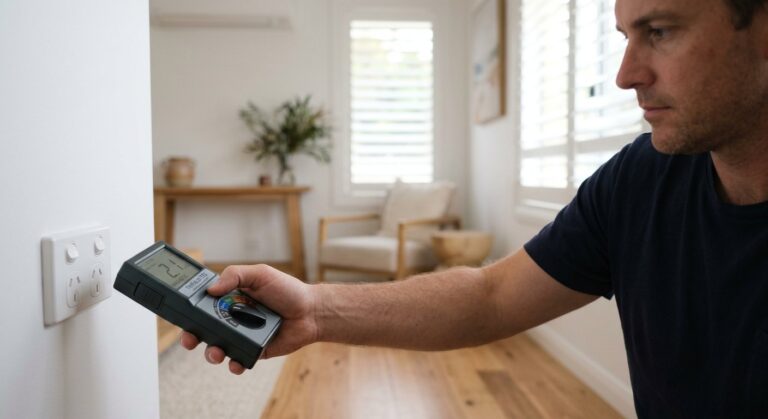
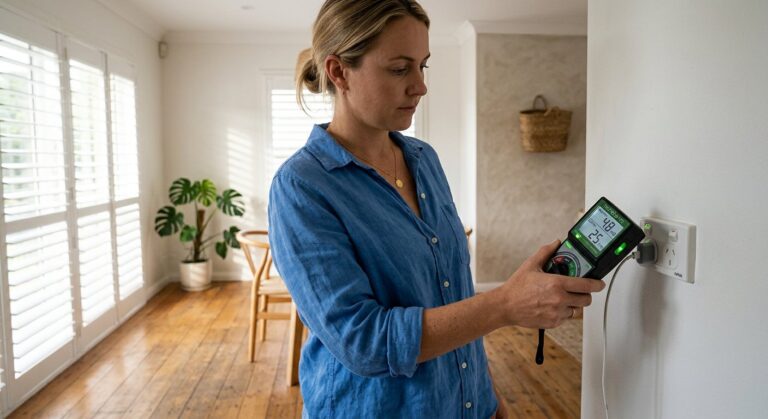
The TriField TF2 measures AC magnetic, AC electric, and RF fields in one meter. Without real readings, every EMF decision is a guess. Every room audit starts here.
ARPANSA/ICNIRP exposure limits are set to prevent established thermal effects — they are not a useful benchmark for optimising your home environment. The relevant reference points for residential assessment are the precautionary guidelines developed by building biology and environmental medicine organisations.
| Field Type | Unit | No Concern | Slight Concern | Severe Concern | ARPANSA Limit |
|---|---|---|---|---|---|
| RF (sleeping area) | µW/m² | <10 | 10–1,000 | >10,000 | 10,000,000 µW/m² |
| ELF Magnetic (sleeping area) | mG | <0.2 | 0.2–1.0 | >1.0 | 1,000 mG |
| ELF Electric (sleeping area) | V/m | <1 | 1–5 | >5 | No specific limit |
Source: Building Biology Standard SBM-2015. These are precautionary guidelines, not regulatory limits. ARPANSA limits are set to prevent established biological effects; building biology guidelines apply the precautionary principle for sleeping environments.
Room-by-Room Assessment Protocol
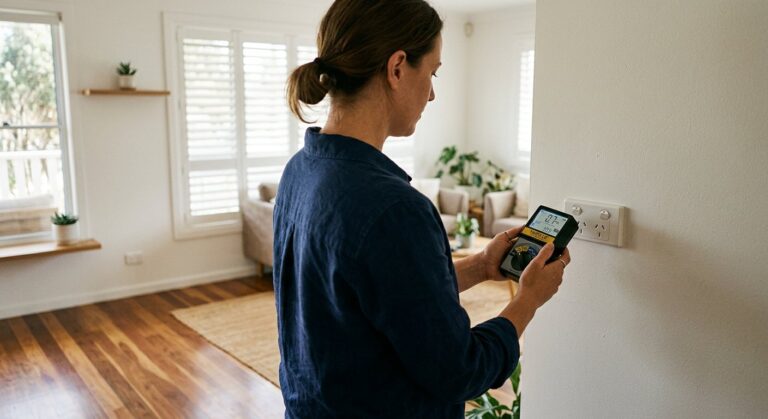
Work through your home systematically. For each room, take readings at multiple positions. Write down results — you want a baseline to compare against after making changes. Turn devices on and off to isolate individual sources.
Bedroom — Highest Priority
This is where you spend 7–9 hours continuously. Small improvements here have the largest health impact.
- Measure RF at pillow position with all devices on, then with your phone switched to aeroplane mode — note the difference
- Measure ELF magnetic at pillow height with your hand at mattress level — check for elevated readings from wiring in adjacent walls
- Walk the meter slowly along each wall, checking for wiring runs behind the headboard
- Measure any clock radio, bedside charging dock, or electric blanket within 1 metre of your sleeping position
- If you share a wall with a smart meter box, measure at the closest internal point
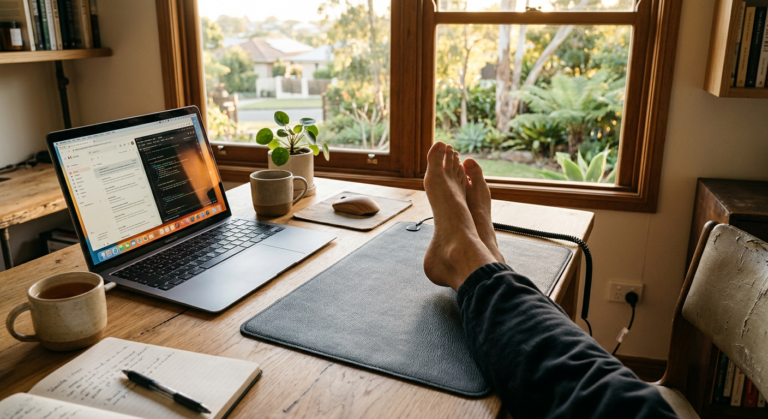
Home Office / Desk
- Measure RF at desk level with Wi-Fi on — note the reading, then connect via ethernet and turn off Wi-Fi on the device (radio stays on in the router) and re-measure
- Measure ELF magnetic at keyboard position from the laptop charger — many chargers generate significant fields at contact distance
- If you use a laptop on your lap, measure ELF at the lap contact surface — the underside of many laptops generates fields above 1 mG at skin contact
- Measure the nearest power board or UPS on the floor under the desk
Living Areas
- Identify Wi-Fi router location and measure RF at typical seating positions — note the reduction with distance (RF decays as inverse square)
- Measure near TV, gaming console, and smart speakers — Bluetooth and Wi-Fi radios in these devices contribute to ambient RF
- Check the smart meter (usually on an exterior wall) — measure inside at the closest internal position
- Measure ELF magnetic near any large appliances on shared walls (fridge compressors, washing machines)
Kitchen
- Measure ELF magnetic near the microwave when operating — stay at arm’s length and note the rapid drop-off with distance (field halves approximately every 30 cm)
- Check ELF magnetic at benchtop height from appliances beneath the bench
- Measure RF near any smart appliances — induction cooktops in particular generate elevated ELF at close range
The Highest-Impact Reductions — In Priority Order
Five actions — all behavioural, most free
- Phone out of the bedroom. Charge in the hallway, or use aeroplane mode. A mobile phone actively seeking signal beside your head for 8 hours is among the highest-RF exposures in most homes. Cost: $0.
- Router on a plug-in timer. Switch off overnight. Most households don’t use Wi-Fi midnight to 6am. Cost: $18.
- Ethernet for stationary devices. Desktop computers, smart TVs, gaming consoles, and streaming devices that don’t move. Eliminates their Wi-Fi radio use and typically improves connection stability. Cost: $25–$40 for switch and cables.
- Address elevated ELF magnetic in sleeping area. If readings exceed 1 mG at your sleeping position, find the source. Common causes: switchboard on adjacent wall, electric blanket left plugged in, power board under the bed. Move the bed if needed — 1–2 metres changes exposure dramatically given inverse square decay.
- Replace wireless baby monitors. Monitors often sit within 30 cm of a sleeping infant at very close range. Analogue or wired alternatives eliminate this entirely.
Frequently Asked Questions
What’s the difference between RF, ELF magnetic, and ELF electric fields — and why does it matter?
These are physically distinct types of electromagnetic energy requiring different measurement instruments and different mitigation strategies. RF (radiofrequency) is emitted by wireless devices and is reduced by distance and shielding. ELF magnetic fields are generated by current-carrying conductors and pass through most materials — the main mitigation is increasing distance from the source. ELF electric fields radiate from voltage-carrying wires and are easily blocked by earthed conductors. Measuring all three gives you a complete picture of your home’s electromagnetic environment.
What equipment do I need to measure EMF at home in Australia?
The TriField TF2 is the recommended starting point — it measures RF (up to ~1 GHz), ELF magnetic, and ELF electric fields in a single device for ~$230–280 AUD. If you have 5 GHz Wi-Fi or live near 5G infrastructure, add the Safe and Sound Pro II (200 MHz to 8 GHz, ~$350–420 AUD) for more complete RF coverage. A basic microsurge meter (~$100 AUD) is useful if you want to assess dirty electricity specifically.
What are safe EMF levels for sleeping areas in Australia?
ARPANSA sets the regulatory limit at 10 W/m² (10,000,000 µW/m²) for RF — well above typical residential levels. Building biology precautionary guidelines (SBM-2015) recommend below 10 µW/m² for sleeping areas, with “slight concern” from 10–1,000 µW/m². For ELF magnetic fields: below 0.2 mG (no concern) vs ARPANSA’s regulatory limit of 1,000 mG. Building biology guidelines are ~1,000,000× more conservative than regulatory limits — they are precautionary, not evidence of harm at intermediate levels.
How do I test my smart meter’s EMF output?
Stand 1 metre from the smart meter on the outside wall, RF meter on peak-hold mode, and measure for at least 60 seconds — smart meters pulse irregularly, so you need to capture peak readings. Then move inside to the closest internal point and repeat. Victorian smart meters typically pulse at 915 MHz, within the TriField TF2’s range. Readings consistently above 10,000 µW/m² at 1 metre are worth addressing — consider RF shielding paint on the internal wall or requesting a basic meter opt-out from your distributor.
Can my neighbour’s Wi-Fi affect my home’s RF levels?
Yes — especially in apartments and townhouses. RF from neighbouring routers can contribute meaningfully to your indoor ambient levels, particularly for walls you share directly. If your meter shows elevated RF with no obvious internal source, measure from all directions to identify which wall it’s coming through. RF-blocking paint on the shared wall is one option; switching your own devices to 5 GHz band (shorter range) reduces your contribution to neighbours’ levels.
Should I hire a building biologist or measure myself?
Start with a DIY assessment using the TriField TF2 — the room-by-room protocol above handles most residential situations. Hire a professional (ASBB-certified building biologist) if you find persistently elevated readings you can’t explain, if you want certified measurements for a tenancy dispute or property purchase assessment, or if you have a specific health concern requiring documented evidence. Residential building biology assessments in Australia cost approximately $300–$600.
How far should I be from my Wi-Fi router?
RF decays as the inverse square of distance — doubling your distance quarters your exposure. A router 1 metre away exposes you to roughly 16× more RF than one 4 metres away. For sleeping areas, aim for the router to be at least 4–5 metres from the bed — ideally in a different room. A plug-in timer that switches the router off overnight eliminates the question entirely during your highest-priority hours.
What are the highest RF sources in a typical Australian home?
In order of typical contribution: (1) mobile phone held to the head during calls — highest SAR exposure in most households; (2) mobile phone on the bedside table seeking signal overnight; (3) Wi-Fi router within 2 metres; (4) smart meter within 5 metres of an interior living space; (5) baby monitor within 1 metre of an infant. Addressing items 1 and 2 alone produces the most significant reduction in personal RF exposure for most Australians without purchasing any equipment.
Get the Australian Home Environment Checklist
30 checks across water, air and EMF. Most of them free. Ranked by impact.
No spam. Unsubscribe any time.

Former Royal Australian Navy Clearance Diver and TAG-E counter-terrorism operator. Founded Clean and Native to apply the same rigorous thinking to the home environment.
Full biography →