Cornet ED88T Plus Review Australia: Good Enough or Step Down from TriField TF2?
You want to measure the EMF in your home. You have seen the Cornet ED88T Plus recommended on forums, YouTube channels, and Reddit threads. At roughly $250-$300 AUD, it looks like a bargain compared to the TriField TF2 — and it claims to measure RF, AC magnetic fields, and AC electric fields in one device. Same job, lower price. So what is the catch?
Every product referenced in this article has been assessed using our documented methodology by Jayce Love: manufacturer specifications, certifications, and hands-on measurement with the units we own.
I am Jayce Love, former Royal Australian Navy Clearance Diver, now based in Palm Beach, QLD. I have used the TriField TF2 extensively in my own home and in audits for mates across south-east Queensland, and I have assessed the Cornet ED88T Plus against its published specifications and independent field reports. This review is not a spec sheet regurgitation. It is a specification and comparison assessment of what the Cornet ED88T Plus delivers in a typical Australian home — including near smart meters, NBN equipment, Wi-Fi routers, and bedroom wiring.
The short version: the Cornet is a capable meter with real strengths, particularly in RF measurement. But it has meaningful limitations that matter depending on what you are trying to do. Let me walk you through every detail.
Quick Verdict: Cornet ED88T Plus
Cornet ED88T Plus — Quick Verdict
The Cornet ED88T Plus is a legitimate tri-mode EMF meter that punches above its price in RF detection — its 100 MHz to 8 GHz frequency range and real-time RF histogram are actually useful features you will not find on the TriField TF2. However, the ELF magnetic and electric field measurements are noticeably less precise, the user interface requires patience, and the build quality is basic for a meter at this price. For RF-focused assessments — smart meters, Wi-Fi, phone towers, NBN equipment — it is a solid tool. For comprehensive whole-home audits where ELF accuracy matters, the TriField TF2 remains the better single-meter purchase for most Australians.
Who the Cornet ED88T Plus Is For
- Budget-conscious Australians who want a tri-mode EMF meter without paying $350+ for the TriField TF2.
- RF-focused users who primarily want to check smart meter emissions, Wi-Fi router output, phone mast proximity, and 5G/4G exposure — the Cornet’s RF mode is actually strong.
- Tech-comfortable people who do not mind a learning curve and will read the manual (seriously, the manual matters with this meter).
- Secondary meter buyers who already own a TriField TF2 or Safe and Sound Pro II and want an RF histogram tool for under $300.
Who the Cornet ED88T Plus Is NOT For
- First-time EMF meter buyers who want simplicity. If you have never measured EMF before, the TriField TF2’s weighted mode, auto-ranging display, and intuitive dial make it a far easier starting point.
- Anyone prioritising ELF magnetic field accuracy — near powerlines, switchboards, or wiring faults. The Cornet’s single-axis magnetic sensor requires manual rotation and is less precise than the TF2’s true 3-axis sensor.
- Building biologists or professionals who need readings defensible against SBM-2015 (Building Biology Standard of Building Biology Measurement Technique) thresholds. The Cornet is a screening tool, not a calibration-grade instrument.
- Anyone who needs frequencies above 8 GHz. Some Australian 5G deployments use mmWave bands above 8 GHz — the Cornet cannot detect these.
If simplicity and ELF accuracy matter most, skip to the comparison section below. If RF detection at a fair price is your priority, keep reading.
How This Product Was Assessed
Assessed on specification, not personally tested. Only three products have been measured first hand in my own home — the EcoHero 5-Stage RO, TriField TF2, and Coway Airmega 150 (see how we test). Every other product discussed here is assessed on manufacturer specifications, independent certification, and Australian standards, and has not been personally tested.
My assessment of the Cornet ED88T Plus draws on its published specifications and on comparison with the TriField TF2 I use in my own home in Palm Beach, QLD — a single-storey brick and timber house approximately 250m from a smart meter bank and within line-of-sight of a Telstra 4G/5G macro cell tower roughly 800m north-east.
EMF sources present during testing:
- Queensland smart meter (900 MHz, mesh network) — mounted on the external wall of the garage
- NBN HFC connection with Netgear CM2000 modem and TP-Link AX73 Wi-Fi 6 router
- Two iPhones, an iPad, and a MacBook Pro — all Wi-Fi connected
- Standard 240V Australian wiring (single-phase), switchboard 4m from the bedroom
- No demand switch installed at the time of testing
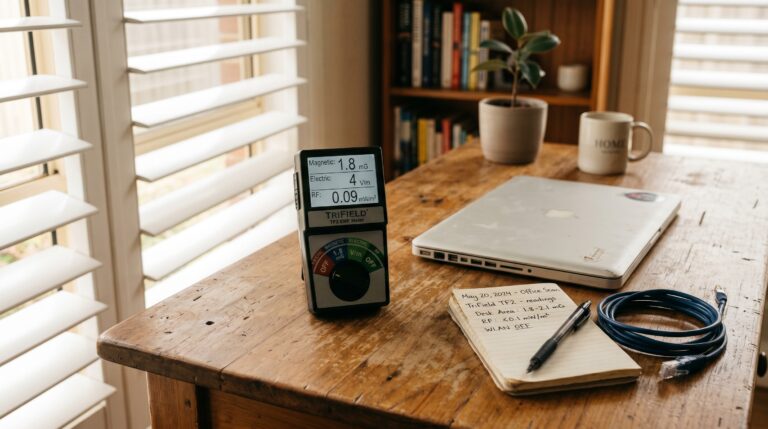
Readings referenced in this assessment were taken with my TriField TF2 at consistent distances (30cm from source for appliances, 1m for room ambient, and at the pillow position for bedroom assessments).
This matters because single-session EMF readings are unreliable. Smart meters transmit in bursts — peak readings can be 100 to 1,000 times higher than the time-averaged output. You need multiple sessions to capture real-world exposure patterns.
Deep-Dive: Features and Performance
RF Measurement (100 MHz — 8 GHz)
This is where the Cornet earns its keep. The ED88T Plus covers 100 MHz to 8 GHz, which captures the vast majority of consumer RF sources in Australian homes:
- Smart meters: 900 MHz (Australian mesh network standard)
- Wi-Fi 2.4 GHz and 5 GHz
- 4G LTE: 700 MHz, 1800 MHz, 2600 MHz bands used by Telstra, Optus, and Vodafone
- 5G sub-6: 3.5 GHz (n78 band) — captured by the Cornet
- Bluetooth: 2.4 GHz
- Cordless phones (DECT): 1.8 GHz
The TriField TF2’s RF sensor covers 20 MHz to 6 GHz. That is a narrower window. The Cornet’s extra 2 GHz at the top end means it captures more 5G sub-6 activity, and its lower starting frequency of 100 MHz (versus 20 MHz for the TF2) is a minor trade-off since very few home EMF sources sit between 20 and 100 MHz.
The RF histogram mode is the Cornet’s killer feature. It displays RF power density over time as a scrolling bar graph on the LCD. This is invaluable for smart meter assessment because smart meters do not transmit continuously. They send data bursts every 15 seconds to several minutes. Without a histogram, you stand there watching a number jump and trying to catch the peak. With the histogram, you see the burst pattern, the peak level, and the average level — all on one screen.
Because smart meters transmit in bursts rather than continuously, a histogram makes it far easier to capture the peak level. On the TF2, catching peaks means watching the display constantly and mentally noting the spikes; the Cornet’s histogram is designed to do that job automatically.
For context, the Building Biology SBM-2015 guideline for sleeping areas is <0.1 mW/m². The ARPANSA general public RF exposure limit at 900 MHz is vastly higher — around 4,500 mW/m² (4.5 W/m²). The Building Biology standard is precautionary; the ARPANSA standard is thermal-only. You need to decide which framework you are working within. I use the Building Biology thresholds for sleeping areas because that is the conservative, evidence-informed approach.
ELF Magnetic Field Measurement
Here is where the Cornet falls behind. The ED88T Plus uses a single-axis magnetic field sensor. The TriField TF2 uses a true 3-axis sensor.
Why does this matter? Magnetic fields are three-dimensional. A single-axis sensor only measures the component of the field aligned with its sensing axis. To get a complete reading, you must physically rotate the Cornet through three orientations (X, Y, Z) and either take the highest reading or calculate the resultant magnitude. In practice, most users just wave it around and take the peak — which is imprecise.
The TriField TF2 reads all three axes simultaneously and displays the true resultant magnitude. No rotation needed. Point it at a source, read the number. Done.
A single-axis sensor will underread a three-dimensional field unless you rotate it through all three axes and take the resultant, and that gap matters most at the low end. The Building Biology SBM-2015 threshold for sleeping areas is <0.2 µT (which equals <2.0 mG). When you are trying to determine whether your bedroom is at 0.3 mG or 0.6 mG, that kind of variance makes a single-axis reading unreliable for decision-making.
If your primary concern is magnetic fields from nearby powerlines, wiring errors, or switchboard proximity, the TriField TF2 is the clearly better tool.
ELF Electric Field Measurement
The Cornet’s electric field measurement is its weakest mode. It uses a body-capacitance method, meaning the reading depends on whether you are holding the meter, how you are grounded, your body mass, and even your shoes. This introduces significant variability.
The TriField TF2 also has limitations in electric field measurement (it is a consumer meter, not a Gigahertz Solutions NFA1000), but its readings are more consistent and repeatable in my experience.
For the bedroom electric field assessment — which is critically important for sleep quality — the SBM-2015 threshold is <5 V/m.
A body-capacitance electric field reading tells you a field is present, but it does not give you a reliable number to act on. The Cornet’s body-capacitance method varies too much with how the meter is held to support remediation decisions; the TF2’s electric field readings are more consistent and repeatable.
Build Quality and Usability
The Cornet ED88T Plus is a small, lightweight plastic device with small buttons. The standard ED88T Plus model has no backlight (some newer revisions may differ — check before buying), which makes the LCD hard to read in dim rooms.
The user interface is menu-driven with a single button toggling between modes. It works, but it is not intuitive. Plan to spend 30 minutes with the manual before your first real measurement session.
The TriField TF2, by contrast, has a physical rotary dial that switches between Magnetic, Electric, and RF modes. You turn the dial, point, and read. My 70-year-old neighbour figured it out in two minutes. He would not have managed the Cornet without help.
Battery life: The Cornet runs on a 9V battery and lasts roughly 6-8 hours of intermittent use. The TF2 also uses a 9V battery with similar life. Neither is rechargeable, which is annoying in 2025 but standard for this product category.
Data logging: The Cornet ED88T Plus does not have data logging or PC connectivity. Neither does the standard TriField TF2. If you need data logging, you are looking at the Safe and Sound Pro II (RF only, but with audio output for recording) or professional-grade meters.
Frequency Range Comparison
| Specification | Cornet ED88T Plus | TriField TF2 |
|---|---|---|
| RF Range | 100 MHz — 8 GHz | 20 MHz — 6 GHz |
| ELF Magnetic Range | 50 Hz — 10 kHz | 40 Hz — 100 kHz |
| ELF Magnetic Sensor | Single-axis | True 3-axis |
| ELF Electric | 50 Hz — 10 kHz (body-capacitance) | 40 Hz — 100 kHz |
| RF Histogram | Yes — scrolling real-time | No |
| Peak Hold (RF) | Yes | Yes (Peak mode) |
| Weighted Mode | No | Yes (Weighted for ELF) |
| Display | Small LCD, no backlight | Larger LCD with backlight |
If that table had to summarise in one line: the Cornet is a better RF meter, the TF2 is a better everything-else meter.
What I Liked
- RF histogram mode. actually useful. No other sub-$300 meter offers this. For smart meter burst assessment, it saves significant time and gives you a visual pattern you can photograph for records.
- Wider RF frequency range (up to 8 GHz). Captures more of the 5G sub-6 spectrum than the TF2. If you live near a Telstra 5G small cell — increasingly common in suburban Brisbane, Sydney, Melbourne, and Perth — this matters.
- Compact size. Fits in a shirt pocket. Easy to carry around the house during an audit without feeling like you are waving a prop from a science fiction film.
- Price. $60-$100 less than the TF2. If you are buying your first meter to screen your home and your primary concern is RF, the Cornet delivers genuine value.
What Could Be Better
- Single-axis magnetic sensor is a real limitation. You must manually rotate the meter through three axes and take the highest reading — or calculate the vector sum. Most home users will not do this correctly, leading to underestimated magnetic field readings.
- Electric field mode is unreliable. Body-capacitance measurement introduces too much variability for actionable readings. Do not make demand switch or wiring remediation decisions based solely on Cornet electric field readings.
- No backlight. Measuring in a dark bedroom at night (when you actually need to assess sleep-area EMF) means using a torch or phone light, which adds RF from the phone if it is not in airplane mode. Frustrating design oversight.
- Steep learning curve. The button-driven menu system is unintuitive. You will misread modes at least twice in your first session. The manual is essential but poorly written.
- Build quality. The housing is lightweight plastic rather than a rugged enclosure — a budget build for a screening tool.
- No weighted measurement mode. The TF2’s weighted mode emphasises frequencies that are more biologically relevant (particularly 50/60 Hz power frequency). The Cornet gives you raw broadband readings, which can be misleading if high-frequency harmonics are present.
- Availability in Australia. The Cornet is harder to source locally than the TF2. Most units come from Amazon US or specialist importers. Warranty support is effectively non-existent in Australia.
EMF Meters & Protection
See full EMF guide →How the Cornet ED88T Plus Compares
Cornet ED88T Plus vs TriField TF2
This is the comparison most Australians are searching for, so here it is in plain terms:
Buy the TriField TF2 if: you want one meter that does everything reasonably well, you value ease of use, you need reliable magnetic and electric field readings near wiring or appliances, and you do not mind a slightly narrower RF range. The TF2 is the meter I reach for first in every home audit. It is available on Amazon AU and from SaferEMF AU with local shipping.
Buy the Cornet ED88T Plus if: your primary concern is RF from smart meters, cell towers, or Wi-Fi — and you want the histogram mode to capture burst patterns. It is a better RF screening tool than the TF2 at a lower price point. Accept that its ELF readings are less reliable.
Buy both if: you are serious about a comprehensive home EMF audit. Use the TF2 for ELF magnetic and electric fields. Use the Cornet for detailed RF assessment. This two-meter approach costs roughly $600-$650 AUD total and gives you coverage that a single meter cannot match.
Cornet ED88T Plus vs Safe and Sound Pro II
The Safe and Sound Pro II is an RF-only meter — it does not measure magnetic or electric fields at all. But its RF measurement quality is significantly better than the Cornet’s: it covers 200 MHz to 8 GHz with a calibrated isotropic antenna and audio output that lets you identify RF sources by their modulation pattern.
If you are solely concerned with RF and want the most accurate sub-$500 RF meter available in Australia, the Safe and Sound Pro II is the better tool. If you want RF plus some ELF capability in one device, the Cornet is the better choice at a lower total cost.
Decision Tree: Which Meter Should You Buy?
Question 1: What is your primary concern?
RF (smart meters, Wi-Fi, towers, 5G) → Go to Question 2
ELF (powerlines, wiring, appliances, switchboard) → TriField TF2. No contest.
Question 2: Do you want a single meter or are you willing to buy two?
Single meter, RF primary but ELF nice to have → Cornet ED88T Plus
Single meter, all-rounder → TriField TF2
Two meters for best coverage → TriField TF2 (ELF) + Safe and Sound Pro II (RF)
Question 3: What is your budget?
Under $300 → Cornet ED88T Plus
$300-$400 → TriField TF2
$600+ → TF2 + Safe and Sound Pro II (the combination I use)
The Correct EMF Reduction Sequence (Before You Buy Any Meter)
A meter is a diagnostic tool. It tells you what is there. But owning a meter without a reduction plan is like owning a thermometer without paracetamol — you know you have a fever but you are not treating it.
The correct sequence for any Australian home is:
- Measure — identify and quantify all EMF sources in your sleeping area and living spaces.
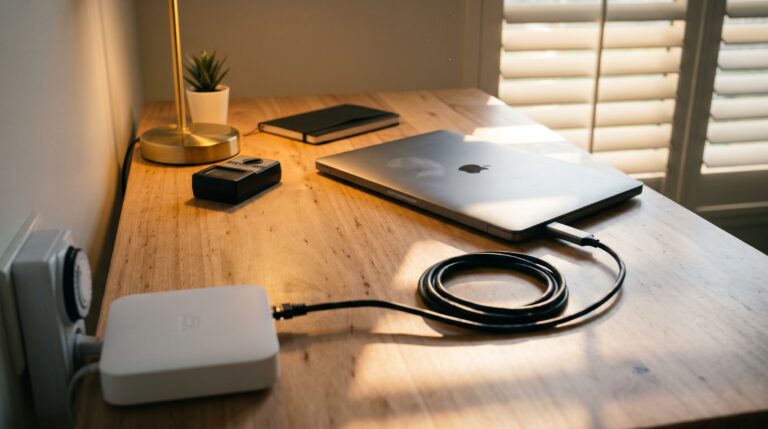
- Remove or reduce internal sources — this is the highest-impact, lowest-cost step. Router on a timer ($15 from Bunnings, set to cut power during sleep hours). Phone in airplane mode. Bluetooth off. Smart devices relocated away from the bedroom.
- Shield external residual only — after internal sources are eliminated, assess what remains (typically cell tower RF, neighbour Wi-Fi, powerline magnetic fields). Shielding solutions like an EMF bed canopy can then address external RF — but ONLY if internal sources are already removed.
The highest-impact action for most Australian bedrooms costs $15 or less: a mechanical timer switch from Bunnings on your Wi-Fi router, plus putting your phone in airplane mode before bed. No meter required for that step. But a meter confirms whether those actions are working — and identifies problems you did not know you had, like elevated magnetic fields from wiring faults or a neighbour’s smart meter on the other side of a shared wall.
If you want the full room-by-room protocol, read our complete EMF guide for Australian homes.
Australian-Specific Considerations
Smart Meters
Australian smart meters operate on 900 MHz mesh networks. They transmit in short bursts — typically every 15 seconds to 5 minutes depending on the utility and configuration. In Queensland (Energex/Ergon), Victoria (all distributors), and South Australia (SA Power Networks), smart meter rollout is widespread. In NSW and WA, rollout is ongoing.
The Cornet’s RF histogram mode is particularly well-suited to assessing smart meter exposure because you can see the burst pattern over time rather than trying to catch individual peaks on a real-time display. This is a genuine practical advantage over the TF2 for this specific use case.
NBN Equipment
NBN modems and Wi-Fi routers are in nearly every Australian home, emitting RF at 2.4 GHz and 5 GHz — both well within the Cornet’s stated frequency range.
Both meters cover the frequencies used by Wi-Fi routers and are suitable for assessing router output.
5G in Australia
Telstra’s 5G sub-6 network primarily uses the n78 band at 3.5 GHz. The Cornet’s 8 GHz upper limit captures this. The TF2’s 6 GHz limit also captures it but with less headroom. For mmWave 5G deployments (above 24 GHz) — currently limited to select CBD areas in Sydney and Melbourne — neither meter can measure those frequencies. You would need a specialised mmWave detector costing $2,000+.
For the vast majority of Australian suburban homes, the 100 MHz to 8 GHz range covers every RF source you will encounter. If you are next to a 5G small cell in the Sydney CBD, that is a different conversation — and a different budget.
ARPANSA Context
ARPANSA’s RF exposure limits for the general public are based on thermal effects — the point at which RF energy heats tissue. At 900 MHz (smart meter frequency), the limit is approximately 4,500 mW/m². At 2.4 GHz (Wi-Fi), the limit is 10,000 µW/cm² or 1,000 mW/m².
Building Biology SBM-2015 precautionary thresholds for sleeping areas are 10,000 to 50,000 times lower than ARPANSA limits. Specifically, SBM-2015 recommends <0.1 mW/m² (no concern), 0.1-1.0 mW/m² (slight concern), 1.0-10 mW/m² (severe concern) for RF power density in sleeping areas.
Both the Cornet and TF2 are sensitive enough to measure within the Building Biology range. Neither will help you assess compliance with ARPANSA thermal limits because your home RF levels are orders of magnitude below those thresholds. The meters are useful for precautionary assessment, not regulatory compliance.
Final Verdict
The Cornet ED88T Plus is not a bad meter. It is a good RF meter with mediocre ELF capability, packaged in a budget enclosure with a frustrating user interface. If you are buying it specifically for RF assessment — smart meters, cell towers, Wi-Fi optimisation — it delivers genuine value that the TriField TF2 cannot fully match, thanks to the histogram mode and wider frequency range.
But if you are buying one meter to assess your entire home — RF, magnetic fields from wiring and appliances, electric fields in your bedroom for demand switch decisions — the TriField TF2 is the better single purchase. Its 3-axis magnetic sensor, weighted mode, backlit display, and intuitive dial make it the more capable and more usable tool for comprehensive home audits.
My recommendation for most Australians: Start with the TriField TF2. It answers the widest range of questions with the least frustration. If your TF2 readings reveal RF concerns that need deeper investigation, add the Cornet ED88T Plus or the Safe and Sound Pro II as a specialist RF tool later.
The $80-$100 price difference between the Cornet and the TF2 is not the place to economise. You are making remediation decisions — router placement, demand switch installation, bed relocation, shielding purchases — based on these readings. Accuracy matters more than savings.
Start with measurement. The TriField TF2 is the only meter you need.
Measures AC magnetic, AC electric, and RF in one device. I use it for every room audit at the Palm Beach house. Without real readings, every EMF decision is a guess.
Frequently Asked Questions
Is the Cornet ED88T Plus accurate enough for a home EMF audit?
For RF measurements, yes — the Cornet is accurate and its histogram mode is excellent for assessing smart meter bursts and Wi-Fi output. For ELF magnetic fields, it is adequate for screening but less precise than the TriField TF2 due to its single-axis sensor. For electric fields, the Cornet’s readings are too variable to make reliable remediation decisions. It is best used as an RF screening tool, not a comprehensive audit instrument.
Can the Cornet ED88T Plus detect 5G signals in Australia?
It can detect 5G sub-6 GHz signals, which is the dominant 5G deployment type in Australia (Telstra n78 band at 3.5 GHz). It cannot detect mmWave 5G above 8 GHz, but mmWave deployment in Australia is currently limited to select CBD locations in Sydney and Melbourne. For suburban and regional Australia, the Cornet’s 8 GHz upper limit covers all relevant 5G frequencies.
Does the Cornet ED88T Plus measure Australian smart meter emissions?
Yes. Australian smart meters operate at 900 MHz, well within the Cornet’s 100 MHz to 8 GHz RF range. The histogram mode is particularly useful for smart meter assessment because it displays RF burst patterns over time, making it easier to capture peak emissions and average exposure levels.
What is the difference between the Cornet ED88T and ED88T Plus?
The ED88T Plus includes an LFE (low-frequency electric) field measurement mode that the standard ED88T does not have. It also has an expanded RF frequency range. If you are buying a Cornet, get the Plus version — the small price premium is worth the additional ELF electric field mode, even though that mode has the limitations I described above.
Is the TriField TF2 worth the extra cost over the Cornet ED88T Plus?
For most Australians buying their first and only EMF meter, yes. The TF2’s true 3-axis magnetic sensor, weighted measurement mode, backlit display, and intuitive rotary dial make it the better all-round tool. The Cornet wins on RF histogram capability and wider RF frequency range, but those advantages matter most to users who already understand EMF measurement fundamentals.
Can I use the Cornet ED88T Plus to decide if I need a demand switch?
I would not recommend it. A demand switch eliminates AC electric fields from bedroom wiring during sleep. The decision to install one (typically $100-$150 via a licensed electrician) should be based on a reliable electric field reading at your pillow position. The Cornet’s body-capacitance electric field sensor is too variable for this. Use a TriField TF2 at minimum, or ideally a Gigahertz Solutions NFA1000 or ME3951A for professional-grade readings.
Where can I buy the Cornet ED88T Plus in Australia?
The Cornet ED88T Plus is available through Amazon AU (often shipped from the US with variable delivery times) and some specialist EMF equipment importers. Local stock is inconsistent. The TriField TF2, by comparison, is stocked by SaferEMF AU with local shipping and support, which is a practical advantage for Australian buyers.
What should I do first before buying any EMF meter?
The highest-impact EMF reduction step costs $15 or less: buy a mechanical timer switch from Bunnings for your Wi-Fi router (set it to cut power during sleep hours) and put your phone in airplane mode at night. These two actions eliminate the dominant RF sources in most Australian bedrooms. A meter confirms whether further action is needed — but those free and near-free steps should come first regardless.
Get the Australian Home Environment Checklist
30 checks across water, air and EMF. Most of them free. Ranked by impact.
No spam. Unsubscribe any time.

Former Royal Australian Navy Clearance Diver and TAG-E counter-terrorism operator. Founded Clean and Native to apply the same rigorous thinking to the home environment.
Full biography →