Best Under-Sink Water Filter Australia (2026): Tested and Ranked
Independently Tested
Jayce Love tests every recommended product personally — with calibrated instruments, no gifted units, and no brand payments. See our testing process →
Disclosure: Clean and Native earns a commission if you purchase through links on this page. Products are recommended based on certifications, testing data, and Australian-specific performance.
Quick verdict
Every product mentioned in this article has been tested using our documented methodology by Jayce Love — calibrated instruments, no gifted units, no brand payments.
BEST COMPREHENSIVE (fluoride + PFAS + everything)
EcoHero 5-Stage RO — WaterMark AS3497 + NSF 58. 0.0001 micron membrane. Tested at Palm Beach: 69 ppm in, 3 ppm out (95.7% TDS reduction). ~$490-590 installed.
See EcoHero 5-Stage RO →BEST CARBON-ONLY (taste + chloramine, no fluoride)
Puretec PureMix Z series — WaterMark certified, Australian brand, catalytic carbon for chloramine cities. ~$200-400 + install. Does not remove fluoride.
The decision between them comes down to one question: do you need fluoride removed? If yes, RO only. If no, a quality carbon block is sufficient and cheaper.
The decision most buyers get wrong
Under-sink water filter covers two completely different technologies that remove completely different things. Most Australian buyers discover this after purchase — when they test their water and realise the filter they installed handles taste but not the fluoride, PFAS, or lead they actually wanted removed.
The split is straightforward. Carbon block filters use physical adsorption to capture organic compounds, chlorine, chloramine, and some heavy metals. They are effective, WaterMark-available, and relatively inexpensive. But they cannot remove fluoride, most PFAS compounds, nitrates, arsenic, or dissolved mineral content. Reverse osmosis systems force water through a semi-permeable membrane at 0.0001 microns — 3,000 times finer than standard HEPA filtration — removing everything the carbon stage missed. They cost more and produce some waste water. Knowing which category your concern falls into determines which system you need before any product comparison matters.
| What you want removed | Carbon block filter | Reverse osmosis (RO) |
|---|---|---|
| Chlorine (taste, odour) | Yes — very effective | Yes (pre-carbon stage) |
| Chloramine (most AU cities) | Catalytic/block carbon only — NOT standard GAC | Yes (pre-carbon stage) |
| Lead (NSF 53 certified) | Yes — up to 99.3% (NSF 53) | Yes — >99% (NSF 58) |
| Fluoride | No — cannot remove fluoride | 93-96% |
| PFAS (NSF 473) | Unreliable without NSF 473 certification | >98% (NSF 58 membrane) |
| Arsenic | No | >95% |
| Nitrates | No | >85% |
| Microplastics | 0.5 micron block: partial. GAC: No. | >99% |
| TDS / hardness (Perth, Adelaide) | No | >90% |
| Bacteria and viruses | No (unless UV stage added) | Yes (membrane barrier) |
WaterMark certification — what it means for Australian installation
WaterMark certification (AS3497) is the Australian plumbing products standard administered by the Australian Building Codes Board. It is not a marketing claim — it is a legal requirement. Any water filtration system installed with a permanent connection to the household cold water supply must be WaterMark certified or its installation may void home insurance, breach AS/NZS 3500 plumbing standards, and create liability for the licensed plumber who installs it.
In practice: the EcoHero 5-Stage RO is lead-free WaterMark certified to AS3497. Puretec systems are WaterMark certified. Many Amazon-imported under-sink filters are not — they may carry NSF 42 or NSF 58 certification for performance, but those are US-market standards and do not substitute for Australian WaterMark compliance. Before purchasing any imported unit for permanent installation, confirm WaterMark certification with the local supplier or contact the ABCB directly. For a unit connecting via a benchtop or temporary adaptor without penetrating the bench or making a permanent supply connection, WaterMark requirements are less stringent.
The chloramine problem — why most basic filters underperform in Australia
The majority of Australian capital city water systems use chloramine as a disinfectant rather than free chlorine. Chloramine is more stable in distribution systems and produces fewer disinfection byproducts at the treatment stage — but it is significantly harder to remove at the household level. Standard granular activated carbon (GAC) — the media in most basic pitcher filters, cartridge filters, and entry-level under-sink systems — removes free chlorine effectively but removes chloramine poorly. The reaction rate between chloramine and standard GAC is 40-50 times slower than for free chlorine, meaning at normal household flow rates, standard GAC provides minimal chloramine reduction.
The fix is catalytic carbon or compressed carbon block. Catalytic carbon has a modified surface structure that is far more reactive with chloramine. Compressed carbon block forces longer contact time through the dense media. Both work. Standard granular carbon at typical under-sink flow rates does not. If you are in Brisbane, Gold Coast, Ipswich, Sydney, Perth, Adelaide, or parts of Melbourne — and you buy a basic under-sink system with GAC — you may not be getting meaningful chloramine reduction despite the system appearing to work (taste improvement from sediment and chlorine taste compound removal can occur even when chloramine removal is poor).
Which disinfectant does your city use?
Chloramine (need catalytic/block carbon):
Brisbane, Gold Coast, Ipswich, Sydney (most zones), Perth, Adelaide, Wollongong, Parramatta
Free chlorine (standard carbon adequate):
Toowoomba, Newcastle, Canberra, some Melbourne zones and regional areas
Our Top-Rated Water Filters
Reverse osmosis is the only residential technology that reliably removes PFAS, fluoride, chloramine, and heavy metals — the four contaminants most Australians are most exposed to.
EcoHero 5-Stage RO — first-hand installation and results
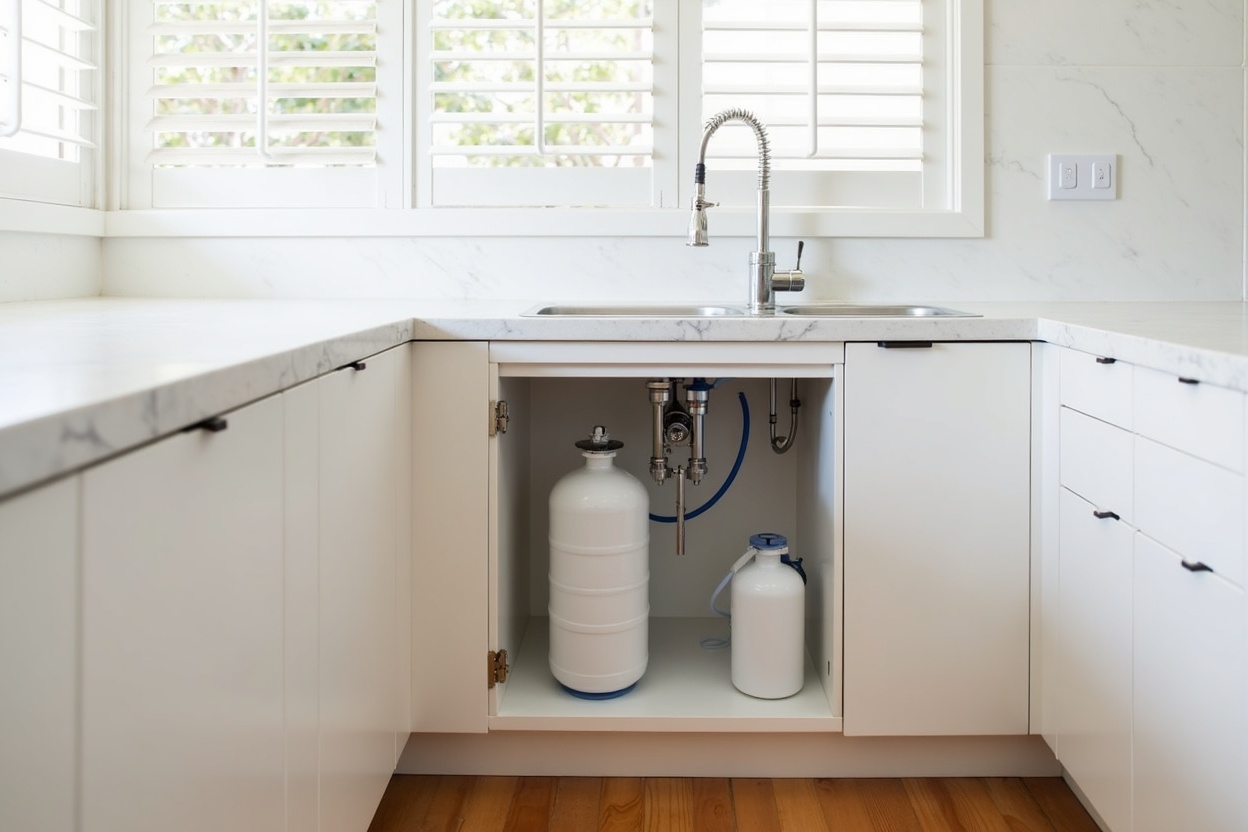
I installed the EcoHero 5-Stage RO at our Palm Beach, Queensland home. Pure Water Systems arranged a local licensed plumber — installation was complete in under an hour. The dedicated RO tap sits beside the main mixer; the household mains supply runs normally through all other taps. The RO system handles drinking and cooking water only.
Palm Beach tap water — before and after EcoHero 5-Stage RO
The EcoHero-50 membrane is the system’s defining component. Standard RO membranes achieve 25-33% water recovery — meaning 3-4 litres are wasted per litre of clean water produced. The EcoHero-50 achieves 50% recovery (1:1 ratio). For Australian households conscious of water use, this is a meaningful operational difference versus standard imported RO systems. The 5-stage process: sediment pre-filter — carbon block (chloramine removal before membrane, protecting membrane life) — EcoHero-50 RO membrane (0.0001 micron) — deionising cartridge (post-membrane TDS polishing) — post-carbon polish.
WaterMark AS3497 certified (lead-free), NSF 42 components, NSF 58 membrane. Also available with a remineraliser stage that adds calcium, magnesium, and potassium back post-membrane, raising pH to approximately 7.5-8.5 — recommended if flat or slightly acidic water taste is a concern. For full specs and pricing, see our dedicated reverse osmosis filter Australia guide.
EcoHero 5-Stage Reverse Osmosis System — The One I Use
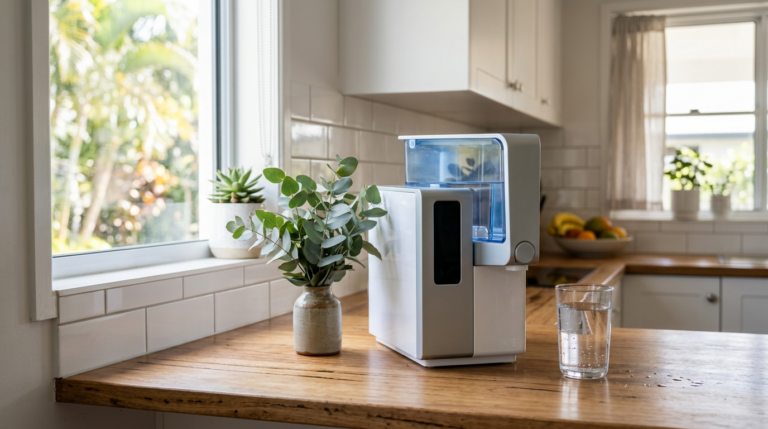
The EcoHero is the undersink RO system running in my Palm Beach home. Five filtration stages including a certified RO membrane, standard undersink installation, and the TDS results speak for themselves. If you want to know what your tap water looks like before and after a properly functioning RO system, 69 ppm to 3 ppm is the benchmark to compare against.
Stocked and shipped by Pure Water Systems AU. No Amazon intermediary, direct from the AU supplier.
- 5-stage filtration including RO membrane
- Removes fluoride, chlorine, heavy metals, PFAS, dissolved solids
- Standard undersink installation — DIY or plumber
- Confirmed: 69 ppm → 3 ppm in Palm Beach mains water
- AU-based supplier, local support
Australian city guide: which under-sink filter for your water supply
| City / water supply | Key water characteristics | Recommended system |
|---|---|---|
| Sydney | Chloramine. Fluoride 1.0 mg/L (highest AU capital). Soft water ~50-75 mg/L TDS. Low PFAS in treated water. | RO if fluoride removal matters (infant formula, preference). Carbon block with catalytic carbon if taste only. |
| Brisbane / SEQ | Chloramine. Fluoride 0.7-0.9 mg/L. Moderate TDS 80-115 mg/L. PFOA detected at Mt Crosby source (36 ppt). | RO preferred (addresses PFAS + fluoride). Catalytic carbon for taste-only concern. |
| Melbourne | Mixed (some zones chloramine, some chlorine). Fluoride ~0.9 mg/L. Very soft water 15-65 mg/L TDS. | Carbon block (catalytic) adequate for most zones. RO if fluoride is a priority. |
| Perth | Chloramine. Fluoride 0.7 mg/L. Hard water 121-180 mg/L TDS. PFAS near RAAF Pearce. | RO strongly recommended — addresses hard water TDS, fluoride, and PFAS. Taste improvement from RO will be most noticeable in Perth. |
| Adelaide | Chloramine. Murray River source — highest TDS of any AU capital (up to 500+ mg/L in summer). Fluoride 0.56 mg/L. | RO most impactful — the high TDS from Murray River minerals means RO output is noticeably different. Taste improvement significant. |
| Canberra | Free chlorine (not chloramine). Very soft (~43 mg/L). Zero PFAS in treated water. Fluoride 0.7 mg/L. | Standard carbon block adequate for taste. RO only if fluoride removal is the goal. Canberra is the easiest AU supply to filter. |
| Newcastle | Free chlorine. Soft water ~77 mg/L. Earthy MIB taste (active issue). Low PFAS at Williamtown below 2025 ADWG limits. | Carbon block effective for MIB taste and chlorine. RO if fluoride is a concern. |
| Pre-2004 homes (any city) | Lead solder in plumbing. Risk highest for first-draw water after idle pipe periods. | NSF 53 carbon block OR RO (both address lead). RO preferred for comprehensive coverage. |
5-year total cost of ownership
| Cost item | Puretec carbon block | EcoHero 5-Stage RO | Bottled water (3L/day) |
|---|---|---|---|
| Year 1 (system + install + filters) | ~$630 | ~$740 | ~$2,190 |
| Years 2-5 filters only | ~$320 ($80/yr x 4) | ~$600 ($150/yr x 4) | ~$8,760 |
| 5-year total | ~$950 | ~$1,340 | ~$10,950 |
| Cost per litre | ~$0.07/L | ~$0.01/L | $1-3/L |
Installation: what to expect
Carbon block under-sink systems: most handy homeowners can install in under 60 minutes using the included push-fit fittings. Required: connection to the cold water supply line under the sink (via a T-valve adaptor included in most kits) and a connection to the existing tap or a new dedicated filtered water tap if a second tap is included. No electricity required. WaterMark compliance is satisfied by the system certification — a licensed plumber is recommended but not always legally required for carbon-only systems depending on state plumbing regulations.
RO systems: more involved. Required connections include cold water supply, drain connection for waste water, and a dedicated tap hole through the benchtop for the RO tap. The dedicated tap requires drilling the benchtop — this is where a licensed plumber adds value. Pure Water Systems arranges local installation for EcoHero; expect $150-200 for the plumber visit. The EcoHero system includes a leak protection system that shuts off water supply in the event of a detected leak — important for any system left running unattended under the sink.
Filter replacement for both categories is annual for most cartridges. RO membranes typically last 2-3 years. EcoHero offers a service plan with Pure Water Systems; cartridges are also available to self-replace. Puretec cartridges are available at Reece plumbing supplies, Bunnings, and online.
When an under-sink filter is not the right answer
If you are renting and cannot make permanent plumbing modifications: the TAPP EcoPro clips onto any standard tap with no plumbing modification. NSF 42+53 certified, 0.5 micron carbon block, removes chloramine, lead, and some PFAS. Not WaterMark required (temporary connection). For PFAS and lead in a rental: this is the practical path.
If your concern is PFAS specifically and you want the highest-certainty protection: an under-sink RO with NSF 58 certification is the recommended path. The PFAS contamination situation across Australia — 60+ documented sites including Brisbane, Williamtown, Oakey, Katherine, Darwin, and multiple defence-adjacent suburbs — is covered in the PFAS in Australian drinking water guide. For lead removal specifically, see the best water filter for lead Australia guide.
Not sure which system suits your home, state, and water supply? The water filter quiz matches you to the right technology in four questions. For a full breakdown of all under-sink options including the Waterdrop D6, Puretec X series, and carbon vs RO comparison with current Australian pricing, see our complete under-sink water filter guide.
Frequently asked questions
Does under-sink filter remove fluoride?
Only RO systems (NSF 58). Carbon block filters cannot remove fluoride. All AU capital cities add fluoride at 0.6-1.0 mg/L.
WaterMark required?
Yes for permanent connections. EcoHero and Puretec are WaterMark certified. Check imported units carefully.
Best for Australia?
EcoHero 5-Stage RO (comprehensive, ~$590 installed, 95.7% TDS reduction tested). Puretec carbon block (taste/chloramine, ~$630 installed). TAPP EcoPro for renters (no install, ~$149).
Get 10% Off Your Water Filter
Enter your email below to unlock an exclusive discount code for PureWaterSystems.com.au — Australia's leading supplier of NSF/ANSI-certified filtration.
Does my filter remove chloramine?
Only if it uses catalytic carbon or compressed carbon block. Standard GAC does not effectively remove chloramine — check your filter media type before assuming.
Get the Australian Home Environment Checklist
30 checks across water, air and EMF. Most of them free. Ranked by impact.
No spam. Unsubscribe any time.

Former Royal Australian Navy Clearance Diver and TAG-E counter-terrorism operator. Founded Clean and Native to apply the same rigorous thinking to the home environment.
Full biography →