Does Hard Water Cause Eczema? What the Science Says for Australian Homes
Drafted with AI assistance and checked against published specifications and certifications. First-hand measurements appear only where stated. How we make content
Disclosure: Clean and Native earns a commission if you purchase through links on this page. This does not affect our editorial position — all recommendations are based on published research and testing data.
Yes — published research shows hard water increases eczema risk in children by 28–87%, with the strongest effect in infants under 12 months and those with filaggrin gene mutations. The mechanism is established: calcium and magnesium ions bind to soap residues on skin, raising pH and disrupting the skin barrier. For Perth (121–180 mg/L), Adelaide (100–150 mg/L), and Geelong (130 mg/L) households, hard water is a legitimate environmental trigger. The catches: effect size varies by individual genetics, and not all dermatologists agree softening water alone resolves moderate-to-severe eczema without concurrent emollient therapy.
| Solution | Hardness Reduction | Verdict |
|---|---|---|
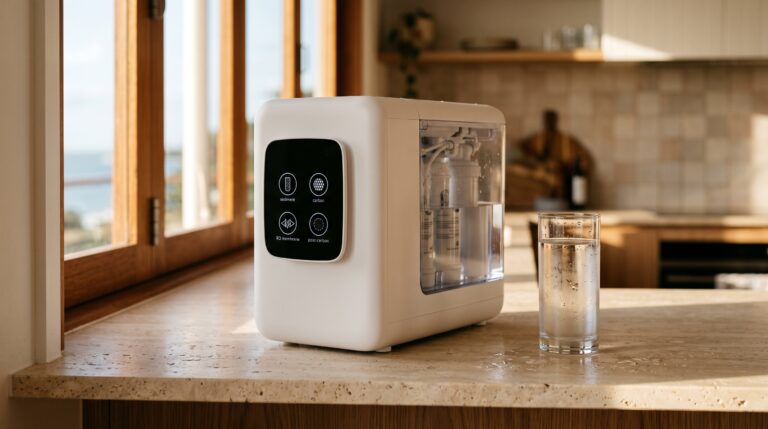
| Whole-house RO (EcoHero 5-Stage) | 95–99% removal of Ca²⁺/Mg²⁺ | Recommended |
| Shower-head softeners | 30–50% (limited flow rate) | Partial relief only |
| No intervention | Ongoing 28–87% elevated risk | Avoid for at-risk infants |
The short answer
The three products we own are measured first-hand by Jayce Love, former Royal Australian Navy Clearance Diver; every other product is assessed on published manufacturer specifications and independent certification using our documented methodology — no gifted units, no brand payments.
Yes — the research shows a real association. A 2021 King’s College London systematic review and meta-analysis of 385,901 participants found a 28% higher odds of eczema in children living in hard water areas. A 2016 study of 1,300 infants found hard water exposure associated with up to 87% increased eczema risk at three months of age. The mechanism is established: calcium and magnesium ions in hard water bind to soap surfactants, leaving a residue on the skin that disrupts the stratum corneum and raises skin pH. The association is strongest in children under school age and in those with filaggrin (FLG) gene mutations. For Australian households in Perth (121-180 mg/L), Adelaide (100-150 mg/L), and Geelong (130 mg/L), hard water is a legitimate environmental eczema risk factor worth addressing.
What the research actually shows
The hard water-eczema link has moved from association to mechanism in the past decade. Here is the published research, in order of strength.
The 2021 meta-analysis (Jabbar-Lopez et al., King’s College London)
Published in Clinical & Experimental Allergy, this is the most comprehensive review to date. Researchers systematically searched MEDLINE, Embase, Cochrane CENTRAL, and Web of Science from inception through mid-2020, selecting 16 studies meeting quality criteria from an initial 5,000+ results. The pooled analysis across 385,901 participants found an odds ratio (OR) of 1.28 (95% CI 1.09-1.50) for eczema prevalence in children exposed to hard water (defined as CaCO3 >350 mg/L in the included studies). That is a 28% higher odds of eczema — modest in absolute terms, but consistent and statistically significant across multiple independent datasets from the UK, Japan, Spain, and Australia.
The same review found no evidence that ion-exchange water softeners improve objective eczema severity scores (EASI) in children who already have the condition. Softeners do remove calcium and magnesium — but they also remove magnesium, which has a protective role in skin barrier function. Subjective parent-reported improvement (POEM scores) was noted, but objective clinical assessment showed no change. This is a critical distinction for product decisions.
The 2016 infant study (Perkin et al., King’s College London)
This King’s College study recruited 1,300 three-month-old infants from across the UK, collecting household water quality data from local suppliers. It found that living in a hard water area was associated with up to 87% increased risk of eczema at three months of age, independent of chlorine levels in the water. The risk was higher in children with filaggrin (FLG) gene mutations — a genetic variant that weakens the skin barrier protein — though this interaction did not reach statistical significance. This study is significant because it studied infants at peak risk period for eczema development, before lifestyle, diet, and other environmental variables accumulate.
The filaggrin-water interaction (Jabbar-Lopez et al., 2020)
A longitudinal follow-up published in the British Journal of Dermatology examined 1,303 children from the Enquiring About Tolerance (EAT) study, dividing them by water hardness (softer: <257 mg/L CaCO3; harder: >258 mg/L). Overall, there was no significant difference between groups. But when filaggrin mutation status was accounted for, children with an FLG mutation exposed to harder water had approximately three times the eczema risk compared to those without the mutation in soft water areas. This gene-environment interaction explains why hard water affects some children dramatically and others not at all: water hardness is an environmental trigger that amplifies genetic susceptibility, not a standalone cause.
The UK Biobank adult cohort (2022)
Published in the British Journal of Dermatology, this analysis of 306,531 adults across 7,642 UK postcodes found OR 1.02 per 50 mg/L CaCO3 increase in water hardness, and OR 1.12 (95% CI 1.04-1.22) for adults in hard water (>200 mg/L) versus soft water areas. The association wanes in older adults, possibly because adults with water-sensitive eczema adapt behaviours (shorter showers, different products) or selectively relocate. The adult effect is real but smaller than in children.
The biological mechanism: what hard water actually does to skin
The mechanism has been characterised through controlled laboratory work, not just epidemiology. When you wash with hard water containing high calcium and magnesium concentrations, two things happen simultaneously.
Metallic soap formation. Calcium and magnesium ions react with soap surfactants — including common cleansers containing sodium lauryl sulphate (SLS) — to form calcium stearate and magnesium stearate: the “soap scum” visible on shower screens. These salts deposit on the skin surface rather than rinsing cleanly. The SLS residue embedded in this scum alters protein secondary structure in the stratum corneum, solubilises lipids that maintain the skin barrier, and elevates skin surface pH in a dose-dependent manner. Research by Danby et al. (published in the Journal of Investigative Dermatology, 2018) demonstrated that the extent of SLS skin deposition and subsequent irritation was directly proportional to water hardness — and that using an ion-exchange water softener (reducing calcium to <0.1 mg/L) protected against this damage.
pH disruption. Healthy skin surface pH sits between 4.5 and 5.5 — mildly acidic. This acidity is maintained by the acid mantle and is critical for barrier function, antimicrobial defence, and the activity of enzymes that regulate desquamation. Hard water is alkaline (pH typically 7.5-8.5 from calcium and magnesium carbonates). Washing with hard water repeatedly raises skin surface pH, impairing barrier homeostasis. Elevated skin pH also activates serine proteases — enzymes that break down structural proteins — contributing to the itch-scratch cycle characteristic of atopic eczema.
The chlorine angle: Hard water in high-chlorine zones compounds the risk. Chlorine is a skin irritant independent of water hardness. The 2016 Perkin infant study found hard water risk was independent of chlorine levels — but chlorine adds a separate mechanism of skin barrier disruption. In Australian cities using chloramine (Brisbane, Gold Coast, Sydney, Adelaide) the combination of moderate-to-hard water plus chloramine creates dual irritant exposure. A shower filter that removes both chlorine/chloramine and reduces mineral load addresses both simultaneously.
Australian hard water by city — who is most at risk
| City | Hardness (mg/L CaCO3) | Classification | Eczema risk level |
|---|---|---|---|
| Perth | 121-180 | Hard to very hard | Highest — above 120 mg/L threshold in all studies |
| Adelaide | 100-150 | Moderately hard to hard | High — Murray River mineral load |
| Geelong | ~130 | Moderately hard | Elevated — above 120 mg/L in multiple studies |
| Brisbane (Mt Crosby) | 80-115 | Moderately hard | Moderate — basalt-influenced Wivenhoe catchment |
| Newcastle | ~77 | Soft | Lower — soft Grahamstown catchment |
| Sydney (metro) | 48-80 | Soft | Lower — sandstone Warragamba catchment |
| Gold Coast | ~34 | Very soft | Lowest — Hinze Dam, softest SEQ supply |
| Canberra | ~43 | Very soft | Lowest — Brindabella Ranges conservation catchment |
What actually helps — and what doesn’t
What the research says about water softeners
Ion-exchange water softeners remove calcium and magnesium through a sodium ion exchange process. The Sheffield Softened Water Eczema Trial (SWET) — a randomised controlled trial in 336 children with established eczema — found no statistically significant effect on objective disease severity (EASI score) after 12 weeks. The Jabbar-Lopez 2021 meta-analysis confirms this: no evidence that softeners improve objective severity in existing eczema.
There is a plausible reason: softeners remove both calcium AND magnesium. Magnesium has a skin-protective role — it supports the skin barrier and is associated with reduced inflammation. Dead Sea salt bathing, which is rich in magnesium despite containing calcium, has shown benefit in clinical studies. A softener that removes both minerals may eliminate the harmful calcium effects while also removing the beneficial magnesium, resulting in net neutrality. The research on softeners as prevention (before eczema develops in at-risk infants) is still ongoing — a pilot clinical trial testing this specific question is underway at BSACI.
What does help: shower filtration for chlorine and chloramine
While the water softener data is inconclusive, the chlorine/chloramine data is clearer as an independent irritant. Chlorine added to water supplies disrupts the skin’s microbiome and damages the stratum corneum’s lipid layer. In the Danby et al. experiment, washing with hard water supplemented with higher chlorine produced the most dramatic skin pH elevation — showing that chlorine and hardness compound their effects. Shower filters using KDF media or vitamin C neutralise chlorine and chloramine at the shower head. For eczema sufferers in chloramine-treated cities (Brisbane, Gold Coast, Sydney, Adelaide, parts of Melbourne), this is an evidence-adjacent practical step.
Bathing practices backed by evidence
The dermatology evidence on bathing practices for eczema is more consistent than the water hardness intervention data. Short, lukewarm baths or showers (10 minutes or under, water temperature <37°C) reduce total hard water exposure time and minimise barrier disruption. Applying an emollient within three minutes of bathing (“wet wrapping” or the “three-minute rule”) locks in moisture before the barrier can dry and contract. Fragrance-free, pH-balanced cleansers (pH 4.5-6, matching healthy skin) avoid the alkalinity of standard soap that hard water compounds. These approaches have Level 1 evidence from randomised controlled trials — stronger than any filtration intervention currently in the literature.
Practical steps for Australian households
For Perth, Adelaide, Geelong (hard water)
- Shower filter: removes chlorine/chloramine (KDF-55 or vitamin C media). Addresses the chloramine co-irritant independently of hardness.
- Fragrance-free, pH-balanced cleanser (pH 4.5-6). Standard alkaline soap compounds hard water pH effect.
- Short, lukewarm showers. Every minute in hard water means more calcium stearate deposit.
- Emollient within 3 minutes of bathing. Non-negotiable for established eczema.
- Point-of-use shower filter or full home RO if serious concern about dissolved content.
For Sydney, Brisbane, Gold Coast (soft to moderate)
- Hard water is not your main eczema environmental trigger — focus on chloramine (Brisbane, Sydney) which is present regardless of hardness.
- Shower filter removes chloramine from shower water in chloramine-treated cities.
- Same bathing practice principles apply — short showers, lukewarm water, immediate emollient.
- For drinking water PFAS and contaminant concerns in these cities, see our PFAS guide.
Not sure what is in your water? Check our water filter quiz for a recommendation matched to your city and concern. For a full breakdown of the contaminants in your tap water by Australian city, see the best water filters Australia guide.
Frequently asked questions
Does hard water cause eczema in Australia?
Hard water is associated with higher eczema risk but does not cause it in isolation. A 2021 King’s College London meta-analysis (385,901 participants) found 28% higher odds of eczema in hard water areas, and a 2016 study found up to 87% increased eczema risk in infants. Perth (121-180 mg/L) and Adelaide (100-150 mg/L) carry the highest Australian exposure.
Do water softeners help eczema?
For established eczema in children, clinical trial evidence does not support water softeners. The Sheffield SWET trial (336 children) found no improvement in objective eczema severity (EASI score) after 12 weeks of softened water. Note that softeners remove magnesium, which has a protective role in skin barrier function, along with calcium.
Is Sydney or Melbourne tap water better for eczema than Perth?
Yes. Sydney (48-80 mg/L) and Melbourne (20-50 mg/L) have soft water, below the hardness thresholds associated with eczema in research. Perth (121-180 mg/L) and Adelaide (100-150 mg/L) sit in the elevated-risk range. However, Sydney and Melbourne both use chloramine as a disinfectant, which is a separate skin irritant — so hardness alone does not determine total water-related eczema risk.
Does chloramine in tap water worsen eczema?
Yes, chloramine is a skin irritant that damages lipid barriers independently of water hardness. Brisbane, Sydney, Adelaide, and Darwin all use chloramine. Standard carbon filters (Brita, basic shower heads) do not remove chloramine — only catalytic carbon or reverse osmosis does. If you are in a chloramine city with eczema, your standard filter is not protecting you.
Can a shower filter reduce eczema symptoms?
In chloramine cities (Brisbane, Sydney, Adelaide, Gold Coast), a shower filter with catalytic carbon or vitamin C can remove chloramine — a known skin barrier irritant. It will not reduce water hardness. For eczema sufferers, a catalytic carbon shower filter addresses chloramine exposure, while a reverse osmosis filter addresses drinking water quality. KDF-55 shower filters are ineffective against chloramine.
At what water hardness level does eczema risk increase?
Research points to elevated risk above approximately 125 mg/L CaCO3. Australian reference: Melbourne (20-50 mg/L) is very soft, Sydney (48-80 mg/L) soft, Brisbane (80-120 mg/L) moderate, Adelaide (100-150 mg/L) moderate to hard, Perth (121-180 mg/L) hard. Perth and Adelaide residents are in the range where population-level studies show measurably higher eczema prevalence.
What water filter is best for eczema sufferers in Australia?
The most effective combination is a reverse osmosis filter for drinking water plus a catalytic carbon shower filter. RO removes chloramine, hardness minerals, fluoride, and heavy metals. A catalytic carbon or vitamin C shower filter removes chloramine from bathing water. Standard carbon filters and KDF-55 shower heads do not remove chloramine and will not help in chloramine cities.
Does bathing in hard water damage the skin barrier?
Yes. A 2018 King’s College London study found that bathing in hard water (180 mg/L) caused measurably greater stratum corneum damage than soft water even in people without eczema. Calcium and magnesium ions form insoluble soap compounds on skin, elevating skin pH. Higher skin pH disrupts the enzymes that maintain the skin barrier, increasing transepidermal water loss — the key mechanism linking hard water to eczema.
Get the Australian Home Environment Checklist
30 checks across water, air and EMF. Most of them free. Ranked by impact.
No spam. Unsubscribe any time.

Former Royal Australian Navy Clearance Diver and TAG-E counter-terrorism operator. Founded Clean and Native to apply the same rigorous thinking to the home environment.
Full biography →