
PFAS Contamination in Victoria Water: What Residents Must Know
6 min read“`html
This article contains affiliate links. We may earn a commission at no extra cost to you.
PFAS Contamination in Victoria Water: What Residents Must Know
Per- and polyfluoroalkyl substances (PFAS) have been detected at more than 30 sites across Victoria, with the highest concentrations found near Defence facilities, former industrial land, and firefighting training areas. These synthetic chemicals don’t break down in the environment or the human body, which is why regulators and public health authorities are paying close attention. This article covers where contamination has been confirmed in Victoria, what the health evidence actually says, and which water filtration technologies have demonstrated the ability to remove PFAS from drinking water.
Where PFAS Contamination Has Been Found in Victoria
Victoria’s contamination footprint is concentrated around sites where aqueous film-forming foam (AFFF) was historically used for firefighting training. The Department of Defence has identified RAAF Base East Sale in Gippsland and the Bandiana Army Barracks near Wodonga as two of the highest-priority remediation sites in the state. Groundwater plumes from both facilities have extended beyond base boundaries, affecting nearby private bores and, in some cases, surface waterways.
The Environment Protection Authority Victoria (EPA Victoria) maintains a public contaminated sites register that lists additional locations including former dry-cleaning operations, landfills, and manufacturing plants where PFAS-containing products were used or disposed of. Suburbs in Melbourne’s west and south-east have flagged elevated PFAS readings in groundwater monitoring wells, though reticulated town water supply systems managed by Melbourne Water and regional authorities such as Goulburn-Murray Water remain within the safe drinking limits set by the Australian Drinking Water Guidelines (ADWG).
The ADWG health guidance values, updated in 2022, set the limit for PFOS and PFHxS combined at 0.07 micrograms per litre, and PFOA at 0.56 micrograms per litre. Residents on private bores near contaminated sites should arrange independent testing, as reticulated supply and private groundwater carry very different risk profiles. If you’re unsure about your local supply, our guide on understanding your water quality report explains how to interpret test results.
Health Risks Associated with PFAS Exposure
The evidence base on PFAS health effects has grown substantially over the past decade. The International Agency for Research on Cancer (IARC) classified PFOA as a Group 1 human carcinogen in 2023, meaning there is sufficient evidence of carcinogenicity in humans. PFOS remains classified as a possible carcinogen. Beyond cancer risk, peer-reviewed research has associated chronic PFAS exposure with disrupted thyroid function, elevated cholesterol, reduced vaccine antibody response in children, and pregnancy complications including pre-eclampsia and reduced birth weight.
It’s important to be precise about what “exposure” means here. The health risks in the published literature are primarily associated with long-term, elevated exposure — the kind seen in communities living adjacent to highly contaminated groundwater sources, or workers in industries that manufactured PFAS compounds. Drinking water at or below the ADWG guidance values represents a much lower risk than the alarming framing sometimes seen in media coverage.
Australia’s National Health and Medical Research Council (NHMRC) continues to review the epidemiological evidence and updates health-based guidance values accordingly. For Victorians who have received notification letters from the EPA or Defence, the Department of Health Victoria runs a PFAS Health Study with free blood testing for eligible residents in affected postcodes. Participation provides both personal health data and contributes to the national evidence base.
Understanding the broader landscape of environmental contaminants is useful context — our overview of common drinking water contaminants in Australia covers PFAS alongside chlorine by-products, heavy metals, and microplastics.
Filters Proven to Remove PFAS from Drinking Water
Not all water filters remove PFAS. Standard activated carbon pitcher filters and basic fridge filters have limited or inconsistent performance against short-chain PFAS compounds in particular. The two technologies with the strongest independent evidence are reverse osmosis (RO) and high-capacity activated carbon block filtration using NSF/ANSI Standard 58 and Standard 53 certified media respectively.
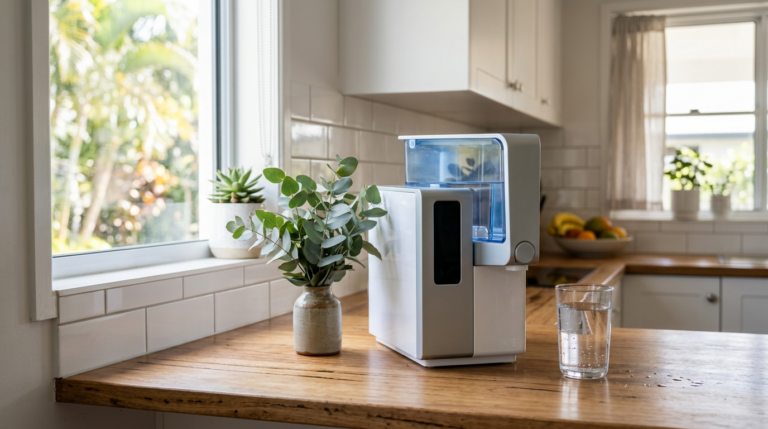
The AquaTru countertop reverse osmosis system is NSF/ANSI 58 certified and has been independently tested to remove PFOA and PFOS to below detectable limits. Its four-stage system — pre-filter, RO membrane, and two post-filters — handles a broad contaminant spectrum without requiring plumbing installation, which suits renters and those in regional Victoria who may not have access to a plumber readily.
The Clearly Filtered pitcher uses Affinity Filtration Technology and holds NSF/ANSI 53 and 58 certifications. Independent testing published by Clearly Filtered shows greater than 99.9% reduction for PFOA, PFOS, and several other PFAS variants. It’s a practical option for households wanting point-of-use protection without capital outlay on an under-sink system.
| Feature | AquaTru (RO) | Clearly Filtered (Carbon Block) |
|---|---|---|
| Technology | Reverse osmosis (4-stage) | Activated carbon block |
| NSF Certification | NSF/ANSI 58 | NSF/ANSI 53 & 58 |
| PFOA/PFOS Reduction | >99% (below detectable limits) | >99.9% |
| Installation | Countertop, no plumbing required | Pitcher, no installation |
| Filter Life | Pre-filter 2 months; RO membrane 2 years | 100 gallons (~380 litres) |
| Best Suited For | Households wanting comprehensive multi-contaminant removal | Renters, smaller households, budget-conscious buyers |
When selecting a filter, verify the NSF certification directly on the NSF International database rather than relying solely on product marketing. For households on private bores in high-risk Victorian postcodes, a whole-of-house filtration assessment may be warranted before choosing point-of-use options alone. Our detailed breakdown of the best water filters available in Australia includes testing data and price comparisons across a wider range of products.
Frequently Asked Questions
Is Melbourne’s tap water safe to drink given PFAS concerns?
Melbourne’s reticulated water supply, managed by Melbourne Water and distributed through retail water corporations, is regularly tested and has consistently returned PFAS readings below the ADWG health guidance values. The catchment systems that supply Melbourne are not adjacent to the major Defence contamination sites. Routine monitoring data is published in annual water quality reports available on each retailer’s website. If you’re on reticulated supply in metropolitan Melbourne, the current evidence does not indicate a PFAS risk from tap water, though individual comfort levels vary and filtration remains a personal choice.
How do I find out if my private bore is affected by PFAS?
Contact the EPA Victoria contaminated sites team or check whether your property falls within a known plume investigation area using the EPA’s public mapping tools. If you are in an area adjacent to a Defence site or a flagged industrial precinct, EPA Victoria or the relevant Defence remediation contractor may offer free bore water testing as part of the site investigation programme. Otherwise, accredited environmental laboratories across Victoria offer PFAS water testing; expect to pay between $150 and $400 depending on the number of individual PFAS compounds in the analytical suite.
Do household water filters certified for PFAS removal need to meet Australian standards?
Australia does not yet have a domestic equivalent of NSF/ANSI Standard 53 or 58 specifically for PFAS filtration performance. Standards Australia references NSF standards in relevant product guidelines, and the ADWG recommends NSF certification as an appropriate benchmark for filter performance claims. When evaluating filters, look for current NSF/ANSI 53 or 58 certification — listed on the NSF International public database — or Water Quality Association (WQA) Gold Seal certification, both of which require independent laboratory verification of contaminant reduction claims including PFAS.
Are there any remediation efforts underway at Victorian PF
FREE CHECKLIST
Get the Australian Home Environment Checklist
30 checks across water, air and EMF. Free PDF. No spam.
FREE CHECKLIST
Get the Australian Home Environment Checklist
30 checks across water, air and EMF. Free PDF. No spam.