HEPA Air Purifier vs Ioniser Air Purifier: Which Should You Choose? (Australia 2026)
HEPA air purifiers trap airborne particles in a dense fibre mat. Ionisers release charged ions that cause particles to clump and fall — but the particles stay in your room, and many ionisers produce ozone as a byproduct. In Australian homes where bushfire smoke, pollen, mould spores, and humidity create real air quality problems, the choice matters more than most people realise.
Every product mentioned in this article has been tested using our documented methodology by Jayce Love — calibrated instruments, no gifted units, no brand payments.
Short answer: for most Australian households, a HEPA air purifier is the safer and more effective choice. Ionisers can complement a HEPA unit in specific situations — but should never replace one, especially in homes with children, asthma sufferers, or pets.
This guide breaks down exactly how each technology works, where each one wins, and which models are worth buying in Australia right now. — Jayce Love, Navy Clearance Diver turned clean living researcher.
Quick Verdict: HEPA vs Ioniser
| Best for whole-home use | HEPA air purifier |
| Best for asthma households | HEPA only — avoid ionisers |
| Safe for children and pets | HEPA only — ozone risk with ionisers |
| Removes bushfire smoke PM2.5 | HEPA: captures permanently / Ioniser: floor deposit |
| Removes odours and VOCs | HEPA + activated carbon best; ioniser: partial |
| Top recommended model | Winix 5500-2 (Amazon AU) |
How HEPA Filtration Actually Works
HEPA stands for High-Efficiency Particulate Air. To earn the designation, a filter must capture 99.97% of particles at 0.3 microns — the hardest size to trap. Smaller particles (ultrafine PM0.1) are captured by Brownian diffusion; larger particles by interception and impaction.
The result: PM2.5 (fine particles from smoke, pollution, pollen), PM10 (dust, mould spores), pet dander, and most bacteria are physically removed from the air and trapped in the filter. They cannot re-enter circulation. The air that exits the unit is genuinely cleaner than the air that entered.
Most quality HEPA units pair the HEPA filter with an activated carbon layer that adsorbs gases, odours, and volatile organic compounds (VOCs) — the invisible chemical pollution from paints, carpets, cleaning products, and off-gassing furniture that HEPA alone cannot address.
The Only Air Purifier Technology Worth Buying
H13 HEPA with activated carbon is the evidence-based choice. Ionisers without HEPA do not remove particles — they just charge them. For Australian homes dealing with bushfire smoke, pollen, or mould, HEPA is non-negotiable.
How Ionisers Work — and Why the Details Matter
Ionisers emit negatively charged ions into the air. These ions attach to airborne particles, giving them a negative charge. Charged particles then attract to positively charged surfaces — walls, floors, furniture — and fall out of the air.
The problem: the particles are still in your home. They coat your surfaces. A gust from an open window, someone walking past, or a child crawling on the floor resuspends them. An ioniser does not remove particles — it relocates them temporarily.
The second problem: ozone. Many ionisers (particularly older or cheaper models) produce ozone as a byproduct of the ionisation process. Ozone (O3) is a lung irritant. At concentrations above 0.07 ppm — easily reached in a closed bedroom with a running ioniser — ozone aggravates asthma, reduces lung function, and causes chest tightness. Australia’s NEPM ambient air standard for ozone is 0.10 ppm over 1 hour; indoor concentrations from ionisers can exceed this.
The California Air Resources Board (CARB) publishes an approved list of ionisers and air cleaners that meet the 0.050 ppm ozone limit. If you are considering any ioniser, check it against the CARB list before buying.
Head-to-Head: HEPA vs Ioniser Across Six Key Criteria
| Criterion | HEPA Air Purifier | Ioniser |
|---|---|---|
| Particle removal method | Physical capture in filter — permanent | Deposits on surfaces — resuspension risk |
| PM2.5 and bushfire smoke | Highly effective | Partial — particles land on surfaces |
| Pollen and mould spores | Highly effective | Some reduction |
| VOCs and odours | Effective with activated carbon layer | Partial oxidation only — not full removal |
| Ozone output | None — HEPA produces no ozone | Many models produce ozone |
| Safe for asthma | Recommended by Asthma Australia | Ozone may worsen symptoms |
| Maintenance cost | Filter replacement $30-$120/year | Low — collector plate wipe every few weeks |
| Noise level | 35-52 dB on medium (24 dB on sleep mode) | Silent to near-silent |
The Australian Context: Why HEPA Wins for Most Households
Australian homes face air quality threats that make HEPA the clear choice for most situations:
Bushfire smoke season: Eastern Australia experiences smoke events every summer. During the 2019-20 Black Summer fires, Sydney recorded AQI readings above 2,000 (the hazardous threshold is 200). PM2.5 from smoke penetrates deeply into lung tissue. HEPA units physically capture these particles; ionisers merely redistribute them. If you live in NSW, Victoria, South Australia, or Queensland, a HEPA unit is a worthwhile investment for smoke season alone.
High pollen counts: Rye grass pollen season (October-December in temperate regions, September-November in subtropical Queensland) triggers severe asthma events across Australia. Asthma Australia explicitly recommends HEPA filtration for pollen management; ionisers are not on the recommended list due to ozone concerns.
Humidity and mould: Coastal cities including Brisbane, Sydney, Darwin, and Cairns experience high humidity conditions that promote mould growth. Airborne mould spores are typically 3-30 microns — well within HEPA capture range. An ioniser causes spores to deposit on walls, where they continue to colonise and spread.
Urban pollution: Melbourne, Sydney, and Perth regularly record elevated PM2.5 from traffic and industry. Homes near arterial roads benefit significantly from HEPA filtration running during peak traffic hours (7-9am, 4-6pm).
When an Ioniser Can Make Sense
Ionisers are not without legitimate uses. Cases where one might be appropriate:
- As a supplement to a HEPA unit: Some high-end air purifiers include both HEPA filtration and a low-level ioniser. When designed properly and CARB-certified, this combination can improve overall particle capture efficiency. The Winix 5500-2, for example, includes PlasmaWave technology that can be toggled on or off.
- Odour reduction in non-residential spaces: In a space where particle removal is not the primary concern (a garage, workshop, or utility room), a standalone ioniser may adequately address mild odours at lower cost.
- Near-silent operation requirement: Ionisers are silent. For people extremely sensitive to fan noise, a low-ozone CARB-certified ioniser may be preferred. But check the dB rating of shortlisted HEPA models first — some (e.g. Levoit Core 300S on Sleep Mode) are as quiet as 24 dB.
In all cases: verify CARB certification and check independent ozone test data before buying any standalone ioniser.
Top HEPA Air Purifiers for Australian Homes (2026)
These are the models I recommend based on actual CADR data, filter availability in Australia, and build quality at each price point.
Best Overall: Winix 5500-2
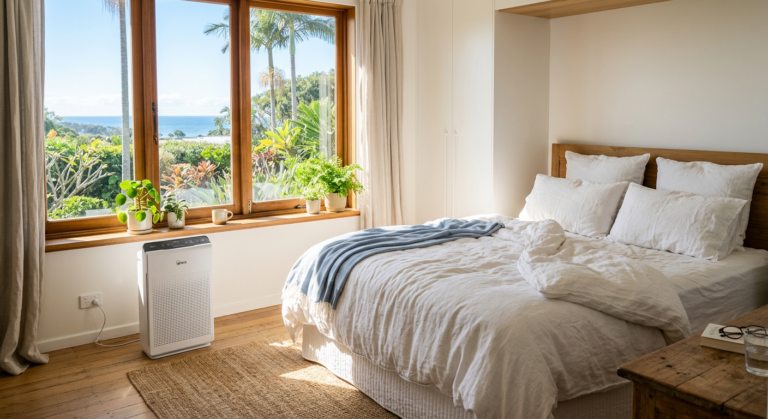
The Winix 5500-2 is consistently rated among the highest-performing HEPA air purifiers available in Australia. It uses a True HEPA filter rated to 99.97% at 0.3 microns, combined with an activated carbon layer for odour and VOC reduction. Auto Mode uses air quality sensors to adjust fan speed automatically — particularly useful during smoke events when you want maximum performance without constant manual adjustment.
CADR: 246 CFM (dust/smoke/pollen). Suited to rooms up to 75m2. Available on Amazon AU with genuine replacement filters locally stocked.
Best Mid-Range: Levoit Core 300S
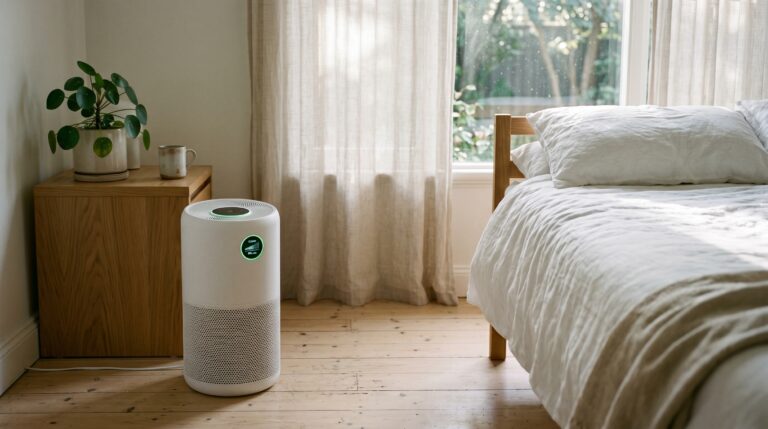
The Levoit Core 300S is the most popular HEPA air purifier sold in Australia. Compact enough for a bedroom (covers up to 17m2), it runs at 24 dB on Sleep Mode — quieter than a whisper. The 360-degree air intake and 3-stage filtration (pre-filter, H13 HEPA, activated carbon) provide reliable performance for smaller spaces. Works with the VeSync app for scheduling and air quality monitoring.
CADR: 141 m3/hour. Best for bedrooms, nurseries, and home offices.
Best for Smoke Events and Severe Air Quality: Winix Zero+ PRO
For households in high-risk fire zones or urban areas with chronic air quality problems, the Winix Zero+ PRO is the top hospital-grade option on Amazon AU. Its 5-stage True HEPA captures particles down to 0.3 microns — far beyond the standard 0.3-micron HEPA spec. Used in hospitals and clean rooms, it delivers filtration performance no ioniser can approach.
CADR: 460 m3/hour. Suited to large open-plan areas up to 100m2. Filter life of 3-4 years reduces long-term running costs.
What About Multi-Technology Units That Include an Ioniser?
Many air purifiers sold in Australia advertise multiple technologies in one unit — HEPA plus UV plus ioniser plus activated carbon plus plasma. The marketing sounds compelling. The reality is mixed.
The HEPA stage works as described — it always does. UV stages are largely ineffective at typical residential airflow speeds (contact time is too short to reliably inactivate pathogens). The ioniser stage is where scrutiny is needed: if the unit is CARB-certified, the ioniser is safe; if not, check third-party ozone test data before running it in an enclosed space.
If you already own a multi-technology unit, most allow the ioniser stage to be disabled. The Winix PlasmaWave button is one example. When in doubt, turn the ioniser off and rely on the HEPA and carbon stages — you lose nothing in particle removal performance.
Ongoing Costs: Filter Replacement vs Ioniser Maintenance
The most common argument for ionisers is no filter to replace. True — but incomplete.
Quality HEPA filters last 12-18 months in normal use (shorter during smoke season). Replacement filters for the Winix 5500-2 cost $45-$65 on Amazon AU. Levoit Core 300S replacement filters run $35-$45. Over three years, HEPA maintenance costs $90-$195 depending on model and replacement frequency.
Ionisers require periodic cleaning of collector plates (a wipe with a damp cloth every 2-4 weeks). If they generate ozone and you run them in a closed room, the hidden cost is respiratory health — difficult to quantify but real.
For most Australians, the filter cost of a quality HEPA unit is a transparent and acceptable running cost compared to the uncertain health trade-offs of ozone-generating ionisers.
Frequently Asked Questions
Is a HEPA air purifier better than an ioniser for asthma?
Yes. Asthma Australia and the Global Initiative for Asthma (GINA) both recommend HEPA filtration for people with asthma and respiratory conditions. Ionisers that produce ozone are contraindicated for asthma sufferers — ozone is a known airway irritant that can trigger and worsen asthma attacks. Choose a HEPA unit and look for one with an activated carbon layer to also address VOC triggers.
Do ionisers actually clean the air?
They reduce airborne particle counts by causing particles to fall out of suspension — but the particles remain in your room, deposited on surfaces. HEPA units physically remove particles from circulation by capturing them in a dense fibre filter. For genuine air cleaning, HEPA is the more thorough and permanent solution.
Do HEPA air purifiers produce ozone?
No. True HEPA filtration is a purely mechanical process — air passes through the filter, particles are trapped, clean air exits. No chemical reactions occur and no ozone is produced. If a device markets itself as “HEPA” but also produces ozone, that ozone comes from a separate ionisation or UV stage, not the HEPA filter itself.
How long do HEPA filters last in Australia?
Under normal conditions, HEPA filters typically last 12-18 months. During bushfire smoke events, filter life can shorten significantly — some users report needing to replace filters after a single severe smoke season. Most quality units have a filter indicator light. Check it monthly during smoke season. Pre-filters (washable) should be cleaned every 2-4 weeks.
Can I use a HEPA purifier and an ioniser together?
Yes, in principle. A HEPA unit handles the heavy lifting of particle removal, and a low-level CARB-certified ioniser can provide supplemental benefit in some situations. Practically, a quality HEPA unit alone is sufficient for almost all residential air quality needs. Most households are better served by running a larger or second HEPA unit rather than adding a separate ioniser.
What HEPA rating do I need for bushfire smoke?
True HEPA (H13 or H14 rating, 99.97%+ at 0.3 microns) is the minimum for effective smoke particle capture. Many budget units use “HEPA-type” or “HEPA-like” filters that do not meet the True HEPA standard — these allow more particles through. For smoke season, prioritise units with confirmed H13 certification. The Winix 5500-2, Levoit Core series, and IQAir HealthPro all use True HEPA filtration.
Which is quieter — HEPA or ioniser?
Ionisers are generally silent to near-silent (no fan required). HEPA units use fans — typically 24-52 dB depending on model and speed setting. On Sleep or Low mode, quality HEPA units like the Levoit Core 300S (24 dB) are barely audible. Fan noise on low is usually less disruptive than the alternative of running an ozone-producing ioniser in a closed bedroom overnight.
Are ionisers banned in Australia?
No. Ionisers are legal and widely sold in Australia. However, no mandatory ozone emission standard exists for air purifiers under Australian Consumer Law — meaning any device can be marketed as an “air purifier” regardless of ozone output. The only voluntary benchmark used by quality manufacturers is California CARB certification (0.050 ppm ozone limit). Always check for CARB certification before buying any ioniser.
The Bottom Line
For most Australian households — particularly those in bushfire smoke zones, high-pollen areas, or homes with asthma sufferers — a True HEPA air purifier is the right choice. It physically removes particles, produces no ozone, and its performance is independently measurable via CADR ratings.
Ionisers have legitimate niche uses and can safely complement a HEPA unit when CARB-certified. They should never replace HEPA filtration in a home with children, respiratory conditions, or real air quality threats.
If you are buying one unit right now, start with the Winix 5500-2 for a large space or the Levoit Core 300S for a bedroom. Both use True HEPA filtration, have genuine Australian stock, and deliver performance that ionisers at the same price point cannot match.
For city-specific air quality context, see our guides for Sydney, Melbourne, and Brisbane. For households concerned about bushfire smoke specifically, our wildfire smoke air purifier guide covers seasonal strategy in detail.
Get the Australian Home Environment Checklist
30 checks across water, air and EMF. Most of them free. Ranked by impact.
No spam. Unsubscribe any time.

Former Royal Australian Navy Clearance Diver and TAG-E counter-terrorism operator. Founded Clean and Native to apply the same rigorous thinking to the home environment.
Full biography →