Air Purifier for a Baby Room Australia 2026: Safety Checklist, Setup
Drafted with AI assistance and checked against published specifications and certifications. First-hand measurements appear only where stated. How we make content
How this guide was made. This is a safety and setup guide for running an air purifier for a baby room, built on Red Nose Australia’s safe-sleep advice, the Australian Government’s Pregnancy, Birth and Baby service, the US EPA and the CDC. I have not tested any purifier in a nursery. The Coway Airmega 150 is the purifier I ran in my own bedroom, and its noise reading and filter photo are mine; every other figure comes from the maker or a retailer listing, checked on 19 November 2026. Nothing here is medical advice: if your baby has breathing problems, eczema or allergies, ask your GP or child health nurse.
An air purifier for a baby room is safe and worth having when the air coming in is the problem: bushfire smoke, burn-offs, wood heaters or a busy road. Choose a filter-only purifier with no ioniser or ozone[5], sized by its clean air delivery rate, quiet on its Sleep setting, and placed on the far side of the room from the cot with the cord out of reach[1]. Run it on high before bed, then on Sleep overnight.
This guide is the checklist and the setup. If you just want the shortlist, our best air purifier for a baby room picks compares four nursery-sized units in detail; the four on this page pass every check below.
Filter only, sized to the room, quiet at night, far from the cot. These four pass every check; the Airmega 100 suits most nurseries because its sensor speeds it up if smoke drifts in overnight.
| Purifier | Best for | Nursery size (EPA rule) | Price |
|---|---|---|---|
| Coway Airmega 100 | Most nurseries; reacts to smoke on its own | ~15 m² | $137.00at Amazon AU · as of 19 Nov 2026, 8:29 pm AEST Details |
| Levoit Core 300 | Budget; you set the speed | ~15 m² | $129.00at Amazon AU · as of 19 Nov 2026, 8:29 pm AEST Details |
| Coway Airmega 50 | Small nurseries | ~9 m² | $88.00at Amazon AU · as of 19 Nov 2026, 8:29 pm AEST Details |
| Coway Airmega 150 | Larger rooms; the one I ran | ~21 m² | $199.00at Amazon AU · as of 19 Nov 2026, 11:43 pm AEST Details |
Does a newborn need an air purifier?
Many nurseries don’t, and no Australian health body recommends one for every baby. A purifier earns its place when the air outside the nursery is the problem: bushfire smoke or hazard-reduction burns, a wood heater in the street, a busy road, or smokers or pets in the home. Pregnancy, Birth and Baby says young children and newborns “can be especially affected” by bushfire smoke, and that a HEPA purifier can reduce smoke particles indoors if it is matched to the room and the room is well sealed[2].
Be wary of bigger promises. None of the health sources behind this guide recommends a purifier to treat eczema or prevent allergies, and ASCIA’s allergen minimisation advice does not include room air purifiers for dust mite or pet allergen[4]. I’m a former Navy clearance diver, not a paediatrician, so if your baby has a diagnosed allergy or asthma, your doctor’s plan comes first.
✓ Worth it if
- You get bushfire smoke or burn-off haze
- A wood heater or busy road is nearby
- Someone in the home smokes (a purifier is no substitute for smoking outside), or you have pets (it doesn’t replace cleaning)
- You want one clean room to retreat to on smoky days
× Not a fix for
- Eczema or a diagnosed allergy
- Mould: fix the damp first
- A room with the window open all night
- Stuffy air: that needs ventilation, not filtering
Watch a purifier clear a nursery
How fast a purifier cleans a room depends on air changes per hour: its clean air delivery rate (CADR) divided by the room’s volume. The CDC’s removal table uses a perfect-mixing model in an empty room: at 2 air changes an hour, 99% of airborne particles take 138 minutes to clear; at 6, 46 minutes; at 12, 23 minutes[8]. Pick your nursery and purifier below and press Play.
Air changes per hour: 6.4
90% cleared in about 22 min
99% cleared in about 43 min
Simulated time: 0 min | Particles remaining: 100%
For a 12 m² nursery with a 2.4 m ceiling, the Coway Airmega 100’s 108 cfm smoke CADR (about 183 m³/h)[10] gives about 6.4 air changes an hour on top speed: 90% cleared in about 22 minutes and 99% in about 43, on the model. On a Sleep setting at an assumed 30% of that airflow, it is about 1.9 air changes an hour. The CDC notes the times assume perfect mixing in an empty room and are longer where air is imperfectly mixed, so treat these as best case.
The nursery checklist: what actually matters
| Check | What to look for | Why |
|---|---|---|
| 1. No ozone | Filter only: no ioniser, plasma, UV or ozone stage, or one you can switch off | US EPA: ionisers may have the potential to emit ozone; inhaled ozone can damage the lungs |
| 2. Sized by CADR | Smoke CADR (cfm) at least two-thirds of the floor area (sq ft) | US EPA sizing rule; the box room size can assume very few air changes |
| 3. Quiet on Sleep | Rated around 20 to 25 dB on its lowest setting; never top speed overnight | Three of the four picks are rated at about 48 dB on top speed, near the 50 dBA hourly nursery limit |
| 4. Lights off | Sleep mode or a switch that turns off the display and indicator light | A dark room at night; check the manual, not the photos |
| 5. Away from the cot | Far side of the room, cord out of reach of the cot and a crawling baby | Red Nose: keep cords and electrical items away from the cot |
| 6. Filters you can buy | Genuine replacement filters in Australia, with a stated life | A clogged filter moves less air; the running cost is the filter |
Ozone first, because it is the one a purifier can make worse. The US EPA says no federal agency has approved ozone generators for occupied spaces and that ozone can damage the lungs[6]; its guide to air cleaners adds that ionisers “may have the potential to emit ozone”[5]. Sizing second: the EPA’s rule for a standard 2.4 m ceiling is a smoke CADR in cubic feet per minute of at least two-thirds of the floor area in square feet[5][7], which is about 65 cfm for a 9 m² nursery and about 110 cfm for 15 m².
Noise third. A 2014 study in Pediatrics of infant sleep machines cites a recommended limit of 50 dBA, averaged over an hour, for hospital nurseries, and found that on maximum all 14 machines exceeded 50 dBA at 30 cm, three of them above 85 dBA; the authors advised placing them as far from the baby as possible, at a low volume[3]. A purifier on Sleep is far quieter than that, but three of these four purifiers are rated at about 48 dB on top speed. More on decibel ratings in our quietest air purifier guide.
What doesn’t matter (despite the box)
- The room size on the box. It may assume as little as one air change an hour: Coway’s Airmega 100 sheet gives 75 m² at one air change an hour[10]. Use the CADR and the EPA rule instead.
- “Medical grade” stickers, or an H13 claim with no test standard named. H13 is a filter class under EN 1822, so ask which standard and lab tested it; see HEPA grades explained.
- Apps and Wi-Fi. Useful for scheduling, not for clean air. A purifier that runs from buttons is fine.
- UV lamps and “sanitising” modes. UV doesn’t capture particles, and the EPA notes some UV lamps can emit ozone.
- The colour ring. A built-in sensor is good for Auto mode, but its colour is a rough guide, not a measurement.
- Turbo CADR. You will not run top speed beside a sleeping baby, so the night-time figure is far lower.
Check all seven rooms, not just this one
38 checks, 29 free, ranked by impact. Sent as a 32-page PDF.
We'll email you the audit and a short series of practical guides. Unsubscribe in one click, any time. Privacy.
Sent. Taking you to your download...
How to set it up in a nursery
| Step | What to do |
|---|---|
| Place it | Far side of the room from the cot, ideally 2 m or more (our rule of thumb, not an official figure), on the floor where it can’t be pulled over |
| Run the cord | Along the skirting board, out of reach of the cot and of a crawling baby |
| Keep it clear | No towels, clothes or curtains over the intake or outlet |
| Before bed | Top speed with the door and windows shut for 30 to 45 minutes, baby out of the room |
| Overnight | Sleep or the lowest speed, lights off, display lock on if it has one |
| Maintain | Vacuum the pre-filter every few weeks; replace the main filter on the maker’s schedule; don’t wash a HEPA filter unless the maker says you can |
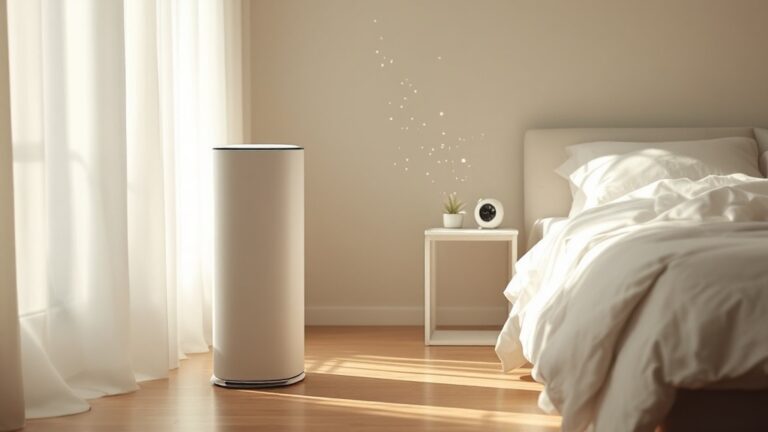
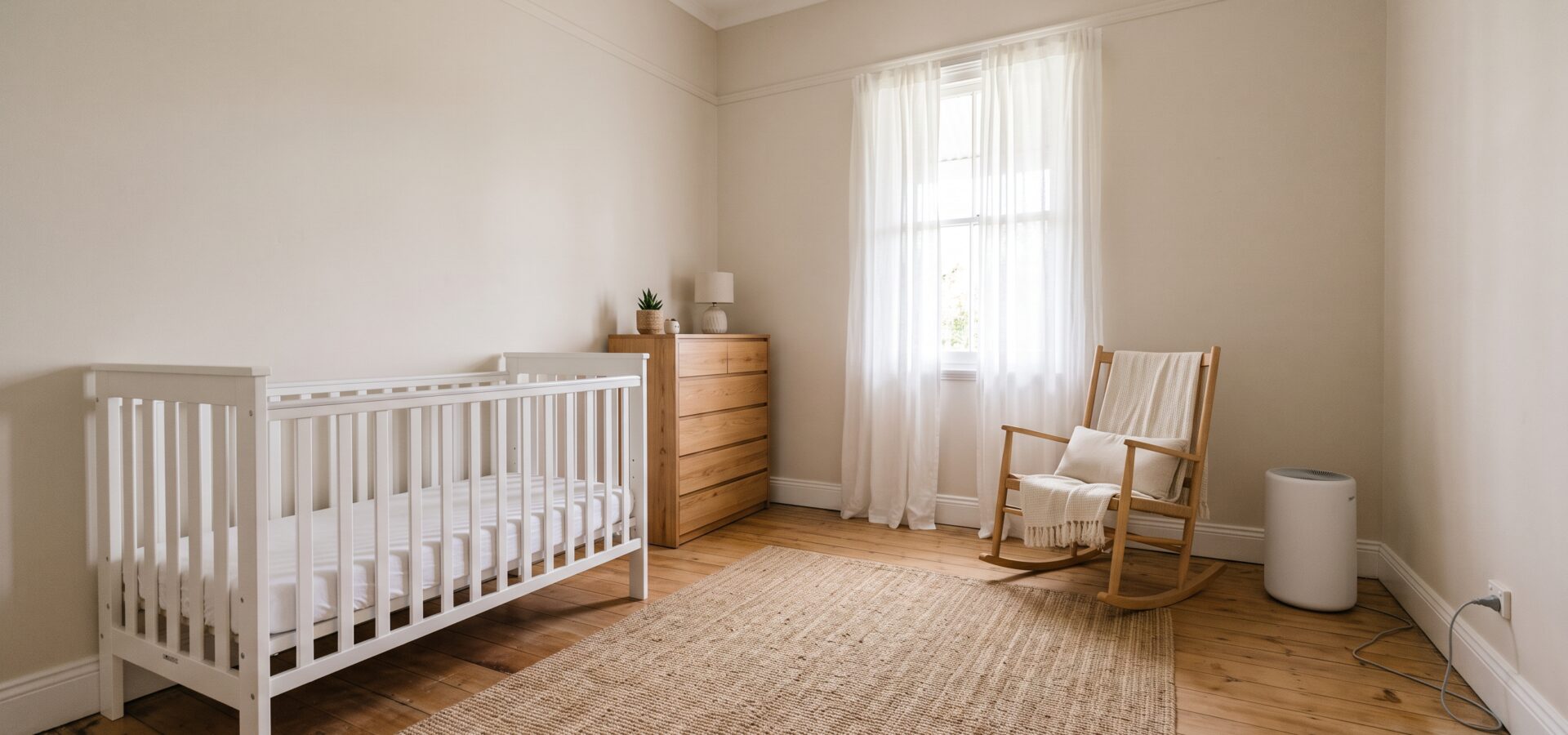
Red Nose’s safe-sleep advice is the anchor: keep the cot away from hanging cords and electrical items, which are strangulation hazards, and keep heaters and electrical appliances away from the cot[1]. A purifier is an electrical item with a cord, so the same rules apply. The fal.ai illustration above shows the layout: cot on one wall, purifier in the opposite corner, cord along the skirting.
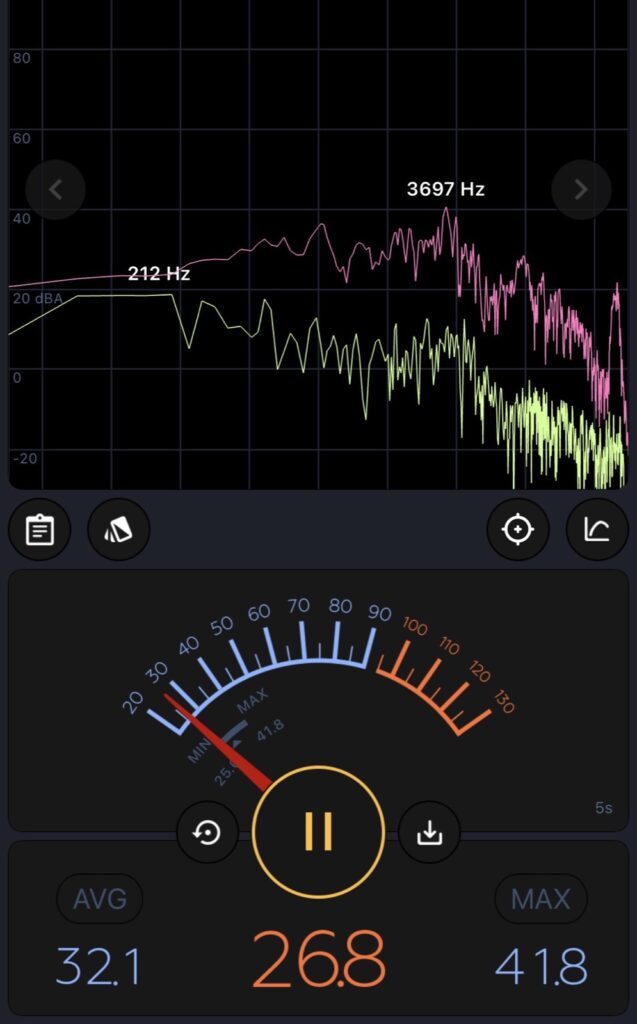
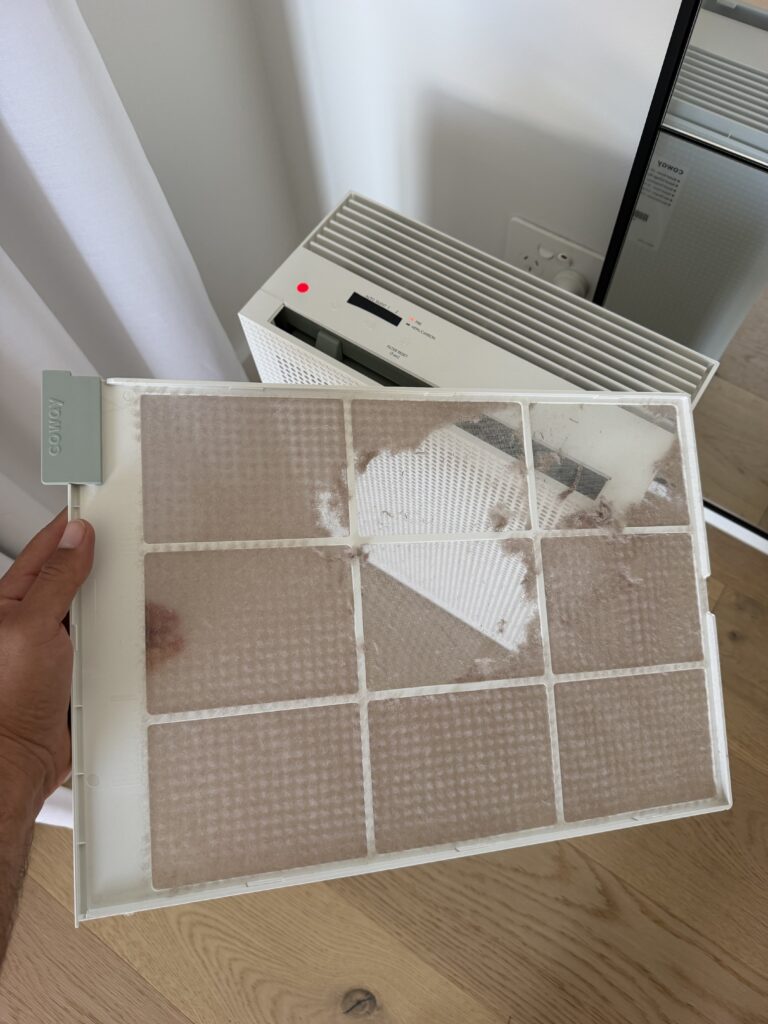
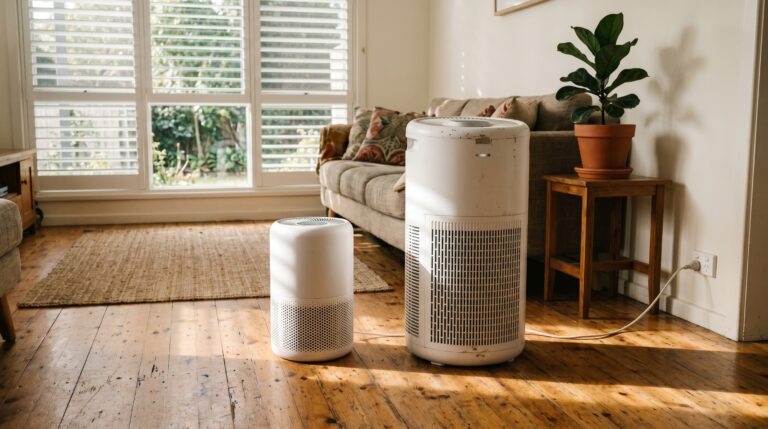
My Coway Airmega 150 on Silent at 1 m read 32.1 dBA on average on the Decibel X phone app, a phone app that is not calibrated, so treat it as a guide (left). Its pre-filter after a month in a house with a dog (right): vacuum it often in a nursery. Photos: Jayce Love.
Bushfire smoke and burn-off days
Smoke is the best reason to own a nursery purifier. Shut the windows and doors, run the purifier on high in the nursery with the baby out of the room, then keep it on a quieter setting while they sleep. NSW Health advises staying indoors with windows and doors closed and says a HEPA purifier works best in a small, well-sealed room[9]. Pregnancy, Birth and Baby notes that P2 and N95 masks are not designed for children, so a clean, closed room is the practical protection for a baby[2]. For larger homes, see the best air purifiers for bushfire smoke.
Purifiers that pass every check
All four are filter-only units with no ioniser, sized for real nurseries on the EPA rule, and in stock on Amazon Australia on 19 November 2026. Full reviews are on our picks page.
| Check | Airmega 100 | Core 300 | Airmega 50 | Airmega 150 |
|---|---|---|---|---|
| Ioniser or UV | No | None in Levoit’s manual | No | No |
| Nursery size (EPA rule) | ~15 m² | ~15 m² | ~9 m² | ~21 m² |
| Lowest noise (maker) | 20 dB(A) | 24 dB | 18.4 dB (JB Hi-Fi) | 19.98 dB(A) |
| Lights off at night | Sleep mode turns off all lighting | Display off | Not stated | Indicator light can be turned off |
| Control lock | Yes | Display lock | Not stated | Not stated |
| Sensor and Auto | Yes | No | Yes (Smart mode) | Yes |
| Filter life (maker) | About 12 months | 6 to 8 months | About 8 months | HEPA about 12 months |
1. Coway Airmega 100: best for most nurseries
 Smoke CADR108 cfmCoway spec sheet
~15 m² on the EPA rule | PM2.5 sensor and Auto mode | Sleep mode turns off all lighting | Control panel lock | 20 to 48 dB(A) | 25 W | Filter about 12 months | Sensitive Choice approved
Check the Airmega 100 on Amazon AU →Amazon AU price: $137.00 · as of 19 Nov 2026, 8:29 pm AEST DetailsThe one I’d put in most nurseries, because its particle sensor and Auto mode speed it up on their own if smoke drifts in at 2 am, and its Sleep mode turns off all lighting[10]. Coway rates it at 20 to 48 dB(A), 25 W and about a year per filter, with a control panel lock for when the baby becomes a toddler. It is approved under Sensitive Choice, the National Asthma Council’s program[11]. There is no app.
✓ Pros
- Reacts to smoke overnight without you
- Lights off and a control lock
- Filters about a year
× Cons
- No app or scheduling
- Suits up to about 15 m²
2. Levoit Core 300: budget pick, you set the speed
 CADR187 m³/hLevoit
~15 m² on the EPA rule | No ioniser or UV in Levoit’s manual | Display off and display lock | 24 to 48 dB | 33 W | Filter 6 to 8 months | No sensor
Check the Core 300 on Amazon AU →Amazon AU price: $129.00 · as of 19 Nov 2026, 8:29 pm AEST DetailsThe cheaper route to the same room size. Levoit’s Australian manual lists 187 m³/h, 24 to 48 dB and 33 W, a display you can turn off and a display lock[12]. It has no sensor, so you set the speed: high before bed, Sleep overnight. The running cost is the filter at 6 to 8 months; see my Core 300 review for the detail.
✓ Pros
- Low price; no ioniser
- Display off and lock
× Cons
- No sensor or Auto mode
- Shorter filter life
3. Coway Airmega 50: for the smallest nurseries
 Smoke CADR66.7 cfmCoway US
~9 m² on the EPA rule | Particle sensor and Smart mode | 18.4 dB on Sleep (JB Hi-Fi) | 14 W | Filter about 8 months | 1.6 kg: place it where it can’t be pulled over
Check the Airmega 50 on Amazon AU →Amazon AU price: $88.00 · as of 19 Nov 2026, 8:29 pm AEST DetailsFor a box room of about 9 m² or less. Coway US rates its smoke CADR at 66.7 cfm and its filter at about 8 months[16], and JB Hi-Fi lists 18.4 dB on Sleep and a weight of just 1.6 kg[15], so stand it on the floor where small hands can’t pull it down.
✓ Pros
- Quietest Sleep rating here
- Sensor and Smart mode
× Cons
- Small rooms only
- Light: easier to pull over
4. Coway Airmega 150: for larger rooms (the one I ran)
 My reading32.1 dBASilent, 1 m, phone app
Smoke CADR 153 (Coway) | ~21 m² on the EPA rule | Auto mode | Indicator light can be turned off | 19.98 to 48.3 dB(A) | 35 W | HEPA about 12 months | Sensitive Choice approved
Check the Airmega 150 on Amazon AU →Amazon AU price: $199.00 · as of 19 Nov 2026, 11:43 pm AEST DetailsThe purifier I ran in my own 12.5 m² bedroom. It suits a room of about 21 m², its air quality light can be switched off for sleep, and Coway rates it at 19.98 to 48.3 dB(A) and 35 W[13]; it is Sensitive Choice approved[14]. On Silent at 1 m, my phone app averaged 32.1 dBA. After burning incense in that room, my PM2.5 reading went from above 200 to below 12 µg/m³; I didn’t time it, so I won’t quote one. Full detail in my Airmega 150 review.
✓ Pros
- Bigger rooms; Auto mode
- My own noise reading and filter photo
× Cons
- Larger than a small nursery needs
- No control lock stated
Final verdict
An air purifier for a baby room is a sensible buy if smoke, heaters, traffic or pets are part of your air, and a waste if you expect it to fix eczema. Pick a filter-only unit sized by CADR, quiet on Sleep, lights off, on the far side of the room. For most nurseries that is the Coway Airmega 100; on a budget, the Levoit Core 300. For the full comparison, see the best air purifier for a baby room picks, and for the bedroom next door, the best air purifier for a bedroom.
Prices change; Amazon prices shown on this page update automatically. Check Amazon AU before buying.
Frequently asked questions
Is an air purifier safe for a newborn?
Yes, if it is a filter-only purifier with no ioniser, plasma or ozone stage, placed on the far side of the room from the cot with its cord out of reach, and run on a low setting at night. Red Nose advises keeping electrical items and cords away from the cot, and the US EPA says ozone can damage the lungs.
Does a newborn need an air purifier?
Not every nursery does, and no Australian health body recommends one for every baby. It earns its place when outside air is the problem: bushfire smoke or burn-offs, wood heaters, a busy road, or smokers or pets in the home. Pregnancy, Birth and Baby says a HEPA purifier matched to the room can reduce smoke particles indoors.
How long should I run an air purifier before putting a baby to bed?
In a closed nursery of 12 m2, a purifier with a smoke CADR of 108 cfm gives about 6.4 air changes an hour on top speed. On the perfect-mixing model behind the CDC’s removal table, that clears 90% of particles in about 22 minutes and 99% in about 43. Real rooms clear more slowly, so run it on high for 30 to 45 minutes with the door shut, then switch to Sleep.
Can I leave an air purifier on all night in a baby’s room?
Yes, on Sleep or the lowest speed. Avoid top speed overnight: three of the four purifiers here are rated at about 48 dB on high, close to the 50 dBA hourly limit for hospital nurseries cited in the 2014 Pediatrics study of infant sleep machines.
How far should the air purifier be from the cot?
On the far side of the room, ideally 2 m or more away (our rule of thumb, not an official figure), with the cord out of reach of the cot and of a crawling baby. Red Nose advises keeping cords and electrical items away from the cot.
Are ionisers or plasma purifiers safe for babies?
Avoid them in a nursery. The US EPA’s guide to air cleaners says those with ionisers may have the potential to emit ozone, and the EPA warns that inhaled ozone can damage the lungs. Choose a filter-only purifier, or one whose ion stage you can switch off.
Will an air purifier help my baby’s eczema or allergies?
None of the health sources behind this guide recommends a room purifier for eczema, and ASCIA’s allergen minimisation advice does not include room air purifiers for dust mite or pet allergen. Follow your doctor’s plan for a diagnosed allergy.
What size air purifier does a nursery need?
Size by the clean air delivery rate, not the room size on the box. The US EPA rule is a smoke CADR in cubic feet per minute of at least two-thirds of the floor area in square feet: about 65 cfm for a 9 m2 nursery and about 110 cfm for 15 m2.
- Red Nose Australia: what is a safe sleeping environment (cords and electrical items away from the cot)
- Pregnancy, Birth and Baby (Healthdirect): pregnant women, children and bushfire smoke
- NEJM Journal Watch: Hugh et al., Pediatrics 2014, infant sleep machines and the 50 dBA nursery noise limit
- ASCIA: allergen minimisation
- US EPA: guide to air cleaners in the home
- US EPA: ozone generators that are sold as air cleaners
- US EPA: how to create a cleaner air room (2/3 CADR sizing rule)
- CDC: Guidelines for Environmental Infection Control, Appendix B, Table B.1 (air changes per hour and removal times)
- NSW Health: protect yourself from bushfire smoke
- Coway Airmega 100 specification sheet (retailer copy)
- Sensitive Choice: three more Coway Airmega purifiers approved
- Levoit Core 300 (220 to 240 V) user manual
- Coway: Airmega 150 specifications
- Sensitive Choice: approved Coway air purifiers
- JB Hi-Fi: Coway Airmega 50 (18.4 dB Sleep, 1.6 kg)
- Coway US: Airmega 50 (smoke CADR, power, filter life)
Checked 19 November 2026. Links to Amazon Australia in the product sections are affiliate links; the sources above are not.

Former Royal Australian Navy Clearance Diver and TAG-E counter-terrorism operator. Founded Clean and Native to apply the same rigorous thinking to the home environment.
Full biography →The 7-Room Home Audit
Air is where most homes have their biggest free fix. The audit walks every room: 38 checks across air, water and EMF, ranked by impact against Australian guidelines.
- The rangehood habit that cuts gas cooking fumes
- Two-minute tests for exhaust fans, mould and stale bedrooms
- When a purifier helps, and the bedroom one I own
We'll email you the audit and a short series of practical guides. Unsubscribe in one click, any time. Privacy.
Sent. Taking you to your download...