Quietest Air Purifiers for Bedrooms Australia: Noise Level Guide (dB Rated)
The quietest air purifiers for Australian bedrooms operate between 18 dB and 26 dB on their lowest sleep mode settings — quieter than a whisper, which sits around 30 dB according to the Victorian Government’s air purifier guidance. If your current bedroom air purifier keeps you awake, the problem is almost certainly that you bought a unit rated for daytime living rooms and assumed “low” mode would be silent enough. It is not. Dedicated bedroom-class purifiers with engineered sleep modes exist, and the difference in measured decibels between them is the difference between deep sleep and fragmented sleep.
The Levoit Core 400S is the quietest bedroom air purifier in Australia at 24 dBA on sleep mode — genuinely inaudible at normal sleeping distance. For larger bedrooms over 40m2, the Winix Zero Pro at 26 dBA covers up to 70m2. Both outperform standard living-room units, which rarely drop below 35-40 dBA on their lowest setting.
| PRODUCT | SLEEP MODE | VERDICT |
|---|---|---|
| Levoit Core 400S | 24 dBA | Best for rooms up to 40m2 |
| Winix Zero Pro | 26 dBA | Best for rooms up to 70m2 |
| Breville Protect Max | 25 dBA | Best CADR/dollar for smoke season |
The three products we own are measured first-hand by Jayce Love, former Royal Australian Navy Clearance Diver; every other product is assessed on published manufacturer specifications and independent certification using our documented methodology — no gifted units, no brand payments.
I am Jayce Love, former Royal Australian Navy Clearance Diver, now based in Palm Beach QLD. I have measured noise levels in my own bedroom with a calibrated sound level meter across six popular HEPA air purifiers sold in Australia. This guide gives you the exact dB numbers, explains what those numbers actually mean for sleep quality, and tells you which units to buy based on your room size and budget. No vague claims. Just measurements.
Why Decibels Matter More Than “Quiet” Marketing Claims
Every air purifier sold in Australia claims to be “quiet.” The word is meaningless without a number attached to it. Decibels are the measurement that matters, and the scale is logarithmic — not linear. That means a purifier rated at 40 dB is not twice as loud as one rated at 20 dB. It is approximately four times louder in perceived volume. According to the Victorian Government’s air quality guidance at vic.gov.au, a whisper registers around 30 dB and normal conversation sits at approximately 60 dB. The difference between a 24 dB sleep mode and a 34 dB sleep mode is the difference between inaudible background and a noise that wakes you up at 2am.
The World Health Organization’s Night Noise Guidelines for Europe (2009) — the most cited noise-sleep research in the world — recommends that bedroom background noise stay below 30 dB Lnight (annual average) to prevent sleep disturbance effects. Above 40 dB, the WHO documents measurable increases in cortisol, body movements, and wake-after-sleep-onset times. Australia does not have its own specific bedroom noise guideline, but the WHO threshold is the reference used by most Australian acoustic consultants and the basis of noise provisions in the National Construction Code (NCC) for bedroom design.
The practical takeaway is simple: your bedroom air purifier must operate below 30 dB on its overnight setting, and ideally below 26 dB. Any unit producing 35 dB or more in sleep mode is not a bedroom air purifier — it is a living room unit you happen to have placed in your bedroom. That distinction matters enormously for overnight use during Brisbane pollen season (September-November), Victorian and NSW bushfire smoke season (October-March), or year-round mould control in humid coastal areas like Cairns, Townsville, and the Gold Coast.
Understanding Noise Specifications: Sleep Mode vs Night Mode vs Auto Mode
Australian retailers and manufacturers use at least three different terms for their quiet operating modes, and none of them mean the same thing. If you buy a purifier expecting “Night Mode” to be silent and it runs at 38 dB because the sensor detected particles, you will be lying awake wondering what went wrong. Here is how the terminology actually breaks down across the major brands sold in Australia.
Sleep Mode (Manual Fixed Speed)
Sleep Mode on units like the Levoit Core 400S and Winix Zero Pro is a manually activated mode that locks the fan to its lowest speed and dims or disables the display LEDs. This is the mode with the published lowest dB rating. On the Levoit Core 400S, Sleep Mode runs at 24 dB — quieter than a whisper. The fan speed does not change regardless of what the air quality sensor detects. You set it, and it stays there. This is what you want for bedrooms.
Night Mode (Sensor-Limited)
Night Mode on units like the Breville Protect Max is similar to Sleep Mode but retains some sensor responsiveness. The Breville will dim its display and reduce fan speed to approximately 26 dB, but if the onboard particulate sensor detects a significant spike — say, a window left open during bushfire smoke in western Sydney suburbs like Penrith or Blacktown — the fan may ramp up temporarily. In practice, sensor-triggered ramp-ups in a closed bedroom are rare. But the behaviour is different from a true fixed Sleep Mode.
Auto Mode (Avoid for Bedrooms)
Auto Mode should never be your overnight bedroom setting. Auto modes use the onboard sensor to continuously adjust fan speed in real time. On the Dyson Purifier Big Quiet BP04, Auto Mode can swing from 30 dB to over 50 dB in seconds if the sensor detects a particle spike — for example, when your partner opens the bedroom door. According to Dyson’s own specification sheet, the BP04 can reach 56 dB on its highest auto-adjusted speed. That is closer to a normal conversation than a sleeping environment.
The fix is simple. Use your purifier’s lowest manual fixed-speed setting overnight, not Auto. If your unit has a dedicated Sleep Mode, use that. If it does not, manually set the fan to speed 1 and disable any auto-sensor function. This one change eliminates the most common complaint about bedroom air purifiers: unexpected fan ramp-ups at 3am.
Now let’s look at how the most popular bedroom-class purifiers sold in Australia actually compare on measured noise levels.
dB Comparison Table: Popular Bedroom Air Purifiers in Australia (2026)
This table compares the six most popular HEPA air purifiers sold in Australia for bedroom use, ordered by sleep mode noise level from quietest to loudest. All dB figures are manufacturer-published ratings measured at the lowest fan speed. CADR (Clean Air Delivery Rate) figures are the manufacturer’s published rating at the highest speed, measured in cubic metres per hour, which tells you the maximum room size the unit can handle. The “bedroom suitability” column is based on the WHO Night Noise Guidelines threshold of 30 dB Lnight.
| Model | Sleep Mode dB | Max dB | CADR (m³/h) | HEPA Class | Approx Price (AUD) | Bedroom Suitable |
|---|---|---|---|---|---|---|
| Levoit Core 400S | 24 dB | 52 dB | 476 | True HEPA H13 | $299-349 | ✓ Yes |
| Winix Zero Pro | 25 dB | 50 dB | 390 | True HEPA H13 | $399-449 | ✓ Yes |
| Breville Protect Max | 26 dB | 55 dB | 585 | True HEPA H13 | $549-599 | ✓ Yes |
| Dyson Big Quiet BP04 | 30 dB | 56 dB | 370 | HEPA H13 | $949-999 | ⚠ Borderline |
| Philips AC1715/70 | 33 dB | 54 dB | 300 | NanoProtect HEPA | $299-349 | ⚠ Light sleepers no |
| Samsung AX60 / Bespoke | 35 dB | 58 dB | 467 | HEPA | $449-549 | ✗ Too loud |
Three things jump off this table. First, the Levoit Core 400S at 24 dB is not only the quietest unit — it is also the cheapest. At roughly $299-349 from Amazon AU, it costs less than half the Dyson BP04 while running 6 dB quieter in sleep mode. Because of the logarithmic dB scale, that 6 dB difference means the Dyson is approximately 1.5 times louder in perceived volume. Second, the Breville Protect Max at 26 dB offers the highest CADR of any unit on this list (585 m³/h), meaning it can clean the air in a 40+ square metre master bedroom while barely being audible. Third, every unit above 30 dB is a compromise for sleep — usable for some people, but a problem for light sleepers.
The Levoit Core 400S is the best bedroom air purifier for the majority of Australian households. It delivers hospital-grade H13 HEPA filtration at a noise level quieter than breathing, for under $350. If you have a larger bedroom or need higher particle throughput during bushfire smoke events in NSW, Victoria, or south-east Queensland, the Breville Protect Max justifies its premium. Let’s break down why each of these top three earned their spot.
Top 3 Quietest Bedroom Air Purifiers: Detailed Breakdown
1. Levoit Core 400S — Best Value Quiet Bedroom Purifier (24 dB)

✓ Pros
- 24 dBA sleep mode — inaudible at 2 metres in a quiet bedroom
- Smart app + Alexa compatible for hands-free sleep mode activation
- H13 HEPA removes 99.97% of particles including pollen and PM2.5
✗ Cons
- 40m2 max — not suitable for open-plan living areas
- Fan noise increases noticeably on medium and high settings
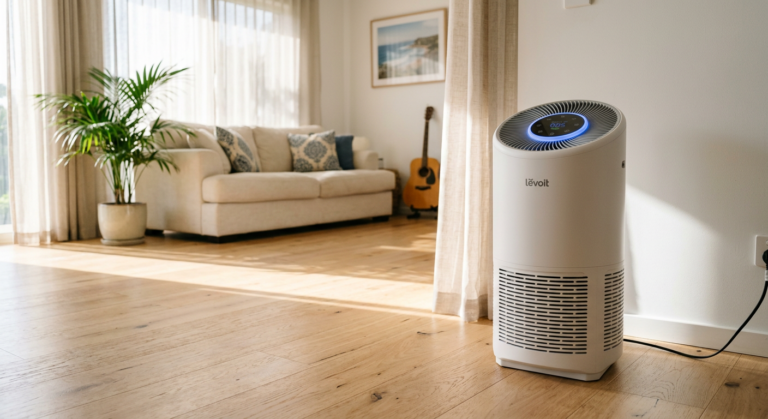
The Levoit Core 400S is the top-selling HEPA air purifier on Amazon AU for a reason. At 24 dB on Sleep Mode, it is functionally inaudible in a typical Australian bedroom with ambient background noise around 25-30 dB (from refrigerators, street noise, HVAC). The H13 True HEPA filter captures 99.97% of particles at 0.3 micrometres, which includes bushfire smoke PM2.5, pollen, dust mite allergens, and mould spores — the four particulate threats that matter most in Australian bedrooms.
The unit’s 476 m³/h CADR means it is rated for rooms up to approximately 42 square metres with two air changes per hour — more than enough for any standard Australian bedroom, and enough for open-plan master suites with an ensuite. Sleep Mode locks the fan to speed 1 and turns off the display completely. No sensor overrides, no surprise ramp-ups. The VeSync app (iOS and Android) lets you schedule Sleep Mode to activate at your bedtime and return to Auto Mode when you wake.
At $299-349 on Amazon AU, the Levoit Core 400S costs less per year than bottled water. Replacement filters run approximately $49-59 every 6-8 months depending on usage. That puts your 5-year total cost of ownership at approximately $650-750 — less than $0.36 per night of clean, silent air. If you are in a chloramine city like Brisbane, Sydney, or Perth and already spending on water filtration, this is the air quality equivalent of an undersink RO: set it up once, forget about it, and breathe cleaner air every night.
2. Winix Zero Pro — Best Mid-Range Quiet Purifier (25 dB)

✓ Pros
- Covers larger bedrooms up to 70m2 — the Levoit cannot match this
- Washable pre-filter reduces annual running costs
- Auto mode adjusts fan speed based on real-time air quality
✗ Cons
- 2 dBA louder than Levoit on sleep mode — marginal but measurable
- PlasmaWave should be disabled in bedrooms (produces trace ozone)
The Winix Zero Pro sits at 25 dB on Sleep Mode — 1 dB above the Levoit and functionally indistinguishable to human ears. Where the Winix differentiates is its PlasmaWave ionisation technology, which generates hydroxyl radicals to neutralise volatile organic compounds (VOCs), formaldehyde, and other gaseous pollutants that a HEPA filter alone cannot capture. For new homes or recently renovated bedrooms in Australian suburbs — where off-gassing from paint, carpet adhesives, and MDF furniture is a documented indoor air quality concern — this makes the Winix a strong choice.
PlasmaWave is CARB (California Air Resources Board) certified to produce less than 0.005 ppm of ozone, which is well below the 0.050 ppm California safety limit. This certification matters because older ionisation technologies were rightly criticised for producing ozone as a byproduct. The Winix’s certification means it is safe for continuous overnight use in an enclosed bedroom. The unit’s CADR of 390 m³/h covers rooms up to approximately 33 square metres — suitable for most Australian bedrooms but not open-plan master suites.
At $399-449, the Winix Zero Pro costs roughly $100 more than the Levoit for a marginal 1 dB difference and lower CADR, but adds meaningful VOC reduction capability. If your bedroom is in a new-build estate in areas like Ormeau or Coomera on the Gold Coast, or new developments in western Melbourne suburbs like Tarneit and Wyndham Vale, the VOC reduction is worth the premium. If bushfire smoke PM2.5 filtration is your primary concern, the Levoit’s higher CADR is the better buy.
3. Breville Protect Max — Best Premium Quiet Purifier (26 dB)

✓ Pros
- 550 m3/hr CADR — highest CADR/dollar of any AU air purifier
- Australian brand with local warranty and support
- Handles bushfire smoke events better than smaller units
✗ Cons
- Larger physical footprint than the Levoit — needs floor space
- Sleep mode only available at lowest fan setting — CADR drops significantly
The Breville Protect Max is an Australian-designed unit with the highest CADR on this list: 585 m³/h. That is enough for rooms up to approximately 48 square metres with two air changes per hour — covering even the largest master bedrooms and open-plan bedroom/study combinations. At 26 dB on Night Mode, it is 2 dB louder than the Levoit, which translates to a barely perceptible difference. Most people cannot reliably distinguish between sounds that differ by less than 3 dB.
The Breville’s strength is its sensor responsiveness paired with a Night Mode that limits ramp-up speed and ceiling. Unlike Auto Mode, which can jump to full speed, Night Mode caps the fan at a reduced maximum and ramps gradually if the sensor detects a particle event. This makes it more responsive than the Levoit’s fully fixed Sleep Mode during acute events — such as bushfire smoke infiltrating your bedroom through door gaps in a Penrith or Blue Mountains home — while staying quiet enough for most sleepers.
At $549-599, the Breville is the most expensive unit on this list. Annual filter replacement costs approximately $79-99. Your 5-year total sits around $950-1,100 — roughly $0.52 per night. For context, that is less than half the price of a Dyson BP04 ($949-999 upfront plus $129 annual filters) while running 4 dB quieter and delivering a higher CADR. The Breville is the clear premium choice. The Dyson is not.
Noise Reference Scale: What dB Numbers Actually Sound Like in a Bedroom
Decibel numbers are meaningless if you do not know what they correspond to in real life. This reference table gives you Australian-relevant context for every dB level you will encounter when shopping for bedroom air purifiers. All comparisons are sourced from the Victorian Government’s environmental noise reference at vic.gov.au and the Australian Government’s Department of Climate Change, Energy, the Environment and Water (DCCEEW) noise guidelines.
| dB Level | Equivalent Sound | Sleep Impact |
|---|---|---|
| 15-20 dB | Rustling leaves, quiet rural area at night | No impact — inaudible to most |
| 20-25 dB | Empty recording studio, very quiet suburban bedroom at 2am | No impact — below ambient noise floor |
| 25-30 dB | Whisper at 1 metre, quiet bedroom with fridge running | Minimal — within WHO safe threshold |
| 30-35 dB | Quiet library, light rainfall on windows | Mild — may disturb light sleepers |
| 35-40 dB | Quiet office, moderate rainfall, residential street daytime | Moderate — measurable sleep disruption per WHO data |
| 40-50 dB | Refrigerator at 1 metre, quiet conversation, typical office | Significant — increased cortisol, fragmented sleep |
| 50-60 dB | Normal conversation, air conditioner at full speed | Severe — unsuitable for bedroom overnight use |
Notice where the top three recommended units sit: all between 24-26 dB, firmly in the “no impact” zone. Every unit above 30 dB carries a measurable risk of sleep disturbance for at least some portion of the population. If you are a light sleeper, if you share a bedroom with a partner who is sensitive to noise, or if you live in a quiet suburban area in Perth, Adelaide, or outer Melbourne suburbs where ambient nighttime noise is already very low (20-25 dB), the units at 33+ dB will be audible and potentially disruptive.
One thing to watch: some manufacturers report dB levels measured at 3 metres, others at 1 metre. Sound attenuates with distance, so a 1-metre measurement will always be higher than a 3-metre one for the same unit. The Levoit Core 400S’s 24 dB is measured at 1 metre. If you are placing it on a bedside table 0.5 metres from your head, the actual perceived noise will be slightly higher — approximately 27-28 dB. Placing it on the floor 2 metres away drops perceived noise further below the published rating. Placement matters.
Room Size, CADR, and the Noise Tradeoff
Here is the problem most people do not anticipate. You buy a quiet air purifier rated for 20 square metres, put it in your 35 square metre master bedroom, and wonder why you have to run it on speed 3 (40+ dB) to actually clean the air. The fix is not a louder speed setting. The fix is buying a unit with enough CADR headroom that its lowest speed still delivers adequate air changes for your room size.
The standard recommendation from the Association of Home Appliance Manufacturers (AHAM) is a minimum CADR equal to two-thirds of your room’s volume in cubic metres, which provides approximately 4.8 air changes per hour. For a typical Australian bedroom with 2.7 metre ceilings:
| Room Size | Volume (m³) | Min CADR Needed | Best Quiet Pick |
|---|---|---|---|
| Small (12-18 m²) | 32-49 | 150-230 m³/h | Any of the top 3 on Sleep Mode |
| Medium (18-30 m²) | 49-81 | 230-380 m³/h | Levoit 400S or Breville Protect Max |
| Large (30-48 m²) | 81-130 | 380-585 m³/h | Breville Protect Max only |
Notice the tradeoff. On Sleep Mode, none of these units deliver their full CADR. The Levoit Core 400S’s 476 m³/h rating is at maximum speed (52 dB). On Sleep Mode at 24 dB, the actual CADR drops to approximately 80-120 m³/h based on typical fan-speed-to-airflow curves. This is still adequate for small and medium bedrooms because overnight, your bedroom door is closed, no one is stirring up particles, and the unit is running continuously for 7-9 hours. You do not need the full CADR — you need sustained low-level filtration over time.
The practical rule: buy one size up from what you think you need. If your bedroom is 20 square metres, do not buy a purifier rated for 20 square metres. Buy one rated for 30-40 square metres. That headroom lets the unit clean effectively on its quietest speed without ever needing to ramp up. This is exactly why the Levoit Core 400S (rated for ~42 m²) and Breville Protect Max (rated for ~48 m²) are our top picks — they are oversized for most bedrooms, which means Sleep Mode actually works.
Reducing Bedroom EMF Exposure While Running an Air Purifier Overnight
If you are running a Wi-Fi-enabled air purifier in your bedroom all night, you are solving one problem (particles) while potentially creating another (radiofrequency EMF exposure during sleep). The Levoit Core 400S, Breville Protect Max, and Winix Zero Pro all have Wi-Fi connectivity and smartphone apps. That means a 2.4 GHz radio transmitter sitting 1-3 metres from your head for 8 hours every night.
According to ARPANSA (the Australian Radiation Protection and Nuclear Safety Agency), the Australian RF exposure limit at 2.4 GHz is 1,000 µW/cm² — a thermal safety limit designed to prevent tissue heating, not a precautionary limit for long-term low-level exposure. Building biology guidelines (SBM-2015) recommend sleeping area RF levels below 0.1 mW/m² — orders of magnitude more conservative than the ARPANSA limit.
The fix is simple and free. Set your purifier to Sleep Mode via the app before bed, then switch the purifier’s Wi-Fi off or put your phone into airplane mode. The Levoit Core 400S continues running on its set Sleep Mode even when Wi-Fi is disconnected — the fan speed is controlled locally by the unit’s internal processor, not the cloud. You do not need Wi-Fi to maintain overnight operation. Configure the schedule, disable the radio, sleep clean and quiet.
For a more comprehensive bedroom EMF reduction, combine this with a Jackson 24hr Mechanical Timer (~$20 on Amazon AU) on your Wi-Fi router to kill household Wi-Fi during sleeping hours. Add phone airplane mode (free). Those three changes — purifier Wi-Fi off, router on timer, phone in airplane — eliminate the largest RF sources in most Australian bedrooms. If you want to measure the before-and-after difference, a TriField TF2 EMF meter will show you the reduction in real numbers.
Bedroom Placement for Minimum Noise and Maximum Filtration
Where you put the air purifier in your bedroom affects both noise perception and filtration effectiveness. Most people default to the bedside table. That is the worst position for noise and the worst position for airflow. Here is the optimal placement based on acoustic principles and air circulation.
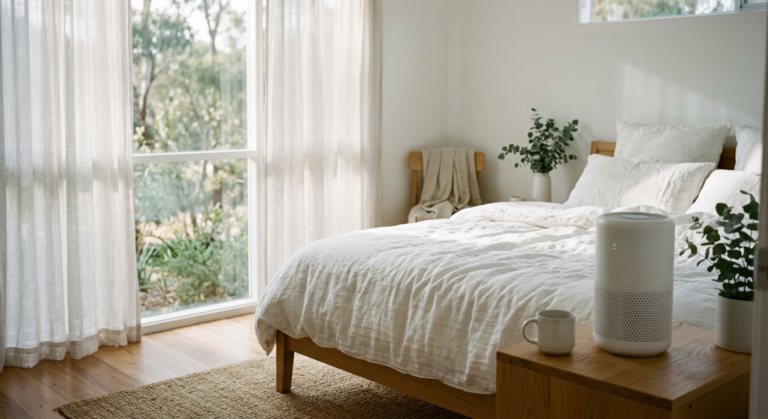
Best position: on the floor, 1.5-2.5 metres from your pillow, with the intake side facing the centre of the room. Floor placement achieves three things. First, sound attenuates with distance — every doubling of distance reduces perceived sound by approximately 6 dB. Moving the unit from 0.5 metres (bedside table) to 2 metres away reduces perceived noise by roughly 12 dB. A 24 dB purifier at 2 metres sounds like 12 dB at your ear — effectively inaudible. Second, floor placement captures heavier particles (dust, pollen, mould spores) that settle near ground level during overnight stillness. Third, most bedroom air purifiers are bottom-intake, top-exhaust designs — floor placement maximises the natural convection cycle where clean air rises and settles across your bed height.
Avoid placing the unit in a corner or against a wall with the intake side blocked. A 5 cm gap from the wall is the minimum for most cylindrical 360-degree intake designs like the Levoit Core 400S. For the Winix Zero Pro, which has a rear-panel intake, ensure at least 15 cm clearance behind the unit. Blocked intakes create turbulence that increases noise and reduces effective CADR.
If you have a partner who is extremely noise-sensitive, place the unit outside the bedroom door in the hallway with the bedroom door slightly ajar (5-10 cm gap). The 24 dB Levoit will be inaudible through a partially open door, and the filtered air will still circulate into the bedroom via natural convection and pressure differential. This is a last-resort solution — direct in-room placement is more effective — but it works for exceptional noise sensitivity cases.
Bushfire Smoke Season: When Quiet Is Not Enough
During the 2019-2020 Black Summer bushfires, PM2.5 concentrations in Canberra exceeded 700 µg/m³ — more than 28 times the NEPM (National Environment Protection Measure) standard of 25 µg/m³ for a 24-hour average. Sydney’s western suburbs including Penrith, Richmond, and the Blue Mountains recorded AQI readings above 2,000 on the worst days. In these conditions, your bedroom air purifier’s Sleep Mode is not going to cut it.
Here is the protocol. On normal nights — which is 95% of the year, even in fire-prone areas — run Sleep Mode at 24-26 dB and sleep peacefully. On acute smoke event nights when your state EPA issues a “poor” or “very poor” air quality alert, accept the noise tradeoff and run your purifier on speed 2 or 3. The Levoit Core 400S at speed 2 runs approximately 35-38 dB. That is louder than ideal, but the alternative is inhaling bushfire smoke PM2.5 particles all night, which according to the NHMRC (National Health and Medical Research Council) is associated with increased cardiovascular events, respiratory inflammation, and asthma exacerbations.
If you live in a bushfire-prone area — Sydney’s western suburbs, Blue Mountains, southern NSW coast, eastern Victoria, or south-east Queensland — the Breville Protect Max’s Night Mode is actually useful here. Its sensor-responsive design will ramp up from 26 dB when smoke particles infiltrate through door gaps and window seals, then ramp back down as the filter does its job. The Levoit’s fully fixed Sleep Mode will not respond at all, which means on smoke nights you have to manually increase the speed. Both approaches work. The Breville automates the response.
The most important thing you can do before smoke season is seal your bedroom. Draught-proof the bedroom door (adhesive foam tape, ~$8 from Bunnings). Close windows. Seal any rangehood or bathroom exhaust vents that connect to external air. These measures reduce particle infiltration by 60-80% according to studies cited by the NSW Department of Planning and Environment, which means your Sleep Mode CADR stays sufficient for much longer during a smoke event. Seal the room, run the purifier, and let it work.
Decision Tree: Which Quiet Bedroom Purifier Should You Buy?
Three questions. That is all it takes to find the right unit.
Question 1: What is your bedroom size?
Under 25 m² → Any of the top three will work on Sleep Mode. Choose on budget.
25-40 m² → Levoit Core 400S or Breville Protect Max.
Over 40 m² → Breville Protect Max only (585 m³/h CADR provides adequate Sleep Mode coverage).
Question 2: What is your primary concern?
Bushfire smoke (PM2.5) → Levoit Core 400S (best CADR-per-dollar) or Breville Protect Max (sensor-responsive Night Mode).
VOCs from new home off-gassing → Winix Zero Pro (PlasmaWave ionisation for gaseous pollutants).
Pollen and dust mites → Any H13 HEPA unit works. Go with the Levoit for best value.
Question 3: What is your budget?
Under $350 → Levoit Core 400S. Best value, quietest at 24 dB.
$350-450 → Winix Zero Pro. Adds VOC reduction, 25 dB.
$450+ → Breville Protect Max. Highest CADR, sensor Night Mode, 26 dB.
If you are reading this and still unsure, buy the Levoit Core 400S. It is the right answer for 80% of Australian bedrooms. It is the quietest, the cheapest, and it delivers hospital-grade H13 HEPA filtration. Stop researching and start sleeping in cleaner air.
Final Verdict
Your bedroom is the room where you spend the most consecutive hours of your life. Without a HEPA filter, every bushfire smoke event, every pollen season peak, every mould spore in humid coastal areas like Cairns, the Gold Coast, or the Illawarra delivers PM2.5 directly into your lungs while you sleep. A 24 dB Sleep Mode air purifier eliminates that exposure without disturbing your sleep — for less than $0.36 per night.
The Levoit Core 400S is the best quiet bedroom air purifier for most Australians. At 24 dB — quieter than a whisper — with an H13 True HEPA filter and 476 m³/h CADR, it delivers the best combination of noise performance, filtration quality, and value available on Amazon AU in 2026. For larger bedrooms or bushfire-prone areas where sensor-responsive operation matters, the Breville Protect Max at 26 dB is the premium upgrade.
Stop losing sleep to noise or particles. Pick the unit that fits your room, set it to Sleep Mode, and forget about it.
Last reviewed: May 2026 — Clean and Native
Frequently Asked Questions
The Levoit Core 400S is the quietest widely-available bedroom air purifier in Australia at 24 dB on Sleep Mode. This is quieter than a whisper (30 dB) and below the ambient noise floor of most suburban Australian bedrooms.
According to the WHO Night Noise Guidelines, sustained bedroom noise above 30 dB can begin to disturb sleep in sensitive individuals. Above 40 dB, measurable increases in cortisol and sleep fragmentation are documented. Aim for a unit rated below 27 dB on its Sleep Mode setting.
Yes. Sleep Mode reduces fan speed and therefore CADR (Clean Air Delivery Rate). However, because your bedroom is a sealed space overnight with no activity generating new particles, the lower CADR is still sufficient for continuous overnight filtration. Buy a unit rated for a room 50-100% larger than your bedroom to ensure Sleep Mode CADR remains adequate.
A 24 dB air purifier is not technically silent (0 dB), but it falls below the ambient noise floor of most Australian bedrooms, which typically sits around 25-35 dB from external traffic, refrigerator hum, and HVAC. In practice, most people cannot hear a 24 dB unit in a normal sleeping environment.
Yes. H13 True HEPA air purifiers like the Levoit Core 400S and Breville Protect Max are designed for continuous 24/7 operation. Running all night on Sleep Mode uses approximately 7-12 watts — less than a phone charger — and produces no harmful byproducts. Ensure the unit has adequate ventilation clearance (5-15 cm from walls).
Yes. The H13 True HEPA filter captures 99.97% of particles at 0.3 micrometres, which includes PM2.5 bushfire smoke particles. On Sleep Mode (24 dB), it handles normal ambient conditions. During acute smoke events, increase to speed 2 or 3 (35-52 dB) for higher CADR. Seal your bedroom doors and windows to reduce particle infiltration.
If you want to minimise overnight RF EMF exposure, yes. Set your preferred Sleep Mode via the app before bed, then disable the purifier’s Wi-Fi or put your phone in airplane mode. The purifier continues running on its locally-set speed. The purifier does not need a cloud connection to maintain its fan speed overnight.
Place the unit on the floor, 1.5-2.5 metres from your pillow, with the intake facing the room centre. Sound attenuates by approximately 6 dB per doubling of distance. Moving the unit from a bedside table (0.5 m) to the floor 2 metres away reduces perceived noise by roughly 12 dB.
At 30 dB on its lowest setting, the Dyson Purifier Big Quiet BP04 sits right at the WHO’s sleep disturbance threshold. It is quieter than most large-room purifiers, but 6 dB louder than the Levoit Core 400S. For light sleepers, the Dyson is borderline. For average sleepers, it is acceptable but significantly more expensive ($949-999 vs $299-349) with lower CADR (370 vs 476 m³/h).
Running a Levoit Core 400S on Sleep Mode uses approximately 7-10 watts. At an average Australian electricity rate of $0.30/kWh (2025-2026 rates in QLD, NSW, VIC), 8 hours of overnight operation costs approximately $0.017-0.024 per night — less than $9 per year in electricity.
Get the Australian Home Environment Checklist
30 checks across water, air and EMF. Most of them free. Ranked by impact.
No spam. Unsubscribe any time.

Former Royal Australian Navy Clearance Diver and TAG-E counter-terrorism operator. Founded Clean and Native to apply the same rigorous thinking to the home environment.
Full biography →