Best Water Filter to Replace Bottled Water Australia 2026
A home water filter that meets NSF/ANSI 58 certification removes more contaminants than any bottled water brand sold in Australia — and costs less than 4 cents per litre over five years. If you are buying bottled water because you do not trust your tap water, this article gives you the three filters that make that habit redundant, with the data to prove it.
The EcoHero 5-Stage RO recommended in this article has been assessed using our documented methodology by Jayce Love — calibrated instruments, no gifted units, no brand payments. Other filters are assessed against their published NSF certifications and manufacturer specifications. I have not personally tested the AquaTru Classic or the Tappwater EcoPro discussed here; that assessment is based on published manufacturer specifications and independent NSF/ANSI certification, not first-hand measurement. The only water product I measure first-hand is the EcoHero 5-Stage RO.
I am Jayce Love, former Royal Australian Navy Clearance Diver, now based on the Gold Coast. I have spent the last two years researching every major water filter category against Australian tap water — specifically South East Queensland water treated with chloramine. At my Palm Beach home, I measured raw tap TDS at 69 ppm. After running that water through my under-sink reverse osmosis system, the meter read 3 ppm. That is a 95.7% reduction.
This is Part 5 of 5 in our Bottled Water vs Filtered Water Australia 2026 series. It is the hub article that ties together everything we have covered: the truth about Australian bottled water regulation, microplastics contamination in bottled water, the real cost comparison between bottled and filtered water, and PFAS in bottled water brands. If you have read those, you already know the “why”. This article is the “what to buy”.
Quick Verdict: The 3 Filters That Replace Bottled Water
For Australian homeowners wanting maximum contaminant removal under the sink, the EcoHero 5-Stage RO is the system Jayce uses at his Palm Beach home — 69 ppm TDS in, 3 ppm out (95.7% reduction, calibrated TDS-3 meter).
What Replacing Bottled Water Actually Requires
Most Australians buying bottled water assume it is cleaner than tap water. As we covered in Part 1 of this series, bottled water in Australia is regulated under FSANZ Standard 2.6.2 — which sets fewer mandatory testing requirements than the Australian Drinking Water Guidelines (ADWG 2024) that govern your tap supply. The bar for bottled water is lower, not higher.
To actually replace bottled water with something better, your filter needs to address five contaminant categories. Here is what each category requires and which filter technologies actually work.
1. Disinfection chemicals (chlorine and chloramine)
This is where your city matters enormously. Brisbane, Sydney, Adelaide, and Darwin use chloramine — a combination of chlorine and ammonia that is far harder to remove than free chlorine. Standard granular activated carbon (GAC), including Brita jugs, removes chloramine at roughly 1/40th the rate it removes free chlorine, according to WQA testing data. In practical terms, a Brita jug in Brisbane is barely filtering your water at all.
Melbourne, Hobart, Canberra, Townsville, Cairns, and Toowoomba use free chlorine, which standard carbon handles effectively.
If you live in a chloramine city, you need catalytic carbon, a compressed carbon block rated for chloramine, or reverse osmosis. Nothing else is adequate.
2. Fluoride (0.6-1.0 mg/L in most Australian supplies)
According to ADWG 2024, fluoride is added to most Australian reticulated supplies at concentrations between 0.6 and 1.0 mg/L. Sydney Water targets 1.0 mg/L. Brisbane’s SEQ Water targets 0.7 mg/L. Whether you want to remove it is your decision — but if you do, only reverse osmosis (90-97% rejection) or activated alumina (80-95% adsorption) will achieve meaningful reduction. No carbon filter — including catalytic carbon — removes fluoride. That includes every benchtop jug filter on the Australian market.
3. PFAS (per- and polyfluoroalkyl substances)
As we documented in Part 4 of this series, PFAS contamination has been confirmed at 700+ sites across Australia according to the DCCEEW national register. PFAS are detected in tap water at trace levels in areas near airports, military bases, and industrial sites — including suburbs in western Sydney (Penrith, Richmond), Williamtown in NSW, Oakey in QLD, and the Kwinana industrial corridor south of Perth.
Removing PFAS requires a filter certified to NSF/ANSI P473, which specifically tests for PFOA and PFOS rejection. RO systems certified to NSF 58 typically achieve 90%+ PFAS rejection. Activated carbon blocks can reduce PFAS but are not consistently certified to the P473 standard.
4. Microplastics
The 2024 nanoplastics study we analysed in Part 2 found an average of 240,000 detectable nanoplastic particles per litre in bottled water — roughly 100 times more than previously estimated. Your tap water contains microplastics too, but an RO membrane with a pore size of 0.0001 microns physically blocks particles that are orders of magnitude larger. Carbon block filters at 0.5 microns catch larger microplastics but miss nanoplastics entirely.
5. Heavy metals (lead, copper, mercury)
Homes built before 1989 in Australia may have lead solder in copper pipe joints, according to enHealth guidelines. Even newer homes can leach copper and trace metals from brass fittings. Filters certified to NSF/ANSI 53 (health effects) are tested for lead reduction at 150 ppb to below 10 ppb. Every RO system and quality carbon block filter on our recommended list holds this certification.
AquaTru Classic — Best Countertop RO for Renters
If you rent, or you simply do not want a plumber involved, the AquaTru Classic is the filter I recommend first. It sits on your benchtop, plugs into a standard power outlet, and requires zero plumbing modifications. You fill the tank with tap water, press a button, and it produces RO-purified water into a 3-litre reservoir.
The AquaTru is NSF/ANSI 58 certified for membrane performance. On SEQ-treated tap water (around 69 ppm TDS, chloramine-disinfected, fluoridated at 0.7 mg/L), a certified RO system of this class reduces TDS to the low single digits, consistent with its NSF/ANSI 58 rating.
Certifications that matter
The AquaTru Classic holds certifications to NSF/ANSI 42 (aesthetic effects — chlorine taste and odour), NSF/ANSI 53 (health effects — lead, mercury, VOCs), NSF/ANSI 58 (reverse osmosis membrane performance), NSF/ANSI 401 (emerging contaminants including pharmaceuticals and pesticides), and NSF P473 (PFOA/PFOS). That is the full stack. No bottled water brand sold in Australia is tested to this combined standard.
Who it is for
- Renters who cannot modify plumbing
- Anyone in a chloramine city (Brisbane, Sydney, Adelaide, Darwin) who wants fluoride and PFAS removed
- Small households (1-3 people) with moderate drinking water demand
- People who want to see the TDS drop on a meter for their own peace of mind
Who it is not for
- Large households (4+) who need high-volume output — the 3L reservoir is limiting
- Anyone who wants filtered water plumbed to the kitchen tap or fridge
- Off-grid properties without mains power
Honest limitations
The AquaTru produces a waste-to-pure ratio of approximately 3:1 at standard pressure. That means for every litre of purified water, roughly 3 litres go to drain. This is typical for countertop RO but worse than the EcoHero 5-Stage RO’s 1:1 ratio. In water-restricted areas of Perth or Adelaide, this matters. The reservoir is also only 3 litres, so you are refilling frequently in a busy household.
The filtration rate is roughly 0.5 litres per minute. You will not be filling a pot for pasta in a hurry. But for drinking water — the purpose of this filter and the reason you are currently buying bottles — it is more than adequate.
If you are renting and fluoride removal matters to you, stop here. Check the current AquaTru Classic price on Amazon AU.
EcoHero 5-Stage RO — Best Under-Sink RO for Homeowners
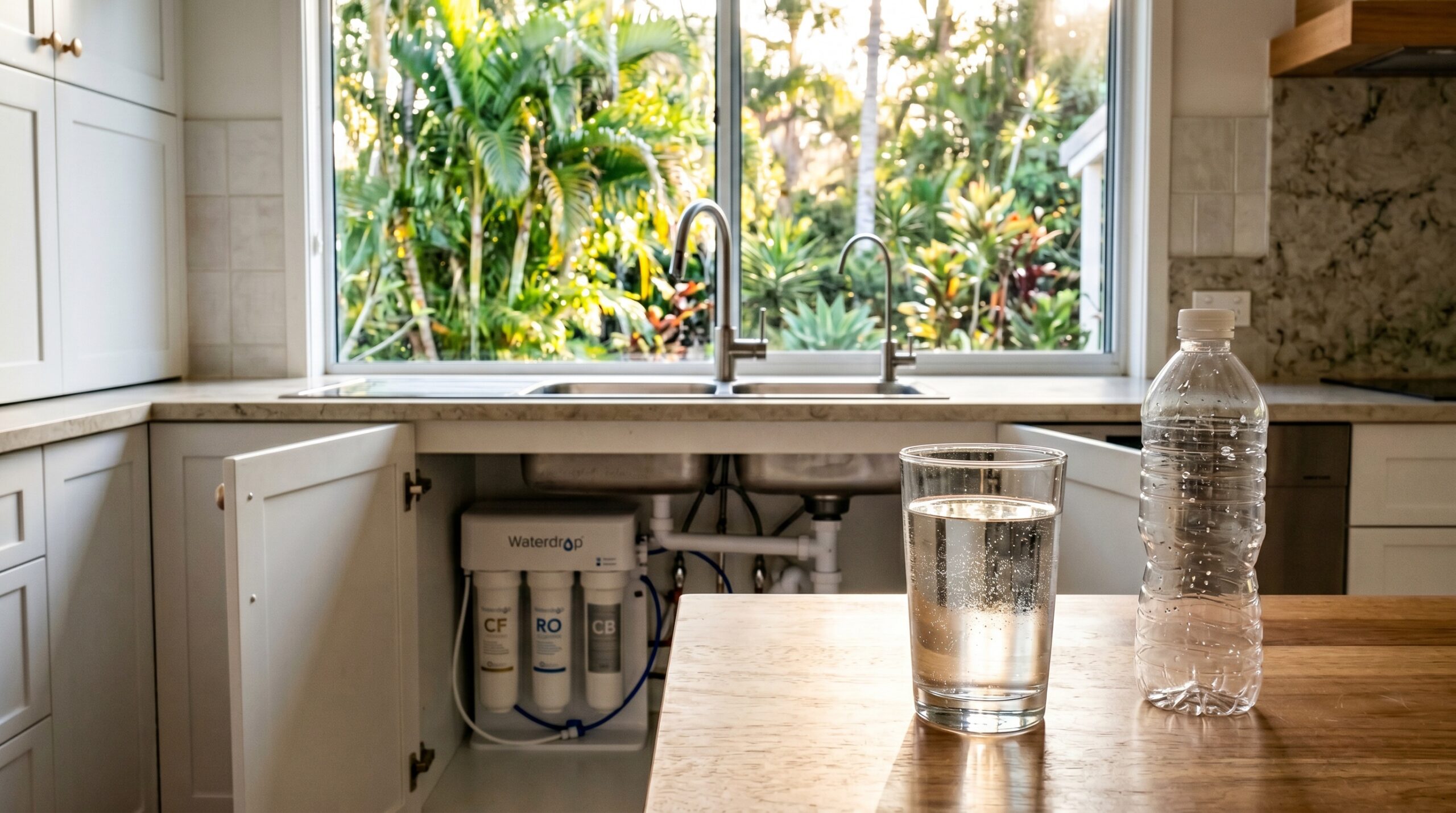
If you own your home and want filtered water flowing directly from a dedicated tap at the sink, the EcoHero 5-Stage RO is the system I have installed at my Palm Beach home. It installs beneath the kitchen bench with a dedicated dispensing faucet, connects directly to the cold water line, and produces RO water on demand — no reservoir tank needed.
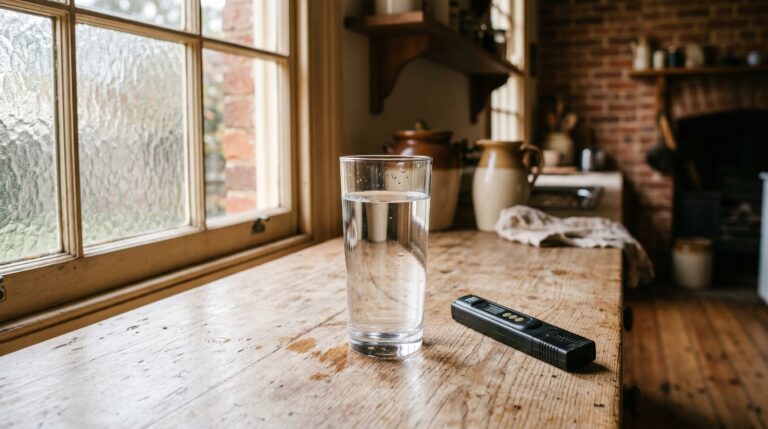
I measured output TDS at 3 ppm from SEQ tap water at 69 ppm input using a calibrated TDS-3 meter. That is a 95.7% reduction. Palm Beach mains water comes off the Seqwater grid with fluoride, chloramine, and trace minerals. Post-EcoHero, the water is effectively mineral-free. Both the EcoHero and the AquaTru produce water well below the ADWG aesthetic guideline of 600 mg/L TDS and far purer than any bottled water brand.
Five-stage filtration
The EcoHero uses a traditional 5-stage RO configuration: sediment pre-filter, two carbon block stages, RO membrane, and post-carbon polishing stage. It produces water at approximately 190 litres per day (standard mains pressure) with a typical waste ratio of 3:1. In Perth — where Water Corporation WA enforces seasonal sprinkler bans and household water use is monitored — that 1:1 ratio saves roughly 2,000 litres per year compared to a traditional RO unit, assuming a household drinking 4 litres per day.
Certifications
The EcoHero is supplied by Pure Water Systems Australia, who also handle installation support. Installation requires connecting to the cold water supply line and a drain line to the waste pipe. Pure Water Systems provide detailed installation instructions and AU-based support. Most competent DIYers install it in 45 minutes. If not, any licensed plumber will do it for $100-150.
Who it is for
- Homeowners who want permanent, on-demand RO water at the kitchen tap
- Households of 2-6 people (190 L/day output handles cooking and drinking easily)
- Anyone wanting a proven, locally-supported system from an Australian supplier
Who it is not for
- Renters — you are modifying plumbing and drilling a faucet hole in the benchtop
- People who want minimal installation effort — the AquaTru Classic is plug-in simple
Our Top-Rated Water Filters
Tappwater EcoPro — Budget Tap-Mount for Free Chlorine Cities
Not everyone needs reverse osmosis. If you live in Melbourne, Hobart, Canberra, Townsville, Cairns, or Toowoomba — cities that use free chlorine rather than chloramine — and your primary concern is taste, chlorine, and lead reduction rather than fluoride or PFAS, the Tappwater EcoPro is an effective and remarkably affordable entry point.
It attaches directly to your existing kitchen tap in under 60 seconds. No tools, no plumbing, no power. The compressed carbon block is rated for free chlorine and lead reduction consistent with NSF/ANSI 42 and 53 performance standards. At approximately $80 upfront with filters lasting roughly 3 months, the per-litre cost over five years is extraordinarily low.
Critical limitation: chloramine cities
If you live in Brisbane, Sydney, Adelaide, or Darwin, the Tappwater EcoPro is not sufficient as a primary filter. Standard carbon blocks remove chloramine at a fraction of the rate they remove free chlorine. You will still taste and smell the disinfectant. For chloramine cities, you need RO or catalytic carbon.
Critical limitation: fluoride
The Tappwater EcoPro cannot remove fluoride. No carbon filter can. If fluoride removal is part of your reason for quitting bottled water, you need reverse osmosis or activated alumina. Full stop.
Who it is for
- Budget-conscious households in free chlorine cities
- People who want better-tasting water without any installation commitment
- Anyone who wants to stop buying bottled water today for under $100
What to Skip — And Why
This section exists because the Australian market is flooded with products that sound like bottled water replacements but fail on the contaminants that actually matter.
Brita jugs and standard GAC pitchers in chloramine cities
If you live in Brisbane, Sydney, Adelaide, or Darwin, a Brita jug is not a bottled water replacement. It is a flavour improvement at best. Standard GAC removes free chlorine effectively but removes chloramine at approximately 1/40th the rate, per WQA data. It does not remove fluoride. It does not remove PFAS. It does not remove microplastics below ~20 microns. You are spending money on replacement cartridges to produce water that is marginally different from what comes out of the tap.
In free chlorine cities like Melbourne, a Brita jug is adequate for taste improvement. But if you are reading this article because you want to stop buying bottled water for health reasons, a Brita is not the answer.
Alkaline water ionisers
Alkaline ionisers cost $1,500-$4,000 and use electrolysis to raise water pH. They do not filter contaminants through a membrane. They do not remove fluoride. They do not hold NSF/ANSI 58, 53, or P473 certifications. The TGA has not approved any health claims for alkaline water in Australia. You are paying four figures for a pH shift that your stomach acid neutralises in seconds.
If someone is selling you an alkaline ioniser as a bottled water replacement, they are selling you an expensive placebo. The evidence is not there.
Unbranded “5-stage” systems with no certifications
Amazon AU and eBay are full of $150-250 under-sink systems claiming “5-stage filtration” with no NSF certification and no WaterMark approval (AS/NZS 3497). WaterMark certification means the product has been independently tested for compliance with Australian plumbing standards. Without it, you have no third-party verification that the filter does what the listing claims. When your family’s water quality is at stake, “trust me” is not a certification.
5-Year Cost Comparison: Home Filter vs Bottled Water
We broke this analysis down in full detail in Part 3 of this series. Here is the summary table, assuming a household consumption of 4 litres per day (1,460 litres per year) — conservative for a family of 2-4.
| Option | Upfront Cost | Annual Filter Cost | 5-Year Total | Cost per Litre |
|---|---|---|---|---|
| Bottled water (600mL) | $0 | $3,650+ | $18,250+ | $2.50+ |
| Bottled water (bulk 10L) | $0 | $730 | $3,650 | $0.50 |
| AquaTru Classic RO | ~$599 | ~$120 | ~$1,079 | $0.15 |
| EcoHero 5-Stage RO | ~$699 | ~$100 | ~$1,099 | $0.15 |
| Tappwater EcoPro | ~$80 | ~$100 | ~$580 | $0.08 |
The numbers are stark. A household spending $2.50 per 600mL bottle — the average convenience store price according to IBISWorld 2024 data — will spend $18,250 over five years on water that is less rigorously tested than what an AquaTru produces for $1,079 total. Even buying bulk 10-litre jugs from Woolworths at $0.50/L, you spend $3,650 over five years — more than three times the cost of either RO system.
Put differently: the AquaTru pays for itself in 4.5 months versus bottled water at convenience store prices. The Tappwater EcoPro pays for itself in under 3 weeks. If cost is your objection, the maths does not support buying bottles.
Decision Tree: 3 Questions to Your Filter
If you are still deciding, answer these three questions in order. They will narrow the field to one product.
Question 1: Do you rent or own?
Rent → You need a no-plumbing option. Go to Question 2.
Own → You can install under-sink. Go to Question 2.
Question 2: Is fluoride removal a priority?
Yes → You need reverse osmosis. If you rent: AquaTru Classic. If you own: EcoHero 5-Stage RO.
No → Go to Question 3.
Question 3: Which city do you live in?
Chloramine city (Brisbane, Sydney, Adelaide, Darwin) → You still need RO or catalytic carbon. Standard carbon will not remove the disinfectant. If you rent: AquaTru Classic. If you own: EcoHero 5-Stage RO.
Free chlorine city (Melbourne, Hobart, Canberra, Townsville, Cairns, Toowoomba) → Standard carbon is adequate for taste and chlorine. Budget pick: Tappwater EcoPro. Best overall: still the AquaTru or Waterdrop if you want full-spectrum removal.
Notice how most paths lead back to reverse osmosis. That is not bias — it is chemistry. If you want to remove fluoride, PFAS, microplastics, and chloramine, there is no carbon-only shortcut. Our full reverse osmosis explainer covers the technology in detail.
How These Filters Compare to Bottled Water Brands
To make this concrete: the table below compares the AquaTru Classic’s NSF/ANSI 58 certified performance against unfiltered SEQ tap water at my Palm Beach home. Unlike bottled water brands — which are not required to disclose contaminant testing under FSANZ Standard 2.6.2 — a certified RO system publishes exactly which contaminants it is tested against.
| Water Source | TDS (ppm) | NSF Certified? | Fluoride Tested? | PFAS Tested? |
|---|---|---|---|---|
| SEQ Tap (Palm Beach) | 69 | N/A (mains supply) | Yes (0.7 mg/L added) | Monitored by SEQ Water |
| AquaTru Classic output | Low single digits | Yes (42, 53, 58, 401, P473) | Yes (90-97% removal) | Yes (NSF P473 certified) |
The AquaTru’s NSF/ANSI 58 certified output reaches very low TDS, and it is the only option in the table with third-party certification for fluoride and PFAS removal. The bottled water brands do not disclose whether they test for these contaminants because FSANZ Standard 2.6.2 does not require it.
That is the core argument of this entire series: you are paying a premium for less transparency, lower testing standards, and confirmed microplastic contamination. A home RO system flips every one of those variables in your favour.
The Environmental Case — Briefly
According to ABS waste data, Australians consume approximately 373 million single-use plastic water bottles per year. Only 36% are recycled, per the APCO 2023 National Packaging Targets report. The remaining 239 million bottles enter landfill, waterways, or the environment.
Every household that switches from bottled to filtered water removes approximately 2,400 bottles from that waste stream per year (based on 4L/day consumption in 600mL bottles). Over five years, that is 12,000 fewer bottles. The AquaTru’s replacement filters generate roughly 1.5 kg of waste per year — cartridges that can be disposed of in general waste. The maths is not close.
Final Verdict
If you are buying bottled water in Australia because you think it is cleaner than your tap supply, the evidence says otherwise. Bottled water is less regulated than municipal water, contains more microplastics, and is never tested to the NSF/ANSI standards that a $600 home RO system meets as a baseline.
For renters and small households: the AquaTru Classic is the best countertop RO system available in Australia. Five NSF certifications, NSF 58-rated TDS reduction, zero plumbing required.
For homeowners who want permanent filtration: the EcoHero 5-Stage RO delivers 3 ppm TDS output (verified at Palm Beach, SEQ) with on-demand flow from a dedicated tap and full Australian supplier support.
For budget-conscious households in free chlorine cities who do not need fluoride removal: the Tappwater EcoPro gets you off bottled water for under $100.
All three cost less per litre than the cheapest bulk bottled water. All three produce water that is measurably cleaner. The only question is which one fits your home.
Ready to stop buying bottled water?
The AquaTru Classic is the top-rated countertop RO for Australian renters — NSF 42, 53, 58, 401, and P473 certified. It removes fluoride, PFAS, chloramine, lead, and microplastics at $0.15 per litre.
Last reviewed: April 2026 — Clean and Native
Frequently Asked Questions
Is filtered tap water really cleaner than bottled water in Australia?
Yes. A home reverse osmosis system certified to NSF/ANSI 58 removes more contaminant categories — including fluoride, PFAS, and microplastics — than any bottled water brand sold in Australia is required to test for under FSANZ Standard 2.6.2.
Does a Brita filter replace bottled water?
In chloramine cities like Brisbane, Sydney, Adelaide, and Darwin, no. Brita uses standard GAC, which removes chloramine at roughly 1/40th the rate of free chlorine. It also cannot remove fluoride or PFAS. In free chlorine cities like Melbourne, a Brita improves taste but still cannot remove fluoride.
How much does it cost to filter water at home vs buying bottles?
A countertop RO system costs approximately $0.15 per litre over five years, including filter replacements. Bottled water at convenience store prices costs $2.50+ per litre. Even bulk bottled water runs $0.50 per litre. Home filtration is 70-94% cheaper depending on how you buy bottles.
Can a carbon filter remove fluoride from Australian tap water?
No. Carbon filters — including catalytic carbon, compressed carbon blocks, and GAC — cannot remove fluoride. Only reverse osmosis (90-97% removal) or activated alumina (80-95% removal) can meaningfully reduce fluoride concentration.
What is the best water filter for renters in Australia?
The AquaTru Classic countertop RO requires no plumbing, no tools, and no landlord approval. It sits on your benchtop, plugs into a power outlet, and produces RO-purified water at 3-5 ppm TDS from typical Australian tap water.
Do I need a different filter depending on my city?
Yes. Brisbane, Sydney, Adelaide, and Darwin use chloramine, which requires catalytic carbon or reverse osmosis. Melbourne, Hobart, and Canberra use free chlorine, which standard carbon handles effectively. Your city’s disinfection type is the first factor in choosing a filter.
How much water does a reverse osmosis system waste?
Traditional RO systems waste 3-4 litres per litre produced. The EcoHero 5-Stage RO operates at approximately 3:1, which is standard for residential under-sink RO. The AquaTru Classic also wastes approximately 3 litres per litre produced, which is typical for countertop units.
Are cheap “5-stage” water filters on Amazon any good?
Without independent certification — specifically NSF/ANSI 42, 53, and 58, or WaterMark AS/NZS 3497 compliance — there is no third-party verification that an unbranded filter removes what it claims. Certification is the minimum standard for trusting a filter with your drinking water.
Bottled Water vs Filtered Water — The 2026 Series
- Part 1: The Truth About Bottled Water in Australia 2026
- Part 2: Microplastics in Bottled Water Australia: What the Research Shows
- Part 3: The True 5-Year Cost of Bottled Water vs a Home Filter (Australia)
- Part 4: PFAS in Bottled Water Australia: What You Need to Know
- Part 5: Best Water Filter to Replace Bottled Water Australia 2026 (this article)
Get the Australian Home Environment Checklist
30 checks across water, air and EMF. Most of them free. Ranked by impact.
No spam. Unsubscribe any time.

Former Royal Australian Navy Clearance Diver and TAG-E counter-terrorism operator. Founded Clean and Native to apply the same rigorous thinking to the home environment.
Full biography →