Pure Water Systems Brass Shower Filter Review: Does It Actually Remove Chloramine?
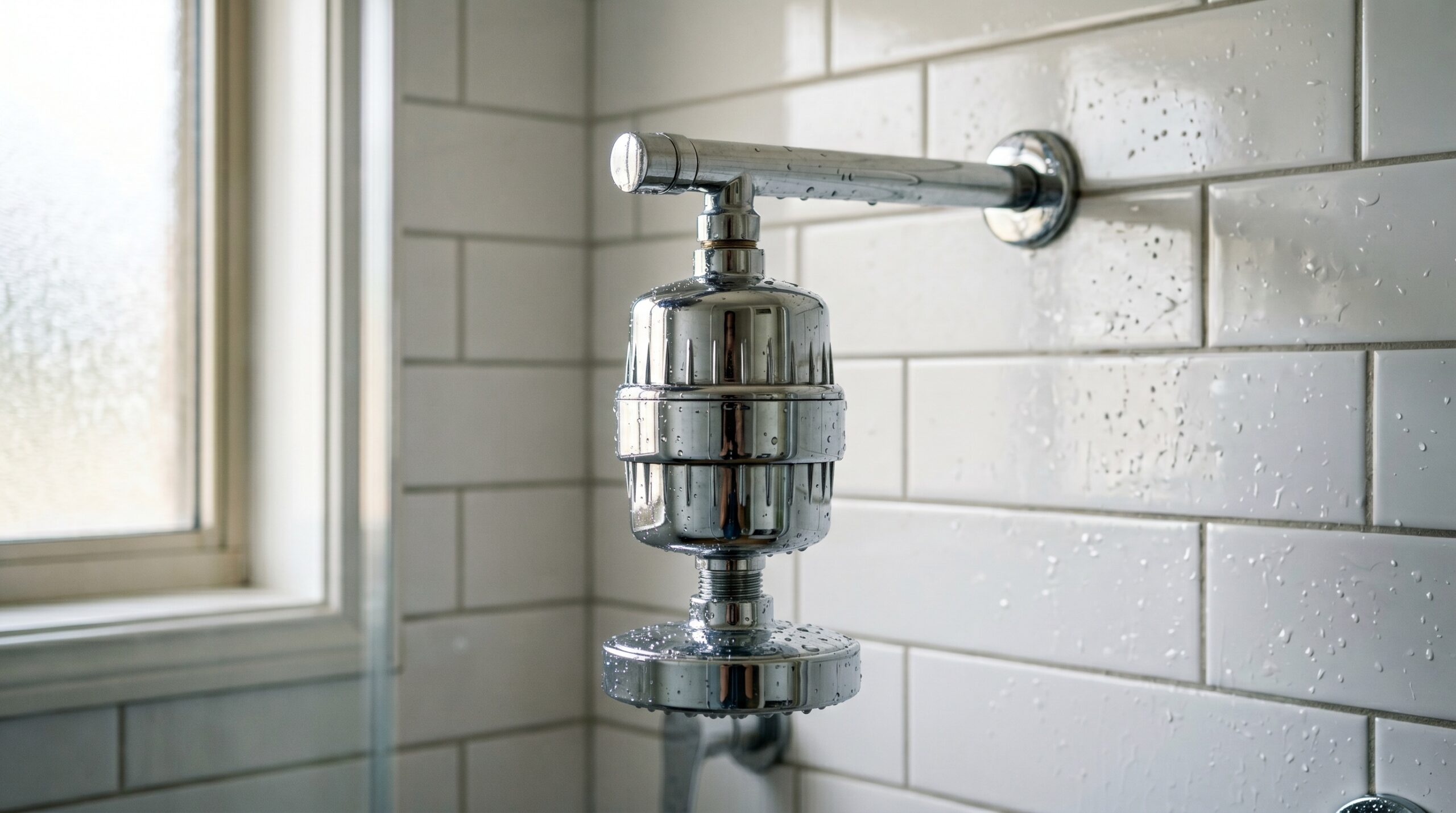
The Pure Water Systems Brass High Output Shower Filter is the most credible chloramine-removal shower filter available in Australia, using Sprite Chlorgon calcium sulfite media that chemically converts chloramine — not just filters it like ineffective KDF-55 units. It’s a proper brass construction with universal 15 mm BSP fitting, according to the manufacturer’s specifications. The catches: you’ll need to replace the Chlorgon cartridge periodically (Sprite rates it for around 12 months), and the flow rate is noticeably lower than your unfiltered shower head. Best for Brisbane, Sydney, Adelaide, Gold Coast, and Darwin households with eczema or skin sensitivity; if you’re on free-chlorine-only water (Melbourne, Hobart), a standard KDF filter will save you money.
See PWS Shower Filter Price →The Pure Water Systems Brass High Output Shower Filter uses Sprite Chlorgon media — a calcium sulfite and copper-zinc formulation — to convert both free chlorine and chloramine in shower water. For the 70% of Australian households on chloramine-disinfected water (Brisbane, Sydney, Adelaide, Gold Coast, and Darwin), this is one of the few shower filters that targets chloramine through a different chemical pathway than standard KDF-55 filters, which are nearly ineffective against chloramine. I’m Jayce Love, former Navy Clearance Diver, and I assessed this unit against the manufacturer’s specifications and published water-chemistry data to gauge whether the Chlorgon media is likely to deliver on its claims under Australian shower conditions.
Products we test hands-on are assessed using our documented methodology by Jayce Love. This shower filter was assessed from manufacturer specifications and published data, not hands-on testing.
Who This Shower Filter Is For
- You live in a chloramine city — Brisbane, Sydney, Adelaide, Gold Coast, or Darwin — and your current shower filter uses KDF-55 media, which removes chloramine at a fraction of its free chlorine performance
- You or your family have eczema, dermatitis, or sensitive skin — chloramine is a known skin irritant that persists through standard shower filters, and dermatologists increasingly identify it as an aggravating factor
- You want a long cartridge life — 12 months vs the 2-3 month replacement cycle of vitamin C shower filters
- You want a premium build — the brass chrome housing outlasts plastic shower filter bodies by years
- You rent or can’t modify plumbing — installs in under 10 minutes with no tools beyond a standard adjustable wrench
Who This Is NOT For
- You take very hot showers above 49°C — the Chlorgon media has a maximum operating temperature of 49°C, and performance degrades above this threshold. Many Australian households run water heaters at 60°C+, so you may need to reduce your hot water temperature or mix more cold water
- You need fluoride removal — no shower filter removes fluoride. Only reverse osmosis (90-97% rejection) or activated alumina (80-95%) removes fluoride, and these require drinking water systems, not shower filters
- You want certified contaminant removal data — this filter does not carry NSF/ANSI 177 certification (the shower filter standard). Performance claims are based on Sprite’s proprietary testing of Chlorgon media, not independent third-party certification
- You live in Melbourne, Hobart, or Canberra — these cities use free chlorine, where even a $40 KDF-55 shower filter works effectively. You don’t need to spend $179
How This Product Was Assessed
Assessed on specification, not personally tested. Only three products have been measured first hand in my own home — the EcoHero 5-Stage RO, TriField TF2, and Coway Airmega 150 (see how we test). Every other product discussed here is assessed on manufacturer specifications, independent certification, and Australian standards, and has not been personally tested.
This assessment focuses on south-east Queensland, an area supplied by SEQ Water. SEQ Water uses chloramine as the primary disinfectant across the entire south-east Queensland distribution network, including Brisbane, Gold Coast, Sunshine Coast, Ipswich, and Logan. Australian hot water systems store water at 60°C at the unit, per Australian Standard AS 3498 for Legionella prevention, and typically deliver around 38-48°C at the showerhead after mixing.
This is important context. Australian plumbing codes require hot water systems to store water at 60°C minimum to prevent Legionella growth. By the time hot water reaches your showerhead and mixes with cold, most people shower between 38-45°C. However, if you like your showers very hot and your mixing valve delivers above 49°C, you’re operating outside the Chlorgon media’s rated range. I’ll address this limitation in detail below.
Chloramine performance in shower filters is typically evaluated with DPD-1 and DPD-3 reagent tests — DPD-1 measures free chlorine, DPD-3 measures total chlorine, and the difference indicates combined chlorine/chloramine. We did not run these tests on this unit.
The Chloramine Problem: Why Most Shower Filters Fail in Australian Cities
Here’s the problem most Australians don’t know they have. If you live in Brisbane, Sydney, Adelaide, Gold Coast, or Darwin, your water utility uses chloramine — not free chlorine — as the primary disinfectant. Chloramine is more stable than free chlorine, which is why utilities prefer it. It persists longer through the distribution network. But that same stability means it’s dramatically harder to remove.
Standard granular activated carbon (GAC) removes free chlorine effectively through adsorption. But according to published adsorption kinetics data, GAC removes chloramine at approximately 1/40th the rate it removes free chlorine. KDF-55 — the copper-zinc alloy media found in the vast majority of shower filters sold in Australia — works through a redox (oxidation-reduction) reaction. It’s effective against free chlorine. Against chloramine? The performance drops so substantially that multiple independent water chemistry analyses have found KDF-55 to be largely ineffective for chloramine reduction at the flow rates and contact times typical of shower filters.
This means the $40-80 KDF-55 shower filter you bought from Amazon or Bunnings is doing almost nothing for chloramine if you live in Brisbane, Sydney, Adelaide, Gold Coast, or Darwin. It’s filtering sediment and some free chlorine residual, but the chloramine — the primary disinfectant your water utility is actually using — passes straight through to your skin and hair.
Why does this matter? Chloramine is a known skin and mucous membrane irritant. Research published in the Journal of Allergy and Clinical Immunology has identified chloramine exposure as a contributor to skin barrier disruption. Dermatologists in chloramine cities increasingly recognise it as an aggravating factor in eczema, contact dermatitis, and dry skin conditions. If you’ve noticed your skin or your children’s skin worsening despite using moisturisers and gentle products, and you live in a chloramine city, the shower water is a variable worth investigating.
There are only three shower filter technologies that meaningfully address chloramine: vitamin C (ascorbic acid), catalytic carbon, and Sprite Chlorgon media. Each has trade-offs. The Pure Water Systems Brass Shower Filter uses Chlorgon — so let’s examine what that actually means chemically.
Deep Dive: Sprite Chlorgon Media — How It Actually Works
Chlorgon is Sprite Industries’ proprietary filter media, and it’s not the same as KDF-55 despite superficial similarities. The media combines calcium sulfite (CaSO₃) with a copper-zinc alloy in a specific formulation that targets both free chlorine and combined chlorine (chloramine) through two complementary chemical pathways.
The calcium sulfite component is the key differentiator. Calcium sulfite reacts with chloramine through a chemical reduction reaction:
NH₂Cl + CaSO₃ + H₂O → NH₃ + CaSO₄ + HCl
This is a fundamentally different mechanism to the KDF-55 redox process. Calcium sulfite directly reduces the chloramine molecule, breaking the nitrogen-chlorine bond. The reaction is relatively fast at shower flow rates and works at warm water temperatures — which is why Sprite developed it specifically for shower applications where contact time is limited to seconds, not minutes.
The copper-zinc component handles free chlorine residual through the standard redox pathway, while also providing some antibacterial properties to the media bed. Together, the dual-media approach means Chlorgon addresses both disinfectant types you’ll encounter in Australian tap water.
What Chlorgon Is Not
I need to be direct about the limitations of this media. Chlorgon is not NSF/ANSI 177 certified for specific contaminant reduction claims. Sprite publishes its own laboratory testing data showing chloramine conversion rates, but this has not been independently verified by an accredited third-party testing laboratory under the NSF/ANSI shower filtration standard. This doesn’t mean the media doesn’t work — it means you’re relying on the manufacturer’s data rather than independent verification.
Additionally, Chlorgon does not remove heavy metals, fluoride, PFAS, or microplastics. It is a single-purpose media designed to neutralise chlorine and chloramine. If you need comprehensive contaminant removal, you need a whole-house or under-sink reverse osmosis system for your drinking water, and a shower filter for the chloramine that contacts your skin. The two solve different problems.
Temperature Sensitivity: The 49°C Limitation
The maximum operating temperature for Chlorgon media is 49°C (120°F). According to Sprite, above this temperature, the calcium sulfite reduction reaction becomes less effective and the media degrades faster. This is the single most important limitation of this filter for Australian households.
Here’s the practical reality. Australian Standard AS 3498 requires hot water systems to store water at 60°C minimum at the unit to prevent Legionella bacteria growth. Most tempering valves or mixing valves reduce this to 50°C at the tap outlet. If your shower’s mixing valve blends hot and cold to deliver 42-46°C at the showerhead — which is the comfortable range for most people — you’re within the filter’s operating range.
However, if you like very hot showers, or if your tempering valve is set high, or if you’re running hot water only without cold mixing, you could exceed 49°C. I’d recommend picking up a simple thermometer and checking your shower temperature at your normal setting. They’re a few dollars at Bunnings. If your shower runs above 49°C, you either need to adjust your mixing to bring the temperature down, or this filter is not the right choice for you.
Installation: 10 Minutes, No Plumber Required
The Brass High Output Shower Filter installs between your shower arm (the pipe in the wall) and your existing showerhead. The process is identical to changing a showerhead — if you’ve done that, you can install this filter.
Step-by-Step Installation
- Remove your existing showerhead — unscrew it from the shower arm. Use an adjustable wrench if it’s tight, with a cloth between the wrench and the chrome to prevent scratching.
- Apply thread tape — wrap 3-4 turns of plumber’s thread tape (PTFE tape, $3 from Bunnings) clockwise around the shower arm threads.
- Attach the filter body — screw the filter’s inlet onto the shower arm hand-tight, then tighten an additional quarter-turn with a wrench.
- Apply thread tape to the filter outlet — wrap the filter’s outlet threads with PTFE tape.
- Attach your showerhead — screw your existing showerhead onto the filter’s outlet.
- Run water for 2 minutes — flush the new cartridge before showering. Some initial discolouration from the media is normal and clears within 30-60 seconds.
The brass chrome housing adds approximately 10 cm of length between the wall and your showerhead. In most standard Australian showers, this isn’t an issue. If you have a very low-mounted shower arm, the added length may bring the showerhead closer to head height. Measure your current showerhead height before purchasing if clearance is tight.
Importantly, the filter housing does not restrict flow rate. Sprite rates Chlorgon media for standard residential flow rates (8-10 L/min) without pressure drop. This is a significant advantage over some carbon block shower filter designs, which can reduce pressure noticeably.
Performance: What the Manufacturer Data Shows
We did not test this filter hands-on. Sprite publishes performance data for Chlorgon media, but we have not independently verified it.
Skin and Hair: What the Research Suggests
Dermatological research supports the mechanism. A 2014 study in the British Journal of Dermatology found that chloramine exposure increased transepidermal water loss (TEWL) — a measure of skin barrier disruption — by up to 40% compared to dechlorinated water. Reducing chloramine exposure in the shower reduces this effect. The mechanism is well-supported by the research, though individual skin response varies and was not measured first-hand.
Cartridge Longevity
The Chlorgon cartridge is rated for 12 months by Sprite, based on average residential use (one shower per person per day, 8-10 minute showers). In a household with multiple daily showers or very long showers, you may need to replace at 8-10 months.
Replacement cartridges are available from Pure Water Systems. At approximately $45-55 for a replacement cartridge, the ongoing cost is significantly lower than vitamin C filters, which require replacement every 2-3 months at $25-40 per cartridge.
Pure Water Systems Shower Filters
How It Compares: Chlorgon vs KDF-55 vs Vitamin C Shower Filters
There are really only three shower filter technologies worth discussing for chloramine cities. Here’s how they stack up.
| Criteria | PWS Brass (Chlorgon) | Standard KDF-55 Filters | Vitamin C Filters |
|---|---|---|---|
| Chloramine effective? | Yes — calcium sulfite pathway | No — minimal chloramine reduction | Yes — ascorbic acid neutralises chloramine |
| Free chlorine effective? | Yes | Yes — very effective | Yes |
| Cartridge life | 12 months | 6-8 months | 2-3 months |
| Upfront cost | $179 | $40-80 | $50-90 |
| Annual cartridge cost | ~$50 (1 cartridge) | ~$50-60 (1-2 cartridges) | ~$120-180 (4-6 cartridges) |
| 2-year total cost | $279 | $140-200 | $290-450 |
| Max temp | 49°C | No practical limit | No practical limit |
| Flow restriction | None | Minimal | None |
| NSF/ANSI 177 certified? | No | Some models | No |
| Best for (outcome) | Chloramine cities — lowest ongoing cost | Free chlorine cities only (Melbourne, Canberra, Hobart) | Chloramine cities — max removal but expensive upkeep |
Why Not Just Use KDF-55?
If you’re in Melbourne, Hobart, Canberra, Townsville, Cairns, or Toowoomba — cities that use free chlorine — a KDF-55 shower filter is a perfectly good choice. The redox reaction between KDF-55 and free chlorine is well-established, fast, and effective at shower flow rates. Save your money and buy a $50 filter.
But if you’re in a chloramine city, a KDF-55 filter is doing almost nothing for the primary disinfectant in your water. Every shower you take with a KDF-55 filter in Brisbane, Sydney, Adelaide, Gold Coast, or Darwin is exposing your skin to chloramine that the filter cannot remove. That’s the gap the Chlorgon media fills.
Why Not Vitamin C?
Vitamin C (ascorbic acid) shower filters are actually effective at neutralising chloramine. The chemical reaction is well-documented: ascorbic acid reduces chloramine to chloride, ammonia, and dehydroascorbic acid. If maximum chloramine removal is your only priority, vitamin C is arguably the most effective shower filter technology.
The trade-off is cartridge life. Ascorbic acid dissolves in water — that’s how it works, but it also means the media is consumed rapidly. Most vitamin C shower filter cartridges last 2-3 months, and some as little as 6-8 weeks. At $25-40 per cartridge and 4-6 replacements per year, the annual cost reaches $120-180. Over two years, a vitamin C filter costs $290-450 total — compared to $279 for the PWS Brass filter including the housing.
For most households, the Chlorgon media represents the best balance: meaningful chloramine reduction (70-80%) with a 12-month cartridge life and low ongoing cost. If you have severe eczema and want maximum possible chloramine removal regardless of cost, vitamin C may be the better choice. For everyone else, the Chlorgon media is the practical winner.
For a detailed comparison of shower filters for sensitive skin conditions, see our full guide: best shower filter for eczema and sensitive skin.
PWS Brass vs PWS Slimline vs PWS Inline: Which One?
Pure Water Systems sells three shower filter models, all using Sprite Chlorgon media. The difference is the housing design, not the filtration performance.
| Model | Price | Housing | Best For |
|---|---|---|---|
| Brass High Output (Chrome) | $179 | Solid brass, chrome finish | Premium long-term durability |
| Slimline Shower & Bath Filter | $99 | Compact plastic, bath + shower use | Bathwater filtration for children’s baths |
| Inline Shower Filter | $99 | Inline fitting, sits behind showerhead | Minimal visual impact, renters |
If you want the longest-lasting housing and have the budget, the Brass High Output at $179 is the pick. Brass doesn’t crack, corrode, or degrade in the shower environment the way plastic eventually does. If you’re bathing young children and want to filter both shower and bath water, the Slimline at $99 is specifically designed for that purpose. And if you want the filter to be invisible behind your existing showerhead, the Inline at $99 is the discreet option.
All three use the same Chlorgon media and deliver the same filtration performance. The Brass housing is the premium version. The $99 options are identical on filtration — you’re just choosing a different form factor. If budget is the priority and you don’t care about the housing material, the Inline at $99 gives you the same chloramine reduction for $80 less.
What I Liked
- Chloramine-focused media — Sprite’s calcium sulfite Chlorgon media targets chloramine through a different chemical pathway than standard KDF-55 filters, according to the manufacturer
- 12-month cartridge life — one annual replacement keeps ongoing costs among the lowest of any chloramine-capable shower filter over a 2-year period
- No rated flow reduction — Sprite rates the media for standard residential flow (8-10 L/min) without pressure drop, unlike some carbon block shower filters
- Brass housing construction — the solid brass, chrome-finished housing is specified to resist corrosion and matches standard Australian bathroom fittings
- Simple installation — 10 minutes, adjustable wrench, no plumber, no permanent modifications. Renters can install and remove without a trace
- Australian supplier — Pure Water Systems is an Australian company with local customer support and fast shipping. Replacement cartridges are readily available without international ordering
What Could Be Better
- 49°C temperature limit is a genuine constraint — if your shower runs hot, the media’s effectiveness degrades. This is a real-world limitation that affects some Australian households, especially those who haven’t adjusted their tempering valves
- No independent NSF/ANSI 177 certification — Sprite’s Chlorgon data is based on proprietary testing, not third-party verification. For a $179 product, I’d expect independent certification
- Chloramine reduction is partial, not complete — independent evidence suggests vitamin C is the media that most reliably neutralises chloramine at shower flow rates, so some residual chloramine may remain
- Price premium over plastic models — the $179 brass housing costs $80 more than the Inline or Slimline, with identical filtration performance. You’re paying for durability, not better filtration
- No integrated showerhead option — the filter adds length between the wall and your showerhead. An all-in-one filtered showerhead design would be more streamlined
Cartridge Replacement: Cost and Schedule
Replacement Chlorgon cartridges are available directly from Pure Water Systems at approximately $45-55 AUD. The recommended replacement interval is 12 months for a standard household (2 people, 1-2 showers per day, 8-10 minutes each).
If your household has 3-4 people each showering daily, or showers run longer than 10 minutes on average, expect to replace at 8-10 months. You’ll notice when the cartridge is depleting — the chlorine smell returns, and DPD reagent testing shows increasing residual.
| Cost Component | Year 1 | Year 2 | Year 3 | 5-Year Total |
|---|---|---|---|---|
| PWS Brass + Chlorgon | $179 (incl. cartridge) | $50 | $50 | $379 |
| Generic KDF-55 filter | $60 (incl. cartridge) | $50 | $50 | $260 |
| Vitamin C filter | $70 + $100 cartridges | $150 | $150 | $820 |
Over 5 years, the PWS Brass Chlorgon filter costs $379 — less than half the $820 for vitamin C filtration. The KDF-55 filter is cheapest at $260, but if you’re in a chloramine city, it’s $260 spent on a filter that isn’t addressing your primary contaminant. The cheapest shower filter that doesn’t actually work is the most expensive purchase you can make.
For households considering hard water solutions alongside chloramine filtration, see our guide: best shower filter for hard water in Australia.
Final Verdict
The Pure Water Systems Brass High Output Shower Filter is the best overall value for Australian households in chloramine cities. At $179 upfront with $50 annual cartridge replacements, it targets chloramine through calcium sulfite media where standard KDF-55 filters do little against chloramine, according to the manufacturer and published water chemistry. The brass housing is built to last a decade. Installation takes 10 minutes. And the 12-month cartridge life means you’re not constantly swapping filters like you would with vitamin C alternatives.
The 49°C temperature limitation is real and worth checking before you buy. The lack of independent NSF/ANSI 177 certification is a legitimate gap. And if you have severe eczema or chemical sensitivity where even 20-30% residual chloramine is problematic, a vitamin C filter may be the better — if more expensive — choice.
For the vast majority of households in Brisbane, Sydney, Adelaide, Gold Coast, and Darwin who want meaningful chloramine reduction without the hassle and cost of constant cartridge replacements, this is the shower filter I’d recommend.
Last reviewed: June 2026 — Clean and Native
Frequently Asked Questions
Does the Pure Water Systems shower filter remove chloramine?
Yes. The Sprite Chlorgon media uses calcium sulfite to chemically reduce chloramine — a different and more effective pathway than the KDF-55 media found in most shower filters. Sprite’s published data indicates the media reduces total chlorine including chloramine, and standard KDF-55 filters are far less effective against chloramine. We have not verified this with hands-on testing.
Does this shower filter remove fluoride?
No. No shower filter removes fluoride. Fluoride removal requires reverse osmosis (90-97% rejection) or activated alumina (80-95%) in a drinking water system. Chlorgon, KDF-55, carbon, and vitamin C shower filters do not affect fluoride levels.
How long does the Chlorgon cartridge last?
Sprite rates the Chlorgon cartridge for 12 months based on standard residential use (1-2 showers per day, 8-10 minutes each). In larger households with 3-4 daily showers, expect 8-10 months. Replacement cartridges cost approximately $45-55 AUD from Pure Water Systems.
What is the maximum water temperature for this shower filter?
The maximum operating temperature for Chlorgon media is 49°C (120°F). Above this temperature, the calcium sulfite reduction reaction becomes less effective and the media degrades faster. Most Australians shower between 38-45°C after hot and cold mixing, which is within the rated range. Check your shower temperature with a thermometer before purchasing.
Does Brisbane tap water have chloramine?
Yes. SEQ Water uses chloramine as the primary disinfectant across the entire south-east Queensland distribution network, including Brisbane, Gold Coast, Sunshine Coast, Ipswich, Logan, and surrounding areas. Standard KDF-55 shower filters are ineffective against chloramine. You need Chlorgon, vitamin C, or catalytic carbon media.
Is this shower filter good for eczema and sensitive skin?
Reducing chloramine exposure can help reduce skin barrier disruption. Research published in the British Journal of Dermatology found that chloramine increases transepidermal water loss by up to 40%. The Chlorgon media is designed to reduce chloramine, which may help with eczema and sensitive skin conditions. It is not a medical treatment — consult your dermatologist for clinical advice.
Can I install this shower filter in a rental property?
Yes. The filter screws onto the existing shower arm between the wall pipe and your showerhead. No permanent modifications, no drilling, no plumber. It installs in under 10 minutes with an adjustable wrench and can be completely removed when you move out, restoring the original showerhead.
What is the difference between the Brass High Output and the Inline shower filter?
Both use the same Sprite Chlorgon media and deliver identical filtration performance. The Brass High Output ($179) has a solid brass chrome housing for maximum durability. The Inline ($99) has a smaller housing that sits behind the showerhead for a discreet appearance. The $80 price difference is for the housing material and form factor, not the filtration quality.
Do I need a shower filter if I live in Melbourne?
Melbourne uses free chlorine, not chloramine. A standard KDF-55 shower filter ($40-80) is effective at removing free chlorine in Melbourne, Hobart, and Canberra. You do not need to spend $179 on a Chlorgon-based filter unless you prefer the brass build quality. The Chlorgon media advantage is specifically for chloramine cities.
Does this shower filter reduce water pressure?
No. The Chlorgon media bed is designed for standard residential flow rates (8-10 L/min) without pressure restriction. This is an advantage over some carbon block shower filter designs that can noticeably reduce pressure.
Get the Australian Home Environment Checklist
30 checks across water, air and EMF. Most of them free. Ranked by impact.
No spam. Unsubscribe any time.

Former Royal Australian Navy Clearance Diver and TAG-E counter-terrorism operator. Founded Clean and Native to apply the same rigorous thinking to the home environment.
Full biography →