Melbourne Tap Water Quality 2026: What’s Actually In It?
Drafted with AI assistance and checked against published specifications and certifications. First-hand measurements appear only where stated. How we make content
Melbourne’s tap water is among the safest, cleanest municipal supplies in Australia — no filtration is required for safety. It’s sourced from pristine mountain catchments with TDS around 60 mg/L, far lower than most bottled water. The catches: Melbourne uses free chlorine (not chloramine) for disinfection, which means taste and odour can be noticeable, especially in summer; fluoride is added at 1.0 mg/L (the upper NHMRC limit); and some older distribution pipes may leach trace metals in specific suburbs.
| Concern | Melbourne Level | Verdict |
|---|---|---|
| Free chlorine taste/odour | 0.5–1.0 mg/L (noticeable) | Simple carbon filter fixes this |
| Fluoride (1.0 mg/L) | Upper NHMRC guideline | RO needed if removing |
| Microbiological safety | E. coli 0/100mL (excellent) | No filter required |
Melbourne’s tap water is, frankly, excellent by global standards — and by Australian standards it’s exceptional. Drawn from protected mountain catchments covering over 157,000 hectares of closed, uninhabited wilderness, the source water arrives at treatment facilities with a TDS of around 60 mg/L: purer than most bottled water brands sold in Australian supermarkets.
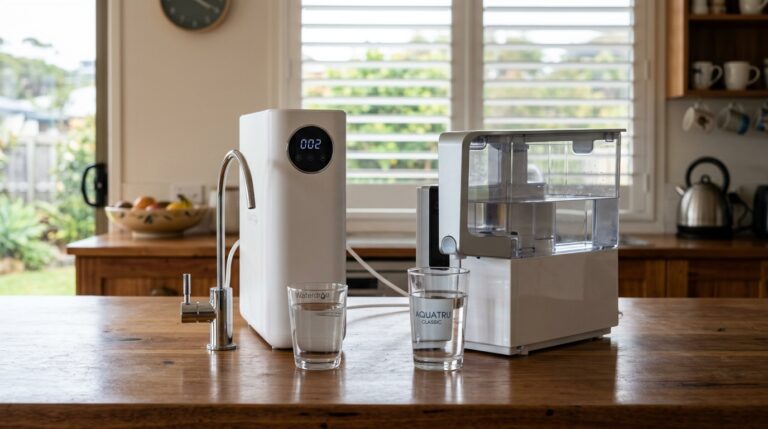
The three products we own are measured first-hand by Jayce Love, former Royal Australian Navy Clearance Diver; every other product is assessed on published manufacturer specifications and independent certification using our documented methodology — no gifted units, no brand payments.
But “safe to drink” and “ideal to drink” aren’t quite the same thing. Melbourne adds fluoride at 1.0 mg/L (the upper end of the NHMRC guideline range), uses free chlorine for disinfection, and the water travels through distribution pipes — some of them old — before reaching your tap. Understanding exactly what’s in your glass lets you make a rational decision about whether to filter, what to filter for, and how to choose the right technology.
This guide covers the 2025–26 water quality data, explains why Melbourne’s free chlorine disinfection is relevant to filter buying decisions (unlike in Brisbane or Sydney), and gives honest recommendations for when a filter genuinely adds value — and when it doesn’t.
Melbourne’s Mountain Catchments: Why the Source Matters
Melbourne Water manages nine major catchment reservoirs covering 157,662 hectares of protected forest east and north of the city. The largest are:
- Thomson Reservoir (180,000 ML capacity) — the primary supply, fed by alpine snowmelt and rainfall in the Thomson River catchment
- Maroondah Reservoir — one of Melbourne’s oldest, drawing from the Maroondah catchment in the Yarra Ranges
- Upper Yarra Reservoir — second-largest, fed by the Upper Yarra River; closed catchment since 1892
- Cardinia Reservoir — the key storage for the south-eastern suburbs
Around 85% of Melbourne’s water comes from these closed catchments — areas where public access is prohibited, farming is banned, and native forest remains largely undisturbed. This is why Melbourne’s source water is so clean: there is no agricultural runoff, no industrial discharge, and no vehicle or recreational pollution in the water before it even reaches a treatment plant.
The remaining ~15% comes from the North–South Pipeline (from the Goulburn system) and local groundwater sources during dry periods, which can slightly increase TDS and hardness. In wet years, almost all supply is closed-catchment water.
Melbourne Water Quality Data 2026
Melbourne Water and Yarra Valley Water publish annual water quality reports under the Safe Drinking Water Act 2003 (Vic). The 2024–25 figures, representative of what comes out of your tap in metropolitan Melbourne:
| Parameter | Melbourne Level | ADWG Guideline | What It Means |
|---|---|---|---|
| TDS | ~60 mg/L | <600 mg/L | Exceptionally pure; lowest of any major AU capital |
| Hardness (CaCO₃) | ~25 mg/L | No guideline (aesthetic) | Very soft — no limescale, better lather |
| Fluoride | ~1.0 mg/L | 0.6–1.1 mg/L | Upper end of guideline range; added as H₂SiF₆ |
| pH | 7.4–7.6 | 6.5–8.5 | Ideal — neutral to mildly alkaline |
| Chlorine residual | 0.2–0.6 mg/L | <5 mg/L | Free chlorine only — no chloramine |
| Turbidity | <0.1 NTU | <5 NTU | Crystal clear; excellent filtration at plants |
| E. coli | 0 / 100 mL | 0 / 100 mL | Compliant — treated and disinfected |
| Lead | <0.001 mg/L | <0.01 mg/L | Very low in treated supply; old plumbing risk |
| THMs (disinfection byproducts) | <20 µg/L | <250 µg/L | Very low; low organic matter in source water |
| PFAS (PFOA + PFOS) | Not detected | <0.07 µg/L | Protected catchments = no PFAS sources |
Sources: Melbourne Water Annual Drinking Water Quality Report 2024–25; Australian Drinking Water Guidelines 2011 (updated 2022), NHMRC/NRMMC.
Free Chlorine vs Chloramine: The Filter Buying Decision You Need to Understand
This is the most important water chemistry fact for Melbourne residents choosing a filter — and it’s almost never explained clearly.
Melbourne Water disinfects using free chlorine. Most other major Australian capitals — Brisbane (and all SEQ), Sydney, Adelaide, Gold Coast, and Darwin — have switched to chloramine (a combination of chlorine and ammonia) because it persists longer in distribution networks.
Why does this matter for your filter purchase?
Melbourne residents can successfully remove chlorine taste and odour with a standard Brita pitcher or basic carbon filter. This option simply does not work for Brisbane, Sydney, Adelaide or Perth residents.
In practical terms: if you’re a Melbourne resident who just wants better-tasting water, a $40–60 Brita pitcher filter with standard activated carbon will do exactly what you’re hoping for. The same filter bought in Brisbane is almost useless for chlorine removal because Brisbane uses chloramine.
Melbourne’s low organic content in source water also means THM (trihalomethane) formation — a disinfection byproduct concern in chlorinated water — is extremely low (<20 µg/L versus the guideline of 250 µg/L). The clean source water combined with free chlorine disinfection produces a very low byproduct load.
Melbourne Water Hardness: What Very Soft Water Actually Means
At ~25 mg/L CaCO₃, Melbourne’s water is classified as “very soft” — significantly softer than most Australian capitals:
| City | Hardness (mg/L CaCO₃) | Classification |
|---|---|---|
| Melbourne | ~25 | Very soft |
| Hobart | ~15 | Very soft |
| Sydney | ~50 | Soft |
| Brisbane | ~100 | Moderately hard |
| Canberra | ~40 | Soft |
| Adelaide | ~140 | Hard |
| Perth | ~180 | Hard to very hard |
Practical implications of very soft Melbourne water:
- No limescale — kettles, coffee machines, dishwashers, and showerheads won’t develop white mineral deposits. Residents moving from Adelaide or Perth often notice this immediately.
- Good lather — soaps, shampoos, and detergents lather easily. You use less product than in hard water cities.
- No water softener needed — unlike residents in Perth, Adelaide, or parts of regional Victoria, metropolitan Melbourne households have zero need for a water softener.
- Mild corrosivity — very soft, slightly acidic water (before fluoride/pH adjustment) can be mildly corrosive to copper and lead pipes. Melbourne Water adjusts pH to 7.4–7.6 to minimise this, but older homes with lead solder joints remain a risk (see below).
- Shower filter compatibility — KDF-55 media and standard activated carbon shower filters work effectively in Melbourne (free chlorine, low TDS). Unlike in Brisbane or Sydney where chloramine defeats most shower filter technologies.
Fluoride in Melbourne Water
Melbourne’s water is fluoridated at ~1.0 mg/L — the upper end of the NHMRC recommended range of 0.6–1.1 mg/L. Melbourne Water uses hexafluorosilicic acid (H₂SiF₆) as the fluoridation agent, which fully dissociates in water to free fluoride ions (F⁻) — chemically identical to the fluoride in toothpaste or naturally occurring mineral water.
The dental health case: At 1.0 mg/L, Melbourne’s fluoridation is consistent with decades of evidence supporting reduced childhood tooth decay. The Australian Dental Association supports community water fluoridation as a public health measure. For most Melbourne residents drinking tap water, fluoride exposure is within established safe limits.
The precautionary case: Some residents prefer to reduce fluoride intake based on concerns about cumulative exposure, infant formula preparation, thyroid health, or personal preference. This is a valid personal choice. The research on fluoride at Australian drinking water levels is extensively reviewed — concerns focus mainly on infants under 6 months (where formula made with fluoridated water may contribute to dental fluorosis in developing teeth) and individuals with impaired kidney function who can’t excrete fluoride as efficiently.
What filters remove fluoride?
- Reverse osmosis (RO) — removes 90–97% of fluoride. The most effective household method. Systems like the AquaTru benchtop RO are suitable for Melbourne apartments with no plumbing modifications.
- Activated alumina filter — removes 80–95% of fluoride when properly maintained. Found in some Doulton and Puretec under-sink units.
- Standard activated carbon (Brita etc.) — does NOT meaningfully remove fluoride. People often buy these thinking they help; they don’t for fluoride.
- Berkey with PF-2 elements — the PF-2 post-filters add activated alumina specifically for fluoride removal. The base black filters alone don’t remove fluoride.
Lead, Heavy Metals and Old Melbourne Plumbing
Melbourne Water’s treated supply contains very low levels of lead (<0.001 mg/L, well under the ADWG guideline of 0.01 mg/L). However, the distribution network and your home’s internal plumbing are a different matter.
The lead pipe problem: Homes built before 1970 in Melbourne may have lead service lines (the pipes connecting the street main to your property boundary) or lead-based solder in internal copper plumbing. Melbourne Water has been progressively replacing lead service lines, but some remain. The very soft, slightly acidic nature of Melbourne’s source water (before pH adjustment) makes it mildly more corrosive than hard water — meaning it’s more likely to leach trace metals from old pipes.
High-risk scenarios:
- Heritage homes in inner suburbs (Carlton, Fitzroy, Collingwood, Richmond, South Melbourne) built before 1950
- First draw of water after the tap has been unused for several hours (lead levels are highest in stagnant water)
- Homes that haven’t had plumbing renovated since the 1980s
What to do: If your home is pre-1970, run the cold tap for 30–60 seconds before drinking or cooking with water that’s been sitting in pipes. For certainty, a simple lead test kit (available from Bunnings, ~$30) or a professional water test through Melbourne Water’s program can confirm. A quality carbon block under-sink filter with NSF 53 certification for lead reduction provides additional protection.
PFAS and Emerging Contaminants
Melbourne’s closed, protected catchments provide a significant advantage here. PFAS (per- and polyfluoroalkyl substances) contamination in Australian water sources is almost exclusively linked to:
- AFFF firefighting foam used at airports, military bases, or industrial sites
- Agricultural runoff from properties using PFAS-containing products
- Industrial sites with historical PFAS discharge
None of these sources are present in Melbourne’s closed mountain catchments. The Victorian EPA’s monitoring program has not identified PFAS concerns in Melbourne’s treated water supply. This contrasts with some interstate water sources (particularly near RAAF bases and industrial areas) where PFAS monitoring remains ongoing.
Microplastics are an emerging area of research. Melbourne Water’s current testing doesn’t detect microplastics above reporting thresholds, though this is partly a function of detection methodology. For those concerned about microplastics, reverse osmosis systems with fine membranes (0.0001 micron) provide effective removal.
Melbourne vs Other Australian Capitals: How Do You Compare?
| City | TDS | Hardness | Fluoride | Disinfection | Overall |
|---|---|---|---|---|---|
| Melbourne | ~60 | Very soft | 1.0 mg/L | Free Cl₂ | Excellent |
| Sydney | ~80 | Soft | 1.0 mg/L | Chloramine | Good |
| Brisbane/SEQ | ~140 | Moderate | 0.7 mg/L | Chloramine | Good (harder) |
| Adelaide | ~400 | Hard | 0.9 mg/L | Chloramine | Fair (salty) |
| Perth | ~170 | Hard | 0.7 mg/L | Chloramine | Good |
| Canberra | ~50 | Soft | 0.7 mg/L | Free Cl₂ | Excellent |
| Hobart | ~25 | Very soft | 0.7 mg/L | Free Cl₂ | Excellent |
Do Melbourne Residents Actually Need a Water Filter?
The honest answer: for health reasons alone, no. Melbourne’s tap water meets all ADWG standards, has an excellent safety record, and comes from some of the cleanest protected catchments in the world. You can drink it straight from the tap with confidence.
But there are legitimate, non-alarmist reasons to filter Melbourne water:
Worth filtering for:
- Chlorine taste or odour — the most common complaint. Even low levels of free chlorine are detectable by sensitive palates, especially in cold water. A basic carbon filter is genuinely effective here (and importantly, it actually works in Melbourne unlike in chloramine cities).
- Coffee and tea brewing — baristas and tea enthusiasts know that TDS and mineral content affect extraction. Melbourne’s low TDS and softness is actually excellent for filter coffee and espresso. The one drawback is trace chlorine, which a carbon filter removes.
- Fluoride concerns — if you’re preparing infant formula, are pregnant, or have a thyroid condition, and want to reduce fluoride intake, an RO system is the appropriate technology.
- Older home with legacy plumbing — if there’s a realistic possibility of lead service lines or old solder joints, filtration adds a meaningful safety margin.
Not worth filtering for:
- TDS or hardness — Melbourne’s water is already at excellent levels. A whole-house RO system would produce water too low in minerals for comfortable daily drinking.
- General contaminants — PFAS, nitrates, pesticides, and industrial chemicals are not meaningful concerns in Melbourne’s protected catchment supply.
- Alkaline water / pH adjustment — Melbourne’s water at pH 7.4–7.6 is already in the ideal range. Alkaline water filters don’t provide the health benefits their marketing claims.
Best Water Filters for Melbourne: By Concern
Just want better-tasting water? Carbon pitcher or benchtop filter
Melbourne’s free chlorine disinfection means standard activated carbon is all you need for taste and odour improvement. This is where Melbourne residents have an advantage over Brisbane or Sydney counterparts — a basic $40–80 pitcher filter does the job.
Look for NSF/ANSI Standard 42 certification (taste and odour reduction). Replacement cartridge cost runs $20–35 every 2–3 months for a typical household. The Brita Maxtra+ and equivalent brands are widely available at Coles, Woolworths, and online.
Fluoride removal: Reverse osmosis
Reverse osmosis is the most reliable technology for fluoride removal (90–97% reduction). A benchtop RO like the AquaTru compact is suitable for Melbourne apartments — it requires no plumbing installation, sits on the benchtop, and produces filtered water on demand.
For under-sink installation, the Puretec Hybrid-G series offers multi-stage filtration including activated alumina for fluoride reduction. The Doulton Ultracarb with fluoride attachment uses ceramic + activated alumina without electricity or water waste.
Shower filter: KDF-55 or vitamin C (both work in Melbourne)
Unlike Brisbane and Sydney residents who need catalytic carbon or vitamin C specifically for chloramine, Melbourne’s free chlorine is effectively removed by standard KDF-55 or activated carbon shower filters.
Common options at Bunnings, Chemist Warehouse, and online range from $30–120 for inline shower filters. Replace cartridges every 6 months or ~30,000 litres. The Sprite HOC-WH and similar KDF-based units are well-suited to Melbourne’s soft, free-chlorine water profile.
Legacy plumbing / lead concern: NSF 53 certified carbon block
If you’re in a pre-1970 Melbourne home and concerned about lead, look for filters with NSF/ANSI Standard 53 certification specifically for lead reduction. A quality under-sink carbon block filter (not a basic pitcher) with this certification provides meaningful lead reduction from first draw water.
Whole-house filtration: Only for specific needs
Given Melbourne’s excellent water quality, whole-house filtration is rarely necessary. The main legitimate use cases are: heritage properties with confirmed lead service lines (consult a licensed plumber first); or properties with specific aesthetic concerns (occasional turbidity after heavy rain events). A simple 20-micron sediment pre-filter on the main line is the appropriate starting point, rather than whole-house RO (which strips all minerals and wastes significant water).
Testing Your Melbourne Tap Water
If you want to verify your specific water quality rather than relying on utility-wide averages:
- Free utility testing — Melbourne Water and the zone retailers (Yarra Valley Water, South East Water, City West Water) provide free water quality information and can arrange tap tests for specific concerns. Contact them directly.
- DIY test kits — Available from Bunnings (~$20–40) for basic parameters (hardness, pH, chlorine, nitrates). Adequate for confirming typical Melbourne water characteristics.
- Professional laboratory testing — For lead, heavy metals, or PFAS testing, laboratories like National Measurement Institute or commercial environmental labs can run full panels. Costs $150–400 depending on parameters. Recommended for pre-1970 homes or if you have unusual taste/odour concerns.
Frequently Asked Questions
Is Melbourne tap water safe to drink straight from the tap?
Yes. Melbourne tap water meets all Australian Drinking Water Guidelines (ADWG) and has an excellent compliance record. The protected mountain catchments produce very low contaminant loads, and Melbourne Water’s treatment and disinfection processes are effective. For healthy adults, Melbourne tap water is safe to drink without filtration.
Does Melbourne use chloramine or chlorine?
Melbourne Water uses free chlorine — not chloramine. This is an important distinction for filter selection. Unlike Brisbane, Sydney, and Adelaide which use chloramine (chlorine + ammonia), Melbourne’s free chlorine residual is easily removed by standard activated carbon filters, including basic pitcher filters. Chloramine is not effectively removed by standard carbon and requires catalytic carbon or vitamin C.
Why does my Melbourne tap water sometimes smell of chlorine?
Melbourne Water adjusts chlorine dosing in response to seasonal demand changes, rainfall events, and treatment plant conditions. Higher chlorine residuals are sometimes needed during summer (higher demand, longer travel times in pipes) and after heavy rainfall (when catchment turbidity increases and higher treatment doses are needed). The taste/odour is more noticeable in cold water and when filling a large vessel. A simple carbon pitcher filter will remove it completely.
Is Melbourne tap water hard or soft?
Very soft. Melbourne’s water hardness is approximately 25 mg/L as CaCO₃ — among the softest of any major Australian city. This means no limescale on appliances or taps, excellent lather with soaps, and lower detergent usage compared to hard water cities like Adelaide (~140 mg/L) or Perth (~180 mg/L).
What is the TDS of Melbourne tap water?
Melbourne’s tap water has a TDS (total dissolved solids) of approximately 60 mg/L. This is exceptionally low — lower than most bottled water brands and among the lowest of any major world city. The low TDS results from the pristine mountain catchment source water and very low mineral content of the volcanic and sedimentary geology in those catchments.
Does Melbourne water have fluoride?
Yes. Melbourne water is fluoridated at approximately 1.0 mg/L — the upper end of the NHMRC recommended range of 0.6–1.1 mg/L. Standard carbon filters (Brita etc.) do not remove fluoride. Reverse osmosis systems remove 90–97% of fluoride and are the most practical home option for fluoride reduction.
Is there lead in Melbourne tap water?
Melbourne Water’s treated supply contains very low lead levels (typically <0.001 mg/L, well under the 0.01 mg/L guideline). However, homes built before 1970 may have lead-containing plumbing internally or lead service lines from the street. In these properties, first-draw water (water that’s been sitting in pipes) may contain elevated lead leached from old pipes or solder. Run the cold tap for 30–60 seconds before drinking, and consider an NSF 53 certified lead-reduction filter if you have heritage plumbing.
Does Melbourne tap water taste different to bottled water?
Many people find filtered Melbourne tap water indistinguishable from — or better than — many bottled water brands. The low TDS (~60 mg/L) and very soft profile produce a clean, neutral taste. The only common negative comparison is trace chlorine, which a basic carbon filter removes. Melbourne tap water has a lower mineral content than popular premium bottled waters like Evian (309 mg/L TDS) or Mount Franklin (~70 mg/L TDS).
Can I use Melbourne tap water for baby formula?
Melbourne tap water is safe for preparing infant formula from a microbiological standpoint. However, given the fluoride level of ~1.0 mg/L, some parents of babies under 6 months choose to use reverse osmosis filtered water for formula preparation to reduce fluoride exposure during tooth development. The NHMRC notes that regular use of fluoridated water for formula preparation during infancy may contribute to mild dental fluorosis. Discuss with your maternal and child health nurse if you have concerns.
What’s the best water filter for Melbourne apartments?
For Melbourne apartment dwellers, a benchtop option requiring no plumbing is most practical. For chlorine taste/odour removal only: a Brita pitcher filter or similar carbon pitcher (these work well in Melbourne with free chlorine). For fluoride removal: the AquaTru benchtop reverse osmosis sits on the counter, requires no plumbing, and removes fluoride, chlorine, and other contaminants. It produces filtered water at the press of a button with no wastewater drain required.
Get the Australian Home Environment Checklist
30 checks across water, air and EMF. Most of them free. Ranked by impact.
No spam. Unsubscribe any time.

Former Royal Australian Navy Clearance Diver and TAG-E counter-terrorism operator. Founded Clean and Native to apply the same rigorous thinking to the home environment.
Full biography →