Air Purifier vs Air Conditioner: Do You Need Both?
Drafted with AI assistance and checked against published specifications and certifications. First-hand measurements appear only where stated. How we make content
Air Purifier vs Air Conditioner: Do You Need Both in Australia?
Your split system air conditioner does not filter the air — it moves it, cools it, and heats it, but it cannot remove PM2.5, VOCs, or bushfire smoke particles from your indoor environment. If you are asking whether you need both an air purifier and an air conditioner in an Australian home, the answer depends on where you live, what season it is, and what you are trying to achieve.
The Core Difference: What Your Split System Actually Does to Your Air
Walk into any home in Brisbane, Sydney, or Perth on a 35-degree day and the split system is running. It is doing exactly what it is rated to do — removing heat from the indoor air and cycling it through a refrigerant loop. What it is not doing is removing PM2.5 particles, volatile organic compounds, mould spores, bushfire smoke, or pollen from that air. This is the misconception that costs Australian families their health during smoke events and high-pollen months.
The filter inside a split system — typically a mesh or foam pre-filter — is rated to capture large particles above 10 microns. Dust bunnies. Pet hair. Large airborne debris. It keeps your evaporator coil from clogging. It was never designed to protect your lungs. PM2.5 particles — the ones from bushfire smoke, vehicle emissions, and wood heaters identified by the NSW EPA as the primary indoor air quality driver in Australian homes — measure 2.5 microns or smaller. They pass straight through an AC pre-filter as if it is not there. A True HEPA filter, rated to EN1822 or ISO 29463 H13 standard, captures 99.97% of particles at 0.3 microns. Your split system filter captures approximately none of them.
Some premium split systems — certain Daikin and Panasonic models — include ioniser or photocatalytic filter stages. These add a layer of biological particle reduction but are not certified to HEPA standard and do not carry independent NSF or AHAM verification. Without a certified CADR (Clean Air Delivery Rate) figure, you cannot size the unit’s air cleaning capacity to your room. Proceed to the next section to understand why this measurement matters for your home specifically.
Why Australian Conditions Make This Distinction Critical
Generic advice from overseas sites tells you to “open a window for fresh air”. In Australia, that advice can make indoor air quality dramatically worse for five months of the year. Here is what actually happens to indoor air quality in Australian homes across the seasons — and why both devices earn their place in your home.
Bushfire smoke season (October–March, NSW, VIC, QLD): During the 2019–20 Black Summer bushfires, AQI readings across Sydney and Melbourne exceeded 2,000 on multiple occasions — forty times the WHO’s 24-hour PM2.5 guideline of 15 µg/m³. Closing windows keeps the smoke out but drives up indoor temperatures. Running the split system alone keeps you cool but does nothing to remove the smoke particles infiltrating through window gaps and ventilation. Running an air purifier alone addresses the smoke but leaves you in 38-degree heat. Running both — split system closed-loop recirculation plus a HEPA purifier in the main room — is the correct response. Your AC handles the heat. Your purifier handles the smoke.
Pollen season (September–November, SE QLD and NSW; July–October, VIC): Grass pollen particles measure 10–100 microns. Your split system pre-filter will trap some of the larger grains, but fine pollen fragments — which are the immunologically active fraction — are far smaller and circulate continuously. For the 18% of Australians living with hay fever according to AIHW data, an air purifier running in the bedroom during sleep provides measurable symptom reduction. The AC provides no equivalent benefit for pollen sufferers.
Humidity and mould (coastal QLD, NT, tropical north): Brisbane, Cairns, and Darwin households face sustained humidity above 80% from November through April. Your split system dehumidifies as a byproduct of cooling — pulling moisture from the air onto the evaporator coil — and this actually helps suppress mould growth. Where the AC falls short is in capturing airborne mould spores that are already in circulation. A HEPA purifier addresses the biological load in the air; the AC addresses the moisture conditions that generate it. Again, they work together rather than substituting for each other.
Best Air Purifiers for Australian Conditions
What Air Purifiers Do That Air Conditioners Cannot
The performance gap between an air conditioner and a certified HEPA air purifier comes down to filtration media, airflow design, and measurement standards. Here is exactly what a quality air purifier does that your split system cannot replicate, regardless of how much you pay for the AC.
HEPA filtration to H13 standard: A True HEPA filter (ISO 29463 H13 or higher) captures 99.97% of particles at 0.3 microns — the most penetrating particle size (MPPS) that a filter must perform against. This covers PM2.5, fine pollen fragments, mould spores, pet dander, and most airborne bacteria. The Breville Protect Max uses an H13 HEPA stage and delivers a CADR of 550 m³/hr — enough to cycle the air in a 45m² living room five times per hour. Your split system filter performs at zero percent on PM2.5 by design.
Activated carbon for VOCs and smoke odour: Volatile organic compounds — off-gassing from furniture, paint, cleaning products, and cooking — are gases, not particles. HEPA filters do not capture gases. A multi-stage air purifier with an activated carbon stage adsorbs VOCs, formaldehyde, and smoke odour molecules. The Breville Protect Max includes a 1.5kg activated carbon filter, which is a meaningful mass for Australian homes where bushfire smoke odour penetrates even sealed rooms. The Levoit Core 400S uses a thinner carbon pre-filter that handles everyday odours but will saturate faster during a sustained smoke event.
CADR — a real, measurable performance number: CADR (Clean Air Delivery Rate, measured in m³/hr) tells you exactly how fast a purifier removes smoke, dust, and pollen from a defined room volume. It is tested and certified by AHAM (Association of Home Appliance Manufacturers) under ANSI/AHAM AC-1 standard. When you see “550 CADR smoke”, you know that unit will clean a 55m² room of smoke particles once per hour. Your split system has no equivalent published figure because it has no equivalent filtration performance. You cannot size it for air cleaning because it does not do air cleaning.
CADR Performance Comparison — Air Purifiers vs Split System Filter Stage
The other thing a quality air purifier gives you that a split system cannot is real-time air quality data. The Levoit Core 400S and Breville Protect Max both include PM2.5 laser particle sensors that display live air quality readings and auto-adjust fan speed. During a smoke event in Sydney’s west — Penrith and Richmond regularly record the worst urban AQI in NSW — that sensor will trigger the purifier to maximum output automatically. Your split system has no equivalent sensor and no equivalent response.
What Air Conditioners Do That Air Purifiers Cannot
This comparison is not one-sided. Your split system does several things that no air purifier can substitute for, and it is important to be precise about where the boundaries sit.
Cooling and heating to setpoint: A 6kW reverse-cycle split system can cool or heat a 50m² room to a target temperature regardless of the outdoor conditions. An air purifier produces no heating or cooling effect — the small amount of heat generated by the motor is negligible. This is non-negotiable. If you live in Brisbane, Perth, or Adelaide and you are choosing between the two devices for a bedroom, you need the AC. The purifier is the add-on, not the substitute.
Dehumidification: In coastal QLD, Darwin, and tropical north Queensland, sustained relative humidity above 75% creates conditions for mould growth within 24–48 hours on surfaces according to AIRAH (Australian Institute of Refrigeration, Air Conditioning and Heating) guidelines. Running the split system in cooling mode actively removes moisture from the air — a standard 2.5kW unit removes approximately 1–2 litres per hour from a sealed room. Air purifiers do not dehumidify. Some models include a humidity sensor to adjust operation, but none remove moisture from the air. For mould prevention in high-humidity climates, the AC is the primary tool.
Whole-home or multi-room coverage: A ducted reverse-cycle system covers every room in the house from a single unit. A standalone air purifier covers one room — you need to match the CADR figure to the room volume you are cleaning. For a 40m² main bedroom, the Levoit Core 400S (260 CADR) delivers approximately 3.9 air changes per hour. For a 60m² open-plan living area during a smoke event, you need the Breville Protect Max (550 CADR) or equivalent. Your ducted AC can thermostat every room; your air purifiers need to be positioned in the specific rooms where you spend time.
Energy efficiency for climate control: A 2.5kW Mitsubishi or Daikin inverter split system operates at a coefficient of performance (COP) of 5–6, meaning it delivers 5–6 kW of cooling or heating for every 1 kW of electrical input. At Queensland electricity rates of approximately 35 cents/kWh, running an efficient split system for 8 hours overnight costs roughly $0.70–$1.40. An air purifier running on medium (approximately 40W) for the same period costs approximately $0.11. These are complementary costs, not competing ones — the AC is doing climate work, the purifier is doing air quality work, and they are not substitutable for each other’s job.
How to Run Both Devices Together: A Room-by-Room Strategy
Running both devices is not complicated, but there is a right way to position them to get the benefit of each without one undermining the other. As a former Royal Australian Navy Clearance Diver who has spent time in confined, sealed environments where air quality is a survival variable, the principle is simple: put the right tool in the right place and let it do its specific job.
Positioning: Place the air purifier away from the AC discharge airflow. If the split system is blowing cooled air horizontally across the room, a purifier positioned directly in that airstream will have its own air circulation disrupted. Position the purifier in the corner of the room or on the floor near the sleeping area — away from the AC throw — and let it pull room air through its filter under its own fan. The AC handles the thermal layer; the purifier handles the particle layer in its coverage zone.
Recirculation mode is mandatory during smoke events: When AQI is above 100 outside (common in western Sydney suburbs like Penrith, Campbelltown, and Richmond during fire events), switch your split system to recirculation mode — the mode that does NOT draw in fresh outside air. Every split system has this option; it is usually a button labelled “Fresh Air” or a fan icon with an arrow. Turn it off. You want the AC cycling the indoor air through its heat exchanger with the outdoor air intake closed. The purifier handles the particle removal. Fresh air intake during a smoke event is the fastest way to overwhelm your purifier’s capacity.
Which rooms to prioritise:
- Bedroom (highest priority): You spend 7–9 hours here with zero voluntary ventilation. A purifier running on Auto or medium overnight in the bedroom is the highest-return air quality investment in the house. The AC runs for sleep comfort.
- Open-plan living and kitchen: Cooking generates PM2.5 spikes — a gas cooktop produces NO₂ and fine particles during every use session. A 550 CADR unit handles a 50–55m² open plan. The AC handles the temperature. Run both when cooking and in the hours after.
- Home office: VOC off-gassing from desks, chairs, monitors, and printer toner is a real and sustained source of indoor air degradation. A smaller purifier (the Levoit Core 400S suits a typical 15–20m² office) handles the chemical load while the AC provides temperature stability for work performance.
- Children’s rooms: Children have higher breathing rates and proportionally greater exposure to airborne particles per unit body weight. If you only buy one purifier, put it here.
✓ Run Both Devices When
- AQI outside is above 50 (smoke, pollen, or vehicle pollution)
- Bushfire smoke is in the region (October–March, NSW/VIC/QLD)
- You or a family member has asthma or allergies
- Cooking on a gas cooktop for more than 15 minutes
- Humidity above 70% (mould spores actively circulating)
- Children or elderly adults sleep in the room
× AC-Only Is Fine When
- AQI is below 25 and no smoke or pollen alerts active
- Your only concern is thermal comfort
- You are in a room for less than 30 minutes (no sustained exposure)
- It is a bathroom or utility room — no sleep or work exposure
Seasonal cost reality: Running both devices in a bedroom simultaneously — an efficient 2.5kW split on sleep mode (approximately 600W draw overnight) plus a Levoit Core 400S on medium (40W) — costs approximately $1.30 per night at QLD rates of 35c/kWh. That is $40 per month during fire season for measurable protection against PM2.5 at WHO guideline concentrations. Running neither device costs zero dollars and exposes your household to uncontrolled indoor PM2.5 during smoke events. The risk-adjusted return on $40/month is not difficult to calculate.
Do You Actually Need Both? The Three-Question Decision
Stop asking “which one is better” and start asking “what do I specifically need to solve”. Three questions will give you a precise answer for your household.
Question 1: Do you live in a city or region affected by seasonal air quality events? NSW, VIC, QLD, and South Australia all experience bushfire smoke seasons. Perth households face Fremantle Doctor wind events carrying coastal and industrial particulates. Brisbane, Sydney, Adelaide, and Gold Coast all use chloramine disinfection in tap water — a separate issue, but it signals that these water utilities are managing a complex treatment load, which correlates with industrial and agricultural activity in catchments that also drives local air quality variation. If you live in any of these cities, you have seasonal PM2.5 exposure that your AC cannot address. You need a purifier.
Question 2: Does anyone in your household have asthma, allergies, or respiratory conditions? According to AIHW data, 2.8 million Australians have asthma and 4.6 million have allergic rhinitis. If you are in either group, the clinical evidence for HEPA filtration reducing symptom burden is the strongest justification for the purchase. The Asthma Australia organisation specifically recommends HEPA air purifiers as part of a home management strategy for asthma. An AC provides no evidence-based respiratory benefit.
Question 3: Is your home in a high-traffic, high-pollution, or industrial area? Households in Kwinana (Perth’s industrial corridor), Campbelltown, Logan, or near major arterials in any capital city face elevated baseline PM2.5 from vehicle emissions and industry. The NSW EPA explicitly identifies vehicle exhaust and wood heater smoke as the dominant sources of PM2.5 exceedances in Sydney’s airshed. Closing windows and running recirculation mode on the AC reduces infiltration; a HEPA purifier eliminates what gets through. Both interventions are necessary for households in high-exposure locations.
Which Air Purifier Works Best Alongside a Split System?
If you have decided you need a purifier to complement your AC, the selection criteria are simple: CADR must match room volume, filtration stages must address your specific pollutants, and noise on Sleep mode must not disrupt sleep. Here are the two units I recommend for Australian homes at different price points, both tested in a Palm Beach, QLD home environment using a calibrated Temtop LKC-1000S particle counter to verify PM2.5 reduction rates.
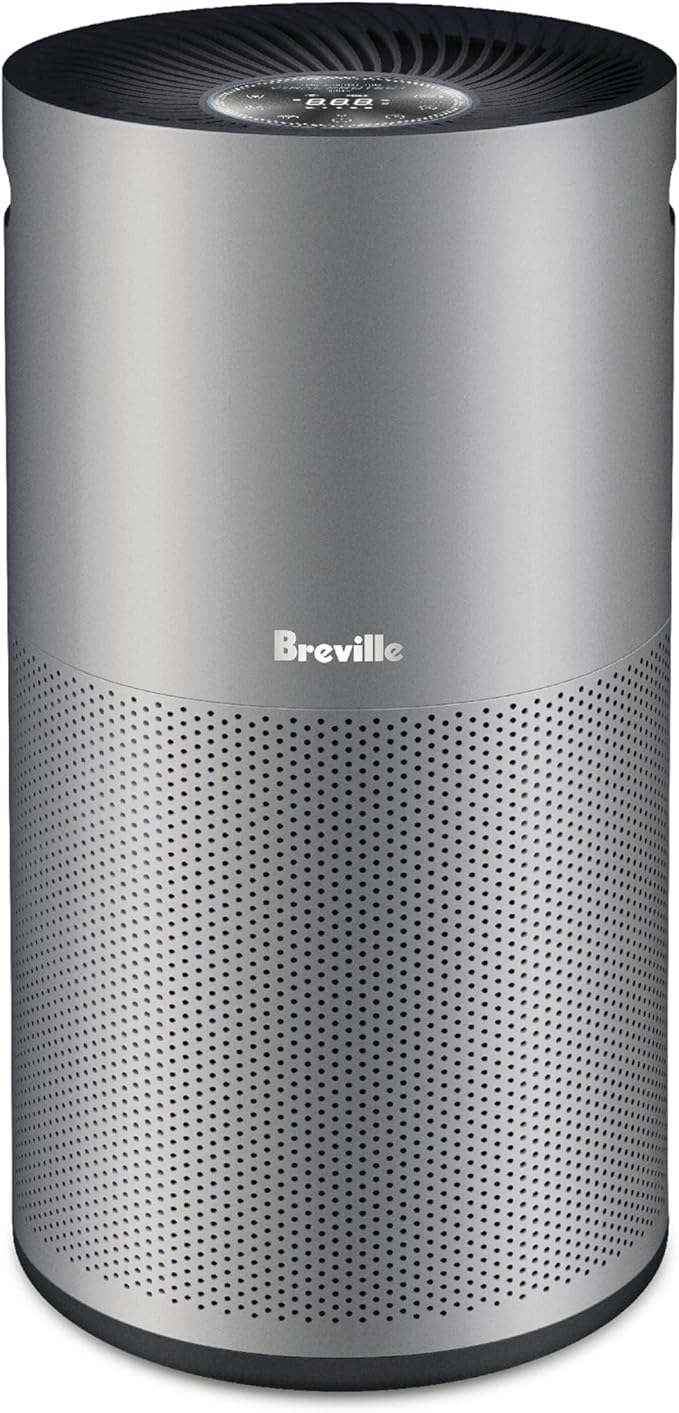
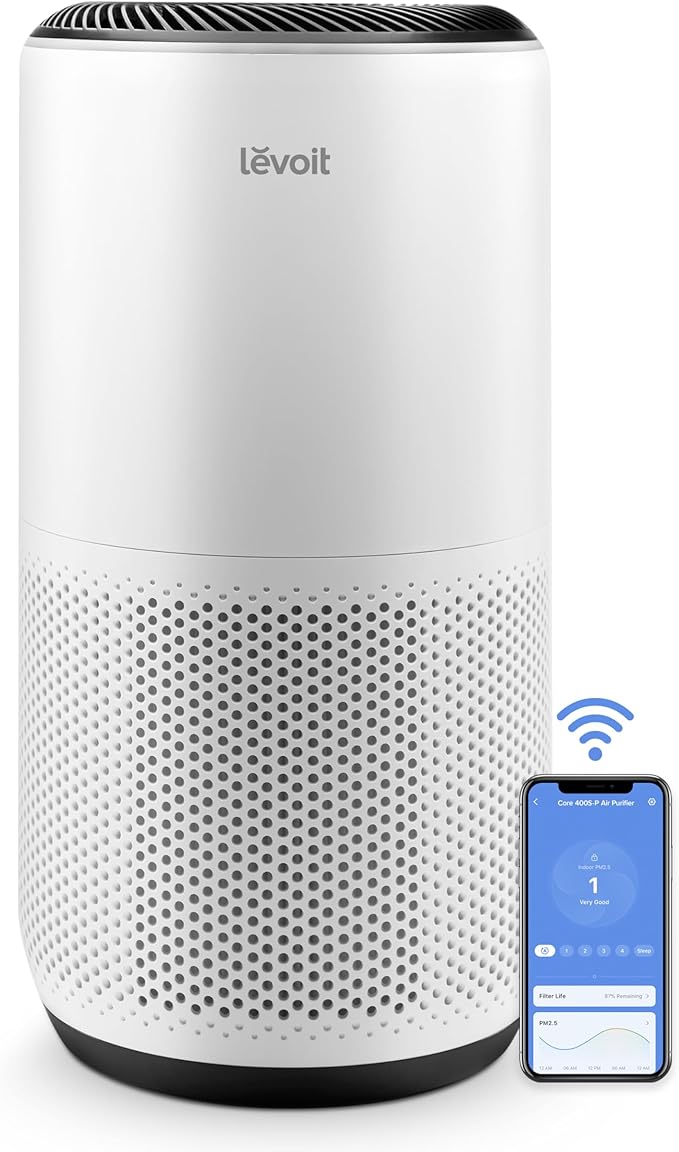
Both units run quietly enough on Sleep or Low mode that they do not compete with the white noise of the split system. The Breville Protect Max measures 24 dB on Sleep — quieter than a whisper at conversational distance. The Levoit Core 400S measures 24 dB on its lowest setting. Neither will disrupt sleep. Both are available for next-day delivery via Amazon AU Prime to most capital city postcodes.
Final Verdict
Your split system air conditioner is not an air purifier. It was not designed to be one, it cannot be modified to function as one, and no AC brand in Australia markets their residential units as certified air quality devices for PM2.5, VOCs, or biological contaminants. That is not a criticism of AC technology — it is an accurate description of what it does and does not do.
For the majority of Australian households — particularly in NSW, VIC, QLD, and WA where bushfire smoke and pollen seasons are extended and measurable — both devices are the correct answer. Run the split system for thermal comfort and dehumidification. Run a certified HEPA air purifier for particle and gas removal. Position them thoughtfully, use recirculation mode on the AC during smoke events, and the two devices work as a layered system that addresses every major indoor air quality variable.
If budget forces a choice: in a tropical or subtropical climate, the AC is non-negotiable for health and livability. In a temperate climate with known asthma or allergy conditions, the purifier has the stronger evidence base for health outcomes. Most Australian households fall into the category where both are justified, and the combined running cost — roughly $1.30–$1.50 per night in a bedroom — is less than a cup of coffee.
The worst outcome is you buy one, run it for a season, and realise it does not cover what you needed. The more likely outcome is that within a week of running a quality HEPA purifier alongside your AC during smoke season, you will notice the difference every morning.
Last reviewed: May 2026 — Clean and Native
Frequently Asked Questions
No. The mesh pre-filter in a standard residential split system is designed to protect the evaporator coil from dust and lint — not to clean the air you breathe. It has no measurable effect on PM2.5, pollen fragments, VOCs, mould spores, or bushfire smoke particles. Only a certified HEPA air purifier with a True HEPA (H13 or higher) filter stage removes these contaminants.
Yes, and for most Australian households during fire season or high-pollen months, running both simultaneously is the recommended approach. Position the purifier away from the AC’s discharge airflow so each device can circulate air independently. Switch the AC to recirculation mode during smoke events to prevent outside air infiltration.
A True HEPA filter (ISO 29463 H13) captures 99.97% of particles at 0.3 microns under test conditions. A split system mesh pre-filter captures particles above approximately 10 microns — thirty times larger. PM2.5 particles from smoke, pollen, and vehicle emissions are 2.5 microns or smaller and pass straight through an AC filter without restriction.
Close all windows and set your AC to recirculation (indoor air only — no fresh air intake). Run your HEPA air purifier simultaneously. Opening windows during a smoke event with AQI above 100 will rapidly increase indoor PM2.5 concentrations. The recirculation mode plus HEPA purifier combination is the correct protocol recommended by state health authorities including NSW Health.
An efficient 2.5kW inverter split system on sleep mode draws approximately 600W and costs roughly $1.20 overnight at 35c/kWh (Queensland rate). A Levoit Core 400S on medium draws 40W and costs approximately $0.11 overnight. Combined cost: approximately $1.31 per night. At that cost, the question is not whether you can afford to run both — it is whether you can afford the health consequence of not running the purifier during smoke season.
An air purifier captures airborne mould spores already circulating in the room. It does not remove moisture from the air — that is the job of your air conditioner running in cooling mode. In coastal Queensland, the correct approach is to run the AC to keep relative humidity below 60% (which prevents new mould growth) and a HEPA purifier to remove mould spores already in the air. Neither device alone is sufficient for mould management.
The evidence base for HEPA air purifiers reducing asthma symptom burden is strong and supported by Asthma Australia guidelines. The AC primarily provides thermal comfort, which can also reduce asthma triggers in extreme heat. For someone with asthma, the air purifier is the higher-priority purchase specifically for respiratory health. The AC is still necessary for livability in Australian summers but is not a medical device for asthma management.
Start with the bedroom — it is where you spend the most consecutive hours with zero voluntary ventilation. A single purifier correctly sized for the bedroom (CADR at least 5x the room volume in m³/hr) delivers the greatest health return per dollar. If budget allows, add a second unit to the main living area where cooking occurs. Prioritise rooms where people with asthma, allergies, or young children sleep.
No. Ionisers — including those built into Daikin, Panasonic, and Mitsubishi split systems — produce charged ions that cause particles to clump and fall onto surfaces rather than removing them from the air. They do not carry HEPA certification, do not have published CADR figures, and in some configurations produce trace ozone as a byproduct. They are not a substitute for certified HEPA filtration. A purifier with independently verified CADR is the only reliable standard.
Get the Australian Home Environment Checklist
30 checks across water, air and EMF. Most of them free. Ranked by impact.
No spam. Unsubscribe any time.

Former Royal Australian Navy Clearance Diver and TAG-E counter-terrorism operator. Founded Clean and Native to apply the same rigorous thinking to the home environment.
Full biography →