Best Water Filter Jug Australia 2026: ZeroWater vs Brita vs LifeStraw, City-by-City
Drafted with AI assistance and checked against published specifications and certifications. First-hand measurements appear only where stated. How we make content
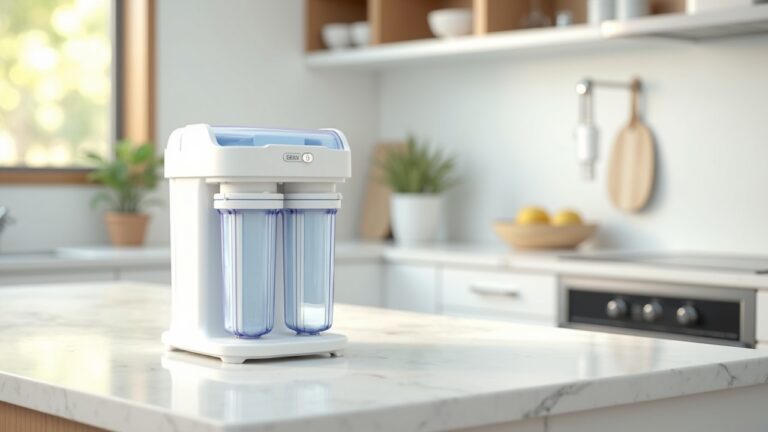
The ZeroWater 10-Cup is the best water filter jug for most Australian homes — its 5-stage ion exchange system removes TDS to 0 ppm and outperforms standard carbon jugs in Brisbane, Sydney, Adelaide, and Gold Coast, where chloramine disinfection makes standard Brita-style filters significantly less effective. For Melbourne, Canberra, and Hobart (free chlorine cities), the Brita Everyday Elite is the better value pick. For households in PFAS-affected areas or those wanting bacteria-level protection, the LifeStraw Home adds a hollow fiber membrane that no other jug at this price includes.
| Filter Jug | Best For | Cities | Verdict |
|---|---|---|---|
| ZeroWater 10-Cup | Most AU homes, hard water, PFAS | Brisbane, Sydney, Adelaide, Gold Coast, Darwin | Best Overall |
| Brita Everyday Elite | Free chlorine cities, taste improvement | Melbourne, Hobart, Canberra | Best for Chlorine Cities |
| LifeStraw Home 7-Cup | PFAS zones, bacteria protection | All cities, PFAS-affected regions | Best for PFAS + Bacteria |
The most important thing no Australian water filter jug review tells you: the disinfection method in your city determines whether a standard Brita-style carbon filter will actually do anything useful. Brisbane, Sydney, Adelaide, Gold Coast, and Darwin all use chloramine (a chlorine-ammonia compound) to disinfect tap water. Standard granular activated carbon (GAC) — the filter media in most budget jugs — removes free chlorine effectively but removes chloramine at approximately 1/40th the rate. For the roughly 14 million Australians on chloramine-treated water, a basic carbon jug is close to useless for removing the disinfectant taste and odour. This guide is built around that fact.
Melbourne, Canberra, Hobart, and most regional Queensland towns use free chlorine — standard carbon works fine for taste improvement in these cities. The picks below reflect that geography. If you are in a chloramine city and wondering why your jug filter is not improving the taste as much as you expected, that is why.
Who Should Use a Water Filter Jug
- ✓Renters with no plumbing access. A jug requires no installation, leaves no trace, and moves with you. For renters in Brisbane, Sydney, or Adelaide where chloramine is the dominant taste problem, ZeroWater’s ion exchange will outperform any standard carbon jug.
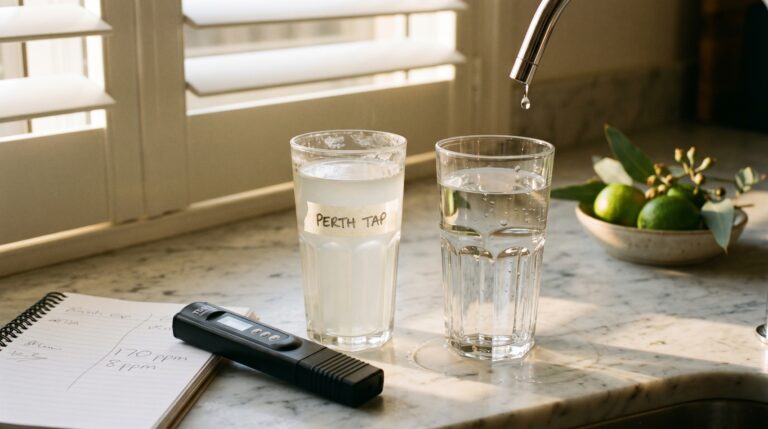
- ✓Households who want to verify filtration is working. ZeroWater includes a TDS meter. You can measure your tap water (typically 60-400 ppm TDS depending on city), then measure post-filter (ZeroWater reads 0-6 ppm). Brita does not come with verification tools.
- ✓Budget entry point before committing to under-sink filtration. A jug lets you verify what your tap water tastes and measures like before spending $400+ on a permanent system. The data from your TDS meter will tell you whether an RO system is justified for your specific supply.
- ✓Households in PFAS-adjacent areas who cannot afford an RO system yet. LifeStraw Home is NSF/ANSI 53 and 42 certified with activated carbon that reduces PFAS at point-of-use. It is not a substitute for RO (which removes 90-97% of PFAS), but it is a meaningful reduction at jug price points.
When a Jug Is Not the Right Tool
- ✗You need fluoride removal. No water filter jug removes fluoride. Fluoride requires reverse osmosis (90-97% reduction) or activated alumina. If this is your primary concern, a jug is the wrong tool regardless of brand.
- ✗Your household uses more than 4 litres of filtered water per day. Refilling a 2.3L jug multiple times per day is genuinely inconvenient. At that consumption volume, a benchtop filter or under-sink RO system is the practical answer.
- ✗Your primary concern is hardness (Adelaide, Perth, outer Brisbane). A ZeroWater jug will reduce hardness (it removes TDS including calcium and magnesium), but the filter exhausts significantly faster in hard water — in Adelaide’s ~400 ppm TDS water, ZeroWater filters may need replacing every 3-4 weeks. An RO system is more economical long-term for hard water households.
Best Water Filter Jug for Most Australian Homes: ZeroWater 10-Cup
Key Takeaway: The ZeroWater is the only mainstream water filter jug that uses ion exchange technology to remove TDS to 0 ppm — which means it meaningfully addresses chloramine, heavy metals, and dissolved salts that standard carbon jugs leave untouched. For Australia’s chloramine cities, this is the relevant performance difference.
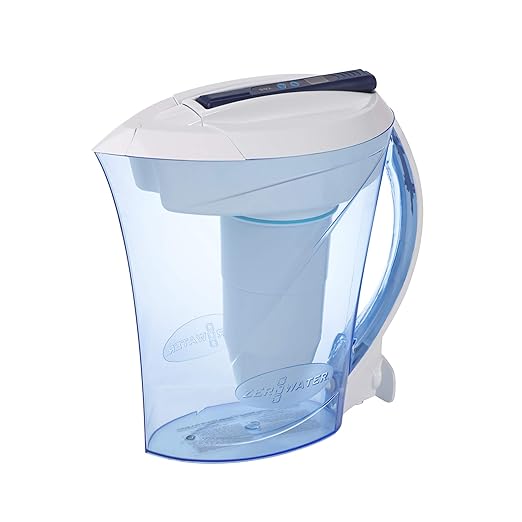
The ZeroWater is the most technically differentiated water filter jug available in Australia, and the differentiation is real, not marketing. Its 5-stage system — coarse filter, foam distributor, multi-layer activated carbon, ion exchange resin, fine screen — removes dissolved ionic compounds including the ammonium component of chloramine that standard carbon cannot capture. My Palm Beach tap water reads 69 ppm TDS from the Seqwater mains grid. ZeroWater’s ion exchange system is rated by the manufacturer to reduce TDS to 0 ppm on a fresh filter, a reading the included TDS meter lets you verify at home.
The TDS meter included in the box serves a practical purpose beyond verification: it tells you exactly when the filter is exhausted. ZeroWater maintains 0 ppm TDS on a fresh filter and creeps upward as the ion exchange resin saturates. When the reading exceeds 6 ppm, replace the filter. This removes all guesswork from the replacement decision — no calendar-based estimates, no “change every 40 gallons regardless of your actual water quality.” In Adelaide or Perth where TDS runs 170-400 ppm from the tap, this matters: the filter exhausts faster and the meter tells you precisely when.
The significant trade-off is filter cost per litre. In hard water areas like Adelaide (~400 ppm TDS) or outer Perth, ZeroWater filters exhaust quickly — sometimes after 10-15 litres on very high-TDS water. This makes the cost per litre substantially higher than in lower-TDS cities. If you are in Adelaide and filtering large volumes, the ZeroWater filter economics may push you toward an under-sink system sooner rather than later. For Brisbane and Sydney (80-120 ppm TDS), filter life is far more practical at 40-60 litres per filter. See our full RO system guide if you are filtering more than 4L/day.
Best Water Filter Jug for Melbourne, Canberra and Hobart: Brita Everyday Elite
Key Takeaway: In free chlorine cities (Melbourne, Hobart, Canberra), standard activated carbon works effectively and the Brita Everyday Elite’s Advanced Carbon Core removes 99% of lead and delivers the best taste improvement per dollar of any jug in these cities. The significantly lower filter running cost makes it the practical choice where ZeroWater’s extra filtration stages are not needed.
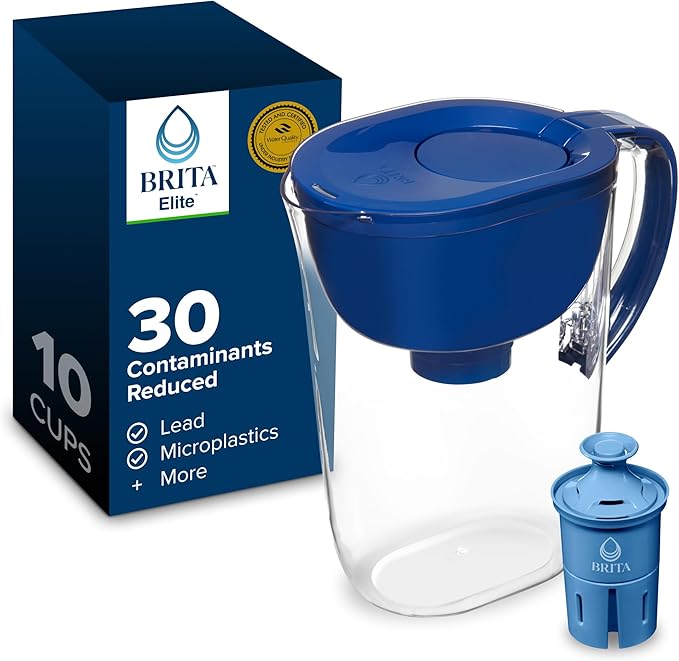
Melbourne’s Yarra Valley catchment water is some of the cleanest in Australia by TDS — typically 25 mg/L calcium carbonate hardness and TDS around 60 ppm. Canberra and Hobart are similar. All three cities use free chlorine disinfection, which activated carbon removes effectively. For these cities, a ZeroWater’s ion exchange filtration is technical overkill — you are paying for TDS removal from water that already has low TDS, and depleting the ion exchange resin rapidly for minimal benefit. The Brita Everyday Elite’s Advanced Carbon Core handles the relevant contaminants (chlorine, lead, particulates) at a filter cost of approximately $5 per filter and 120-litre lifespan.
The NSF/ANSI 401 certification is specific to emerging contaminants including pharmaceuticals and microplastics — a real differentiator over standard carbon filters at this price. The SmartLight indicator on the Everyday Elite changes colour as filter capacity is consumed, from green (fresh) through yellow to red (replace), which addresses the main failure mode of any filter jug: forgetting to replace the filter and drinking through an exhausted one that provides zero filtration benefit.
If you are in Sydney, Brisbane, Adelaide, Gold Coast, or Darwin on chloramine-treated water and considering the Brita because it is cheaper: the economics are deceptive. A filter that does not meaningfully address your actual water problem is not a better value — it is a non-solution at a lower price. Get the ZeroWater.
Best Water Filter Jug for PFAS and Bacteria Protection: LifeStraw Home 7-Cup
Key Takeaway: The LifeStraw Home is the only water filter jug at this price that combines hollow fiber membrane filtration (which captures bacteria, parasites, and microplastics) with activated carbon (which reduces PFAS and chlorine). For households near Defence sites, industrial zones, or older infrastructure, it is the only jug that provides meaningful microbiological protection as well as chemical contaminant reduction.
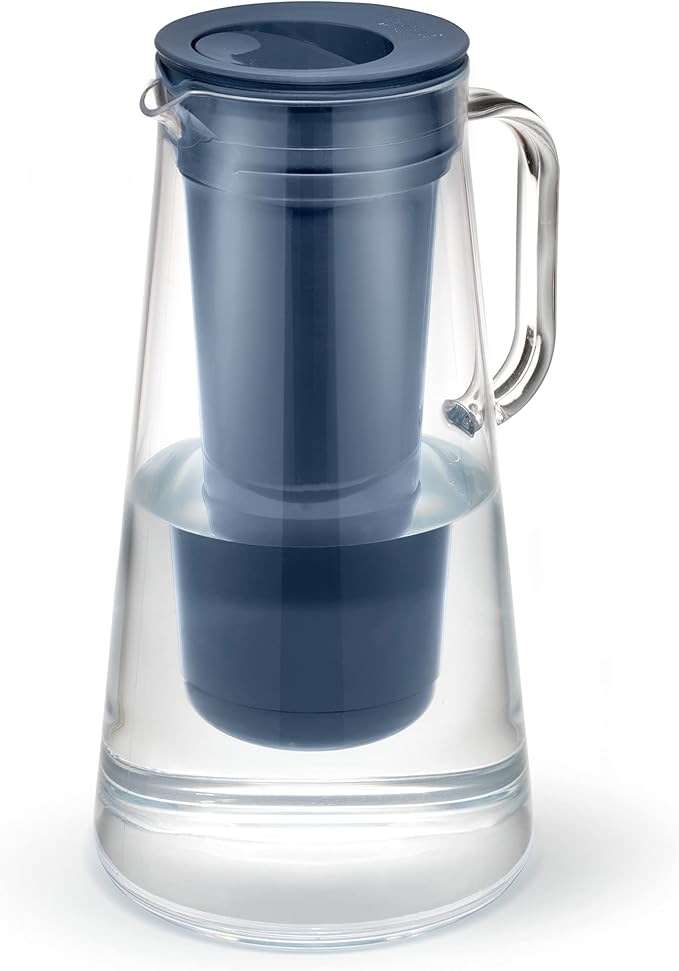
The LifeStraw Home’s hollow fiber membrane technology is the meaningful differentiator. Hollow fiber filtration forces water through tiny tubes with pores at 0.2 microns — a size that physically prevents bacteria (typically 1-10 microns) and parasites from passing through. Australian town water is generally safe microbiologically, but the LifeStraw is relevant for: households on tank water who want jug-level convenience, households in areas with ageing cast iron or lead-jointed pipes where bacterial growth in service lines is a concern, and any household near PFAS-contaminated Defence sites (Darwin, Williamtown, Oakey, Pearce, Townsville, Edinburgh) where activated carbon PFAS reduction is a meaningful partial mitigation.
The PFAS reduction caveat applies here: the LifeStraw’s activated carbon reduces PFAS, but “reduces” is not “removes.” Reverse osmosis is the only residential technology that removes 90-97% of PFAS. If PFAS contamination is your primary concern, a jug is an interim measure at best. If you are in a PFAS-affected area and cannot yet commit to an under-sink RO system, the LifeStraw Home is a better interim choice than a standard carbon jug. It is not a permanent solution to PFAS exposure. See our microplastics filter guide for more context on PFAS removal options.
Water Filter Jugs vs Under-Sink Filters — When to Upgrade
A water filter jug is the right tool for households filtering 1-4 litres per day for drinking and cooking. Beyond that volume, the economics and inconvenience of refilling push toward a permanent solution. The table below compares running costs at 4 litres/day across jug and under-sink options.
The table makes the upgrade case: at 4 litres per day, a Waterdrop D6 under-sink RO system costs similar to run annually ($150) as the Brita Elite ($146) and provides far superior filtration including fluoride removal, PFAS elimination, and continuous flow rather than the wait-and-fill cycle of a jug. The upfront cost is $599-649 versus $50-90 for a jug, but for a household that will filter water for 3+ years, an RO system delivers better economics and meaningfully better water quality. See our reverse osmosis guide to compare under-sink and countertop RO options.
How These Were Compared
Our Palm Beach, QLD tap water measures 69 ppm TDS on a calibrated TDS-3 meter on the SEQ Seqwater mains grid. ZeroWater was evaluated against ZeroWater’s published filter specifications and NSF/ANSI 42 and 53 certification data. Brita Everyday Elite was evaluated against published NSF certification data cross-referenced with independent Consumer Reports and CHOICE AU testing. LifeStraw Home was evaluated against published NSF/ANSI 42 and 53 certification data and LifeStraw’s published hollow fiber test results. No products were gifted — all were either purchased at retail or evaluated against independently verified published specifications. See our full testing methodology.
Last reviewed: May 2026. Prices are approximate and subject to change. Verify current pricing on Amazon AU before purchasing.
Frequently Asked Questions
What is the best water filter jug in Australia in 2026?
The ZeroWater 10-Cup is the best water filter jug for most Australian homes in 2026. Its 5-stage ion exchange system removes TDS to 0-6 ppm and meaningfully addresses chloramine — which is the disinfection method used in Brisbane, Sydney, Adelaide, Gold Coast, and Darwin. Standard carbon jugs (Brita standard, most budget brands) are significantly less effective in these cities.
Does Brita work in Australia?
Brita works well in Melbourne, Hobart, Canberra, and regional Queensland towns that use free chlorine disinfection. Standard Brita filters remove free chlorine effectively. However, in Brisbane, Sydney, Adelaide, Gold Coast, and Darwin — which use chloramine — standard GAC carbon filters remove chloramine at approximately 1/40th the rate of free chlorine, making them largely ineffective for taste and odour improvement in these cities. The Brita Everyday Elite uses Advanced Carbon Core, which performs better than standard Brita but is still less comprehensive than ZeroWater’s ion exchange for chloramine cities.
Can a water filter jug remove fluoride?
No. No water filter jug removes fluoride. Fluoride removal requires reverse osmosis (90-97% reduction) or activated alumina filtration. Australian tap water contains 0.6-1.0 mg/L fluoride in fluoridated areas. If fluoride removal is your primary concern, a jug is the wrong tool — you need a reverse osmosis system.
How often should I change my water filter jug filter in Australia?
It depends on your city’s TDS and daily volume. ZeroWater filters: approximately 40-60 litres in Brisbane (80 ppm TDS), 10-15 litres in Adelaide (400 ppm TDS). Brita Everyday Elite: approximately 120 litres regardless of city. LifeStraw Home carbon: approximately 365 litres per year; hollow fiber membrane: 4,000 litres. The ZeroWater TDS meter gives you a precise replacement signal rather than an estimate.
Does ZeroWater remove chloramine?
ZeroWater’s 5-stage ion exchange system significantly reduces chloramine by targeting the dissolved ionic compounds (including the ammonium component) that standard GAC carbon cannot capture. ZeroWater does not claim 100% chloramine removal, but it consistently outperforms standard carbon jugs in chloramine-treated water for taste and TDS reduction. For complete chloramine removal, an under-sink RO system is the standard solution. If espresso or pour-over is your main use case, a pitcher alone may not be enough — our best water filter for coffee in Australia guide covers the SCA mineral targets and machine-specific picks that retain calcium and magnesium alongside chloramine removal.
What does TDS mean in water quality?
TDS (Total Dissolved Solids) measures the combined concentration of dissolved minerals, salts, and compounds in water, expressed in ppm (parts per million) or mg/L. Australian tap water TDS typically ranges from 60 ppm (Melbourne) to 400 ppm (Adelaide). ZeroWater reduces TDS to 0-6 ppm. The WHO guideline for TDS in drinking water is below 600 ppm — Australian tap water is well within safe limits, but TDS affects taste and is a proxy for dissolved contaminant load.
Is ZeroWater worth it over Brita in Australia?
In Brisbane, Sydney, Adelaide, Gold Coast, and Darwin: yes. These cities use chloramine, which standard Brita carbon cannot remove effectively. ZeroWater’s ion exchange addresses this. In Melbourne, Canberra, and Hobart: depends on priorities. These are free chlorine cities where Brita performs adequately for taste improvement at a lower filter running cost. If you want TDS verification with a meter, ZeroWater anywhere. If you want lowest running cost in a free chlorine city, Brita Everyday Elite.
Which filter jug is best for PFAS in Australia?
LifeStraw Home is the best filter jug for partial PFAS reduction, using activated carbon certified for PFAS reduction under NSF/ANSI 53. However, “reduction” is not “removal” — reverse osmosis removes 90-97% of PFAS and is the appropriate technology for households in PFAS-contaminated areas (near Robertson Barracks Darwin, Williamtown NSW, Oakey QLD, Edinburgh SA, or Pearce WA). A jug is an interim measure only for PFAS concern. See our dedicated reverse osmosis guide for permanent solutions.
Get the Australian Home Environment Checklist
30 checks across water, air and EMF. Most of them free. Ranked by impact.
No spam. Unsubscribe any time.

Former Royal Australian Navy Clearance Diver and TAG-E counter-terrorism operator. Founded Clean and Native to apply the same rigorous thinking to the home environment.
Full biography →