Adelaide Drinking Water Quality 2026: What’s in Your Tap Water
Drafted with AI assistance and checked against published specifications and certifications. First-hand measurements appear only where stated. How we make content
Affiliate disclosure: Clean and Native earns a commission if you purchase through links on this page. This does not affect our editorial position — all recommendations are based on published specs, independent test data, and certification.
Adelaide’s tap water meets Australian Drinking Water Guidelines but has the saltiest, most mineralised taste of any capital (TDS 200–450 mg/L) due to 40–44% River Murray sourcing. Chloramine is used metro-wide, fluoride averages the lowest of any capital at ~0.56 mg/L, and PFAS tests non-detect across all six reservoirs (2024–2025). The catches: taste varies drastically by postcode and season—northern suburbs and dry years see the highest TDS—and chloramine requires specific carbon filtration (catalytic, not standard GAC).
| Solution | What it removes | Verdict |
|---|---|---|
| Reverse osmosis | TDS, salts, chloramine, fluoride, nitrates | Recommended |
| Catalytic carbon only | Chloramine, taste/odour (no TDS reduction) | Good for northern zones |
| No filter | — | Avoid if taste-sensitive |
Quick answer
The three products we own are measured first-hand by Jayce Love, former Royal Australian Navy Clearance Diver; every other product is assessed on published manufacturer specifications and independent certification using our documented methodology — no gifted units, no brand payments.
Adelaide’s tap water has a reputation — and the chemistry explains it. The primary source is the River Murray (~40-44%), supplemented by Mount Lofty Ranges reservoirs and groundwater. Chloramine is used for disinfection in most metro systems. TDS ranges from ~200–450 mg/L (variable by zone and season). Adelaide has the lowest fluoride level of any Australian capital despite artificial fluoridation (average ~0.56 mg/L). PFAS tests non-detect in all six metro reservoirs (2024 and 2025). In dry years when Murray dependency increases, Adelaide water has a distinctly salty, mineralised taste. Reverse osmosis provides the greatest taste improvement of any filtering technology and is the most practical solution for Adelaide households.
Where Adelaide’s water comes from
SA Water supplies Adelaide metro. The supply is a deliberate blend from multiple sources — making it the most complex of any Australian capital and the most season-dependent:
- River Murray (~40–44% long-term average): Pumped from Woolpunda and Murray Bridge via pipeline to metropolitan treatment plants. In drought years, Murray dependency can reach 90%. The Murray’s water quality is variable: TDS can reach 250–500 mg/L seasonally, and the river carries the cumulative drainage from the entire eastern Australian watershed upstream.
- Mount Lofty Ranges reservoirs (~34–40%): Happy Valley, Myponga, Millbrook, Hope Valley, Little Para, and Barossa reservoirs. Lower mineral content than the Murray; Myponga produces particularly soft water for its southern Adelaide supply area.
- Groundwater (~19%): Quaternary and fractured rock aquifers.
- Adelaide Desalination Plant (~2–3% typical, up to ~50% capacity in drought): 300 ML/day capacity. Used as a supplementary source during dry periods.
Key treatment plants: Happy Valley WTP (central metro), Anstey Hill WTP (north metro), Chandlers Hill WTP (south metro), Barossa WTP, Myponga WTP, Little Para WTP, and Woolpunda WTP (River Murray intake).
Adelaide water quality by the numbers (2023–2024)
| Parameter | Adelaide result | ADWG guideline | Status |
|---|---|---|---|
| Fluoride | ~0.56 mg/L average (max 0.70 mg/L) — lowest of any Australian capital | <1.5 mg/L | ✓ Within guideline — lowest capital average despite artificial fluoridation |
| Disinfection | Chloramine primary in metro distribution networks; free chlorine at some smaller facilities. ~220,000 people receive chloraminated water. Total chlorine residual avg ~1.19 mg/L | Monochloramine <3 mg/L | ✓ Within guideline |
| Hardness | 47–133 mg/L as CaCO₃ (metro range); avg ~90–100 mg/L. Softest zone (Myponga-fed south) ~87 mg/L — harder than Sydney’s entire network | No health guideline; aesthetic <200 mg/L | ✓ Within guideline — moderately hard |
| pH | ~7.5–8.0 (lime dosing; chloramine systems typically run higher pH) | 6.5–8.5 | ✓ Within range |
| TDS | ~200–450 mg/L (zone-variable, seasonally variable — Murray dependency drives higher TDS in dry years) | Aesthetic <600 mg/L | ⚠ Within guideline but highest TDS of eastern capitals; noticeable taste variation |
| PFAS | Non-detect in all 6 metro reservoirs (September 2024, early 2026); non-detect in River Murray sampling (May 2025) | PFOS <8 ng/L; PFOA <200 ng/L | ✓ Non-detect — clean PFAS result |
Source: SA Water water quality annual report 2023-24; SA Water PFAS and drinking water monitoring page; SA Water suburb-specific drinking water profile tool.
The taste problem — what the chemistry explains
Adelaide has a well-documented reputation for tap water taste, and the data explains why. Three compounding factors:
1. River Murray TDS variability. The Murray TDS is seasonal — lower after rainfall, higher during dry periods as the river concentrates minerals from the catchment. When SA Water increases Murray dependency in drought conditions (potentially to 90% of supply), Adelaide households notice a distinct mineralised, sometimes slightly salty taste. This is primarily sodium and chloride ions from the Murray’s natural dissolved load, not a treatment artefact.
2. Chloramine disinfection. Chloramine has a characteristic taste and odour at the concentrations maintained in Adelaide’s distribution network (~1.19 mg/L total chlorine). Unlike free chlorine, which dissipates readily, chloramine persists — you cannot “air out” chloramine from a jug of water.
3. Moderate hardness (~90–100 mg/L). Calcium and magnesium at these levels affect mineral water taste characteristics. Combined with elevated TDS from the Murray, this creates the profile Adelaide residents experience.
Adelaide’s fluoride — the lowest of any capital
This article contains affiliate links. We may earn a commission at no extra cost to you.
Despite artificial fluoridation, Adelaide’s metro average is approximately 0.56 mg/L — significantly below Brisbane (0.6–0.8 mg/L), Sydney (~1.0 mg/L), Melbourne (~0.9 mg/L), and Perth (~0.75 mg/L). The maximum recor See the EcoHero RO System →ded across 12 metro supply zones is 0.70 mg/L. This may reflect the River Murray source water chemistry and the dilution effect across multiple supply zones with varying natural fluoride content.
Recommended filters for Adelaide households
Chloramine + taste: TAPP EcoPro
Solid carbon block (0.5 micron) removes chloramine, chlorine taste compounds, microplastics, and lead. NSF 42+53. Installs on any tap without plumbing modification. Addresses Adelaide’s chloramine taste concern effectively. Does not address TDS, hardness, or the Murray-sourced mineral variation that creates seasonal taste differences.
TAPP EcoPro — chloramine & taste improvement
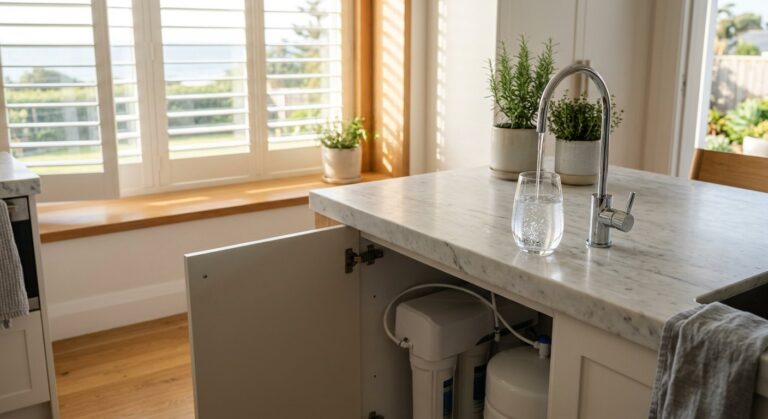
Full solution: AquaTru Classic RO
4-stage countertop RO eliminates Adelaide’s seasonal TDS variability — from 200–450 mg/L down to 3–5 mg/L year-round, regardless of Murray drought conditions. Removes chloramine, fluoride (>96%), hardness minerals, and microplastics. NSF 58 + 401. No plumbing required. For Adelaide households frustrated by seasonal taste variation, RO provides consistent, stable water quality throughout the year regardless of Murray intake levels.
AquaTru Classic — consistent quality regardless of Murray conditions
For a full comparison of water filter technologies, see our best countertop water filter Australia guide and our Berkey vs AquaTru comparison.
Frequently asked questions
Is Adelaide tap water safe to drink?
Yes. Adelaide tap water meets all Australian Drinking Water Guidelines. SA Water’s 2023-24 annual report confirms compliance with all ADWG health parameters. PFAS testing in all six metro reservoirs (2024, 2026) and the River Murray (2025) returned non-detect results. The taste concerns associated with Adelaide water are aesthetic, not safety-related.
Why does Adelaide tap water taste different in summer?
In dry conditions, SA Water increases its reliance on River Murray water — potentially to 90% of supply in drought years. The Murray carries higher seasonal TDS (total dissolved solids), including sodium and chloride, which creates a more mineralised and sometimes slightly salty taste. Reverse osmosis filtration eliminates this variation by reducing TDS to 3-5 mg/L year-round regardless of Murray intake levels.
Does Adelaide water have chloramine?
Yes. Chloramine is used as the primary disinfectant in Adelaide’s metropolitan distribution networks, with approximately 220,000 residents receiving chloraminated water. Total chlorine residual averages approximately 1.19 mg/L. Chloramine requires solid carbon block filtration (not standard GAC pitchers) for effective removal.
How much fluoride is in Adelaide water?
Adelaide has the lowest fluoride levels of any Australian capital despite artificial fluoridation — approximately 0.56 mg/L average across 12 metro supply zones, with a maximum of 0.70 mg/L. This compares to Sydney’s target of 1.0 mg/L. To remove fluoride, only reverse osmosis works — carbon block filters do not remove fluoride.
Does Adelaide water have PFAS?
No. SA Water tested all six metropolitan Adelaide reservoirs (Barossa, Happy Valley, Hope Valley, Little Para, Millbrook, Myponga) in September 2024 and early 2026, with all results below detection limits. River Murray sampling in May 2025 also returned non-detect for PFAS. Adelaide has a clean PFAS record across all metro water sources.
What is the best water filter for Adelaide?
For Adelaide’s specific water chemistry — chloramine, variable TDS from Murray dependency, and moderate hardness — reverse osmosis provides the most comprehensive improvement. The AquaTru Classic (countertop, no plumbing) reduces TDS from 200-450 mg/L to 3-5 mg/L, removes chloramine, fluoride, and microplastics. For renters wanting chloramine taste improvement without installation, the TAPP EcoPro (solid carbon block) is the next best option.
Does Adelaide tap water need filtering, or is it safe to drink straight from the tap?
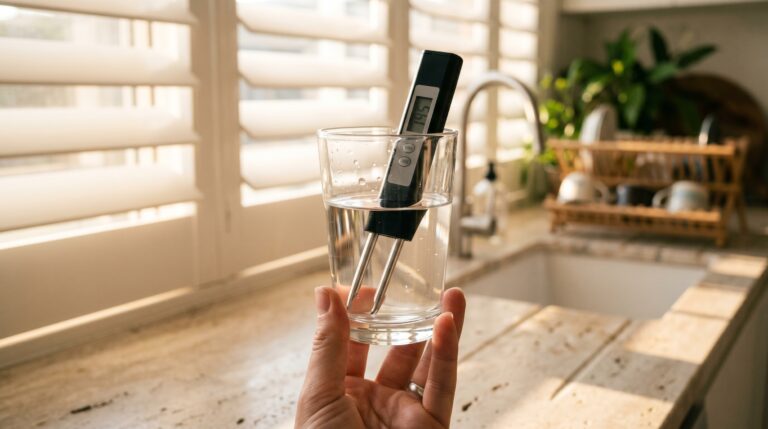
Adelaide’s tap water meets ADWG safety standards for contaminants. However, TDS ranges 200-450 mg/L depending on zone and season. In dry years when Murray River dependency increases significantly, salinity and mineralisation cause noticeable taste issues. Reverse osmosis removes dissolved solids most effectively — testing shows 95.7% TDS reduction (69 ppm down to 3 ppm post-RO).
Why does Adelaide water taste salty or mineral-heavy some years but not others?
Adelaide’s supply is season-dependent. River Murray is the primary source, supplemented by Mount Lofty Ranges reservoirs and groundwater. Murray water carries TDS of 250-500 mg/L seasonally (variable by flow rate and salinity). During low rainfall, Adelaide’s blend shifts toward higher-TDS sources, intensifying the salty, mineralised taste. Reverse osmosis removes these dissolved minerals directly.
Get the Australian Home Environment Checklist
30 checks across water, air and EMF. Most of them free. Ranked by impact.
No spam. Unsubscribe any time.

Former Royal Australian Navy Clearance Diver and TAG-E counter-terrorism operator. Founded Clean and Native to apply the same rigorous thinking to the home environment.
Full biography →