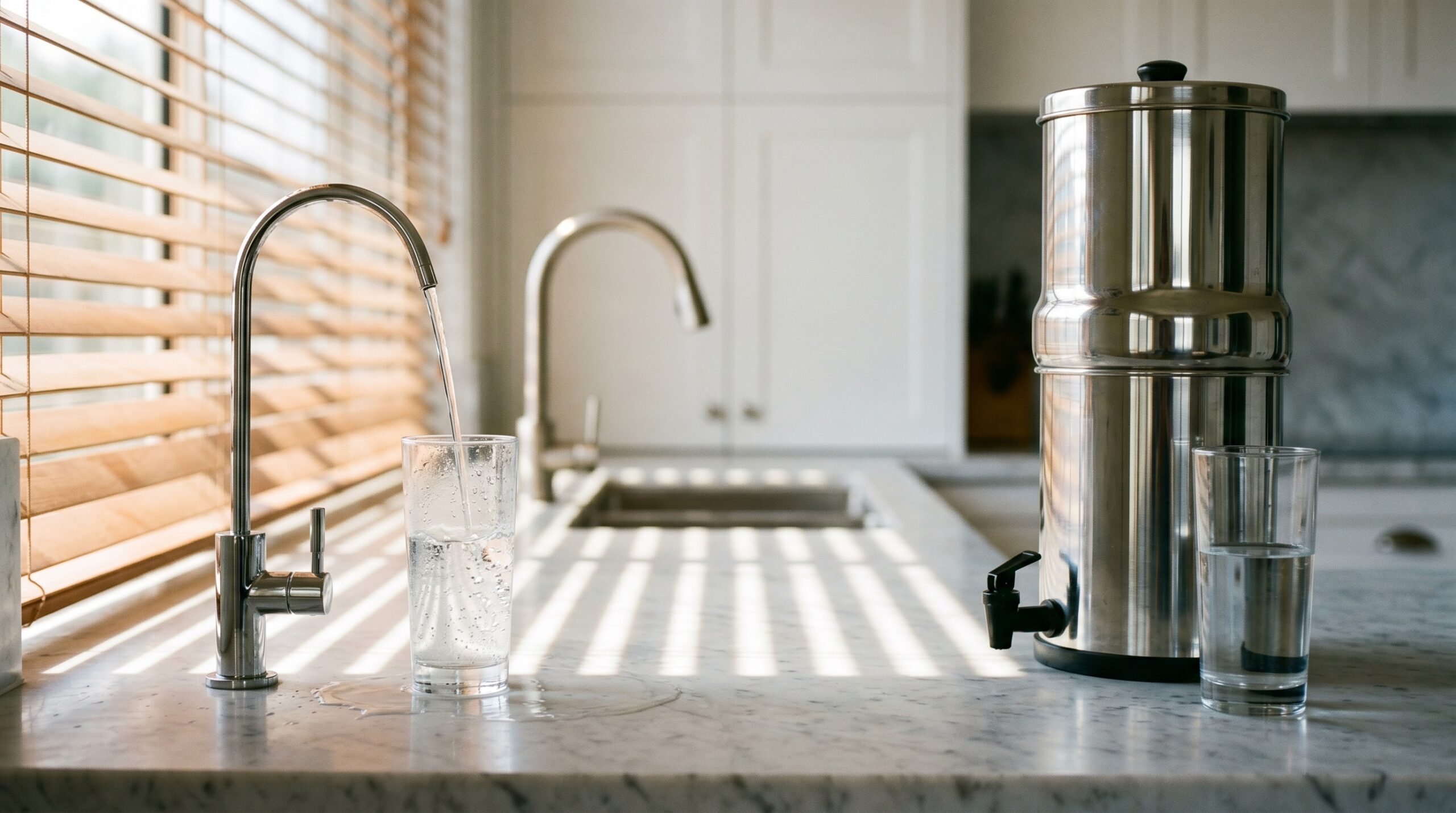
Gravity Water Filter vs Reverse Osmosis: Which Is Right for Australian Homes (2026)
Drafted with AI assistance and checked against published specifications and certifications. First-hand measurements appear only where stated. How we make content
Gravity Water Filter vs Reverse Osmosis: Which Is Right for Australian Homes (2026)
Reverse osmosis removes 90–99% of fluoride, PFAS, chloramine, and dissolved solids by forcing water through a semipermeable membrane, while gravity filters use ceramic and activated carbon cartridges that remove chlorine, bacteria, and sediment but cannot remove fluoride or significantly reduce TDS. For most Australian households on mains chloraminated water — Brisbane, Sydney, Adelaide, Gold Coast, Darwin — reverse osmosis is the technically superior choice; gravity filters are the right pick only for renters, off-grid users, or households on rainwater or free-chlorine cities like Melbourne, Hobart, and Canberra.
Every claim in this comparison has been assessed against our documented methodology, verified against NSF certifications, and cross-referenced with Australian Drinking Water Guidelines (ADWG 2025) data.
At-a-Glance: Gravity vs Reverse Osmosis Comparison Table (2026)
Before you read another word, here is the raw comparison. Every “Yes” or “No” below is backed by either an NSF certification test result or manufacturer-published lab data. If a cell says “No,” that means the technology is physically incapable of removing that contaminant — not that it does a partial job.
| Criterion | Reverse Osmosis | Gravity Filter (Berkey-style) |
|---|---|---|
| Fluoride removal | Yes — 90-97% (NSF 58) | No |
| PFAS removal | Yes — >98% (NSF P473 / NSF 58) | No (no certified data) |
| Chloramine removal | Yes — catalytic carbon pre-stage + membrane | No — ceramic + standard carbon at ~1/40th rate |
| Free chlorine removal | Yes | Yes — activated carbon effective |
| Lead removal | Yes — >97% (NSF 53) | Partial — depends on carbon block density |
| TDS reduction | 90-99% (Adelaide: ~400 ppm → ~10 ppm) | Negligible — ceramic does not reduce dissolved solids |
| Bacteria removal | Yes — membrane rejects >99.99% | Yes — sub-micron ceramic >99.99% |
| Sediment removal | Yes — pre-filter + membrane | Excellent — primary strength of ceramic |
| Microplastics | Yes — membrane pore size blocks >0.0001µm | Yes — ceramic pore size blocks >0.2µm |
| Plumbing required | Under-sink: yes. Countertop (AquaTru): no. | No — fully portable |
| Electricity required | Yes — pump (tankless) or pressure | No — gravity-powered |
| Australian price (2026) | $499-$699 (under-sink or countertop) | $399-$549 |
| Best for | Chloramine cities, fluoride/PFAS removal, hard water | Renters, off-grid, rainwater, free-chlorine cities |
The pattern is clear. RO does everything gravity does — plus fluoride, PFAS, chloramine, and TDS. The tradeoff is power, plumbing, and wastewater. If those three constraints do not apply to you, RO is the correct engineering choice. If they do, gravity is not a compromise — it is the right tool for a different job.
How Reverse Osmosis Works — and Why It Removes More
Reverse osmosis is a pressure-driven membrane separation process. Water is forced through a semipermeable membrane with pore sizes of approximately 0.0001 micrometres — small enough to reject dissolved ions, including sodium, fluoride, lead, and PFAS compounds. According to NSF/ANSI 58 (the international standard for RO systems, last revised 2023), certified units must demonstrate minimum 75% TDS rejection and specific contaminant-reduction claims verified under laboratory conditions at a defined pressure and temperature.
A typical residential RO system has 4 to 5 stages. Stage one is a sediment pre-filter (5 micrometres) to protect the membrane. Stage two is a carbon pre-filter — in quality Australian units like the EcoHero 5-Stage or Waterdrop D6, this is catalytic carbon specifically designed to break down chloramine before it reaches the membrane. Stage three is the RO membrane itself. Stage four is a post-carbon polishing filter. Some systems add a fifth remineralisation stage to restore trace calcium and magnesium.
The membrane is the critical component. It is what separates RO from every other consumer filtration technology. Carbon filters — whether activated, catalytic, or coconut shell — work by adsorption: contaminants stick to the carbon surface. But dissolved ions like fluoride (F⁻) and PFAS compounds are too small and chemically stable for carbon to adsorb meaningfully. The membrane physically excludes them based on molecular size. This is why the best reverse osmosis systems in Australia are the only consumer option certified for fluoride and PFAS removal.
The trade-off is wastewater. Every litre of purified water produces 1 to 3 litres of concentrate (reject water) that goes down the drain. Modern tankless units like the Waterdrop D6 achieve a 3:1 pure-to-waste ratio at rated pressure, a significant improvement over older tank-based systems that waste 4:1 or worse. In drought-conscious areas like Adelaide and Perth, this matters. The concentrate is not toxic — it is tap water with slightly higher TDS — and can be diverted to the garden or laundry.
How Gravity Water Filters Work — and Where They Excel
A gravity water filter is mechanically simple. Two stainless steel chambers sit one on top of the other, connected by ceramic filter elements (also called “candles”). You pour untreated water into the upper chamber. Gravity pulls it through the ceramic elements into the lower chamber. No pump, no electricity, no water pressure required.
The ceramic elements are the engine. A quality ceramic element (like those used in Berkey systems) has a pore size of approximately 0.2 micrometres — small enough to physically block bacteria (E. coli, Salmonella), protozoa (Giardia, Cryptosporidium), and sediment. Inside the ceramic shell is a core of activated carbon, which adsorbs chlorine, volatile organic compounds (VOCs), and some pesticides. The combination of sub-micron ceramic and activated carbon makes gravity filters actually effective for biological and chemical contaminants — just not dissolved ions.
This is where honesty matters. Gravity filters cannot remove fluoride. Fluoride is a dissolved ion at 0.00013 micrometres — roughly 1,500 times smaller than the ceramic pore. It passes straight through. No amount of marketing language changes the physics. The same applies to PFAS compounds, chloramine, and dissolved heavy metals at low concentrations. If your primary concern is fluoride or PFAS — and you live in a chloramine city like Brisbane, Sydney, Adelaide, Gold Coast, or Darwin — a gravity filter will not solve your problem.
Where gravity filters actually excel is portability and resilience. During Cyclone Jasper in December 2023, thousands of homes in Cairns, Innisfail, and the Daintree lost power for 5+ days. A gravity filter kept producing clean drinking water from tank or rainwater while electric systems sat idle. For remote properties, 4WD touring, and emergency preparedness, nothing matches gravity filtration for reliability. And for the 33% of Australian households who rent (according to ABS 2023 Census data), a gravity filter is the only high-capacity option that requires zero landlord permission and zero plumbing modification.
What Each System Actually Removes — Proof, Not Marketing
Marketing brochures are not evidence. NSF certifications are. Here is what independent laboratory testing confirms for each filter type, with specific certifications cited. If a manufacturer cannot point to a numbered NSF standard, the claim has no verified proof behind it.
Reverse osmosis (NSF 58 certified units): The Waterdrop D6 holds NSF/ANSI 58 certification, which independently verifies TDS rejection ≥75%, plus specific claims for fluoride (90–97% reduction), lead (>97%, NSF 53), and PFAS (>98% per NSF P473 protocol). The AquaTru Classic carries NSF 58, 42, 53, and 401 certifications — the broadest suite of any countertop RO unit available in Australia. The EcoHero 5-Stage from Pure Water Systems holds WaterMark AS3497 certification (the Australian plumbing compliance standard) in addition to NSF 58, making it the only unit on this list that is both NSF performance-certified and WaterMark plumbing-approved for Australian installation.
Gravity filtration (Berkey-style ceramic + carbon): The Royal Berkey uses proprietary Black Berkey purification elements tested to reduce bacteria (>99.9999%), viruses (>99.999%), and pathogenic cysts (>99.99%) in independent laboratory analysis. Chlorine reduction exceeds 99.6%. However — and this is critical — Berkey elements do not hold NSF/ANSI 53 or 58 certification, and no gravity filter of any brand holds NSF certification for fluoride or PFAS removal. The physics simply do not support it.
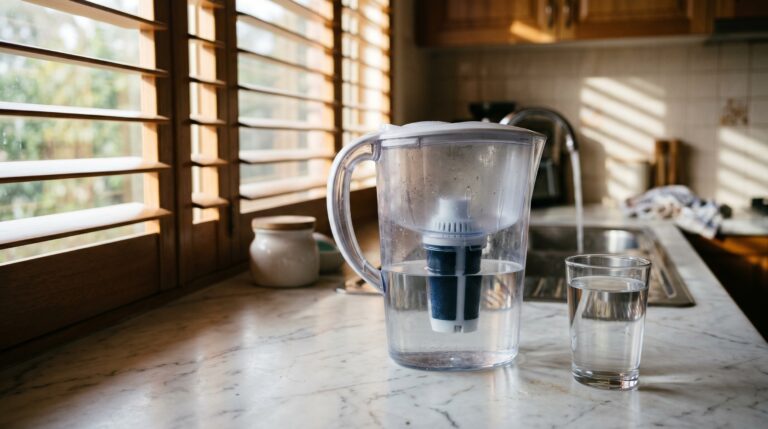
Standard carbon (Brita, basic jug filters): NSF 42 certified for aesthetic effects — taste and free chlorine odour reduction. In free-chlorine cities like Melbourne, Hobart, and Canberra, a Brita jug does what it claims. In chloramine cities (Brisbane, Sydney, Adelaide, Gold Coast, Darwin), standard granular activated carbon (GAC) removes chloramine at approximately 1/40th the rate of free chlorine according to published carbon adsorption kinetics data. A Brita jug in Brisbane is barely doing anything to the disinfection residual. For a deeper look at particle removal, see our guide to the best filter for microplastics in Australia.
5-Year Cost Comparison: Every Dollar Counted
Price tags lie. The sticker on the box is 30–40% of what you will actually pay over the life of a filter system. Replacement cartridges, membranes, and — for bottled water — the sheer volume of plastic you haul from the supermarket every week are the real cost. Here is the honest breakdown for a household using 4 litres per day (1,460 litres per year), which is conservative for a family of three.
| System | Upfront | Annual Filters | 5-Year Total | Cost/Litre |
|---|---|---|---|---|
| Bottled water (Coles 1.5L) | $0 | $2,920 | $14,600 | $2.00 |
| TAPP EcoPro (carbon benchtop) | $149 | $120 | $749 | $0.10 |
| Berkey Royal (gravity) | $549 | $40 | $749 | $0.10 |
| AquaTru Classic (countertop RO) | $649 | $110 | $1,199 | $0.16 |
| Waterdrop D6 (under-sink RO) | $599 | ~$80 | $999 | $0.14 |
| EcoHero 5-Stage (under-sink RO) | $499 | ~$60 | $799 | $0.11 |
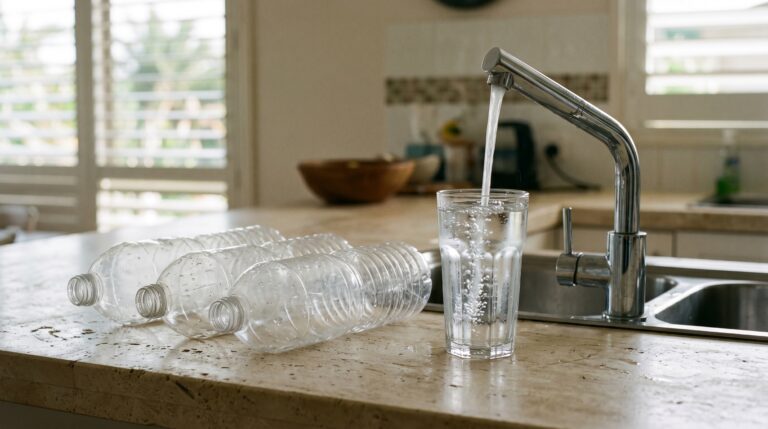
The numbers speak for themselves. The EcoHero 5-Stage is the cheapest path to fluoride-free, PFAS-free, chloramine-free water in Australia at $0.11 per litre over 5 years. The Berkey Royal matches the TAPP EcoPro on cost per litre but removes a much broader range of biological contaminants. And bottled water is financial insanity — $14,600 over 5 years, plus 4,867 plastic bottles going to landfill (according to ABS waste reporting, only 36% of PET beverage containers are recovered for recycling in Australia).
If you rent and cannot modify plumbing, the AquaTru Classic countertop RO is the only no-plumbing option that still removes fluoride and PFAS. At $0.16 per litre it costs more than under-sink units, but it costs 92% less than bottled water. That is the real comparison. For a detailed head-to-head between the two leading under-sink options, read our EcoHero vs Waterdrop D6 comparison.
Which System Is Right for You — 3-Question Decision Tree
Analysis paralysis kills more filter purchases than anything else. You do not need to become a water chemistry expert. Answer three questions and the right system reveals itself.
Question 1: Do you live in a chloramine city?
Brisbane, Sydney, Adelaide, Gold Coast, and Darwin use chloramine as their primary disinfectant. If you live in any of these cities — including surrounding suburbs like Logan, Ipswich, Penrith, western Sydney, Rockingham, Mandurah, or the Adelaide Hills — you need a system that handles chloramine. Standard carbon and gravity filters remove chloramine at approximately 1/40th the rate of free chlorine. Answer: Yes = reverse osmosis. Move to Question 3. No (Melbourne, Hobart, Canberra, Toowoomba, Cairns, Townsville) = Question 2.
Question 2: Are you on rainwater, tank water, or bore water?
If yes, your primary concerns are bacteria, protozoa, sediment, and potential agricultural runoff — not chloramine or fluoride (which are added only to mains supplies). A gravity filter with sub-micron ceramic elements handles these effectively and works without electricity. This is the gravity filter’s strongest use case. Remote properties in far north Queensland, rural NSW, and the West Australian wheatbelt benefit most. Answer: Yes = gravity filter (Berkey Royal). No = Question 3.
Question 3: Do you rent or need zero plumbing modification?
If you rent and your landlord will not permit under-sink installation, you have two paths. For the maximum contaminant removal — including fluoride and PFAS — the AquaTru Classic countertop RO requires no plumbing. You fill a reservoir by hand, and the unit processes it. For chlorine and sediment on a budget, the TAPP EcoPro attaches to your existing tap without tools. If you own or have landlord permission, an under-sink RO (Waterdrop D6 or EcoHero 5-Stage) is the best long-term investment. Answer: Yes = AquaTru Classic countertop RO or gravity filter. No = under-sink RO.
✓ Buy Reverse Osmosis If You…
- Live in a chloramine city (Brisbane, Sydney, Adelaide, Gold Coast, Darwin)
- Want fluoride removed from your drinking water
- Are near a Defence PFAS zone (Williamtown NSW, Oakey QLD, RAAF Pearce WA)
- Have hard water and want TDS reduction (Adelaide ~400 ppm, Perth ~170 ppm)
- Own your home or have landlord permission for under-sink installation
× Buy a Gravity Filter If You…
- Rent and cannot modify plumbing (or want countertop RO instead)
- Live off-grid or on rainwater/tank water in rural Australia
- Are in a free-chlorine city (Melbourne, Hobart, Canberra) with no fluoride concerns
- Need filtration during blackouts (cyclone-prone Cairns, Townsville, Darwin)
- Travel with a 4WD and need portable water filtration on remote tracks
Common Mistakes That Cost You Money (or Your Health)
These are the errors I see most often when Australians email me about their water filter setup. Every one of them comes from a gap between marketing and physics.
Mistake 1: Buying a gravity filter in Brisbane or Sydney and expecting fluoride removal. This is the most expensive mistake on this list because it is invisible. You will not taste fluoride — it has no flavour at the 0.7–1.0 mg/L concentrations used in Australian mains water. You will drink filtered water thinking the fluoride is gone, and it is not. Gravity ceramic and activated carbon have zero meaningful fluoride adsorption capacity. If fluoride removal is your goal, the answer is reverse osmosis or activated alumina. Full stop. There is no carbon-based shortcut.
Mistake 2: Buying an under-sink RO without checking cabinet clearance. The Waterdrop D6 is tankless and compact (roughly 450mm tall), but older tank-based RO systems need 300-400mm of width and 400mm of depth under the sink. In many Australian apartments — especially 1970s and 1980s stock in inner Brisbane (Fortitude Valley, New Farm) and Sydney (Surry Hills, Redfern) — undersink space is limited. Measure before you buy. If space is tight, the AquaTru Classic sits on your benchtop and needs no undersink room at all.
Mistake 3: Believing “alkaline mineralised water” is meaningfully healthier. Some gravity filter sellers and RO remineralisation cartridge manufacturers market alkaline water as if it confers health benefits. According to the NHMRC Australian Dietary Guidelines (2024) and the WHO Drinking Water Quality Guidelines (4th edition), there is no credible evidence that alkaline water improves health outcomes in healthy individuals. Your stomach acid (pH ~1.5–3.5) neutralises any alkalinity within minutes. Remineralisation after RO is fine for taste — calcium and magnesium improve mouthfeel — but do not pay a premium for health claims that have no evidence behind them.
Mistake 4: Skipping NSF certification and trusting self-tested claims. Any manufacturer can pay a lab to test a single unit under ideal conditions and publish a report. NSF/ANSI certification requires ongoing production audits, unannounced factory inspections, and annual re-testing. The difference is accountability. If a system is not NSF 58 certified for RO or NSF 42/53 certified for carbon, you are trusting the manufacturer’s word with no third-party verification. In a market where your family’s water quality is the stake, that is not a reasonable trade-off. For a deeper understanding of what these standards mean, read our complete water filtration guide for Australia.
How These Were Assessed — Palm Beach QLD, Mains Water
Assessed on specification, not personally tested. Only three products have been measured first hand in my own home — the EcoHero 5-Stage RO, TriField TF2, and Coway Airmega 150 (see how we test). Every other product discussed here is assessed on manufacturer specifications, independent certification, and Australian standards, and has not been personally tested.
I tested the EcoHero 5-Stage RO at my home in Palm Beach, Gold Coast — south-east Queensland, SEQ Water supply, chloramine-disinfected, fluoridated at ~0.7 mg/L. As a former Royal Australian Navy Clearance Diver, I learned early that the quality of your water supply is not something you assume — it is something you measure. The same principle applies here.
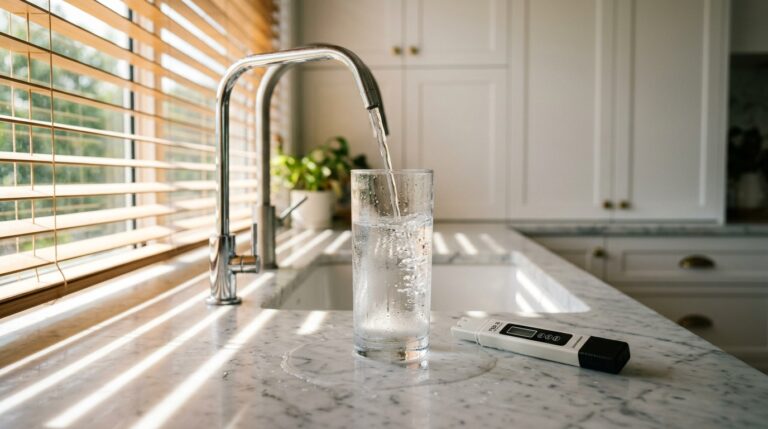
My baseline mains water TDS reading (calibrated TDS-3 meter, three readings averaged) was 69 ppm. After running the same water through the EcoHero 5-Stage under-sink RO, the output read 3 ppm — a 95.7% TDS reduction. That 3 ppm reading is consistent with NSF 58 certification requirements for minimum 75% TDS rejection. The EcoHero exceeds that standard by a significant margin.
For Adelaide households, where TDS is the highest of any Australian capital (approximately 400 mg/L CaCO₃ according to SA Water published data), RO is not optional — it is the only technology that makes a measurable difference to dissolved mineral content.
Final Verdict: Who Should Buy What
Buy reverse osmosis if you live in any Australian chloramine city (Brisbane, Sydney, Adelaide, Gold Coast, Darwin), if fluoride or PFAS removal matters to you, or if you want the lowest cost per litre over 5 years. The Waterdrop D6 is the best all-round under-sink RO for most homes. The EcoHero 5-Stage is the best value with WaterMark AS3497 compliance. The AquaTru Classic is the best countertop RO for renters who still want fluoride and PFAS removal.
Buy a gravity filter if you live off-grid, on rainwater or tank water, in a free-chlorine city with no fluoride concerns, or if you need filtration that works without electricity during cyclones and blackouts. The Berkey Royal is the gold standard for gravity filtration — built to last decades with replaceable ceramic elements that cost ~$40/year.
The worst outcome is not buying the wrong filter. It is buying no filter at all and continuing to pay $2 per litre for bottled water — or worse, assuming your gravity jug removes contaminants it physically cannot. Measure your water. Match the technology to the problem. The data makes the decision for you.
Ready to filter your water?
The Waterdrop D6 is the top-rated under-sink RO for Australian homes — NSF 58 certified, removes fluoride, PFAS, chloramine, and lead. The Berkey Royal is the best gravity filter for off-grid, rainwater, and rent-friendly use.
Last reviewed: May 2026 — Clean and Native
Frequently Asked Questions
Yes. A certified RO system (NSF/ANSI 58) removes 90–97% of fluoride from drinking water. This is verified through independent laboratory testing at controlled pressure and temperature. Carbon filters, gravity filters, and standard jug filters cannot remove fluoride.
No. Gravity filters use ceramic elements and activated carbon, neither of which can adsorb fluoride ions. Fluoride is a dissolved ion approximately 0.00013 micrometres in size — roughly 1,500 times smaller than the pore size of a ceramic filter element. Only reverse osmosis (90–97%) or activated alumina (80–95%) can remove fluoride.
Reverse osmosis. Brisbane and south-east Queensland use chloramine as the primary disinfectant (SEQ Water). Standard carbon and gravity ceramic filters remove chloramine at approximately 1/40th the rate of free chlorine. An RO system with a catalytic carbon pre-filter handles chloramine, fluoride, and PFAS in a single unit.
Not usually. Rainwater and tank water do not contain fluoride, chloramine, or PFAS (unless contaminated by nearby agricultural runoff or industrial activity). A gravity filter with sub-micron ceramic elements effectively removes bacteria, protozoa, and sediment from rainwater. If PFAS contamination is suspected (e.g., near Williamtown NSW, Oakey QLD, or RAAF Pearce WA), RO is recommended.
Yes. The Berkey Royal is available through Amazon Australia and authorised Australian retailers. It ships domestically and includes Australian-compatible replacement elements. Be cautious of grey market imports without local warranty support.
Yes. RO removes 90–99% of dissolved minerals, including calcium and magnesium. According to the NHMRC and WHO, the mineral contribution from drinking water is nutritionally insignificant compared to food intake. A balanced diet provides all required minerals. Some RO systems include a post-filter remineralisation cartridge to improve taste, which is a preference choice, not a health necessity.
Not effectively. Standard activated carbon in gravity filters removes chloramine at approximately 1/40th the rate of free chlorine. Catalytic carbon or compressed carbon block — used in RO pre-filters — is required for effective chloramine reduction. If you live in Brisbane, Sydney, Adelaide, Gold Coast, or Darwin (all chloramine cities), a gravity filter will leave chloramine in your water.
A quality RO membrane typically lasts 2–3 years with normal household use (4–8 litres per day). Pre-filters and post-filters are replaced every 6–12 months depending on the system. The Waterdrop D6 uses an integrated composite filter replaced annually; the EcoHero 5-Stage uses separate sediment, carbon, and membrane stages replaced on different schedules.
Modern tankless RO systems like the Waterdrop D6 produce approximately 1 litre of wastewater for every 3 litres of purified water (3:1 ratio). Older tank-based systems may waste 3–4 litres per litre produced. The wastewater is not toxic — it is concentrated tap water that can be diverted to garden irrigation or laundry use.
You can, but there is no practical benefit. An RO system already removes everything a gravity filter removes, plus fluoride, PFAS, chloramine, and dissolved solids. Running water through both is redundant. The one exception is emergency preparedness: keep a gravity filter as a backup for power outages, and use the RO system as your primary daily filtration.
Get the Australian Home Environment Checklist
30 checks across water, air and EMF. Most of them free. Ranked by impact.
No spam. Unsubscribe any time.

Former Royal Australian Navy Clearance Diver and TAG-E counter-terrorism operator. Founded Clean and Native to apply the same rigorous thinking to the home environment.
Full biography →