Best Air Purifier for VOCs and Gas Australia 2026: Activated Carbon That Actually Works
Drafted with AI assistance and checked against published specifications and certifications. First-hand measurements appear only where stated. How we make content
Best Air Purifier for VOCs and Gas Australia 2026: Activated Carbon That Actually Works
The best air purifier for VOCs in Australia requires a substantial activated carbon stage — not the thin carbon-coated pad most mainstream purifiers include. For Australian homes dealing with off-gassing furniture, bushfire smoke benzene, or paint fumes, the Austin Air HealthMate’s 6.8 kg carbon bed is the benchmark; the Winix 5500-2 is the best mainstream option for everyday households.
What VOCs Are — and Why Australian Homes Are Full of Them
Volatile organic compounds are carbon-based chemicals that evaporate at room temperature and enter the air you breathe. The word “volatile” means they readily become gas. That new-furniture smell, that paint smell, that fresh-carpet smell — all of it is VOCs releasing into your indoor air. According to the NSW EPA’s State of the Environment report, indoor VOC concentrations routinely exceed outdoor levels by a factor of two to five, even in homes without obvious chemical sources.
Australian households face VOC exposure from a broad range of sources. New furniture and flat-pack cabinetry off-gas formaldehyde from particleboard and MDF adhesives — a process that continues for one to three years after purchase. Interior paints release benzene, toluene, xylene, and ethylbenzene during application and for weeks after. Cleaning products contribute glycol ethers and fragranced compounds. Cooking produces acrolein from high-heat oils. Mould — a significant problem in Brisbane, coastal NSW, and tropical Queensland — releases microbial VOCs (mVOCs) including geosmin and 2-ethyl-1-hexanol, which cause the characteristic musty smell and carry their own respiratory irritant load.
Bushfire smoke is the trigger most Australians now recognise. During the 2019-2020 Black Summer fires, Sydney’s AQI exceeded 2,000 on multiple occasions — more than 20 times the acceptable threshold. Bushfire smoke is not just particulate matter. It contains benzene, formaldehyde, acrolein, and polycyclic aromatic hydrocarbons (PAHs) — confirmed carcinogens that HEPA filters cannot capture. The CSIRO documented significant benzene elevation in Sydney residential air during the Black Summer event. If you live in NSW, Victoria, the ACT, or coastal Queensland, bushfire smoke season running October through March is the hardest argument for owning a genuine activated carbon purifier.
New-build apartments compound the problem. Under the National Construction Code (NCC), new residential buildings now have improved airtightness requirements for energy efficiency. Higher airtightness means lower natural ventilation rates. The result: off-gassing chemicals from new materials accumulate faster and clear slower. A freshly finished apartment in inner Sydney or Melbourne’s Docklands precinct can have formaldehyde readings several times the World Health Organisation’s guideline of 0.1 mg/m³ in the first twelve months.
Why HEPA Alone Will Not Solve a VOC Problem
This is the most important technical distinction in air purification, and most product listings obscure it. HEPA filtration — True HEPA meeting the H13 standard at 99.97% capture of 0.3-micron particles — is a mechanical filter. It captures particles: dust, pollen, mould spores, pet dander, PM2.5 from smoke. It does this extremely well. But VOCs are gas-phase molecules, not particles. A HEPA filter does nothing to a benzene molecule. The benzene passes straight through the HEPA media and returns to your breathing air unchanged.
This distinction matters enormously when buying a purifier for a specific purpose. If your concern is pollen and dust, a HEPA-only unit works. If your concern is new-paint fumes, formaldehyde from flat-pack furniture, bushfire smoke chemicals, or cooking odours, you need an activated carbon stage capable of adsorption — the process by which gas molecules bond to the porous surface of carbon granules and are held there.
The critical variable is carbon mass. A thin activated carbon pad — the kind you find behind the HEPA filter in most consumer purifiers — contains between 50 and 300 grams of carbon. This provides enough surface area for mild odour control over a short period. It is not adequate for sustained VOC adsorption in a room with active off-gassing sources. The Austin Air HealthMate contains 6.8 kilograms of granular activated carbon mixed with zeolite, a mineral adsorbent that targets formaldehyde and ammonia compounds that standard carbon is less effective on. That is roughly twenty to forty times more adsorption capacity than a standard consumer carbon pad.
Dwell time is the second variable. VOC molecules need sufficient contact time with carbon granules to bond. A thin carbon pad with high airflow has poor dwell time — air moves through before molecules can adsorb. A deep carbon bed like the Austin Air’s forces slower passage and higher adsorption efficiency. When a manufacturer claims “activated carbon filtration” without disclosing the weight or bed depth, treat that claim sceptically.
How to Evaluate Carbon Filter Weight: The Number That Actually Matters
When comparing air purifiers for VOC removal, the single most useful specification is the weight of activated carbon in the filter. Here is a practical reference table for Australian consumers.
| Carbon Weight | Typical Product Tier | VOC Capability | Outcome for You |
|---|---|---|---|
| Under 100g | HEPA-only with carbon coating | Negligible | Odour reduction for a few weeks, then saturated |
| 100-300g | Consumer mid-range (Levoit, Coway) | Mild odour and light VOC control | Adequate for cooking smells and pet odours; limited for off-gassing furniture |
| 300-700g | Consumer premium (Winix, Breville) | Moderate VOC adsorption | Handles everyday household VOC load with 6-12 month filter life |
| 1-3 kg | Semi-professional | Strong sustained VOC removal | Suited to renovation environments, high-chemical workspaces |
| 6+ kg (e.g. Austin Air HealthMate) | Medical/industrial grade consumer | Sustained chemical-level VOC removal, 5-year filter life | The only tier appropriate for chemical sensitivity, severe mould environments, and sustained bushfire smoke exposure |
Beyond raw weight, look at carbon type. Granular activated carbon (GAC) is the most common — crushed and sized coconut shell or coal-based carbon. Zeolite additions (as in Austin Air) improve formaldehyde capture. Impregnated carbon — carbon treated with potassium permanganate or other chemicals — targets specific compounds like hydrogen sulphide and ammonia. For general-purpose Australian household VOC removal, untreated GAC mixed with zeolite covers the broadest compound range.
Filter replacement cost is the second consideration most buyers miss. A cheap purifier with a 200g carbon pad that needs quarterly replacement can cost more over three years than a premium unit with a 5-year filter life. Always calculate the annual filter cost, not just the upfront price. The 5-year cost comparison table in the product section below does this work for you.
The Five Best VOC Air Purifiers for Australian Homes in 2026
1. Austin Air HealthMate — Best for Severe VOC and Chemical Sensitivity
The Austin Air HealthMate is not a conventional consumer air purifier. It is a steel-cased, medical-grade unit designed for environments where VOC and chemical exposure is the primary concern — not just particles. The filter stage contains 6.8 kg (15 lbs) of activated carbon blended with zeolite, followed by a True HEPA stage rated at 99.97% of 0.3-micron particles. The rated coverage is up to 47 m² (500 sq ft), running on three fan speeds. The filter is rated for five years under normal operating conditions — a claim that is credible given the carbon mass.
The zeolite component is significant. Zeolite is a naturally occurring aluminosilicate mineral with a cage-like molecular structure that traps polar molecules — formaldehyde, ammonia, and hydrogen sulphide compounds that activated carbon handles less efficiently. The combination means the HealthMate covers a broader chemical spectrum than carbon-only units.
For Australian households, the most relevant use cases are: new-build apartments with high off-gassing loads in the first twelve months; homes undergoing renovation with fresh paint, new flooring, and adhesive fumes; individuals with multiple chemical sensitivity (MCS) who react to trace VOC concentrations; and households in NSW, Victoria, or Queensland who want sustained protection across the October-March bushfire smoke season. The unit draws approximately 110W on high — at Queensland electricity rates of 35c/kWh that is around $4.40 per 24-hour period of continuous operation.
The honest limitation: the HealthMate is large, heavy (approximately 10 kg), and expensive upfront. It is not a portable unit you move between rooms. You buy it for a specific space — typically a bedroom or main living area — and run it there permanently. There is no app, no smart home integration, no air quality display. It does one thing exceptionally well and requires no management beyond annual pre-filter cleaning.
| Specification | Austin Air HealthMate HM400 |
|---|---|
| Carbon weight | 6.8 kg (15 lbs) activated carbon + zeolite |
| HEPA grade | True HEPA (99.97% at 0.3 micron) |
| Coverage | Up to 47 m² (500 sq ft) |
| Filter life | 5 years (manufacturer rated) |
| Power draw | ~110W on high |
| Smart features | None |
| Best for | Chemical sensitivity, renovation, new-build, bushfire VOC |
2. Winix 5500-2 — Best Mainstream Value for Everyday VOC Control
The Winix 5500-2 covers a room up to 107 m² and runs a four-stage filtration process: washable pre-filter, True HEPA (99.97% at 0.3 micron), an activated carbon filter containing approximately 360g of granular carbon, and Winix’s PlasmaWave system which generates hydroxyls to neutralise additional chemical compounds and biological contaminants. PlasmaWave produces a small amount of ozone — below 0.05 ppm at all settings, within the US EPA’s safety threshold — but if you have respiratory sensitivity, you can disable it independently via the control panel.
For Australian living rooms and open-plan kitchen-living areas, the 5500-2’s real strength is its auto mode. An onboard air quality sensor detects VOC and particulate changes and ramps fan speed accordingly. Walk in from a smoke-affected day, start cooking, or open a fresh can of paint and the unit responds within minutes. This is actually useful in a Queensland household during bushfire season — you do not need to manually adjust settings during AQI spikes.
The carbon layer is honest but not exceptional. At approximately 360g, it handles cooking odours, pet odours, and mild off-gassing reliably. It will not sustain heavy-duty chemical adsorption the way the Austin Air does — and the carbon filter requires replacement roughly every 12 months (approximately AU$50-70 for genuine Winix filters on Amazon AU). For a household running the unit in a living area for mixed particle and odour control, that cost is reasonable and predictable.
The 5500-2 is also relatively quiet on its lower settings — rated at 28 dB on Sleep mode — making it viable overnight in a bedroom where the Austin Air’s fan noise might be more noticeable. This is a practical purifier for households that want set-and-forget air quality management without committing to the medical-grade category.
3. Coway Airmega 200M — Best Compact Option for Apartments
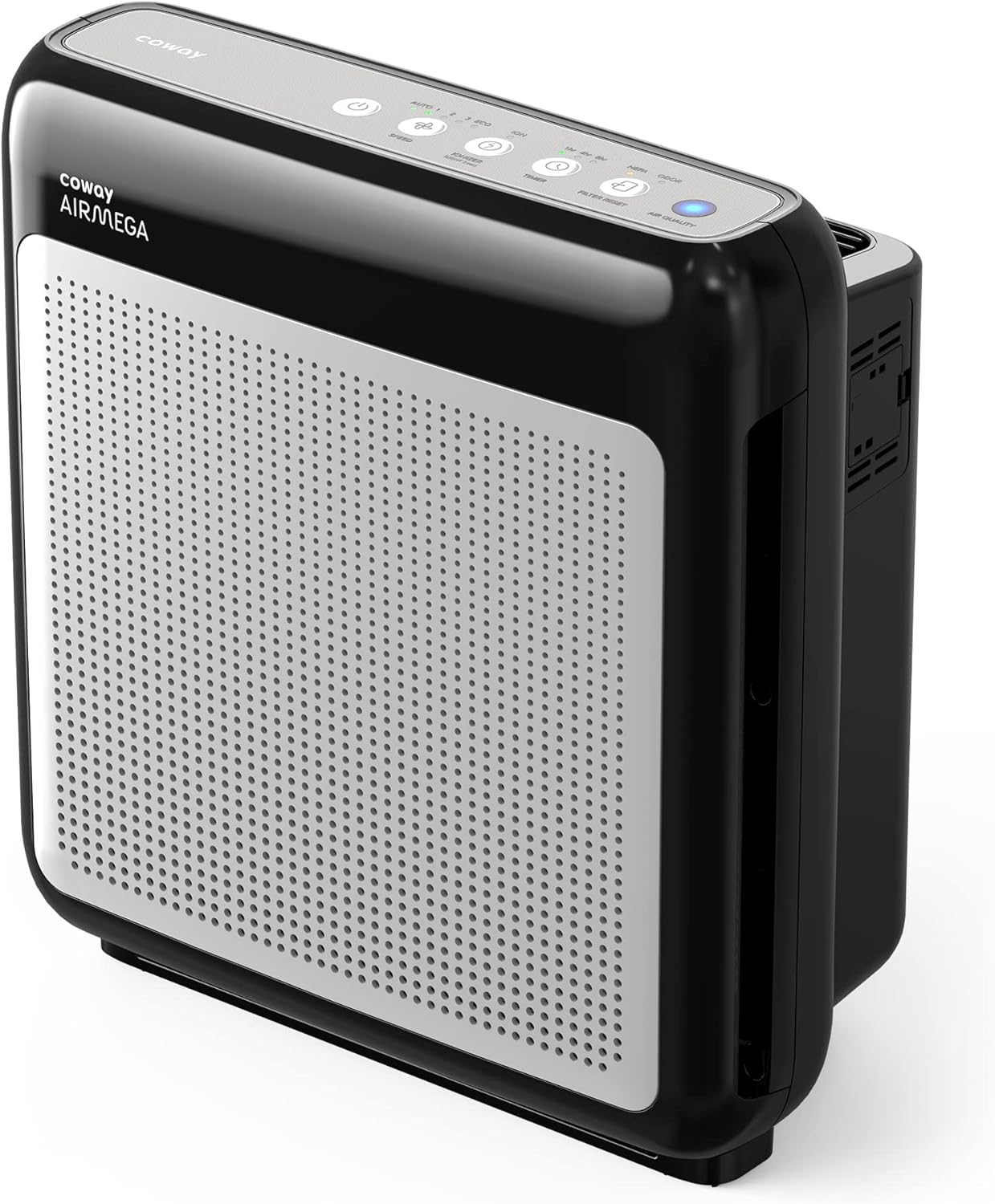
The Coway Airmega 200M is the right choice for studio apartments, single bedrooms, or compact Brisbane high-rise units where benchtop space is limited and the air quality challenge is cooking, light off-gassing, and pollen — not heavy chemical contamination. The dual carbon filter panels contain approximately 200g of activated carbon in total. This is adequate for the scale of room the unit targets. Trying to use it as a whole-apartment VOC solution in a large open-plan space would overtask it.
What distinguishes the 200M is its build quality and quiet operation. At 24.4 dB on its lowest setting, it is actually whisper-quiet for overnight bedroom use. The auto mode responds to the onboard air quality sensor, which detects both particulate (PM2.5) and VOC concentration changes, and the LED indicator ring provides real-time feedback — green for clean air, red for elevated contamination. This feedback loop is useful for new apartment residents who want to understand how their home’s air quality changes after cooking, cleaning, or opening windows during a smoky period.
Filter replacement costs for the Coway 200M are moderate — the combined HEPA and carbon filter typically runs AU$45-65 on Amazon AU and requires replacement every 6-12 months depending on usage intensity. For a compact apartment running the unit in a bedroom overnight, 12-month intervals are realistic.
4. Breville Smart Air — Best for Australian Warranty and Brand Support
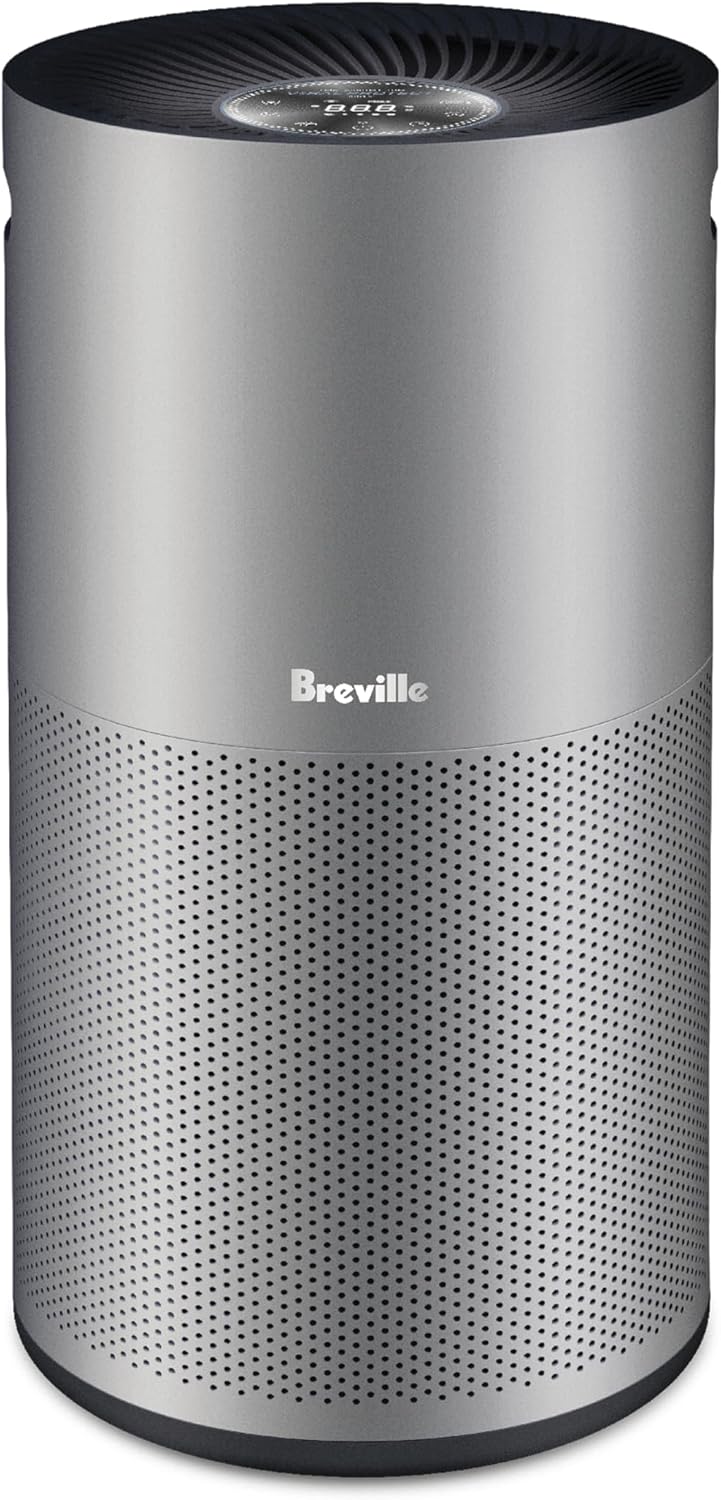
The Breville Smart Air (BAP001) carries a CADR of 550 m³/hr — an impressive particle-removal airflow rating for its size, and the headline specification it competes on. H13 HEPA filtration covers 99.97% of particles at 0.3 microns. For Australian households concerned about particle-heavy pollution — PM2.5 from bushfire smoke, pollen, dust — the Breville performs exceptionally well.
The carbon stage is the honest limitation. At approximately 280g of activated carbon, the Breville handles cooking odours and light household VOC loads effectively. It is not engineered for chemical sensitivity or heavy renovation off-gassing — the carbon mass simply is not sufficient for sustained adsorption at that level. If your primary concern is particles and your VOC concern is incidental (cooking smells, occasional cleaning products), the Breville is a practical all-rounder with the advantage of Australian warranty processing through Harvey Norman, JB Hi-Fi, and direct Breville service centres.
The Breville app integration is competent — you can schedule operation, monitor filter life, and view air quality history. This is useful in a household where you want to understand air quality patterns over time. For anyone who has owned Breville kitchen appliances and values the consistency of that brand experience in Australia, this is a sensible choice.
5. Levoit Core 400S — Best Entry-Level Smart Option
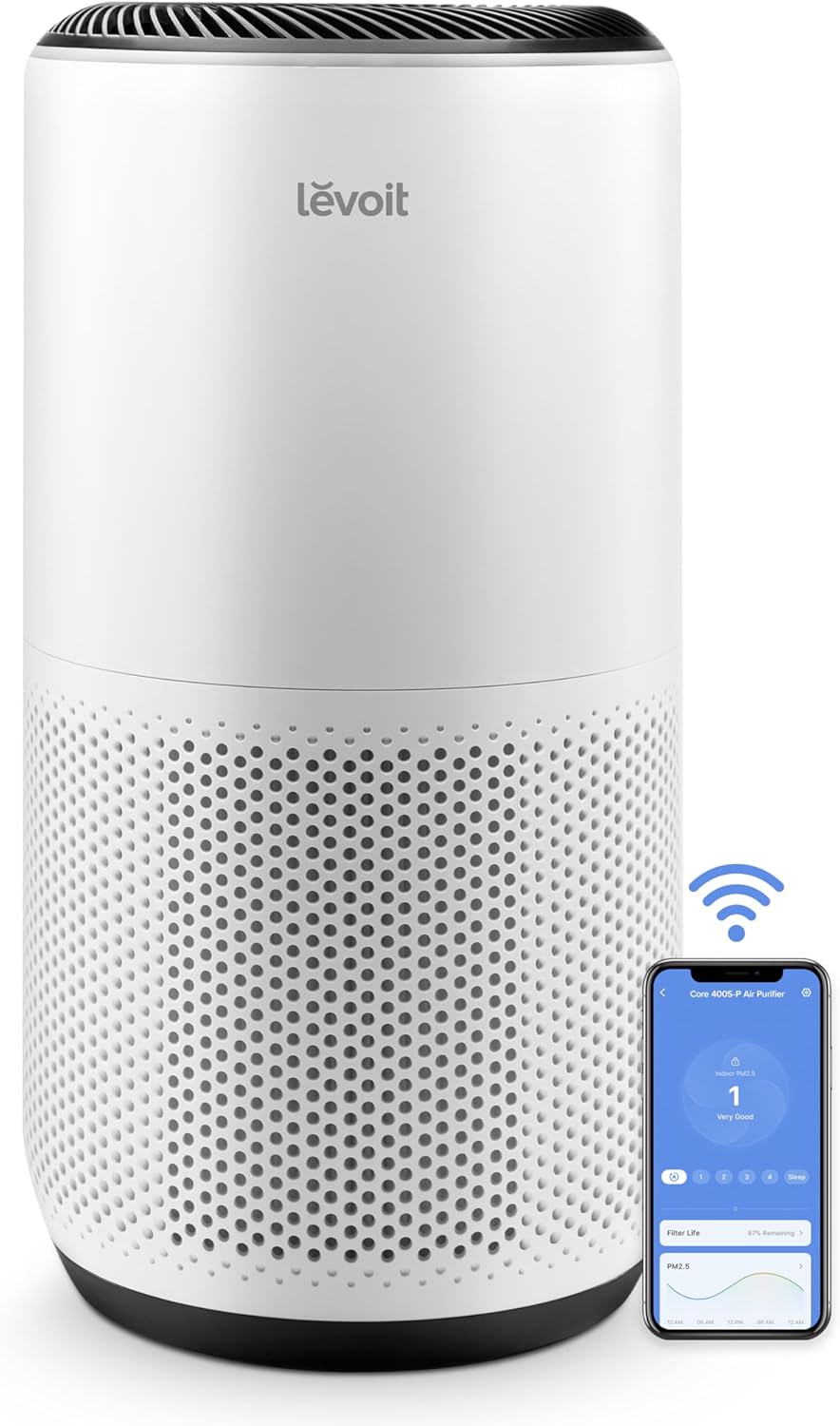
The Levoit Core 400S is the most accessible entry point on this list and the unit with the most feature density at its price. VeSync app control, voice assistant compatibility, auto mode, a real-time PM2.5 display, and scheduling are all included. The 360-degree air intake design draws air from all sides simultaneously, improving particle-capture efficiency in central room placement.
The VOC limitation is the carbon weight. At approximately 180g, the carbon stage in the Core 400S is adequate for cooking odour suppression and periodic light VOC exposure — you open a tin of paint, run the unit on high for an hour, and the odour clears. It is not designed to manage sustained off-gassing from a newly furnished apartment over months. Anyone who moves into a new home with fresh carpet, flat-pack furniture, and painted walls and expects the Core 400S to handle the formaldehyde load long-term will be disappointed.
Where the Levoit Core 400S earns its place is for Australian renters who need smart-home integration, a compact footprint, and a brand with widely available replacement filters on Amazon AU. At around AU$199-249 on Amazon, it is roughly one-third the price of the Austin Air and appropriate for the mild VOC environment it targets.
Our Top VOC Air Purifier Picks — Australia 2026
See our full Australian air quality guide →5-Year Cost of Ownership Comparison
The upfront price of an air purifier tells you almost nothing about its true cost. Filter replacement costs, electricity consumption, and filter lifespan determine what you actually spend. For Australian households running a purifier year-round in a living area or bedroom, this is the calculation that matters.
| Product | Approx. Upfront (AUD) | Annual Filter Cost (AUD) | Annual Power Cost (35c/kWh, 12hr/day) | 5-Year Total (AUD) |
|---|---|---|---|---|
| Austin Air HealthMate | ~$900 | ~$90 (1 filter per 5 yrs = ~$450 / 5) | ~$173 (110W) | ~$2,165 |
| Winix 5500-2 | ~$450 | ~$70 | ~$74 (60W) | ~$1,170 |
| Coway Airmega 200M | ~$250 | ~$55 | ~$44 (35W) | ~$745 |
| Breville Smart Air | ~$499 | ~$80 | ~$91 (73W) | ~$1,354 |
| Levoit Core 400S | ~$220 | ~$60 | ~$46 (37W) | ~$740 |
Power cost calculated at 35c/kWh (QLD average), 12 hours/day continuous operation. Filter costs based on Amazon AU pricing at time of publication. Austin Air filter replacement at 5-year interval per manufacturer specification.
The Austin Air’s 5-year total looks high against the Levoit — but the comparison is not equivalent. The Austin Air provides twenty to forty times the carbon adsorption capacity with a filter that does not require annual replacement. You are comparing a diesel generator to a torch. Both produce light; one is categorically different in scale. For a household with genuine chemical sensitivity or sustained off-gassing load, the Austin Air at $2,165 over five years is still cheaper than the health consequences of inadequate VOC removal.
Australian Context: New Builds, Bushfire Season, and the Units That Respond
Australian housing conditions create VOC profiles that most international guides do not address. Three scenarios deserve specific attention.
The first is the new-build apartment. Australia’s construction boom — particularly in inner-Brisbane, Sydney’s western corridor, and Melbourne’s inner north — has produced hundreds of thousands of apartments built and fitted out between 2018 and 2025. These units contain engineered timber floors with formaldehyde-based adhesives, kitchen cabinetry made from MDF with urea-formaldehyde resins, and interior finishes with VOC-containing paints and sealants. The NCC’s improved airtightness requirements mean natural ventilation rates are lower than in older buildings. Formaldehyde off-gassing from these materials can take 12-24 months to stabilise. Residents in new builds in Newstead (Brisbane), Green Square (Sydney), or Docklands (Melbourne) face a meaningful formaldehyde exposure in the first year of occupancy. A unit with sub-300g of carbon will not adequately address this load over a sustained period.
The second is bushfire smoke. The NSW EPA’s State of the Environment data confirms that PM2.5 and gaseous pollutant concentrations in Sydney, Canberra, and Melbourne reached levels during Black Summer that had no precedent in the monitoring record. The gas-phase components of smoke — benzene, formaldehyde, acrolein, naphthalene — are what a HEPA filter misses entirely. For households in the Blue Mountains, Penrith, the Illawarra, the ACT’s Tuggeranong and Belconnen suburbs, and Melbourne’s outer east including Lilydale and Healesville, having activated carbon capacity that can absorb gaseous combustion products is not a luxury during October-March. It is a direct health decision.
The third is mould. Coastal Queensland, Darwin, and the northern NSW coast have humidity levels that promote mould growth in homes with poor ventilation. Mould produces microbial VOCs including geosmin, 1-octen-3-ol, and 2-ethyl-1-hexanol. These compounds carry respiratory irritant properties and are associated with the “sick building” smell. An activated carbon purifier addresses the airborne VOC component of mould contamination — but will not eliminate the source. If you have visible mould, remediation comes first. The purifier handles residual airborne load while you address the root cause.
Who Should Buy What: Decision Framework
✓ Who the Austin Air HealthMate Is For
- Individuals with multiple chemical sensitivity (MCS)
- Households in new-build apartments within the first 24 months of occupancy
- Anyone undertaking a major renovation with fresh paint, adhesives, or new flooring
- NSW, Victorian, and QLD households wanting year-round bushfire VOC protection
- People who want a set-and-forget unit with a 5-year filter and no app dependency
✕ Who the Austin Air HealthMate Is Not For
- Renters who move frequently — this is a permanent installation unit
- Households where smart home integration and app control matter
- Buyers with a primary concern of particles (dust, pollen) — a HEPA-focused unit at lower cost handles that better
- Small bedroom use where the unit’s fan noise on high may be intrusive
- Buyers with a sub-$500 budget — explore the Winix 5500-2 or Coway 200M instead
✓ Who the Winix 5500-2 Is For
- Families in open-plan kitchen-living areas with cooking odour and pet smell loads
- Households wanting auto-mode VOC response during bushfire smoke days
- Buyers who want a balance of particle and gas filtration without medical-grade pricing
- Anyone who values the PlasmaWave feature for biological neutralisation (and can disable it if needed)
✕ Who the Winix 5500-2 Is Not For
- Households with severe chemical sensitivity needing sustained heavy-duty carbon adsorption
- Buyers sensitive to ozone — PlasmaWave produces trace amounts
- Compact studio apartments where the 5500-2’s size and price exceed what the room warrants
Final Verdict
I’m Jayce Love, former Royal Australian Navy Clearance Diver, and I have been testing air purifiers in my Palm Beach QLD home through pollen season, cooking cycles, and the smoke events that roll through from Queensland’s inland during bushfire season. The conclusion from testing and the data is consistent: carbon weight is the specification that separates actually functional VOC purifiers from marketing claims.
The Austin Air HealthMate is the only unit on this list that addresses severe VOC environments with the credibility that its carbon mass provides. If you are managing MCS, moving into a new build, or living through a renovation, this is the unit to buy. At $900 upfront with a 5-year filter, it is expensive relative to consumer alternatives but cheap relative to the health consequences of inadequate chemical filtration.
For everyday Australian households — cooking, cleaning products, pet odours, and the occasional smoke event — the Winix 5500-2 at approximately $450 provides balanced particle and gas filtration with auto-mode responsiveness that makes it practical to run year-round without management.
For compact apartments in Brisbane, Sydney, or Melbourne where space is limited and the VOC load is mild, the Coway Airmega 200M delivers quiet, auto-mode air quality management at a price that makes sense for a single room.
The Breville Smart Air earns its place for Australian consumers who value local warranty, domestic support, and Breville’s established service network — and whose primary concern is particle filtration with secondary odour control.
The Levoit Core 400S is the entry point for renters and smart-home users who want app control and want to address mild VOC and odour loads without significant upfront spend.
Match the unit to your actual exposure scenario. Do not overspend on carbon capacity you do not need — and do not underspend and discover the hard way that 180g of carbon has no meaningful impact on a freshly off-gassing apartment.
Last reviewed: May 2026 — Clean and Native
For severe VOC environments in Australia, the Austin Air HealthMate has no equal in the consumer market.
6.8 kg of activated carbon and zeolite. 5-year filter life. True HEPA. The only unit built for chemical sensitivity, new-build off-gassing, and bushfire season benzene at a consumer price point. For everyday VOC and odour control, the Winix 5500-2 is the balanced choice at half the price.
Frequently Asked Questions
No. HEPA filters capture particles — dust, pollen, mould spores, PM2.5. VOCs are gas-phase molecules that pass through HEPA media unchanged. VOC removal requires activated carbon adsorption. Any purifier marketed for VOC removal must include a genuine activated carbon stage, not just a HEPA filter.
For mild household odours (cooking, pets, light cleaning products), 200-400g of granular activated carbon is adequate with 6-12 month filter replacement cycles. For sustained VOC removal from off-gassing furniture, renovation materials, or bushfire smoke benzene, a minimum of 1 kg is recommended. The Austin Air HealthMate at 6.8 kg is the benchmark for severe chemical environments.
Yes. Australian homes face VOC exposure from flat-pack furniture formaldehyde (off-gassing for 1-3 years), interior paints, cleaning products, cooking at high heat (acrolein from oil), mould mVOCs in humid coastal climates, and bushfire smoke benzene during the October-March season. New-build apartments with improved airtightness under the NCC accumulate off-gassing faster due to lower natural ventilation rates.
Bushfire smoke contains benzene, formaldehyde, acrolein, naphthalene, and polycyclic aromatic hydrocarbons (PAHs) — all confirmed respiratory and carcinogenic hazards. The CSIRO documented significant benzene elevation in Sydney residential air during the 2019-2020 Black Summer fires. HEPA filters remove the particulate (PM2.5) component of smoke but not these gas-phase compounds. Activated carbon is required for gas-phase smoke removal.
Replacement frequency depends on carbon mass and VOC load. The Austin Air HealthMate’s 6.8 kg carbon bed is rated for 5 years under normal conditions. Standard consumer units with 150-400g of carbon typically require filter replacement every 6-12 months. In high-VOC environments (heavy off-gassing, renovation, regular cooking) carbon saturates faster — replacement intervals shorten accordingly.
Winix states the PlasmaWave system produces ozone below 0.05 ppm at all settings, within the US EPA’s indoor safety threshold of 0.07 ppm (8-hour average). For most households this is acceptable. If you have respiratory sensitivity, asthma, or prefer to avoid any ozone generation, the PlasmaWave feature can be disabled independently on the Winix 5500-2 control panel without affecting HEPA or carbon filtration performance.
Activated carbon and zeolite can adsorb formaldehyde from the air. The Austin Air HealthMate’s zeolite component specifically targets formaldehyde — zeolite’s cage-like molecular structure captures polar molecules that standard carbon handles less efficiently. Consumer units with small carbon-only pads (under 300g) will adsorb some formaldehyde but saturate relatively quickly given sustained off-gassing loads from new furniture and cabinetry.
Granular activated carbon (GAC) is a deep bed of discrete carbon particles with enormous combined surface area — measured in hundreds of square metres per gram. A carbon-coated HEPA filter has a thin layer of carbon dust applied to the filter media surface with minimal surface area and very short dwell time for gas molecules. For VOC removal, only granular activated carbon in a dedicated deep-bed stage provides meaningful and sustained adsorption performance.
Yes. Breville is an Australian brand with domestic warranty processing and an established service network through Harvey Norman, JB Hi-Fi, and direct Breville customer service. This is the primary advantage over US-origin brands like Austin Air for Australian consumers who value the ability to resolve warranty issues domestically without international shipping or import complications.
Get the Australian Home Environment Checklist
30 checks across water, air and EMF. Most of them free. Ranked by impact.
No spam. Unsubscribe any time.

Former Royal Australian Navy Clearance Diver and TAG-E counter-terrorism operator. Founded Clean and Native to apply the same rigorous thinking to the home environment.
Full biography →