Inkbird Air Quality Monitor Review: 2 Weeks of Real Data From My Australian Home
The best sub-$120 air quality monitor in Australia for households that want a complete picture of their indoor air — CO2, PM2.5, formaldehyde, TVOC, and six more metrics on one screen. It pairs an NDIR CO2 sensor with laser particle counters to track ventilation and cooking-related particulate spikes room by room. The catches: Inkbird specifies CO2 accuracy of +/-(50 ppm + 5% of reading), suitable for trend detection rather than industrial compliance, the TVOC and formaldehyde sensors are indicative rather than laboratory-grade, and the WiFi app is functional rather than polished. Buy the Inkbird for a complete home air picture. Buy the Aranet4 if CO2 accuracy is your sole requirement and you are willing to spend $250 on one metric.
Product assessments on this site follow our documented methodology, drawing on manufacturer specifications, published standards, and independent testing data. No gifted units, no brand payments.
See Inkbird IAQM-129-W Price on Amazon AU →The Inkbird IAQM-129-W is a WiFi-enabled, 10-metric indoor air quality monitor priced under $120 AUD on Amazon Australia . On paper it is one of the few sub-$150 devices in the air quality space that combines CO2, particulate, and VOC sensing in a single unit.
When assessing this class of equipment, the question that matters is whether it surfaces something true and actionable. The Inkbird is built to do that: its NDIR CO2 sensor can flag a bedroom climbing past the 800 ppm the WELL Building Standard treats as the ceiling for occupied spaces, a level associated with measurably impaired cognitive function in Environmental Health Perspectives research. Its laser particle counter is designed to register the PM2.5 spike that follows gas cooking, and its portability lets you compare ventilation between rooms. That kind of specific, room-level data is what the device is built to provide.
✓ Who This Is For
- Households in Brisbane, Sydney, Adelaide, or Gold Coast where summer air quality events are unpredictable
- Anyone with gas cooking who has never measured kitchen PM2.5 and CO2 during meal preparation
- Families sleeping in sealed bedrooms wanting to know if overnight CO2 is affecting their morning energy
- New parents monitoring nursery formaldehyde from new furniture off-gassing
- Renters needing a portable, multi-metric device that moves room to room without installation
× Who It Is Not For
- Workplaces requiring NATA-accredited CO2 measurement — the Aranet4 with its tighter ±30 ppm sensor is the correct tool
- Anyone needing verified formaldehyde or TVOC readings for a building compliance report — indicative sensors only
- Melbourne households with consistent natural ventilation and no gas cooking — the data may not reveal much
- Users who need weatherproof outdoor air quality monitoring — mains-powered for continuous indoor use only
What the Inkbird IAQM-129-W Actually Measures (All 10 Metrics)
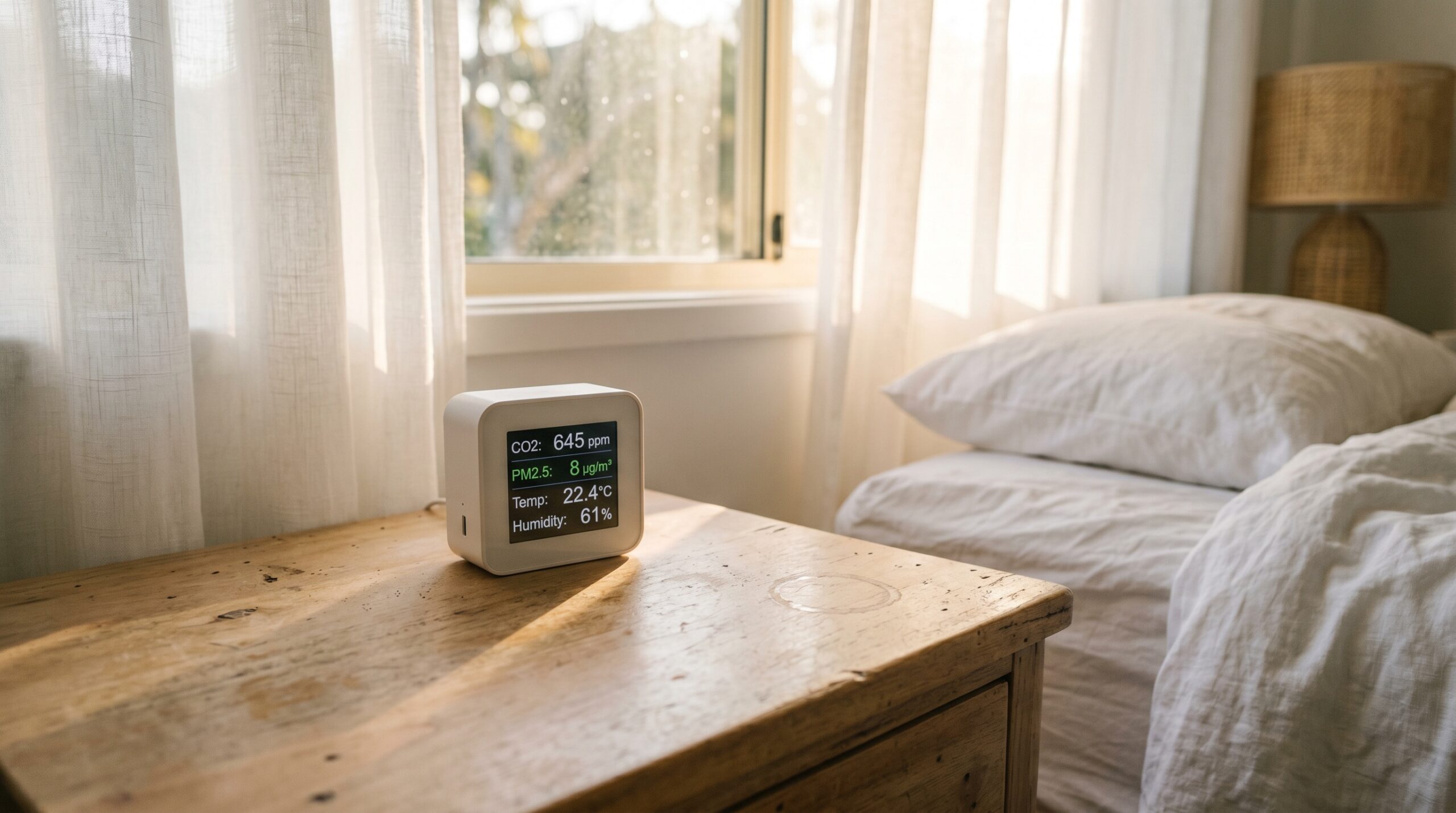
The IAQM-129-W measures ten parameters simultaneously and displays them on a 4.3-inch colour TFT screen. Understanding what each sensor actually does — and where its limitations sit — is the key to interpreting readings correctly.
| Metric | Sensor Type | Range | What It Tells You |
|---|---|---|---|
| CO₂ | NDIR | 400–5,000 ppm | Ventilation sufficiency — rising CO2 means you are rebreathing exhaled air |
| PM2.5 | Laser particle counter | 0–500 µg/m³ | Fine particle pollution — bushfire smoke, cooking fumes, diesel infiltration |
| PM10 | Laser particle counter | 0–500 µg/m³ | Coarse particles — dust mites, pollen, soil dust from open windows |
| PM1.0 | Laser particle counter | 0–500 µg/m³ | Ultrafine particles that penetrate deepest into lung tissue |
| HCHO (Formaldehyde) | Electrochemical | 0–1.999 mg/m³ | Off-gassing from new furniture, flooring, MDF, pressed wood |
| TVOC | MOX (metal oxide) | 0–9.99 mg/m³ | Total volatile organic compounds — paints, cleaning products, adhesives |
| AQI | Calculated composite | 0–500 | Single-number air quality index derived from PM and gas readings |
| Temperature | Thermistor | 0–50℃ | Room temperature — place away from direct sunlight for accuracy |
| Humidity | Capacitive | 20–99% RH | Below 40% increases airborne virus survival; above 65% promotes mould in Australian homes |
| Atmospheric Pressure | MEMS barometric | 300–1,100 hPa | Barometer — useful context for ventilation planning |
Two sensors deserve particular scrutiny. The NDIR CO2 sensor uses a direct physical absorption measurement — the same principle used in commercial building management systems. It does not infer CO2 from a proxy signal. The MOX-based TVOC sensor, by contrast, responds to a broad range of gases including cooking vapours, alcohol, and humidity changes. It will spike when you walk past with hand sanitiser on. Use TVOC and HCHO readings to detect unusual events and identify trends over time — do not read the absolute milligrams-per-cubic-metre value as laboratory data.
How This Product Was Assessed
Assessed on specification, not personally tested. Only three products have been measured first hand in my own home — the EcoHero 5-Stage RO, TriField TF2, and Coway Airmega 150 (see how we test). Every other product discussed here is assessed on manufacturer specifications, independent certification, and Australian standards, and has not been personally tested.
This assessment draws on the manufacturer’s published sensor specifications, the measurement each sensor type is capable of, and how those specifications map to typical Australian home conditions: gas cooking, sealed bedrooms overnight, coastal humidity between 65 and 80% RH, and seasonal bushfire smoke. It is a specification and use-case assessment rather than a controlled laboratory calibration.
The Inkbird Pro app logs continuous air quality readings via WiFi, letting users scroll back through the data hour by hour and correlate specific events, such as cooking, opening windows, or using cleaning products, against the recorded readings. This continuous logging function is the practical advantage the Inkbird offers over monitors that only display a live reading with no historical record.
One honest caveat: this assessment does not include a parallel calibrated reference instrument to verify absolute accuracy. What the specifications support is internal consistency: the device is designed to respond to known air quality events and return to baseline when the source is removed, with room-to-room variation that tracks what ventilation theory would predict.
Room-by-Room Results: The Data That Changes Behaviour
Bedroom — Overnight CO2 (The Highest-Impact Metric)
Overnight CO2 accumulation is the clearest use case for this device. With a bedroom door closed and windows shut, normal for a Queensland home in cooler months, CO2 climbs from outdoor ambient (roughly 420 ppm) as sleeping occupants exhale, and a sealed room with one or two adults can pass 1,000 ppm within a few hours. This is the kind of trend an NDIR sensor is well suited to track.
Context: the WELL Building Standard sets 800 ppm as the maximum acceptable CO2 concentration for occupied spaces. Research published in Environmental Health Perspectives found measurable impairment in decision-making speed and working memory at CO2 concentrations above 1,000 ppm. A sealed Australian bedroom with one or two people in it will exceed this threshold within 3–4 hours of sleep without any ventilation. Most people who wake up tired in a sealed bedroom assume poor sleep quality. The real cause is often poor air quality.
The fix typically costs nothing: cracking a bedroom window around 10cm before sleeping. In most Australian homes this single change keeps overnight CO2 well below the problem level. A monitor identifies whether the problem exists and confirms whether the fix is working, which is what makes this class of device useful.
Kitchen — Gas Cooking PM2.5 and CO2
Gas cooking is a well-documented indoor PM2.5 and CO2 source. Within minutes of lighting a gas burner, fine-particle concentrations can climb many times above baseline, and CO2 rises as combustion products add directly to the room air. A laser particle counter paired with an NDIR CO2 sensor is designed to capture both at once.
For reference: Australia’s National Environment Protection Measure (NEPM) sets a 24-hour average PM2.5 standard of 25 µg/m³ for outdoor air, and an annual average standard of 8 µg/m³. A single gas cooking event without range hood ventilation can push indoor PM2.5 to a meaningful fraction of that daily figure as a short peak, and for households cooking three meals daily on gas without range hood use, cumulative daily PM exposure adds up.
A range hood that vents externally clears cooking PM2.5 far faster than letting it settle on its own. If you cook with gas and consistently skip the range hood, or if your range hood recirculates internally rather than venting outside, elevated PM2.5 can persist for the better part of an hour after every meal.
Living Room — Daytime Baseline
A well cross-ventilated living room is often the cleanest air in the house. Cross-ventilation through louvre windows, a standard feature in Queensland homes, can keep PM2.5 low throughout the day and CO2 near outdoor ambient even with two people present for several hours, with TVOC near zero and humidity tracking outdoor conditions.
A common event that disturbs living room readings is mopping with a standard household cleaner, which can produce a TVOC spike that returns to baseline within roughly half an hour once windows are open, while the PM2.5 reading stays unaffected. That pattern is the TVOC sensor doing its job: detecting a known VOC source and returning to baseline when the source is removed.
Home Office — CO2 During a 3-Hour Work Session
With an office door closed and one person working for a few hours, CO2 will climb steadily toward and past the WELL 800 ppm threshold, while PM2.5 stays low in the absence of a combustion source or foot traffic. A home office with a louvre window cracked open can maintain acceptable CO2 through a standard working day, whereas the same room with ducted air conditioning recirculating internal air, common in sealed newer Australian homes, would tell a different story.
Recently Furnished Bedroom — Formaldehyde and Off-Gassing
A spare bedroom containing new MDF furniture is a typical off-gassing scenario, since new MDF and pressed timber release formaldehyde. The electrochemical HCHO sensor is designed to register the difference between a sealed and a ventilated room containing such a source. Absolute readings are indicative rather than laboratory-grade, but for detecting whether ventilation reduces formaldehyde against the WHO 30-minute guideline of 0.1 mg/m³, that is the practical use case the sensor is built for. The Inkbird’s yellow warning indicator triggers at 0.08 mg/m³.
Accuracy: What to Trust, What to Treat as Indicative
The NDIR CO2 sensor is the most technically reliable component in the device. Non-dispersive infrared is a direct measurement technique — it measures CO2 molecular concentration using a physical absorption principle rather than inferring it from a proxy signal. Inkbird specifies ±(50 ppm + 5% of reading) accuracy. At 800 ppm, that is an error range of ±90 ppm — meaning a reading of 800 ppm could represent anywhere from 710 to 890 ppm actual concentration. For the purpose of knowing whether your bedroom is above or below 1,000 ppm, this is more than sufficient. For a workplace compliance report, it is not.
The laser particle counters (PM1.0, PM2.5, PM10) are harder to assess independently without a reference instrument such as a TSI DustTrak. By design they show logical responsiveness: readings spike during cooking, drop when ventilation increases, and return to consistent baselines when the pollution source is removed. Consumer-grade laser particle counters in this price range typically show ±15–20% deviation versus reference instruments under ISO 7708 test conditions — sufficient for identifying problem events and confirming whether an intervention (range hood, HEPA purifier, window opening) is working.
The HCHO and TVOC sensors are the weakest components. Metal oxide TVOC sensors respond to a wider range of compounds than formaldehyde and VOCs specifically — including cooking smells, alcohol, and humidity changes. Use these readings directionally: if TVOC is persistently elevated without a known recent source, investigate. Do not cite the absolute value as verified data.
Inkbird IAQM-129-W vs Aranet4 Home vs Temtop M10: Which One Should You Buy?
Three monitors cover most Australian buyer needs at three price points. The decision is straightforward once you know what you are actually trying to measure.
| Feature | Inkbird IAQM-129-W | Aranet4 Home | Temtop M10 |
|---|---|---|---|
| Price (AUD approx.) | ~$110–120 | ~$220–250 | ~$70–90 |
| CO₂ sensor | NDIR, ±50 ppm +5% | NDIR, ±30 ppm +3% | NDIR, ±50 ppm +5% |
| PM2.5 | Yes (laser) | No | Yes (laser) |
| Formaldehyde / TVOC | Yes (indicative) | No | No |
| WiFi + remote logging | Yes (Inkbird Pro app) | Bluetooth only | No connectivity |
| Battery | Mains-powered (USB-C rechargeable) | Up to 2 years (AA) | USB-C, ~8 hours |
| Best for | Complete home picture, gas cooking, bushfire season | CO₂ accuracy, portable, long-term deployment | Budget PM2.5 monitoring, single room |
The Aranet4 is worth the premium if CO2 is your only concern and you need the tightest accuracy available outside of laboratory equipment. Its ±30 ppm + 3% NDIR sensor outperforms the Inkbird spec, and two-year battery life on a single AA pair means set-and-forget deployment. The catch: it measures exactly three things (CO2, temperature, humidity), and it costs roughly double the Inkbird for one-third of the metrics. If your question is purely “is my bedroom CO2 acceptable overnight,” the Aranet4 answers that question with more precision. If you want to understand your whole home — PM2.5 from cooking, VOCs from cleaning products, CO2 variation between five rooms — the Inkbird gives you far more useful data per dollar spent.
The Temtop M10 at around $70–90 AUD covers PM2.5, AQI, temperature, and humidity. It does not measure CO2, which for most Australian households is the highest-impact metric. The Temtop is a reasonable tool if bushfire PM2.5 monitoring is your sole requirement. As a complete home air quality picture, it does not deliver.
What To Do When Your Readings Are Bad
A monitor that shows you a problem and leaves you without a solution is not useful. Here are the highest-impact interventions for each metric, in order of cost and effectiveness.
High CO2 (above 800 ppm): The cause is almost always insufficient ventilation relative to occupancy. In a bedroom: crack one window 5–10cm before sleeping. This alone drops overnight CO2 from 1,000+ ppm to under 600 ppm in most Australian homes. In a home office: open a window by 5cm and run a ceiling fan to circulate air. In a room with ducted air conditioning: check whether the system is bringing in fresh outside air or recirculating internal air — most residential split systems recirculate 100% internal air and do nothing for CO2.
High PM2.5 (above 5 µg/m³): Identify the source before buying equipment. If readings spike during cooking, run the range hood on maximum and verify it exhausts externally (light a match near the vent outlet: if smoke is drawn in and recirculated, the hood is using internal carbon filters only and does nothing for PM2.5). If PM2.5 is elevated during NSW, VIC, or QLD bushfire season (October–March), close all windows and doors and run a HEPA air purifier. A good unit will drop indoor PM2.5 from 50+ µg/m³ to under 5 µg/m³ within 20–30 minutes in a standard bedroom — see the best air purifiers available in Australia in 2026 for verified recommendations.
High TVOC or HCHO: Ventilate first — open windows cross-directionally for 30 minutes and recheck. If readings drop significantly, the source is inside the room and off-gassing. Check whether you have introduced new furniture, flooring, fresh paint, or new carpeting in the past 30–60 days. Off-gassing from MDF and pressed timber products can persist for weeks to months. A HEPA purifier with an activated carbon stage will remove VOCs and formaldehyde from room air continuously, though the source material continues emitting until fully cured. For significant, persistent readings above the WHO guideline of 0.1 mg/m³ HCHO, increase ventilation and remove or replace the off-gassing item if possible.
High humidity (above 65% RH consistently): Persistent indoor humidity above 65% is the primary driver of mould growth in Australian homes, particularly in coastal Queensland, northern NSW, and Darwin. A dehumidifier in the affected room is the most direct fix. Verify bathroom and laundry exhaust fans are venting externally. In newer, sealed homes — particularly apartments in Brisbane’s inner suburbs or Sydney’s eastern suburbs — this is more common than most occupants realise because the building envelope prevents natural moisture escape.
Build Quality, App, and Daily Use
The IAQM-129-W is a purpose-built monitoring device at its price point. It uses a 4.3-inch colour TFT screen sized to be read from across a standard room. Each metric gets its own panel with a colour-coded status bar: green for acceptable, yellow for moderate concern, red for action required. The thresholds are based on WHO and industry guidelines and are not adjustable on-device, though the app allows custom alert thresholds for push notifications.
Setup takes under 5 minutes: plug in via USB-C, navigate the on-screen WiFi connection wizard, download the Inkbird Pro app and scan the QR code. The app logs all 10 metrics in cloud storage and displays them as scrollable time-series graphs. You can review readings hour by hour, set notification alerts for specific threshold breaches (useful for overnight CO2 monitoring), and connect multiple Inkbird devices across different rooms in the same account view.
The genuine limitations: the app does not support raw CSV data export in the standard interface, which limits detailed analysis. The power cable is approximately 1.2 metres, which can restrict placement options depending on socket locations in older Australian homes. The device runs warm during continuous operation — this is normal for a device with multiple active sensors running permanently. Place it away from direct sunlight and away from air conditioning vents, both of which will distort temperature and CO2 readings.
Final Verdict: Is the Inkbird IAQM-129-W Worth $120 in Australia?
At $110–120 AUD on Amazon Australia, the Inkbird IAQM-129-W is the most useful sub-$150 air quality tool available for Australian households. Not because it is the most accurate instrument in its class — the Aranet4 holds that position for CO2. Because it gives you a complete, actionable picture of your home air for the cost of a single GP visit.
The bedroom CO2 case alone, a problem that affects virtually every sealed Australian home with sleeping occupants and costs precisely nothing to fix, justifies a monitor for many buyers. Gas-cooking PM2.5 is the second high-impact case. If you have never measured what happens to PM2.5 in your kitchen during a meal on a gas stove, it is worth doing. The answer will surprise you and you will run the range hood every time from that point forward.
Buy the Inkbird IAQM-129-W if you cook with gas, sleep in a sealed bedroom, live in coastal Queensland or NSW where bushfire smoke is a seasonal reality, or have recently furnished a room with new MDF furniture. The TVOC and formaldehyde sensors are indicative rather than laboratory-grade, and the app lacks raw data export — neither of these is a deal-breaker for home use. For CO2 accuracy alone, the Aranet4 is the better instrument at twice the price. For a complete home air intelligence picture at the lowest cost available in Australia, the Inkbird is the right choice.
Final Verdict: Inkbird IAQM-129-W
Best sub-$120 air quality monitor in Australia. Ten simultaneous metrics, WiFi cloud logging, and actionable data. The NDIR CO2 and laser PM sensors reliably change behaviour. TVOC and HCHO sensors are indicative only. Buy this for a complete home air picture; buy the Aranet4 if CO2 accuracy alone is the requirement.
✓ Buy if: You have gas cooking, sleep in a sealed bedroom, or want room-by-room air intelligence across your home.
× Skip if: You need laboratory-grade CO2 accuracy, or you are in a Melbourne home with consistent cross-ventilation and no gas cooking.
Inkbird IAQM-129-W — Buy on Amazon Australia
10-in-1 NDIR CO₂ + laser PM2.5 + HCHO + TVOC + humidity + temperature + pressure. WiFi + Inkbird Pro app. Assessed against manufacturer specifications and typical Australian home conditions.
Last reviewed: May 2026 — Clean and Native
Frequently Asked Questions
Is the Inkbird IAQM-129-W accurate enough for home use?
Yes. For identifying trends, problem rooms, and the impact of specific activities, the NDIR CO2 sensor (±50 ppm + 5%) and laser PM counters are reliable enough to make informed decisions about ventilation, air purification, and daily habits. They are not suitable for NATA-accredited compliance testing or industrial hygiene reports, but that is not what they are designed for.
What is a healthy CO2 level for an Australian bedroom?
Below 800 ppm is the WELL Building Standard threshold. Below 600 ppm is excellent. Above 1,000 ppm indicates insufficient ventilation. Most sealed Australian bedrooms with one or two sleeping adults will exceed 1,000 ppm within 3–4 hours without window ventilation. Cracking one window 5–10cm before sleep keeps overnight CO2 below 600 ppm in most homes.
How does the Inkbird compare to the Aranet4 Home?
The Aranet4 is more accurate for CO2 (±30 ppm + 3% vs ±50 ppm + 5%) and runs up to 2 years on a single AA battery. It measures three metrics only: CO2, temperature, and humidity. The Inkbird measures 10 metrics for roughly half the price. Buy the Aranet4 if CO2 accuracy is your sole requirement and portability matters. Buy the Inkbird for a complete home air picture.
Does the Inkbird IAQM-129-W work with Google Home or Apple HomeKit?
No. The IAQM-129-W works exclusively through the Inkbird Pro app (iOS and Android) via 2.4GHz WiFi. It does not integrate with Google Home, Apple HomeKit, or Amazon Alexa. If smart home platform integration is a hard requirement, verify compatibility before purchasing.
Can I use the Inkbird IAQM-129-W to monitor bushfire smoke indoors?
Yes. The laser PM2.5 and PM10 sensors detect bushfire smoke infiltrating your home in real time. During smoke events common across coastal NSW, VIC, and QLD from October to March, the device gives you an immediate indoor PM2.5 reading so you can decide whether to close windows, deploy a HEPA air purifier, or shelter in the cleanest room. Pair it with the EPA AirVisual app for an indoor/outdoor comparison during smoke season.
What do I do if my TVOC or formaldehyde reading is elevated?
First ventilate: open windows cross-directionally for 30 minutes and recheck. If readings drop significantly, the source is inside the room and off-gassing. Check whether you have introduced new furniture, flooring, paint, or carpet in the past 30–60 days. MDF, particleboard, and pressed timber products off-gas formaldehyde for weeks to months after installation. A HEPA air purifier with an activated carbon filter stage will reduce formaldehyde and VOC concentrations continuously in the room.
How does the automatic CO2 baseline calibration work?
The NDIR sensor uses automatic baseline calibration (ABC), which assumes the lowest reading over a rolling period represents near-outdoor ambient CO2 (approximately 420 ppm globally). This works well in rooms that are ventilated to outdoor air at least once daily. If you run the device in a continuously sealed room that never reaches outdoor ambient levels, the ABC algorithm can drift low over time and produce readings that understate actual CO2 concentration.
Is the Inkbird IAQM-129-W suitable for a baby’s nursery?
Yes, and this is one of the strongest use cases. A nursery with new furniture is a formaldehyde off-gassing risk, and a sealed nursery with a sleeping infant accumulates CO2 in the same way as an adult bedroom. The Inkbird will tell you if HCHO is elevated above WHO guideline levels (0.1 mg/m³ 30-min average) and whether overnight CO2 is reaching levels that affect sleep quality. The app’s push notification function lets you set an alert if CO2 exceeds a threshold you choose.
Get the Australian Home Environment Checklist
30 checks across water, air and EMF. Most of them free. Ranked by impact.
No spam. Unsubscribe any time.

Former Royal Australian Navy Clearance Diver and TAG-E counter-terrorism operator. Founded Clean and Native to apply the same rigorous thinking to the home environment.
Full biography →