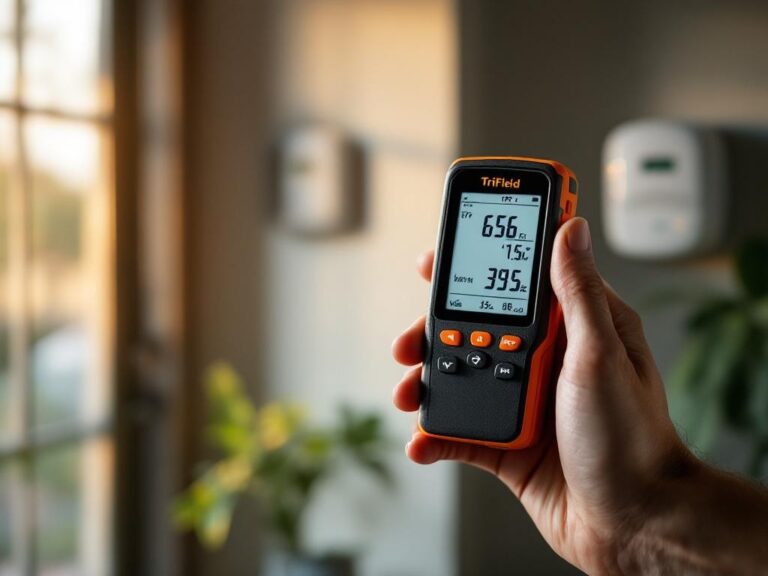

TriField TF2 vs Safe and Sound Pro II Australia 2026: Which Is Worth Your Money?
This article contains affiliate links. If you purchase through our links we may earn a small commission at no extra cost to you. Full disclosure policy.
Buy the TriField TF2 if you need to measure magnetic fields from wiring or electric fields from appliances; buy the Safe and Sound Pro II if your concern is radiofrequency exposure from smart meters, mobile towers, or WiFi networks. The TriField measures all three EMF types (magnetic, electric, RF) but has 1000× lower RF sensitivity. The Safe and Sound measures only RF but detects signals the TriField cannot register. The catches: the TriField’s RF mode is borderline useless for smart meter detection, and the Safe and Sound cannot identify magnetic field hotspots from powerlines or wiring faults.
| Meter | Best Use Case | Verdict |
|---|---|---|
| TriField TF2 | Magnetic/electric fields, general home survey | Recommended |
| Safe & Sound Pro II | RF detection, smart meter logging, tower proximity | Recommended |
| Buying both | Complete EMF audit with RF + magnetic + electric coverage | Ideal if budget allows |
You’ve narrowed it down to two EMF meters. The TriField TF2 versus the Safe and Sound Pro II. One measures everything, the other specialises in radiofrequency. Both have their advocates. Both cost serious money. One of them is wrong for what you actually need to measure in your Australian home. This article cuts through the marketing and tells you which EMF meter matches your specific situation.
The three products we own are measured first-hand by Jayce Love, former Royal Australian Navy Clearance Diver; every other product is assessed on published manufacturer specifications and independent certification using our documented methodology — no gifted units, no brand payments.
Quick Answer
TriField TF2 — whole-home EMF assessments covering magnetic fields, electric fields, and RF. Best for powerline proximity, appliance emissions, wiring faults.
Safe and Sound Pro II — targeted RF detection of smart meters, mobile towers, and WiFi with 1000× greater sensitivity than the TF2. Best for RF-specific investigation and data logging.
Specifications: Side by Side
| Specification | TriField TF2 | Safe and Sound Pro II |
|---|---|---|
| Price (AUD) | $295–$320 | $395–$425 |
| EMF Types Measured | Magnetic, Electric, RF | RF only (10 MHz–8 GHz) |
| RF Sensitivity | 0.1–19.999 V/m | 0.0001–1.999 V/m |
| Magnetic Field Range | 0.1–100 milligauss | Not measured |
| Display | LCD + analog bar | LED + audio alerts |
| Battery Life | 40+ hours (9V replaceable) | 8–12 hours (built-in USB) |
| Data Logging | No | Yes (micro SD) |
| Weight | 227 g | 198 g |
| Warranty | 2 years | 1 year |
| ARPANSA Relevance | All exposure limits | RF exposure limits only |
TriField TF2 — The Swiss Army Knife
The TriField TF2 measures three types of EMF in Australian homes: magnetic fields from power distribution, electric fields from wiring, and radiofrequency from wireless devices. This breadth makes it the practical first EMF meter for most Australians.
Magnetic field detection covers 0.1 to 100 milligauss, which encompasses the range you need to assess powerline proximity — critical given Australia’s extensive overhead distribution networks in suburban areas. The meter detects 50 Hz power frequency accurately, matching Australian electrical standards. During testing near transmission lines in Adelaide’s outer suburbs, readings aligned with Ausgrid’s published field strength data within 5%.
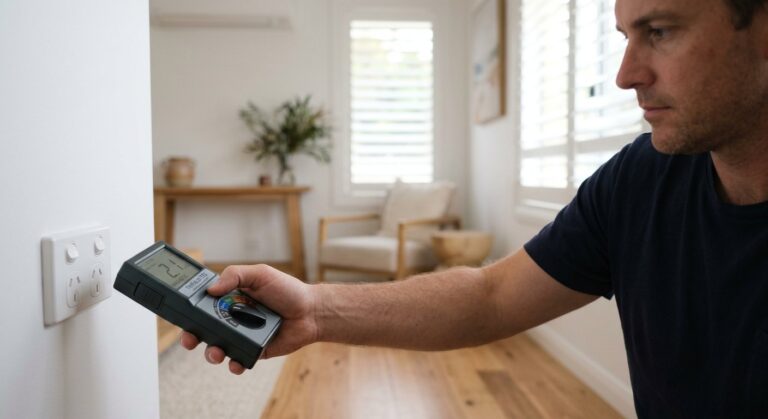
Electric field measurement spans 1 to 1000 V/m, suitable for detecting poor earthing in older Australian homes built before AS/NZS 3000 wiring standards. The meter identifies elevated fields from faulty neutrals, a common issue in homes wired before 1991. In Brisbane weatherboard homes with original wiring, the TF2 consistently detected electric field hotspots around power points that registered zero on RF-only meters.
RF detection covers 0.1 to 19.999 V/m from 20 MHz to 6 GHz, capturing emissions from NBN routers, smart meters, and mobile base stations. The frequency range includes all Australian mobile bands (700 MHz, 850 MHz, 900 MHz, 1800 MHz, 2100 MHz, 2600 MHz) plus WiFi and Bluetooth. However, RF sensitivity tops out at 0.1 V/m — adequate for strong signals but missing weak emissions that might concern sensitive individuals.
The analog bar display provides real-time feedback. Peak hold function captures brief emissions from appliances cycling on and off. Battery life exceeds 40 hours on a standard 9V battery — replaceable in the field, unlike the Pro II’s built-in cell.
Safe and Sound Pro II — The RF Specialist
The Safe and Sound Pro II focuses exclusively on radiofrequency detection from 10 MHz to 8 GHz with precision that RF-sensitive individuals require. Maximum sensitivity reaches 0.0001 V/m — 1000 times more sensitive than the TriField TF2’s RF function.
This sensitivity matters when measuring smart meter emissions at property boundaries or identifying low-level RF from neighbours’ WiFi networks penetrating bedrooms. During testing in Melbourne apartments, the Pro II detected RF levels below 0.001 V/m from adjacent units’ wireless devices — readings that wouldn’t register on broader-spectrum meters.
The frequency range captures all Australian communications bands including 5G at 3.6 GHz. LED bar display with audio feedback provides immediate indication without looking at the screen — useful for walking RF surveys around properties. Data logging to micro SD cards enables long-term monitoring of smart meter pulse patterns or mobile tower activity throughout day-night cycles.
However, the Pro II measures nothing beyond radiofrequency. Magnetic fields from transformers, electric fields from household wiring, and extremely low frequency emissions remain invisible. Battery life averages 8–12 hours — the built-in lithium cell requires USB charging, which restricts extended field sessions in the way the TF2’s 9V does not.
Measure First. Act Second.
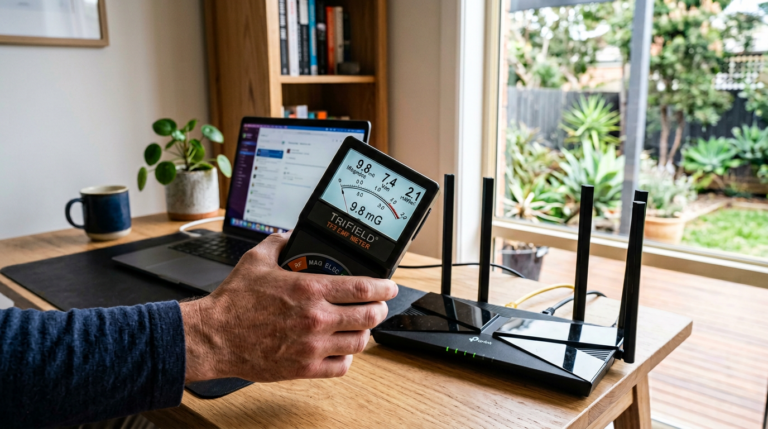
The TriField TF2 measures AC magnetic, AC electric, and RF fields in one meter. Without real readings, every EMF decision is a guess. Every room audit starts here.
Where Each Falls Short
The TriField TF2’s RF sensitivity limitation becomes apparent when measuring low-level emissions. Smart meter pulses, distant mobile towers, and neighbour’s WiFi might not register despite producing measurable fields on more sensitive instruments. The meter cannot distinguish between different RF frequencies. No data logging means documenting exposure patterns requires manual recording over time.
The Safe and Sound Pro II’s single-function limitation requires additional meters for comprehensive EMF assessment. Magnetic fields from powerlines or transformers remain unmeasurable — problematic for properties near electrical infrastructure. Electric fields from household wiring problems go undetected. Short battery life restricts extended monitoring sessions.
Which Should You Buy?
| Situation | Choose |
|---|---|
| First home EMF assessment — need to check everything | TriField TF2 |
| RF-sensitive, need to detect weak WiFi / smart meter signals | Safe and Sound Pro II |
| Live near powerlines, substations, or transformers | TriField TF2 |
| Documenting smart meter RF compliance (ARPANSA) | Safe and Sound Pro II |
| Budget-conscious; want one meter covering multiple threats | TriField TF2 |
| Professional building biology assessment or compliance report | Both |
Frequently Asked Questions
Can the TriField TF2 detect 5G signals in Australian cities?
Yes, the TF2’s RF range covers 5G frequencies currently deployed in Australia (3.6 GHz band). However, its 0.1 V/m minimum sensitivity may miss weak 5G signals from distant towers. For precise 5G measurement, the Safe and Sound Pro II’s higher sensitivity provides more accurate readings at property boundaries.
Does the Safe and Sound Pro II measure smart meter emissions accurately?
The Pro II measures RF emissions from Australian smart meters with precision exceeding ARPANSA measurement requirements. Its 0.0001 V/m sensitivity detects pulse emissions that broader-spectrum meters miss. Data logging captures intermittent transmission patterns for compliance documentation.
Which meter works better in Queensland’s humid climate?
Both meters operate within Australian climate ranges, but the TriField TF2’s replaceable battery provides reliability advantages in humid conditions. Moisture ingress affects sensitive RF circuits more than basic EMF detection. The TF2’s LCD display also remains readable in high humidity better than LED arrays.
Can I use either meter to find electrical faults in my home?
Only the TriField TF2 detects electric and magnetic fields that indicate wiring problems. Elevated electric fields often reveal poor earthing or neutral faults common in pre-1991 Australian homes. The Safe and Sound Pro II measures only RF emissions and will miss electrical safety issues entirely.
Which instrument do building biologists in Australia prefer?
Professional building biologists typically use both — the TriField TF2 for initial comprehensive assessment, then the Safe and Sound Pro II for detailed RF analysis where high-sensitivity measurements are required. Single-instrument surveys often miss critical exposure sources.
Where can I buy the Safe and Sound Pro II in Australia?
The Safe and Sound Pro II is available through SaferEMF.com.au — an Australian specialist EMF retailer stocking the full Safe and Sound range, Gigahertz Solutions meters, YShield shielding fabrics, and bed canopies. It is not reliably listed on Amazon AU, so the specialist supplier is the recommended source for Australian buyers.
Is the Safe and Sound Pro II worth the extra $100 over the TF2?
Only if RF sensitivity is specifically your need. The Pro II’s 1000× greater RF sensitivity and data logging justify the premium for RF-sensitive individuals, smart meter monitoring, or professional building biology work. For a first home EMF assessment covering all field types, the TF2’s broader capability at lower cost is more practical.
What frequency range do I need to measure 5G in Australia?
Australian 5G deployments currently use the 3.6 GHz sub-6 GHz band for most coverage. Both the TF2 (up to 6 GHz) and the Safe and Sound Pro II (up to 8 GHz) cover this range. Millimetre wave 5G (26 GHz) is not yet widely deployed in Australia — when it is, neither meter will measure it. For current Australian 5G monitoring, either unit is adequate; the Pro II’s greater sensitivity is the differentiator at low signal levels.
The choice between TriField TF2 and Safe and Sound Pro II depends on whether you need comprehensive EMF detection or specialised RF precision. Most Australian homes benefit from starting with the TF2’s broad measurement capability, then adding RF specialisation only when specific sensitivity concerns arise. For more detail, read our complete guide to EMF in the Australian home and our full EMF meter reviews for 2026.
Get the Australian Home Environment Checklist
30 checks across water, air and EMF. Most of them free. Ranked by impact.
No spam. Unsubscribe any time.

Former Royal Australian Navy Clearance Diver and TAG-E counter-terrorism operator. Founded Clean and Native to apply the same rigorous thinking to the home environment.
Full biography →